engine removal JEEP LIBERTY 2002 KJ / 1.G User Guide
[x] Cancel search | Manufacturer: JEEP, Model Year: 2002, Model line: LIBERTY, Model: JEEP LIBERTY 2002 KJ / 1.GPages: 1803, PDF Size: 62.3 MB
Page 173 of 1803

(4) Position the tube in the flaring tool flush with
the top of the tool bar (Fig. 3). Then tighten the tool
bar on the tube.
(5) Install the correct size adaptor on the flaring
tool yoke screw.
(6) Lubricate the adaptor.
(7) Align the adaptor and yoke screw over the tube
(Fig. 3).
(8) Turn the yoke screw in until the adaptor is
squarely seated on the tool bar.
REMOVAL
REMOVAL - FRONT HOSE
(1) Install prop rod on the brake pedal to keep
pressure on the brake system.
(2) Remove the brake line from the brake hose
inside the engine compartment by the front control
arm bolt (Fig. 4).
(3) Raise and support vehicle.
(4) Remove the brake hose banjo bolt at the cali-
per.
(5) Remove the mounting bolt for the top of the
brake hose at the vehicle (Fig. 5).
(6) Remove the hose.
REMOVAL - REAR BRAKE HOSE
(1) Install prop rod on the brake pedal to keep
pressure on the brake system.
(2) Raise and support the vehicle.
(3) Remove the brake line from the hose at the
body (Fig. 6).
(4) Remove the brake hose mounting bolt at the
top of the hose located at the body (Fig. 6).
(5) Remove the vent tube (Fig. 7).
(6) Remove the two brake lines at the bottom of
the hose located at the axle (Fig. 7).
(7) Remove the mounting bolt for the brake hose
at the axle (Fig. 7).
(8) Remove the hose.
Fig. 3 ISO Flaring
1 - ADAPTER
2 - LUBRICATE HERE
3 - PILOT
4 - FLUSH WITH BAR
5 - TUBING
6 - BAR ASSEMBLY
Fig. 4 INNER FENDER BRAKE LINE
1 - GROMMET
2 - BRAKE LINE
Fig. 5 FRONT BRAKE HOSE
1 - TOP OF FRONT BRAKE HOSE
2 - WHEEL SPEED SENSOR WIRE
3 - UPPER CONTROL ARM
KJBRAKES - BASE 5 - 9
BRAKE LINES (Continued)
Page 187 of 1803

(6) Remove knee blocker under the steering colum-
n,(Refer to 23 - BODY/INSTRUMENT PANEL/KNEE
BLOCKER - REMOVAL).
(7) Remove retaining clip that secures booster
push rod to brake pedal (Fig. 36).(8) Remove nuts attaching booster to the dash
panel (Fig. 37).
(9) In engine compartment, slide booster studs out
of dash panel, tilt booster upward, and remove
booster from engine compartment.
INSTALLATION
(1) Align and position booster on the dash panel.
(2) Install booster mounting nuts. Tighten nuts
just enough to hold booster in place.
(3) Slide booster push rod onto the brake pedal.
Then secure push rod to pedal pin with retaining
clip.
NOTE: Lubricate the pedal pin and bushing with
Mopar multi-mileage grease before installation.
Fig. 34 Typical Booster Vacuum Test Connections
1 - TEE FITTING
2 - SHORT CONNECTING HOSE
3 - CHECK VALVE
4 - CHECK VALVE HOSE
5 - CLAMP TOOL
6 - INTAKE MANIFOLD
7 - VACUUM GAUGE
Fig. 35 TYPICAL - VACUUM CHECK VALVE AND
SEAL
1 - BOOSTER CHECK VALVE
2 - APPLY TEST VACUUM HERE
3 - VALVE SEAL
Fig. 36 BOOSTER PUSH ROD
1 - BRAKE PEDAL
2 - BOOSTER ROD
Fig. 37 BOOSTER MOUNTING
1 - BRAKE BOOSTER
KJBRAKES - BASE 5 - 23
POWER BRAKE BOOSTER (Continued)
Page 191 of 1803

SPECIFICATIONS
BRAKE FLUID
The brake fluid used in this vehicle must conform
to DOT 3 specifications and SAE J1703 standards.
No other type of brake fluid is recommended or
approved for usage in the vehicle brake system. Use
only Mopar brake fluid or an equivalent from a
tightly sealed container.
CAUTION: Never use reclaimed brake fluid or fluid
from an container which has been left open. An
open container will absorb moisture from the air
and contaminate the fluid.
CAUTION: Never use any type of a petroleum-based
fluid in the brake hydraulic system. Use of such
type fluids will result in seal damage of the vehicle
brake hydraulic system causing a failure of the
vehicle brake system. Petroleum based fluids would
be items such as engine oil, transmission fluid,
power steering fluid, etc.
DRUM
DIAGNOSIS AND TESTING - BRAKE DRUM
The maximum allowable diameter of the drum
braking surface is indicated on the drum outer edge.
Generally, a drum can be machined to a maximum of
1.52 mm (0.060 in.) oversize. Always replace the
drum if machining would cause drum diameter to
exceed the size limit indicated on the drum.
BRAKE DRUM RUNOUT
Measure drum diameter and runout with an accu-
rate gauge. The most accurate method of measure-
ment involves mounting the drum in a brake lathe
and checking variation and runout with a dial indi-
cator.
Variations in drum diameter should not exceed
0.076 mm (0.003 in.). Drum runout should not exceed
0.20 mm (0.008 in.) out of round. Machine the drum
if runout or variation exceed these values. Replace
the drum if machining causes the drum to exceed the
maximum allowable diameter.
STANDARD PROCEDURES - BRAKE DRUM
MACHINING
The brake drums can be machined on a drum lathe
when necessary. Initial machining cuts should be lim-
ited to 0.12 - 0.20 mm (0.005 - 0.008 in.) at a time as
heavier feed rates can produce taper and surface
variation. Final finish cuts of 0.025 to 0.038 mm(0.001 to 0.0015 in.) are recommended and will gen-
erally provide the best surface finish.
Be sure the drum is securely mounted in the lathe
before machining operations. A damper strap should
always be used around the drum to reduce vibration
and avoid chatter marks.
The maximum allowable diameter of the drum
braking surface is stamped or cast into the drum
outer edge.
CAUTION: Replace the drum if machining will cause
the drum to exceed the maximum allowable diame-
ter.
SUPPORT PLATE
REMOVAL
REMOVAL - 198 RBI AXLE
(1) Remove wheel and tire assembly.
(2) Remove the brake drum.
(3) Remove the brake shoes.
(4) Remove parking brake cable from parking
brake lever.
(5) Compress parking brake cable retainer tabs.
Then push retainer and cable through and out of
support plate.
(6) Disconnect brake line at wheel cylinder.
(7) Remove wheel cylinder from support plate,(Re-
fer to 5 - BRAKES/HYDRAULIC/MECHANICAL/
WHEEL CYLINDERS - REMOVAL).
(8) Remove the four bolts attaching the support
plate to axle and remove the support plate with the
axle, bearing and seal.
(9) Remove axle shaft,(Refer to 3 - DIFFEREN-
TIAL & DRIVELINE/REAR AXLE/AXLE SHAFTS -
REMOVAL).
REMOVAL - 8 1/4 AXLE
(1) Remove the wheel and tire assembly.
(2) Remove the brake drum.
(3) Install the brake pedal prop rod.
(4) Remove the brake shoes (Refer to 5 - BRAKES/
HYDRAULIC/MECHANICAL/BRAKE PADS/SHOES
- REMOVAL).
(5) Remove parking brake cable from parking
brake lever.
(6) Compress parking brake cable retainer tabs.
Then push retainer and cable through and out of
support plate.
(7) Disconnect the brake line at wheel cylinder.
(8) Remove the wheel cylinder from the support
plate,(Refer to 5 - BRAKES/HYDRAULIC/MECHAN-
ICAL/WHEEL CYLINDERS - REMOVAL).
KJBRAKES - BASE 5 - 27
FLUID (Continued)
Page 201 of 1803

BRAKES
TABLE OF CONTENTS
page page
POWER BRAKE BOOSTER
REMOVAL - RHD........................1INSTALLATION - RHD.....................1
POWER BRAKE BOOSTER
REMOVAL - RHD
(1) Remove the air box (Refer to 9 - ENGINE/AIR
INTAKE SYSTEM/AIR CLEANER ELEMENT -
REMOVAL).
(2) Relocate the cruise control servo to gain access
to the booster for removal.
(3) Remove the brake lines from the master cylin-
der.
(4) Remove the master cylinder (Refer to 5 -
BRAKES/HYDRAULIC/MECHANICAL/MASTER
CYLINDER - REMOVAL).
(5) Disconnect vacuum hose from booster check
valve.
(6) Remove knee blocker under the steering colum-
n,(Refer to 23 - BODY/INSTRUMENT PANEL/KNEE
BLOCKER - REMOVAL).
(7) Remove the brake light switch.(Refer to 8 -
ELECTRICAL/LAMPS/LIGHTING - EXTERIOR/
BRAKE LAMP SWITCH - REMOVAL)
(8) Remove retaining clip that secures booster
push rod to brake pedal (Fig. 1).
(9) Remove nuts attaching booster to the dash
panel (Fig. 2).(10) In engine compartment, slide booster studs
out of dash panel, tilt booster upward, and remove
booster from engine compartment.
INSTALLATION - RHD
(1) Align and position booster on the dash panel.
(2) Install booster mounting nuts. Tighten nuts
just enough to hold booster in place.
(3) Slide booster push rod onto the brake pedal.
Then secure push rod to pedal pin with retaining
clip.
NOTE: Lubricate the pedal pin with Mopar multi-
mileage grease before installation.
(4) Tighten booster mounting nuts to 39 N´m (29
ft. lbs.).
(5) Install the brake light switch.
(6) Install the knee blocker,(Refer to 23 - BODY/
INSTRUMENT PANEL/KNEE BLOCKER - INSTAL-
LATION).
(7) If original master cylinder is being installed,
check condition of seal at rear of master cylinder.
Replace seal if cut, or torn.
(8) Clean cylinder mounting surface of brake
booster. Use shop towel wetted with brake cleaner for
Fig. 1 BOOSTER PUSH ROD
1 - BRAKE PEDAL
2 - BOOSTER ROD
Fig. 2 BOOSTER MOUNTING
1 - BRAKE BOOSTER
KJBRAKES 5s - 1
Page 203 of 1803

BRAKES
TABLE OF CONTENTS
page page
POWER BRAKE BOOSTER
REMOVAL - RHD........................1INSTALLATION - RHD.....................1
POWER BRAKE BOOSTER
REMOVAL - RHD
(1) Remove the air box (Refer to 9 - ENGINE/AIR
INTAKE SYSTEM/AIR CLEANER ELEMENT -
REMOVAL).
(2) Relocate the cruise control servo to gain access
to the booster for removal.
(3) Remove the brake lines from the master cylin-
der.
(4) Remove the master cylinder (Refer to 5 -
BRAKES/HYDRAULIC/MECHANICAL/MASTER
CYLINDER - REMOVAL).
(5) Disconnect vacuum hose from booster check
valve.
(6) Remove knee blocker under the steering colum-
n,(Refer to 23 - BODY/INSTRUMENT PANEL/KNEE
BLOCKER - REMOVAL).
(7) Remove the brake light switch.(Refer to 8 -
ELECTRICAL/LAMPS/LIGHTING - EXTERIOR/
BRAKE LAMP SWITCH - REMOVAL)
(8) Remove retaining clip that secures booster
push rod to brake pedal (Fig. 1).
(9) Remove nuts attaching booster to the dash
panel (Fig. 2).(10) In engine compartment, slide booster studs
out of dash panel, tilt booster upward, and remove
booster from engine compartment.
INSTALLATION - RHD
(1) Align and position booster on the dash panel.
(2) Install booster mounting nuts. Tighten nuts
just enough to hold booster in place.
(3) Slide booster push rod onto the brake pedal.
Then secure push rod to pedal pin with retaining
clip.
NOTE: Lubricate the pedal pin with Mopar multi-
mileage grease before installation.
(4) Tighten booster mounting nuts to 39 N´m (29
ft. lbs.).
(5) Install the brake light switch.
(6) Install the knee blocker,(Refer to 23 - BODY/
INSTRUMENT PANEL/KNEE BLOCKER - INSTAL-
LATION).
(7) If original master cylinder is being installed,
check condition of seal at rear of master cylinder.
Replace seal if cut, or torn.
(8) Clean cylinder mounting surface of brake
booster. Use shop towel wetted with brake cleaner for
Fig. 1 BOOSTER PUSH ROD
1 - BRAKE PEDAL
2 - BOOSTER ROD
Fig. 2 BOOSTER MOUNTING
1 - BRAKE BOOSTER
KJBRAKES 5s - 1
Page 205 of 1803

CLUTCH
TABLE OF CONTENTS
page page
CLUTCH
DESCRIPTION..........................1
OPERATION............................1
WARNING.............................2
DIAGNOSIS AND TESTING - CLUTCH........2
SPECIFICATIONS - CLUTCH...............5
CLUTCH DISC
REMOVAL.............................6
INSTALLATION..........................6
CLUTCH RELEASE BEARING
REMOVAL.............................6
INSTALLATION..........................6
FLYWHEEL
DESCRIPTION..........................7
OPERATION............................7
DIAGNOSIS AND TESTING - FLYWHEEL......8
PILOT BEARING
REMOVAL.............................8
INSTALLATION..........................8LINKAGE
REMOVAL.............................8
INSTALLATION..........................9
MASTER CYLINDER
INSPECTION...........................9
CLUTCH PEDAL
REMOVAL.............................10
INSTALLATION.........................10
CLUTCH SWITCH OVERRIDE RELAY
DESCRIPTION.........................10
OPERATION...........................10
REMOVAL.............................10
INSTALLATION.........................10
CLUTCH PEDAL POSITION SWITCH
DESCRIPTION.........................11
OPERATION...........................11
DIAGNOSIS AND TESTING - CLUTCH PEDAL
POSITION SWITCH....................11
CLUTCH
DESCRIPTION
The clutch mechanism consists of a flywheel, dry-
type disc, diaphragm style pressure plate and
hydraulic linkage. The flywheel is bolted to the rear
flange of the crankshaft. The clutch pressure plate is
bolted to the flywheel with the clutch disc between
these two components. The clutch system provides
the mechanical, link between the engine and the
transmission. The system is designed to transfer the
torque output of the engine, to the transmission
while isolating the transmission from the engine fir-
ing pulses to minimize concerns such as gear rattle.
OPERATION
The clutch operates with leverage, clamping force
and friction. The disc serves as the friction element,
the diaphragm spring and pressure plate provide the
clamping force. The clutch pedal, hydraulic linkage,
release lever and bearing provide the leverage.
The clutch master cylinder push rod is connected
to the clutch pedal. When the clutch pedal is
depressed, the slave cylinder is operated by the
clutch master cylinder mounted on the dash panel.
The release fork is actuated by the hydraulic slave
cylinder mounted on the transmission housing. The
release bearing is operated by a release fork pivoting
on a ball stud mounted in the transmission housing.
The release bearing then depresses the pressure
plate spring fingers, thereby releasing pressure on
the clutch disc and allowing the engine crankshaft to
spin independently of the transmission input shaft.
KJCLUTCH 6 - 1
Page 207 of 1803
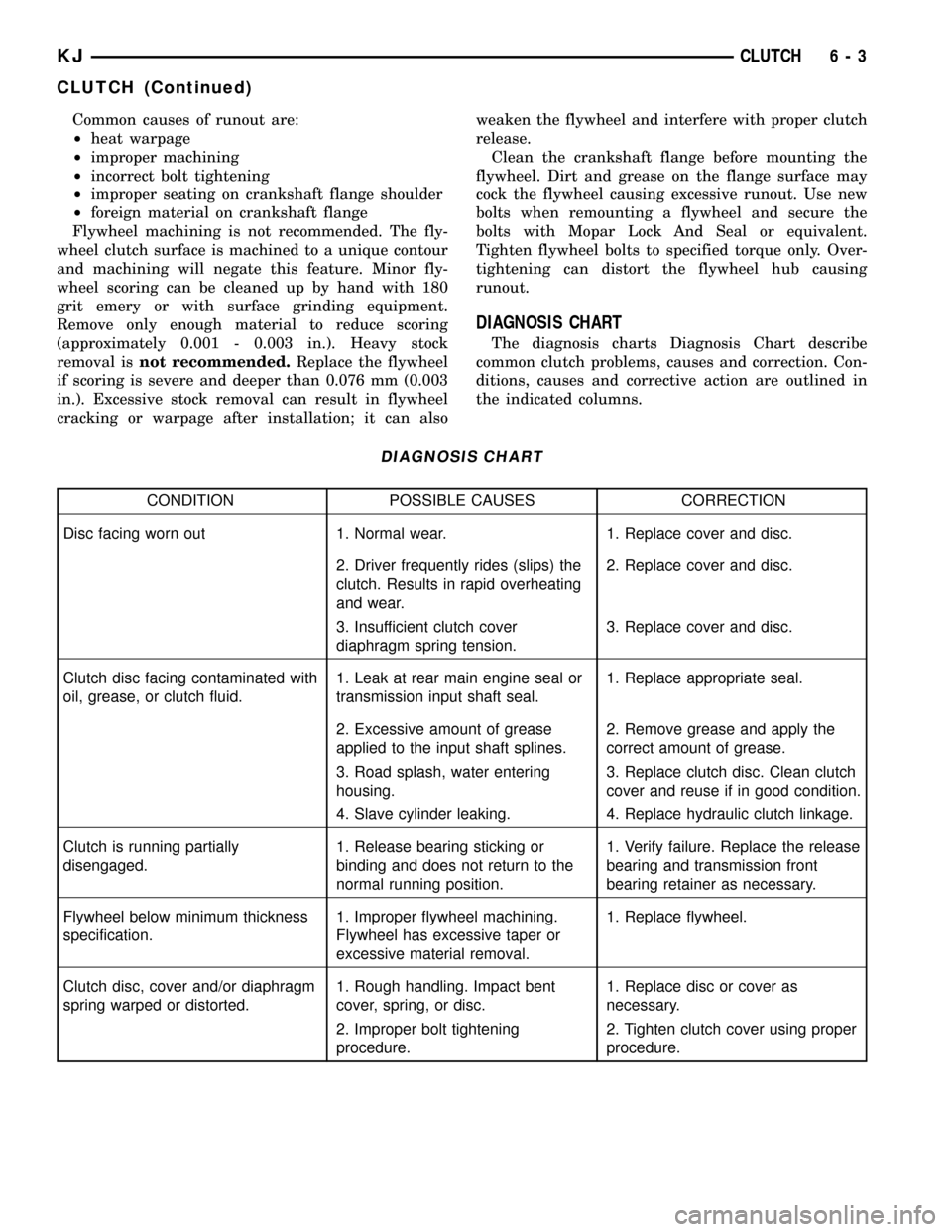
Common causes of runout are:
²heat warpage
²improper machining
²incorrect bolt tightening
²improper seating on crankshaft flange shoulder
²foreign material on crankshaft flange
Flywheel machining is not recommended. The fly-
wheel clutch surface is machined to a unique contour
and machining will negate this feature. Minor fly-
wheel scoring can be cleaned up by hand with 180
grit emery or with surface grinding equipment.
Remove only enough material to reduce scoring
(approximately 0.001 - 0.003 in.). Heavy stock
removal isnot recommended.Replace the flywheel
if scoring is severe and deeper than 0.076 mm (0.003
in.). Excessive stock removal can result in flywheel
cracking or warpage after installation; it can alsoweaken the flywheel and interfere with proper clutch
release.
Clean the crankshaft flange before mounting the
flywheel. Dirt and grease on the flange surface may
cock the flywheel causing excessive runout. Use new
bolts when remounting a flywheel and secure the
bolts with Mopar Lock And Seal or equivalent.
Tighten flywheel bolts to specified torque only. Over-
tightening can distort the flywheel hub causing
runout.
DIAGNOSIS CHART
The diagnosis charts Diagnosis Chart describe
common clutch problems, causes and correction. Con-
ditions, causes and corrective action are outlined in
the indicated columns.
DIAGNOSIS CHART
CONDITION POSSIBLE CAUSES CORRECTION
Disc facing worn out 1. Normal wear. 1. Replace cover and disc.
2. Driver frequently rides (slips) the
clutch. Results in rapid overheating
and wear.2. Replace cover and disc.
3. Insufficient clutch cover
diaphragm spring tension.3. Replace cover and disc.
Clutch disc facing contaminated with
oil, grease, or clutch fluid.1. Leak at rear main engine seal or
transmission input shaft seal.1. Replace appropriate seal.
2. Excessive amount of grease
applied to the input shaft splines.2. Remove grease and apply the
correct amount of grease.
3. Road splash, water entering
housing.3. Replace clutch disc. Clean clutch
cover and reuse if in good condition.
4. Slave cylinder leaking. 4. Replace hydraulic clutch linkage.
Clutch is running partially
disengaged.1. Release bearing sticking or
binding and does not return to the
normal running position.1. Verify failure. Replace the release
bearing and transmission front
bearing retainer as necessary.
Flywheel below minimum thickness
specification.1. Improper flywheel machining.
Flywheel has excessive taper or
excessive material removal.1. Replace flywheel.
Clutch disc, cover and/or diaphragm
spring warped or distorted.1. Rough handling. Impact bent
cover, spring, or disc.1. Replace disc or cover as
necessary.
2. Improper bolt tightening
procedure.2. Tighten clutch cover using proper
procedure.
KJCLUTCH 6 - 3
CLUTCH (Continued)
Page 210 of 1803

CLUTCH DISC
REMOVAL
(1) Remove transmission.
(2) Mark position of pressure plate on flywheel
with paint or a scriber for assembly reference, if
clutch is not being replaced.
(3) Loosen pressure plate bolts evenly and in rota-
tion to relieve spring tension and avoid warping the
plate.
(4) Remove pressure plate bolts and pressure plate
and disc.
INSTALLATION
(1) Lightly scuff sand flywheel face with 180 grit
emery cloth, then clean with a wax and grease
remover.
(2) Lubricate pilot bearing with Mopar high tem-
perature bearing grease or equivalent.
(3) Check runout and operation ofnewclutch disc.
NOTE: Disc must slide freely on transmission input
shaft splines.
(4) With the disc on the input shaft, check face
runout with dial indicator. Check runout at disc hub
6 mm (1/4 in.) from outer edge of facing. Obtain
another clutch disc if runout exceed 0.5 mm (0.020
in.).
(5) Position clutch disc on flywheel with side
marked flywheel against the flywheel.
NOTE: If not marked, the flat side of disc hub goes
towards the flywheel on the 3.7L engine and
towards the transmission on 2.4L engine.
(6) Insert clutch alignment tool through the clutch
disc and into the pilot bearing (Fig. 1).
(7) Position clutch pressure plate over disc and on
the flywheel (Fig. 1).
(8) Install pressure plate bolts finger tight.
CAUTION: Use only the factory bolts to mount the
pressure plate. The bolts must be the correct size.
If bolts are too short, there isn't enough thread
engagement, if too long bolts interfere with the Dual
Mass Flywheel.
(9) Tighten pressure plate bolts evenly and in rota-
tion a few threads at a time.
CAUTION: The bolts must be tightened evenly and
to specified torque to avoid distorting the pressure
plate.(10) Tighten pressure plate bolts to 31 N´m (23 ft.
lbs.) on 2.4L engines and 50 N´m (37ft. lbs.) on 3.7L
engines.
(11) Apply light coat of Mopar high temperature
bearing grease or equivalent to clutch disc hub and
splines of transmission input shaft.
CAUTION: Do not over lubricate shaft splines. This
will result in grease contamination of disc.
(12) Install transmission.
CLUTCH RELEASE BEARING
REMOVAL
(1) Remove transmission.
(2) Disconnect release bearing from release lever
and remove the bearing (Fig. 2).
(3) Inspect bearing slide surface of transmission
front bearing retainer. Replace retainer if slide sur-
face is scored, worn, or cracked.
(4) Inspect release fork and fork pivot. Be sure
pivot is secure and in good condition. Be sure fork is
not distorted or worn. Replace release fork retainer
spring if bent or damaged.
INSTALLATION
(1) Lubricate crankshaft pilot bearing with Mopar
high temperature bearing grease or equivalent. Apply
grease to end of long shank, small diameter flat
blade screwdriver. Then insert tool through clutch
disc hub to reach bearing.
Fig. 1 ALIGNING CLUTCH DISC
1 - FLYWHEEL
2 - PRESSURE PLATE
3 - CLUTCH DISC ALIGNMENT TOOL
6 - 6 CLUTCHKJ
Page 220 of 1803

the pan, it will drain first because it is heavier than
oil. An alternative method is to operate engine for a
short period to churn the oil. After this is done,
remove engine dipstick and inspect for water glob-
ules. Also inspect transmission dipstick for water
globules and transmission fluid cooler for leakage.
WARNING: WITH RADIATOR PRESSURE TESTER
TOOL INSTALLED ON RADIATOR, DO NOT ALLOW
PRESSURE TO EXCEED 124 KPA (18 PSI). PRES-
SURE WILL BUILD UP QUICKLY IF A COMBUSTION
LEAK IS PRESENT. TO RELEASE PRESSURE,
ROCK TESTER FROM SIDE TO SIDE. WHEN
REMOVING TESTER, DO NOT TURN TESTER MORE
THAN 1/2 TURN IF SYSTEM IS UNDER PRESSURE.
Operate engine without pressure cap on radiator
until thermostat opens. Attach a Pressure Tester to
filler neck. If pressure builds up quickly it indicates a
combustion leak exists. This is usually the result of a
cylinder head gasket leak or crack in engine. Repair
as necessary.
If there is not an immediate pressure increase,
pump the Pressure Tester. Do this until indicated
pressure is within system range of 110 kPa (16 psi).
Fluctuation of gauge pointer indicates compression or
combustion leakage into cooling system.
Because the vehicle is equipped with a catalytic
converter,do notremove spark plug cables or short
out cylinders to isolate compression leak.
If the needle on dial of pressure tester does not
fluctuate, race engine a few times to check for an
abnormal amount of coolant or steam. This would be
emitting from exhaust pipe. Coolant or steam from
exhaust pipe may indicate a faulty cylinder head gas-
ket, cracked engine cylinder block or cylinder head.A convenient check for exhaust gas leakage into
cooling system is provided by a commercially avail-
able Block Leak Check tool. Follow manufacturers
instructions when using this product.
COMBUSTION LEAKAGE TEST - WITHOUT
PRESSURE TESTER
DO NOT WASTE reusable coolant. If solution is
clean, drain coolant into a clean container for reuse.
WARNING: DO NOT REMOVE CYLINDER BLOCK
DRAIN PLUGS OR LOOSEN RADIATOR DRAIN-
COCK WITH SYSTEM HOT AND UNDER PRESSURE.
SERIOUS BURNS FROM COOLANT CAN OCCUR.
Drain sufficient coolant to allow thermostat
removal. (Refer to 7 - COOLING/ENGINE/ENGINE
COOLANT THERMOSTAT - REMOVAL). Remove
accessory drive belt (Refer to 7 - COOLING/ACCES-
SORY DRIVE/DRIVE BELTS - REMOVAL).
Add coolant to radiator to bring level to within 6.3
mm (1/4 in) of top of thermostat housing.
CAUTION: Avoid overheating. Do not operate
engine for an excessive period of time. Open drain-
cock immediately after test to eliminate boil over.
Start engine and accelerate rapidly three times, to
approximately 3000 rpm while observing coolant. If
internal engine combustion gases are leaking into
cooling system, bubbles will appear in coolant. If bub-
bles do not appear, internal combustion gas leakage
is not present.
KJCOOLING 7 - 5
COOLING (Continued)
Page 223 of 1803

CONDITION POSSIBLE CAUSES CORRECTION
15. Thermostat partially or
completely shut.15. Check thermostat operation and
replaces necessary. (Refer to 7 -
COOLING/ENGINE/ENGINE
COOLANT THERMOSTAT -
DIAGNOSIS AND TESTING).
16. Viscous fan drive not operating
properly.16. Check fan drive operation and
replace as necessary. (Refer to 7 -
COOLING/ENGINE/FAN DRIVE
VISCOUS CLUTCH - DIAGNOSIS
AND TESTING).
17. Cylinder head gasket leaking. 17. Check for cylinder head gasket
leaks. (Refer to 7 - COOLING -
DIAGNOSIS AND TESTING). For
repair, (Refer to 9 - ENGINE/
CYLINDER HEAD - REMOVAL).
18. Heater core leaking. 18. Check heater core for leaks.
(Refer to 24 - HEATING & AIR
CONDITIONING/PLUMBING/
HEATER CORE - REMOVAL).
Repair as necessary.
19. Electric fan not functioning. 19. Inspect electric fan for proper
operation. Refer to Electric Cooling
Fan in this section. Refer to Group
8W for electric cooling fan and relay
circuit schematic data.
TEMPERATURE GAUGE READING
IS INCONSISTENT (FLUCTUATES,
CYCLES OR IS ERRATIC)1. During cold weather operation,
with the heater blower in the high
position, the gauge reading may
drop slightly.1. A normal condition. No correction
is necessary.
2. Temperature gauge or engine
mounted gauge sensor defective or
shorted. Also, corroded or loose
wiring in this circuit.2. Check operation of gauge and
repair if necessary. Refer to Group
8J, Instrument cluster.
3. Gauge reading rises when
vehicle is brought to a stop after
heavy use (engine still running)3. A normal condition. No correction
is necessary. Gauge should return
to normal range after vehicle is
driven.
4. Gauge reading high after
re-starting a warmed up (hot)
engine.4. A normal condition. No correction
is necessary. The gauge should
return to normal range after a few
minutes of engine operation.
5. Coolant level low in cooling
system (air will build up in the
cooling system causing the
thermostat to open late).5. Check and correct coolant leaks.
(Refer to 7 - COOLING -
DIAGNOSIS AND TESTING).
7 - 8 COOLINGKJ
COOLING (Continued)