belt JEEP RENEGADE 2018 Owner handbook (in English)
[x] Cancel search | Manufacturer: JEEP, Model Year: 2018, Model line: RENEGADE, Model: JEEP RENEGADE 2018Pages: 356, PDF Size: 6.11 MB
Page 138 of 356

Main recommendations to carry children
safely
Install the child restraint systems on
the rear seat, which is the most protected
position in the event of an impact.
Keep children in rearward facing child
restraint systems for as long as possible,
until 3–4 years old if possible.
If a rear facing child restraint system
is installed on the front seat, passenger's
side, it is recommended to remove the
head restraint (refer to the procedure
described in "Head restraint" paragraph,
"Knowing your vehicle" chapter). The
head restraint must be repositioned
properly if no child restraint system is to
be transported.
If the passenger's front airbag is
deactivated always check the dedicated
warning light on the panel located on the
dashboard to make sure that it has
actually been deactivated.
Carefully follow the child restraint
manufacturer's instruction supplied with
the child restraint system. Keep the
instructions in the vehicle along with the
other documents and this handbook. Do
not use second-hand child restraint
systems without instructions.
Only one child is to be strapped into
each restraint system; never carry two
children using one child restraint system.
Always check that the seat belts do
not rest on the child’s neck.
Always check that the seat belt is well
fastened by pulling on it.
While travelling, do not let the child
sit incorrectly or unfasten the belts.
Never allow a child to put the belt's
diagonal section under an arm or behind
their back.
Never carry children on your lap, even
newborns. No-one could restrain them in
the event of an accident.
In the event of an accident, replace
the child restraint system with a new
one.
WARNING
88)SEVERE DANGER When a front
passenger airbag is fitted, do not install
rearward facing child restraint systems on
the front passenger seat. Deployment of
the airbag in an accident could cause fatal
injuries to the child regardless of the
severity of the collision. It is advisable to
always carry children in a child restraint
system on the rear seat, which is the most
protected position in the event of a
collision.89)On the sun visor there is a label with
suitable symbols reminding the user that
it is compulsory to deactivate the airbag if
a rearward facing child restraint system is
fitted. Always comply with the instructions
on the passenger side sun visor (see the
"Supplementary Restraint System (SRS) -
Airbag" paragraph).
90)Should it be necessary to carry a child
on the passenger side front seat in a rear
facing child restraint system, the
passenger side front airbag and side bag
must be deactivated through the display
main menu (see the "Display" paragraph,
"Knowing the instrument panel" chapter),
verifying deactivation by checking whether
the
OFF LED has switched on in the
trim located on the dashboard. Move the
passenger's seat as far back as possible to
avoid contact between the child seat and
the dashboard.
91)Do not move the front or rear seat if a
child is seated on it or on the dedicated
child restraint system.
136
SAFETY
Page 139 of 356

92)Incorrect fitting of the child restraint
system may result in an inefficient
protection system. In the event of an
accident the child restraint system may
become loose and the child may be
injured, even fatally. When fitting a
restraint system for newborns or children,
strictly comply with the instructions
provided by the Manufacturer.
93)When the child restraint system is not
used, secure it with the seat belt or with
the ISOFIX anchorages, or remove it from
the vehicle. Do not leave it unsecured
inside the passenger compartment. In this
way, in the case of sudden braking or an
accident, it will not cause injuries to the
occupants.
94)After installing a child restraint
system, do not move the seat: always
remove the child restraint system before
making any adjustment.
95)Always make sure that the chest
section of the seat belt does not pass
under the arms or behind the back of the
child. In the event of an accident the seat
belt will not be able to secure the child,
with the risk of injury, including fatal
injury. Therefore the child must always
wear the seat belt correctly.96)Do not use the same lower anchorage
to install more than one child restraint
system.
97)If a Universal ISOFIX child seat is not
fixed to all three anchorages, the child
seat will not be able to protect the child
correctly. In a crash, the child could be
seriously or fatally injured.
98)Fit the child restraint system when the
car is stationary. The child restraint
system is correctly fixed to the brackets
when you hear the click. Follow the
instructions for assembly, disassembly
and positioning that the Manufacturer
must supply with the child restraint
system.
99)If the vehicle was involved in an
accident of a certain severity, have the
ISOFIX anchorages and the child restraint
system replaced.
100)If the vehicle was involved in an
accident of a certain severity, have both
the child restraint system and the seat
belt it was attached to replaced.SUPPLEMENTARY
RESTRAINT SYSTEM (SRS)-
AIRBAG
The vehicle is equipped with:front driver airbag;front passenger airbag;driver and passenger front side bags
for pelvis, chest and shoulder protection
(Side bags);
front and rear side passenger side
bags for head protection (window bag).
FRONT AIRBAGS
The front driver/passenger airbags and
the driver knee bag (where provided)
protect the front seat occupants in the
event of frontal impacts of medium/high
severity, by placing the bag between the
occupant and the steering wheel or
dashboard.
Therefore non-activation of airbags in
other types of collisions (side impacts,
rear shunts, roll-overs, etc.) does not
indicate a system malfunction.
The driver and passenger front airbags
are not a replacement for, but are
complementary to, the seat belts, which
should always be worn as required by law
in Europe and most non-European
countries.
In the event of impact, anyone not
wearing a seat belt is projected forwards
137
Page 140 of 356
and may come into contact with the bag
while it is still inflating. The protection
offered by the bag is compromised in
these circumstances.
The front airbags may not activate in the
case of a frontal impact against highly
deformable objects not involving the
front surface of the car (e.g. wing
collision against guard rail) or in the case
of the car wedging under other cars or
protective barriers (e.g. under trucks or
guard rails).
Failure to activate in the conditions
described above is due to the fact that
they may not provide any additional
protection compared with seat belts, so
their activation would be inappropriate.
In these cases, non-deployment does not
indicate a system malfunction.Driver's side front airbag
101) 102)
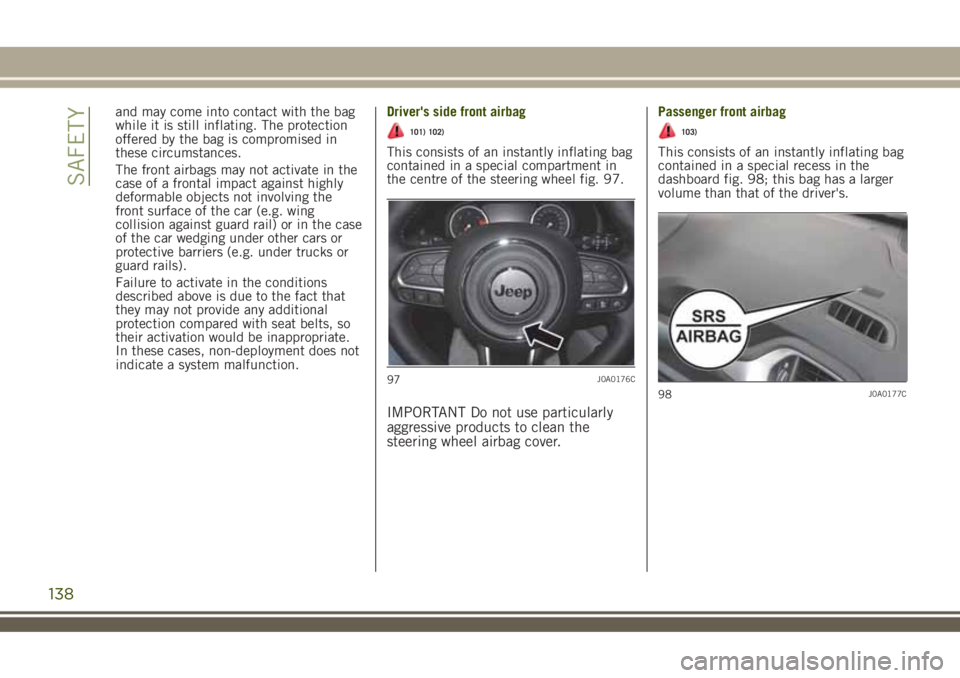
This consists of an instantly inflating bag
contained in a special compartment in
the centre of the steering wheel fig. 97.
IMPORTANT Do not use particularly
aggressive products to clean the
steering wheel airbag cover.
Passenger front airbag
103)
This consists of an instantly inflating bag
contained in a special recess in the
dashboard fig. 98; this bag has a larger
volume than that of the driver's.
97J0A0176C
98J0A0177C
138
SAFETY
Page 145 of 356
112)If the ignition device is at MAR, even
if the engine is switched off, airbags may
be deployed when the vehicle is stationary
and hit by another vehicle. Therefore,
even if the vehicle is stationary, when an
active front passenger airbag is fitted, DO
NOT install rearward facing child restraint
systems on the front passenger seat.
Deployment of the airbag following an
impact could cause fatal injuries to the
child. Therefore, always deactivate the
passenger side airbag when a rearward
facing child restraint system is installed
on the front passenger seat. The front
passenger seat must also be positioned
back as far as possible in order to prevent
the child restraint system from coming
into contact with the dashboard.
Immediately reactivate the passenger
airbag as soon as the child restraint
system has been removed. Also remember
that, if the ignition device is set to STOP,
none of the safety devices (airbags or
pretensioners) will be deployed in the
event of collision. Non-deployment in
such cases does not indicate a system
malfunction.113)Malfunction of the airbag failure
warning light is indicated by the activation
of an airbag failure icon and a dedicated
message on the instrument panel display.
The pyrotechnic charges are not disabled.
Before continuing, contact a Jeep
Dealership immediately to have the
system checked.
114)The airbag deployment threshold is
higher than that of the pretensioners. For
collisions in the range between the two
thresholds, it is normal for only the
pretensioners to be activated.
115)The airbag does not replace seat
belts but increases their efficiency.
Because front airbags are not deployed for
low-speed crashes, side collisions,
rear-end shunts or rollovers, occupants are
protected, in addition to any side bags,
only by their seat belts, which must
therefore always be fastened.
143
Page 148 of 356
STARTING THE ENGINE
116) 117) 118)44) 45) 46) 47)
Before starting the engine, adjust the
seat, the interior rear view mirrors, the
door mirrors and fasten the seat belt
correctly.
Never press the accelerator pedal for
starting the engine.
If necessary, messages indicating the
starting procedure can be shown on the
display.
LPG versions
The engine always starts up on petrol
independently of the previously selected
mode.
There must therefore always be some
petrol in the tank to protect the petrol
pump and to guarantee temporary
switching from Methane or LPG to petrol
operation, if high performance is
required.
PROCEDURE FOR VERSIONS
WITH MANUAL GEARBOX
Proceed as follows:engage the electric parking brake and
place the gear lever in neutral;
bring the ignition device to MAR. On
Diesel versions, waning lightlights upin the instrument panel: wait for the
warning light to switch off;
fully depress the clutch pedal without
touching the accelerator;
turn the ignition device to AVV and
release it as soon as the engine starts;
if the engine does not start within
10 seconds, bring the ignition device
back to STOP and wait for
10-15 seconds before repeating the
starting procedure.
PROCEDURE FOR VERSIONS
WITH AUTOMATIC
TRANSMISSION
Proceed as follows:engage the electric parking brake and
place the gear lever to P (Park) or N
(Neutral);
fully depress the brake pedal without
touching the accelerator;
place the ignition device to AVV;if the engine does not start, bring the
ignition device back to STOP and wait for
10-15 seconds before repeating the
starting procedure.
IMPORTANT If, with the ignition
device at MAR, thesymbol on the
instrument panel stays on together
with warning light
, turn the
ignition device to STOP and then back
to MAR. If the warning light (or thesymbol on the display) remains on, try
with the other keys provided with the
vehicle. Contact a Jeep Dealership if
the engine still does not start.
ENGINE STARTING FAILURE
Starting the engine with electronic key
battery (Keyless Enter-N-Go) run down or
flat
If the ignition device does not respond
when the relevant button is pressed the
electronic key battery might be run down
or flat. Therefore, the system does not
detect the presence of the electronic key
on board the vehicle and displays a
dedicated message.
In this case, rest the rounded edge of the
electronic key (the side opposite the
metal insert) on the ignition device and
press the button by the electronic key.
The ignition device is thus activated and
the engine can be started.
STOPPING THE ENGINE
Proceed as follows:park the car in a position that is not
dangerous for oncoming traffic; engage a
gear (versions with manual gearbox) or
position the gear lever to P (Parking)
(versions with automatic transmission);
turn the ignition device to STOP with
the engine idling.
146
STARTING AND DRIVING
Page 151 of 356

reached and the switch is kept pulled,
the parking brake will definitively
engage.
IMPORTANT Driving the vehicle with
the electric parking brake engaged, or
using it several times to slow down the
vehicle, may cause severe damage to
the braking system.
Releasing the electric parking brake
manually
The ignition device must be in the MAR
position in order to manually release the
parking brake. Moreover, you need to
press the brake pedal, then press the
switch on the central tunnel briefly.
Noise may be heard from the rear of the
vehicle and a slight movement of the
brake pedal may be detected during
disengagement.
After disengaging the electric parking
brake, the
warning light on the
instrument panel and the LED on the
switch will turn off.
If the
warning light on the instrument
panel remains on with the electric
parking brake disengaged, it indicates a
fault. In this case contact a Jeep
Dealership.
IMPORTANT On versions with
automatic transmission never use theP (Park) position instead of the electric
parking brake. Always engage the
electric parking brake when parking
the vehicle to prevent injury or damage
caused by the unexpected movement
of the vehicle.
IMPORTANT For versions with manual
transmission, if the clutch pedal is
pressed all the way and then released
at the same time as pressing the
accelerator pedal, the electric parking
brake will be released automatically.
OPERATING THE ELECTRIC
PARKING BRAKE
The electric parking brake can operate in
the following ways:
“Dynamic operating mode”: this
mode is enabled by pulling the switch
continuously whilst driving;
“Static engagement and release
mode”: with the car stationary, the
electric parking brake can be activated
by pulling the switch on the central
tunnel once. On the other hand, press
the switch and the brake pedal at the
same time to disengage the brake;
“Drive Away Release” (where
provided): the electric parking brake will
automatically disengage with the
detection of the driver’s intention to
move the car forward or in reverse. Onversions with automatic transmission, it
is also necessary for the driver side safety
belt to be properly fastened;
“Safe Hold”: if the car speed is lower
than 3 km/h and, for the versions with
automatic transmission, the gear lever is
not in P (Park) position, and the driver’s
intention to leave the car is detected, the
electric parking brake will automatically
engage to hold the car in safety
conditions;
“Auto Park Brake”: if the car speed is
lower than 3 km/h, the electric parking
brake will automatically engage when the
gear lever is moved to P (Park) position
(versions with automatic transmission),
or with the ignition device at STOP
(versions with manual transmission). The
fig. 104 switch LED on the central
tunnel turns on together with the
warning light on the instrument panel
when the parking brake is engaged and
applied to the wheels. Each automatic
parking brake engagement can be
cancelled by pressing the switch on the
central tunnel and at the same time
moving the gear lever for the automatic
transmission to position P (Park) or the
ignition device to STOP (versions with
manual gearbox). This way can be
handled by using the system Menu
Uconnect™.
149
Page 152 of 356
SAFE HOLD
It is a safety function that automatically
engages the electric parking brake in the
event of a dangerous condition for the
vehicle.
If:
the vehicle speed is below 3 km/h;the gear lever is not at P (Park)
(versions with automatic transmission);
the driver's seat belt is not fastened;the driver side door is open;no attempted operation of the brake
pedal or the accelerator pedal, or, in
versions with manual gearbox, the clutch
pedal is detected;
the parking brake engages automatically
to prevent the vehicle movement.
The Safe Hold function can be
temporarily disabled by pressing the
switch located on the central tunnel and
the brake pedal at the same time, with
the vehicle stationary and the driver side
door open.
Once disabled, the function will activate
again when the vehicle speed reaches
20 km/h or the ignition device is moved
to STOP and then to MAR.
WARNING
119)In the case of parking manoeuvres on
roads on a gradient, the front wheels must
be steered towards the pavement (when
parking downhill), or in the opposite
direction if the vehicle is parked uphill.
Block the wheels with a wedge or a stone
if the car is parked on a steep slope.
120)Never leave children unattended in
the car. Always remove the key from the
ignition when leaving the car and take it
with you.
121)The electric parking brake must
always be engaged when leaving the
vehicle.
MANUAL GEARBOX
122)48)
To engage the gears, press the clutch
pedal fully and put the gear lever into the
required position (the diagram for gear
engagement is shown on the knob ).
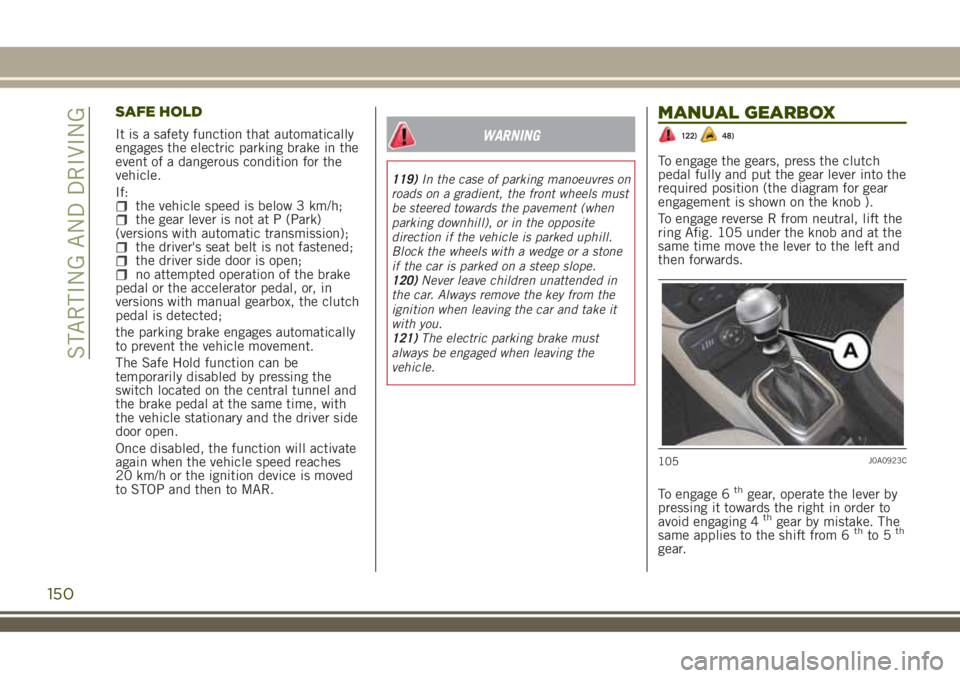
To engage reverse R from neutral, lift the
ring Afig. 105 under the knob and at the
same time move the lever to the left and
then forwards.
To engage 6
thgear, operate the lever by
pressing it towards the right in order to
avoid engaging 4
thgear by mistake. The
same applies to the shift from 6thto 5th
gear.
105J0A0923C
150
STARTING AND DRIVING
Page 230 of 356
SCHEDULED SERVICING
Correct servicing is crucial for
guaranteeing a long life for the car under
the best conditions. For this reason, Jeep
has planned a series of checks and
services at fixed distance intervals and,
where provided, at fixed time intervals,
as described in the Scheduled Servicing
Plan.
Before each coupon however you always
need to pay attention to what is written
in the Scheduled Servicing Plan (e.g.
periodically check liquid levels, tire
pressure, etc.).
The Scheduled Servicing is carried out
by the Jeep Assistance Network at
pre-set times. If, during each operation,
in addition to the ones scheduled, the
need arises for further replacements or
repairs, these may be carried out with the
owner's explicit agreement only. If your
car is used frequently for towing, the
interval between one scheduled servicing
operation and the next should be
reduced.
IMPORTANT Scheduled Servicing
interventions are set out by the
Manufacturer. Failure to have them
carried out may invalidate the
warranty. It is advisable to inform aJeep Dealership of any small operating
irregularities without waiting for the
next service.
PERIODIC CHECKS
Every1,000km or before long trips
check and, if necessary, top up:
engine coolant level;brake fluid level;windscreen washer fluid level;tyre inflation pressure and condition;operation of lighting system
(headlights, direction indicators, hazard
warning lights, etc.);
operation of screen washer/wiper
system and positioning/wear of
windscreen/rear window wiper blades.
Every3,000km, check and top up if
required: engine oil level.
DEMANDING USE OF THE CAR
If the vehicle is used in one of the
following conditions:
Law enforcement (or security service),
taxi service
towing a trailer or caravan;dusty roads;short, repeated journeys (less than
7-8 km) at sub-zero outside
temperatures;
engine often idling or driving long
distances at low speeds or long periods
of inactivity;the following checks must be carried out
more often than indicated in the
Scheduled Service Plan:
check front disc brake pad condition
and wear;
check cleanliness of bonnet and
luggage compartment locks, cleanliness
and lubrication of linkage;
visually inspect conditions of: engine,
gearbox, transmission, pipes and hoses
(exhaust/fuel system/brakes) and rubber
elements (gaiters/sleeves/bushes, etc.);
check battery charge and battery fluid
level (electrolyte);
visually inspect conditions of the
accessory drive belts;
check and, if necessary, change
engine oil and replace oil filter;
check and, if necessary, replace pollen
filter;
check and, if necessary, replace air
cleaner.
228
SERVICING AND MAINTENANCE
Page 233 of 356
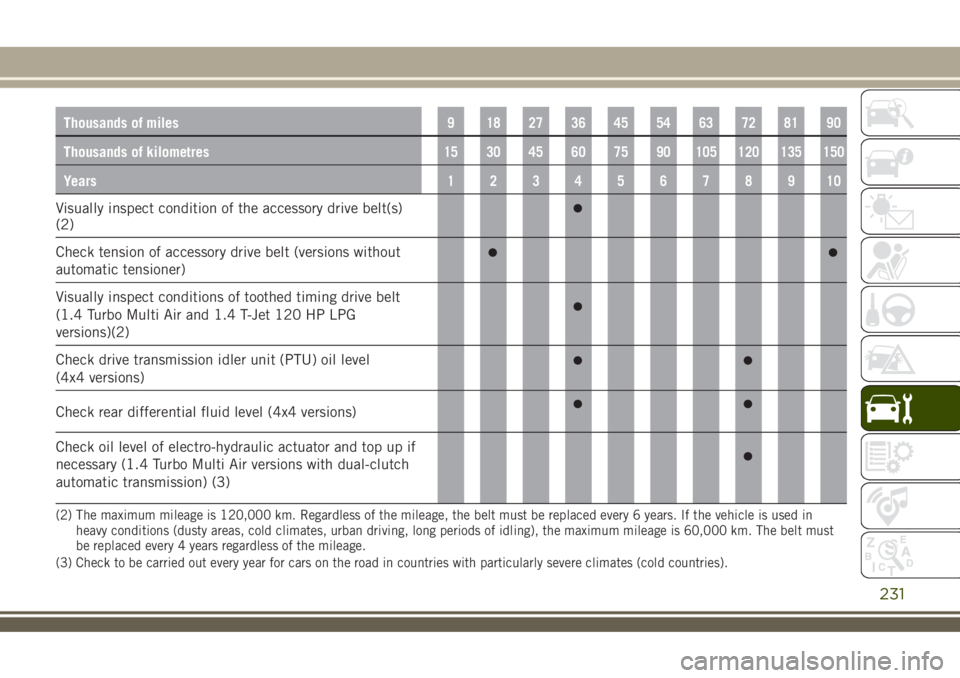
Thousands of miles9 182736455463728190
Thousands of kilometres15 30 45 60 75 90 105 120 135 150
Years12345678910
Visually inspect condition of the accessory drive belt(s)
(2)
Check tension of accessory drive belt (versions without
automatic tensioner)
Visually inspect conditions of toothed timing drive belt
(1.4 Turbo Multi Air and 1.4 T-Jet 120 HP LPG
versions)(2)
Check drive transmission idler unit (PTU) oil level
(4x4 versions)
Check rear differential fluid level (4x4 versions)
Check oil level of electro-hydraulic actuator and top up if
necessary (1.4 Turbo Multi Air versions with dual-clutch
automatic transmission) (3)
(2) The maximum mileage is 120,000 km. Regardless of the mileage, the belt must be replaced every 6 years. If the vehicle is used in
heavy conditions (dusty areas, cold climates, urban driving, long periods of idling), the maximum mileage is 60,000 km. The belt must
be replaced every 4 years regardless of the mileage.
(3) Check to be carried out every year for cars on the road in countries with particularly severe climates (cold countries).
231
Page 235 of 356

Thousands of miles9 182736455463728190
Thousands of kilometres15 30 45 60 75 90 105 120 135 150
Years12345678910
Replace starter spark plug (2.4 Tigershark versions -
where there is one)
Replace accessory drive belt/s(2)
Replace timing belt (1.4 T-Jet 120 HP LPG and
1.4 Turbo Multi Air versions)(2)
Replace air cleaner cartridge (7)
Replace the filter inside the pressure regulator (1.4 T-Jet
120 HP LPG versions)
Replace the paper filter (gaseous LPG) (1.4 T-Jet 120 HP
LPG versions)
(2) The maximum mileage is 120,000 km. Regardless of the mileage, the belt must be replaced every 6 years. If the vehicle is used in
heavy conditions (dusty areas, cold climates, urban driving, long periods of idling), the maximum mileage is 60,000 km. The belt must
be replaced every 4 years regardless of the mileage.
(7) If the vehicle is used in dusty areas, this cleaner must be replaced every 15,000 km.
233