ECO mode JEEP RENEGADE 2023 Workshop Manual
[x] Cancel search | Manufacturer: JEEP, Model Year: 2023, Model line: RENEGADE, Model: JEEP RENEGADE 2023Pages: 364, PDF Size: 18.65 MB
Page 268 of 364
266 SAFETY
(Continued)
(Continued)
Floor Mat Safety Information
Always use floor mats designed to fit your vehicle.
Only use a floor mat that does not interfere with the
operation of the accelerator, brake or clutch
pedals. Only use a floor mat that is securely
attached using the floor mat fasteners so it cannot
slip out of position and interfere with the
accelerator, brake or clutch pedals or impair safe
operation of your vehicle in other ways.
WARNING!
An improperly attached, damaged, folded, or
stacked floor mat, or damaged floor mat
fasteners may cause your floor mat to interfere
with the accelerator, brake, or clutch pedals and
cause a loss of vehicle control. To prevent
SERIOUS INJURY or DEATH:
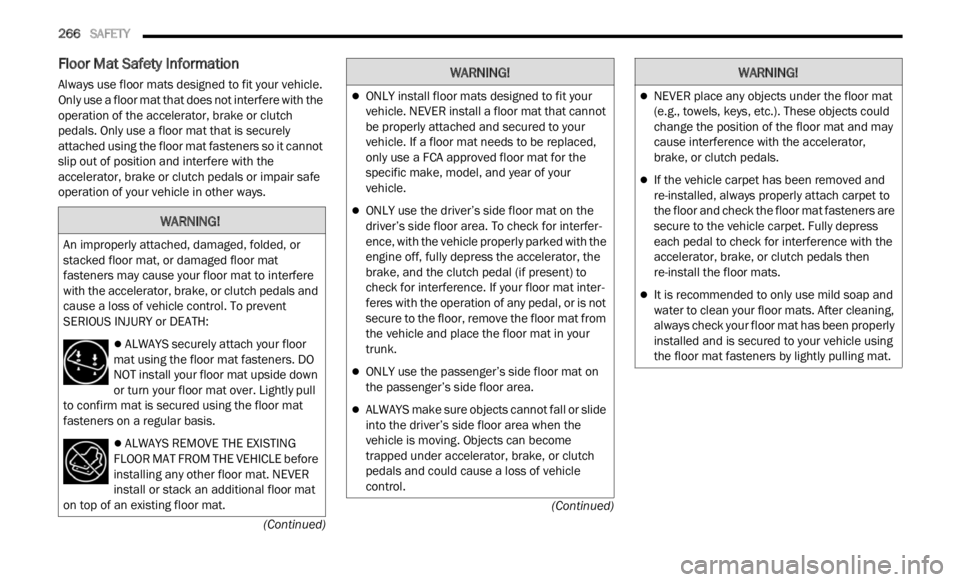
ALWAYS securely attach your floor
mat using the floor mat fasteners. DO
NOT i n
stall your floor mat upside down
or turn your floor mat over. Lightly pull
to confirm mat is secured using the floor mat
fasteners on a regular basis.
ALWAYS REMOVE THE EXISTING
FLOOR MAT FROM THE VEHICLE before
i n s
ta
l
ling any other floor mat. NEVER
install or stack an additional floor mat
on top of an existing floor mat.
ONLY install floor mats designed to fit your
vehicle. NEVER install a floor mat that cannot
be properly attached and secured to your
vehicle. If a floor mat needs to be replaced,
only use a FCA approved floor mat for the
specific make, model, and year of your
vehicle.
ONLY use the driver’s side floor mat on the
driver’s side floor area. To check for interfer -
ence, with the vehicle properly parked with the
e ngine
off, fully depress the accelerator, the
brake, and the clutch pedal (if present) to
check for interference. If your floor mat inter -
feres with the operation of any pedal, or is not
s ecure
to the floor, remove the floor mat from
the vehicle and place the floor mat in your
trunk.
ONLY use the passenger’s side floor mat on
the passenger’s side floor area.
ALWAYS make sure objects cannot fall or slide
into the driver’s side floor area when the
vehicle is moving. Objects can become
trapped under accelerator, brake, or clutch
pedals and could cause a loss of vehicle
control.
WARNING!
NEVER place any objects under the floor mat
(e.g., towels, keys, etc.). These objects could
change the position of the floor mat and may
cause interference with the accelerator,
brake, or clutch pedals.
If the vehicle carpet has been removed and
re-installed, always properly attach carpet to
the floor and check the floor mat fasteners are
secure to the vehicle carpet. Fully depress
each pedal to check for interference with the
accelerator, brake, or clutch pedals then
re-install the floor mats.
It is recommended to only use mild soap and
water to clean your floor mats. After cleaning,
always check your floor mat has been properly
installed and is secured to your vehicle using
the floor mat fasteners by lightly pulling mat.
WARNING!
Page 270 of 364
268
IN CASE OF EMERGENCY
HAZARD WARNING FLASHERS
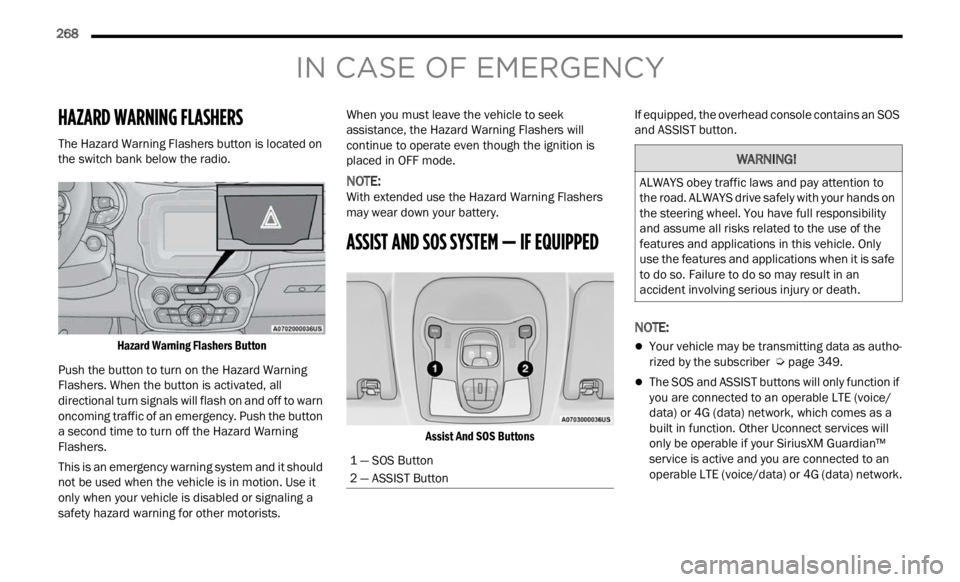
The Hazard Warning Flashers button is located on
the switch bank below the radio.
Hazard Warning Flashers Button
Push the button to turn on the Hazard Warning
Flash e
rs. When the button is activated, all
directional turn signals will flash on and off to warn
oncoming traffic of an emergency. Push the button
a second time to turn off the Hazard Warning
Flashers.
This is an emergency warning system and it should
not be
used when the vehicle is in motion. Use it
only when your vehicle is disabled or signaling a
safety hazard warning for other motorists. When you must leave the vehicle to seek
assis
t
ance, the Hazard Warning Flashers will
continue to operate even though the ignition is
placed in OFF mode.
NOTE:
With extended use the Hazard Warning Flashers
may w e
ar down your battery.
ASSIST AND SOS SYSTEM — IF EQUIPPED
Assist And SOS Buttons
If equipped, the overhead console contains an SOS
and A
S
SIST button.
NOTE:
Your vehicle may be transmitting data as autho -
rized by the subscriber Ú page 349.
The SOS and ASSIST buttons will only function if
you are connected to an operable LTE (voice/
data) or 4G (data) network, which comes as a
built in function. Other Uconnect services will
only be operable if your SiriusXM Guardian™
service is active and you are connected to an
operable LTE (voice/data) or 4G (data) network.
1 — SOS Button
2 — ASSIST Button
WARNING!
ALWAYS obey traffic laws and pay attention to
the road. ALWAYS drive safely with your hands on
the steering wheel. You have full responsibility
and assume all risks related to the use of the
features and applications in this vehicle. Only
use the features and applications when it is safe
to do so. Failure to do so may result in an
accident involving serious injury or death.
Page 284 of 364
282 IN CASE OF EMERGENCY
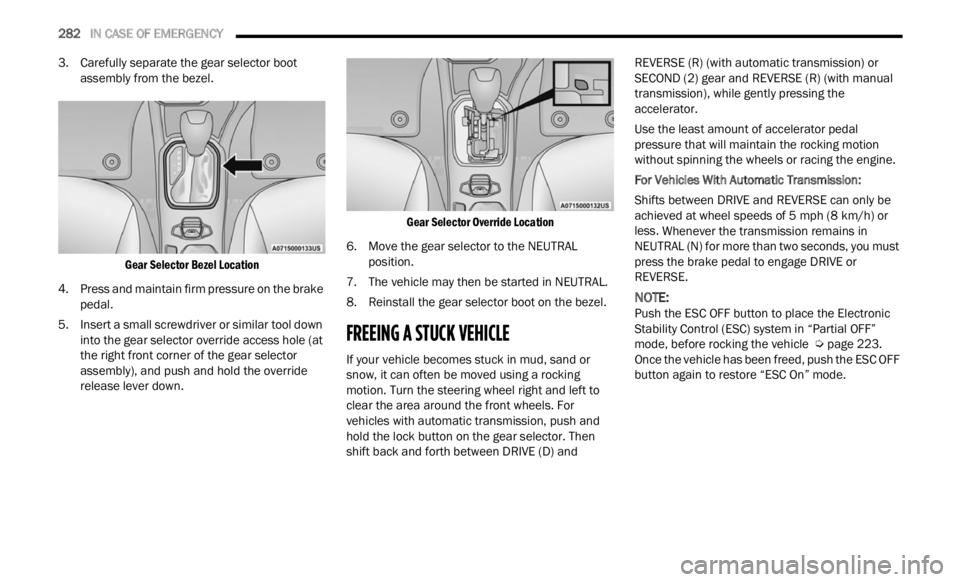
3. Carefully separate the gear selector boot
assembly from the bezel.
Gear Selector Bezel Location
4. Press and maintain firm pressure on the brake peda l
.
5. Insert a small screwdriver or similar tool down into t
he gear selector override access hole (at
the right front corner of the gear selector
assembly), and push and hold the override
release lever down.
Gear Selector Override Location
6. Move the gear selector to the NEUTRAL posit i
on.
7. The vehicle may then be started in NEUTRAL.
8. R ein
stall the gear selector boot on the bezel.
FREEING A STUCK VEHICLE
If your vehicle becomes stuck in mud, sand or
snow, it can often be moved using a rocking
motion. Turn the steering wheel right and left to
clear the area around the front wheels. For
vehicles with automatic transmission, push and
hold the lock button on the gear selector. Then
shift back and forth between DRIVE (D) and REVERSE (R) (with automatic transmission) or
SECOND (2) gear and REVERSE (R) (with manual
transmission), while gently pressing the
accelerator.
Use the least amount of accelerator pedal
pressu
re that will maintain the rocking motion
without spinning the wheels or racing the engine.
For Vehicles With Automatic Transmission:
Shifts between DRIVE and REVERSE can only be
a chiev
ed at wheel speeds of 5 mph (8 km/h) or
less.
Whenever the transmission remains in
NEUTRAL (N) for more than two seconds, you must
press the brake pedal to engage DRIVE or
REVERSE.
NOTE:
Push the ESC OFF button to place the Electronic
Stabi l
ity Control (ESC) system in “Partial OFF”
mode, before rocking the vehicle Ú page 223.
Once the vehicle has been freed, push the ESC OFF
button
again to restore “ESC On” mode.
Page 299 of 364

SERVICING AND MAINTENANCE 297
Refrigerant Recovery And Recycling —
R–1234yf
R–1234yf Air Conditioning Refrigerant is a
hydrofluoroolefin (HFO) that is endorsed by the
Environmental Protection Agency and is an
ozone-friendly substance with a low
global-warming potential. The manufacturer
recommends that air conditioning service be
performed by an authorized dealer using recovery
and recycling equipment.
NOTE:
Use only the manufacturer approved A/C system
PAG c om
pressor oil, and refrigerants.
Cabin Air Cleaner
See an authorized dealer for service.
BODY LUBRICATION
Locks and all body pivot points, including such
items as seat tracks, door hinge pivot points and
rollers, liftgate, tailgate, decklid, sliding doors and
hood hinges, should be lubricated periodically with
a lithium-based grease, such as Mopar® Spray
White Lube to ensure quiet, easy operation and to
protect against rust and wear. Prior to the
application of any lubricant, the parts concerned
should be wiped clean to remove dust and grit;
after lubricating, excess oil and grease should be
removed. Particular attention should also be given to hood latching components to ensure proper
function. When performing other underhood
services, the hood latch, release mechanism and
safety catch should be cleaned and lubricated.
The external lock cylinders should be lubricated
twice
a year, preferably in the Autumn and Spring.
Apply a small amount of a high quality lubricant,
such as Mopar® Lock Cylinder Lubricant directly
into the lock cylinder.
WINDSHIELD WIPER BLADES
Clean the rubber edges of the wiper blades and the
windshield periodically with a sponge or soft cloth
and a mild nonabrasive cleaner. This will remove
accumulations of salt or road film.
Operation of the wipers on dry glass for long
periods
may cause deterioration of the wiper
blades. Always use washer fluid when using the
wipers to remove salt or dirt from a dry windshield.
Avoid using the wiper blades to remove frost or ice
from th
e windshield. Keep the blade rubber out of
contact with petroleum products such as engine
oil, gasoline, etc.
NOTE:
Life expectancy of wiper blades varies depending
on geog r
aphical area and frequency of use. Poor
performance of blades may be present with chat -tering, marks, water lines or wet spots. If any of
these
conditions are present, clean the wiper
blades or replace as necessary.
Service Position Strategy
The service position allows the wiper blades to be
placed in a position that allows the wiper blades to
be easily changed.
To enable the Service Position Strategy, the wipers
must b
e in the Park position before placing the
ignition in the STOP/OFF position.
Service mode must be activated within two
minut e
s after the ignition is placed in the STOP/
OFF position.
To have a correct activation of strategy, the Service
Positi on
command (antipanic) must be active for at
least half a second.
At every valid activation of Service Position
comman d
, the wiper blades are activated for
250 ms.
The Service Position command can be repeated
sever a
l times to bring the blades into the desired
position, up to a maximum of three times.
After three subsequent activations the strategy is
disab l
ed.
8
Page 332 of 364

330 SERVICING AND MAINTENANCE
Inflation pressures specified on the placard are
always “cold tire inflation pressure”. Cold tire
inflation pressure is defined as the tire pressure
after the vehicle has not been driven for at least
three hours, or driven less than 1
mile (1.6 km)
after
sitting for a minimum of three hours. The cold
tire inflation pressure must not exceed the
maximum inflation pressure molded into the tire
sidewall.
Check tire pressures more often if subject to a
wide r
ange of outdoor temperatures, as tire
pressures vary with temperature changes.
Tire pressures change by approximately 1 psi
(7 kPa) per 12°F (7°C) of air temperature change.
K eep t
his in mind when checking tire pressure
inside a garage, especially in the Winter.
Example: If garage temperature = 68°F (20°C)
and t h
e outside temperature = 32°F (0°C) then
the cold tire inflation pressure should be increased
by 3 psi (21 kPa), which equals 1 psi (7 kPa) for
every 12°F (7°C) for this outside temperature
condition.
Tire pressure may increase from 2 to 6 psi (13 to
40 kPa
) during operation. DO NOT reduce this
normal pressure build up or your tire pressure will
be too low.
Tire Pressures For High Speed Operation
The manufacturer advocates driving at safe
speeds and within posted speed limits. Where
speed limits or conditions are such that the vehicle
can be driven at high speeds, maintaining correct
tire inflation pressure is very important. Increased
tire pressure and reduced vehicle loading may be
required for high-speed vehicle operation. Refer to
an authorized tire dealer or original equipment
vehicle dealer for recommended safe operating
speeds, loading and cold tire inflation pressures.
Radial Ply Tires
Tire Repair
If your tire becomes damaged, it may be repaired if
it me e
ts the following criteria:
The tire has not been driven on when flat.
The damage is only on the tread section of your
tire (sidewall damage is not repairable).
The puncture is no greater than a ¼ of an inch
(6 mm).
Consult an authorized tire dealer for tire repairs
a nd ad
ditional information.
Damaged Run Flat tires, or Run Flat tires that have
experi
enced a loss of pressure should be replaced
immediately with another Run Flat tire of identical
size and service description (Load Index and
Speed Symbol). Replace the tire pressure sensor
as well as it is not designed to be reused.
Run Flat Tires — If Equipped
Run Flat tires allow you the capability to drive
50 miles (80 km) at 50 mph (80 km/h) after a
r a
pi
d
loss of inflation pressure. This rapid loss of
inflation is referred to as the Run Flat mode. A Run
Flat mode occurs when the tire inflation pressure is
of/or below 14 psi (96 kPa). Once a Run Flat tire
reaches the Run Flat mode it has limited driving
capabilities and needs to be replaced immediately.
A Run Flat tire is not repairable. When a Run Flat
tire is changed after driving with underinflated tire
WARNING!
High speed driving with your vehicle under
maximum load is dangerous. The added strain
on your tires could cause them to fail. You could
have a serious collision. Do not drive a vehicle
loaded to the maximum capacity at continuous
speeds above 75 mph (120 km/h).
WARNING!
Combining radial ply tires with other types of
tires on your vehicle will cause your vehicle to
handle poorly. The instability could cause a colli
-
sion. Always use radial ply tires in sets of four.
Never
combine them with other types of tires.
Page 333 of 364
SERVICING AND MAINTENANCE 331
condition, please replace the TPMS sensor as it is
not designed to be reused when driven under Run
Flat mode 14 psi (96 kPa) condition.
NOTE:
TPMS sensor must be replaced after driving the
vehic l
e on a flat tire condition.
It is not recommended driving a vehicle loaded at
full c
apacity or to tow a trailer while a tire is in the
Run Flat mode.
See the Tire Pressure Monitoring System section
for mor e
information Ú page 235.
Tire Spinning
When stuck in mud, sand, snow, or ice conditions,
do not spin your vehicle's wheels above 30
mph
( 4
8 k
m /
h) or for longer than 30 seconds
contin u
ously without stopping.
For further information Ú page 282.
Tread Wear Indicators
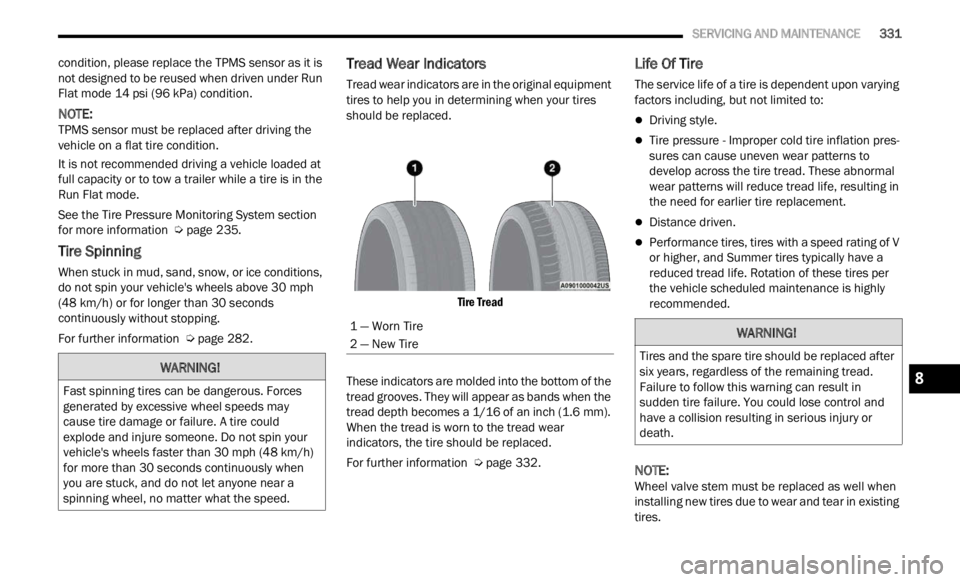
Tread wear indicators are in the original equipment
tires to help you in determining when your tires
should be replaced.
Tire Tread
These indicators are molded into the bottom of the
tread
grooves. They will appear as bands when the
tread depth becomes a 1/16 of an inch (1.6 mm).
When t
he tread is worn to the tread wear
indicators, the tire should be replaced.
For further information Ú page 332.
Life Of Tire
The service life of a tire is dependent upon varying
factors including, but not limited to:
Driving style.
Tire pressure - Improper cold tire inflation pres -
sures can cause uneven wear patterns to
d ev
e l
op
across the tire tread. These abnormal
wear patterns will reduce tread life, resulting in
the need for earlier tire replacement.
Distance driven.
Performance tires, tires with a speed rating of V
or higher, and Summer tires typically have a
reduced tread life. Rotation of these tires per
the vehicle scheduled maintenance is highly
recommended.
NOTE:
Wheel valve stem must be replaced as well when
insta l
ling new tires due to wear and tear in existing
tires.
WARNING!
Fast spinning tires can be dangerous. Forces
generated by excessive wheel speeds may
cause tire damage or failure. A tire could
explode and injure someone. Do not spin your
vehicle's wheels faster than 30 mph (48 km/h)
for more
than 30 seconds continuously when
you are stuck, and do not let anyone near a
spinning wheel, no matter what the speed.
1 — Worn Tire
2 — New TireWARNING!
Tires and the spare tire should be replaced after
six years, regardless of the remaining tread.
Failure to follow this warning can result in
sudden tire failure. You could lose control and
have a collision resulting in serious injury or
death.
8
Page 345 of 364

TECHNICAL SPECIFICATIONS 343
Problems that result from using gasoline
containing more than 15% ethanol (E-15) or
gasoline containing methanol are not the
responsibility of the manufacturer and may void or
not be covered under New Vehicle Limited
Warranty.
E-85 USAGE IN NON-FLEX FUEL
V
EHICLES
Non-Flex Fuel Vehicles (FFV) are compatible with
gasoline containing up to 15% ethanol (E-15).
Gasoline with higher ethanol content may void the
New Vehicle Limited Warranty.
If a Non-FFV vehicle is inadvertently fueled with
E-85 f
uel, the engine will have some or all of these
symptoms:
Operate in a lean mode.
OBD II Malfunction Indicator Light on.
Poor engine performance.
Poor cold start and cold drivability.
Increased risk for fuel system component corro -
sion.
CNG AND LP FUEL SYSTEM
M
ODIFICATIONS
Modifications that allow the engine to run on
Compressed Natural Gas (CNG) or Liquid Propane
(LP) may result in damage to the engine,
emissions, and fuel system components. Problems
that result from running CNG or LP are not the
responsibility of the manufacturer and may void or
not be covered under the New Vehicle Limited
Warranty.
METHYLCYCLOPENTADIENYL
M
ANGANESE TRICARBONYL (MMT) IN
G
ASOLINE
MMT is a manganese-containing metallic additive
that is blended into some gasoline to increase
octane. Gasoline blended with MMT provides no
performance advantage beyond gasoline of the
same octane number without MMT. Gasoline
blended with MMT reduces spark plug life and
reduces emissions system performance in some
vehicles. The manufacturer recommends that
gasoline without MMT be used in your vehicle. The
MMT content of gasoline may not be indicated on
the gasoline pump, therefore, you should ask your
gasoline retailer whether the gasoline contains
MMT. MMT is prohibited in Federal and California
reformulated gasoline.
MATERIALS ADDED TO FUEL
Besides using unleaded gasoline with the proper
octane rating, gasolines that contain detergents,
corrosion, and stability additives are
recommended. Using gasolines that have these
additives will help improve fuel economy, reduce
emissions, and maintain vehicle performance.
Designated TOP TIER Detergent Gasoline
contains a higher level of detergents to
furth
e
r aide in minimizing engine and
fuel system deposits. When available,
the usage of Top Tier Detergent Gasoline is
recommended. Visit www.toptiergas.com for a list
of TOP TIER Detergent Gasoline Retailers.
Indiscriminate use of fuel system cleaning agents
s hould
be avoided. Many of these materials
intended for gum and varnish removal may contain
active solvents or similar ingredients. These can
harm fuel system gasket and diaphragm materials.
9
Page 358 of 364

356
Modifications/Alterations
Vehicle........................................................10Monitor, Tire Pressure System.......................235Mopar Parts...................................................348
N
NavigationBefore Route Guidance
.............................190Map Updates.............................................200View Map...................................................191View Map — Main Menu............................191View Map — Settings.................................192View Map — Settings — Guidance..............196View Map — Settings — Map Setup...........193Where To?.................................................180Where To? — City Center...........................189Where To? — Go Home..............................188Where To? — Main Menu...........................180Where To? — Phone..................................189Where To? — Point of Interest...................185Where To? — Point on Map........................187Where To? — Trips.....................................187Navigation Mode...........................................180Navigation, Emergency..................................200Navigation, Information Menu.......................199New Vehicle Break-In Period............................82
O
Occupant Restraints.....................................240Octane Rating, Gasoline (Fuel)............342, 345Oil Change Indicator........................................65Reset...........................................................65Oil Filter, Change..........................................296Oil Filter, Selection........................................296Oil Pressure Light......................................71, 72Oil, Engine............................................295, 345Capacity....................................................344Checking...................................................294Dipstick....................................................294Disposal...................................................296Filter................................................296, 345Filter Disposal...........................................296Identification Logo....................................295Materials Added To..................................296Pressure Warning Light........................71, 72Recommendation............................295, 344Synthetic..................................................295Viscosity...................................................344Onboard Diagnostic System.............................77Operating Navigation....................................180Operating Precautions.....................................77Operator ManualOwner's Manual........................................348Outside Rearview Mirrors................................35Overheating, Engine......................................281
P
Paint Care.....................................................338Pair (Link) Uconnect Phone To A Mobile
Phone
S
.....................................................166Parking Brake..................................................82ParkSense Front And Rear..........................................105ParkSense Active Park Assist........................111Personalized Main Menu Bar........................149Pets...............................................................265Phone Mode..................................................164Placard, Tire And Loading Information..........326Point of InterestAll Points of Interest..................................186Restaurants..............................................186Spell Name...............................................186PowerBrakes......................................................341Door Locks...................................................22Inverter........................................................51Outlet (Auxiliary Electrical Outlet).................50Sunroof........................................................54Windows......................................................52Power SeatsRecline.........................................................29Pregnant Women And Seat Belts..................245Preparation For Jacking................................271Presets..........................................................160PretensionersSeat Belts
.................................................245