engine oil JEEP WRANGLER 2023 Owner's Guide
[x] Cancel search | Manufacturer: JEEP, Model Year: 2023, Model line: WRANGLER, Model: JEEP WRANGLER 2023Pages: 396, PDF Size: 25.15 MB
Page 325 of 396

SERVICING AND MAINTENANCE323
10. Lubricate o-ring on the cap with clean engine oil.
11. Install the new fuel filter cartridge onto the cap.
12. Insert the cap and filter into the housing with
clockwise rotation, use a socket to tighten.
13. Push the ignition switch twice without your foot on the brake to place vehicle in RUN position. This will
activate the in tank fuel pump for approximately 30
seconds. Repeat this process twice to prime the fuel
system. Start the engine using the Normal Starting
procedure. After engine start, verify the fuel filter cap
does not leak.
PRIMING IF THE ENGINE HAS RUN OUT
O
F FUEL — DIESEL ENGINE
1. Add a substantial amount of fuel to the tank, approx -
imately 2 to 5 gal (8L to 19L).
2. Push ignition switch twice without your foot on brake to put vehicle in RUN position. This will activate the in
tank fuel pump for approximately 30 seconds.
Repeat this process twice to prime the fuel system.
3. Start the engine using the Normal Starting procedure
Úpage 130.
NOTE:The engine may run rough until the air is forced from all
the fuel lines.
NOTE:
Use of biodiesel mixture in excess of 20% can nega -
tively impact the fuel filter's ability to separate water
from the fuel, resulting in high pressure fuel system
corrosion or damage.
In addition, commercially available fuel additives are
not necessary for the proper operation of your diesel
engine.
For extreme cold conditions, "Mopar® Premium Diesel
Fuel Treatment" is recommended to assist with cold
starting.
INTERVENTION REGENERATION
S
TRATEGY — MESSAGE PROCESS FLOW
This engine meets all required diesel engine emissions
standards. To achieve these emissions standards, your
vehicle is equipped with a state-of-the-art engine and
exhaust system. These systems are seamlessly integrated
into your vehicle and managed by the Powertrain Control
Module (PCM). The PCM manages engine combustion to
allow the exhaust system’s catalyst to trap and burn
Particulate Matter (PM) pollutants, with no input or
interaction on your part.
Additionally, your vehicle has the ability to alert you to
additional maintenance required on your vehicle or
engine.
Refer to Instrument Cluster Display for further information
Úpage 108.
DIESEL EXHAUST FLUID
Diesel Exhaust Fluid (DEF) sometimes known simply by
the name of its active component, UREA—is a key
component of Selective Catalytic Reduction (SCR)
systems, which help diesel vehicles meet stringent
emission regulations. DEF is a liquid reducing agent that
WARNING!
Do not open the high pressure fuel system with the
engine running. Engine operation causes high fuel
pressure. High pressure fuel spray can cause serious
injury or death.
CAUTION!
The starter motor will engage for approximately
30 seconds at a time. Allow two minutes between
cranking intervals.
WARNING!
Do not use alcohol or gasoline as a fuel blending agent.
They can be unstable under certain conditions and be
hazardous or explosive when mixed with diesel fuel.
CAUTION!
Due to lack of lubricants in alcohol or gasoline, the use
of these fuels can cause damage to the fuel system.WARNING!
A hot exhaust system can start a fire if you park over
materials that can burn. Such materials might be grass
or leaves coming into contact with your exhaust system.
Do not park or operate your vehicle in areas where your
exhaust system can contact anything that can burn.
8
23_JL_OM_EN_USC_t.book Page 323
Page 328 of 396
326SERVICING AND MAINTENANCE
8. Rotate the glove compartment door back into
position ensuring you have properly engaged the
travel dampener.
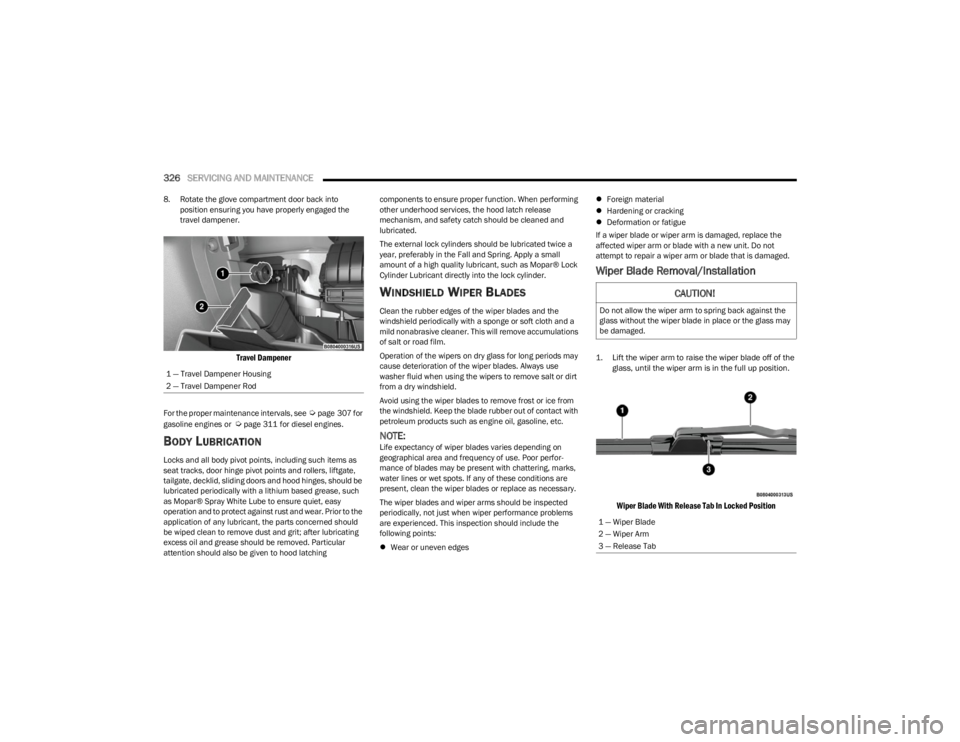
Travel Dampener
For the proper maintenance intervals, see Úpage 307 for
gasoline engines or Úpage 311 for diesel engines.
BODY LUBRICATION
Locks and all body pivot points, including such items as
seat tracks, door hinge pivot points and rollers, liftgate,
tailgate, decklid, sliding doors and hood hinges, should be
lubricated periodically with a lithium based grease, such
as Mopar® Spray White Lube to ensure quiet, easy
operation and to protect against rust and wear. Prior to the
application of any lubricant, the parts concerned should
be wiped clean to remove dust and grit; after lubricating
excess oil and grease should be removed. Particular
attention should also be given to hood latching components to ensure proper function. When performing
other underhood services, the hood latch release
mechanism, and safety catch should be cleaned and
lubricated.
The external lock cylinders should be lubricated twice a
year, preferably in the Fall and Spring. Apply a small
amount of a high quality lubricant, such as Mopar® Lock
Cylinder Lubricant directly into the lock cylinder.
WINDSHIELD WIPER BLADES
Clean the rubber edges of the wiper blades and the
windshield periodically with a sponge or soft cloth and a
mild nonabrasive cleaner. This will remove accumulations
of salt or road film.
Operation of the wipers on dry glass for long periods may
cause deterioration of the wiper blades. Always use
washer fluid when using the wipers to remove salt or dirt
from a dry windshield.
Avoid using the wiper blades to remove frost or ice from
the windshield. Keep the blade rubber out of contact with
petroleum products such as engine oil, gasoline, etc.
NOTE:Life expectancy of wiper blades varies depending on
geographical area and frequency of use. Poor perfor
-
mance of blades may be present with chattering, marks,
water lines or wet spots. If any of these conditions are
present, clean the wiper blades or replace as necessary.
The wiper blades and wiper arms should be inspected
periodically, not just when wiper performance problems
are experienced. This inspection should include the
following points:
Wear or uneven edges
Foreign material
Hardening or cracking
Deformation or fatigue
If a wiper blade or wiper arm is damaged, replace the
affected wiper arm or blade with a new unit. Do not
attempt to repair a wiper arm or blade that is damaged.
Wiper Blade Removal/Installation
1. Lift the wiper arm to raise the wiper blade off of the glass, until the wiper arm is in the full up position.
Wiper Blade With Release Tab In Locked Position
1 — Travel Dampener Housing
2 — Travel Dampener Rod
CAUTION!
Do not allow the wiper arm to spring back against the
glass without the wiper blade in place or the glass may
be damaged.
1 — Wiper Blade
2 — Wiper Arm
3 — Release Tab
23_JL_OM_EN_USC_t.book Page 326
Page 330 of 396

328SERVICING AND MAINTENANCE
(Continued)
(Continued)
Installing The Rear Wiper
1. Lift the wiper arm off of the glass.
2. Insert the wiper blade pivot pin into the opening on
the end of the wiper arm and rotate the wiper in to
place.
3. Place with wiper on the glass and close the tail gate.
EXHAUST SYSTEM
The best protection against carbon monoxide entry into
the vehicle body is a properly maintained engine exhaust
system.
If you notice a change in the sound of the exhaust system;
or if the exhaust fumes can be detected inside the vehicle;
or when the underside or rear of the vehicle is damaged;
have an authorized technician inspect the complete
exhaust system and adjacent body areas for broken,
damaged, deteriorated, or mispositioned parts. Open
seams or loose connections could permit exhaust fumes
to seep into the passenger compartment. In addition, have
the exhaust system inspected each time the vehicle is
raised for lubrication or oil change. Replace as required.
Under normal operating conditions, the catalytic converter
will not require maintenance. However, it is important to
keep the engine properly tuned to ensure proper catalyst
operation and prevent possible catalyst damage.
NOTE:Intentional tampering with emissions control systems can
result in civil penalties being assessed against you.
In unusual situations involving grossly malfunctioning
engine operation, a scorching odor may suggest severe
and abnormal catalyst overheating. If this occurs, stop the
vehicle, turn off the engine and allow it to cool. Service,
including a tune-up to manufacturer's specifications,
should be obtained immediately.
To minimize the possibility of catalytic converter damage:
Do not interrupt the ignition when the transmission is
in gear and the vehicle is in motion.
Do not try to start the vehicle by pushing or towing the
vehicle.
Do not idle the engine with any ignition components
disconnected or removed, such as when diagnostic
testing, or for prolonged periods during very rough idle
or malfunctioning operating conditions.
COOLING SYSTEM
WARNING!
Exhaust gases can injure or kill. They contain Carbon
Monoxide (CO), which is colorless and odorless.
Breathing it can make you unconscious and can
eventually poison you
Úpage 288.
A hot exhaust system can start a fire if you park over
materials that can burn. Such materials might be
grass or leaves coming into contact with your
exhaust system. Do not park or operate your vehicle
in areas where your exhaust system can contact
anything that can burn.
CAUTION!
The catalytic converter requires the use of unleaded
fuel only. Leaded gasoline will destroy the effective -
ness of the catalyst as an emissions control device
and may seriously reduce engine performance and
cause serious damage to the engine.
Damage to the catalytic converter can result if your
vehicle is not kept in proper operating condition. In
the event of engine malfunction, particularly
involving engine misfire or other apparent loss of
performance, have your vehicle serviced promptly.
Continued operation of your vehicle with a severe
malfunction could cause the converter to overheat,
resulting in possible damage to the converter and
vehicle.
WARNING!
WARNING!
You or others can be badly burned by hot engine
coolant (antifreeze) or steam from your radiator. If
you see or hear steam coming from under the hood,
do not open the hood until the radiator has had time
to cool. Never open a cooling system pressure cap
when the radiator or coolant bottle is hot.
Keep hands, tools, clothing, and jewelry away from
the radiator cooling fan when the hood is raised. The
fan starts automatically and may start at any time,
whether the engine is running or not.
23_JL_OM_EN_USC_t.book Page 328
Page 332 of 396

330SERVICING AND MAINTENANCE
NOTE:
It is the owner's responsibility to maintain the proper
level of protection against freezing according to the
temperatures occurring in the area where the vehicle is
operated.
Use care when filling under hood fluids such as engine
oil, washer fluid, antifreeze, etc., to minimize spillage
onto the top of the engine. Any excess fluid that is
spilled onto the top of the engine should be removed
using compressed air or an absorbent cloth.
Some vehicles require special tools to add coolant
properly. Failure to fill these systems properly could
lead to severe internal engine damage. If any coolant is
needed to be added to the system, please contact an
authorized dealer.
Mixing engine coolant types is not recommended and
can result in cooling system damage. If HOAT and OAT
coolant are mixed in an emergency, have an authorized
dealer drain, flush, and refill with OAT coolant
(conforming to MS.90032) as soon as possible.
Cooling System Pressure Cap
The cap must be fully tightened to prevent loss of engine
coolant (antifreeze), and to ensure that engine coolant will
return to the radiator from the coolant expansion bottle/
recovery tank if so equipped.
The cap should be inspected and cleaned if there is any
accumulation of foreign material on the sealing surfaces.
Disposal Of Used Coolant
Used ethylene glycol-based coolant (antifreeze) OAT or
HOAT, is a regulated substance requiring proper disposal.
Check with your local authorities to determine the disposal
rules for your community. To prevent ingestion by animals
or children, do not store ethylene glycol-based coolant in
open containers or allow it to remain in puddles on the
ground, clean up any ground spills immediately. If
ingested, seek emergency assistance immediately.
Coolant Level
The coolant bottle provides a quick visual method for
determining that the coolant level is adequate. With the
engine OFF and cold, the level of the engine coolant
(antifreeze) in the bottle should be between the ranges
indicated on the bottle. The radiator normally remains completely full, so there is
no need to remove the radiator/coolant pressure cap
unless checking for engine coolant freeze point or
replacing coolant. Advise your service attendant of this. As
long as the engine operating temperature is satisfactory,
the coolant bottle need only be checked once a month.
When additional engine coolant is needed to maintain the
proper level, only OAT coolant that meets the
requirements of the manufacturer Material Standard
MS.90032 should be added to the coolant bottle. Do not
overfill.
Engine Coolant Level — 2.0L
WARNING!
Do not open hot engine cooling system. Never add
engine coolant (antifreeze) when the engine is over -
heated. Do not loosen or remove the cap to cool an
overheated engine. Heat causes pressure to build up
in the cooling system. To prevent scalding or injury,
do not remove the pressure cap while the system is
hot or under pressure.
Do not use a pressure cap other than the one speci -
fied for your vehicle. Personal injury or engine
damage may result.
WARNING!
Do not open hot engine cooling system. Never add
engine coolant (antifreeze) when the engine is over -
heated. Do not loosen or remove the cap to cool an
overheated engine. Heat causes pressure to build up
in the cooling system. To prevent scalding or injury,
do not remove the pressure cap while the system is
hot or under pressure.
Do not use a pressure cap other than the one speci -
fied for your vehicle. Personal injury or engine
damage may result.
23_JL_OM_EN_USC_t.book Page 330
Page 334 of 396
332SERVICING AND MAINTENANCE
FRONT/REAR AXLE FLUID
For normal service, periodic fluid level checks are not
required. When the vehicle is serviced for other reasons
the exterior surfaces of the axle assembly should be
inspected. If gear oil leakage is suspected inspect the fluid
level.
Fluid Level Check
Lubricant should be approximately 1/8 inch (3 mm) below
the bottom edge of the oil fill hole.
NOTE:Make sure that the vehicle is level and supported by the
axles.
Adding Fluid
Add lubricant only at the fill hole and only to the level
specified above.
Selection Of Lubricant
Use only manufacturer recommended fluid Úpage 376.
TRANSFER CASE
Fluid Level Check
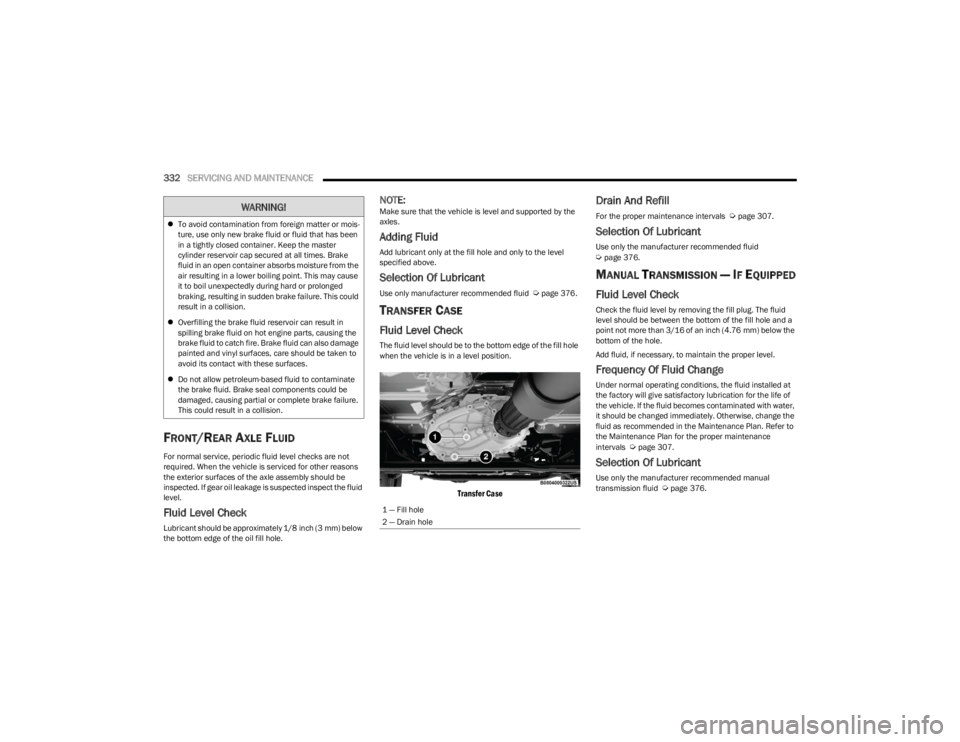
The fluid level should be to the bottom edge of the fill hole
when the vehicle is in a level position.
Transfer Case
Drain And Refill
For the proper maintenance intervals Úpage 307.
Selection Of Lubricant
Use only the manufacturer recommended fluid Úpage 376.
MANUAL TRANSMISSION — IF EQUIPPED
Fluid Level Check
Check the fluid level by removing the fill plug. The fluid
level should be between the bottom of the fill hole and a
point not more than 3/16 of an inch (4.76 mm) below the
bottom of the hole.
Add fluid, if necessary, to maintain the proper level.
Frequency Of Fluid Change
Under normal operating conditions, the fluid installed at
the factory will give satisfactory lubrication for the life of
the vehicle. If the fluid becomes contaminated with water,
it should be changed immediately. Otherwise, change the
fluid as recommended in the Maintenance Plan. Refer to
the Maintenance Plan for the proper maintenance
intervals
Úpage 307.
Selection Of Lubricant
Use only the manufacturer recommended manual
transmission fluid Úpage 376.
To avoid contamination from foreign matter or mois -
ture, use only new brake fluid or fluid that has been
in a tightly closed container. Keep the master
cylinder reservoir cap secured at all times. Brake
fluid in an open container absorbs moisture from the
air resulting in a lower boiling point. This may cause
it to boil unexpectedly during hard or prolonged
braking, resulting in sudden brake failure. This could
result in a collision.
Overfilling the brake fluid reservoir can result in
spilling brake fluid on hot engine parts, causing the
brake fluid to catch fire. Brake fluid can also damage
painted and vinyl surfaces, care should be taken to
avoid its contact with these surfaces.
Do not allow petroleum-based fluid to contaminate
the brake fluid. Brake seal components could be
damaged, causing partial or complete brake failure.
This could result in a collision.
WARNING!
1 — Fill hole
2 — Drain hole
23_JL_OM_EN_USC_t.book Page 332
Page 370 of 396
368
TECHNICAL SPECIFICATIONS
VEHICLE IDENTIFICATION NUMBER (VIN)
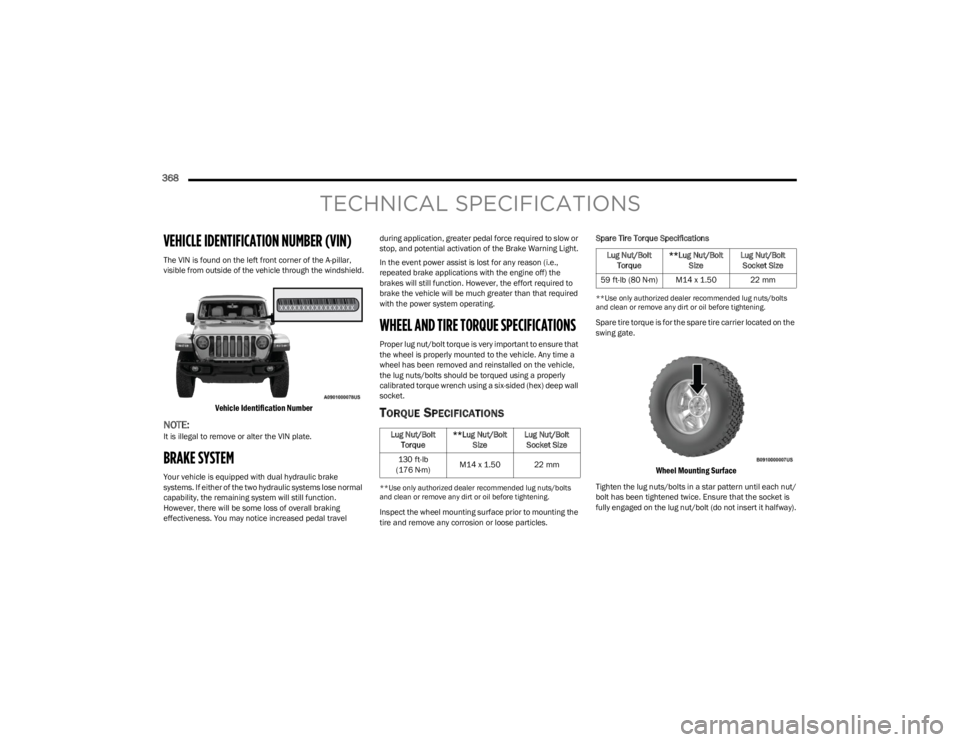
The VIN is found on the left front corner of the A-pillar,
visible from outside of the vehicle through the windshield.
Vehicle Identification Number
NOTE:It is illegal to remove or alter the VIN plate.
BRAKE SYSTEM
Your vehicle is equipped with dual hydraulic brake
systems. If either of the two hydraulic systems lose normal
capability, the remaining system will still function.
However, there will be some loss of overall braking
effectiveness. You may notice increased pedal travel during application, greater pedal force required to slow or
stop, and potential activation of the Brake Warning Light.
In the event power assist is lost for any reason (i.e.,
repeated brake applications with the engine off) the
brakes will still function. However, the effort required to
brake the vehicle will be much greater than that required
with the power system operating.
WHEEL AND TIRE TORQUE SPECIFICATIONS
Proper lug nut/bolt torque is very important to ensure that
the wheel is properly mounted to the vehicle. Any time a
wheel has been removed and reinstalled on the vehicle,
the lug nuts/bolts should be torqued using a properly
calibrated torque wrench using a six-sided (hex) deep wall
socket.
TORQUE SPECIFICATIONS
**Use only authorized dealer recommended lug nuts/bolts
and clean or remove any dirt or oil before tightening.
Inspect the wheel mounting surface prior to mounting the
tire and remove any corrosion or loose particles.Spare Tire Torque Specifications
**Use only authorized dealer recommended lug nuts/bolts
and clean or remove any dirt or oil before tightening.
Spare tire torque is for the spare tire carrier located on the
swing gate.
Wheel Mounting Surface
Tighten the lug nuts/bolts in a star pattern until each nut/
bolt has been tightened twice. Ensure that the socket is
fully engaged on the lug nut/bolt (do not insert it halfway).
Lug Nut/Bolt
Torque **Lug Nut/Bolt
Size Lug Nut/Bolt
Socket Size
130 ft-lb
(176 N·m) M14 x 1.50 22 mm
Lug Nut/Bolt
Torque **Lug Nut/Bolt
Size Lug Nut/Bolt
Socket Size
59 ft-lb (80 N·m) M14 x 1.50 22 mm
23_JL_OM_EN_USC_t.book Page 368
Page 373 of 396

TECHNICAL SPECIFICATIONS371
FUEL REQUIREMENTS – DIESEL ENGINE
Federal law requires that you must fuel this vehicle with
Ultra Low Sulfur Highway Diesel fuel (15 ppm Sulfur
maximum) and prohibits the use of Low Sulfur Highway
Diesel fuel (500 ppm Sulfur maximum) to avoid damage to
the emissions control system.
Use good quality diesel fuel from a reputable supplier in
your vehicle. For most year-round service, No. 2 diesel fuel
meeting ASTM (formerly known as the American Society
for Testing and Materials) specification D-975 Grade S15
will provide good performance. If the vehicle is exposed to
extreme cold (below 20°F or -7°C), or is required to
operate at colder-than-normal conditions for prolonged
periods, use climatized No. 2 diesel fuel or dilute the No.
2 diesel fuel with 50% No. 1 diesel fuel. This will provide
better protection from fuel gelling or wax-plugging of the
fuel filters.
Diesel fuel is seldom completely free of water. To prevent
fuel system trouble, drain the accumulated water from the
fuel/water separator using the fuel/water separator drain
provided on the fuel filter housing. If you buy good quality
fuel and follow the cold weather advice above, fuel
conditioners should not be required in your vehicle. If
available in your area, a high cetane “premium” diesel fuel
may offer improved cold-starting and warm-up
performance.
DIESEL FUEL SPECIFICATIONS
This diesel engine has been developed to take advantage
of the high energy content and generally lower cost No. 2
Ultra Low Sulfur diesel fuel or No. 2 Ultra Low Sulfur
climatized diesel fuels.
NOTE:
If you accidentally fill the fuel tank with gasoline on your
diesel vehicle, do not start the engine. Damage to the
engine and fuel system could occur. Please call an
authorized dealer for service.
A maximum blend of 5% biodiesel meeting ASTM spec -
ification D-975 may be used with your diesel engine
without any adjustments to regular service schedules.
Commercially available fuel additives are not neces -
sary for the proper operation of your diesel engine.
No. 1 Ultra Low Sulfur diesel fuel should only be used
where extended arctic conditions (-10°F or -23°C)
exist.
BIODIESEL FUEL REQUIREMENTS
A maximum blend of 5% biodiesel meeting ASTM
specification D975 is recommended for use with your
diesel engine. If frequent operation with Biodiesel blends
that are between 6% and 20% (B6–B20) is desired, the
maintenance schedule is subject to shorter intervals. The oil and filter change along with fuel filter replacement
is subject to shorter intervals when operating your engine
on biodiesel greater than 5%. Do not use biodiesel greater
than 20%.
For regular use of biodiesel blends between 6% and 20%
(B6–B20) it is important that you understand and comply
with these requirements
Úpage 311.
Biodiesel is a fuel produced from renewable resources
typically derived from animal fat, rapeseed oil (Rapeseed
Methyl Ester (RME) base), or soybean oil (Soy Methyl Ester
(SME or SOME) base).
Biodiesel fuel has inherent limitations which require that
you understand and adhere to the following requirements
if you use blends of Biodiesel between 6% and 20%
(B6–B20). There are no unique restrictions for the use of
B5.
WARNING!
Do not use alcohol or gasoline as a fuel blending agent.
They can be unstable under certain conditions and
hazardous or explosive when mixed with diesel fuel.
CAUTION!
If the Water in Fuel Indicator Light remains on, DO NOT
START engine before you drain the water from the fuel
filter(s) to avoid engine damage
Úpage 321.
CAUTION!
Failure to comply with Oil Change requirements for
vehicles operating on biodiesel blends between 6% and
20% (B6–B20) will result in premature engine wear.
Such wear is not covered by the New Vehicle Limited
Warranty.
CAUTION!
Use of blends greater than 20% is not approved. Use of
blends greater than 20% can result in engine damage.
Such damage is not covered by the New Vehicle Limited
Warranty.
9
23_JL_OM_EN_USC_t.book Page 371
Page 374 of 396

372TECHNICAL SPECIFICATIONS
Biodiesel Fuel Properties — Low Ambient
Temperatures
Biodiesel fuel may gel or solidify at low ambient
temperatures, which may pose problems for both storage
and operation. Precautions can be necessary at low
ambient temperatures, such as storing the fuel in a
heated building or a heated storage tank, or using cold
temperature additives.
Fuel Quality — Must Comply With ASTM
Standards
The quality of Biodiesel fuel may vary widely. Only fuel
produced by a BQ9000 supplier to the following
specifications may be blended to meet Biodiesel blend
B6 – B20 fuel meeting ASTM specification D-7467:
Petrodiesel fuel meeting ASTM specification D-975
and Biodiesel fuel (B100) meeting ASTM specification
D-6751
Fuel Oxidation Stability — Must Use Fuel
Within Six Months Of Manufacture
Biodiesel fuel has poor oxidation stability which can result
in long term storage problems. Fuel produced to approved
ASTM standards, if stored properly, provides for protection
against fuel oxidation for up to six months.
Fuel Water Separation — Must Use
Mopar® Approved Fuel Filter Elements
Biodiesel fuel has a natural affinity to water and water
accelerates microbial growth. Your Mopar® filtration
system is designed to provide adequate fuel water
separation capabilities.
Fuel In Oil Dilution — Must Adhere To
Required Oil Change Interval
Fuel dilution of lubricating oil has been observed with the
use of Biodiesel fuel. Fuel in oil must not exceed 5%. To
ensure this limit is met your oil change interval must be
maintained within the suggested schedule. The regular
use of biodiesel between 6% and 20% requires intervals
shorter than the outlined 10,000 miles (16,000 km) and
must not exceed the suggested schedule. When routinely
operating on biodiesel between 6% and 20%, oil and filter
replacement intervals must not exceed 8,000 miles
(12,875 km) or six months, whichever comes first.
Biodiesel Fuel Filter Change Intervals
The use of biodiesel requires more frequent fuel filter
change intervals. When operating on biodiesel between
6% and 20%, fuel filter replacement intervals should be
every second oil change, and must not exceed
16,000 miles (25,750 km).
NOTE:Under no circumstances should oil change intervals
exceed 8,000 miles (12,875 km) or 6 months, if regular
operation occurs with 6% - 20% biodiesel blends. Under no
circumstances should fuel filter replacement intervals
exceed every second oil change and must not exceed
16,000 miles (25,750 km), if regular operation occurs
with 6% - 20% biodiesel blends. Failure to comply with
these Oil Change and fuel filter requirements for vehicles
operating on biodiesel blends up to B20 may result in
premature engine wear. Such wear is not covered by the
New Vehicle Limited Warranty. The engine may suffer
severe damage if operated with concentrations of
biodiesel higher than 20%.
CAUTION!
In the event that the vehicle is filled with biodiesel and
not used for more than a month, the fuel should either
be used up by driving (up to quarter tank) and filled with
standard diesel blends with less than 5% that is
normally available. This will help prevent the fuel filter
clogging and potential damage to the fuel injection
system due to degraded biodiesel, which is not covered
by the New Vehicle Limited Warranty.
23_JL_OM_EN_USC_t.book Page 372
Page 375 of 396

TECHNICAL SPECIFICATIONS373
FLUID CAPACITIES
USMetric
Fuel (Approximate)
Two Door Models 17.5 gal66 L
Four Door Models 21.5 gal81 L
3.0L Diesel Engine 18.3 gal69 L
Diesel Exhaust Fluid Tank 5.1 gal19.3 L
Engine Oil with Filter
2.0L Engine 5 qt4.73 L
3.6L Engine 5 qt4.73 L
3.0L Diesel Engine 9 qt8.5 L
Cooling System *
2.0L Engine 11.8 qt11.2 L
2.0L Engine Intercooler 3.7 qt3.5 L
3.6L Engine 13.4 qt12.7 L
3.6L Motor Generator Unit (MGU) 2.3 qt2.2 L
3.6L Power Pack Unit (PPU) Coolant 3.1 qt2.9 L
3.0L Diesel Engine 14 qt13.2 L
* Includes coolant recovery bottle filled to MAX level.9
23_JL_OM_EN_USC_t.book Page 373
Page 376 of 396

374TECHNICAL SPECIFICATIONS
ENGINE FLUIDS AND LUBRICANTS
GASOLINE ENGINES
Component Fluid, Lubricant, or Genuine Part
Engine Coolant
We recommend using Mopar® Antifreeze/Coolant 10 Year/150,000 Mile (240,000 km)
Formula OAT (Organic Additive Technology) or equivalent meeting the requirements of the
manufacturer Material Standard MS.90032.
Intercooler We recommend using Mopar® Antifreeze/Coolant 10 Year/150,000 Mile (240,000 km)
Formula OAT (Organic Additive Technology) or equivalent meeting the requirements of the
manufacturer Material Standard MS.90032.
Engine Oil — 2.0L Engine We recommend using Mopar® API SP/GF-6A Certified SAE 5W-30 Full Synthetic Engine
Oil which meets the requirements of the manufacturer Material Standard MS-13340.
Equivalent full synthetic 5W-30 API SP engine oil can be used but must have the API
Donut trademark
Úpage 318.
CAUTION!
Failure to use the recommended API SP/GF-6A or equivalent oil can cause engine
damage not covered by the vehicle warranty.
Engine Oil — 3.6L Engine We recommend using Mopar® SAE 0W-20 Full Synthetic Engine Oil which meets the
requirements of the manufacturer Material Standard MS-6395. Equivalent full synthetic
SAE 0W-20 engine oil can be used but must have the API Starburst trademark
Úpage 318.
Fuel Selection — 2.0L Engine 87 Octane (R+M)/2 Method, 0-15% Ethanol.
Fuel Selection — 3.6L Engine 87 Octane (R+M)/2 Method, 0-15% Ethanol.
23_JL_OM_EN_USC_t.book Page 374