seats JEEP WRANGLER 2023 Owners Manual
[x] Cancel search | Manufacturer: JEEP, Model Year: 2023, Model line: WRANGLER, Model: JEEP WRANGLER 2023Pages: 396, PDF Size: 25.15 MB
Page 4 of 396

2
INTRODUCTION
SYMBOLS KEY ....................................................................... 8
ROLLOVER WARNING ......................................................... 8
VEHICLE MODIFICATIONS/ALTERATIONS ......................... 8
SYMBOL GLOSSARY ............................................................. 9
GETTING TO KNOW YOUR VEHICLE
KEYS ....................................................................................13
Key Fob ........................................................................ 13
SENTRY KEY ........................................................................15
IGNITION SWITCH ...............................................................15 Keyless Enter ‘n Go™ Ignition .................................... 15
REMOTE START — IF EQUIPPED (GASOLINE)..................17 How To Use Remote Start .......................................... 17
To Exit Remote Start Mode ........................................ 18
Remote Start Front Defrost Activation —
If Equipped .................................................................. 18
Remote Start Comfort Systems — If Equipped ......... 18
Remote Start Windshield Wiper De-Icer
Activation — If Equipped ............................................. 18
Remote Start Cancel Message .................................. 18
REMOTE START — IF EQUIPPED (DIESEL) ......................19 How To Use Remote Start .......................................... 19
VEHICLE SECURITY SYSTEM — IF EQUIPPED .................19 To Arm The System .................................................... 20
To Disarm The System ............................................... 20
Rearming Of The System ............................................ 20 DOORS ................................................................................ 20
Manual Door Locks......................................................20
Power Door Locks — If Equipped ............................... 21
Keyless Enter ‘n Go™ — Passive Entry
(If Equipped) ................................................................ 21
Automatic Door Locks — If Equipped ......................... 23
Child-Protection Door Lock System — Rear Doors.....23
Front Door Removal..................................................... 24
Rear Door Removal (Four-Door Models) ................... 27
Door Off Mirror Kit — If Equipped
S
........................ 29
Half-Door Installation — If Equipped
S
................... 31
STEERING WHEEL............................................................... 36 Tilt/Telescoping Steering Column ..............................36
Heated Steering Wheel — If Equipped........................ 37
SEATS .................................................................................. 37 Manual Adjustment Front Seats ................................. 37
60/40 Split Folding Rear Seat —
Four Door Models ........................................................ 39
Fold And Tumble Rear Seat — Two Door Models....... 39
Heated Seats — If Equipped........................................ 41
Rear Seat Armrest — If Equipped ............................... 41
Head Restraints ........................................................... 41
UCONNECT VOICE RECOGNITION ..................................... 44 Introducing Voice Recognition .................................... 44
Basic Voice Commands............................................... 44
Get Started ................................................................... 44
Additional Information................................................. 45
MIRRORS ............................................................................ 45 Inside Rearview Mirror ................................................ 45
Illuminated Vanity Mirrors .......................................... 46
Outside Mirrors ........................................................... 46
Outside Mirrors With Turn Signal — If Equipped ........ 46
Heated Mirrors — If Equipped ..................................... 46
Power Mirrors — If Equipped ....................................... 46 UNIVERSAL GARAGE DOOR OPENER
(HOMELINK®) — IF EQUIPPED
S
.................................. 47
Before You Begin Programming HomeLink® ............ 47
Erasing All The HomeLink® Channels ....................... 47
Identifying Whether You Have A Rolling Code Or
Non-Rolling Code Device............................................. 47
Programming HomeLink® To A Garage Door
Opener ......................................................................... 48
Programming HomeLink® To A Miscellaneous
Device .......................................................................... 48
Reprogramming A Single HomeLink® Button ........... 49
Canadian/Gate Operator Programming .................... 49
Security ........................................................................ 49
Troubleshooting Tips ................................................... 50
EXTERIOR LIGHTS .............................................................. 50 Headlight Switch.......................................................... 50
Daytime Running Lights (DRLs) — If Equipped ......... 51
High/Low Beam Switch............................................... 51
Automatic High Beam Headlamp Control —
If Equipped .................................................................. 51
Flash-To-Pass............................................................... 51
Automatic Headlights — If Equipped ......................... 51
Lights-On Reminder..................................................... 51
Front Fog Lights — If Equipped ................................... 52
Turn Signals ................................................................. 52
Lane Change Assist — If Equipped ............................. 52
INTERIOR LIGHTS .............................................................. 52 Interior Courtesy Lights ............................................... 52
Dimmer Control ........................................................... 53
WINDSHIELD WIPERS AND WASHERS ........................... 53 Windshield Wiper Operation ...................................... 53
Rear Window Wiper/Washer — If Equipped .............. 54
23_JL_OM_EN_USC_t.book Page 2
Page 8 of 396

6
VEHICLE MAINTENANCE ................................................ 318
Engine Oil................................................................... 318
Engine Oil Filter ......................................................... 319
Engine Air Cleaner Filter ........................................... 319
Draining Fuel/Water Separator Filter —
Diesel Engine............................................................. 321Fuel Filter Replacement — Diesel Engine................ 321
Priming If The Engine Has Run Out Of Fuel —
Diesel Engine ............................................................ 323
Intervention Regeneration Strategy —
Message Process Flow ............................................ 323
Diesel Exhaust Fluid ................................................. 323
Accessory Drive Belt Inspection ............................... 324
Air Conditioner Maintenance ................................... 324
Body Lubrication ....................................................... 326Windshield Wiper Blades.......................................... 326
Exhaust System ........................................................ 328
Cooling System.......................................................... 328
Brake System ........................................................... 331
Front/Rear Axle Fluid ............................................... 332Transfer Case ........................................................... 332
Manual Transmission — If Equipped ....................... 332
Automatic Transmission — If Equipped .................. 333Fuses ........................................................................ 333
Bulb Replacement .................................................... 342
TIRES ................................................................................ 345 Tire Safety Information ............................................. 345
Tires — General Information ..................................... 352
Tire Types................................................................... 355
Spare Tires — If Equipped ........................................ 355Wheel And Wheel Trim Care ..................................... 356
Snow Traction Devices ............................................ 357
Tire Rotation Recommendations ............................ 358 DEPARTMENT OF TRANSPORTATION UNIFORM
TIRE QUALITY GRADES .................................................. 358
Treadwear ................................................................. 358Traction Grades ........................................................ 359Temperature Grades ................................................ 359
STORING THE VEHICLE ................................................... 359
BODYWORK ...................................................................... 360 Protection From Atmospheric Agents ...................... 360Body And Underbody Maintenance ......................... 361
Preserving The Bodywork ......................................... 361
INTERIORS ....................................................................... 362 Carpet Safety Information ........................................ 362
Carpet Removal ........................................................ 363Seats And Fabric Parts ............................................. 367
Plastic And Coated Parts .......................................... 367Leather Surfaces ...................................................... 367
Glass Surfaces ......................................................... 367
TECHNICAL SPECIFICATIONS
VEHICLE IDENTIFICATION NUMBER (VIN)..................... 368
BRAKE SYSTEM ............................................................... 368
WHEEL AND TIRE TORQUE SPECIFICATIONS .............. 368 Torque Specifications ............................................... 368
FUEL REQUIREMENTS — GASOLINE ENGINE ............... 369 2.0L Engine ............................................................... 3693.6L Engine ............................................................... 369Reformulated Gasoline ............................................ 369
Materials Added To Fuel .......................................... 369Gasoline/Oxygenate Blends ................................... 370Do Not Use E-85 In Non-Flex Fuel Vehicles ............ 370
CNG And LP Fuel System Modifications.................. 370
MMT In Gasoline ....................................................... 370
Fuel System Cautions ............................................... 370 FUEL REQUIREMENTS – DIESEL ENGINE ..................... 371
Diesel Fuel Specifications ........................................ 371Biodiesel Fuel Requirements ................................... 371
FLUID CAPACITIES ...........................................................373
ENGINE FLUIDS AND LUBRICANTS ................................374
CHASSIS FLUIDS AND LUBRICANTS ............................. 376
CUSTOMER ASSISTANCE
SUGGESTIONS FOR OBTAINING SERVICE FOR
YOUR VEHICLE ................................................................. 377 Prepare For The Appointment .................................. 377
Prepare A List ............................................................ 377Be Reasonable With Requests ................................. 377
IF YOU NEED ASSISTANCE .............................................377 Roadside Assistance ................................................. 377
FCA US LLC Customer Center ................................... 378
FCA Canada Inc. Customer Center........................... 378
Mexico ........................................................................ 378
Puerto Rico And US Virgin Islands............................ 378
Customer Assistance For The Hearing Or
Speech Impaired
(TDD/TTY)................................................................... 379Service Contract ....................................................... 379
WARRANTY INFORMATION.............................................379
MOPAR® PARTS ..............................................................379
REPORTING SAFETY DEFECTS ......................................379 In The 50 United States And Washington, D.C........ 379
In Canada................................................................... 380
PUBLICATION ORDER FORMS .......................................380
CHANGE OF OWNERSHIP OR ADDRESS.......................380
GENERAL INFORMATION................................................. 381
23_JL_OM_EN_USC_t.book Page 6
Page 18 of 396
16GETTING TO KNOW YOUR VEHICLE
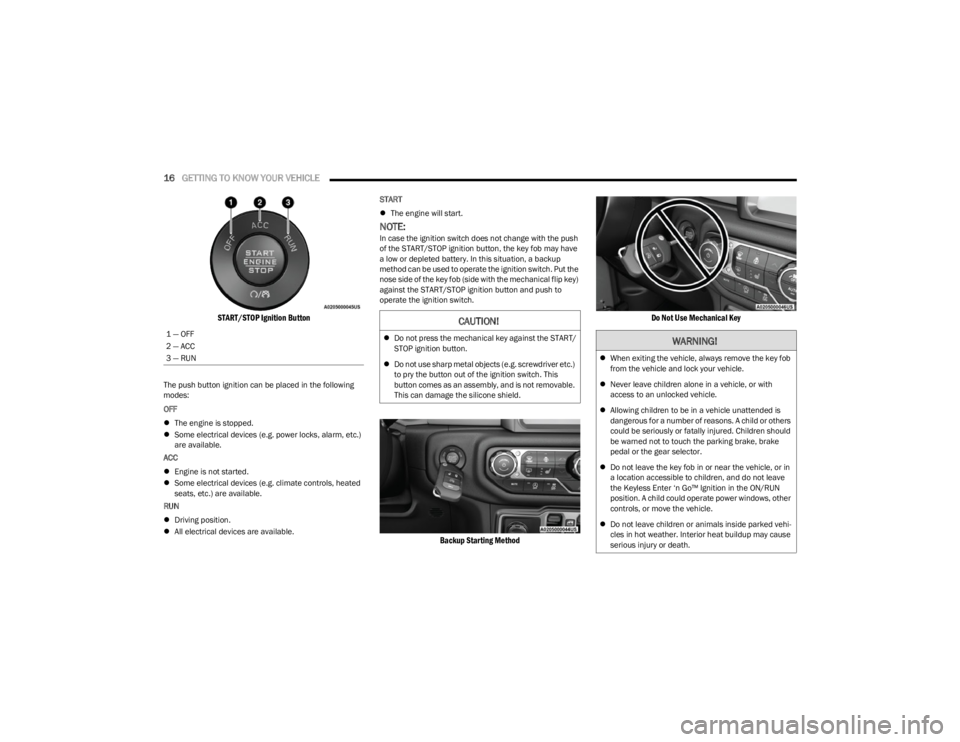
START/STOP Ignition Button
The push button ignition can be placed in the following
modes:
OFF
The engine is stopped.
Some electrical devices (e.g. power locks, alarm, etc.)
are available.
ACC
Engine is not started.
Some electrical devices (e.g. climate controls, heated
seats, etc.) are available.
RUN
Driving position.
All electrical devices are available. START
The engine will start.
NOTE:In case the ignition switch does not change with the push
of the START/STOP ignition button, the key fob may have
a low or depleted battery. In this situation, a backup
method can be used to operate the ignition switch. Put the
nose side of the key fob (side with the mechanical flip key)
against the START/STOP ignition button and push to
operate the ignition switch.
Backup Starting Method Do Not Use Mechanical Key
1 — OFF
2 — ACC
3 — RUNCAUTION!
Do not press the mechanical key against the START/
STOP ignition button.
Do not use sharp metal objects (e.g. screwdriver etc.)
to pry the button out of the ignition switch. This
button comes as an assembly, and is not removable.
This can damage the silicone shield.WARNING!
When exiting the vehicle, always remove the key fob
from the vehicle and lock your vehicle.
Never leave children alone in a vehicle, or with
access to an unlocked vehicle.
Allowing children to be in a vehicle unattended is
dangerous for a number of reasons. A child or others
could be seriously or fatally injured. Children should
be warned not to touch the parking brake, brake
pedal or the gear selector.
Do not leave the key fob in or near the vehicle, or in
a location accessible to children, and do not leave
the Keyless Enter ‘n Go™ Ignition in the ON/RUN
position. A child could operate power windows, other
controls, or move the vehicle.
Do not leave children or animals inside parked vehi -
cles in hot weather. Interior heat buildup may cause
serious injury or death.
23_JL_OM_EN_USC_t.book Page 16
Page 25 of 396
GETTING TO KNOW YOUR VEHICLE23
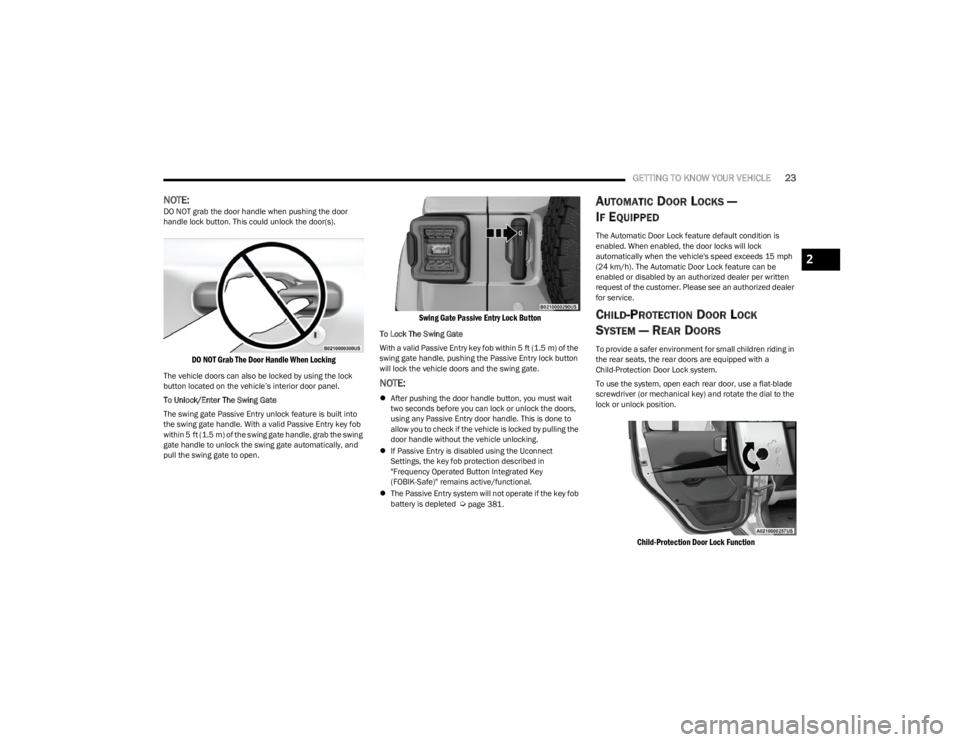
NOTE:DO NOT grab the door handle when pushing the door
handle lock button. This could unlock the door(s).
DO NOT Grab The Door Handle When Locking
The vehicle doors can also be locked by using the lock
button located on the vehicle’s interior door panel.
To Unlock/Enter The Swing Gate
The swing gate Passive Entry unlock feature is built into
the swing gate handle. With a valid Passive Entry key fob
within 5 ft (1.5 m) of the swing gate handle, grab the swing
gate handle to unlock the swing gate automatically, and
pull the swing gate to open.
Swing Gate Passive Entry Lock Button
To Lock The Swing Gate
With a valid Passive Entry key fob within 5 ft (1.5 m) of the
swing gate handle, pushing the Passive Entry lock button
will lock the vehicle doors and the swing gate.
NOTE:
After pushing the door handle button, you must wait
two seconds before you can lock or unlock the doors,
using any Passive Entry door handle. This is done to
allow you to check if the vehicle is locked by pulling the
door handle without the vehicle unlocking.
If Passive Entry is disabled using the Uconnect
Settings, the key fob protection described in
"Frequency Operated Button Integrated Key
(FOBIK-Safe)" remains active/functional.
The Passive Entry system will not operate if the key fob
battery is depleted
Úpage 381.
AUTOMATIC DOOR LOCKS —
I
F EQUIPPED
The Automatic Door Lock feature default condition is
enabled. When enabled, the door locks will lock
automatically when the vehicle's speed exceeds 15 mph
(24 km/h). The Automatic Door Lock feature can be
enabled or disabled by an authorized dealer per written
request of the customer. Please see an authorized dealer
for service.
CHILD-PROTECTION DOOR LOCK
S
YSTEM — REAR DOORS
To provide a safer environment for small children riding in
the rear seats, the rear doors are equipped with a
Child-Protection Door Lock system.
To use the system, open each rear door, use a flat-blade
screwdriver (or mechanical key) and rotate the dial to the
lock or unlock position.
Child-Protection Door Lock Function
2
23_JL_OM_EN_USC_t.book Page 23
Page 27 of 396
GETTING TO KNOW YOUR VEHICLE25
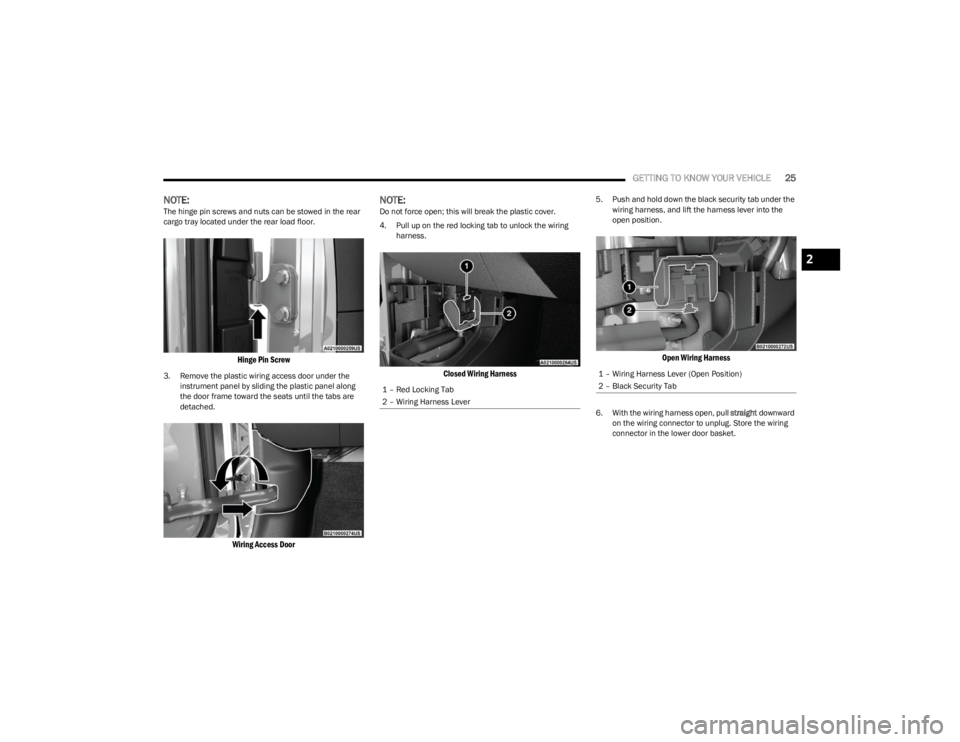
NOTE:The hinge pin screws and nuts can be stowed in the rear
cargo tray located under the rear load floor.
Hinge Pin Screw
3. Remove the plastic wiring access door under the
instrument panel by sliding the plastic panel along
the door frame toward the seats until the tabs are
detached.
Wiring Access Door
NOTE:Do not force open; this will break the plastic cover.
4. Pull up on the red locking tab to unlock the wiring harness.
Closed Wiring Harness
5. Push and hold down the black security tab under the wiring harness, and lift the harness lever into the
open position.
Open Wiring Harness
6. With the wiring harness open, pull straight downward
on the wiring connector to unplug. Store the wiring
connector in the lower door basket.
1 – Red Locking Tab
2 – Wiring Harness Lever
1 – Wiring Harness Lever (Open Position)
2 – Black Security Tab
2
23_JL_OM_EN_USC_t.book Page 25
Page 39 of 396
GETTING TO KNOW YOUR VEHICLE37
(Continued)
HEATED STEERING WHEEL —
I
F EQUIPPED
The steering wheel contains a heating element
that helps warm your hands in cold weather.
The heated steering wheel has only one
temperature setting. Once the heated steering
wheel has been turned on, it will stay on until the operator
turns it off. The heated steering wheel may not turn on
when it is already warm.
The heated steering wheel control button is located within
the Climate or Comfort screen of the touchscreen.
Press the heated steering wheel button once to turn
the heating element on.
Press the heated steering wheel button a second time
to turn the heating element off.
NOTE:The engine must be running for the heated steering wheel
to operate.
For information on use with the Remote Start system, see
Úpage 18.
SEATS
Seats are a part of the Occupant Restraint system of the
vehicle.
MANUAL ADJUSTMENT FRONT SEATS
Manual Front Seat Forward/Rearward
Adjustment
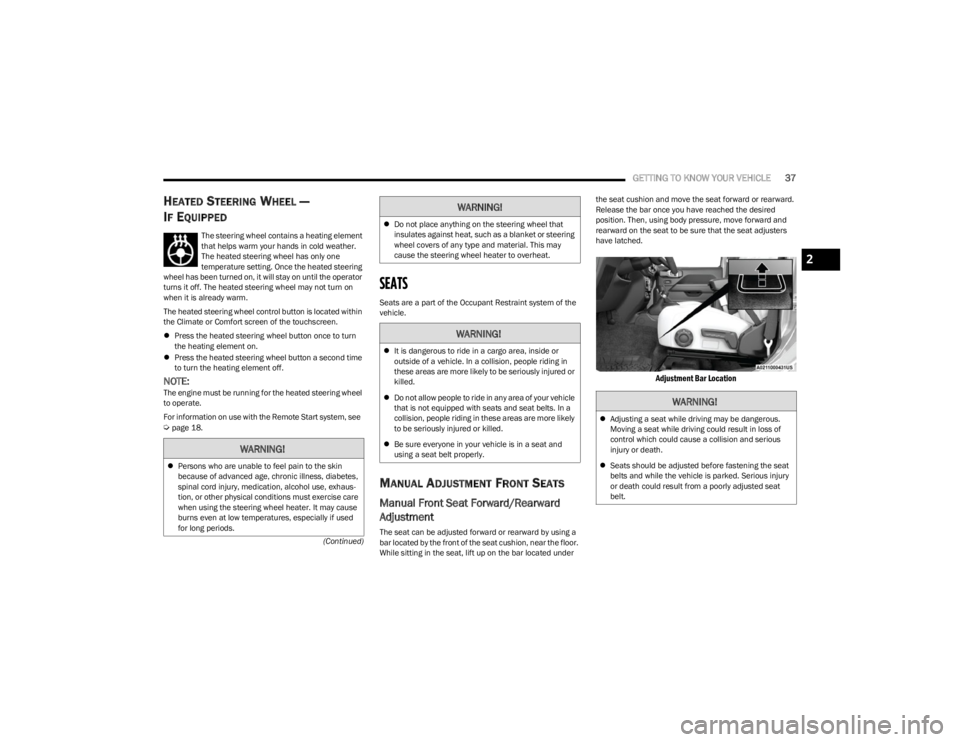
The seat can be adjusted forward or rearward by using a
bar located by the front of the seat cushion, near the floor.
While sitting in the seat, lift up on the bar located under the seat cushion and move the seat forward or rearward.
Release the bar once you have reached the desired
position. Then, using body pressure, move forward and
rearward on the seat to be sure that the seat adjusters
have latched.
Adjustment Bar Location
WARNING!
Persons who are unable to feel pain to the skin
because of advanced age, chronic illness, diabetes,
spinal cord injury, medication, alcohol use, exhaus -
tion, or other physical conditions must exercise care
when using the steering wheel heater. It may cause
burns even at low temperatures, especially if used
for long periods.
Do not place anything on the steering wheel that
insulates against heat, such as a blanket or steering
wheel covers of any type and material. This may
cause the steering wheel heater to overheat.
WARNING!
It is dangerous to ride in a cargo area, inside or
outside of a vehicle. In a collision, people riding in
these areas are more likely to be seriously injured or
killed.
Do not allow people to ride in any area of your vehicle
that is not equipped with seats and seat belts. In a
collision, people riding in these areas are more likely
to be seriously injured or killed.
Be sure everyone in your vehicle is in a seat and
using a seat belt properly.
WARNING!
WARNING!
Adjusting a seat while driving may be dangerous.
Moving a seat while driving could result in loss of
control which could cause a collision and serious
injury or death.
Seats should be adjusted before fastening the seat
belts and while the vehicle is parked. Serious injury
or death could result from a poorly adjusted seat
belt.
2
23_JL_OM_EN_USC_t.book Page 37
Page 41 of 396
GETTING TO KNOW YOUR VEHICLE39
(Continued)
To return the seat to a sitting position, fold the seatback
upright until it locks and push the seat rearward until the
track locks.
NOTE:
The front passenger seats have a track memory, which
returns the seat to its original position.
The recline strap and easy entry lever should not be
used during the automatic returning of the seat to its
sitting position.
60/40 SPLIT FOLDING REAR SEAT —
F
OUR DOOR MODELS
To provide additional storage area, each rear seat can be
folded flat to allow for extended cargo space.
NOTE:
Be sure that the front seats are fully upright and posi -
tioned forward. This will allow the rear seat to fold down
easily.
The center head restraints must be in the lowest posi-
tion to avoid contact with the center console when
folding the seat.
To Fold Down The Rear Seat
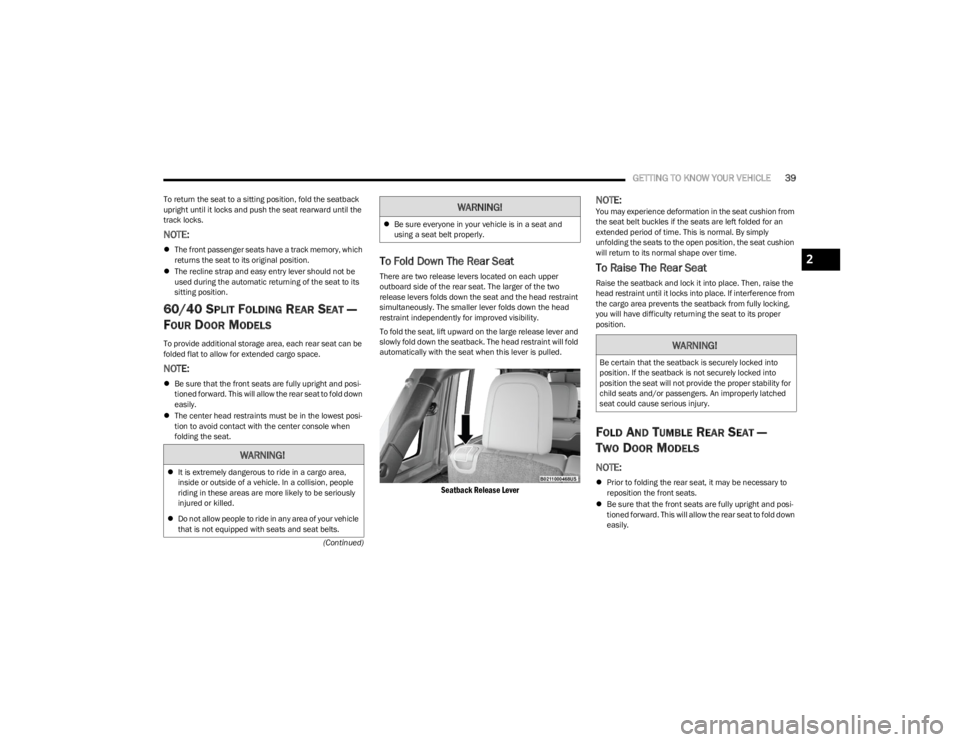
There are two release levers located on each upper
outboard side of the rear seat. The larger of the two
release levers folds down the seat and the head restraint
simultaneously. The smaller lever folds down the head
restraint independently for improved visibility.
To fold the seat, lift upward on the large release lever and
slowly fold down the seatback. The head restraint will fold
automatically with the seat when this lever is pulled.
Seatback Release Lever
NOTE:You may experience deformation in the seat cushion from
the seat belt buckles if the seats are left folded for an
extended period of time. This is normal. By simply
unfolding the seats to the open position, the seat cushion
will return to its normal shape over time.
To Raise The Rear Seat
Raise the seatback and lock it into place. Then, raise the
head restraint until it locks into place. If interference from
the cargo area prevents the seatback from fully locking,
you will have difficulty returning the seat to its proper
position.
FOLD AND TUMBLE REAR SEAT —
T
WO DOOR MODELS
NOTE:
Prior to folding the rear seat, it may be necessary to
reposition the front seats.
Be sure that the front seats are fully upright and posi -
tioned forward. This will allow the rear seat to fold down
easily.
WARNING!
It is extremely dangerous to ride in a cargo area,
inside or outside of a vehicle. In a collision, people
riding in these areas are more likely to be seriously
injured or killed.
Do not allow people to ride in any area of your vehicle
that is not equipped with seats and seat belts.
Be sure everyone in your vehicle is in a seat and
using a seat belt properly.
WARNING!
WARNING!
Be certain that the seatback is securely locked into
position. If the seatback is not securely locked into
position the seat will not provide the proper stability for
child seats and/or passengers. An improperly latched
seat could cause serious injury.
2
23_JL_OM_EN_USC_t.book Page 39
Page 42 of 396
40GETTING TO KNOW YOUR VEHICLE
Folding The Rear Seat
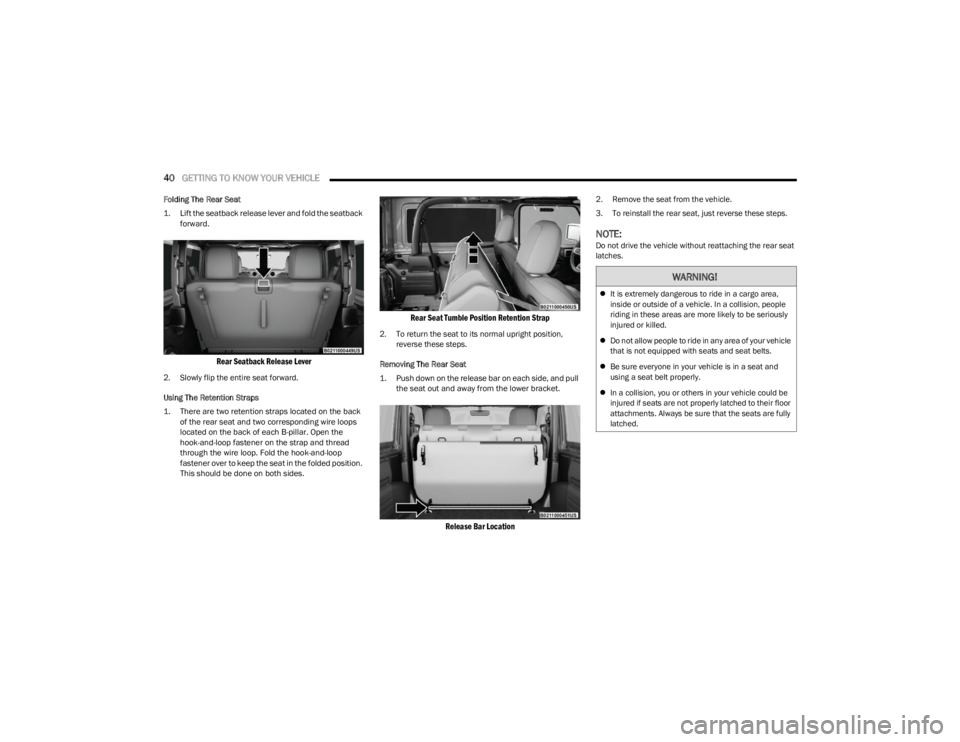
1. Lift the seatback release lever and fold the seatback
forward.
Rear Seatback Release Lever
2. Slowly flip the entire seat forward.
Using The Retention Straps
1. There are two retention straps located on the back of the rear seat and two corresponding wire loops
located on the back of each B-pillar. Open the
hook-and-loop fastener on the strap and thread
through the wire loop. Fold the hook-and-loop
fastener over to keep the seat in the folded position.
This should be done on both sides.
Rear Seat Tumble Position Retention Strap
2. To return the seat to its normal upright position, reverse these steps.
Removing The Rear Seat
1. Push down on the release bar on each side, and pull the seat out and away from the lower bracket.
Release Bar Location
2. Remove the seat from the vehicle.
3. To reinstall the rear seat, just reverse these steps.
NOTE:Do not drive the vehicle without reattaching the rear seat
latches.
WARNING!
It is extremely dangerous to ride in a cargo area,
inside or outside of a vehicle. In a collision, people
riding in these areas are more likely to be seriously
injured or killed.
Do not allow people to ride in any area of your vehicle
that is not equipped with seats and seat belts.
Be sure everyone in your vehicle is in a seat and
using a seat belt properly.
In a collision, you or others in your vehicle could be
injured if seats are not properly latched to their floor
attachments. Always be sure that the seats are fully
latched.
23_JL_OM_EN_USC_t.book Page 40
Page 43 of 396
GETTING TO KNOW YOUR VEHICLE41
(Continued)
HEATED SEATS — IF EQUIPPED
The heated seat control buttons are located on
the center instrument panel below the
touchscreen and also in the Climate Control
touchscreen menu.
Press the heated seat button once to turn the HI setting
on.
Press the heated seat button a second time to turn the
MED setting on.
Press the heated seat button a third time to turn the LO
setting on.
Press the heated seat button a fourth time to turn the
heating elements off.
NOTE:
The engine must be running for the heated seats to
operate.
The level of heat selected will stay on until the operator
changes it.
For information on use with the Remote Start system, see
Úpage 18.
REAR SEAT ARMREST — IF EQUIPPED
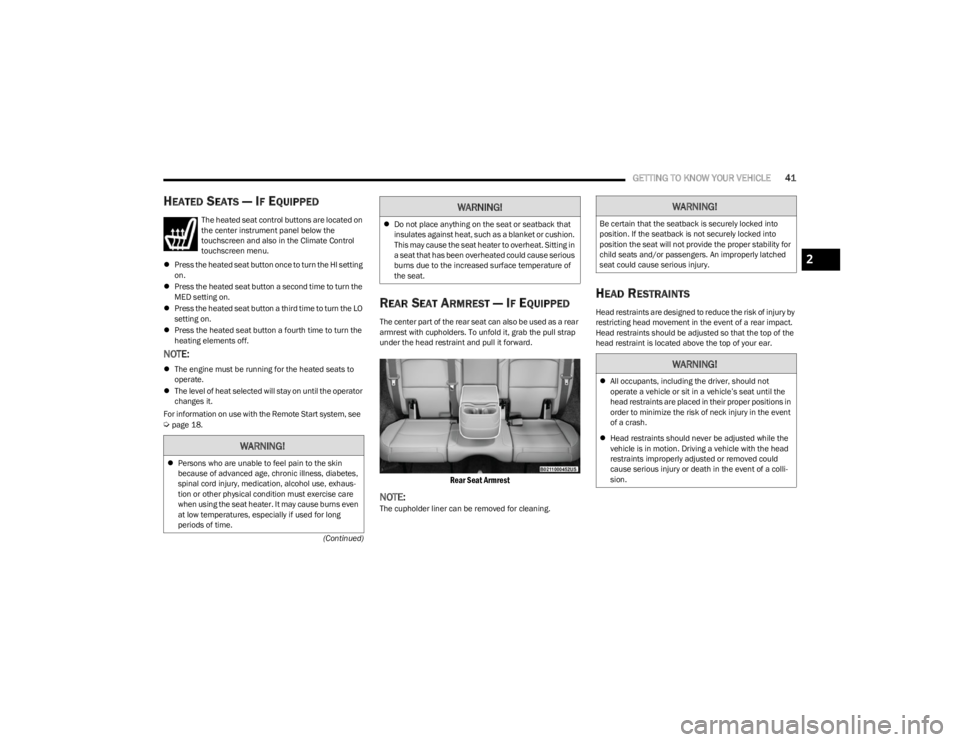
The center part of the rear seat can also be used as a rear
armrest with cupholders. To unfold it, grab the pull strap
under the head restraint and pull it forward.
Rear Seat Armrest
NOTE:The cupholder liner can be removed for cleaning.
HEAD RESTRAINTS
Head restraints are designed to reduce the risk of injury by
restricting head movement in the event of a rear impact.
Head restraints should be adjusted so that the top of the
head restraint is located above the top of your ear.
WARNING!
Persons who are unable to feel pain to the skin
because of advanced age, chronic illness, diabetes,
spinal cord injury, medication, alcohol use, exhaus -
tion or other physical condition must exercise care
when using the seat heater. It may cause burns even
at low temperatures, especially if used for long
periods of time.
Do not place anything on the seat or seatback that
insulates against heat, such as a blanket or cushion.
This may cause the seat heater to overheat. Sitting in
a seat that has been overheated could cause serious
burns due to the increased surface temperature of
the seat.
WARNING!WARNING!
Be certain that the seatback is securely locked into
position. If the seatback is not securely locked into
position the seat will not provide the proper stability for
child seats and/or passengers. An improperly latched
seat could cause serious injury.
WARNING!
All occupants, including the driver, should not
operate a vehicle or sit in a vehicle’s seat until the
head restraints are placed in their proper positions in
order to minimize the risk of neck injury in the event
of a crash.
Head restraints should never be adjusted while the
vehicle is in motion. Driving a vehicle with the head
restraints improperly adjusted or removed could
cause serious injury or death in the event of a colli -
sion.
2
23_JL_OM_EN_USC_t.book Page 41
Page 61 of 396

GETTING TO KNOW YOUR VEHICLE59
AUTOMATIC TEMPERATURE CONTROL
(ATC) — I
F EQUIPPED
Automatic Operation
1. Push the AUTO button on the faceplate, or the AUTO
button on the touchscreen on the Automatic
Temperature Control (ATC) Panel.
2. Next, adjust the temperature that you would like the system to maintain by adjusting the driver and
passenger temperature control buttons. Once the
desired temperature is displayed, the system will
achieve and automatically maintain that comfort
level.
3. When the system is set up for your comfort level, it is not necessary to change the settings. You will
experience the greatest efficiency by simply allowing
the system to function automatically.
NOTE:
It is not necessary to move the temperature settings for
cold or hot vehicles. The system automatically adjusts
the temperature, mode, and blower speed to provide
comfort as quickly as possible.
The temperature can be displayed in US or Metric units
by selecting the US/Metric customer-programmable
feature within Uconnect Settings
Úpage 184.
To provide you with maximum comfort in the Automatic
mode during cold start-ups, the blower fan will remain on
low until the engine warms up. The blower will increase in
speed and transition into Auto mode.
Manual Operation Override
This system offers a full complement of manual override
features. The AUTO symbol in the front ATC display will be
turned off when the system is being used in the manual
mode.
CLIMATE VOICE COMMANDS
Adjust vehicle temperatures hands-free and keep
everyone comfortable while you keep moving ahead.
Push the VR button on the steering wheel. After the beep,
say one of the following commands:
“Set the driver temperature to 70 degrees ”
“Set the passenger temperature to 70 degrees ”
Did You Know: Voice Command for Climate may only be
used to adjust the interior temperature of your vehicle.
Voice Command will not work to adjust the heated seats
or steering wheel if equipped.
OPERATING TIPS
Refer to the chart at the end of this section for suggested
control settings for various weather conditions.
Summer Operation
The engine cooling system must be protected with a
high-quality antifreeze coolant to provide proper corrosion
protection and to protect against engine overheating. OAT
coolant (conforming to MS.90032) is recommended.
Winter Operation
To ensure the best possible heater and defroster
performance, make sure the engine cooling system is
functioning properly and the proper amount, type, and concentration of coolant is used. Use of the Air
Recirculation mode during Winter months is not
recommended, because it may cause window fogging.
Vacation/Storage
For information on maintaining the Climate Control system
when the vehicle is being stored for an extended period of
time, see
Úpage 359.
Window Fogging
Vehicle windows tend to fog on the inside in mild, rainy,
and/or humid weather. To clear the windows, select
Defrost or Mix mode and increase the front blower speed.
Do not use the Recirculation mode without A/C for long
periods, as fogging may occur.
Outside Air Intake
Make sure the air intake, located directly in front of the
windshield, is free of obstructions, such as leaves. Leaves
collected in the air intake may reduce airflow, and if they
enter the plenum, they could plug the water drains. In
Winter months, make sure the air intake is clear of ice,
slush, and snow.
Cabin Air Filter
The Climate Control system filters out dust and pollen
from the air. Contact an authorized dealer to service your
cabin air filter, and to have it replaced when needed.
Stop/Start System — If Equipped
While in an Autostop, the Climate Control system may
automatically adjust airflow to maintain cabin comfort.
Customer settings will be maintained upon return to an
engine running condition.
2
23_JL_OM_EN_USC_t.book Page 59