battery JEEP WRANGLER 2023 Service Manual
[x] Cancel search | Manufacturer: JEEP, Model Year: 2023, Model line: WRANGLER, Model: JEEP WRANGLER 2023Pages: 396, PDF Size: 25.15 MB
Page 302 of 396

300IN CASE OF EMERGENCY
5. Start the engine in the vehicle that has the booster
battery, let the engine idle a few minutes, and then
start the engine in the vehicle with the discharged
battery.
6. Once the engine is started, remove the jumper cables in the reverse sequence.
Disconnecting The Jumper Cables
1. Disconnect the negative
(-)
end of the jumper cable
from the engine ground of the vehicle with the
discharged battery.
2. Disconnect the opposite end of the negative (-)
jumper cable from the negative (-) post of the booster
battery.
3. Disconnect the positive (+) end of the jumper cable
from the positive (+) post of the booster battery. 4. Disconnect the opposite end of the positive
(+)
jumper cable from the positive (+) post of the
discharged vehicle.
5. Reinstall the protective cover over the positive (+)
post of the discharged vehicle.
NOTE:If frequent jump starting is required to start your vehicle
you should have the battery and charging system tested at
an authorized dealer.
IF YOUR ENGINE OVERHEATS
If the vehicle is overheating, it will need to be serviced by
an authorized dealer.
Potential signs of vehicle overheating:
Temperature gauge is at HOT (H)
Strong smell of coolant
White smoke coming from engine or exhaust
Coolant bottle coolant has bubbles present In the event it is observed that the temperature gauge is
moving towards or close to the HOT (H) position, you can
reduce the potential for overheating by taking the
appropriate action.
On the highways — slow down.
In city traffic — while stopped, place the transmission in
NEUTRAL (N), but do not increase the engine idle speed
while preventing vehicle motion with the brakes.
If your Air Conditioner (A/C) is on, turn it off. The A/C
system adds heat to the engine cooling system and
turning the A/C off can help remove this heat.
You can also turn the temperature control to maximum
heat, the mode control to floor and the blower control
to high. This allows the heater core to act as a supple -
ment to the radiator and aids in removing heat from the
engine cooling system.
CAUTION!
Make sure at all times that unused ends of jumper
cables are not contacting each other or either vehicle
while making connections. Failure to follow these
procedures could result in damage to the charging
system of the booster vehicle or the discharged vehicle.
CAUTION!
Do not run the booster vehicle engine above 2,000 RPM
since it provides no charging benefit, wastes fuel, and
can damage booster vehicle engine.
CAUTION!
Accessories plugged into the vehicle power outlets draw
power from the vehicle’s battery, even when not in use
(i.e., cellular devices, etc.). Eventually, if plugged in long
enough without engine operation, the vehicle’s battery
will discharge sufficiently to degrade battery life and/or
prevent the engine from starting.
WARNING!
You or others can be badly burned by hot engine
coolant (antifreeze) or steam from your radiator. If you
see or hear steam coming from under the hood, do not
open the hood until the radiator has had time to cool.
Never try to open a cooling system pressure cap when
the radiator or coolant bottle is hot.
23_JL_OM_EN_USC_t.book Page 300
Page 303 of 396
IN CASE OF EMERGENCY301
MANUAL PARK RELEASE
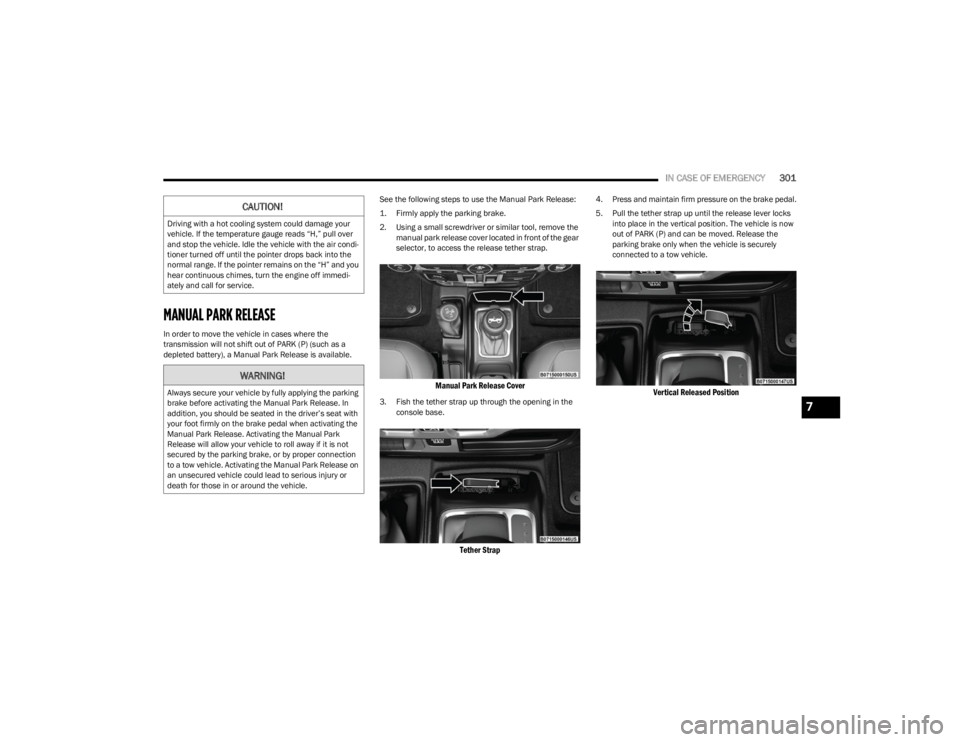
In order to move the vehicle in cases where the
transmission will not shift out of PARK (P) (such as a
depleted battery), a Manual Park Release is available. See the following steps to use the Manual Park Release:
1. Firmly apply the parking brake.
2. Using a small screwdriver or similar tool, remove the
manual park release cover located in front of the gear
selector, to access the release tether strap.
Manual Park Release Cover
3. Fish the tether strap up through the opening in the console base.
Tether Strap
4. Press and maintain firm pressure on the brake pedal.
5. Pull the tether strap up until the release lever locks into place in the vertical position. The vehicle is now
out of PARK (P) and can be moved. Release the
parking brake only when the vehicle is securely
connected to a tow vehicle.
Vertical Released Position
CAUTION!
Driving with a hot cooling system could damage your
vehicle. If the temperature gauge reads “H,” pull over
and stop the vehicle. Idle the vehicle with the air condi -
tioner turned off until the pointer drops back into the
normal range. If the pointer remains on the “H” and you
hear continuous chimes, turn the engine off immedi -
ately and call for service.
WARNING!
Always secure your vehicle by fully applying the parking
brake before activating the Manual Park Release. In
addition, you should be seated in the driver’s seat with
your foot firmly on the brake pedal when activating the
Manual Park Release. Activating the Manual Park
Release will allow your vehicle to roll away if it is not
secured by the parking brake, or by proper connection
to a tow vehicle. Activating the Manual Park Release on
an unsecured vehicle could lead to serious injury or
death for those in or around the vehicle.
7
23_JL_OM_EN_USC_t.book Page 301
Page 305 of 396

IN CASE OF EMERGENCY303
TOWING A DISABLED VEHICLE
This section describes procedures for towing a disabled vehicle using a commercial towing service.
If the transmission and drivetrain are operable, disabled 4x4 vehicles may also be towed as described
Úpage 176.
Proper towing or lifting equipment is required to prevent
damage to your vehicle. Use only tow bars and other
equipment designed for this purpose, following equipment
manufacturer’s instructions. Use of safety chains is
mandatory. Attach a tow bar or other towing device to
main structural members of the vehicle, not to fascia/
bumpers or associated brackets. State and local laws
regarding vehicles under tow must be observed.
If you must use the accessories (wipers, defrosters, etc.)
while being towed, the ignition must be in the ON/RUN
position, not the ACC position.
If the vehicle's battery is discharged, instructions on
shifting the automatic transmission out of PARK (P) in
order to move the vehicle
Úpage 301.
FOUR–WHEEL DRIVE MODELS
FCA US LLC recommends towing with all wheels OFF the
ground. Acceptable methods are to tow the vehicle on a
flatbed or with one end of the vehicle raised and the
opposite end on a towing dolly.
If flatbed equipment is not available and the transfer case
is operable, the vehicle may be towed (in the forward
direction, with ALL wheels on the ground), IF the transfer
case is in NEUTRAL (N) and the transmission is in PARK (P)
(for automatic transmissions) or in gear NOT in NEUTRAL ,
for manual transmissions)
Úpage 176.
Towing Condition
Wheels OFF The Ground 4WD MODELS
Flat Tow NONE
Automatic Transmission in PARK (P)
Manual Transmission in gear ( NOT in NEUTRAL)
Transfer Case in NEUTRAL (N)
Tow in Forward direction
Wheel Lift Or Dolly Tow Front
NOT ALLOWED
Rear NOT ALLOWED
Flatbed ALLBEST METHOD
NOTE:When towing your vehicle, always follow applicable state and provincial laws. Contact state and provincial Highway Safety offices for additional details.
CAUTION!
Do not use sling type equipment when towing.
Vehicle damage may occur.
When securing the vehicle to a flatbed truck, do not
attach to front or rear suspension components.
Damage to your vehicle may result from improper
towing.
If the vehicle being towed requires steering, the igni -
tion switch must be in the ACC or ON/RUN mode, not
in the OFF mode.
7
23_JL_OM_EN_USC_t.book Page 303
Page 309 of 396

SERVICING AND MAINTENANCE307
MAINTENANCE PLAN
Refer to the maintenance plan for the required maintenance intervals.
NOTE:Using white lithium grease, lubricate the door hinge joints twice a year to prevent premature wear.
At Every Oil Change Interval As Indicated By Oil Change Indicator System
Change oil and filter.
Rotate the tires. Rotate at the first sign of irregular wear, even if it occurs before the oil indicator system turns on.
Inspect battery and clean and tighten terminals as required.
Inspect the CV/Universal joints.
Inspect brake pads, shoes, rotors, drums, hoses and parking brake.
Inspect engine cooling system protection and hoses.
Inspect exhaust system.
Inspect engine air cleaner filter if using in dusty or off-road conditions; replace engine air cleaner filter if necessary.
Inspect all door latches for presence of grease; reapply if necessary.
8
23_JL_OM_EN_USC_t.book Page 307
Page 313 of 396

SERVICING AND MAINTENANCE311
MAINTENANCE PLAN — DIESEL FUEL UP TO B5 BIODIESEL
Refer to the maintenance plan for the required maintenance intervals.
At Every Oil Change Interval As Indicated By Oil Change Indicator System
Change oil and filter.
Completely fill the Diesel Exhaust Fluid tank.
Drain water from fuel filter assembly.
Rotate the tires. Rotate at the first sign of irregular wear, even if it occurs before the oil indicator system turns on.
Inspect battery and clean and tighten terminals as required.
Inspect the CV/Universal joints.
Inspect brake pads, shoes, rotors, drums, hoses and parking brake.
Inspect engine cooling system protection and hoses.
Inspect exhaust system.
Inspect engine air cleaner filter if using in dusty or off-road conditions; replace engine air cleaner filter if necessary.
At Every Second Oil Change Interval As Indicated By Oil Change Indicator System
Change fuel filter.8
23_JL_OM_EN_USC_t.book Page 311
Page 316 of 396
314SERVICING AND MAINTENANCE
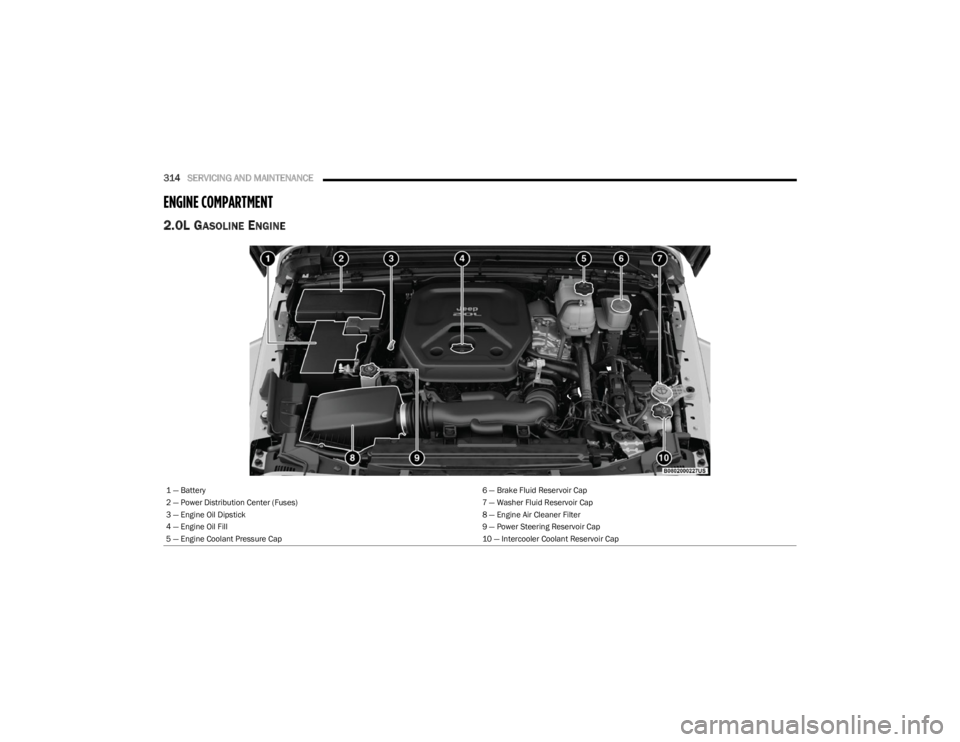
ENGINE COMPARTMENT
2.0L GASOLINE ENGINE
1 — Battery 6 — Brake Fluid Reservoir Cap
2 — Power Distribution Center (Fuses) 7 — Washer Fluid Reservoir Cap
3 — Engine Oil Dipstick 8 — Engine Air Cleaner Filter
4 — Engine Oil Fill 9 — Power Steering Reservoir Cap
5 — Engine Coolant Pressure Cap 10 — Intercooler Coolant Reservoir Cap
23_JL_OM_EN_USC_t.book Page 314
Page 317 of 396
SERVICING AND MAINTENANCE315
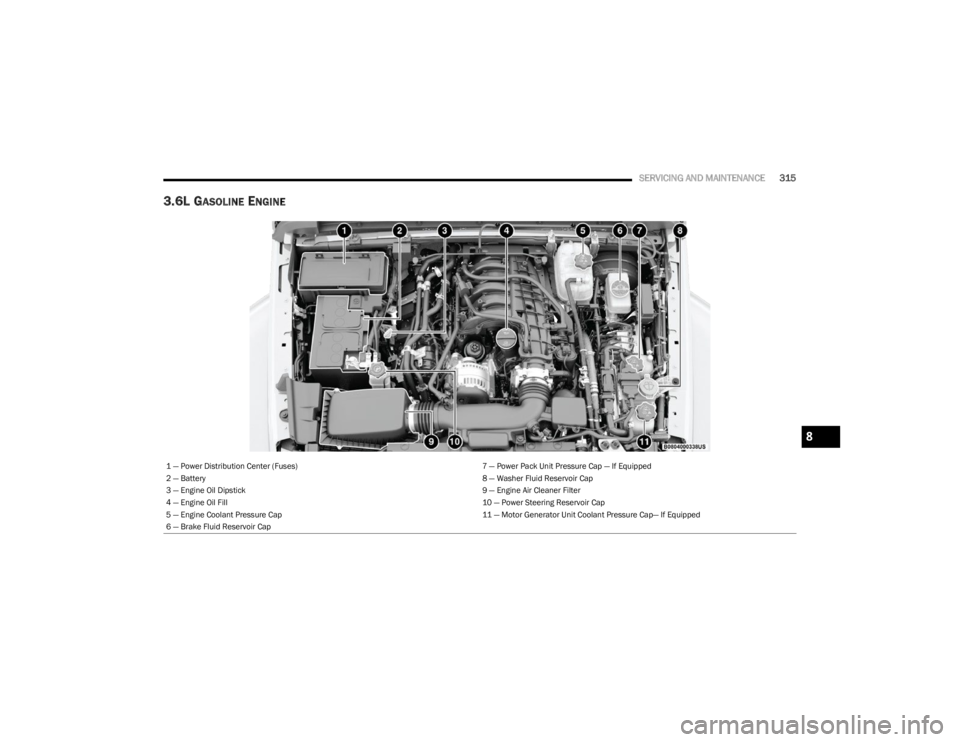
3.6L GASOLINE ENGINE
1 — Power Distribution Center (Fuses) 7 — Power Pack Unit Pressure Cap — If Equipped
2 — Battery 8 — Washer Fluid Reservoir Cap
3 — Engine Oil Dipstick 9 — Engine Air Cleaner Filter
4 — Engine Oil Fill 10 — Power Steering Reservoir Cap
5 — Engine Coolant Pressure Cap 11 — Motor Generator Unit Coolant Pressure Cap— If Equipped
6 — Brake Fluid Reservoir Cap
8
23_JL_OM_EN_USC_t.book Page 315
Page 318 of 396
316SERVICING AND MAINTENANCE
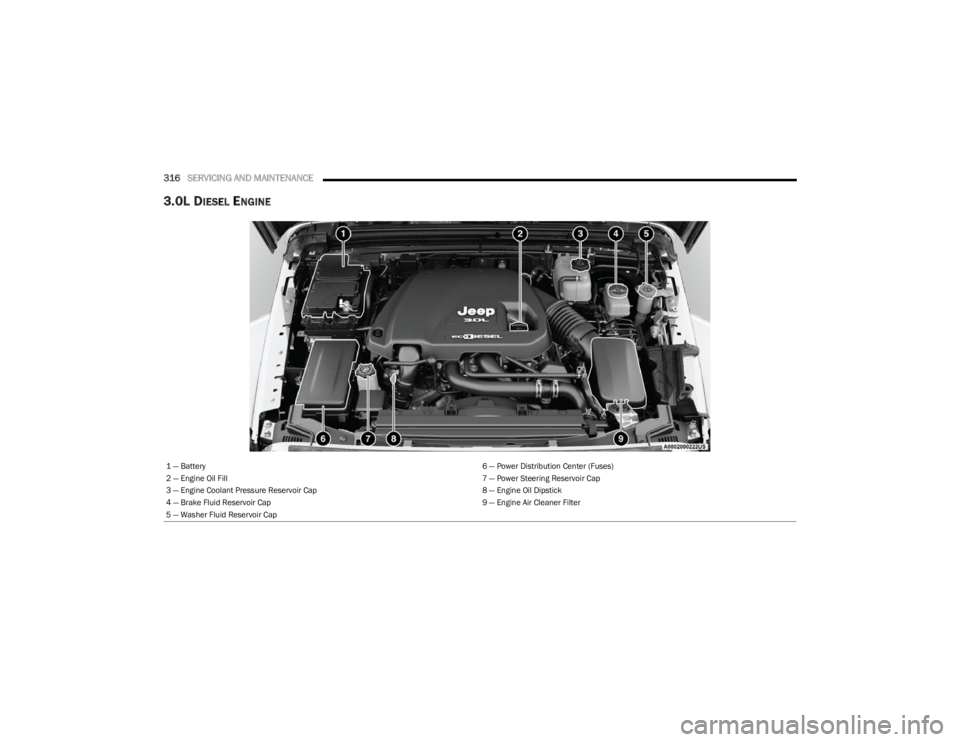
3.0L DIESEL ENGINE
1 — Battery 6 — Power Distribution Center (Fuses)
2 — Engine Oil Fill 7 — Power Steering Reservoir Cap
3 — Engine Coolant Pressure Reservoir Cap 8 — Engine Oil Dipstick
4 — Brake Fluid Reservoir Cap 9 — Engine Air Cleaner Filter
5 — Washer Fluid Reservoir Cap
23_JL_OM_EN_USC_t.book Page 316
Page 319 of 396

SERVICING AND MAINTENANCE317
CHECKING OIL LEVEL
To ensure proper engine lubrication, the engine oil must
be maintained at the correct level. Check the oil level at
regular intervals, such as every fuel stop. The best time to
check the engine oil level is about five minutes after a fully
warmed up engine is shut off.
Checking the oil while the vehicle is on level ground will
improve the accuracy of the oil level readings.
There are four possible dipstick types:
Crosshatched zone.
Crosshatched zone marked SAFE.
Crosshatched zone marked with MIN at the low end of
the range and MAX at the high end of the range.
Crosshatched zone marked with dimples at the MIN
and the MAX ends of the range.
NOTE:Always maintain the oil level within the crosshatch
markings on the dipstick.
NOTE:Use care when filling under hood fluids such as engine oil,
washer fluid, antifreeze, etc., to minimize spillage onto the
top of the engine. Any excess fluid that is spilled onto the
top of the engine should be removed using compressed
air or an absorbent cloth.
Adding 1 qt (1 L) of oil when the reading is at the low end
of the dipstick range will raise the oil level to the high end
of the range marking.
ADDING WASHER FLUID
The fluid reservoir for the windshield washers and the rear
window washer (if equipped) is shared. The fluid reservoir
is located in the engine compartment. Be sure to check
the fluid level at regular intervals. Fill the reservoir with
windshield washer solvent only (not radiator antifreeze).
When refilling the washer fluid reservoir, take some
washer fluid and apply it to a cloth or towel and wipe clean
the wiper blades; this will help blade performance.
To prevent freeze-up of your windshield washer system in
cold weather, select a solution or mixture that meets or
exceeds the temperature range of your climate. This rating
information can be found on most washer fluid containers.
NOTE:Use care when filling under hood fluids such as engine oil,
washer fluid, antifreeze, etc., to minimize spillage onto the
top of the engine. Any excess fluid that is spilled onto the
top of the engine should be removed using compressed
air or an absorbent cloth.
MAINTENANCE-FREE BATTERY
Your vehicle is equipped with a maintenance-free battery.
You will never have to add water, and periodic
maintenance is not required.
CAUTION!
Overfilling or underfilling the crankcase will cause
aeration or loss of oil pressure. This could damage your
engine.
WARNING!
Commercial windshield washer solvents are flammable.
They could ignite and burn you. Care must be exercised
when filling or working around the washer solution.
WARNING!
Battery fluid is a corrosive acid solution and can burn
or even blind you. Do not allow battery fluid to
contact your eyes, skin, or clothing. Do not lean over
a battery when attaching clamps. If acid splashes in
eyes or on skin, flush the area immediately with large
amounts of water
Úpage 298.
Battery gas is flammable and explosive. Keep flame
or sparks away from the battery. Do not use a
booster battery or any other booster source with an
output greater than 12 Volts. Do not allow cable
clamps to touch each other.
Battery posts, terminals, and related accessories
contain lead and lead compounds. Wash hands after
handling.
Vehicles with the Stop/Start system will be equipped
with two batteries. Both the main and the supple -
mental batteries must be disconnected to
completely de-energize the 12 Volt electrical system.
Serious injury or death could result if you do not
disconnect both batteries. To learn how to properly
disconnect, see an authorized dealer.
8
23_JL_OM_EN_USC_t.book Page 317
Page 320 of 396
318SERVICING AND MAINTENANCE
PRESSURE WASHING
Cleaning the engine compartment with a high pressure
washer is not recommended.
VEHICLE MAINTENANCE
An authorized dealer has the qualified service personnel,
special tools, and equipment to perform all service
operations in an expert manner. Service Manuals are
available which include detailed service information for
your vehicle. Refer to these Service Manuals before
attempting any procedure yourself.
NOTE:Intentional tampering with emissions control systems may
void your warranty and could result in civil penalties being
assessed against you.
ENGINE OIL
Engine Oil Selection
For engine oil selection Úpage 374.
American Petroleum Institute (API)
Approved Engine Oil
These symbols mean that the oil has been certified by the
API. The manufacturer only recommends API trademark
oils.
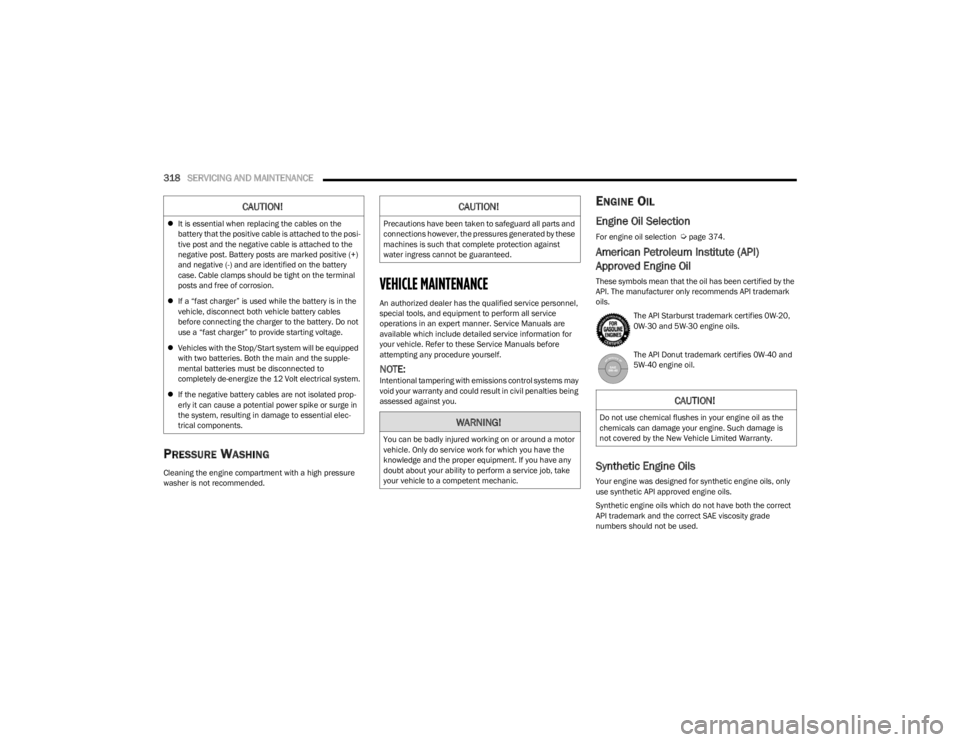
The API Starburst trademark certifies 0W-20,
0W-30 and 5W-30 engine oils.
The API Donut trademark certifies 0W-40 and
5W-40 engine oil.
Synthetic Engine Oils
Your engine was designed for synthetic engine oils, only
use synthetic API approved engine oils.
Synthetic engine oils which do not have both the correct
API trademark and the correct SAE viscosity grade
numbers should not be used.
CAUTION!
It is essential when replacing the cables on the
battery that the positive cable is attached to the posi -
tive post and the negative cable is attached to the
negative post. Battery posts are marked positive (+)
and negative (-) and are identified on the battery
case. Cable clamps should be tight on the terminal
posts and free of corrosion.
If a “fast charger” is used while the battery is in the
vehicle, disconnect both vehicle battery cables
before connecting the charger to the battery. Do not
use a “fast charger” to provide starting voltage.
Vehicles with the Stop/Start system will be equipped
with two batteries. Both the main and the supple -
mental batteries must be disconnected to
completely de-energize the 12 Volt electrical system.
If the negative battery cables are not isolated prop -
erly it can cause a potential power spike or surge in
the system, resulting in damage to essential elec -
trical components.
CAUTION!
Precautions have been taken to safeguard all parts and
connections however, the pressures generated by these
machines is such that complete protection against
water ingress cannot be guaranteed.
WARNING!
You can be badly injured working on or around a motor
vehicle. Only do service work for which you have the
knowledge and the proper equipment. If you have any
doubt about your ability to perform a service job, take
your vehicle to a competent mechanic.
CAUTION!
Do not use chemical flushes in your engine oil as the
chemicals can damage your engine. Such damage is
not covered by the New Vehicle Limited Warranty.
23_JL_OM_EN_USC_t.book Page 318