frame JEEP YJ 1995 Service And Manual PDF
[x] Cancel search | Manufacturer: JEEP, Model Year: 1995, Model line: YJ, Model: JEEP YJ 1995Pages: 2158, PDF Size: 81.9 MB
Page 2002 of 2158
REAR SEATBACK LATCH STRIKER AND BUMPERÐ
XJ
REMOVAL
(1) Disengage the seat cushion at the rear by pull-
ing upward on the release strap.
(2) Tilt the seat cushion forward.
(3) Release the seatback latch from the striker.
(4) Tilt the seatback forward for access to the
striker bracket.
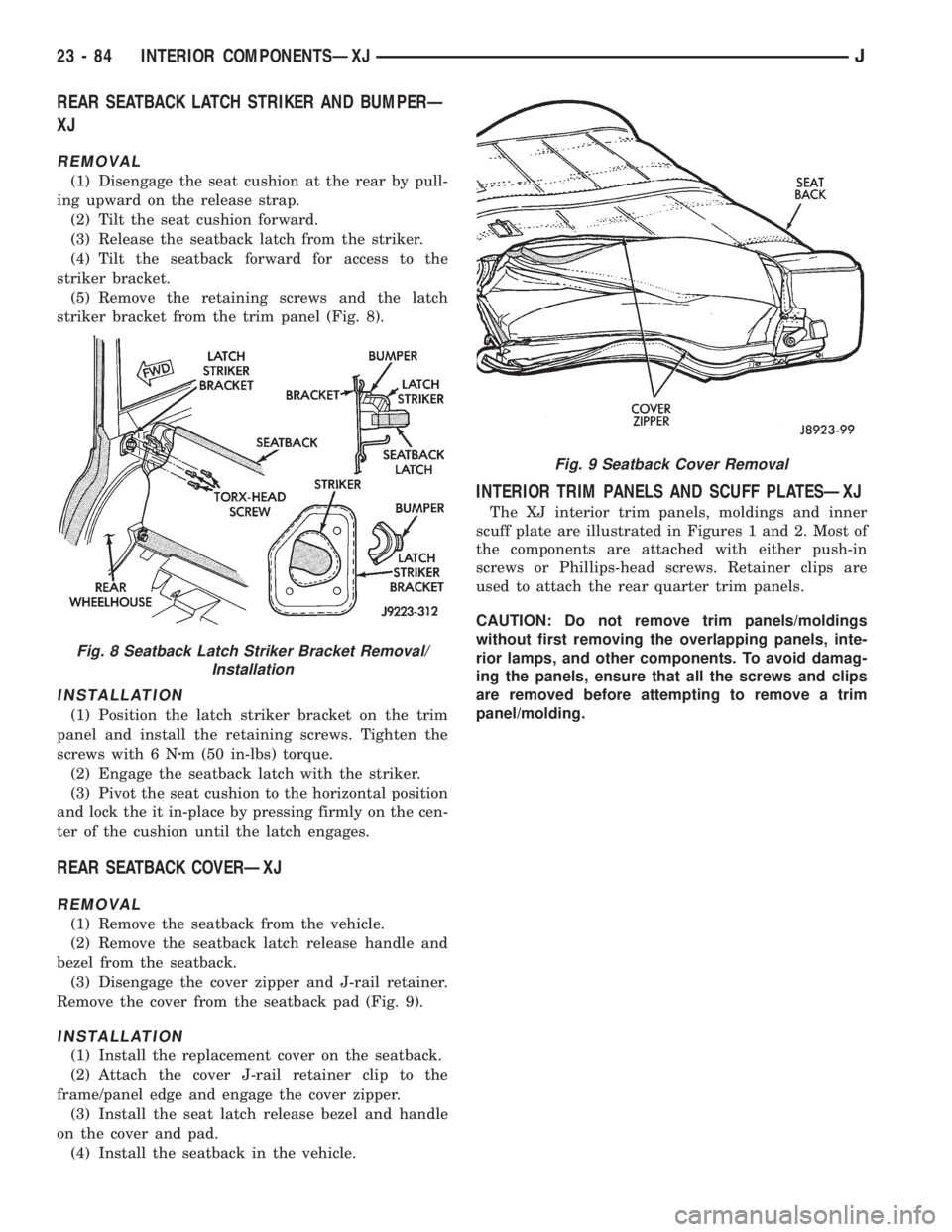
(5) Remove the retaining screws and the latch
striker bracket from the trim panel (Fig. 8).
INSTALLATION
(1) Position the latch striker bracket on the trim
panel and install the retaining screws. Tighten the
screws with 6 Nzm (50 in-lbs) torque.
(2) Engage the seatback latch with the striker.
(3) Pivot the seat cushion to the horizontal position
and lock the it in-place by pressing firmly on the cen-
ter of the cushion until the latch engages.
REAR SEATBACK COVERÐXJ
REMOVAL
(1) Remove the seatback from the vehicle.
(2) Remove the seatback latch release handle and
bezel from the seatback.
(3) Disengage the cover zipper and J-rail retainer.
Remove the cover from the seatback pad (Fig. 9).
INSTALLATION
(1) Install the replacement cover on the seatback.
(2) Attach the cover J-rail retainer clip to the
frame/panel edge and engage the cover zipper.
(3) Install the seat latch release bezel and handle
on the cover and pad.
(4) Install the seatback in the vehicle.
INTERIOR TRIM PANELS AND SCUFF PLATESÐXJ
The XJ interior trim panels, moldings and inner
scuff plate are illustrated in Figures 1 and 2. Most of
the components are attached with either push-in
screws or Phillips-head screws. Retainer clips are
used to attach the rear quarter trim panels.
CAUTION: Do not remove trim panels/moldings
without first removing the overlapping panels, inte-
rior lamps, and other components. To avoid damag-
ing the panels, ensure that all the screws and clips
are removed before attempting to remove a trim
panel/molding.
Fig. 8 Seatback Latch Striker Bracket Removal/
Installation
Fig. 9 Seatback Cover Removal
23 - 84 INTERIOR COMPONENTSÐXJJ
Page 2044 of 2158
(4) Apply weatherstrip adhesive to the hard top
weatherstrip seal (Fig. 4).
(5) Carefully position the weatherstrip seal on the
rear panels and the hard top.
(6) Press the seal onto the hard top flange and en-
sure that it is correctly seated on the flange.
(7) Install the seal retaining screws in the rear
panels and tighten them securely.
HARD TOPÐYJ
The hard top is constructed of compressed molded
fiberglass and painted to a special spatter paint. The
hard top can be removed for service access or for
other purposes.
REMOVAL
CAUTION: When removing the hard top, avoid dam-
aging the foam sealant between the hard top and
body panels.
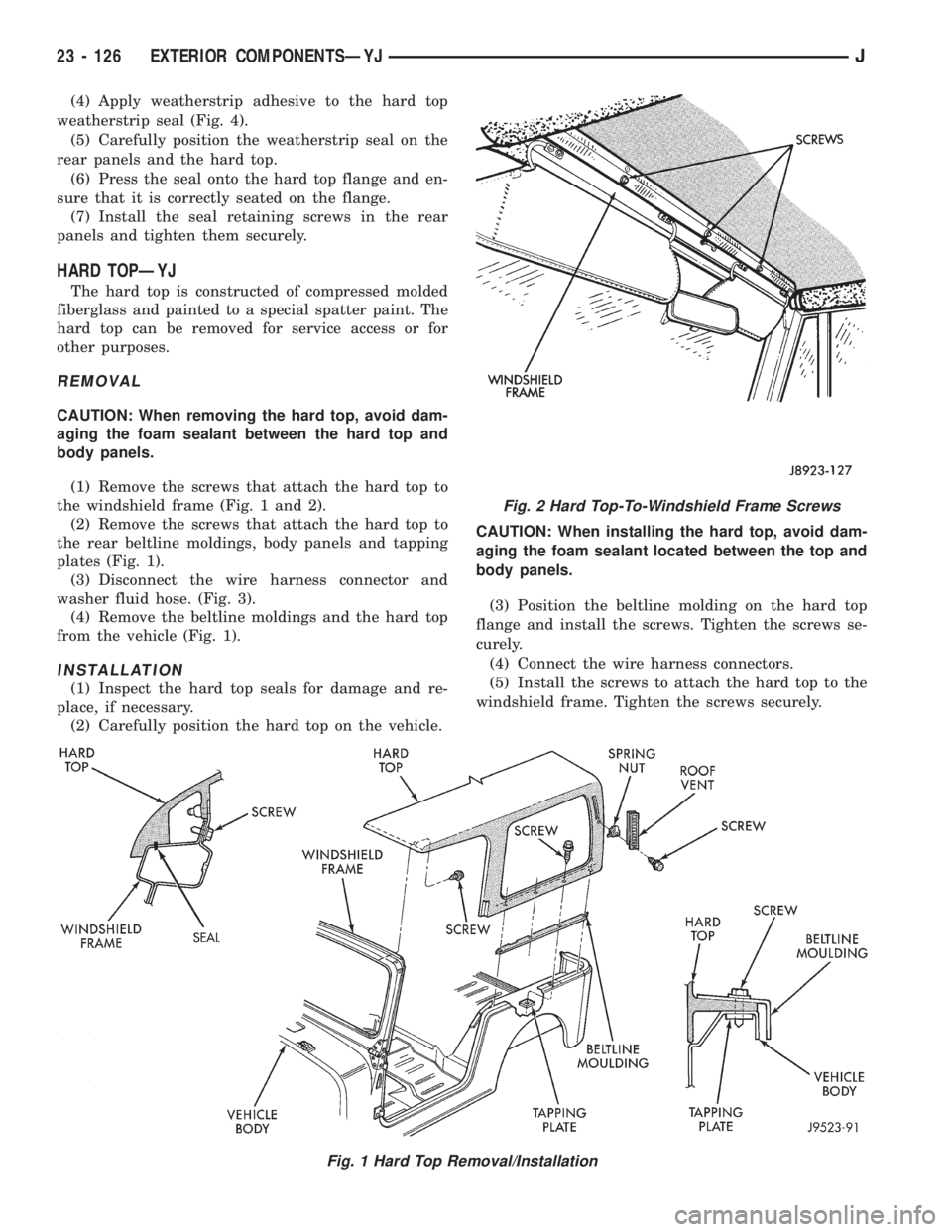
(1) Remove the screws that attach the hard top to
the windshield frame (Fig. 1 and 2).
(2) Remove the screws that attach the hard top to
the rear beltline moldings, body panels and tapping
plates (Fig. 1).
(3) Disconnect the wire harness connector and
washer fluid hose. (Fig. 3).
(4) Remove the beltline moldings and the hard top
from the vehicle (Fig. 1).
INSTALLATION
(1) Inspect the hard top seals for damage and re-
place, if necessary.
(2) Carefully position the hard top on the vehicle.CAUTION: When installing the hard top, avoid dam-
aging the foam sealant located between the top and
body panels.
(3) Position the beltline molding on the hard top
flange and install the screws. Tighten the screws se-
curely.
(4) Connect the wire harness connectors.
(5) Install the screws to attach the hard top to the
windshield frame. Tighten the screws securely.
Fig. 1 Hard Top Removal/Installation
Fig. 2 Hard Top-To-Windshield Frame Screws
23 - 126 EXTERIOR COMPONENTSÐYJJ
Page 2045 of 2158
HARD TOP ROOF VENTÐYJ
REMOVAL/INSTALLATION
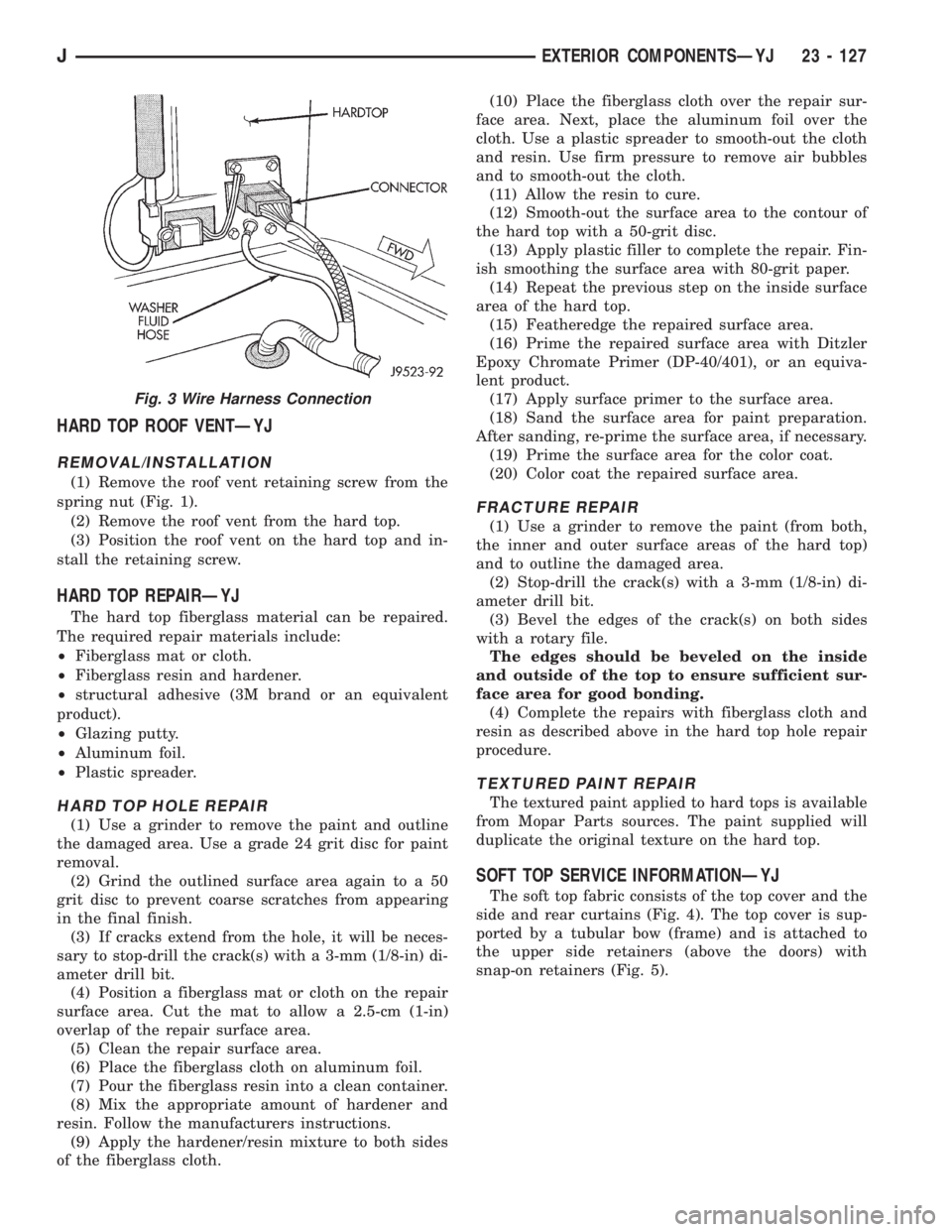
(1) Remove the roof vent retaining screw from the
spring nut (Fig. 1).
(2) Remove the roof vent from the hard top.
(3) Position the roof vent on the hard top and in-
stall the retaining screw.
HARD TOP REPAIRÐYJ
The hard top fiberglass material can be repaired.
The required repair materials include:
²Fiberglass mat or cloth.
²Fiberglass resin and hardener.
²structural adhesive (3M brand or an equivalent
product).
²Glazing putty.
²Aluminum foil.
²Plastic spreader.
HARD TOP HOLE REPAIR
(1) Use a grinder to remove the paint and outline
the damaged area. Use a grade 24 grit disc for paint
removal.
(2) Grind the outlined surface area again to a 50
grit disc to prevent coarse scratches from appearing
in the final finish.
(3) If cracks extend from the hole, it will be neces-
sary to stop-drill the crack(s) with a 3-mm (1/8-in) di-
ameter drill bit.
(4) Position a fiberglass mat or cloth on the repair
surface area. Cut the mat to allow a 2.5-cm (1-in)
overlap of the repair surface area.
(5) Clean the repair surface area.
(6) Place the fiberglass cloth on aluminum foil.
(7) Pour the fiberglass resin into a clean container.
(8) Mix the appropriate amount of hardener and
resin. Follow the manufacturers instructions.
(9) Apply the hardener/resin mixture to both sides
of the fiberglass cloth.(10) Place the fiberglass cloth over the repair sur-
face area. Next, place the aluminum foil over the
cloth. Use a plastic spreader to smooth-out the cloth
and resin. Use firm pressure to remove air bubbles
and to smooth-out the cloth.
(11) Allow the resin to cure.
(12) Smooth-out the surface area to the contour of
the hard top with a 50-grit disc.
(13) Apply plastic filler to complete the repair. Fin-
ish smoothing the surface area with 80-grit paper.
(14) Repeat the previous step on the inside surface
area of the hard top.
(15) Featheredge the repaired surface area.
(16) Prime the repaired surface area with Ditzler
Epoxy Chromate Primer (DP-40/401), or an equiva-
lent product.
(17) Apply surface primer to the surface area.
(18) Sand the surface area for paint preparation.
After sanding, re-prime the surface area, if necessary.
(19) Prime the surface area for the color coat.
(20) Color coat the repaired surface area.
FRACTURE REPAIR
(1) Use a grinder to remove the paint (from both,
the inner and outer surface areas of the hard top)
and to outline the damaged area.
(2) Stop-drill the crack(s) with a 3-mm (1/8-in) di-
ameter drill bit.
(3) Bevel the edges of the crack(s) on both sides
with a rotary file.
The edges should be beveled on the inside
and outside of the top to ensure sufficient sur-
face area for good bonding.
(4) Complete the repairs with fiberglass cloth and
resin as described above in the hard top hole repair
procedure.
TEXTURED PAINT REPAIR
The textured paint applied to hard tops is available
from Mopar Parts sources. The paint supplied will
duplicate the original texture on the hard top.
SOFT TOP SERVICE INFORMATIONÐYJ
The soft top fabric consists of the top cover and the
side and rear curtains (Fig. 4). The top cover is sup-
ported by a tubular bow (frame) and is attached to
the upper side retainers (above the doors) with
snap-on retainers (Fig. 5).
Fig. 3 Wire Harness Connection
JEXTERIOR COMPONENTSÐYJ 23 - 127
Page 2047 of 2158
SOFT TOP SERVICEÐYJ
REMOVAL
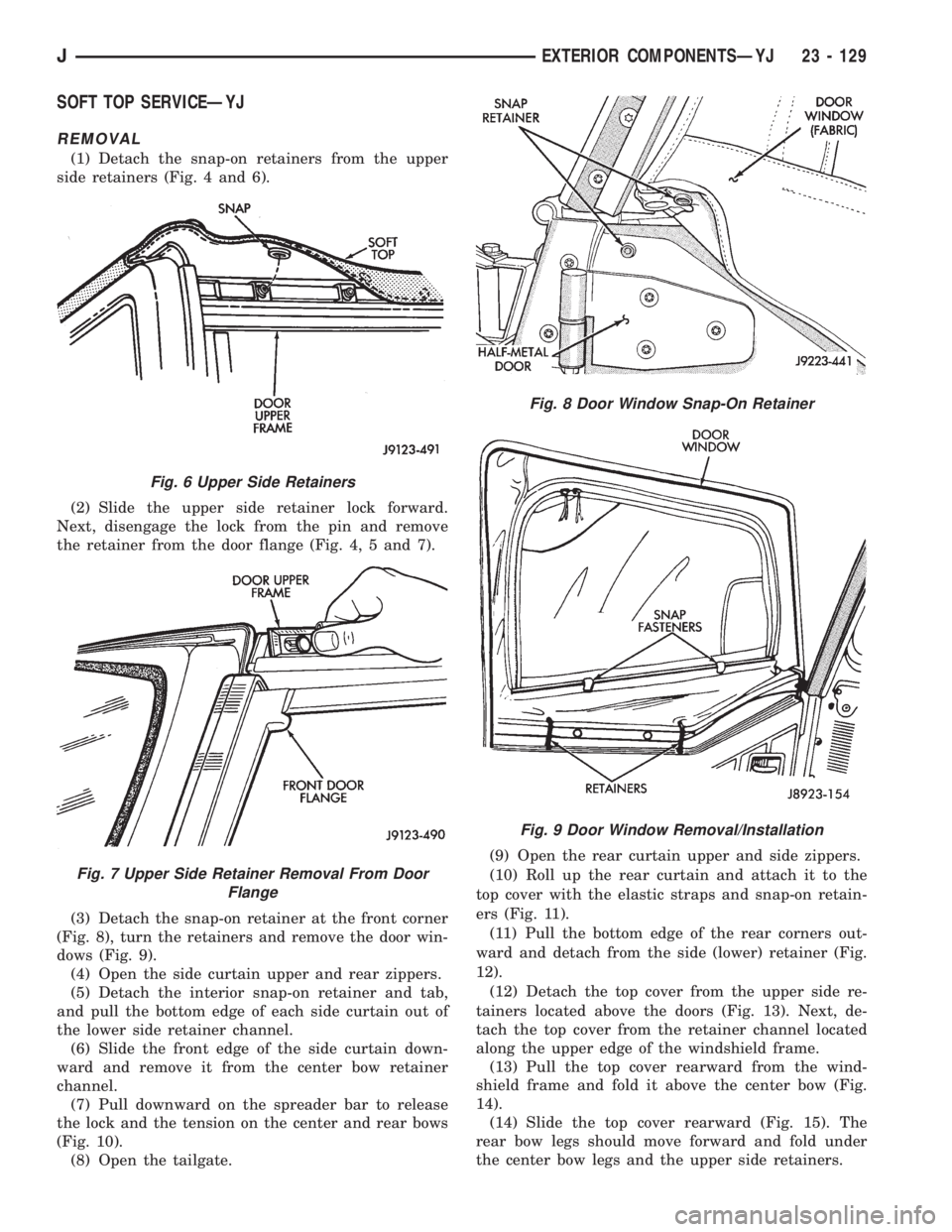
(1) Detach the snap-on retainers from the upper
side retainers (Fig. 4 and 6).
(2) Slide the upper side retainer lock forward.
Next, disengage the lock from the pin and remove
the retainer from the door flange (Fig. 4, 5 and 7).
(3) Detach the snap-on retainer at the front corner
(Fig. 8), turn the retainers and remove the door win-
dows (Fig. 9).
(4) Open the side curtain upper and rear zippers.
(5) Detach the interior snap-on retainer and tab,
and pull the bottom edge of each side curtain out of
the lower side retainer channel.
(6) Slide the front edge of the side curtain down-
ward and remove it from the center bow retainer
channel.
(7) Pull downward on the spreader bar to release
the lock and the tension on the center and rear bows
(Fig. 10).
(8) Open the tailgate.(9) Open the rear curtain upper and side zippers.
(10) Roll up the rear curtain and attach it to the
top cover with the elastic straps and snap-on retain-
ers (Fig. 11).
(11) Pull the bottom edge of the rear corners out-
ward and detach from the side (lower) retainer (Fig.
12).
(12) Detach the top cover from the upper side re-
tainers located above the doors (Fig. 13). Next, de-
tach the top cover from the retainer channel located
along the upper edge of the windshield frame.
(13) Pull the top cover rearward from the wind-
shield frame and fold it above the center bow (Fig.
14).
(14) Slide the top cover rearward (Fig. 15). The
rear bow legs should move forward and fold under
the center bow legs and the upper side retainers.
Fig. 6 Upper Side Retainers
Fig. 7 Upper Side Retainer Removal From Door
Flange
Fig. 8 Door Window Snap-On Retainer
Fig. 9 Door Window Removal/Installation
JEXTERIOR COMPONENTSÐYJ 23 - 129
Page 2049 of 2158
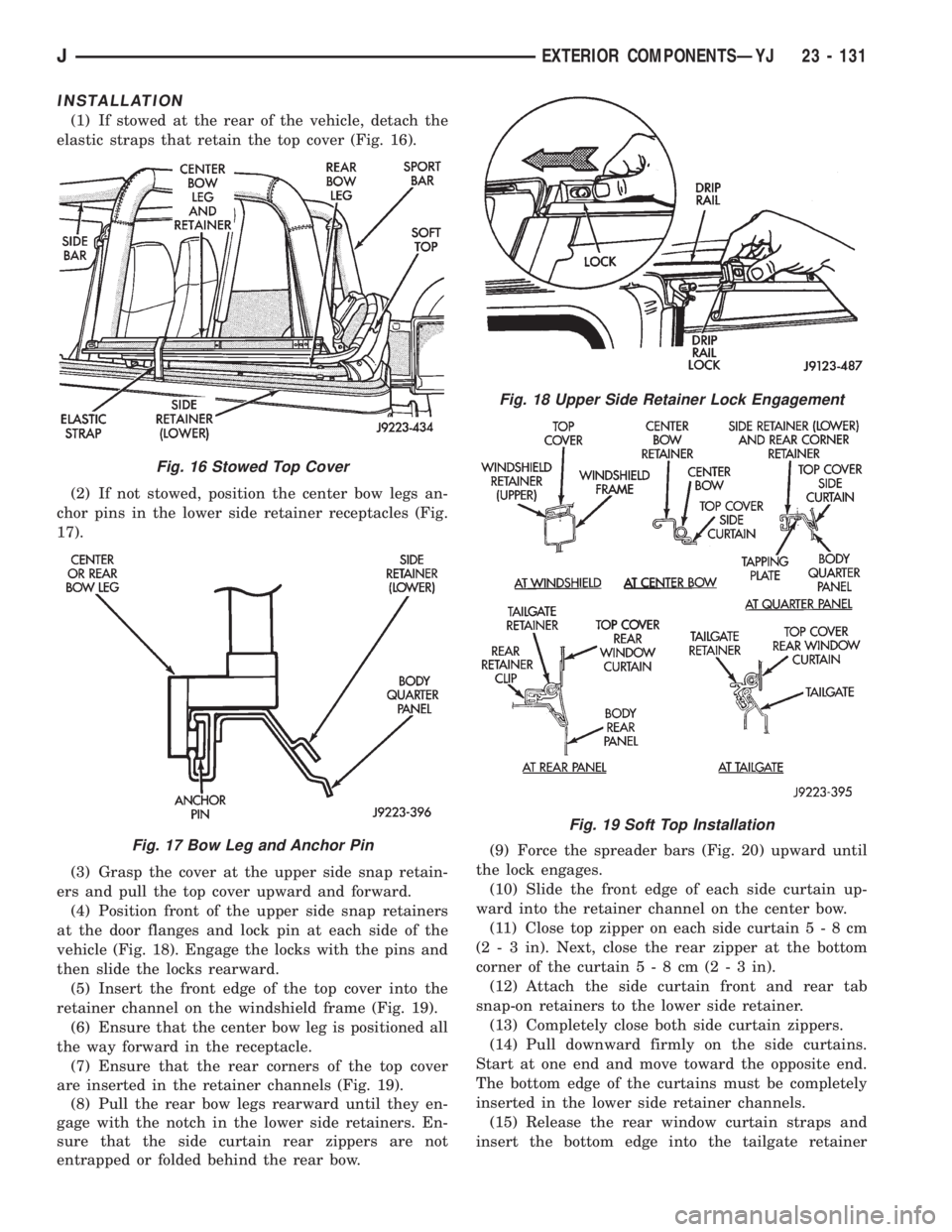
INSTALLATION
(1) If stowed at the rear of the vehicle, detach the
elastic straps that retain the top cover (Fig. 16).
(2) If not stowed, position the center bow legs an-
chor pins in the lower side retainer receptacles (Fig.
17).
(3) Grasp the cover at the upper side snap retain-
ers and pull the top cover upward and forward.
(4) Position front of the upper side snap retainers
at the door flanges and lock pin at each side of the
vehicle (Fig. 18). Engage the locks with the pins and
then slide the locks rearward.
(5) Insert the front edge of the top cover into the
retainer channel on the windshield frame (Fig. 19).
(6) Ensure that the center bow leg is positioned all
the way forward in the receptacle.
(7) Ensure that the rear corners of the top cover
are inserted in the retainer channels (Fig. 19).
(8) Pull the rear bow legs rearward until they en-
gage with the notch in the lower side retainers. En-
sure that the side curtain rear zippers are not
entrapped or folded behind the rear bow.(9) Force the spreader bars (Fig. 20) upward until
the lock engages.
(10) Slide the front edge of each side curtain up-
ward into the retainer channel on the center bow.
(11) Close top zipper on each side curtain5-8cm
(2 - 3 in). Next, close the rear zipper at the bottom
corner of the curtain5-8cm(2-3in).
(12) Attach the side curtain front and rear tab
snap-on retainers to the lower side retainer.
(13) Completely close both side curtain zippers.
(14) Pull downward firmly on the side curtains.
Start at one end and move toward the opposite end.
The bottom edge of the curtains must be completely
inserted in the lower side retainer channels.
(15) Release the rear window curtain straps and
insert the bottom edge into the tailgate retainer
Fig. 16 Stowed Top Cover
Fig. 17 Bow Leg and Anchor Pin
Fig. 18 Upper Side Retainer Lock Engagement
Fig. 19 Soft Top Installation
JEXTERIOR COMPONENTSÐYJ 23 - 131
Page 2050 of 2158
channel. Close the rear window curtain zippers and
attach the side snap-on retainers.
(16) Attach all the top cover snap-on retainers to
the upper side retainers located above both doors. As
necessary, slide the mating half of the snap-on re-
tainers so that they will align with the snap-on re-
tainers on the top cover. Tuck the edge of the top
cover inside the side retainer.
(17) Install the door windows by inserting the re-
tainers into the door grommets. Attach the snap-on
retainers located along the bottom edge of the win-
dow to the door retainer.
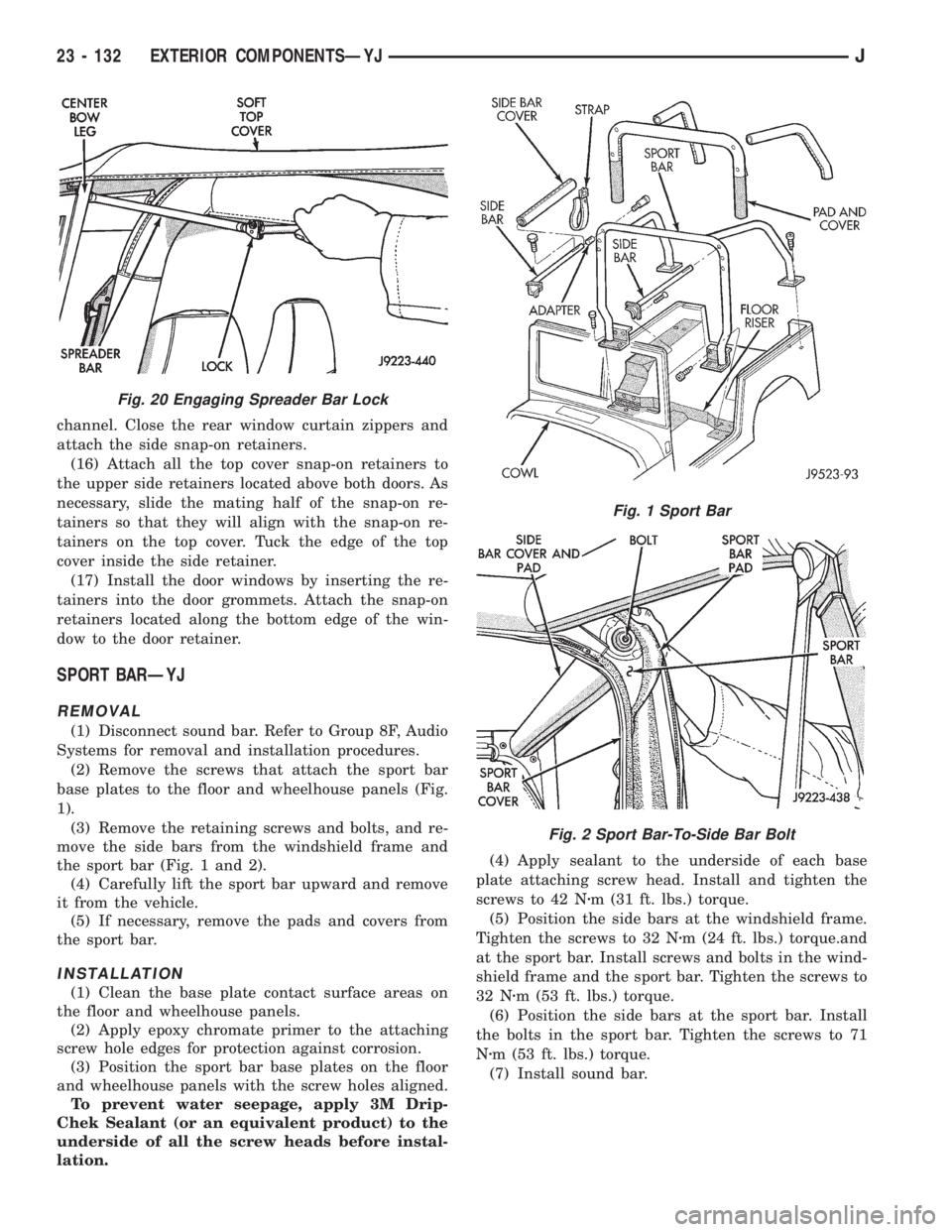
SPORT BARÐYJ
REMOVAL
(1) Disconnect sound bar. Refer to Group 8F, Audio
Systems for removal and installation procedures.
(2) Remove the screws that attach the sport bar
base plates to the floor and wheelhouse panels (Fig.
1).
(3) Remove the retaining screws and bolts, and re-
move the side bars from the windshield frame and
the sport bar (Fig. 1 and 2).
(4) Carefully lift the sport bar upward and remove
it from the vehicle.
(5) If necessary, remove the pads and covers from
the sport bar.
INSTALLATION
(1) Clean the base plate contact surface areas on
the floor and wheelhouse panels.
(2) Apply epoxy chromate primer to the attaching
screw hole edges for protection against corrosion.
(3) Position the sport bar base plates on the floor
and wheelhouse panels with the screw holes aligned.
To prevent water seepage, apply 3M Drip-
Chek Sealant (or an equivalent product) to the
underside of all the screw heads before instal-
lation.(4) Apply sealant to the underside of each base
plate attaching screw head. Install and tighten the
screws to 42 Nzm (31 ft. lbs.) torque.
(5) Position the side bars at the windshield frame.
Tighten the screws to 32 Nzm (24 ft. lbs.) torque.and
at the sport bar. Install screws and bolts in the wind-
shield frame and the sport bar. Tighten the screws to
32 Nzm (53 ft. lbs.) torque.
(6) Position the side bars at the sport bar. Install
the bolts in the sport bar. Tighten the screws to 71
Nzm (53 ft. lbs.) torque.
(7) Install sound bar.
Fig. 20 Engaging Spreader Bar Lock
Fig. 1 Sport Bar
Fig. 2 Sport Bar-To-Side Bar Bolt
23 - 132 EXTERIOR COMPONENTSÐYJJ
Page 2052 of 2158
DOORS
INDEX
page page
Beltline SealÐYJ........................ 142
Door Frame Glass Channel ReplacementÐYJ . . . 142
Door Weatherstrip Seal ReplacementÐYJ...... 142
Full-Metal Door Assist HandleÐYJ........... 136
Full-Metal Door HingesÐYJ................ 140
Full-Metal Door Key Lock CylinderÐYJ........ 139
Full-Metal Door Latch External Release
HandleÐYJ........................... 140
Full-Metal Door Latch Inside Release and Lock
HandleÐYJ........................... 137
Full-Metal Door LatchÐYJ.................. 140Full-Metal Door ServiceÐYJ................ 142
Full-Metal Door Trim PanelÐYJ.............. 137
Full-Metal Door Vent Window GlassÐYJ....... 137
Full-Metal Door WaterdamÐYJ.............. 137
Full-Metal Door Weatherstrip SealsÐYJ........ 141
Full-Metal Door Window Glass Regulator
HandleÐYJ........................... 136
Full-Metal Door Window Glass RegulatorÐYJ . . . 138
Full-Metal Door Window GlassÐYJ........... 139
Half-Metal Door Latch StrikerÐYJ............ 135
Half-Metal Soft Top DoorÐYJ............... 134
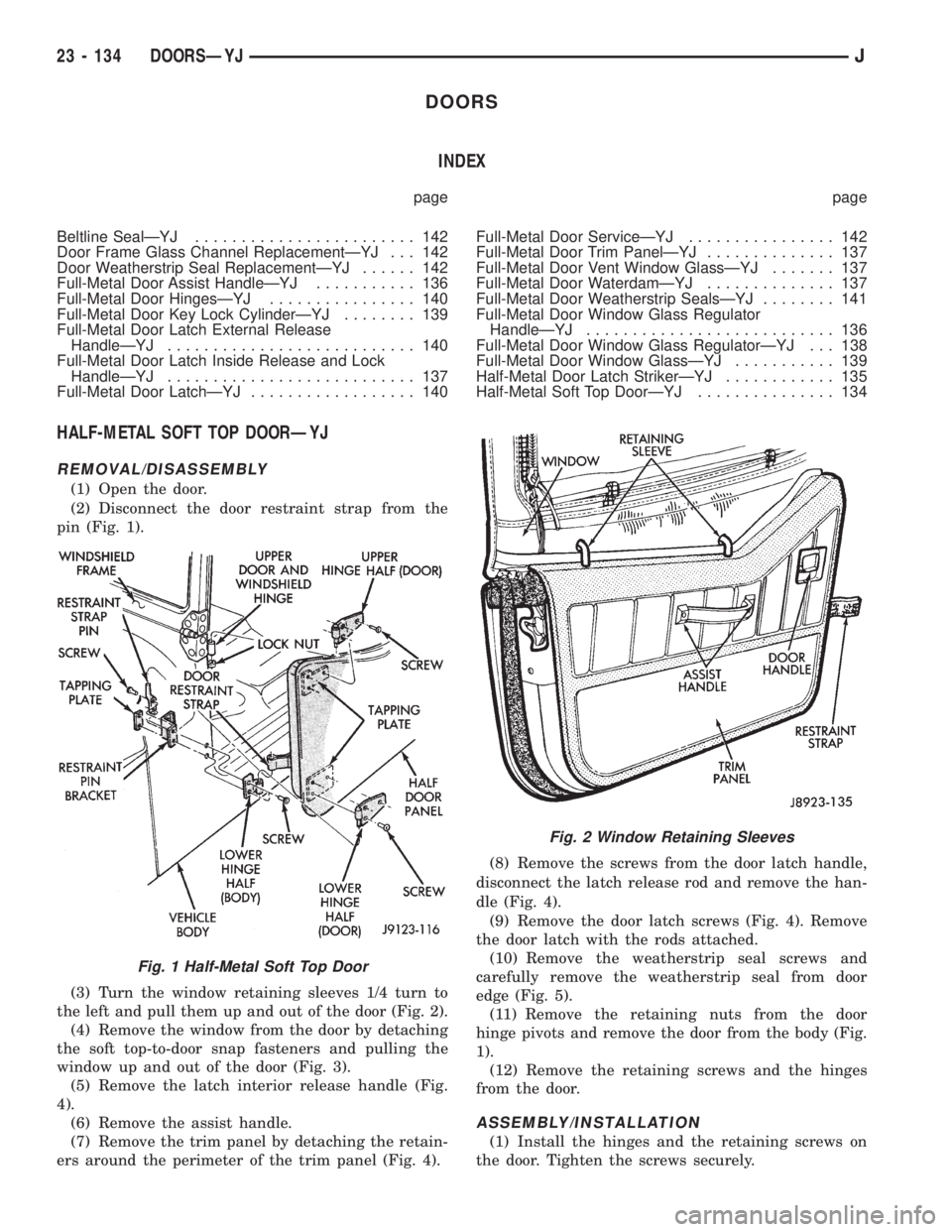
HALF-METAL SOFT TOP DOORÐYJ
REMOVAL/DISASSEMBLY
(1) Open the door.
(2) Disconnect the door restraint strap from the
pin (Fig. 1).
(3) Turn the window retaining sleeves 1/4 turn to
the left and pull them up and out of the door (Fig. 2).
(4) Remove the window from the door by detaching
the soft top-to-door snap fasteners and pulling the
window up and out of the door (Fig. 3).
(5) Remove the latch interior release handle (Fig.
4).
(6) Remove the assist handle.
(7) Remove the trim panel by detaching the retain-
ers around the perimeter of the trim panel (Fig. 4).(8) Remove the screws from the door latch handle,
disconnect the latch release rod and remove the han-
dle (Fig. 4).
(9) Remove the door latch screws (Fig. 4). Remove
the door latch with the rods attached.
(10) Remove the weatherstrip seal screws and
carefully remove the weatherstrip seal from door
edge (Fig. 5).
(11) Remove the retaining nuts from the door
hinge pivots and remove the door from the body (Fig.
1).
(12) Remove the retaining screws and the hinges
from the door.
ASSEMBLY/INSTALLATION
(1) Install the hinges and the retaining screws on
the door. Tighten the screws securely.
Fig. 1 Half-Metal Soft Top Door
Fig. 2 Window Retaining Sleeves
23 - 134 DOORSÐYJJ
Page 2056 of 2158
(4) Detach the front three inches of weatherstrip
seal from the door upper frame. Lower the division
channel and tilt it toward the rear of the door.
(5) Remove the vent window glass from the door
frame.
INSTALLATION
(1) Position the vent window glass in the door
frame.
(2) Install the division channel in the door and po-
sition the channel on the window glass.(3) Install the upper attaching screw and the lower
adjustment screw.
(4) Attach the weatherstrip seal to the door upper
frame.
(5) Water test the window and inspect for leaks.
(6) If water leakage is evident, apply windshield
sealant to seal the area or re-align the weatherstrip
seal.
(7) Test the operation and adjustment of the door
window glass.
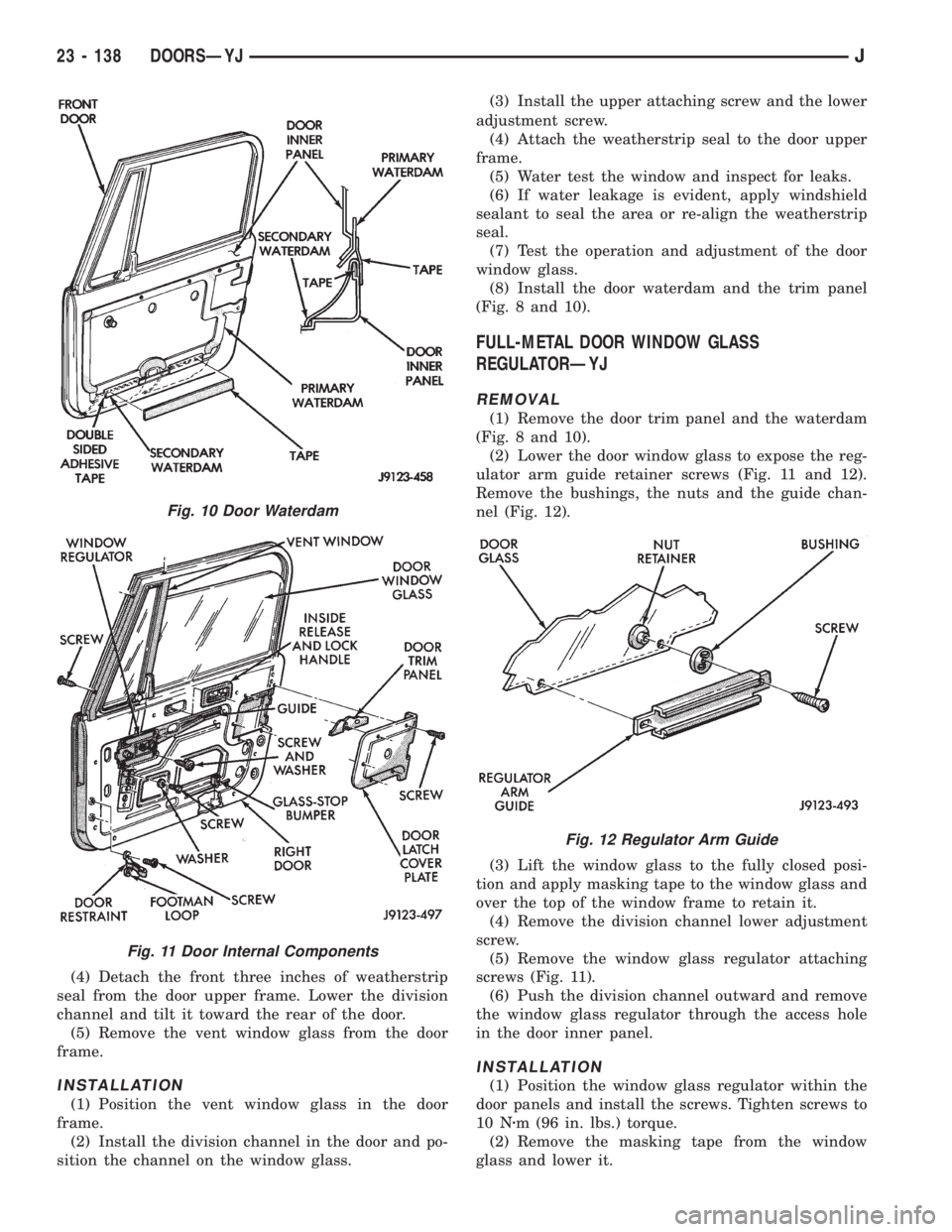
(8) Install the door waterdam and the trim panel
(Fig. 8 and 10).
FULL-METAL DOOR WINDOW GLASS
REGULATORÐYJ
REMOVAL
(1) Remove the door trim panel and the waterdam
(Fig. 8 and 10).
(2) Lower the door window glass to expose the reg-
ulator arm guide retainer screws (Fig. 11 and 12).
Remove the bushings, the nuts and the guide chan-
nel (Fig. 12).
(3) Lift the window glass to the fully closed posi-
tion and apply masking tape to the window glass and
over the top of the window frame to retain it.
(4) Remove the division channel lower adjustment
screw.
(5) Remove the window glass regulator attaching
screws (Fig. 11).
(6) Push the division channel outward and remove
the window glass regulator through the access hole
in the door inner panel.
INSTALLATION
(1) Position the window glass regulator within the
door panels and install the screws. Tighten screws to
10 Nzm (96 in. lbs.) torque.
(2) Remove the masking tape from the window
glass and lower it.
Fig. 10 Door Waterdam
Fig. 11 Door Internal Components
Fig. 12 Regulator Arm Guide
23 - 138 DOORSÐYJJ
Page 2057 of 2158
(3) Slide the regulator arm guide onto the regula-
tor arm and position the guide on the window glass
(Fig. 12). Install the nuts, bushings and screws.
(4) Install the division channel lower adjustment
screw.
(5) Test the window glass for proper operation.
(6) Install the door waterdam and the trim panel
(Fig. 8 and 10).
FULL-METAL DOOR WINDOW GLASSÐYJ
ADJUSTMENT
One adjustment location provides amount of effort
required to raise and lower the door window glass.
The door window glass division channel is adjustable
fore and aft at the lower attaching location.
(1) Remove the door trim panel and the waterdam
(Fig. 8 and 10).
(2) Loosen channel lower adjustment screw and
move the division channel fore or aft to obtain the
desired door window glass operation.
Movement of the division channel fore or aft
will decrease or increase the free-play between
the channels.
(3) Tighten the division channel lower adjustment
screw.
(4) Install the door waterdam and the trim panel
(Fig. 8 and 10).
REMOVAL
(1) Remove the door trim panel and the waterdam
(Fig. 8 and 10).
(2) Remove the window glass down-stop bumper
(Fig. 11).
(3) Remove the screws that attach the regulator
arm guide to the window glass. Remove the screws,
bushings, nuts and the guide from the glass (Fig. 11).
(4) Lower the window glass to the bottom of the
door.
(5) Remove the division channel upper attaching
screw and the lower adjustment screw. Detach the
front 3 inches of window glass weatherstrip seal from
the door upper frame.
(6) Separate the division channel from the front
window glass rubber seal. Pull the division channel
up and in toward the inside of vehicle.
(7) Raise and tilt the window glass toward the
hinge side of the door and disengage it from the rear
channel.
(8) Pull the window glass up and out of the door
panel.
INSTALLATION
(1) Lower the window glass into the door, while in-
serting the window glass into the front and rear
channels.
(2) Slide the window glass downward to the bottom
of the door panel.(3) Lower the division channel into the door and
position the window glass securely in the channel.
(4) Install the weatherstrip seal in the upper door
frame and install the upper attaching screw and the
lower adjustment screw.
(5) Slide the guide onto the regulator arm and po-
sition the guide on the window glass. Install the re-
taining nuts, bushings and screws (Fig. 12).
(6) Install the window glass down-stop bumper
(Fig. 11).
(7) Test the window operation for proper adjust-
ment.
(8) Install the door waterdam and the trim panel
(Fig. 8 and 10).
FULL-METAL DOOR KEY LOCK CYLINDERÐYJ
REMOVAL
(1) Remove the door trim panel and the waterdam
(Fig. 8 and 10).
(2) Remove the door latch cover screws and remove
the cover (Fig. 11).
(3) Remove the retaining clip and remove lock cyl-
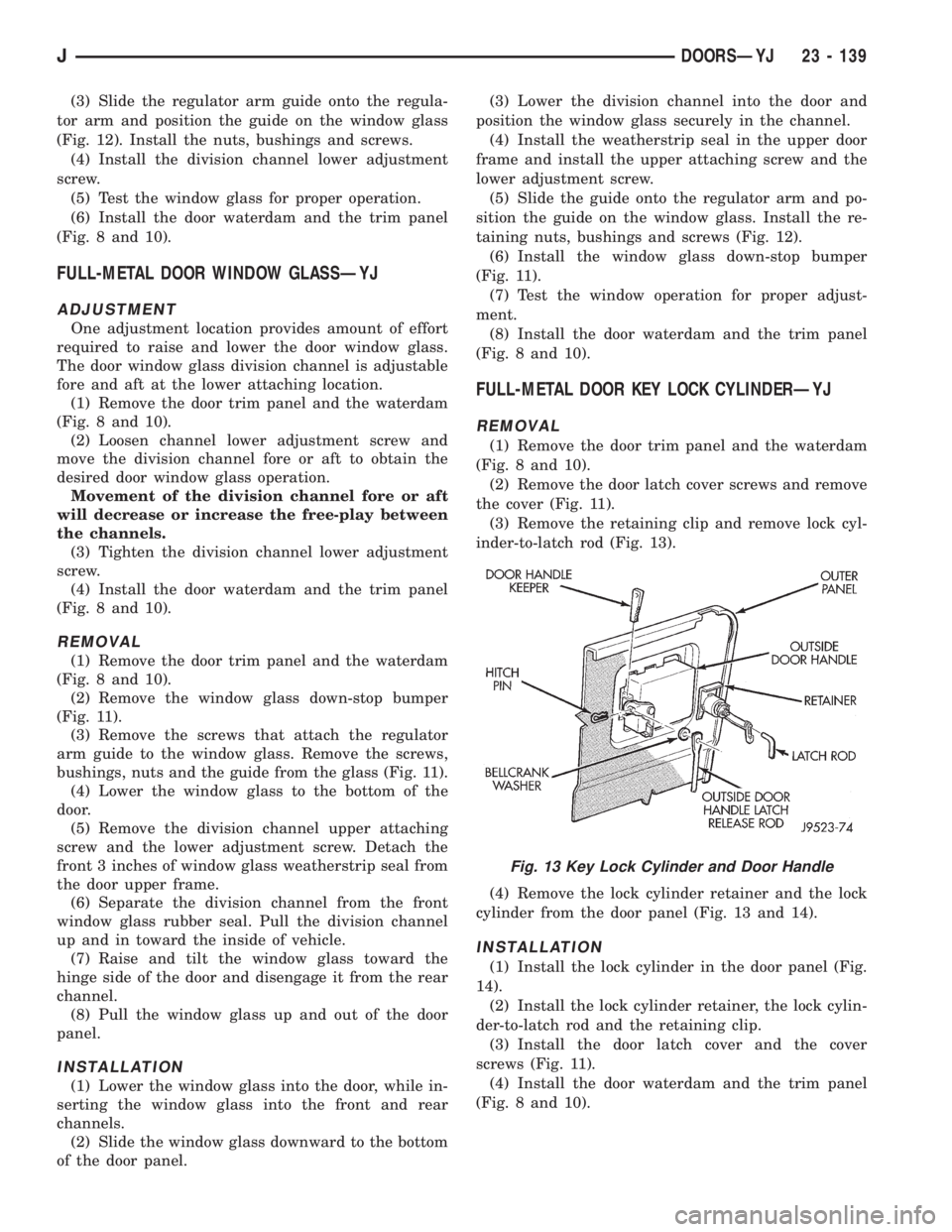
inder-to-latch rod (Fig. 13).
(4) Remove the lock cylinder retainer and the lock
cylinder from the door panel (Fig. 13 and 14).
INSTALLATION
(1) Install the lock cylinder in the door panel (Fig.
14).
(2) Install the lock cylinder retainer, the lock cylin-
der-to-latch rod and the retaining clip.
(3) Install the door latch cover and the cover
screws (Fig. 11).
(4) Install the door waterdam and the trim panel
(Fig. 8 and 10).
Fig. 13 Key Lock Cylinder and Door Handle
JDOORSÐYJ 23 - 139
Page 2059 of 2158
Prior to door adjustment or alignment, the door
latch must be removed to allow the door to close
freely and be properly aligned.
The door latch striker should be adjusted in or out
to allow the door latch to be fully engaged. The door
should be flush with the adjacent body panels.
REPLACEMENT
(1) Mark the outline of the existing hinge on the
body and the door with a wax pencil for installation
alignment reference.
When removing the door or hinge DO NOT
discard the plastic shims or the hinge pin.
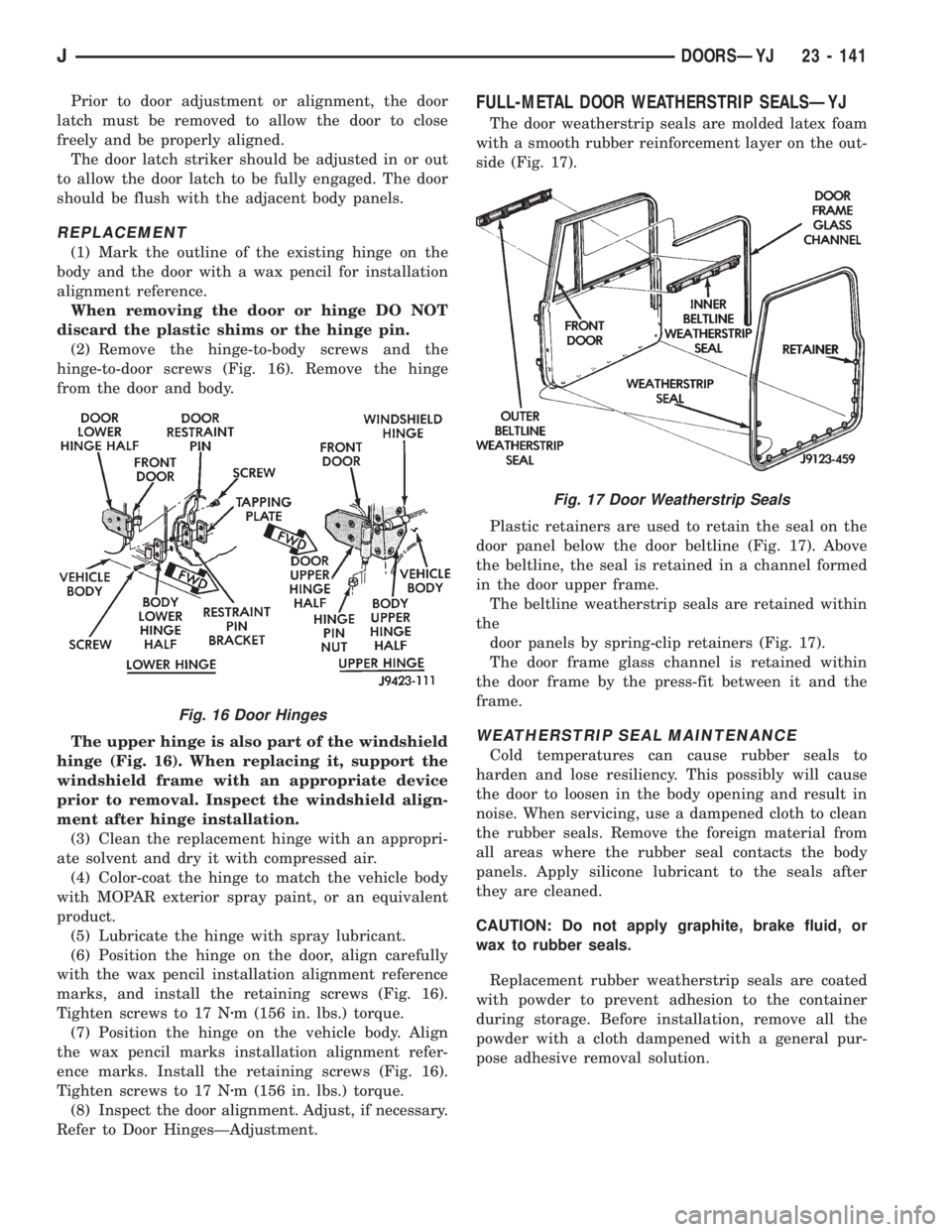
(2) Remove the hinge-to-body screws and the
hinge-to-door screws (Fig. 16). Remove the hinge
from the door and body.
The upper hinge is also part of the windshield
hinge (Fig. 16). When replacing it, support the
windshield frame with an appropriate device
prior to removal. Inspect the windshield align-
ment after hinge installation.
(3) Clean the replacement hinge with an appropri-
ate solvent and dry it with compressed air.
(4) Color-coat the hinge to match the vehicle body
with MOPAR exterior spray paint, or an equivalent
product.
(5) Lubricate the hinge with spray lubricant.
(6) Position the hinge on the door, align carefully
with the wax pencil installation alignment reference
marks, and install the retaining screws (Fig. 16).
Tighten screws to 17 Nzm (156 in. lbs.) torque.
(7) Position the hinge on the vehicle body. Align
the wax pencil marks installation alignment refer-
ence marks. Install the retaining screws (Fig. 16).
Tighten screws to 17 Nzm (156 in. lbs.) torque.
(8) Inspect the door alignment. Adjust, if necessary.
Refer to Door HingesÐAdjustment.
FULL-METAL DOOR WEATHERSTRIP SEALSÐYJ
The door weatherstrip seals are molded latex foam
with a smooth rubber reinforcement layer on the out-
side (Fig. 17).
Plastic retainers are used to retain the seal on the
door panel below the door beltline (Fig. 17). Above
the beltline, the seal is retained in a channel formed
in the door upper frame.
The beltline weatherstrip seals are retained within
the
door panels by spring-clip retainers (Fig. 17).
The door frame glass channel is retained within
the door frame by the press-fit between it and the
frame.
WEATHERSTRIP SEAL MAINTENANCE
Cold temperatures can cause rubber seals to
harden and lose resiliency. This possibly will cause
the door to loosen in the body opening and result in
noise. When servicing, use a dampened cloth to clean
the rubber seals. Remove the foreign material from
all areas where the rubber seal contacts the body
panels. Apply silicone lubricant to the seals after
they are cleaned.
CAUTION: Do not apply graphite, brake fluid, or
wax to rubber seals.
Replacement rubber weatherstrip seals are coated
with powder to prevent adhesion to the container
during storage. Before installation, remove all the
powder with a cloth dampened with a general pur-
pose adhesive removal solution.
Fig. 16 Door Hinges
Fig. 17 Door Weatherstrip Seals
JDOORSÐYJ 23 - 141