ignition KIA CARENS RHD 2018 Owners Manual
[x] Cancel search | Manufacturer: KIA, Model Year: 2018, Model line: CARENS RHD, Model: KIA CARENS RHD 2018Pages: 723, PDF Size: 40.94 MB
Page 555 of 723
75
What to do in an emergency
EMERGENCY STARTING
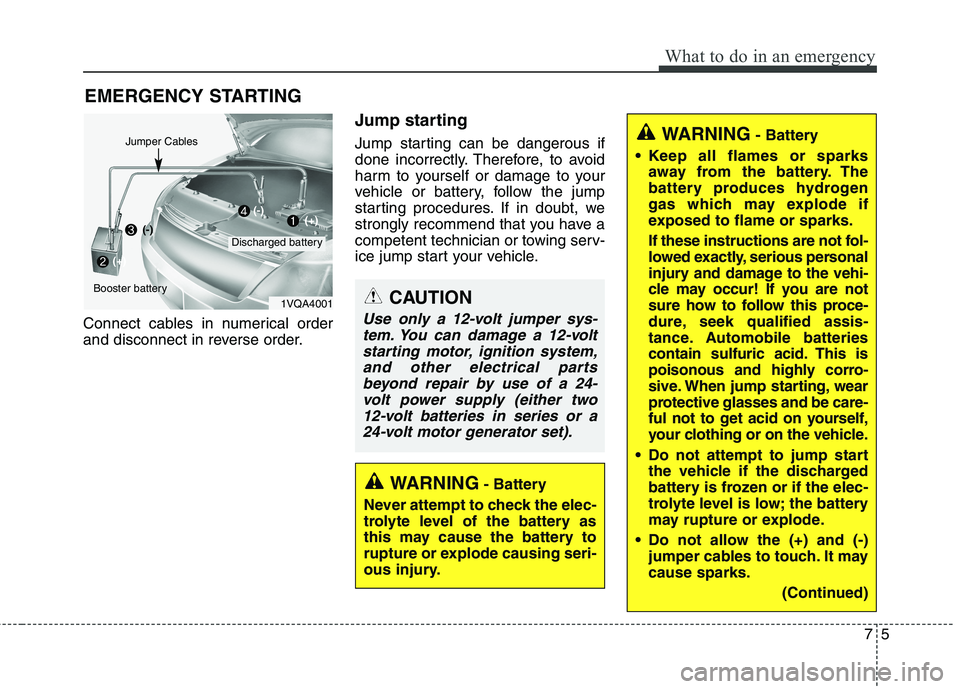
Connect cables in numerical order
and disconnect in reverse order. Jump starting
Jump starting can be dangerous if
done incorrectly. Therefore, to avoid
harm to yourself or damage to your
vehicle or battery, follow the jump
starting procedures. If in doubt, we
strongly recommend that you have a
competent technician or towing serv-
ice jump start your vehicle.
CAUTION
Use only a 12-volt jumper sys-
tem. You can damage a 12-voltstarting motor, ignition system, and other electrical partsbeyond repair by use of a 24-volt power supply (either two 12-volt batteries in series or a24-volt motor generator set).
WARNING - Battery
Never attempt to check the elec-
trolyte level of the battery as
this may cause the battery to
rupture or explode causing seri-
ous injury.
1VQA4001
Discharged battery
Jumper Cables
Booster battery(-)
(+)
(+)(-)
WARNING - Battery
• Keep all flames or sparks away from the battery. The
battery produces hydrogen
gas which may explode if
exposed to flame or sparks.
If these instructions are not fol-
lowed exactly, serious personal
injury and damage to the vehi-
cle may occur! If you are not
sure how to follow this proce-
dure, seek qualified assis-
tance. Automobile batteries
contain sulfuric acid. This is
poisonous and highly corro-
sive. When jump starting, wear
protective glasses and be care-
ful not to get acid on yourself,
your clothing or on the vehicle.
Do not attempt to jump start the vehicle if the discharged
battery is frozen or if the elec-
trolyte level is low; the battery
may rupture or explode.
Do not allow the (+) and (-) jumper cables to touch. It maycause sparks.
(Continued)
Page 556 of 723
What to do in an emergency
6
7
Jump starting procedure
✽✽
NOTICE
If the battery is discharged, the
engine can be started using a battery
of another vehicle and two jumper
cables. Only use jumper cables with
fully insulated clamp handles.
To prevent personal injury or dam-
age to both vehicles, adhere strictly
to the following procedure.
1.Make sure the booster battery is 12-volt and that its negative termi-
nal is grounded.
2.If the booster battery is in another vehicle, do not allow the vehicles totouch.
3.Turn off all unnecessary electrical loads.
4.Connect the jumper cables in the exact sequence shown in the illus-
tration. First connect one end of a
jumper cable to the positive termi-
nal of the discharged battery (1),then connect the other end to the
positive terminal on the booster
battery (2). Proceed to connect
one end of the other jumper cable
to the negative terminal of the
booster battery (3), then the other
end to a solid, stationary, metallic
point (for example, the engine lift-
ing bracket) away from the battery
(4). Do not connect it to or near any
part that moves when the engine is
cranked. Make sure that there is no
contact between the bodywork of
the two vehicles; otherwise, there
is the danger of short circuits.(Continued)
The battery may rupture orexplode when you jump start
with a low or frozen battery.
CAUTION - AGM battery
(if equipped)
Absorbent Glass Matt (AGM) batteries are maintenance freeand have the AGM batteryserviced by a professionalworkshop. Kia recommends to visit an authorised Kia deal-er/service partner. For charg-ing your AGM battery, use only fully automatic battery charg-ers that are specially devel-oped for AGM batteries.
When replacing the AGM bat- tery, use parts for replacementfrom a professional workshop.Kia recommends to visit anauthorised Kia dealer/service partner.
(Continued)
(Continued)
Do not open or remove the cap on top of the battery. Thismay cause leaks of internal electrolyte that could result insevere injury.
If the AGM battery is reconnect- ed or replaced, ISG functionwill not operate immediately.
If you want to use the ISGfunction, the battery sensor needs to be calibrated forapproximately 4 hours withthe ignition off.
Page 560 of 723
What to do in an emergency
10
7
Your vehicle has also been equipped
with a TPMS malfunction indicator toindicate when the system is not oper-
ating properly. The TPMS malfunction
indicator is combined with the low
tyre pressure telltale. When the sys-tem detects a malfunction, the telltale
will flash for approximately one
minute and then remain continuously
illuminated. This sequence will con-
tinue upon subsequent vehicle start-
ups as long as the malfunction exists.When the malfunction indicator is illu-
minated, the system may not be able
to detect or signal low tyre pressure
as intended. TPMS malfunctions may
occur for a variety of reasons, includ-ing the installation of replacement or
alternate tyres or wheels on the vehi-
cle that prevent the TPMS from func-
tioning properly. Always check theTPMS malfunction telltale afterreplacing one or more tyres or
wheels on your vehicle to ensure that
the replacement or alternate tyres
and wheels allow the TPMS to con-
tinue to function properly.✽✽
NOTICE
If the TPMS, Low Tyre Pressure
indicator do not illuminate for 3 sec-
onds when the ignition switch is
turned to the ON position or engine
is running, or if they remain illumi-
nated after coming on for approxi-
mately 3 seconds, have the system
checked by a professional workshop.
Kia recommends to visit an autho-
rised Kia dealer/service partner.Low tyre pressure telltale
When the tyre pressure monitoring
system warning indicators are illumi-
nated, one or more of your tyres issignificantly under-inflated.
If the telltale illuminates, immediately
reduce your speed, avoid hard cor-
nering and anticipate increased stop-
ping distances. You should stop and
check your tyres as soon as possi-
ble. Inflate the tyres to the proper
pressure as indicated on the vehi-
cle’s placard or tyre inflation pres-
sure label located on the driver’s side
centre pillar outer panel. If you can-
not reach a service station or if the
tyre cannot hold the newly added air,
replace the low pressure tyre with
the spare tyre.
Page 579 of 723
729
What to do in an emergency
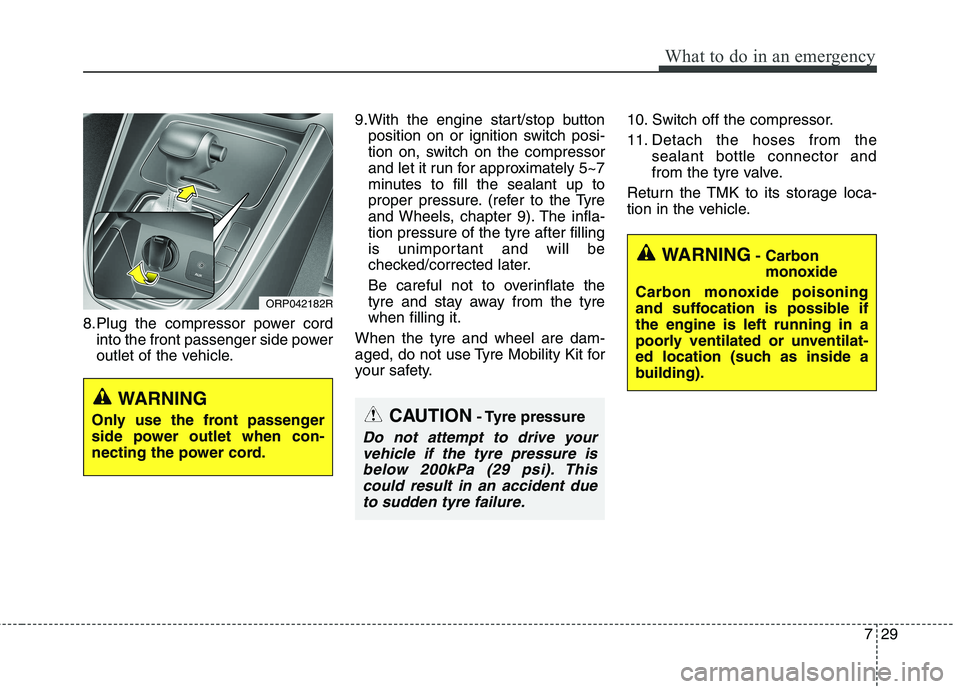
8.Plug the compressor power cordinto the front passenger side power
outlet of the vehicle. 9.With the engine start/stop button
position on or ignition switch posi-
tion on, switch on the compressor
and let it run for approximately 5~7
minutes to fill the sealant up to
proper pressure. (refer to the Tyre
and Wheels, chapter 9). The infla-tion pressure of the tyre after filling
is unimportant and will be
checked/corrected later.
Be careful not to overinflate the
tyre and stay away from the tyrewhen filling it.
When the tyre and wheel are dam-
aged, do not use Tyre Mobility Kit for
your safety. 10. Switch off the compressor.
11. Detach the hoses from the
sealant bottle connector and
from the tyre valve.
Return the TMK to its storage loca-
tion in the vehicle.
WARNING - Carbon
monoxide
Carbon monoxide poisoning
and suffocation is possible ifthe engine is left running in a
poorly ventilated or unventilat-
ed location (such as inside a
building).
WARNING
Only use the front passenger
side power outlet when con-
necting the power cord.
CAUTION - Tyre pressure
Do not attempt to drive your
vehicle if the tyre pressure is below 200kPa (29 psi). Thiscould result in an accident dueto sudden tyre failure.
ORP042182R
Page 580 of 723
What to do in an emergency
30
7
Distributing the sealant
12. Immediately drive approximately
7~10km (4~6miles or, about
10min) to evenly distribute the
sealant in the tyre. Checking the tyre inflation pressure
1.After driving approximately 7~10
km (4~6 miles or about 10 min-
utes), stop at a suitable location.
2.Connect connection hose (9) of the compressor directly to the tyre
valve.
3.Connect between compressor and the vehicle power outlet using the
cable and connectors.
4.Adjust the tyre inflation pressure to 220 kPa (32 psi). With the ignition
switched on, proceed as follows.
- To increase the inflation pres-sure: Switch on the compressor,
position "I". To check the current
inflation pressure setting, briefly
switch off the compressor. - To reduce the inflation pres-
sure: Loosen the screw cap (8)
on the compressor hose.
CAUTION
Do not exceed a speed of 60
km/h (35 mph). If possible, donot fall below a speed of 20 km/h (12 mph).
Whilst driving, if you experienceany unusual vibration, ride dis-turbance or noise, reduce yourspeed and drive with caution until you can safely pull off ofthe side of the road. Call forroad side service or towing.
When you use the Tyre MobilityKit, the tyre pressure sensors and wheel may be stained bysealant. Therefore, remove thetyre pressure sensors and have the vehicle inspected at a pro-fessional workshop. Kia recom-mends to visit an authorised Kiadealer/service partner.
WARNING
Do not let the compressor run
for more than 10 minutes, other-
wise the device will overheat
and may be damaged.
CAUTION
If the inflation pressure is not maintained, drive the vehicle asecond time, refer toDistributing the sealant. Then repeat steps 1 to 4.
Use of the TMK may be ineffec-tual for tyre damage larger thanapproximately 4 mm (0.16 in).
Contact a professional work-shop if the tyre cannot be made roadworthy with the TyreMobility Kit. Kia recommends tovisit an authorised Kia dealer/service partner.
WARNING
The tyre inflation pressure must
be at least 220 kPa (32 psi). If it
is not, do not continue driving.
Call for road side service or
towing.
Page 583 of 723
733
What to do in an emergency
When towing your vehicle in an emergency without wheel dollies :
1.Set the ignition switch in the ACCposition.
2.Place the transaxle shift lever in N (Neutral).
3.Release the parking brake. Removable towing hook
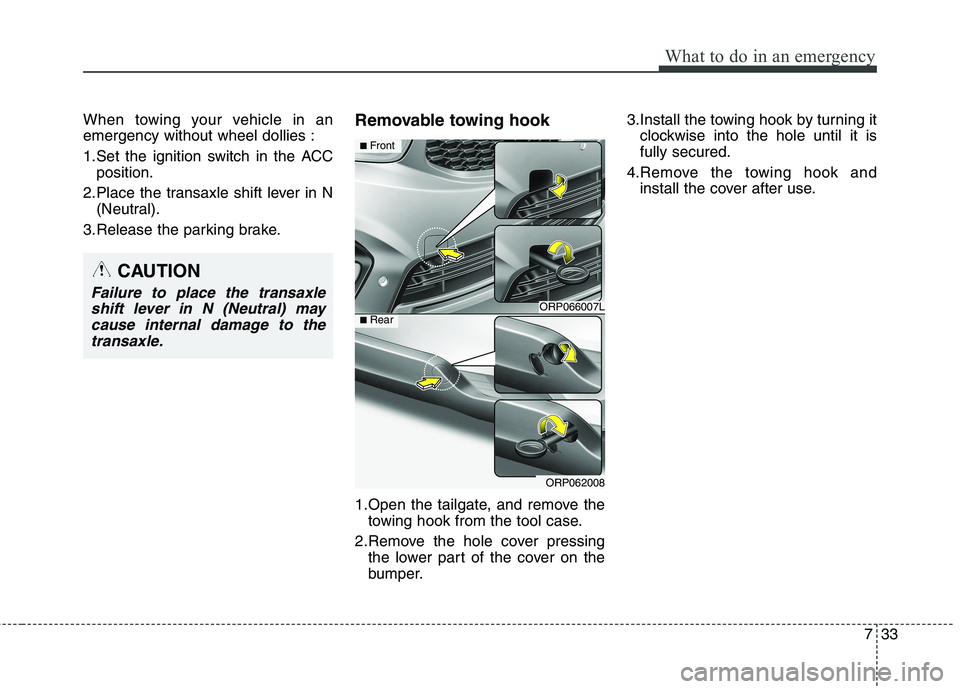
1.Open the tailgate, and remove the
towing hook from the tool case.
2.Remove the hole cover pressing the lower part of the cover on the
bumper. 3.Install the towing hook by turning it
clockwise into the hole until it isfully secured.
4.Remove the towing hook and install the cover after use.
CAUTION
Failure to place the transaxle
shift lever in N (Neutral) maycause internal damage to the transaxle.ORP066007L
ORP062008
■ Front
■Rear
Page 585 of 723
735
What to do in an emergency
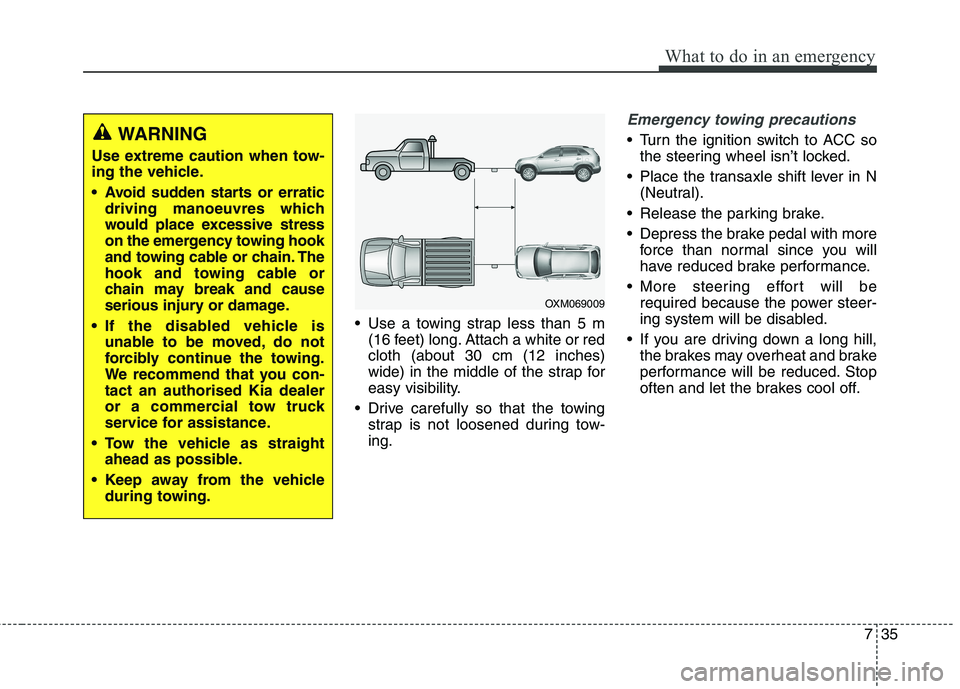
Use a towing strap less than 5 m(16 feet) long. Attach a white or red cloth (about 30 cm (12 inches)
wide) in the middle of the strap for
easy visibility.
Drive carefully so that the towing strap is not loosened during tow-ing.
Emergency towing precautions
Turn the ignition switch to ACC sothe steering wheel isn’t locked.
Place the transaxle shift lever in N (Neutral).
Release the parking brake.
Depress the brake pedal with more force than normal since you will
have reduced brake performance.
More steering effort will be required because the power steer-
ing system will be disabled.
If you are driving down a long hill, the brakes may overheat and brake
performance will be reduced. Stop
often and let the brakes cool off.
OXM069009
WARNING
Use extreme caution when tow-
ing the vehicle.
Avoid sudden starts or erratic driving manoeuvres which
would place excessive stress
on the emergency towing hook
and towing cable or chain. The
hook and towing cable or
chain may break and cause
serious injury or damage.
If the disabled vehicle is unable to be moved, do not
forcibly continue the towing.
We recommend that you con-tact an authorised Kia dealer
or a commercial tow truck
service for assistance.
Tow the vehicle as straight ahead as possible.
Keep away from the vehicle during towing.
Page 586 of 723
What to do in an emergency
36
7
CAUTION
- Automatic transaxle /
dual clutch transmission
If the car is being towed with all four wheels on the ground, itcan be towed only from thefront. Be sure that the transaxleis in neutral. Be sure the steer- ing is unlocked by placing theignition switch in the ACC posi-tion. A driver must be in the towed vehicle to operate thesteering and brakes.
To avoid serious damage to the automatic transaxle / dualclutch transmission, limit the vehicle speed to 15 km/h (10mph) and drive less than 1.5km (1 mile) when towing.
(Continued)
(Continued)
Before towing, check the auto- matic transaxle / dual clutchtransmission fluid leak under your vehicle. If the automatictransaxle / dual clutch trans-mission fluid is leaking, a flatbed equipment or towingdolly must be used.
Page 595 of 723
Maintenance
8
8
WARNING - Diesel Engine
Never work on injection system with engine running or within 30seconds after shutting off
engine. High-pressure pump,
rail, injectors and high-pressurepipes are subject to high pres-
sure even after the engine
stopped. The fuel jet produced by
fuel leaks may cause serious
injury, if it touches the body.
People using pacemakers
should not move than 30cm clos-er to the ECU or wiring harness
within the engine room whilst
engine is running, since the high
currents in the electronic engine
control system produce consid-
erable magnetic fields.CAUTION
Do not put heavy objects or apply excessive force on top ofthe engine cover (if equipped)or fuel related parts.
When you inspect the fuel sys- tem (fuel lines and fuel injec-tion devices), contact a profes- sional workshop. Kia recom-mends to visit an authorisedKia dealer/service partner.
Do not drive long time with the engine cover (if equipped)removed.
When checking the engine room, do not go near fire.
Fuel, washer fluid, etc. areflammable oils that may causefire.
Before touching the battery, ignition cables and electricalwiring, you should disconnect the battery "-" terminal. Youmay get an electric shockfrom the electric current.
(Continued)
(Continued) When you remove the interior trim cover with a flat head (-)driver, be careful not to dam-age the cover.
Be careful when you replace and clean bulbs to avoidburns or electrical shock.
Page 615 of 723
Maintenance
28
8
EXPLANATION OF SCHEDULED MAINTENANCE ITEMS
Engine oil and filter The engine oil and filter should be
changed at the intervals specified in
the maintenance schedule. If the car
is being driven in severe conditions,more frequent oil and filter changesare required. Drive belts
Inspect all drive belts for evidence of
cuts, cracks, excessive wear or oil
saturation and replace if necessary.
Drive belts should be checked peri-
odically for proper tension and
adjusted as necessary. Fuel filter cartridge (for diesel) A clogged filter can limit the speed at
which the vehicle may be driven,damage the emission system and
cause multiple issues such as hard
starting. If an excessive amount of for-
eign matter accumulates in the fuel
tank, the filter may require replace-
ment more frequently. After installing
a new filter, run the engine for several
minutes, and check for leaks at the
connections. Have the fuel filter
replaced by a professional workshop.Kia recommends to visit an autho-
rised Kia dealer/service partner.
Fuel filter (for petrol)
Kia petrol vehicle is equipped a life-
time fuel filter that integrated with the
fuel tank. Regular maintenance or
replacement is not needed but
depends on fuel quality. If there are
some important safety matters like
fuel flow restriction, surging, loss of
power, hard starting problem etc, fuelfilter inspection or replace is needed.
Have the fuel filter inspected or
replaced by a professional workshop.Kia recommends to visit an autho-
rised Kia dealer/service partner.Fuel lines, fuel hoses and con- nections
Check the fuel lines, fuel hoses and
connections for leakage and dam-
age. Have the fuel lines, fuel hoses
and connections replaced by a pro-
fessional workshop. Kia recommends
to visit an authorised Kia dealer/serv-
ice partner.
WARNING -
Diesel only
Never work on injection system with engine running or within 30seconds after shutting off
engine. High pressure pump,
rail, injectors and high pressurepipes are subject to high pres-
sure even after the engine
stopped. The fuel jet produced
by fuel leaks may cause serious
injury, if it touch the body. People
using pacemakers should not
move more than 30cm closer tothe ECU or wiring harness with-
in the engine room whilst engine
is running, since the high cur-rents in the Common Rail sys-
tem produce considerable mag-netic fields.
CAUTION
When you are inspecting the belt, place the ignition
switch in the LOCK/OFF or ACCposition.