check oil KIA CARNIVAL 2007 User Guide
[x] Cancel search | Manufacturer: KIA, Model Year: 2007, Model line: CARNIVAL, Model: KIA CARNIVAL 2007Pages: 1575, PDF Size: 44.86 MB
Page 79 of 1575

14.Remove and arrange the main bearings and thrust bearings in the correct order.
15.Remove the CKP sensor(A).
16.Check the free play between a piston and a piston pin.
Try to move the piston back and forth on the piston pin. If any movement is felt, replace the piston and the piston
pin as a set.
17. Remove the piston rings.
(1) Using a piston ring expander, remove the 2 compression rings.
(2) Remove the 2 side rails and the oil ring by hand.
Page 80 of 1575
Arrange the piston rings in the correct order only.
18. Disconnect the connecting rod from the piston.
Using a press, remove the piston pin from the piston.
(Press- in load : 2451.7 ~ 12258.3N(250 ~ 1250kg, 551.2 ~ 2755.81lb)
INSPECTION
CONNECTING ROD AND CRANKSHAFT
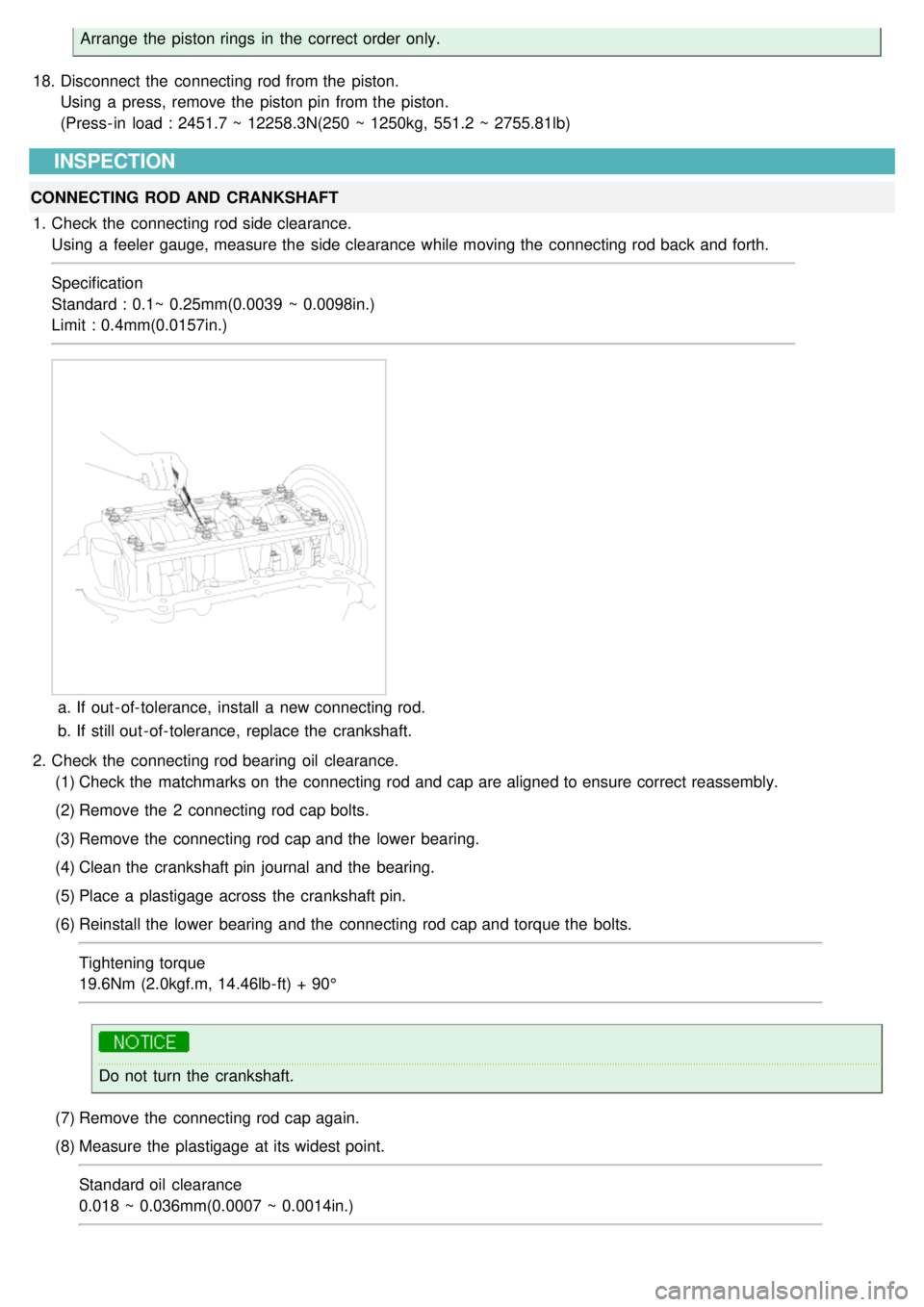
1. Check the connecting rod side clearance.
Using a feeler gauge, measure the side clearance while moving the connecting rod back and forth.
Specification
Standard : 0.1~ 0.25mm(0.0039 ~ 0.0098in.)
Limit : 0.4mm(0.0157in.)
a.If out - of- tolerance, install a new connecting rod.
b. If still out - of- tolerance, replace the crankshaft.
2. Check the connecting rod bearing oil clearance.
(1) Check the matchmarks on the connecting rod and cap are aligned to ensure correct reassembly.
(2) Remove the 2 connecting rod cap bolts.
(3) Remove the connecting rod cap and the lower bearing.
(4) Clean the crankshaft pin journal and the bearing.
(5) Place a plastigage across the crankshaft pin.
(6) Reinstall the lower bearing and the connecting rod cap and torque the bolts.
Tightening torque
19.6Nm (2.0kgf.m, 14.46lb- ft) + 90°
Do not turn the crankshaft.
(7) Remove the connecting rod cap again.
(8) Measure the plastigage at its widest point.
Standard oil clearance
0.018 ~ 0.036mm(0.0007 ~ 0.0014in.)
Page 83 of 1575
C-
(0.0588 ~ 0.0589in.)
D GREEN 1.491 ~ 1.494mm
(0.0587 ~ 0.0588in.)
E YELLOW 1.488 ~ 1.491mm
(0.0586 ~ 0.0587in)
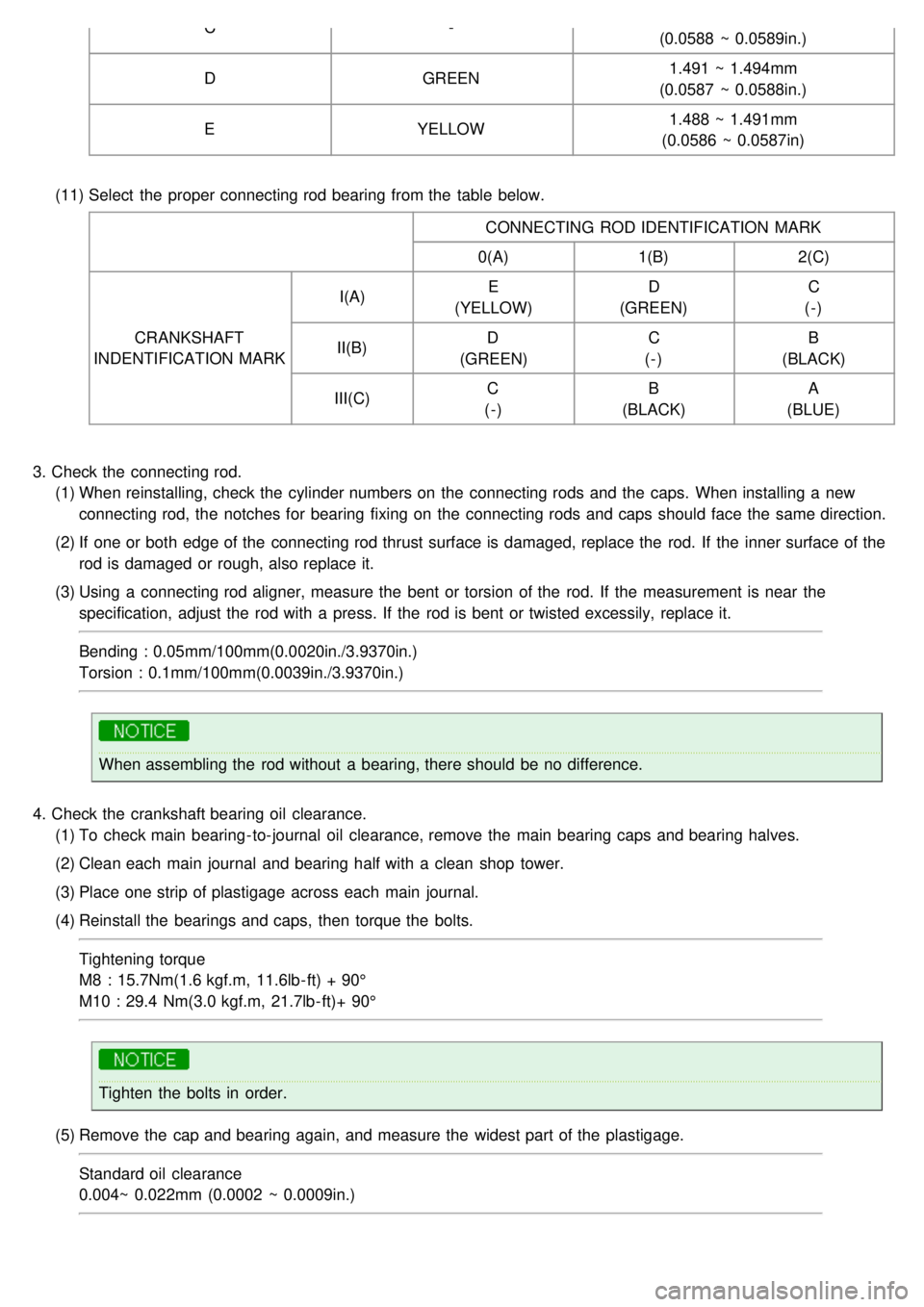
(11) Select the proper connecting rod bearing from the table below.
CONNECTING ROD IDENTIFICATION MARK
0(A) 1(B)2(C)
CRANKSHAFT
INDENTIFICATION MARK I(A)
E
(YELLOW) D
(GREEN) C
(-)
II(B) D
(GREEN) C
(-) B
(BLACK)
III(C) C
(-) B
(BLACK) A
(BLUE)
3. Check the connecting rod.
(1) When reinstalling, check the cylinder numbers on the connecting rods and the caps. When installing a new
connecting rod, the notches for bearing fixing on the connecting rods and caps should face the same direction.
(2) If one or both edge of the connecting rod thrust surface is damaged, replace the rod. If the inner surface of the
rod is damaged or rough, also replace it.
(3) Using a connecting rod aligner, measure the bent or torsion of the rod. If the measurement is near the
specification, adjust the rod with a press. If the rod is bent or twisted excessily, replace it.
Bending : 0.05mm/100mm(0.0020in./3.9370in.)
Torsion : 0.1mm/100mm(0.0039in./3.9370in.)
When assembling the rod without a bearing, there should be no difference.
4. Check the crankshaft bearing oil clearance.
(1) To check main bearing- to- journal oil clearance, remove the main bearing caps and bearing halves.
(2) Clean each main journal and bearing half with a clean shop tower.
(3) Place one strip of plastigage across each main journal.
(4) Reinstall the bearings and caps, then torque the bolts.
Tightening torque
M8 : 15.7Nm(1.6 kgf.m, 11.6lb- ft) + 90°
M10 : 29.4 Nm(3.0 kgf.m, 21.7lb- ft)+ 90°
Tighten the bolts in order.
(5) Remove the cap and bearing again, and measure the widest part of the plastigage.
Standard oil clearance
0.004~ 0.022mm (0.0002 ~ 0.0009in.)
Page 90 of 1575
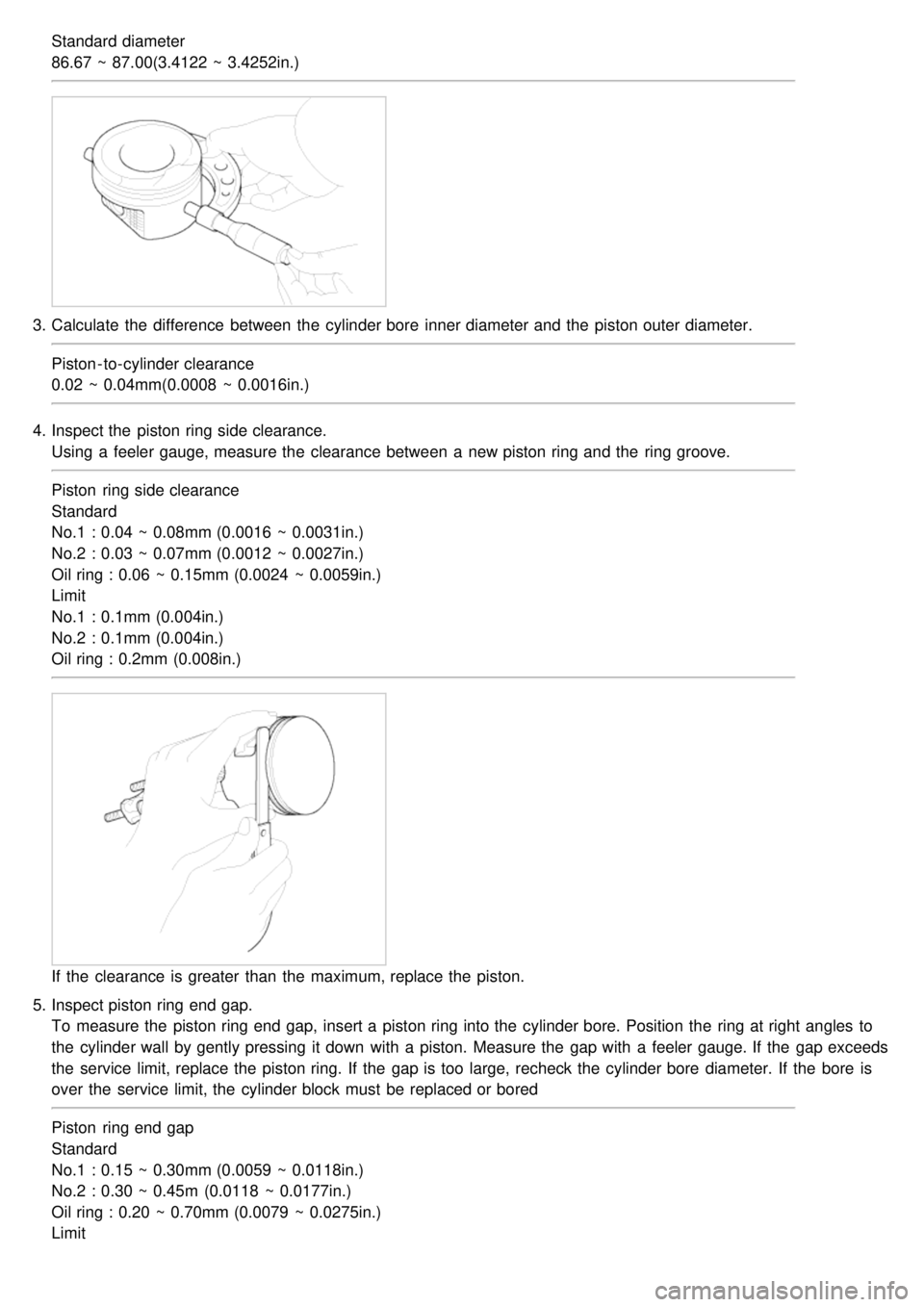
Standard diameter
86.67 ~ 87.00(3.4122 ~ 3.4252in.)
3.Calculate the difference between the cylinder bore inner diameter and the piston outer diameter.
Piston - to- cylinder clearance
0.02 ~ 0.04mm(0.0008 ~ 0.0016in.)
4. Inspect the piston ring side clearance.
Using a feeler gauge, measure the clearance between a new piston ring and the ring groove.
Piston ring side clearance
Standard
No.1 : 0.04 ~ 0.08mm (0.0016 ~ 0.0031in.)
No.2 : 0.03 ~ 0.07mm (0.0012 ~ 0.0027in.)
Oil ring : 0.06 ~ 0.15mm (0.0024 ~ 0.0059in.)
Limit
No.1 : 0.1mm (0.004in.)
No.2 : 0.1mm (0.004in.)
Oil ring : 0.2mm (0.008in.)
If the clearance is greater than the maximum, replace the piston.
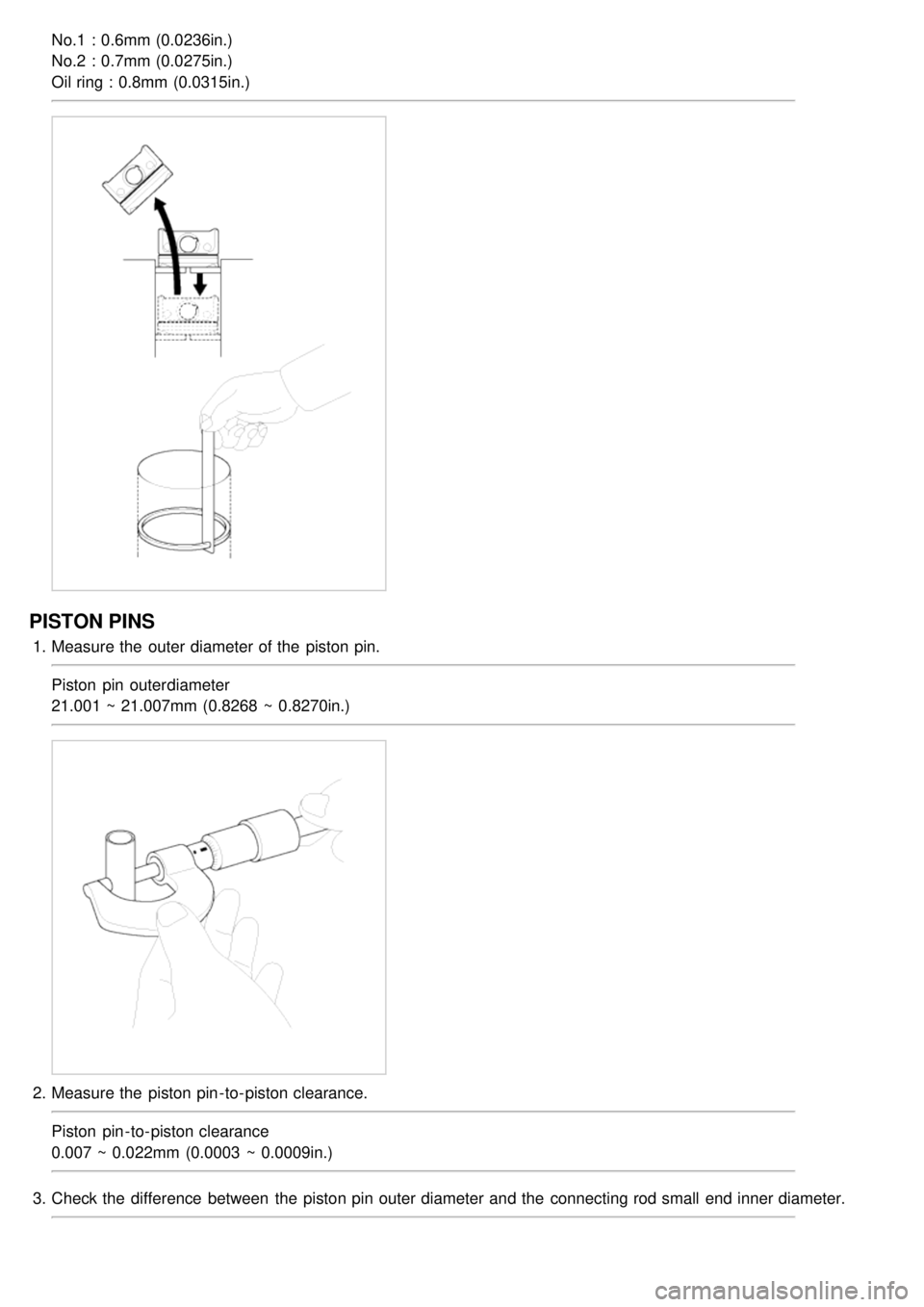
5. Inspect piston ring end gap.
To measure the piston ring end gap, insert a piston ring into the cylinder bore. Position the ring at right angles to
the cylinder wall by gently pressing it down with a piston. Measure the gap with a feeler gauge. If the gap exceeds
the service limit, replace the piston ring. If the gap is too large, recheck the cylinder bore diameter. If the bore is
over the service limit, the cylinder block must be replaced or bored
Piston ring end gap
Standard
No.1 : 0.15 ~ 0.30mm (0.0059 ~ 0.0118in.)
No.2 : 0.30 ~ 0.45m (0.0118 ~ 0.0177in.)
Oil ring : 0.20 ~ 0.70mm (0.0079 ~ 0.0275in.)
Limit
Page 91 of 1575
No.1 : 0.6mm (0.0236in.)
No.2 : 0.7mm (0.0275in.)
Oil ring : 0.8mm (0.0315in.)
PISTON PINS
1.Measure the outer diameter of the piston pin.
Piston pin outer diameter
21.001 ~ 21.007mm (0.8268 ~ 0.8270in.)
2. Measure the piston pin- to- piston clearance.
Piston pin- to- piston clearance
0.007 ~ 0.022mm (0.0003 ~ 0.0009in.)
3. Check the difference between the piston pin outer diameter and the connecting rod small end inner diameter.
Page 95 of 1575

M8 : 15.7Nm(1.6 kgf.m, 11.6lb- ft) + 90°
M10 : 29.4Nm(3.0 kgf.m, 21.7lb- ft)+ 90°
a.Use new main bearing cap bolt with engine oil applied.
b. If any of the bearing cap bolts are broken or deformed, replace it.
c. Washers have their direction(Up/Down)
d. Assemble the bearing cap bridge on which its arrow mark faces the engine front.
e. Before tightening, make the bearing caps be seated on the block firmly.
Use SST( 09221 - 4A000 ), install main bearing cap bolts.
(2) Check that the crankshaft turns smoothly.
10. Check crankshaft end play.
11. Install the piston and connecting rod assemblies.
a.Before installing the pistons, apply a coat of engine oil to the ring grooves and cylinder bores.
b. When installing the piston, ensure that the coat on the cylinder wall is not damaged or scratched.
(1) Install the ring compressor, check that the bearing is securely in place, then position the piston in the cylinder,
and tap it in using the wooden handle of a hammer.
(2) Stop inserting the piston when the ring inserted in the cylinder and check the alignment of the journal and the
connecting rod.
(3) Apply engine oil to the bolt threads. Install the rod caps with bearings, and torque the bolts.
Tightening torque
Page 119 of 1575
c.In order to preserve environment, used oil or used oil filter must be disposed only at designated disposal
sites.
1. Park the car on a level ground.
Start the engine and let it warm up.
2. Turn the engine off.
3. Drain engine oil.
(1) Remove the oil filler cap.
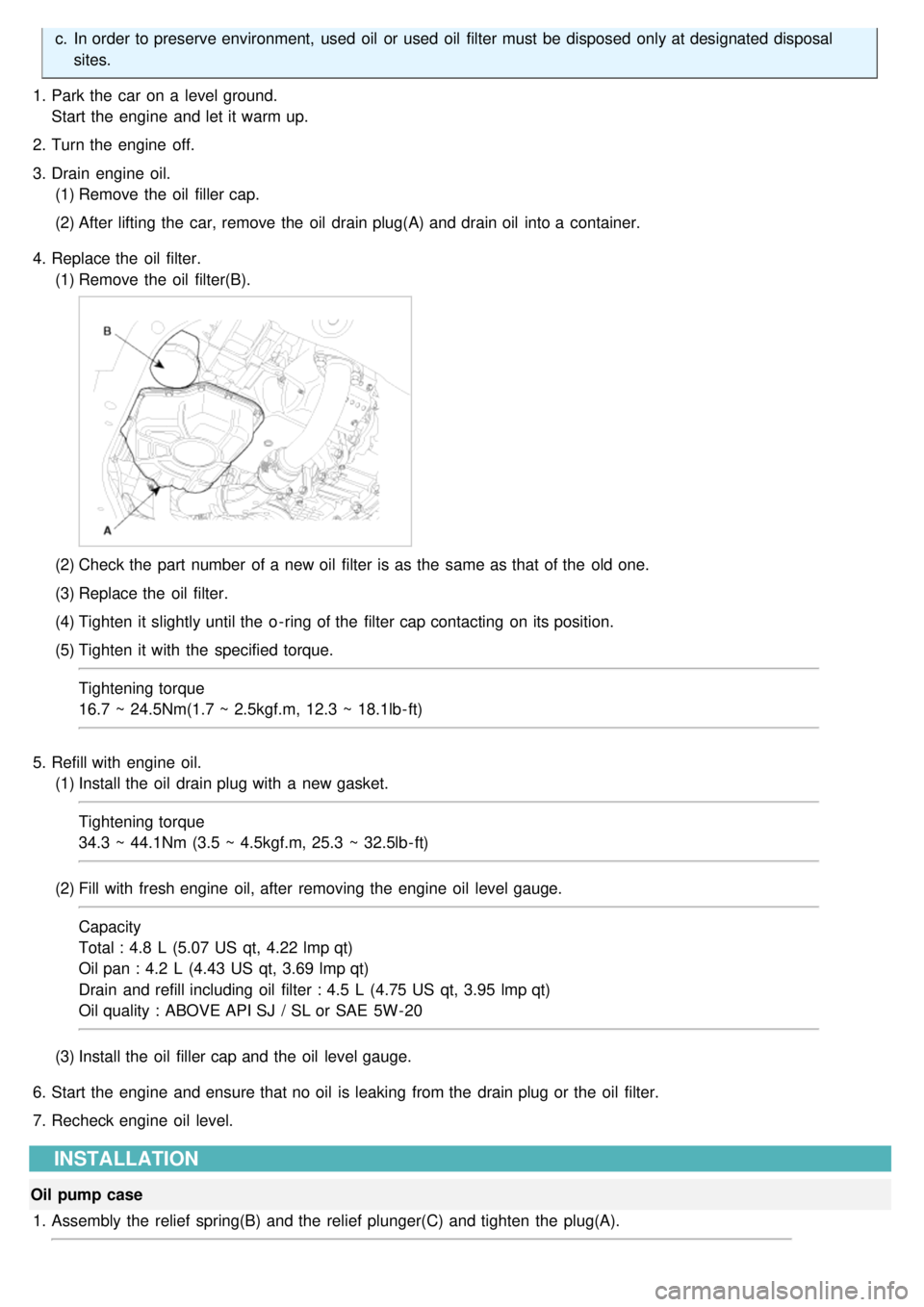
(2) After lifting the car, remove the oil drain plug(A) and drain oil into a container.
4. Replace the oil filter.
(1) Remove the oil filter(B).
(2)Check the part number of a new oil filter is as the same as that of the old one.
(3) Replace the oil filter.
(4) Tighten it slightly until the o - ring of the filter cap contacting on its position.
(5) Tighten it with the specified torque.
Tightening torque
16.7 ~ 24.5Nm(1.7 ~ 2.5kgf.m, 12.3 ~ 18.1lb- ft)
5. Refill with engine oil.
(1) Install the oil drain plug with a new gasket.
Tightening torque
34.3 ~ 44.1Nm (3.5 ~ 4.5kgf.m, 25.3 ~ 32.5lb- ft)
(2) Fill with fresh engine oil, after removing the engine oil level gauge.
Capacity
Total : 4.8 L (5.07 US qt, 4.22 lmp qt)
Oil pan : 4.2 L (4.43 US qt, 3.69 lmp qt)
Drain and refill including oil filter : 4.5 L (4.75 US qt, 3.95 lmp qt)
Oil quality : ABOVE API SJ / SL or SAE 5W- 20
(3) Install the oil filler cap and the oil level gauge.
6. Start the engine and ensure that no oil is leaking from the drain plug or the oil filter.
7. Recheck engine oil level.
INSTALLATION
Oil pump case
1. Assembly the relief spring(B) and the relief plunger(C) and tighten the plug(A).
Page 124 of 1575
Always use a new O - ring.
8. Install the timing belt, the generator and the front muffler.
9. Install the front right side cover and the wheel and tire.
10. Fill with engine coolant.
11. Start engine and check for leaks.
12. Recheck engine coolant level.
INSPECTION
1.Check engine oil quality.
Check the oil for deterioration, entry of water, discoloring or thinning.
If the quality is visibly poor, replace oil.
2. Check the engine oil level.
After warning up the engine, make the engine stand still for five minutes or more. The oil level should be between
the 'L' and 'F' marks on the dipstick, then.
If low, check for leakage and add oil up to the "F" mark.
Do not fill with engine oil above the "F" mark.
SELECTION OF ENGINE OIL
Recommended API classification : Above SJ or SL
Recommended SAE viscosity grades : 5W- 20
Page 125 of 1575
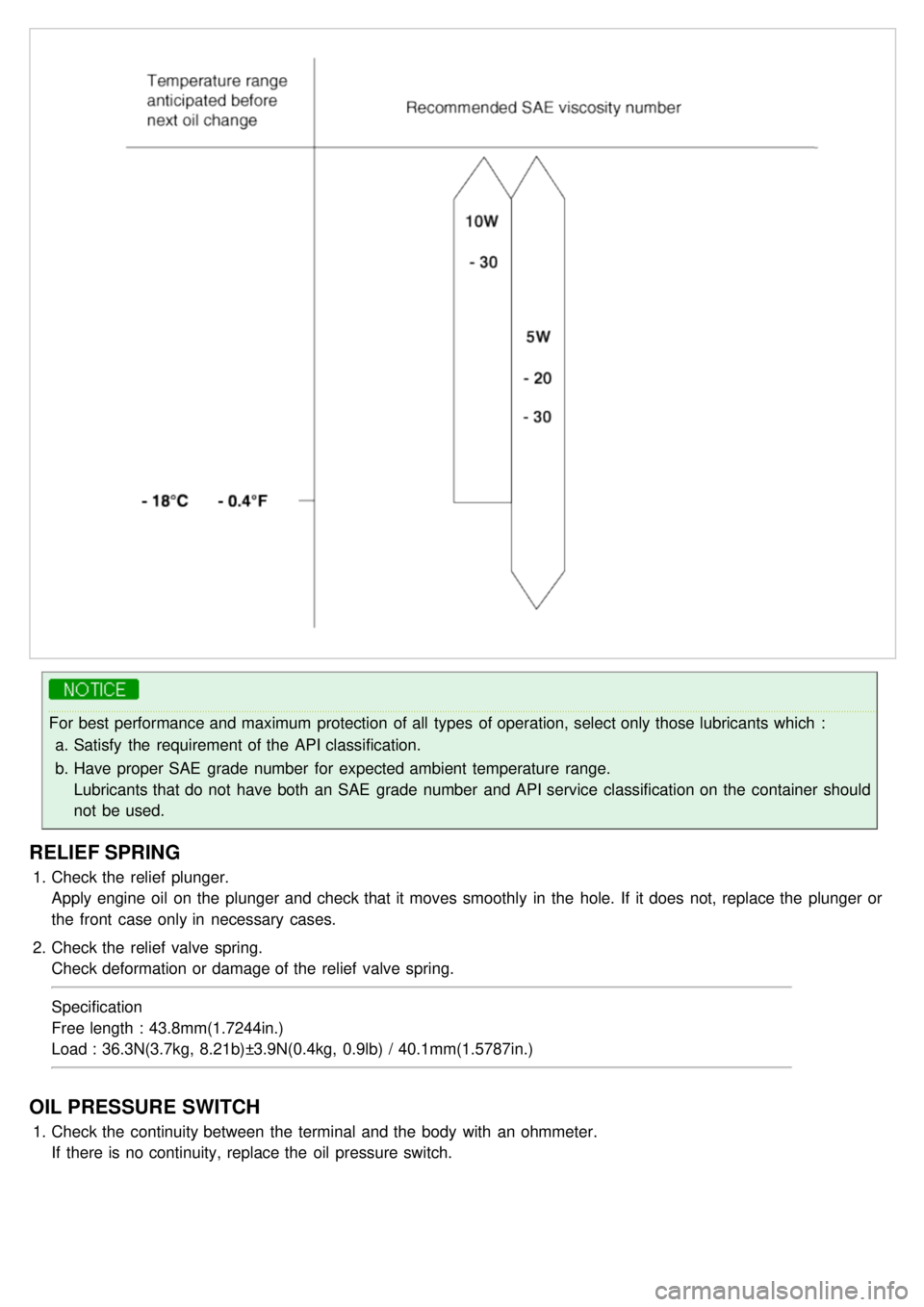
For best performance and maximum protection of all types of operation, select only those lubricants which :a. Satisfy the requirement of the API classification.
b. Have proper SAE grade number for expected ambient temperature range.
Lubricants that do not have both an SAE grade number and API service classification on the container should
not be used.
RELIEF SPRING
1.Check the relief plunger.
Apply engine oil on the plunger and check that it moves smoothly in the hole. If it does not, replace the plunger or
the front case only in necessary cases.
2. Check the relief valve spring.
Check deformation or damage of the relief valve spring.
Specification
Free length : 43.8mm(1.7244in.)
Load : 36.3N(3.7kg, 8.21b)±3.9N(0.4kg, 0.9lb) / 40.1mm(1.5787in.)
OIL PRESSURE SWITCH
1.Check the continuity between the terminal and the body with an ohmmeter.
If there is no continuity, replace the oil pressure switch.
Page 126 of 1575
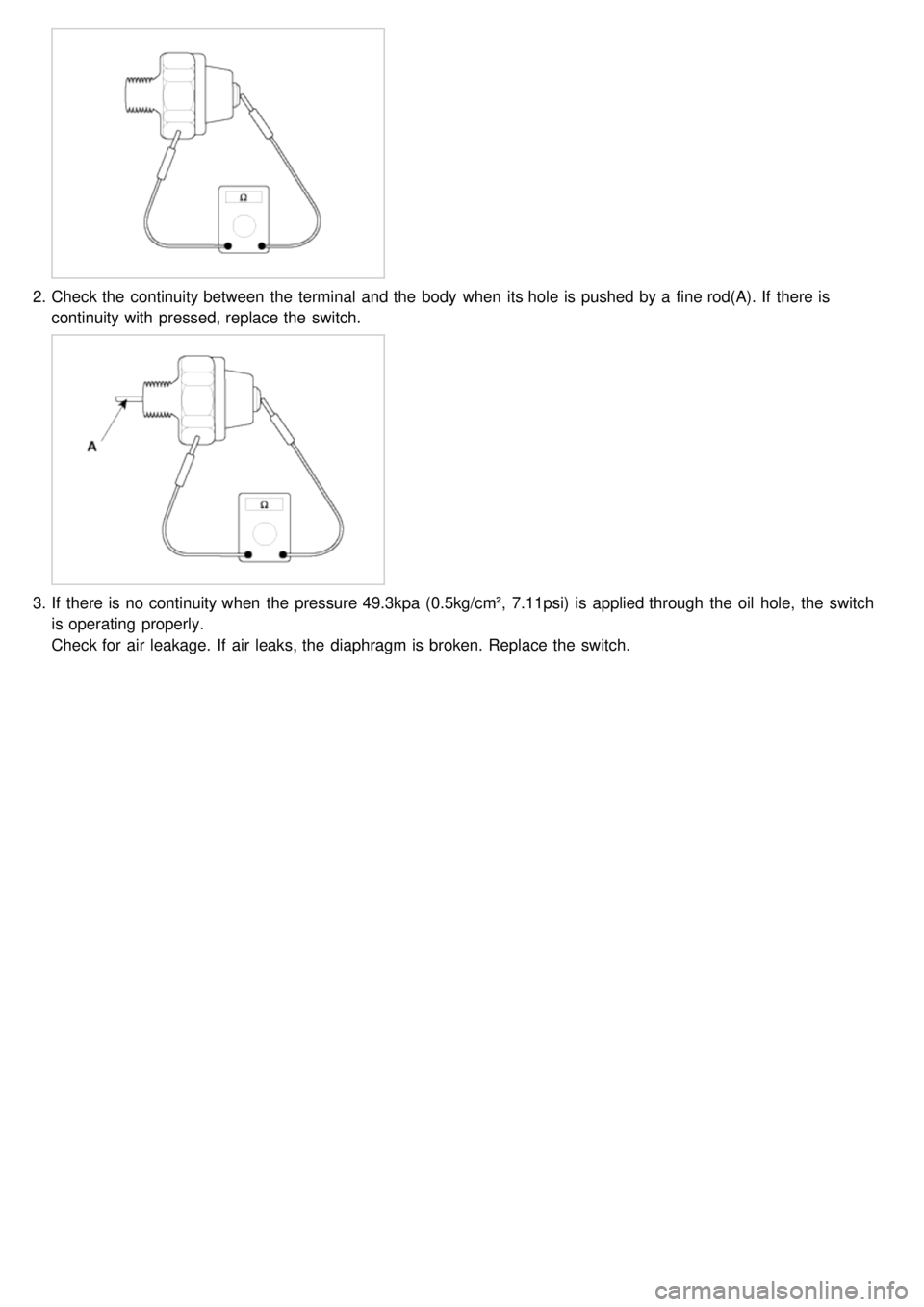
2.Check the continuity between the terminal and the body when its hole is pushed by a fine rod(A). If there is
continuity with pressed, replace the switch.
3.If there is no continuity when the pressure 49.3kpa (0.5kg/cm², 7.11psi) is applied through the oil hole, the switch
is operating properly.
Check for air leakage. If air leaks, the diaphragm is broken. Replace the switch.