check oil KIA CARNIVAL 2007 Repair Manual
[x] Cancel search | Manufacturer: KIA, Model Year: 2007, Model line: CARNIVAL, Model: KIA CARNIVAL 2007Pages: 1575, PDF Size: 44.86 MB
Page 665 of 1575
2007 > 2.7L V6 GASOLINE >
INSPECTION
Oil Specification
1. The HFC- 134a system requires synthetic (PAG) compressor oil whereas the R- 12 system requires mineral
compressor oil. The two oils must never be mixed.
2. Compressor (PAG) oil varies according to compressor model. Be sure to use oil specified for the model of
compressor.
Handling of Oil
1.The oil should be free from moisture, dust, metal powder, etc.
2. Do not mix with other oil.
3. The water content in the oil increases when exposed to the air. After use, seal oil from air immediately. (HFC - 134a
Compressor Oil absorbs moisture very easily.)
4. The compressor oil must be stored in steel containers, not in plastic containers.
Compressor oil check
The oil used to lubricate the compressor is circulating with the refrigerant.
Whenever replacing any component of the system or a large amount of gas leakage occurs, add oil to maintain the
original amount of oil.
Oil total volume in system:
120±10cc (4.05±0.34 fl.oz)
Oil Return Operation
There is close affinity between the oil and the refrigerant.
During normal operation, part of the oil recirculates with the refrigerant in the system. When checking the amount of
oil in the system, or replacing any component of the system, the compressor must be run in advance for oil return
operation. The procedure is as follows:
1. Open all the doors and the engine hood.
2. Start the engine and air conditioning switch to "ON" and set the blower motor control knob at its highest position.
3. Run the compressor for more than 20 minutes between 800 and 1,000 rpm in order to operate the system.
4. Stop the engine.
Replacement of Component Parts
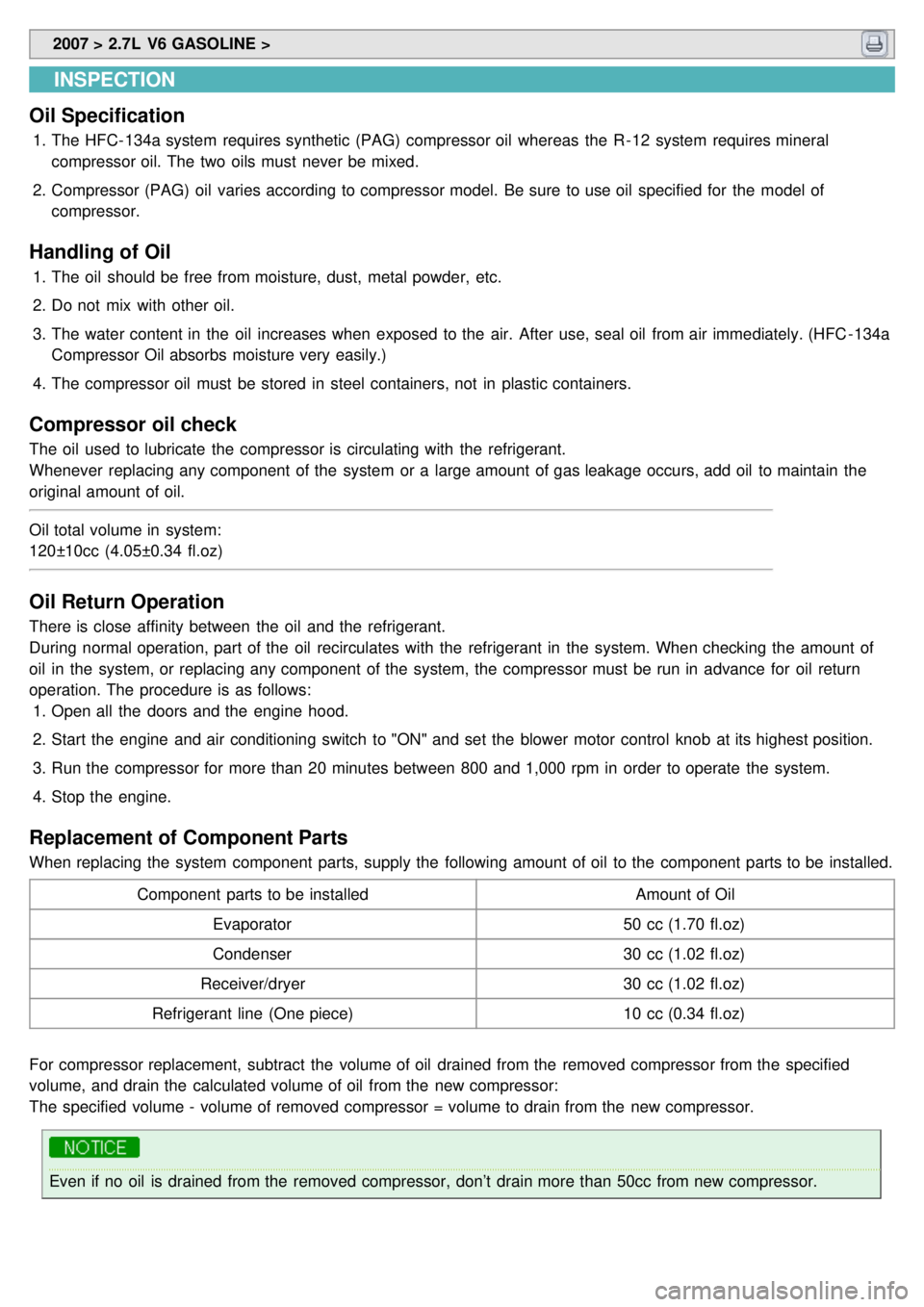
When replacing the system component parts, supply the following amount of oil to the component parts to be installed.
Component parts to be installed Amount of Oil
Evaporator 50 cc (1.70 fl.oz)
Condenser 30 cc (1.02 fl.oz)
Receiver/dryer 30 cc (1.02 fl.oz)
Refrigerant line (One piece) 10 cc (0.34 fl.oz)
For compressor replacement, subtract the volume of oil drained from the removed compressor from the specified
volume, and drain the calculated volume of oil from the new compressor:
The specified volume - volume of removed compressor = volume to drain from the new compressor.
Even if no oil is drained from the removed compressor, don’t drain more than 50cc from new compressor.
Page 668 of 1575

2007 > 2.7L V6 GASOLINE >
INSPECTION
1.Check the condenser fins for clogging and damage. If clogged, clean them with water, and blow them with
compressed air. If bent, gently bend them using a screwdriver or pliers.
2. Check the condenser connections for leakage, and repair or replace it, if required.
REPLACEMENT
CONDENSER ASSEMBLY
1. Recover the refrigerant with a recovery/ recycling/ charging station (Refer to HA - 8).
2. Disconnect the negative ( - ) battery terminal.
3. Remove the radiator. (Refer to EM group)
4. Remove 2 bolts, and then remove the condenser (A) by lifting it up. Be careful not to damage the radiator and
condenser fins when removing the condenser.
5.Install in the reverse order of removal, and note these items :
a. If you're installing a new condenser, add refrigerant oil ND- OIL8.
b. Replace the O - rings with new ones at each fitting, and apply a thin coat of refrigerant oil before installing them.
Be sure to use the right O - rings for R- 134a to avoid leakage.
c. Be careful not to damage the radiator and condenser fins when installing the condenser.
d. Be sure to install the lower mount cushions of condenser securely into the holes.
e. Charge the system, and test its performance. (Refer to HA - 9)
DESICCANT
1.Remove the condenser, and then remove the bottom cap (B) with L wrench (A) from the condenser.
TORQUE: 20~25N.m (2.0~2.5kgf•m, 14.5~18.2lb - ft)
Page 669 of 1575
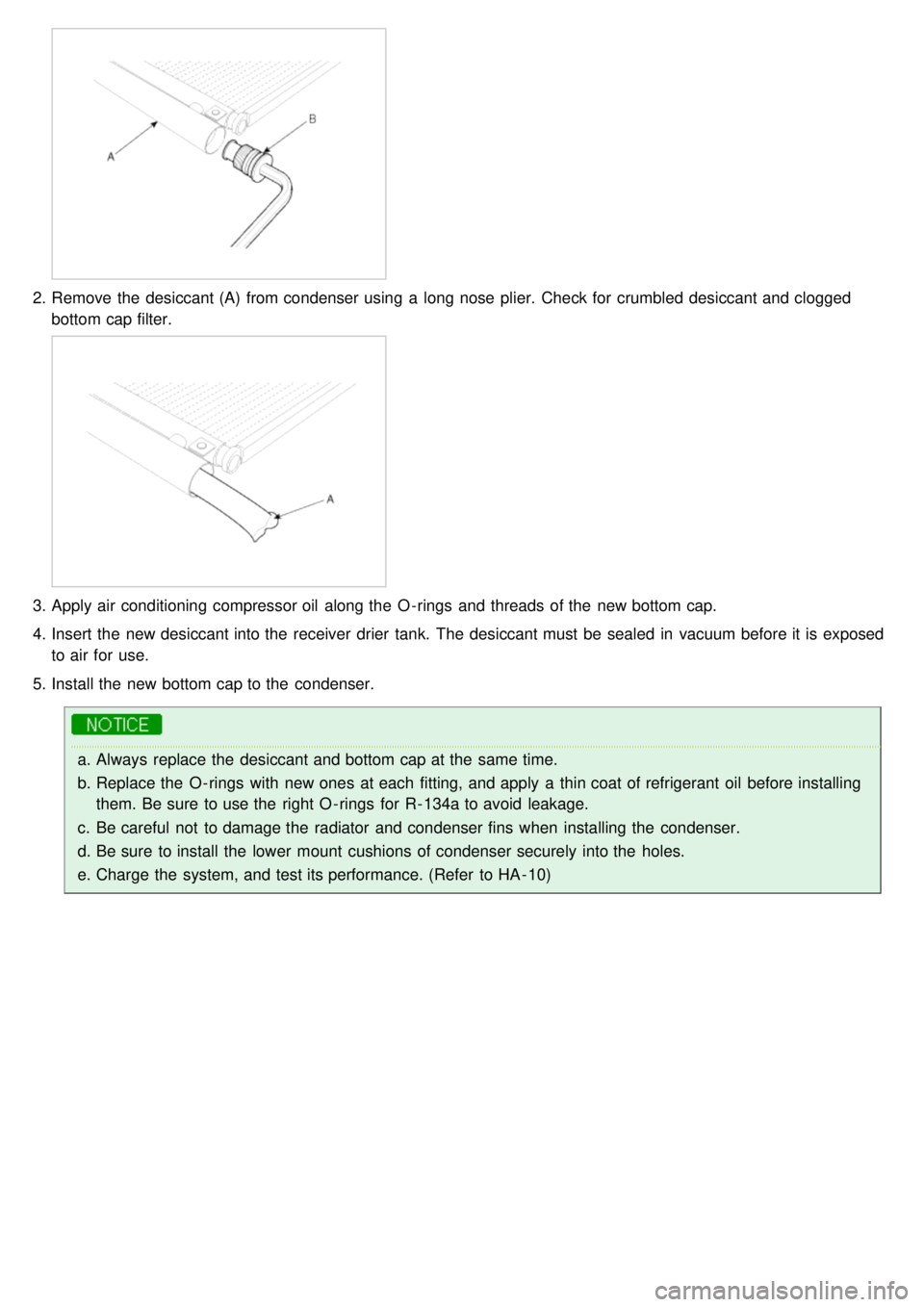
2.Remove the desiccant (A) from condenser using a long nose plier. Check for crumbled desiccant and clogged
bottom cap filter.
3.Apply air conditioning compressor oil along the O - rings and threads of the new bottom cap.
4. Insert the new desiccant into the receiver drier tank. The desiccant must be sealed in vacuum before it is exposed
to air for use.
5. Install the new bottom cap to the condenser.
a.Always replace the desiccant and bottom cap at the same time.
b. Replace the O - rings with new ones at each fitting, and apply a thin coat of refrigerant oil before installing
them. Be sure to use the right O - rings for R- 134a to avoid leakage.
c. Be careful not to damage the radiator and condenser fins when installing the condenser.
d. Be sure to install the lower mount cushions of condenser securely into the holes.
e. Charge the system, and test its performance. (Refer to HA - 10)
Page 889 of 1575
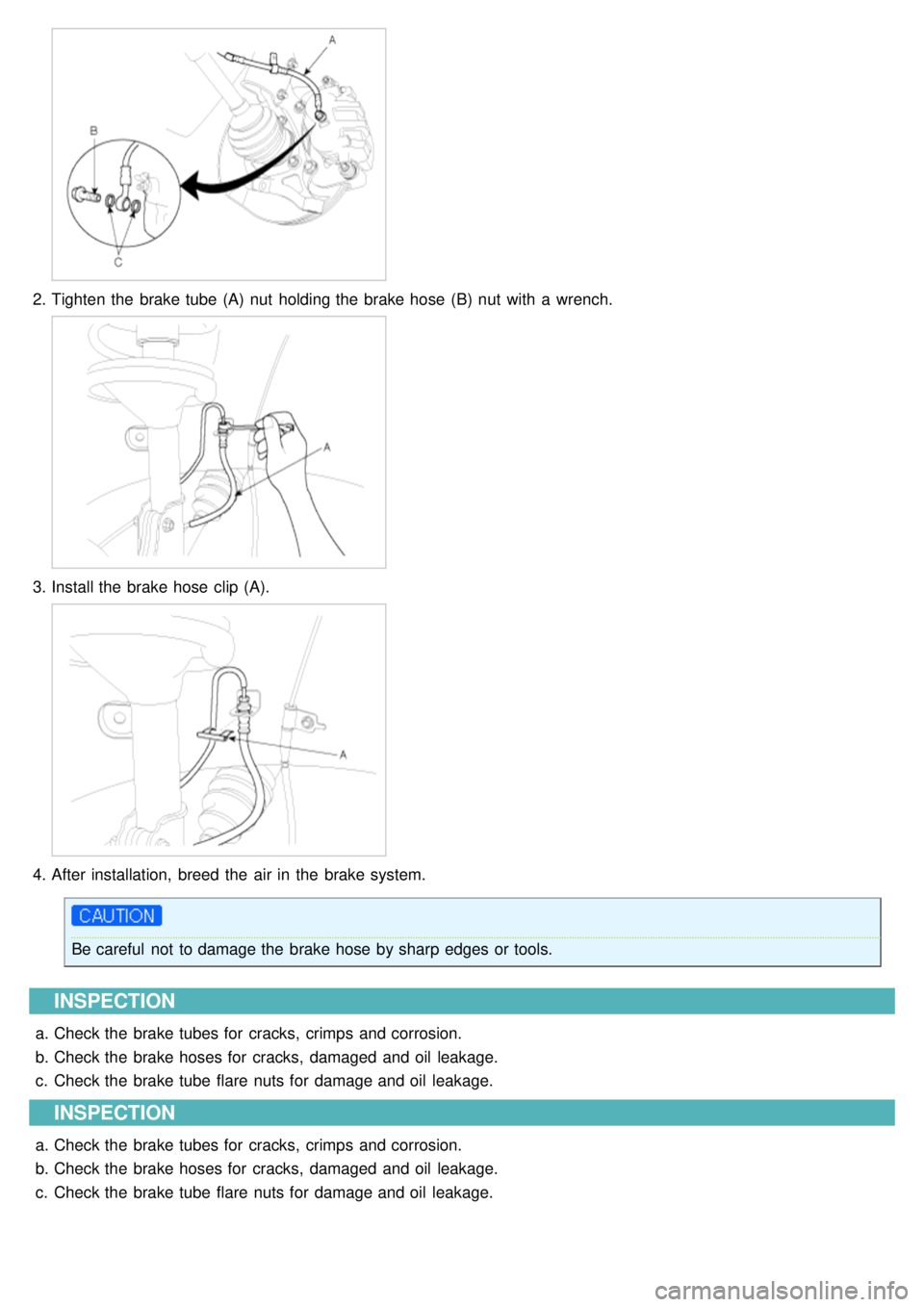
2.Tighten the brake tube (A) nut holding the brake hose (B) nut with a wrench.
3.Install the brake hose clip (A).
4.After installation, breed the air in the brake system.
Be careful not to damage the brake hose by sharp edges or tools.
INSPECTION
a.Check the brake tubes for cracks, crimps and corrosion.
b. Check the brake hoses for cracks, damaged and oil leakage.
c. Check the brake tube flare nuts for damage and oil leakage.
INSPECTION
a.Check the brake tubes for cracks, crimps and corrosion.
b. Check the brake hoses for cracks, damaged and oil leakage.
c. Check the brake tube flare nuts for damage and oil leakage.
Page 928 of 1575

2007 > 2.7L V6 GASOLINE >
DESCRIPTION
This specification applies to HCU(Hydraulic Control Unit) and ECU(Electronic Control Unit) of the HECU.(Hydraulic and
Electronic Control Unit)
This specification is for the wiring design and installation of ABS/TCS/ESC ECU.
This unit has the functions as follows.
a. Input of signal from Pressure sensor, Steering angle sensor, Yaw & Lateral G sensor, the wheel speed sensors
attached to each wheel.
b. Control of braking force / traction force/ yaw moment.
c. Failsafe function.
d. Self diagnosis function.
e. Interface with the external diagnosis tester.
Installation position : engine compartment a. Brake tube length from Master cylinder port to HECU inlet port should be max. 1m
b. The position should not be close to the engine block and not lower than the wheel.
OPERATION
The ECU shall be put into operation by switching on the operating voltage (IGN).
On completion of the initialization phase, the ECU shall be ready for operation.
In the operating condition, the ECU shall be ready, within the specified limits (voltage and temperature), to process the
signals offered by the various sensors and switches in accordance with the control algorithm defined by the software
and to control the hydraulic and electrical actuators.
Wheel Sensor signal processing
The ECU shall receive wheel speed signal from the four active wheel sensors.
The wheel signals are converted to voltage signal by the signal conditioning circuit after receiving current signal from
active wheel sensors and given as input to the MCU.
Solenoid Valve Control
When one side of the valve coil is connected to the positive voltage that is provided through the valve relay and the
other side is connected to the ground by the semiconductor circuit, the solenoid valve goes into operation.
The electrical function of the coils are always monitored by the valve test pulse under normal operation conditions.
Voltage limits
a.Overvoltage
When overvoltage is detected(above 16.8 V), the ECU switches off the valve relay and shuts down the system.
When voltage is returned to operating range, the system goes back to the normal condition after the initialization
phase.
b. Undervoltage
In the event of undervoltage(below 9.3 V), ABS control shall be inhibited and the warning lamp shall be turned on.
When voltage is returned to operating range, the warning lamp is switched off and ECU returns to normal operating
mode.
Pump Motor Checking
The ECU performs a pump motor test at a speed of 15km/h once after IGN is switched on.
Diagnostic Interface
Failures detected by the ECU are encoded on the ECU, stored in a EEPROM and read out by diagnostic equipment
when the ignition switch is turned on.
The diagnosis interface can also be used for testing the ECU during production of the ECU and for actuating the HCU
(Air - bleeding line or Roll and Brake Test line).
Warning Lamp module
Page 1242 of 1575
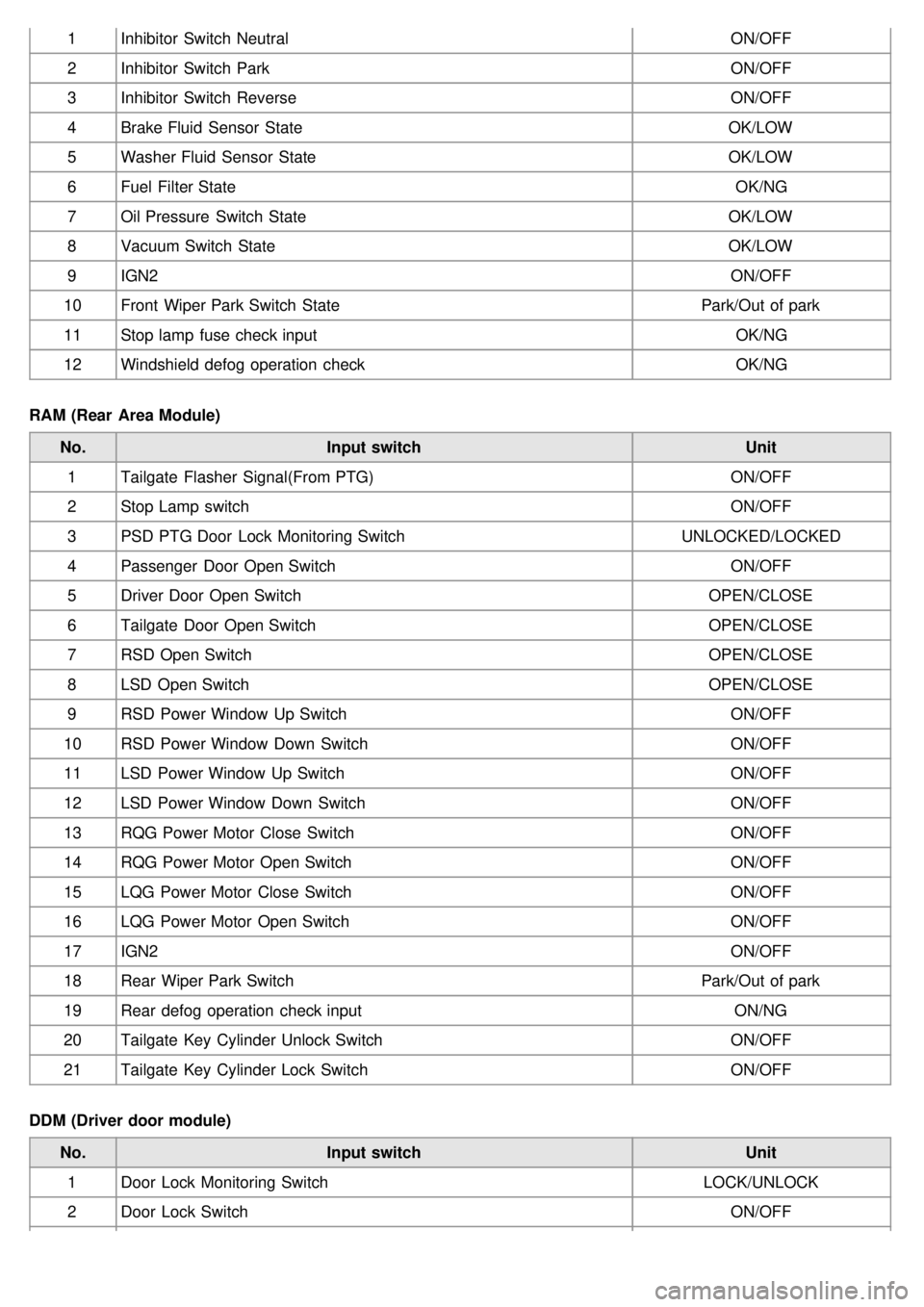
1Inhibitor Switch Neutral ON/OFF
2 Inhibitor Switch Park ON/OFF
3 Inhibitor Switch Reverse ON/OFF
4 Brake Fluid Sensor State OK/LOW
5 Washer Fluid Sensor State OK/LOW
6 Fuel Filter State OK/NG
7 Oil Pressure Switch State OK/LOW
8 Vacuum Switch State OK/LOW
9 IGN2 ON/OFF
10 Front Wiper Park Switch State Park/Out of park
11 Stop lamp fuse check input OK/NG
12 Windshield defog operation check OK/NG
RAM (Rear Area Module) No. Input switch Unit
1 Tailgate Flasher Signal(From PTG) ON/OFF
2 Stop Lamp switch ON/OFF
3 PSD PTG Door Lock Monitoring Switch UNLOCKED/LOCKED
4 Passenger Door Open Switch ON/OFF
5 Driver Door Open Switch OPEN/CLOSE
6 Tailgate Door Open Switch OPEN/CLOSE
7 RSD Open Switch OPEN/CLOSE
8 LSD Open Switch OPEN/CLOSE
9 RSD Power Window Up Switch ON/OFF
10 RSD Power Window Down Switch ON/OFF
11 LSD Power Window Up Switch ON/OFF
12 LSD Power Window Down Switch ON/OFF
13 RQG Power Motor Close Switch ON/OFF
14 RQG Power Motor Open Switch ON/OFF
15 LQG Power Motor Close Switch ON/OFF
16 LQG Power Motor Open Switch ON/OFF
17 IGN2 ON/OFF
18 Rear Wiper Park Switch Park/Out of park
19 Rear defog operation check input ON/NG
20 Tailgate Key Cylinder Unlock Switch ON/OFF
21 Tailgate Key Cylinder Lock Switch ON/OFF
DDM (Driver door module) No. Input switch Unit
1 Door Lock Monitoring Switch LOCK/UNLOCK
2 Door Lock Switch ON/OFF
Page 1309 of 1575

Tolerance(rpm) 5,000
6,0007,0008,000Engine
Revolution (rpm) ±150
±180±210 -Gasoline
±150 ±150 --Diesel
FUEL GAUGE SENDER
1.Using an ohmmeter, measure the resistance between terminals 1 and 2 of sender connector (A) at each float level.
2.Also check that the resistance changes smoothly when the float is moved from "E" to "F".
Position Resistance(Ω)
Sender (E) 200
Warning lamp 160
1/2 54.5
Sender (F) 8
If the height resistance is not within specifications, replace the fuel sender as an assembly.
After completing this test, wipe the sender dry and reinstall it in the fuel tank.
ENGINE COOLANT TEMPERATURE SENDER
1.Using an ohmmeter, measure the resistance between the terminal 2 and ground.
Temperature[°F(°C)] 140
(60) 185
(85) 230
(110) 257
(127.4) E/G
Resistance (Ω) 12856.1 25.216.1Gasoline
Temperature [°F(°C)] 120
(49) 160
(71) 230
(110) 260
(127.4) E/G
Resistance (Ω) 209.688.724.315.9Diesel
OIL PRESSURE SWITCH
1.Check that there is continuity between the oil press switch terminal and ground with the engine off.
2. Check that there is no continuity between the terminal and ground with the engine running.
3. If operation is not as specified, replace the switch.
Page 1310 of 1575

4.Connect the oil pressure switch wire harness.
5. Turn the ignition switch ON. Check that the warning lamp lights up. If the warning lamp doesn't light, test the wire
harness.
BRAKE FLUID LEVEL WARNING SWITCH
1.Remove the connector (A) from the switch located at the brake fluid reservoir (B).
2. Verify that continuity exists between switch terminals 1 and 2 while pressing the switch (float) down with a rod.
BRAKE FLUID LEVEL WARNING LAMP
1.Ignition "ON"
2. Release the parking brake.
3. Remove the connector from the brake fluid level warning switch.
4. Ground the connector at the harness side.
5. Verify that the warning lamp lights.
PARKING BRAKE SWITCH
The parking brake switch is a push type. It is located at the side of the parking brake pedal.
1. Check that there is continuity between the terminal and switch body with the switch (A) ON.
Page 1414 of 1575

2007 > 2.7L V6 GASOLINE >
INSPECTION
Wrap tin foil around the end of the voltmeter test lead to prevent damaging the heater line. Apply finger pressure
on the tin foil, moving the tin foil along the grid line to check for open circuits.
1.Turn on the defogger switch and use a voltmeter to measure the voltage of each heater line at the glass center
point. If a voltage of approximately 6V is indicated by the voltmeter, the heater line of the rear window is
considered satisfactory.
2.If a heater line is burned out between the center point and (+) terminal, the voltmeter will indicate 12V.
3.If a heater line is burned out between the center point and ( - ) terminal, the voltmeter will indicate 0V.
Page 1503 of 1575
2007 > 2.7L V6 GASOLINE >
DESCRIPTION
The immobilizer system will disable the vehicle unless the proper ignition key is used, in addition to the currently
available anti- theft systems such as car alarms, the immobilizer system aims to drastically reduce the rate of auto
theft.
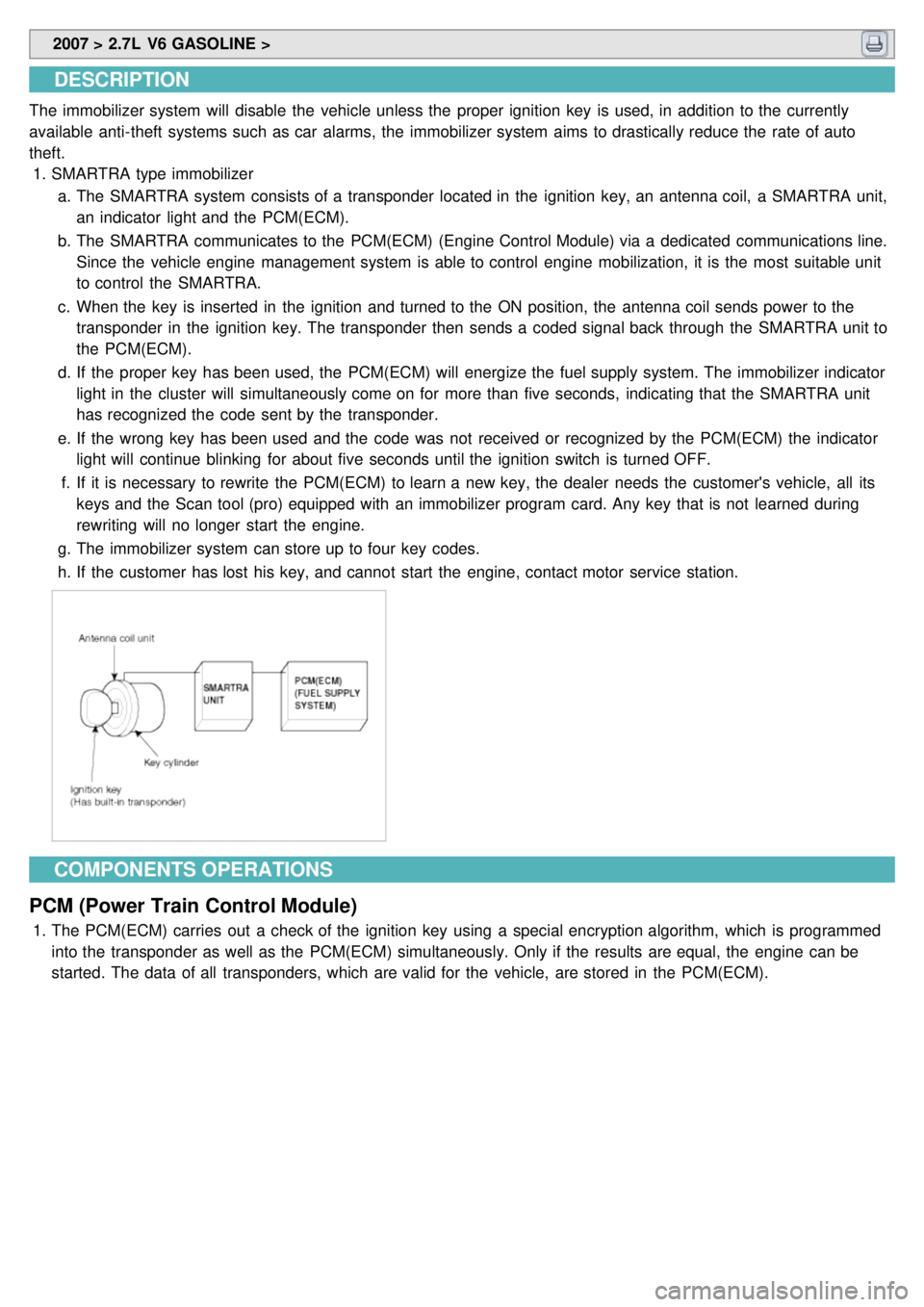
1. SMARTRA type immobilizer
a. The SMARTRA system consists of a transponder located in the ignition key, an antenna coil, a SMARTRA unit,
an indicator light and the PCM(ECM).
b. The SMARTRA communicates to the PCM(ECM) (Engine Control Module) via a dedicated communications line.
Since the vehicle engine management system is able to control engine mobilization, it is the most suitable unit
to control the SMARTRA.
c. When the key is inserted in the ignition and turned to the ON position, the antenna coil sends power to the
transponder in the ignition key. The transponder then sends a coded signal back through the SMARTRA unit to
the PCM(ECM).
d. If the proper key has been used, the PCM(ECM) will energize the fuel supply system. The immobilizer indicator
light in the cluster will simultaneously come on for more than five seconds, indicating that the SMARTRA unit
has recognized the code sent by the transponder.
e. If the wrong key has been used and the code was not received or recognized by the PCM(ECM) the indicator
light will continue blinking for about five seconds until the ignition switch is turned OFF.
f. If it is necessary to rewrite the PCM(ECM) to learn a new key, the dealer needs the customer's vehicle, all its
keys and the Scan tool (pro) equipped with an immobilizer program card. Any key that is not learned during
rewriting will no longer start the engine.
g. The immobilizer system can store up to four key codes.
h. If the customer has lost his key, and cannot start the engine, contact motor service station.
COMPONENTS OPERATIONS
PCM (Power Train Control Module)
1. The PCM(ECM) carries out a check of the ignition key using a special encryption algorithm, which is programmed
into the transponder as well as the PCM(ECM) simultaneously. Only if the results are equal, the engine can be
started. The data of all transponders, which are valid for the vehicle, are stored in the PCM(ECM).