check oil KIA CARNIVAL 2007 Owner's Guide
[x] Cancel search | Manufacturer: KIA, Model Year: 2007, Model line: CARNIVAL, Model: KIA CARNIVAL 2007Pages: 1575, PDF Size: 44.86 MB
Page 366 of 1575
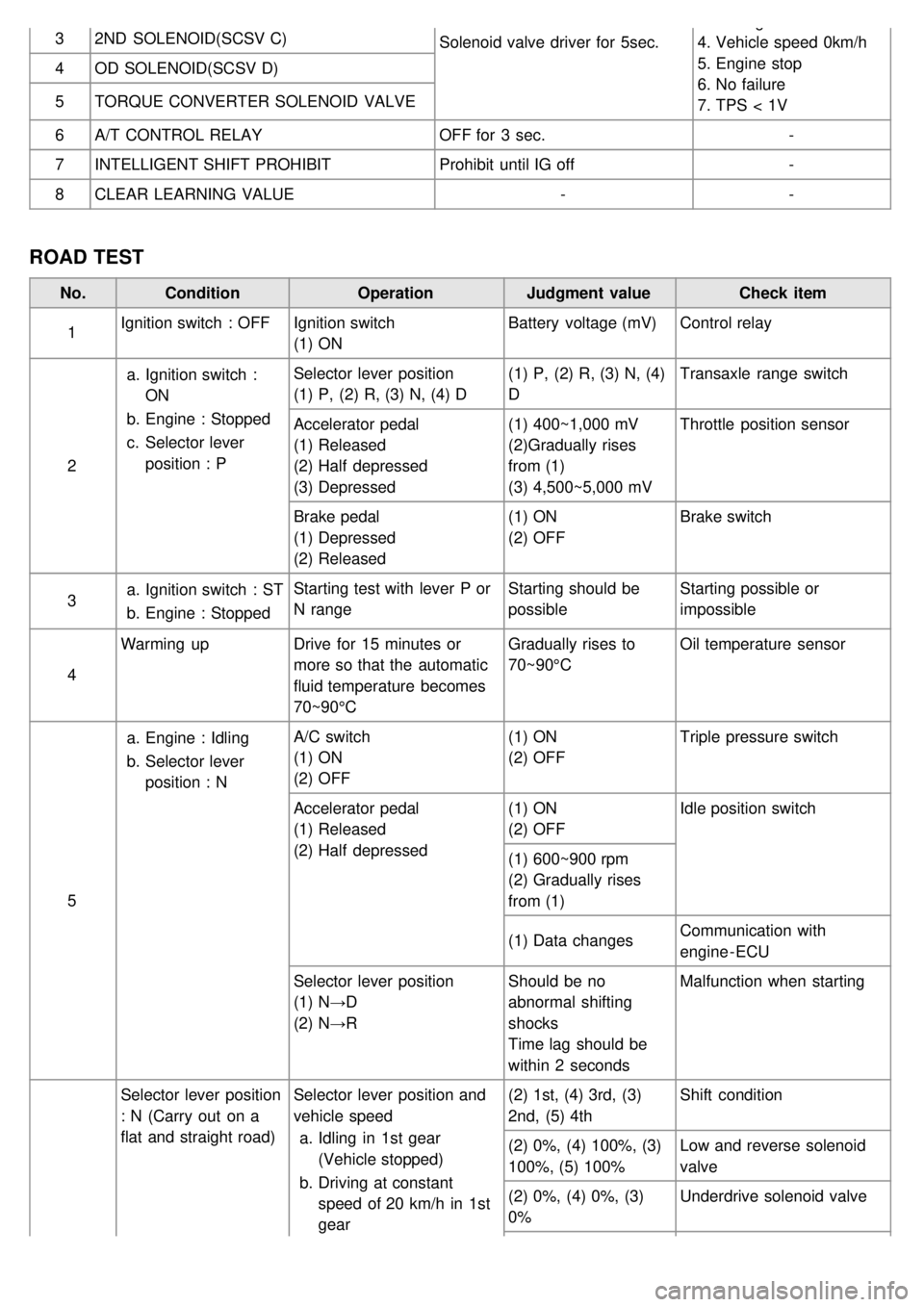
32ND SOLENOID(SCSV C)
Solenoid valve driver for 5sec.3. P range
4. Vehicle speed 0km/h
5. Engine stop
6. No failure
7. TPS < 1V
4
OD SOLENOID(SCSV D)
5 TORQUE CONVERTER SOLENOID VALVE
6 A/T CONTROL RELAY OFF for 3 sec. -
7 INTELLIGENT SHIFT PROHIBIT Prohibit until IG off -
8 CLEAR LEARNING VALUE --
ROAD TEST
No.Condition OperationJudgment value Check item
1 Ignition switch : OFF
Ignition switch
(1) ON Battery voltage (mV)
Control relay
2 a.
Ignition switch :
ON
b. Engine : Stopped
c. Selector lever
position : P Selector lever position
(1) P, (2) R, (3) N, (4) D
(1) P, (2) R, (3) N, (4)
DTransaxle range switch
Accelerator pedal
(1) Released
(2) Half depressed
(3) Depressed (1) 400~1,000 mV
(2)Gradually rises
from (1)
(3) 4,500~5,000 mVThrottle position sensor
Brake pedal
(1) Depressed
(2) Released (1) ON
(2) OFF
Brake switch
3 a.
Ignition switch : ST
b. Engine : Stopped Starting test with lever P or
N range
Starting should be
possibleStarting possible or
impossible
4 Warming up
Drive for 15 minutes or
more so that the automatic
fluid temperature becomes
70~90°C Gradually rises to
70~90°C
Oil temperature sensor
5 a.
Engine : Idling
b. Selector lever
position : N A/C switch
(1) ON
(2) OFF
(1) ON
(2) OFF
Triple pressure switch
Accelerator pedal
(1) Released
(2) Half depressed (1) ON
(2) OFF
Idle position switch
(1) 600~900 rpm
(2) Gradually rises
from (1)
(1) Data changes Communication with
engine - ECU
Selector lever position
(1) N→D
(2) N→R Should be no
abnormal shifting
shocks
Time lag should be
within 2 secondsMalfunction when starting
Selector lever position
: N (Carry out on a
flat and straight road) Selector lever position and
vehicle speed
a. Idling in 1st gear
(Vehicle stopped)
b. Driving at constant
speed of 20 km/h in 1st
gear (2) 1st, (4) 3rd, (3)
2nd, (5) 4th
Shift condition
(2) 0%, (4) 100%, (3)
100%, (5) 100% Low and reverse solenoid
valve
(2) 0%, (4) 0%, (3)
0% Underdrive solenoid valve
Page 367 of 1575
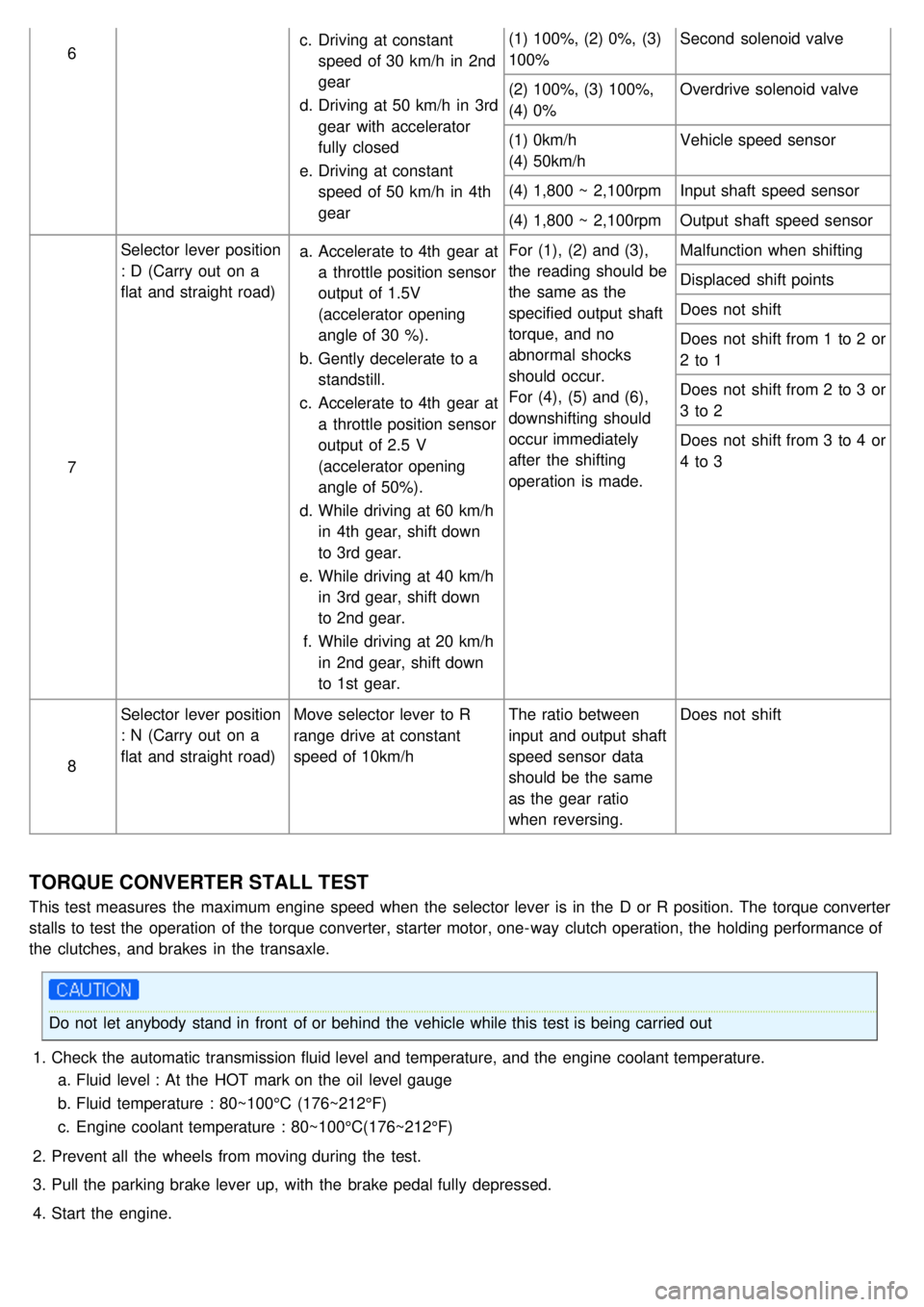
6c.
Driving at constant
speed of 30 km/h in 2nd
gear
d. Driving at 50 km/h in 3rd
gear with accelerator
fully closed
e. Driving at constant
speed of 50 km/h in 4th
gear (1) 100%, (2) 0%, (3)
100%
Second solenoid valve
(2) 100%, (3) 100%,
(4) 0% Overdrive solenoid valve
(1) 0km/h
(4) 50km/h Vehicle speed sensor
(4) 1,800 ~ 2,100rpm Input shaft speed sensor
(4) 1,800 ~ 2,100rpm Output shaft speed sensor
7 Selector lever position
: D (Carry out on a
flat and straight road)
a.
Accelerate to 4th gear at
a throttle position sensor
output of 1.5V
(accelerator opening
angle of 30 %).
b. Gently decelerate to a
standstill.
c. Accelerate to 4th gear at
a throttle position sensor
output of 2.5 V
(accelerator opening
angle of 50%).
d. While driving at 60 km/h
in 4th gear, shift down
to 3rd gear.
e. While driving at 40 km/h
in 3rd gear, shift down
to 2nd gear.
f. While driving at 20 km/h
in 2nd gear, shift down
to 1st gear. For (1), (2) and (3),
the reading should be
the same as the
specified output shaft
torque, and no
abnormal shocks
should occur.
For (4), (5) and (6),
downshifting should
occur immediately
after the shifting
operation is made.
Malfunction when shifting
Displaced shift points
Does not shift
Does not shift from 1 to 2 or
2 to 1
Does not shift from 2 to 3 or
3 to 2
Does not shift from 3 to 4 or
4 to 3
8 Selector lever position
: N (Carry out on a
flat and straight road)
Move selector lever to R
range drive at constant
speed of 10km/h The ratio between
input and output shaft
speed sensor data
should be the same
as the gear ratio
when reversing.Does not shift
TORQUE CONVERTER STALL TEST
This test measures the maximum engine speed when the selector lever is in the D or R position. The torque converter
stalls to test the operation of the torque converter, starter motor, one- way clutch operation, the holding performance of
the clutches, and brakes in the transaxle.
Do not let anybody stand in front of or behind the vehicle while this test is being carried out
1. Check the automatic transmission fluid level and temperature, and the engine coolant temperature.
a. Fluid level : At the HOT mark on the oil level gauge
b. Fluid temperature : 80~100°C (176~212°F)
c. Engine coolant temperature : 80~100°C(176~212°F)
2. Prevent all the wheels from moving during the test.
3. Pull the parking brake lever up, with the brake pedal fully depressed.
4. Start the engine.
Page 368 of 1575
5.Move the selector lever to the "D" position, fully depress the accelerator pedal and take a reading of the maximum
engine speed at this time.
Stall speed : 2,100~2,900rpm
a.The throttle should not be left fully open for any more than five seconds.
b. If carrying out the stall test two or more times, move the selector lever to the "N" position and run the
engine at 1,000 r/min to let the automatic transaxle fluid cool down before carrying out subsequent tests.
6. Move the selector lever to the "R" position and carry out the same test again.
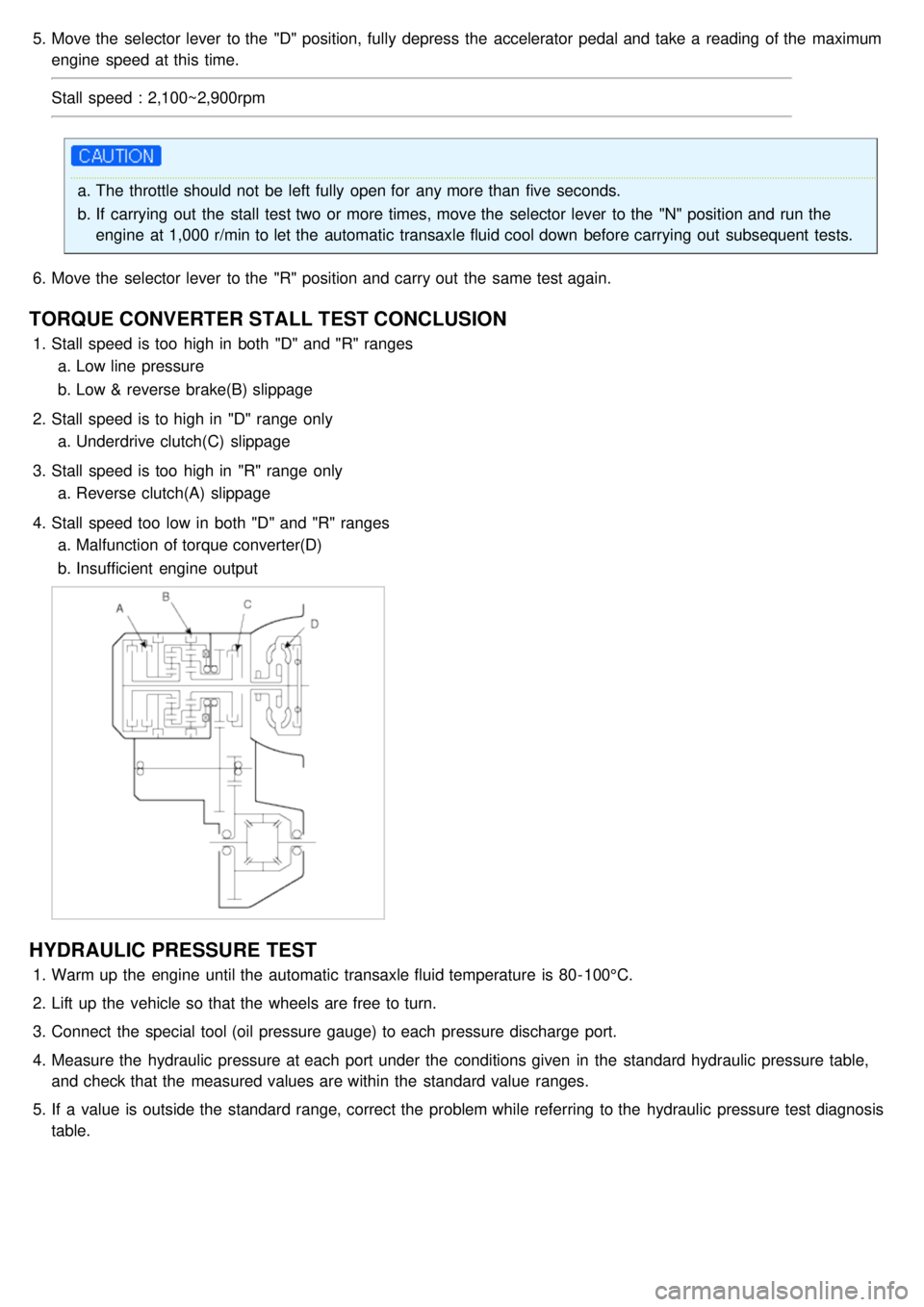
TORQUE CONVERTER STALL TEST CONCLUSION
1.Stall speed is too high in both "D" and "R" ranges
a. Low line pressure
b. Low & reverse brake(B) slippage
2. Stall speed is to high in "D" range only
a. Underdrive clutch(C) slippage
3. Stall speed is too high in "R" range only
a. Reverse clutch(A) slippage
4. Stall speed too low in both "D" and "R" ranges
a. Malfunction of torque converter(D)
b. Insufficient engine output
HYDRAULIC PRESSURE TEST
1.Warm up the engine until the automatic transaxle fluid temperature is 80- 100°C.
2. Lift up the vehicle so that the wheels are free to turn.
3. Connect the special tool (oil pressure gauge) to each pressure discharge port.
4. Measure the hydraulic pressure at each port under the conditions given in the standard hydraulic pressure table,
and check that the measured values are within the standard value ranges.
5. If a value is outside the standard range, correct the problem while referring to the hydraulic pressure test diagnosis
table.
Page 371 of 1575
![KIA CARNIVAL 2007 Owners Guide 2007 > 2.7L V6 GASOLINE >
SERVICE ADJUSTMENT PROCEDURE
Automatic transaxle fluid
INSPECTION 1. Drive the vehicle until the fluid reaches normal operating temperature [70~80°C].
2. Place the](/img/2/57045/w960_57045-370.png "KIA CARNIVAL 2007 Owners Guide 2007 > 2.7L V6 GASOLINE >
SERVICE ADJUSTMENT PROCEDURE
Automatic transaxle fluid
INSPECTION 1. Drive the vehicle until the fluid reaches normal operating temperature [70~80°C].
2. Place the")
2007 > 2.7L V6 GASOLINE >
SERVICE ADJUSTMENT PROCEDURE
Automatic transaxle fluid
INSPECTION 1. Drive the vehicle until the fluid reaches normal operating temperature [70~80°C].
2. Place the vehicle on a level surface.
3. Move the selector lever through all gear positions. This will fill the torque converter and the hudraulic system with
fluid and move the selector lever to the "N" (Neutral) or "P"(Park) position.
4. Before removing the oil level gauge, wipe all contaminants from around the oil level gauge. Then take out the oil
level gauge and check the condition of the fluid.
If the fluid smells as if it is burning, it means that the fluid has been contaminated by fine particles from the
bushes and friction materials, a transaxle overhaul may be necessary.
5. Check that the fluid level is at the HOT mark on the oil level gauge. If the fluid level is low, add automatic transaxle
fluid until the level reaches the "HOT" mark.
Auto transaxle fluid:
DIAMOND ATF SP - III, SK ATF SP - III
Quantity : 8.5ℓ (9.0 US qt, 7.5 lmp.qt)
Low fluid level can cause a variety of a abnormal conditions because it allows the pump to take in air along
with fluid. Air trapped in the hydraulic system forms bubbles, which are compressable. Therefore, pressures
will be erratic, causing delayed shifting ,slipping clutches and brakes, etc. Improper filling can also raise fluid
level too high. When the transaxle has too much fluid, gears churn up foam and acuise the same conditions
which occur with low fluid level, resulting in accelerated deterioration of automatic transaxle fluid. In either
case, air bubbles can cause overheating, and fluid oxidation, which can interfere with normal valve, clutch, and
brake operation. Foaming can also result in fluid escaping from the transaxle vent where it may be mistaken
for a leak.
6. Insert the oil level gauge(A) securely.
When new, automatic transmission fluid should be red. The red dye is added so the assembly plant can
identify it as transmission fluid and distinguish it from engine oil or antifreeze. The red dye, which is not an
indicator of fluid quality, is not permanent. As the vehicle is driven the transmission fluid will begin to look
darker. The color may eventually appear light brown.
Page 372 of 1575
REPLACEMENT
If you have a fluid changer, use this changer to replace the fluid. If you do not, replace it using the following
procedure.1. Disconnect the hose which connects the transmission and the oil cooler which is within the radiator only in 2.4L
engine(3.3L- the oil cooler is separated).
2. Start the engine and let the fluid drain out.
Running conditions : "N" range with engine idling.
The engine should be stopped within one minute after it is started. If the fluid has all drained out before then,
the engine should be stopped at that point.
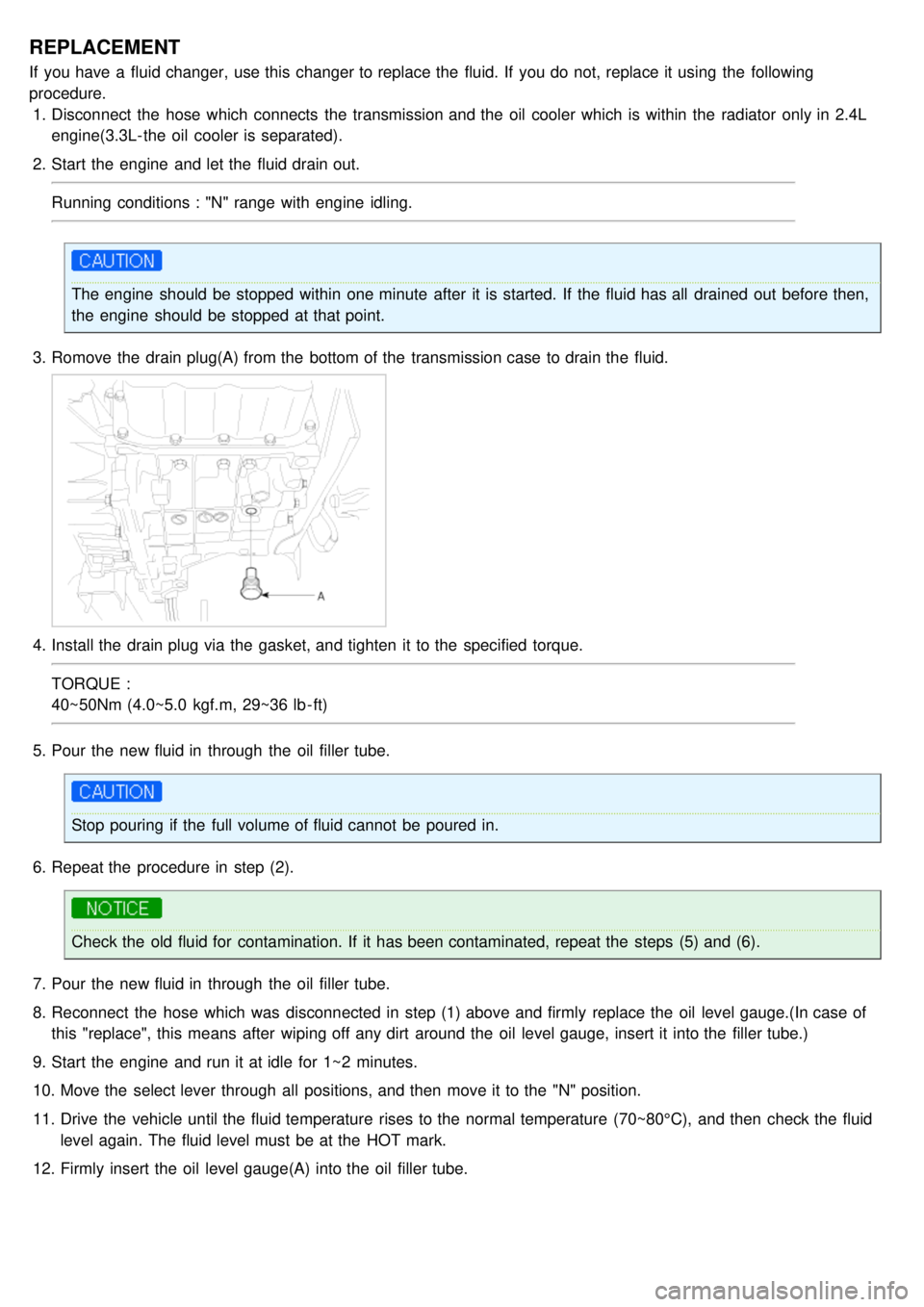
3. Romove the drain plug(A) from the bottom of the transmission case to drain the fluid.
4.Install the drain plug via the gasket, and tighten it to the specified torque.
TORQUE :
40~50Nm (4.0~5.0 kgf.m, 29~36 lb - ft)
5. Pour the new fluid in through the oil filler tube.
Stop pouring if the full volume of fluid cannot be poured in.
6. Repeat the procedure in step (2).
Check the old fluid for contamination. If it has been contaminated, repeat the steps (5) and (6).
7. Pour the new fluid in through the oil filler tube.
8. Reconnect the hose which was disconnected in step (1) above and firmly replace the oil level gauge.(In case of
this "replace", this means after wiping off any dirt around the oil level gauge, insert it into the filler tube.)
9. Start the engine and run it at idle for 1~2 minutes.
10. Move the select lever through all positions, and then move it to the "N" position.
11. Drive the vehicle until the fluid temperature rises to the normal temperature (70~80°C), and then check the fluid
level again. The fluid level must be at the HOT mark.
12. Firmly insert the oil level gauge(A) into the oil filler tube.
Page 421 of 1575
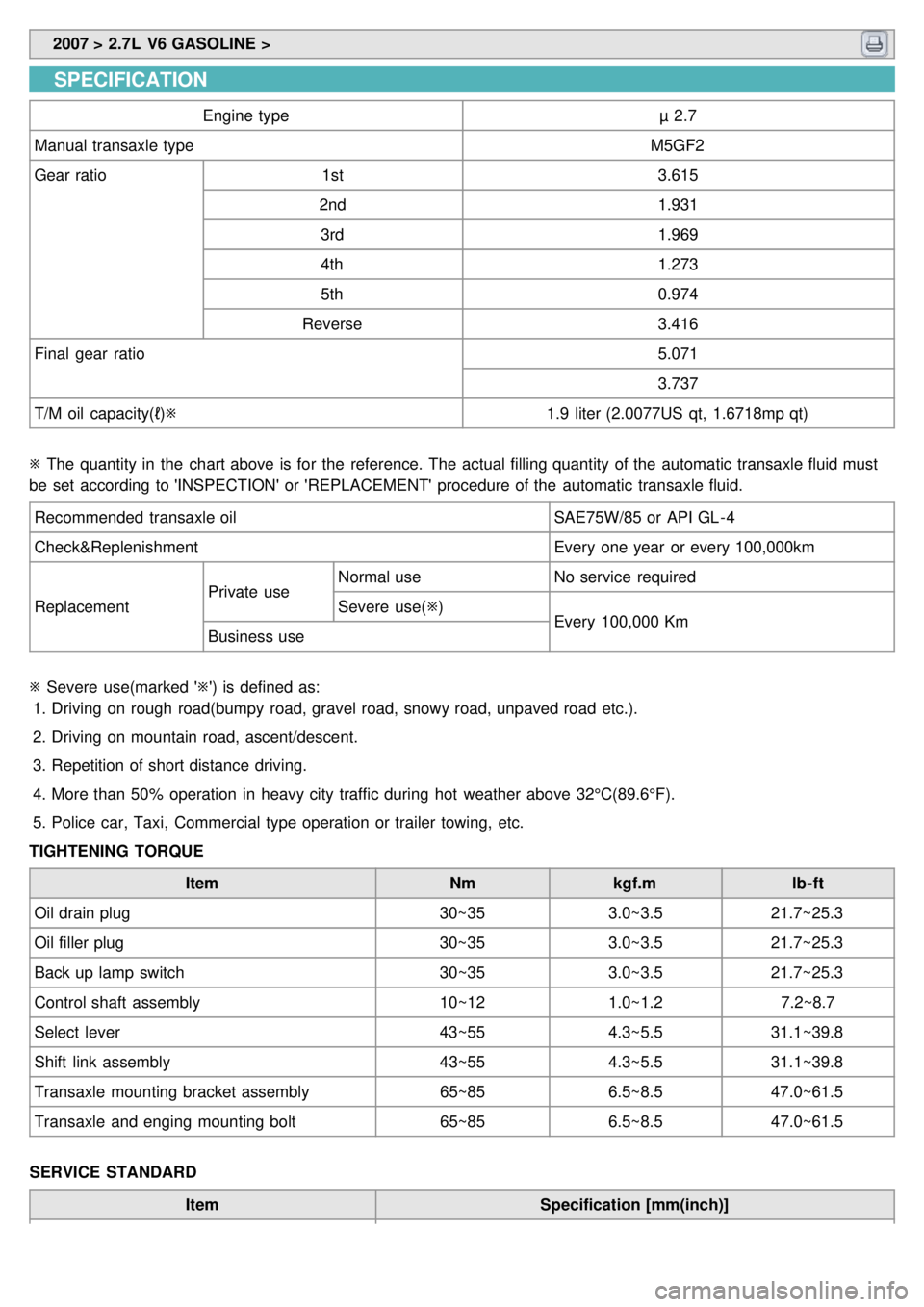
2007 > 2.7L V6 GASOLINE >
SPECIFICATION
Engine type µ 2.7
Manual transaxle type M5GF2
Gear ratio 1st 3.615
2nd 1.931
3rd 1.969
4th 1.273
5th 0.974
Reverse 3.416
Final gear ratio 5.071
3.737
T/M oil capacity(ℓ) ※ 1.9 liter (2.0077US qt, 1.6718mp qt)
※ The quantity in the chart above is for the reference. The actual filling quantity of the automatic transaxle fluid must
be set according to 'INSPECTION' or 'REPLACEMENT' procedure of the automatic transaxle fluid.
Recommended transaxle oil SAE75W/85 or API GL - 4
Check&Replenishment Every one year or every 100,000km
Replacement Private useNormal use
No service required
Severe use( ※)
Every 100,000 Km
Business use
※ Severe use(marked '※') is defined as:
1. Driving on rough road(bumpy road, gravel road, snowy road, unpaved road etc.).
2. Driving on mountain road, ascent/descent.
3. Repetition of short distance driving.
4. More than 50% operation in heavy city traffic during hot weather above 32°C(89.6°F).
5. Police car, Taxi, Commercial type operation or trailer towing, etc.
TIGHTENING TORQUE
Item Nmkgf.m lb- ft
Oil drain plug 30~353.0~3.521.7~25.3
Oil filler plug 30~353.0~3.521.7~25.3
Back up lamp switch 30~353.0~3.521.7~25.3
Control shaft assembly 10~121.0~1.2 7.2~8.7
Select lever 43~554.3~5.531.1~39.8
Shift link assembly 43~554.3~5.531.1~39.8
Transaxle mounting bracket assembly 65~856.5~8.547.0~61.5
Transaxle and enging mounting bolt 65~856.5~8.547.0~61.5
SERVICE STANDARD Item Specification [mm(inch)]
Page 498 of 1575
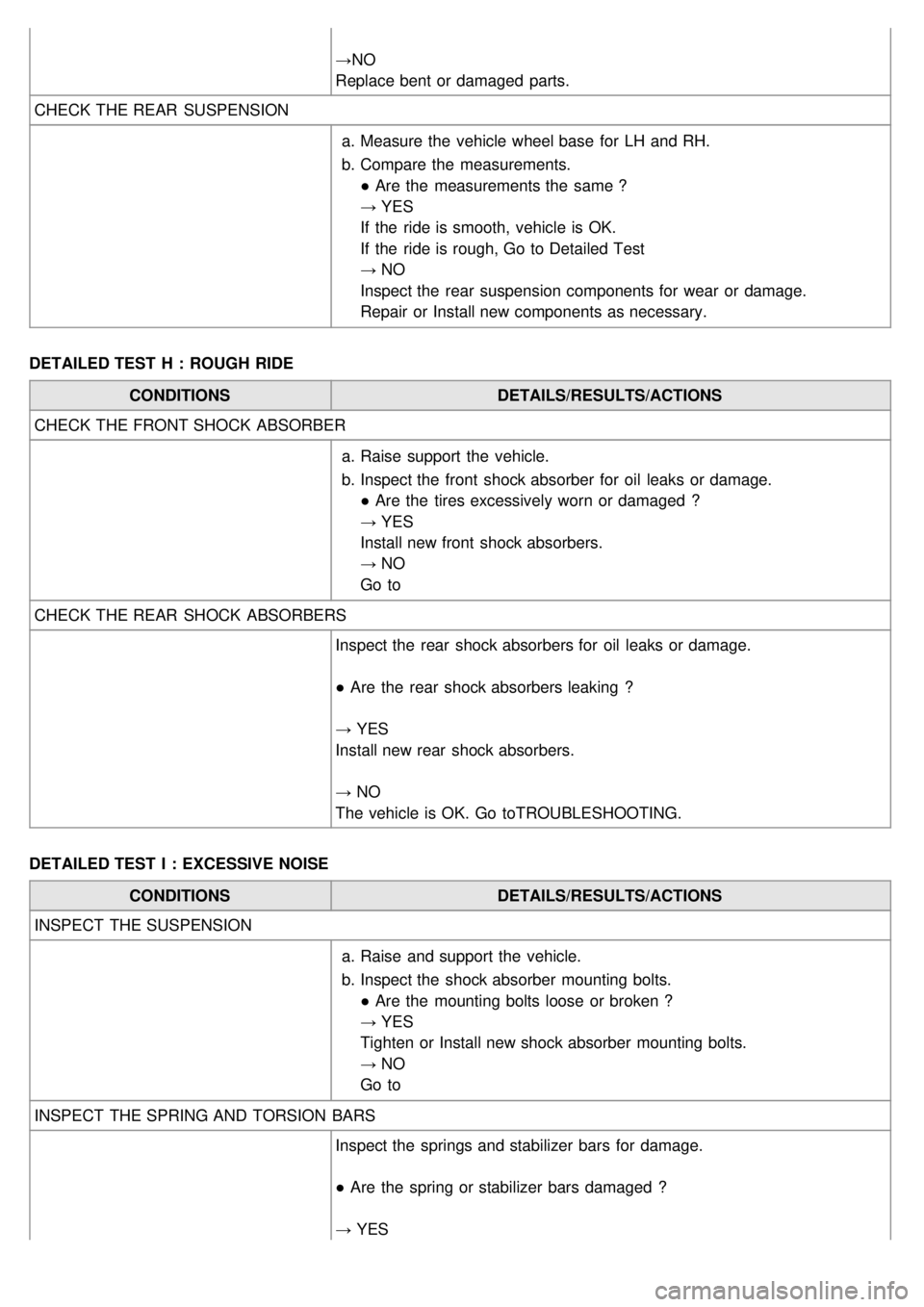
→NO
Replace bent or damaged parts.
CHECK THE REAR SUSPENSION
a.Measure the vehicle wheel base for LH and RH.
b. Compare the measurements.
● Are the measurements the same ?
→ YES
If the ride is smooth, vehicle is OK.
If the ride is rough, Go to Detailed Test
→ NO
Inspect the rear suspension components for wear or damage.
Repair or Install new components as necessary.
DETAILED TEST H : ROUGH RIDE CONDITIONS DETAILS/RESULTS/ACTIONS
CHECK THE FRONT SHOCK ABSORBER
a.Raise support the vehicle.
b. Inspect the front shock absorber for oil leaks or damage.
● Are the tires excessively worn or damaged ?
→ YES
Install new front shock absorbers.
→ NO
Go to
CHECK THE REAR SHOCK ABSORBERS Inspect the rear shock absorbers for oil leaks or damage.
● Are the rear shock absorbers leaking ?
→ YES
Install new rear shock absorbers.
→ NO
The vehicle is OK. Go to TROUBLESHOOTING.
DETAILED TEST I : EXCESSIVE NOISE CONDITIONS DETAILS/RESULTS/ACTIONS
INSPECT THE SUSPENSION
a.Raise and support the vehicle.
b. Inspect the shock absorber mounting bolts.
● Are the mounting bolts loose or broken ?
→ YES
Tighten or Install new shock absorber mounting bolts.
→ NO
Go to
INSPECT THE SPRING AND TORSION BARS Inspect the springs and stabilizer bars for damage.
● Are the spring or stabilizer bars damaged ?
→ YES
Install new spring and/or stabilizer bars.
Page 513 of 1575
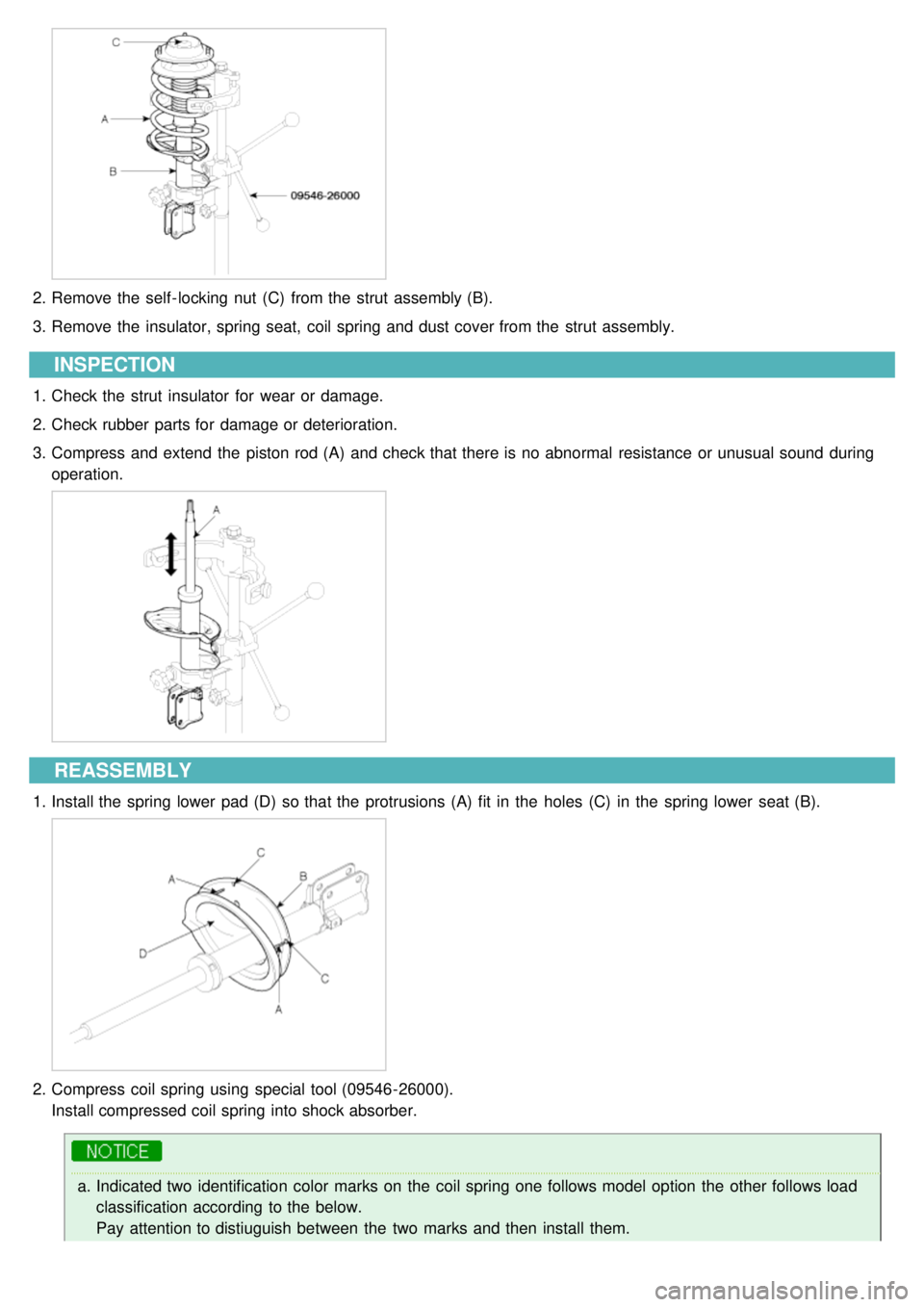
2.Remove the self - locking nut (C) from the strut assembly (B).
3. Remove the insulator, spring seat, coil spring and dust cover from the strut assembly.
INSPECTION
1.Check the strut insulator for wear or damage.
2. Check rubber parts for damage or deterioration.
3. Compress and extend the piston rod (A) and check that there is no abnormal resistance or unusual sound during
operation.
REASSEMBLY
1.Install the spring lower pad (D) so that the protrusions (A) fit in the holes (C) in the spring lower seat (B).
2.Compress coil spring using special tool (09546- 26000).
Install compressed coil spring into shock absorber.
a.Indicated two identification color marks on the coil spring one follows model option the other follows load
classification according to the below.
Pay attention to distiuguish between the two marks and then install them.
Page 583 of 1575

2.Shake the ball joint stud several times to check for looseness.
Tie rod end ball joint starting torque :
30 kg·cm or less
3.If the starting torque exceeds the upper limit of the standard value, replace the tie rod end.
4. Even if the starting torque is below the lower limit of the standard value, check the play of the ball joint and replace
if necessary.
CHECKING STEERING WHEEL RETURN
1.The force required to turn the steering wheel and the wheel return should be the same for both moderate and sharp
turns.
2. When the steering wheel is turned 90° and held for a couple of seconds while the vehicle is being driven at 20- 30
kph (12- 19 mph), the steering wheel should return at least 20° from its central position when it is released.
If the steering wheel is turned very quickly, steering may be momentarily difficult. This is not a malfunction
because the oil pump output will be somewhat decreased.
Page 584 of 1575

CHECKING POWER STEERING BELT TENSION
Refer to EM group(Timing system).
CHECKING POWER STEERING FLUID LEVEL
1.Position the vehicle on a level surface.
2. Start the engine. With the vehicle kept stationary, turn the steering wheel several times continuously to raise the
fluid temperature to 50- 60°C (122 - 140°F).
3. With the engine at idle, turn the steering wheel fully clockwise and counter- clockwise several times.
4. Make sure that there is no foaming or cloudiness in the reservoir fluid.
5. Stop the engine and check for any difference in fluid level between a stationary and a running engine.
a.If the fluid level varies 5 mm (0.2 in) or more, bleed the system again.
b. If the fluid level suddenly rises after stopping the engine, further bleeding is required.
c. Incomplete bleeding will produce a chattering sound in the pump and noise in the flow control valve, and
lead to decreased durability of the pump.
REPLACING POWER STEERING FLUID
1.Jack up the front wheels and support them with jackstands.
2. Disconnect the return hose from the oil reservoir and plug the oil reservoir.
3. Connect a vinyl hose to the disconnected return hose, and drain the oil into a container.
4. Remove the fuel pump fuse, then start the engine and wait for the engine to stall. Next, while operating the starting
motor intermittently, turn the steering wheel all the way to the left and then to the right several times to drain the
fluid.
5. Connect the return hoses, then fill the oil reservoir with the specified fluid.
6. Reinstall the fuel pump fuse.
7. Start the engine. Check for oil leakage.
8. Stop the engine.
9. Bleed the system.
Power steering fluid type : PSF - 3
Total quantity : Approx 1.1 liter
AIR BLEEDING
1.Remove the fuel pump fuse, then start the engine and wait for the engine to stall. Next, while operating the starting
motor intermittently (for 15 ~ 20 seconds), turn the steering wheel all the way to the left and then to the right five or
six times.