air condition KIA CARNIVAL 2007 Owner's Manual
[x] Cancel search | Manufacturer: KIA, Model Year: 2007, Model line: CARNIVAL, Model: KIA CARNIVAL 2007Pages: 1575, PDF Size: 44.86 MB
Page 371 of 1575
![KIA CARNIVAL 2007 Owners Manual 2007 > 2.7L V6 GASOLINE >
SERVICE ADJUSTMENT PROCEDURE
Automatic transaxle fluid
INSPECTION 1. Drive the vehicle until the fluid reaches normal operating temperature [70~80°C].
2. Place the](/img/2/57045/w960_57045-370.png "KIA CARNIVAL 2007 Owners Manual 2007 > 2.7L V6 GASOLINE >
SERVICE ADJUSTMENT PROCEDURE
Automatic transaxle fluid
INSPECTION 1. Drive the vehicle until the fluid reaches normal operating temperature [70~80°C].
2. Place the")
2007 > 2.7L V6 GASOLINE >
SERVICE ADJUSTMENT PROCEDURE
Automatic transaxle fluid
INSPECTION 1. Drive the vehicle until the fluid reaches normal operating temperature [70~80°C].
2. Place the vehicle on a level surface.
3. Move the selector lever through all gear positions. This will fill the torque converter and the hudraulic system with
fluid and move the selector lever to the "N" (Neutral) or "P"(Park) position.
4. Before removing the oil level gauge, wipe all contaminants from around the oil level gauge. Then take out the oil
level gauge and check the condition of the fluid.
If the fluid smells as if it is burning, it means that the fluid has been contaminated by fine particles from the
bushes and friction materials, a transaxle overhaul may be necessary.
5. Check that the fluid level is at the HOT mark on the oil level gauge. If the fluid level is low, add automatic transaxle
fluid until the level reaches the "HOT" mark.
Auto transaxle fluid:
DIAMOND ATF SP - III, SK ATF SP - III
Quantity : 8.5ℓ (9.0 US qt, 7.5 lmp.qt)
Low fluid level can cause a variety of a abnormal conditions because it allows the pump to take in air along
with fluid. Air trapped in the hydraulic system forms bubbles, which are compressable. Therefore, pressures
will be erratic, causing delayed shifting ,slipping clutches and brakes, etc. Improper filling can also raise fluid
level too high. When the transaxle has too much fluid, gears churn up foam and acuise the same conditions
which occur with low fluid level, resulting in accelerated deterioration of automatic transaxle fluid. In either
case, air bubbles can cause overheating, and fluid oxidation, which can interfere with normal valve, clutch, and
brake operation. Foaming can also result in fluid escaping from the transaxle vent where it may be mistaken
for a leak.
6. Insert the oil level gauge(A) securely.
When new, automatic transmission fluid should be red. The red dye is added so the assembly plant can
identify it as transmission fluid and distinguish it from engine oil or antifreeze. The red dye, which is not an
indicator of fluid quality, is not permanent. As the vehicle is driven the transmission fluid will begin to look
darker. The color may eventually appear light brown.
Page 487 of 1575
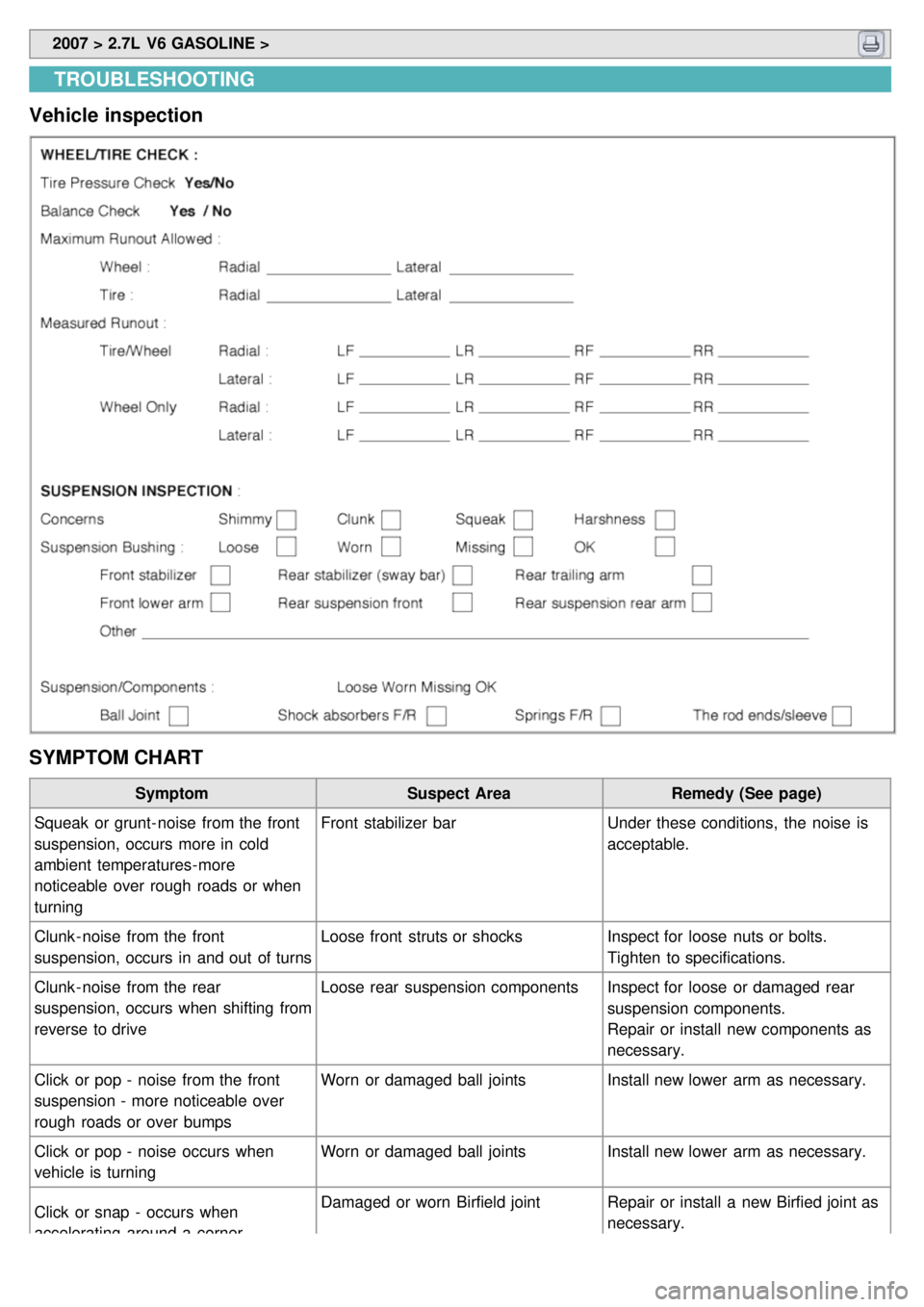
2007 > 2.7L V6 GASOLINE >
TROUBLESHOOTING
Vehicle inspection
SYMPTOM CHART
Symptom Suspect AreaRemedy (See page)
Squeak or grunt- noise from the front
suspension, occurs more in cold
ambient temperatures- more
noticeable over rough roads or when
turning Front stabilizer bar
Under these conditions, the noise is
acceptable.
Clunk - noise from the front
suspension, occurs in and out of turns Loose front struts or shocks
Inspect for loose nuts or bolts.
Tighten to specifications.
Clunk - noise from the rear
suspension, occurs when shifting from
reverse to drive Loose rear suspension components
Inspect for loose or damaged rear
suspension components.
Repair or install new components as
necessary.
Click or pop - noise from the front
suspension - more noticeable over
rough roads or over bumps Worn or damaged ball joints
Install new lower arm as necessary.
Click or pop - noise occurs when
vehicle is turning Worn or damaged ball joints
Install new lower arm as necessary.
Click or snap - occurs when
accelerating around a corner Damaged or worn Birfield joint
Repair or install a new Birfied joint as
necessary.
See DS group - driveshaft.
Page 488 of 1575

accelerating around a cornerSee DS group - driveshaft.
Front suspension noise - A squeak,
creak, or rattle noise - occurs mostly
over bumps or rough roads Steering components
Loose or bent front struts or shock
absorbers
Damaged spring or spring mounts
Damaged or worn arm bushings
Worn or damaged stabilizer bar
bushing or linksGo to detailed test A.
Groaning or grinding - noise from the
front strut, occurs when driving on
bumpy roads or turning the vehicle Uneven seating surface between the
insulator and panel by the burrs
around the strut insulator mounting
bolts and the insulator boltes
mounting holesRepair or install a new parts as
necessary.
Rear suspension noise - a squeak,
creak or rattle noise - occurs mostly
over bumps or rough roads Loose or bent rear shock absorbers
Damaged spring or spring mounts
Damaged or worn control arm
bushingsGo to detailed test B.
Shudder - occurs during acceleration
from a slow speed or stop Rear axle assembly mis - positioned
Damaged or worn front suspension
componentsCheck the axle mounts and rear
suspension for damage or wear.
Repair as necessary.
Check for a loose stabilizer bar,
damaged or loose strut/strut bushings
or loose or worn ball joints. Inspect
the steering linkage for wear or
damage. Repair or Install new
components as necessary.
Shimmy - most noticeable on
coast/deceleration - also hard steering
condition Excessive positive caster
Check the caster alignment angle.
Correct as necessary.
Tire noise - hum/moan at constant
speeds Abnormal wear patterns
Spin the tire and Check for tire wear.
Install a new tire as necessary.
Inspect for damaged/worn suspension
components. Perform wheel
alignment.
Tire noise - noise tone lowers as the
vehicle speed is lowered Out- of- balance tire
Balance the tire and road test. Install
a new tire as necessary.
Tire noise - ticking noise, change with
speed Nail puncture or stone in tire tread
Inspect the tire. Repair or replace as
necessary.
Wheel and tire - vibration and noise
concern is directly related to vehicle
speed and is not affected by
acceleration, coasting or decelerating Damaged or worn tire
Go to detailed test C.
Tire wobble or shudder - occurs at
lower speeds Damaged wheel bearings
Spin the tire and check for abnormal
wheel bearing play or roughness.
Adjust or Install new wheel bearings
as necessary.
See DS group - front/rear axle.
Damaged wheel Inspect the wheel for damage. Install
a new wheel as necessary.
Damaged or worn suspension
components Inspect the suspension components
for wear or damage. Repair as
necessary.
Page 490 of 1575
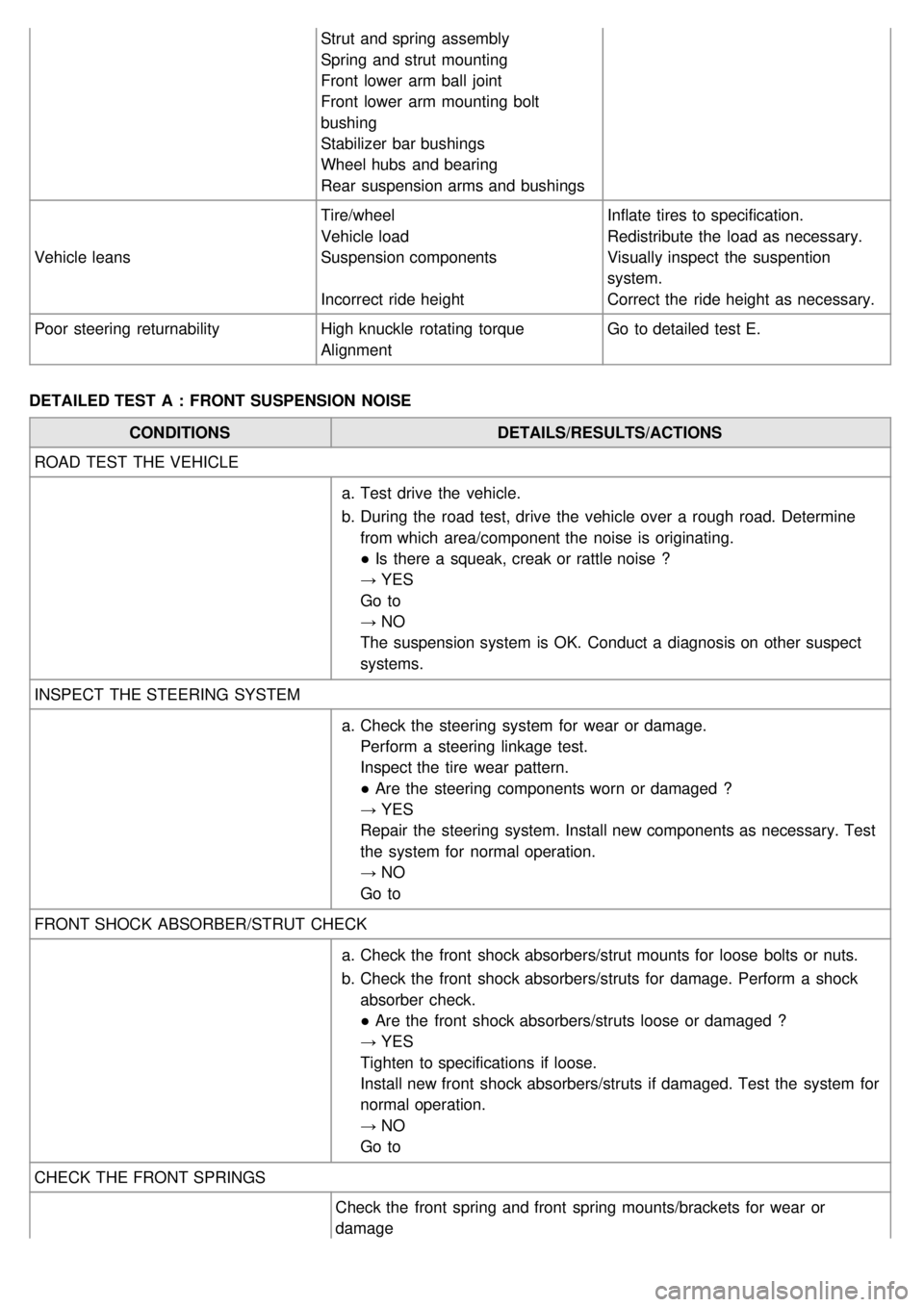
Strut and spring assembly
Spring and strut mounting
Front lower arm ball joint
Front lower arm mounting bolt
bushing
Stabilizer bar bushings
Wheel hubs and bearing
Rear suspension arms and bushings
Vehicle leans Tire/wheel
Vehicle load
Suspension components
Incorrect ride heightInflate tires to specification.
Redistribute the load as necessary.
Visually inspect the suspention
system.
Correct the ride height as necessary.
Poor steering returnability High knuckle rotating torque
AlignmentGo to detailed test E.
DETAILED TEST A : FRONT SUSPENSION NOISE CONDITIONS DETAILS/RESULTS/ACTIONS
ROAD TEST THE VEHICLE
a.Test drive the vehicle.
b. During the road test, drive the vehicle over a rough road. Determine
from which area/component the noise is originating.
● Is there a squeak, creak or rattle noise ?
→ YES
Go to
→ NO
The suspension system is OK. Conduct a diagnosis on other suspect
systems.
INSPECT THE STEERING SYSTEM a.Check the steering system for wear or damage.
Perform a steering linkage test.
Inspect the tire wear pattern.
● Are the steering components worn or damaged ?
→ YES
Repair the steering system. Install new components as necessary. Test
the system for normal operation.
→ NO
Go to
FRONT SHOCK ABSORBER/STRUT CHECK a.Check the front shock absorbers/strut mounts for loose bolts or nuts.
b. Check the front shock absorbers/struts for damage. Perform a shock
absorber check.
● Are the front shock absorbers/struts loose or damaged ?
→ YES
Tighten to specifications if loose.
Install new front shock absorbers/struts if damaged. Test the system for
normal operation.
→ NO
Go to
CHECK THE FRONT SPRINGS Check the front spring and front spring mounts/brackets for wear or
damage
Page 491 of 1575
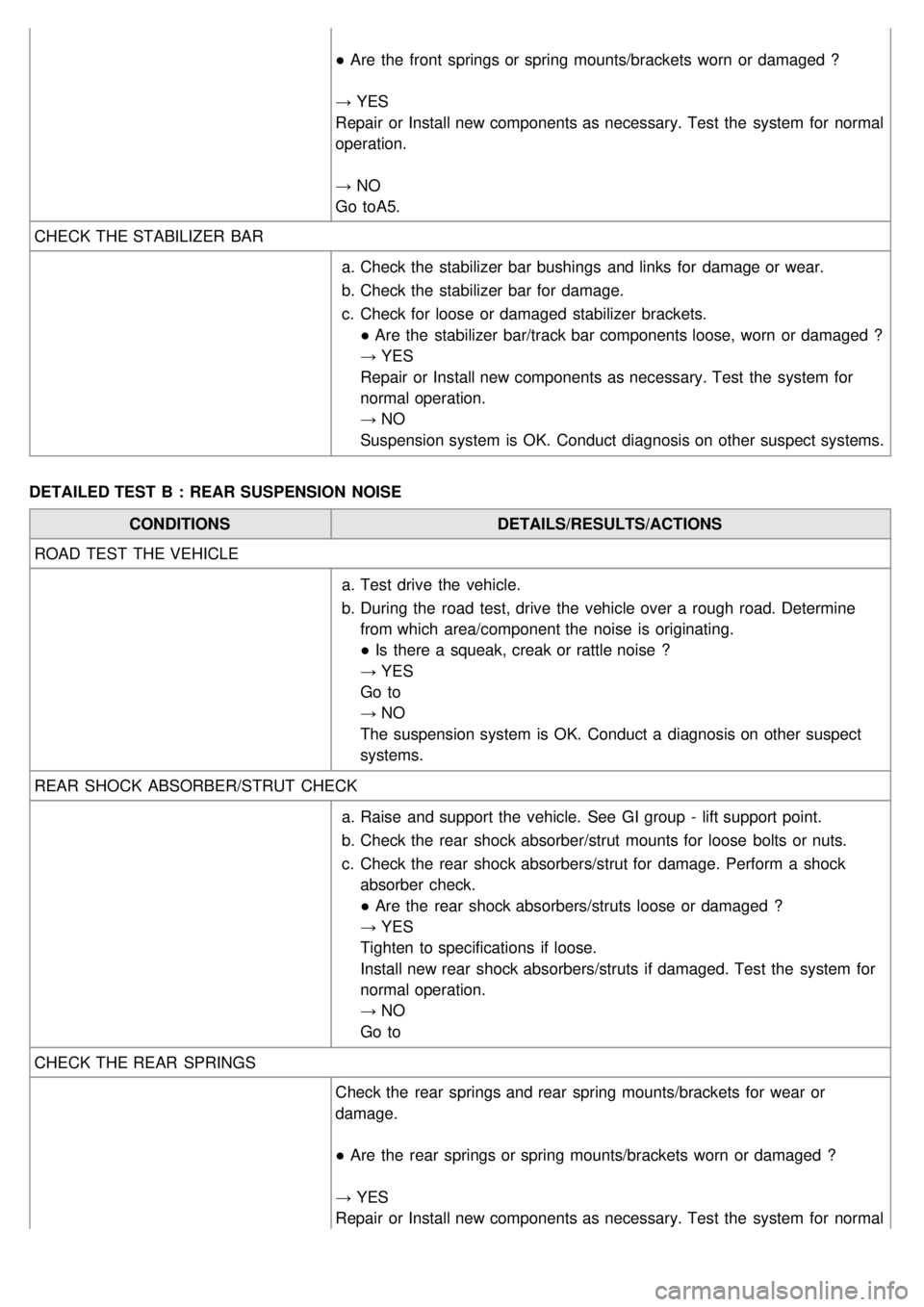
● Are the front springs or spring mounts/brackets worn or damaged ?
→ YES
Repair or Install new components as necessary. Test the system for normal
operation.
→ NO
Go to A5.
CHECK THE STABILIZER BAR
a.Check the stabilizer bar bushings and links for damage or wear.
b. Check the stabilizer bar for damage.
c. Check for loose or damaged stabilizer brackets.
● Are the stabilizer bar/track bar components loose, worn or damaged ?
→ YES
Repair or Install new components as necessary. Test the system for
normal operation.
→ NO
Suspension system is OK. Conduct diagnosis on other suspect systems.
DETAILED TEST B : REAR SUSPENSION NOISE CONDITIONS DETAILS/RESULTS/ACTIONS
ROAD TEST THE VEHICLE
a.Test drive the vehicle.
b. During the road test, drive the vehicle over a rough road. Determine
from which area/component the noise is originating.
● Is there a squeak, creak or rattle noise ?
→ YES
Go to
→ NO
The suspension system is OK. Conduct a diagnosis on other suspect
systems.
REAR SHOCK ABSORBER/STRUT CHECK a.Raise and support the vehicle. See GI group - lift support point.
b. Check the rear shock absorber/strut mounts for loose bolts or nuts.
c. Check the rear shock absorbers/strut for damage. Perform a shock
absorber check.
● Are the rear shock absorbers/struts loose or damaged ?
→ YES
Tighten to specifications if loose.
Install new rear shock absorbers/struts if damaged. Test the system for
normal operation.
→ NO
Go to
CHECK THE REAR SPRINGS Check the rear springs and rear spring mounts/brackets for wear or
damage.
● Are the rear springs or spring mounts/brackets worn or damaged ?
→ YES
Repair or Install new components as necessary. Test the system for normal
operation.
Page 492 of 1575
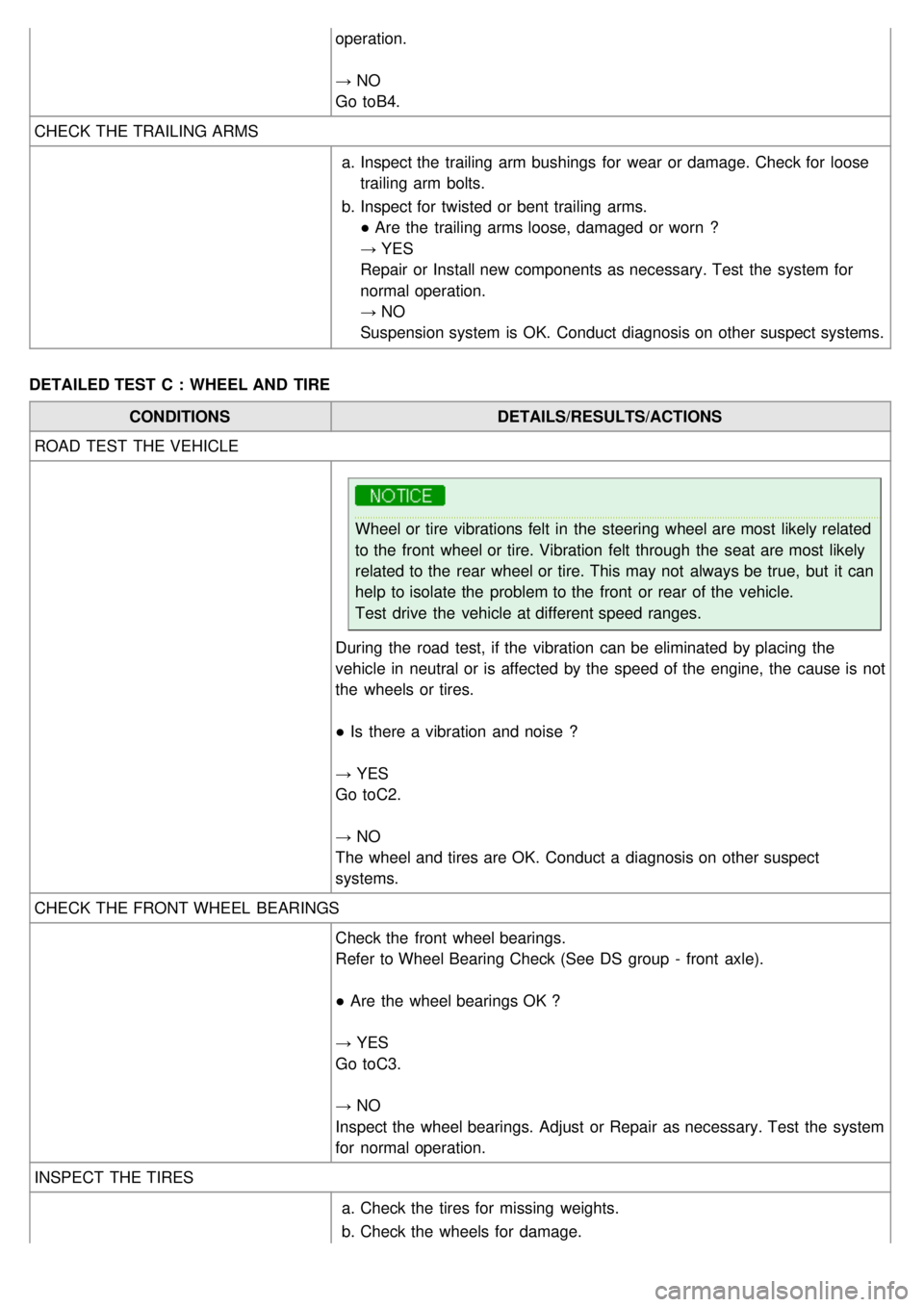
operation.
→ NO
Go toB4.
CHECK THE TRAILING ARMS
a.Inspect the trailing arm bushings for wear or damage. Check for loose
trailing arm bolts.
b. Inspect for twisted or bent trailing arms.
● Are the trailing arms loose, damaged or worn ?
→ YES
Repair or Install new components as necessary. Test the system for
normal operation.
→ NO
Suspension system is OK. Conduct diagnosis on other suspect systems.
DETAILED TEST C : WHEEL AND TIRE CONDITIONS DETAILS/RESULTS/ACTIONS
ROAD TEST THE VEHICLE
Wheel or tire vibrations felt in the steering wheel are most likely related
to the front wheel or tire. Vibration felt through the seat are most likely
related to the rear wheel or tire. This may not always be true, but it can
help to isolate the problem to the front or rear of the vehicle.
Test drive the vehicle at different speed ranges.
During the road test, if the vibration can be eliminated by placing the
vehicle in neutral or is affected by the speed of the engine, the cause is not
the wheels or tires.
● Is there a vibration and noise ?
→ YES
Go to C2.
→ NO
The wheel and tires are OK. Conduct a diagnosis on other suspect
systems.
CHECK THE FRONT WHEEL BEARINGS Check the front wheel bearings.
Refer to Wheel Bearing Check (See DS group - front axle).
● Are the wheel bearings OK ?
→ YES
Go to C3.
→ NO
Inspect the wheel bearings. Adjust or Repair as necessary. Test the system
for normal operation.
INSPECT THE TIRES
a.Check the tires for missing weights.
b. Check the wheels for damage.
Page 493 of 1575

c.Inspect the tire wear pattern.
● Do the tires have an abnormal wear pattern ?
→ YES
Correct the condition that caused the abnormal wear. Install new tire(s).
Test the system for normal operation.
→ NO
Go to
TIRE ROTATION DIAGNOSIS a.Spin the tires slowly and watch for signs of lateral runout.
b. Spin the tires slowly and watch for signs of radial runout.
● Are there signs of visual runout ?
→ YES
Go to
→ NO
Check the wheel and tire balance.
Correct as necessary. Test the system for normal operation.
RADIAL RUNOUT CHECK ON THE TIRE Measure the radial runout of the wheel and tire assembly. A typical
specification for total radial runout is 1.15mm (0.059 inch).
● Is the radial runout within specifications ?
→ YES
Go to C8.
→ NO
Go to C6.
RADIAL RUNOUT CHECK ON THE WHEEL Measure the radial runout of the wheel. A typical specification for total radial
runout is 1.14mm (0.045 inch.).
● Is the radial runout within specifications ?
→ YES
Install a new tire. Test the system for normal operation.
→ NO
Go to C7.
CHECK THE HUB/BRAKE DISC OR DRUM PILOT RUNOUT OR BOLT CIRCLE RUNOUT Measure the pilot or bolt circle runout. A typical specification for radial
runout is :
● pilot runout - less than 0.15mm (0.006 inch.)
● bolt circle runout - less than 0.38 mm (0.015 inch.)
● Is the radial runout within specification ?
→ YES
Install a new wheel. Test the system for normal operation.
→ NO
Repair or Install new components as necessary.
LATERAL RUNOUT CHECK ON THE TIRE Measure the lateral runout of the wheel and tire assembly. A typical
specification for total lateral runout is 2.5mm (0.098 inch).
Page 494 of 1575
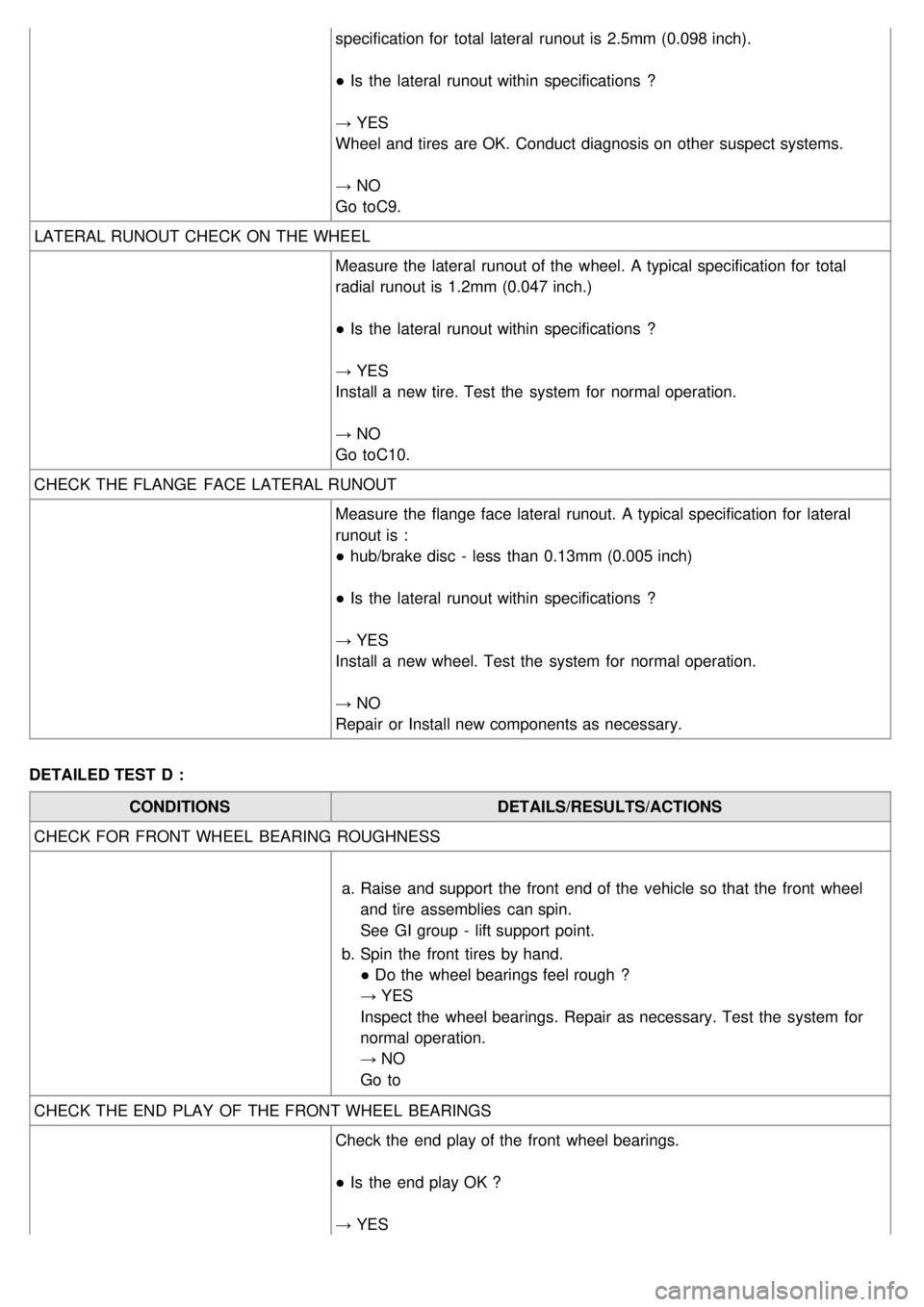
specification for total lateral runout is 2.5mm (0.098 inch).
● Is the lateral runout within specifications ?
→ YES
Wheel and tires are OK. Conduct diagnosis on other suspect systems.
→ NO
Go to C9.
LATERAL RUNOUT CHECK ON THE WHEEL Measure the lateral runout of the wheel. A typical specification for total
radial runout is 1.2mm (0.047 inch.)
● Is the lateral runout within specifications ?
→ YES
Install a new tire. Test the system for normal operation.
→ NO
Go to C10.
CHECK THE FLANGE FACE LATERAL RUNOUT Measure the flange face lateral runout. A typical specification for lateral
runout is :
● hub/brake disc - less than 0.13mm (0.005 inch)
● Is the lateral runout within specifications ?
→ YES
Install a new wheel. Test the system for normal operation.
→ NO
Repair or Install new components as necessary.
DETAILED TEST D : CONDITIONS DETAILS/RESULTS/ACTIONS
CHECK FOR FRONT WHEEL BEARING ROUGHNESS
a.Raise and support the front end of the vehicle so that the front wheel
and tire assemblies can spin.
See GI group - lift support point.
b. Spin the front tires by hand.
● Do the wheel bearings feel rough ?
→ YES
Inspect the wheel bearings. Repair as necessary. Test the system for
normal operation.
→ NO
Go to
CHECK THE END PLAY OF THE FRONT WHEEL BEARINGS Check the end play of the front wheel bearings.
● Is the end play OK ?
→ YES
Go to D3.
Page 496 of 1575

Dismount the tire and mount the wheel on a wheel balancer. Measure the
runout on both wheel flanges. Go to detailed test C
● Is the runout within specifications ?
→ YES
Locate and Mark the low spot on the wheel. Install the tire, matching the
high spot on the tire with the low spot on the wheel. Balance the assembly.
Test the system for normal operation. If the condition persists, Go to D8.
→ NO
Install a new wheel. Check the runout on the new wheel. If the new wheel
is within limits, locate and Mark the low spot. Install the tire, matching the
high spot on the tire with the low spot on the wheel. Balance the assembly.
Test the system for normal operation. If the condition persists, Go to D8.
CHECK FOR VIBRATION FROM THE FRONT OF THE VEHICLE Spin the front wheel and tire assemblies with a wheel balancer while the
vehicle is raised on a hoist. Feel for vibration in the front fender or while
seated in the vehicle.
● Is the vibration present ?
→ YES
Substitute known good wheel and tire assemblies as necessary.
Test the system for normal operation.
→ NO
Check the driveline components. Test the system for normal operation.
DETAILED TEST E : DRIFT LEFT OR RIGHT CONDITIONS DETAILS/RESULTS/ACTIONS
CHECK THE TIRES Inspect the tires for excessive wear or damage.
● Are the tires excessively worn or damaged ?
→ YES
Install new tires.
→ NO
Go to E2.
CHECK THE STEERING LINKAGE
a.Raise and support the vehicle.
b. Check the steering components for indications of excessive wear or
damage.
See ST group - specification.
● Is there an indication of excessive wear or damage ?
→ YES
Repair or Install new components as necessary.
→ NO
Go to
CHECK THE VEHICLE ALIGNMENT a.Place the vehicle on an alignment rack.
Page 497 of 1575

Check the vehicle alignmnt.
● Is the alignment within specification ?
→ YES
Go to
→ NO
Adjust the alignment as necessary.
See page SS - 69 (wheel alignment).
BRAKE DRAG DIAGNOSIS Apply the brakes while driving.
● Does drift or pull occur when the brakes are applied ?
→ YES
See BR group - specification.
→ NO
If the steering wheel is in the center, the vehicle is OK.
If the steering wheel is off- center, Go to Detailed Test F.
DETAILED TEST F : STEERING WHEEL OFF- CENTER CONDITIONS DETAILS/RESULTS/ACTIONS
CHECK THE CLEAR VISION Place the vehicle on an alignment rack.
● Is the clear vision within specification ?
→ YES
Go to F2.
→ NO
Adjust the clear vision to specification.
INSPECT THE STEERING COMPONENTS
a.Raise and support the vehicle.
b. Inspect the steering components for excessive wear or damage.
See ST group - specification.
● Are the steering components excessively worn or damaged ?
→ YES
Repair or Install new components as necessary.
→ NO
If it tracks correctly, vehicle is OK.
If it tracks incorrectly, Go to Detailed Test
DETAILED TEST G : TRACKS INCORRECTLY CONDITIONS DETAILS/RESULTS/ACTIONS
CHECK THE CASTER Place the vehicle on an alignment rack.
● Is the caster within specification ?
→ YES
Go to G2.