air condition KIA CARNIVAL 2007 Service Manual
[x] Cancel search | Manufacturer: KIA, Model Year: 2007, Model line: CARNIVAL, Model: KIA CARNIVAL 2007Pages: 1575, PDF Size: 44.86 MB
Page 655 of 1575
Additional health and safety information may be obtained from the refrigerant and lubricant manufacturers.1. When an A/C System has been opened to the atmosphere, such as during installation or repair, it must be
evacuated using an R- 134a refrigerant Recovery/Recycling/Charging System. (If the system has been open for
several days, the receiver/dryer should be replaced, and the system should be evacuated for several hours.)
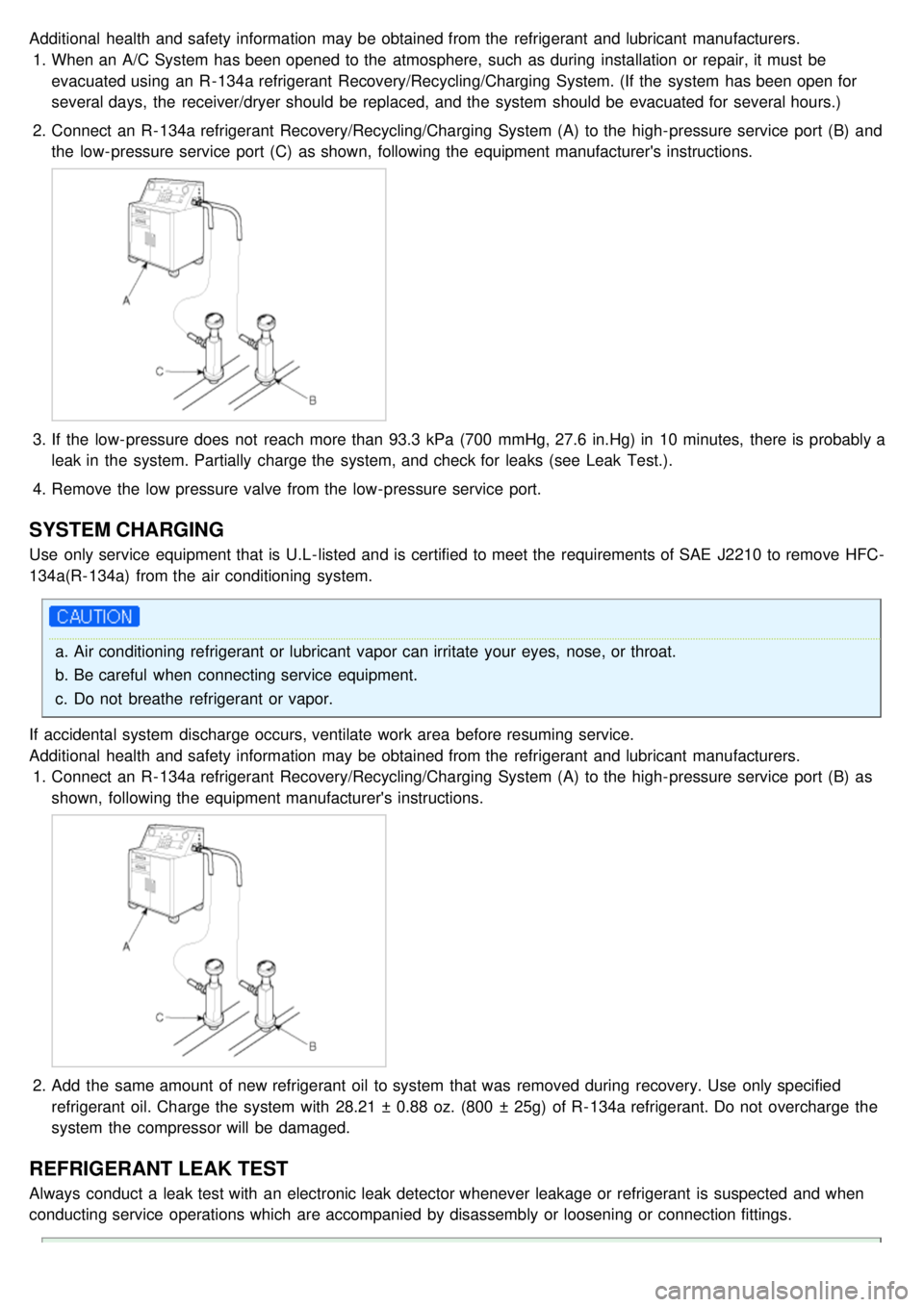
2. Connect an R- 134a refrigerant Recovery/Recycling/Charging System (A) to the high- pressure service port (B) and
the low- pressure service port (C) as shown, following the equipment manufacturer's instructions.
3.If the low- pressure does not reach more than 93.3 kPa (700 mmHg, 27.6 in.Hg) in 10 minutes, there is probably a
leak in the system. Partially charge the system, and check for leaks (see Leak Test.).
4. Remove the low pressure valve from the low- pressure service port.
SYSTEM CHARGING
Use only service equipment that is U.L - listed and is certified to meet the requirements of SAE J2210 to remove HFC-
134a(R- 134a) from the air conditioning system.
a.Air conditioning refrigerant or lubricant vapor can irritate your eyes, nose, or throat.
b. Be careful when connecting service equipment.
c. Do not breathe refrigerant or vapor.
If accidental system discharge occurs, ventilate work area before resuming service.
Additional health and safety information may be obtained from the refrigerant and lubricant manufacturers. 1. Connect an R- 134a refrigerant Recovery/Recycling/Charging System (A) to the high- pressure service port (B) as
shown, following the equipment manufacturer's instructions.
2.Add the same amount of new refrigerant oil to system that was removed during recovery. Use only specified
refrigerant oil. Charge the system with 28.21 ± 0.88 oz. (800 ± 25g) of R- 134a refrigerant. Do not overcharge the
system the compressor will be damaged.
REFRIGERANT LEAK TEST
Always conduct a leak test with an electronic leak detector whenever leakage or refrigerant is suspected and when
conducting service operations which are accompanied by disassembly or loosening or connection fittings.
Page 660 of 1575
2007 > 2.7L V6 GASOLINE >
REMOVAL
1.If the compressor is marginally operable, run the engine at idle speed, and let the air conditioning work for a few
minutes, then shut the engine off.
2. Disconnect the negative cable from the battery.
3. Recover the refrigerant with a recovery/charging station (Refer to HA - 8).
4. Loosen the drive belt (Refer to HA - 14).
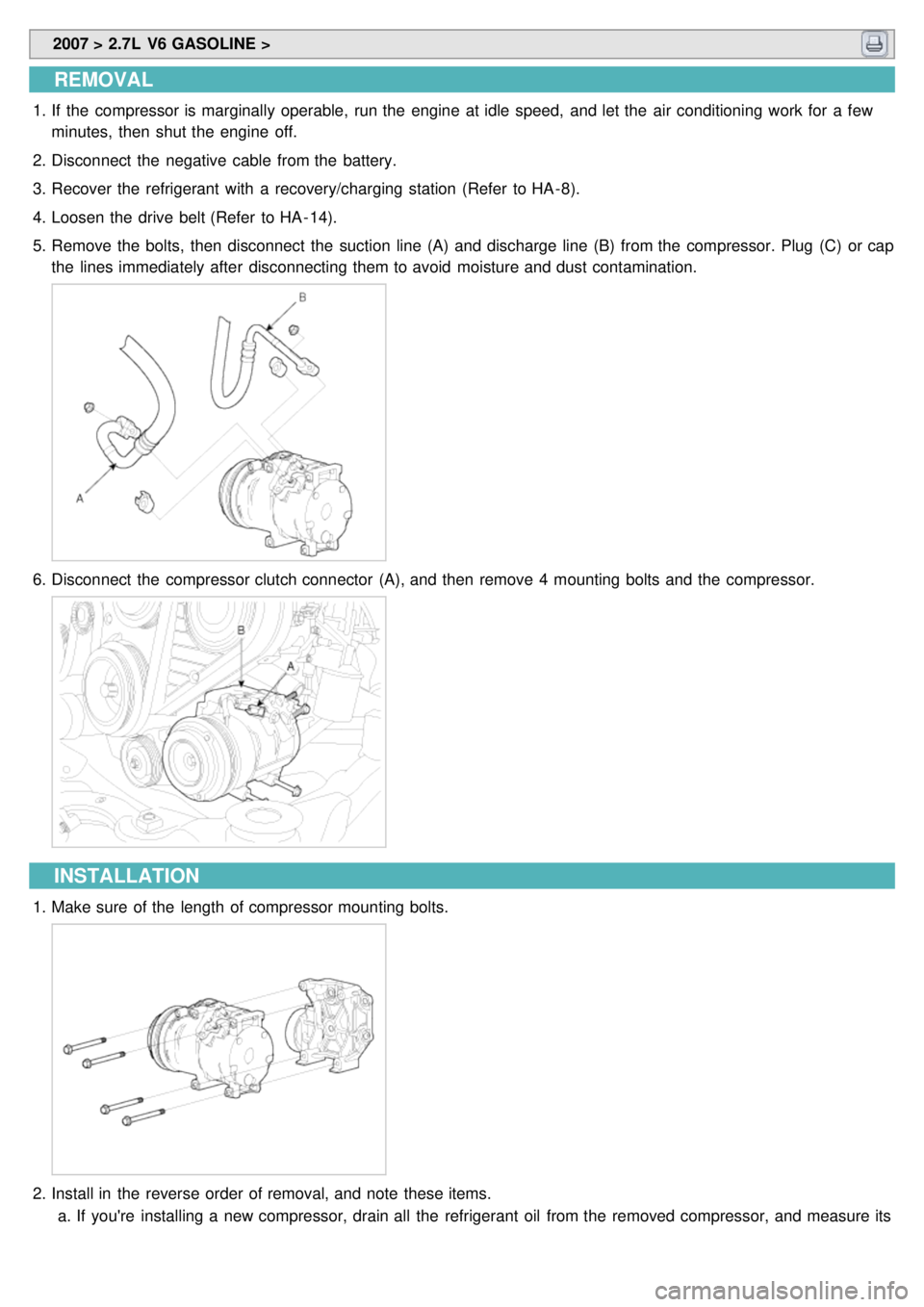
5. Remove the bolts, then disconnect the suction line (A) and discharge line (B) from the compressor. Plug (C) or cap
the lines immediately after disconnecting them to avoid moisture and dust contamination.
6.Disconnect the compressor clutch connector (A), and then remove 4 mounting bolts and the compressor.
INSTALLATION
1.Make sure of the length of compressor mounting bolts.
2.Install in the reverse order of removal, and note these items.
a. If you're installing a new compressor, drain all the refrigerant oil from the removed compressor, and measure its
volume, Subtract the volume of drained oil from 120cc(4.20 oz.) the result is the amount of oil you should drain
Page 665 of 1575
2007 > 2.7L V6 GASOLINE >
INSPECTION
Oil Specification
1. The HFC- 134a system requires synthetic (PAG) compressor oil whereas the R- 12 system requires mineral
compressor oil. The two oils must never be mixed.
2. Compressor (PAG) oil varies according to compressor model. Be sure to use oil specified for the model of
compressor.
Handling of Oil
1.The oil should be free from moisture, dust, metal powder, etc.
2. Do not mix with other oil.
3. The water content in the oil increases when exposed to the air. After use, seal oil from air immediately. (HFC - 134a
Compressor Oil absorbs moisture very easily.)
4. The compressor oil must be stored in steel containers, not in plastic containers.
Compressor oil check
The oil used to lubricate the compressor is circulating with the refrigerant.
Whenever replacing any component of the system or a large amount of gas leakage occurs, add oil to maintain the
original amount of oil.
Oil total volume in system:
120±10cc (4.05±0.34 fl.oz)
Oil Return Operation
There is close affinity between the oil and the refrigerant.
During normal operation, part of the oil recirculates with the refrigerant in the system. When checking the amount of
oil in the system, or replacing any component of the system, the compressor must be run in advance for oil return
operation. The procedure is as follows:
1. Open all the doors and the engine hood.
2. Start the engine and air conditioning switch to "ON" and set the blower motor control knob at its highest position.
3. Run the compressor for more than 20 minutes between 800 and 1,000 rpm in order to operate the system.
4. Stop the engine.
Replacement of Component Parts
When replacing the system component parts, supply the following amount of oil to the component parts to be installed.
Component parts to be installed Amount of Oil
Evaporator 50 cc (1.70 fl.oz)
Condenser 30 cc (1.02 fl.oz)
Receiver/dryer 30 cc (1.02 fl.oz)
Refrigerant line (One piece) 10 cc (0.34 fl.oz)
For compressor replacement, subtract the volume of oil drained from the removed compressor from the specified
volume, and drain the calculated volume of oil from the new compressor:
The specified volume - volume of removed compressor = volume to drain from the new compressor.
Even if no oil is drained from the removed compressor, don’t drain more than 50cc from new compressor.
Page 669 of 1575
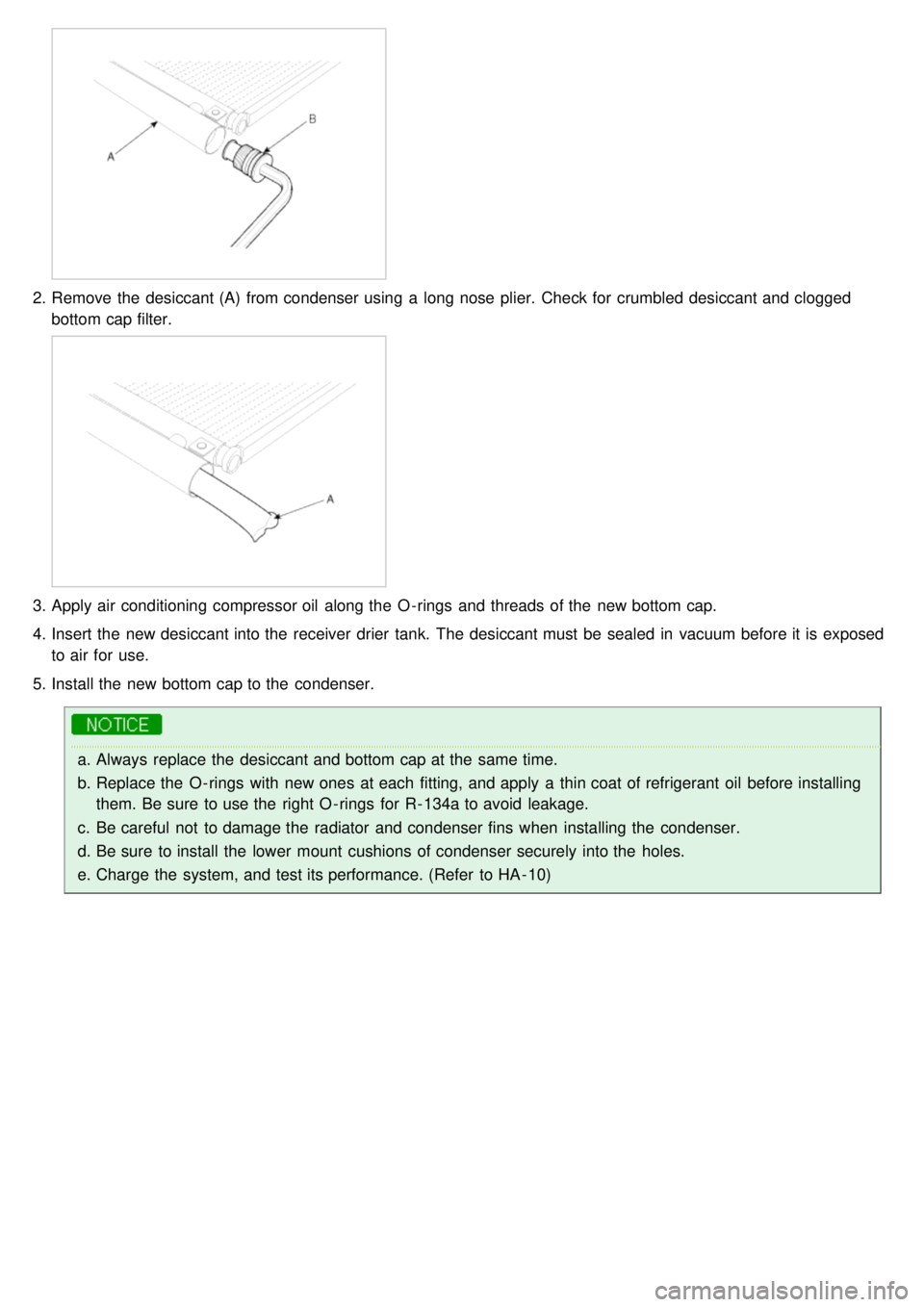
2.Remove the desiccant (A) from condenser using a long nose plier. Check for crumbled desiccant and clogged
bottom cap filter.
3.Apply air conditioning compressor oil along the O - rings and threads of the new bottom cap.
4. Insert the new desiccant into the receiver drier tank. The desiccant must be sealed in vacuum before it is exposed
to air for use.
5. Install the new bottom cap to the condenser.
a.Always replace the desiccant and bottom cap at the same time.
b. Replace the O - rings with new ones at each fitting, and apply a thin coat of refrigerant oil before installing
them. Be sure to use the right O - rings for R- 134a to avoid leakage.
c. Be careful not to damage the radiator and condenser fins when installing the condenser.
d. Be sure to install the lower mount cushions of condenser securely into the holes.
e. Charge the system, and test its performance. (Refer to HA - 10)
Page 675 of 1575

2007 > 2.7L V6 GASOLINE >
DESCRIPTION
A/C pressure transducer convert the pressure value of high pressure line into voltage value after measure it. By
converted voltage value, engine ECM controls cooling fan by operating it high speed or low speed. Engine ECM stop
the operation of compressor when the temperature of refrigerant line is so high or so low irregularly to optimize air
conditioning system.
Page 705 of 1575
2007 > 2.7L V6 GASOLINE >
DESCRIPTION
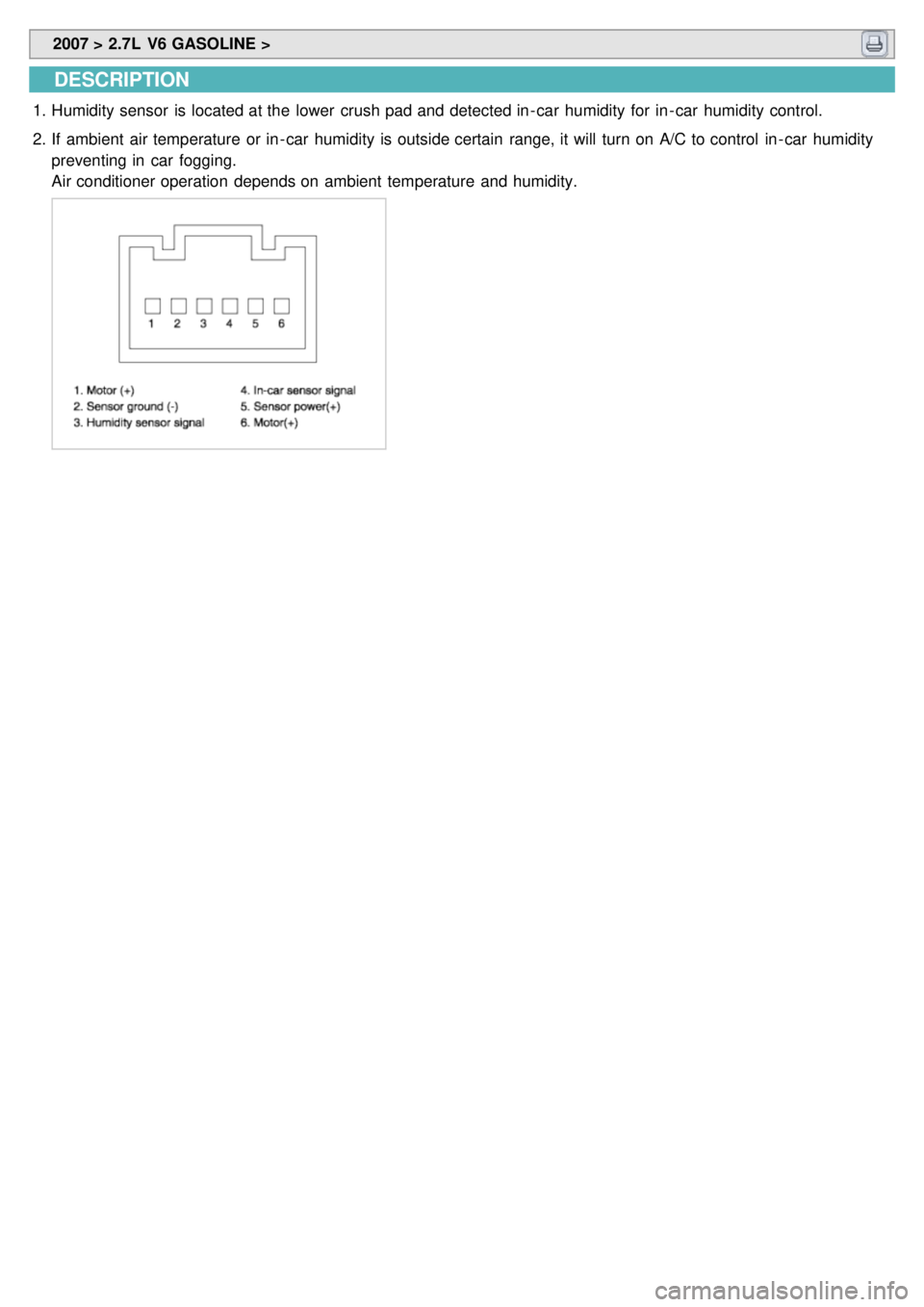
1.Humidity sensor is located at the lower crush pad and detected in - car humidity for in - car humidity control.
2. If ambient air temperature or in - car humidity is outside certain range, it will turn on A/C to control in - car humidity
preventing in car fogging.
Air conditioner operation depends on ambient temperature and humidity.
Page 728 of 1575
2007 > 2.7L V6 GASOLINE >
DESCRIPTION
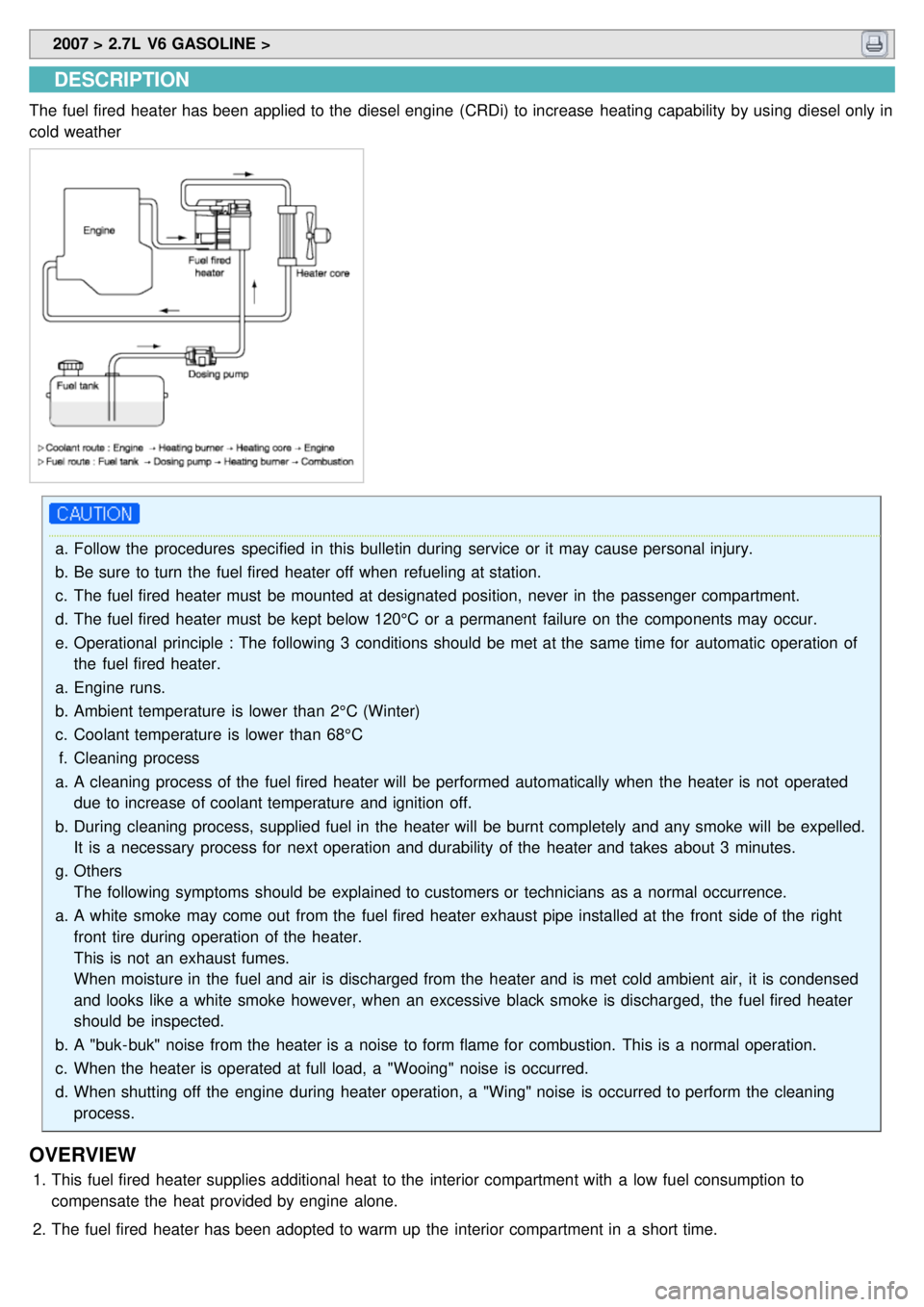
The fuel fired heater has been applied to the diesel engine (CRDi) to increase heating capability by using diesel only in
cold weather
a.Follow the procedures specified in this bulletin during service or it may cause personal injury.
b. Be sure to turn the fuel fired heater off when refueling at station.
c. The fuel fired heater must be mounted at designated position, never in the passenger compartment.
d. The fuel fired heater must be kept below 120°C or a permanent failure on the components may occur.
e. Operational principle : The following 3 conditions should be met at the same time for automatic operation of
the fuel fired heater.
a. Engine runs.
b. Ambient temperature is lower than 2°C (Winter)
c. Coolant temperature is lower than 68°C
f. Cleaning process
a. A cleaning process of the fuel fired heater will be performed automatically when the heater is not operated
due to increase of coolant temperature and ignition off.
b. During cleaning process, supplied fuel in the heater will be burnt completely and any smoke will be expelled.
It is a necessary process for next operation and durability of the heater and takes about 3 minutes.
g. Others
The following symptoms should be explained to customers or technicians as a normal occurrence.
a. A white smoke may come out from the fuel fired heater exhaust pipe installed at the front side of the right
front tire during operation of the heater.
This is not an exhaust fumes.
When moisture in the fuel and air is discharged from the heater and is met cold ambient air, it is condensed
and looks like a white smoke however, when an excessive black smoke is discharged, the fuel fired heater
should be inspected.
b. A "buk- buk" noise from the heater is a noise to form flame for combustion. This is a normal operation.
c. When the heater is operated at full load, a "Wooing" noise is occurred.
d. When shutting off the engine during heater operation, a "Wing" noise is occurred to perform the cleaning
process.
OVERVIEW
1.This fuel fired heater supplies additional heat to the interior compartment with a low fuel consumption to
compensate the heat provided by engine alone.
2. The fuel fired heater has been adopted to warm up the interior compartment in a short time.
Page 729 of 1575

3.The two coolant temperature sensors are installed to the heater inner. The sensor valves determine heater
operation.
4. One of the temperature sensors functions to prevent the heater from overheating.
If the sensor temperature valve exceeds 125°C, the fuel will be cut and the heater will be deactivated by the
determination of the overheating of the heater.
The other temperature sensor determines the operation mode of the fuel fired heater.The temperature of this
sensor enables to activate the heater at full load(5kw) or half load(2.5kw).
• The coolant temperature shown on the above Figure is the value of the inner sensor and the actual coolant
temperature is higher about 5°C ~7°C than the above value.
OPERATION
Switch on/ Operation start
The fuel fired heater is operated when the coolant temperature is below 68°C and the ambient temperature is below
2°C after starting the engine.
At this time, the glow plug and combustion air fan are operated first and after 30 seconds, the dosing pump is
operated with stopping the combustion fan for 3 seconds.
After that, the operation of the fan increases continuously until it approaches to full load within 56 seconds. If fuel
supply reaches to full load the glow plug does not operate and the operation of the fan reaches to full load.
After that the glow plug monitors ignition condition as a flame sensor for 45 seconds.
The above operation procedure is done automatically and in case the ignition fails, the above operation will be done
again automatically.
If the condition of ignition failure sustains continuously, fuel supply and fan operation will be stopped and error codes
will be stored to find cause of failure.
Generally, the cause of ignition failure during combustion is caused by the automatic re- operation of the above
procedure.
Operation for heating
The fuel fired heater operates at full load when the coolant temperature is below 68°C and the ambient temperature is
below 2°C after starting the engine.
It operates at half load when the coolant temperature is 74°C and it operates at idle mode when the coolant
temperature is 78°C.
The fuel fired heater during the transformation process does a cleaning function from the half mode to the idle mode.
At idle mode, all components do not work.
The fuel fired heater operating at idle mode turns into the half load when the coolant temperature is 74°C. At this time,
if the coolant temperature drops again below 68°C, the heater operates with full load and turns into the idle mode if
the temperature is 78°C.
This serial operating process is performed automatically.
Key switch off / Operation stop
The fuel fired heater ECU stops the operation of the fuel pump and cuts fuel supply when shutting off the engine
during the heater operation.
The heater conducts cleaning operation at this time.
This is a process of burning the fuel completely supplied in the heater inner.
In this process, the glow plug and combustion air fan are operated.
Page 736 of 1575
2007 > 2.7L V6 GASOLINE >
DESCRIPTION
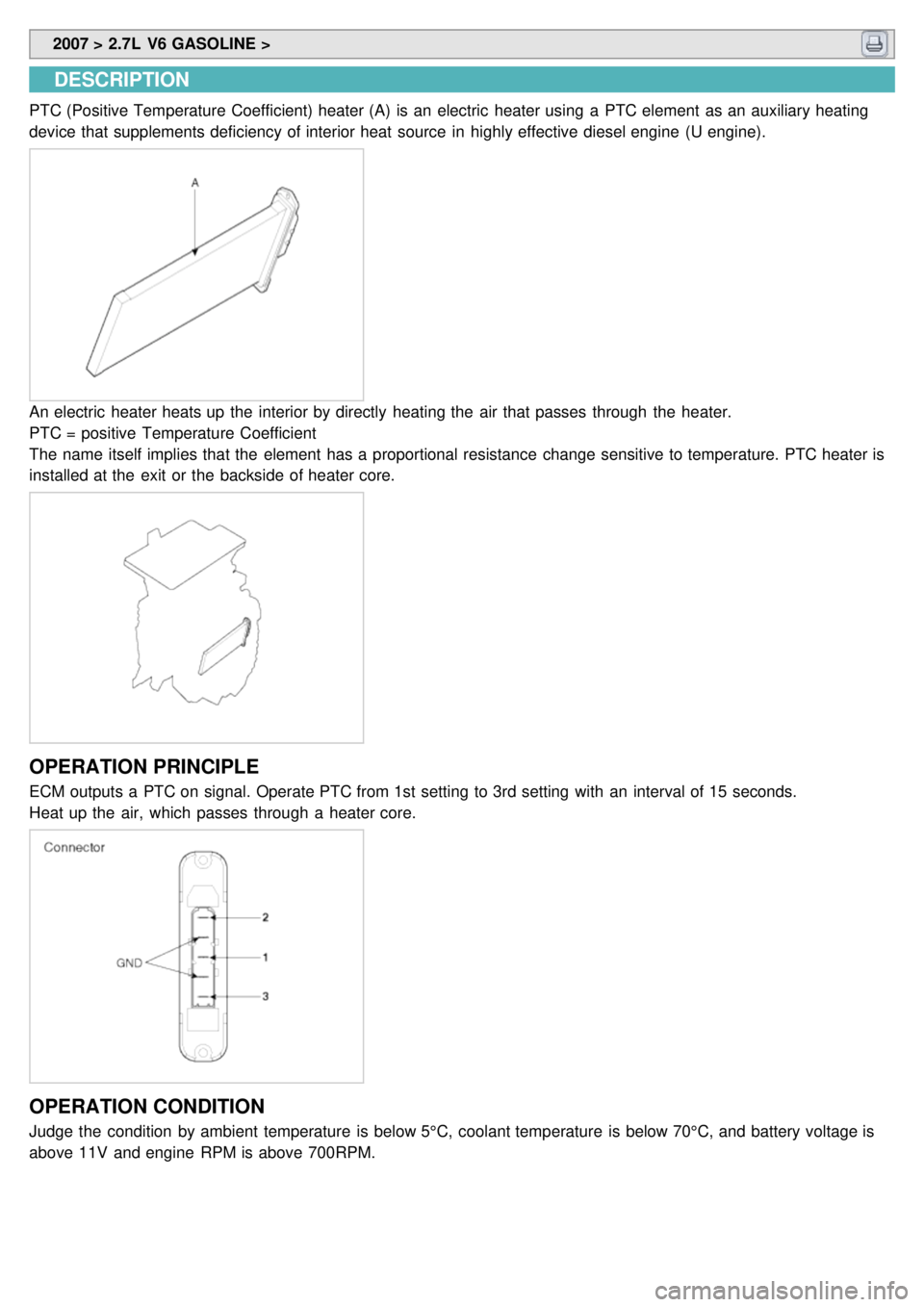
PTC (Positive Temperature Coefficient) heater (A) is an electric heater using a PTC element as an auxiliary heating
device that supplements deficiency of interior heat source in highly effective diesel engine (U engine).
An electric heater heats up the interior by directly heating the air that passes through the heater.
PTC = positive Temperature Coefficient
The name itself implies that the element has a proportional resistance change sensitive to temperature. PTC heater is
installed at the exit or the backside of heater core.
OPERATION PRINCIPLE
ECM outputs a PTC on signal. Operate PTC from 1st setting to 3rd setting with an interval of 15 seconds.
Heat up the air, which passes through a heater core.
OPERATION CONDITION
Judge the condition by ambient temperature is below 5°C, coolant temperature is below 70°C, and battery voltage is
above 11V and engine RPM is above 700RPM.
Page 795 of 1575

2007 > 2.7L V6 GASOLINE >
General
The supplemental restraint system (SRS) is designed to supplement the seat belt to help reduce the risk or severity of
injury to the driver and passenger by activating and deploying the driver, passenger, side airbag and belt pretensioner
in certain frontal or side collisions.
The SRS (Airbag) consists of : a driver side airbag module located in the center of the steering wheel, which contains
the folded cushion and an inflator unit ; a passenger side airbag module located in the passenger side crash pad
contains the folded cushion assembled with inflator unit ; side airbag modules located in the driver and passenger seat
contain the folded cushion and an inflator unit ; curtain airbag modules located inside of the headliner which contains
folded cushions and inflator units. The impact sensing function of the SRSCM is carried out by electronic
accelerometer that continuously measure the vehicle's acceleration and delivers a corresponding signal through
amplifying and filtering circuitry to the microprocessor.
SRSCM (SRS Control Module)
SRSCM will detect front impact with front impact sensor, and side impact with side impact sensor, and determine
airbag module deployment.
1. DC/DC converter: DC/DC converter in power supply unit includes up/down transformer converter, and provide
ignition voltage for 2 front airbag ignition circuits and the internal operation voltage of the SRSCM. If the internal
operation voltage is below critical value setting, it will perform resetting.
2. Safety sensor: Safety sensor is located in airbag ignition circuit. Safety sensor will operate airbag circuit at any
deployment condition and release airbag circuit safely at normal driving condition. Safety sensor is a double contact
electro - mechanical switch that will close detecting deceleration above certain criteria.
3. Back up power supply: SRSCM has separate back up power supply, that will supply deployment energy instantly in
low voltage condition or upon power failure by front crash.
4. Self diagnosis: SRSCM will constantly monitor current SRS operation status and detect system failure while vehicle
power supply is on, system failure may be checked with trouble codes using scan tool. (Hi- Scan)
5. Airbag warning lamp on: Upon detecting error, the module will transmit signal to SRSCM indicator lamp located at
cluster. MIL lamp will indicate driver SRS error. Upon ignition key on, SRS lamp will turn on for about six seconds.
6. Trouble code registration: Upon error occurrence in system, SRSCM will store DTC corresponding to the error.
DTC can be cleared only by Hi - Scan. However, if an internal fault code is logged or if a crash is recorded the fault
clearing should not happen.
7. Self diagnostic connector: Data stored in SRSCM memory will be output to Hi - Scan or other external output
devices through connector located below driver side crash pad.
8. Once airbag is deployed, SRSCM should not be used again but replaced.
9. SRSCM will determine whether passenger put on seat belt by the signal from built- in switch in seat belt buckle, and
deploy front seat airbag at each set crash speed.
10. Side airbag deployment will be determined by SRSCM that will detect satellite sensor impact signal upon side
crash, irrespective to seat belt condition.