air condition KIA CARNIVAL 2007 Owner's Guide
[x] Cancel search | Manufacturer: KIA, Model Year: 2007, Model line: CARNIVAL, Model: KIA CARNIVAL 2007Pages: 1575, PDF Size: 44.86 MB
Page 498 of 1575
→NO
Replace bent or damaged parts.
CHECK THE REAR SUSPENSION
a.Measure the vehicle wheel base for LH and RH.
b. Compare the measurements.
● Are the measurements the same ?
→ YES
If the ride is smooth, vehicle is OK.
If the ride is rough, Go to Detailed Test
→ NO
Inspect the rear suspension components for wear or damage.
Repair or Install new components as necessary.
DETAILED TEST H : ROUGH RIDE CONDITIONS DETAILS/RESULTS/ACTIONS
CHECK THE FRONT SHOCK ABSORBER
a.Raise support the vehicle.
b. Inspect the front shock absorber for oil leaks or damage.
● Are the tires excessively worn or damaged ?
→ YES
Install new front shock absorbers.
→ NO
Go to
CHECK THE REAR SHOCK ABSORBERS Inspect the rear shock absorbers for oil leaks or damage.
● Are the rear shock absorbers leaking ?
→ YES
Install new rear shock absorbers.
→ NO
The vehicle is OK. Go to TROUBLESHOOTING.
DETAILED TEST I : EXCESSIVE NOISE CONDITIONS DETAILS/RESULTS/ACTIONS
INSPECT THE SUSPENSION
a.Raise and support the vehicle.
b. Inspect the shock absorber mounting bolts.
● Are the mounting bolts loose or broken ?
→ YES
Tighten or Install new shock absorber mounting bolts.
→ NO
Go to
INSPECT THE SPRING AND TORSION BARS Inspect the springs and stabilizer bars for damage.
● Are the spring or stabilizer bars damaged ?
→ YES
Install new spring and/or stabilizer bars.
Page 581 of 1575

2007 > 2.7L V6 GASOLINE >
TROUBLESHOOTING
Symptom Probable cause Remedy
Excessive play in
steering Loose yoke plug
Retighten
Loose steering gear mounting bolts Retighten
Loose or worn tie rod end Retighten or replace as necessary
Steering wheel
operation is not
smooth (Insufficient
power assist) V- belt slippage
Readjust
Damaged V- belt Replace
Low fluid level Replenish
Air in the fluid Bleed air
Twisted or damaged hoses Correct the routing or replace
Insufficient oil pump pressure Repair or replace the oil pump
Sticky flow control valve Replace
Excessive internal oil pump leakage Replace the damaged parts
Excessive oil leaks from rack and pinion in
gear box Replace the damaged parts
Distorted or damaged gear box or valve body
seals Replace
Steering wheel does
not return properly Excessive turning resistance of tierod end
Replace
Yoke plug excessively tight Adjust
Tie rod and/or ball joint cannot turn smoothly Replace
Loose mounting of gear box mounting bracket
Worn steering shaft joint and/or Retighten
Worn steering shaft joint and/or body
grommet Correct or replace
Distorted rack Replace
Damaged pinion bearing Replace
Twisted or damaged hoses Reposition or replace
Damaged oil pressure control valve Replace
Damaged oil pump input shaft bearing Replace
Noise Hissing Noise in Steering Gear
There is some noise with all power steering systems. One of the most common is a hissing
sound when the steering wheel is turned and the car is not moving. This noise will be most
evident when turning the wheel while the brakes are being applied. There is no relationship
between this noise and steering performance. Do not replace the valve unless the "hissing"
noise becomes extreme. A replaced valve will also make a slight noise, and is not always a
solution for the condition.
Rattling or chucking
noise in the rack and
pinion Interference with hoses from vehicle body
Reposition
Loose gear box bracket Retighten
Loose tie rod end and/or ball joint Retighten
Worn tie rod and/or ball joint Replace
Noise in the oil pump Low fluid level Replenish
Air in the fluid Bleed air
Loose pump mounting bolts Retighten
Page 635 of 1575

2007 > 2.7L V6 GASOLINE >
TROUBLE SHOOTING
Symptom Probable cause Remedy
There is no change made in rack
stroke even though turning the VRS
switch ON or OFF. a.
VRS operating unit
b. VRS control module
c. VRS switch a.
Inspect the VRS operating unit.
b. Check Input/ output signal of the
VRS control module.
c. Inspect connection of the VRS
switch.
LED is not illuminated even though
turning the VRS switch ON. VRS switch a.
Inspect connection of the VRS
switch.
b. Check the LED for damage.
Inspection of the rack stroke
1.Is the rack stoke (the maximum steering angle) changed when pressing the VRS switch ?
▶ The VRS system is in normal condition.
▶ Go to step 2.
2. Measure the resistance of the VRS operating unit.
(1) Disconnect the VRS operating unit connector.
(2) Measure the resistance between the terminal No.1 and No.2.
Repeat the terminal No.3 and No.4.
Is the measured resistance within standard value ?
4 ~ 20 Ω → Normal condition (standard value)
1 Ω or below → Short
100 Ω or above → Open circuit
▶ Go to step 3.
▶ Repair or replace the power steering gear box.
3. Measure the output voltage of the VRS control module.
(1) Disconnect the VRS control module connector.
(2) Connect 9 ~ 15 V power between the terminal No.3 and No.4.
(3) Measure the output voltage (to DC motor) between the terminal No.5 ~ 8.
Is the voltage measured within standard value ?
Supplied power Measured output voltage
Page 636 of 1575
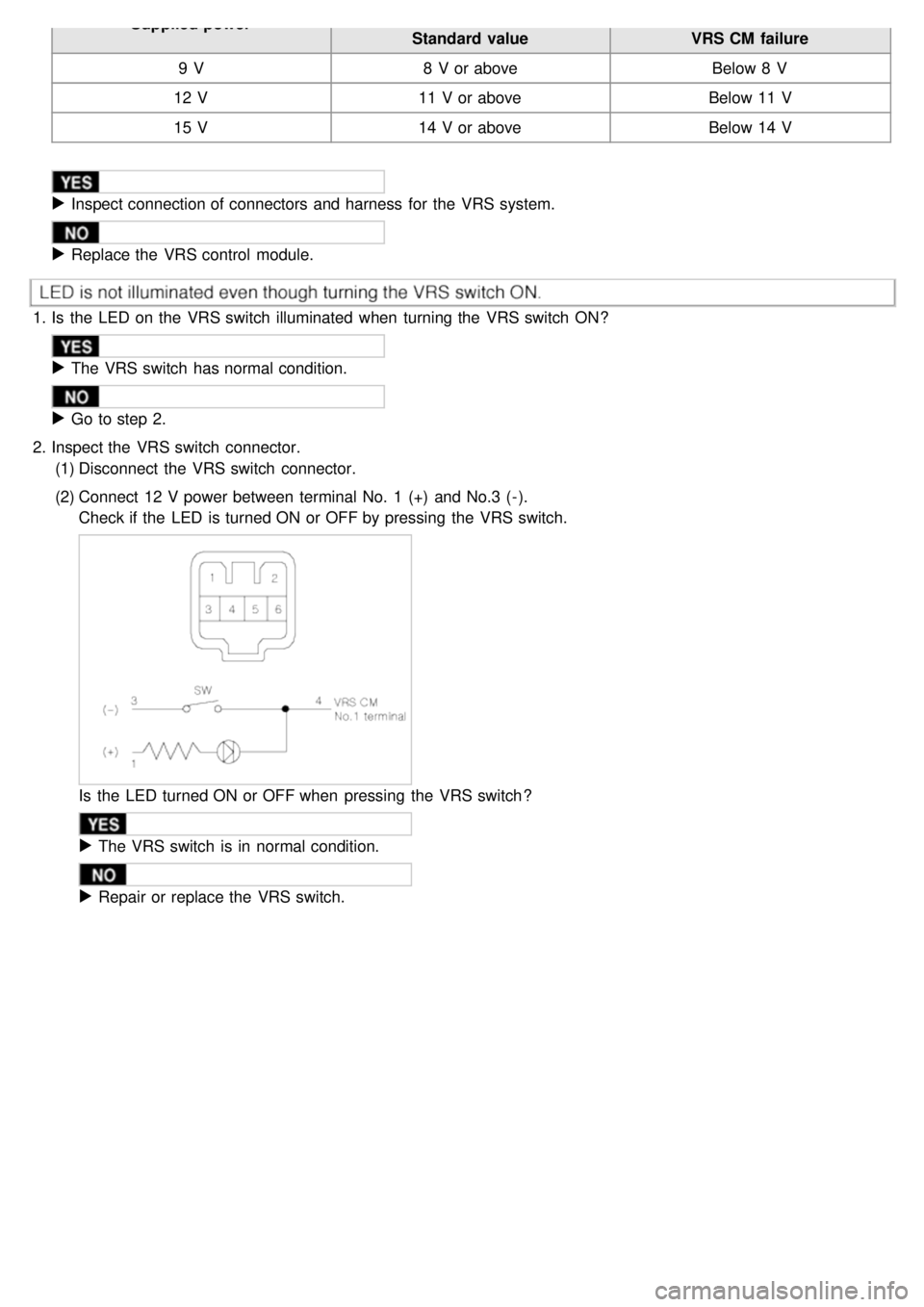
Supplied powerStandard valueVRS CM failure
9 V 8 V or above Below 8 V
12 V 11 V or above Below 11 V
15 V 14 V or above Below 14 V
▶ Inspect connection of connectors and harness for the VRS system.
▶ Replace the VRS control module.
1. Is the LED on the VRS switch illuminated when turning the VRS switch ON?
▶ The VRS switch has normal condition.
▶ Go to step 2.
2. Inspect the VRS switch connector.
(1) Disconnect the VRS switch connector.
(2) Connect 12 V power between terminal No. 1 (+) and No.3 ( - ).
Check if the LED is turned ON or OFF by pressing the VRS switch.
Is the LED turned ON or OFF when pressing the VRS switch ?
▶ The VRS switch is in normal condition.
▶ Repair or replace the VRS switch.
Page 643 of 1575
CHAPTER 11:
Heating, Ventilation, Air Conditioning
Page 644 of 1575
Air Conditioning System
Page 646 of 1575
2007 > 2.7L V6 GASOLINE >
TROUBLESHOOTING
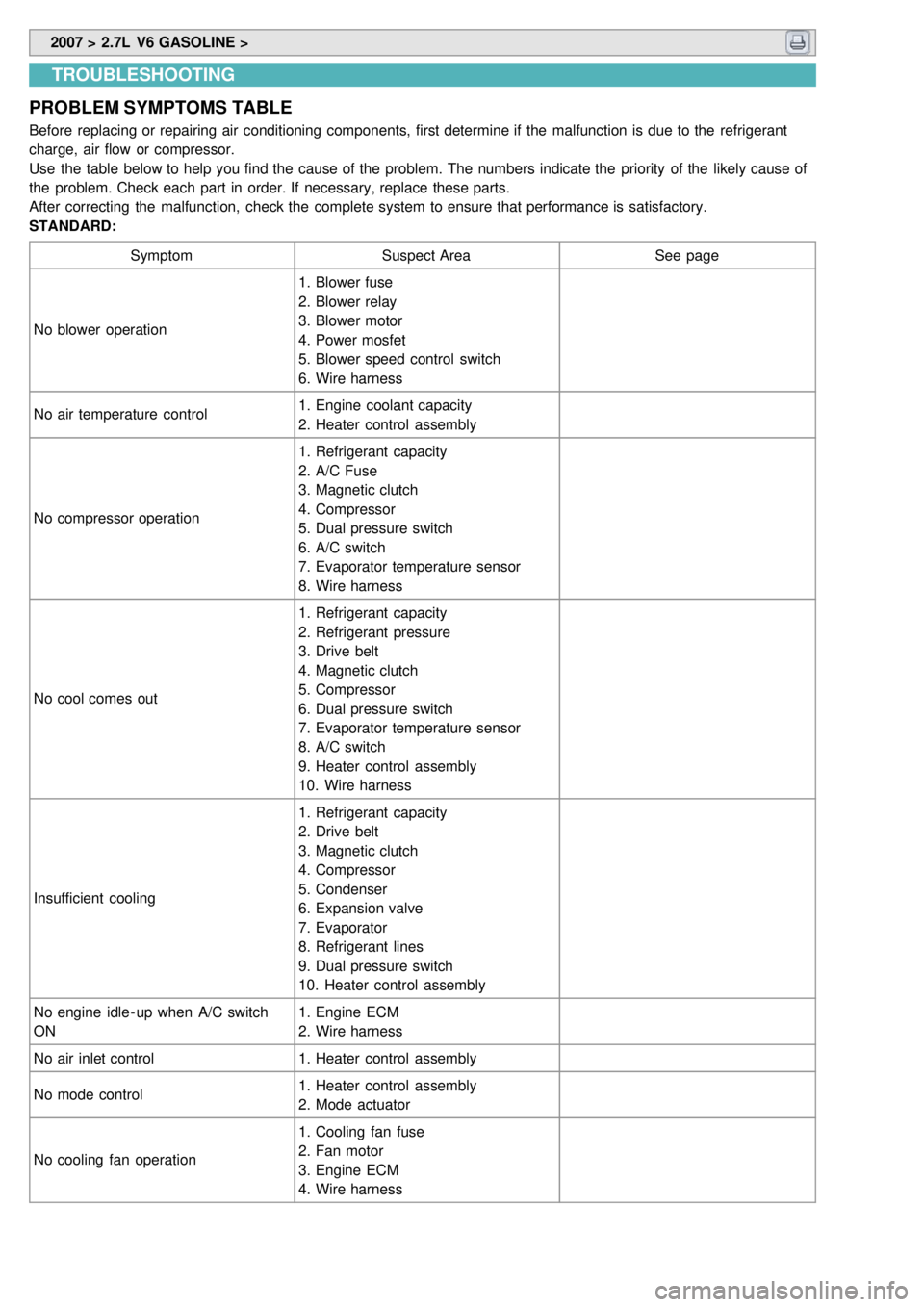
PROBLEM SYMPTOMS TABLE
Before replacing or repairing air conditioning components, first determine if the malfunction is due to the refrigerant
charge, air flow or compressor.
Use the table below to help you find the cause of the problem. The numbers indicate the priority of the likely cause of
the problem. Check each part in order. If necessary, replace these parts.
After correcting the malfunction, check the complete system to ensure that performance is satisfactory.
STANDARD:
Symptom Suspect Area See page
No blower operation 1. Blower fuse
2. Blower relay
3. Blower motor
4. Power mosfet
5. Blower speed control switch
6. Wire harness
No air temperature control 1. Engine coolant capacity
2. Heater control assembly
No compressor operation 1. Refrigerant capacity
2. A/C Fuse
3. Magnetic clutch
4. Compressor
5. Dual pressure switch
6. A/C switch
7. Evaporator temperature sensor
8. Wire harness
No cool comes out 1. Refrigerant capacity
2. Refrigerant pressure
3. Drive belt
4. Magnetic clutch
5. Compressor
6. Dual pressure switch
7. Evaporator temperature sensor
8. A/C switch
9. Heater control assembly
10. Wire harness
Insufficient cooling 1. Refrigerant capacity
2. Drive belt
3. Magnetic clutch
4. Compressor
5. Condenser
6. Expansion valve
7. Evaporator
8. Refrigerant lines
9. Dual pressure switch
10. Heater control assembly
No engine idle - up when A/C switch
ON 1. Engine ECM
2. Wire harness
No air inlet control 1. Heater control assembly
No mode control 1. Heater control assembly
2. Mode actuator
No cooling fan operation 1. Cooling fan fuse
2. Fan motor
3. Engine ECM
4. Wire harness
Page 647 of 1575
2007 > 2.7L V6 GASOLINE >
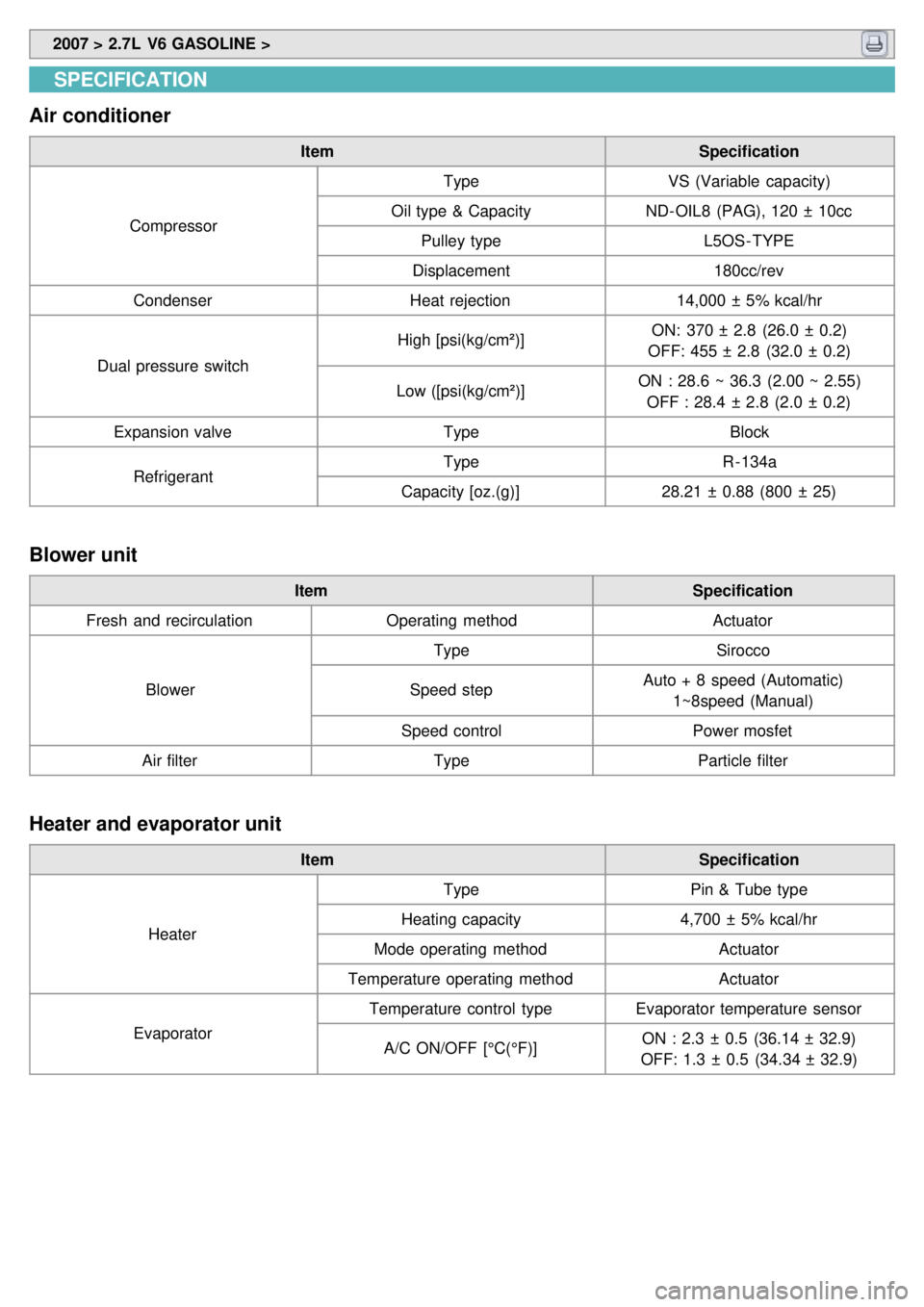
SPECIFICATION
Air conditioner
Item Specification
Compressor Type
VS (Variable capacity)
Oil type & Capacity ND- OIL8 (PAG), 120 ± 10cc
Pulley type L5OS - TYPE
Displacement 180cc/rev
Condenser Heat rejection14,000 ± 5% kcal/hr
Dual pressure switch High [psi(kg/cm²)]
ON: 370 ± 2.8 (26.0 ± 0.2)
OFF: 455 ± 2.8 (32.0 ± 0.2)
Low ([psi(kg/cm²)] ON : 28.6 ~ 36.3 (2.00 ~ 2.55)
OFF : 28.4 ± 2.8 (2.0 ± 0.2)
Expansion valve TypeBlock
Refrigerant Type
R- 134a
Capacity [oz.(g)] 28.21 ± 0.88 (800 ± 25)
Blower unit
Item Specification
Fresh and recirculation Operating method Actuator
Blower Type
Sirocco
Speed step Auto + 8 speed (Automatic)
1~8speed (Manual)
Speed control Power mosfet
Air filter TypeParticle filter
Heater and evaporator unit
Item Specification
Heater Type
Pin & Tube type
Heating capacity 4,700 ± 5% kcal/hr
Mode operating method Actuator
Temperature operating method Actuator
Evaporator Temperature control type
Evaporator temperature sensor
A/C ON/OFF [°C(°F)] ON : 2.3 ± 0.5 (36.14 ± 32.9)
OFF: 1.3 ± 0.5 (34.34 ± 32.9)
Page 648 of 1575
Air Conditioning System
Page 654 of 1575
2007 > 2.7L V6 GASOLINE >
REFRIGERANT SYSTEM SERVICE BASICS
REFRIGERANT RECOVERY
Use only service equipment that is U.L - listed and is certified to meet the requirements of SAE J2210 to remove HFC-
134a(R- 134a) from the air conditioning system.
a. Air conditioning refrigerant or lubricant vapor can irritate your eyes, nose, or throat.
b. Be careful when connecting service equipment.
c. Do not breathe refrigerant or vapor.
If accidental system discharge occurs, ventilate work area before resuming service.
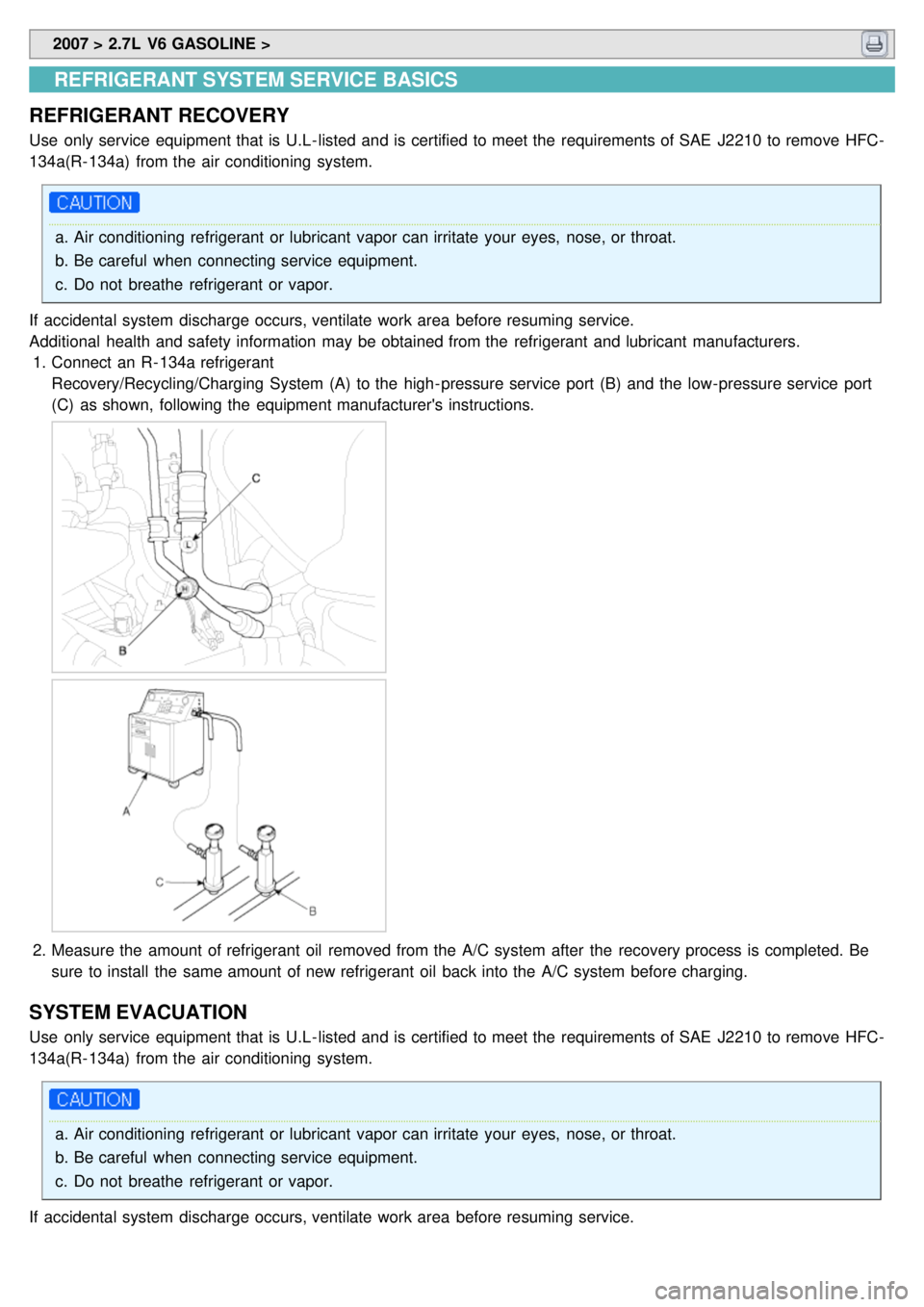
Additional health and safety information may be obtained from the refrigerant and lubricant manufacturers. 1. Connect an R- 134a refrigerant
Recovery/Recycling/Charging System (A) to the high- pressure service port (B) and the low- pressure service port
(C) as shown, following the equipment manufacturer's instructions.
2.Measure the amount of refrigerant oil removed from the A/C system after the recovery process is completed. Be
sure to install the same amount of new refrigerant oil back into the A/C system before charging.
SYSTEM EVACUATION
Use only service equipment that is U.L - listed and is certified to meet the requirements of SAE J2210 to remove HFC-
134a(R- 134a) from the air conditioning system.
a.Air conditioning refrigerant or lubricant vapor can irritate your eyes, nose, or throat.
b. Be careful when connecting service equipment.
c. Do not breathe refrigerant or vapor.
If accidental system discharge occurs, ventilate work area before resuming service.