wiring KIA CARNIVAL 2007 Service Manual
[x] Cancel search | Manufacturer: KIA, Model Year: 2007, Model line: CARNIVAL, Model: KIA CARNIVAL 2007Pages: 1575, PDF Size: 44.86 MB
Page 1388 of 1575
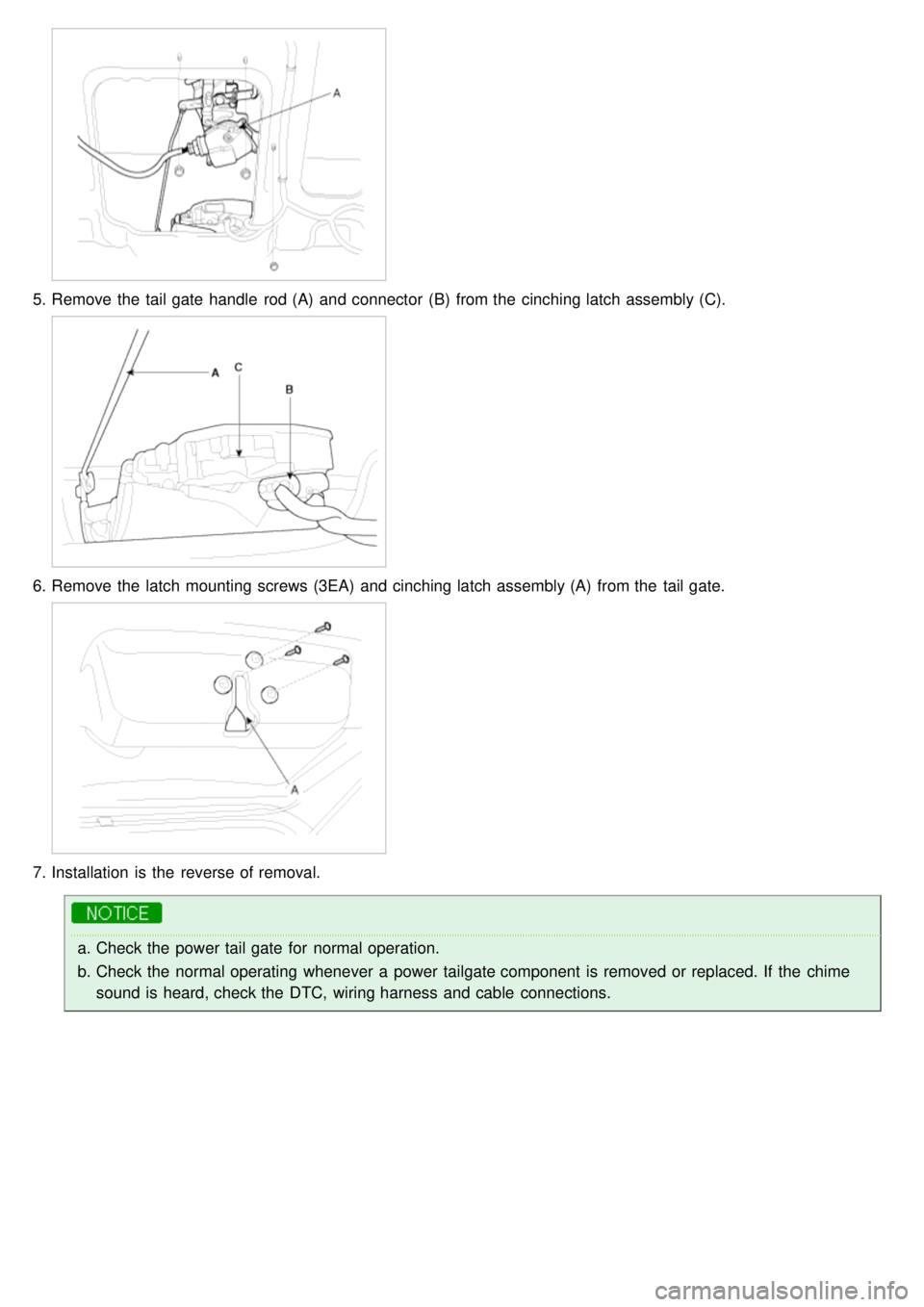
5.Remove the tail gate handle rod (A) and connector (B) from the cinching latch assembly (C).
6.Remove the latch mounting screws (3EA) and cinching latch assembly (A) from the tail gate.
7.Installation is the reverse of removal.
a.Check the power tail gate for normal operation.
b. Check the normal operating whenever a power tailgate component is removed or replaced. If the chime
sound is heard, check the DTC, wiring harness and cable connections.
Page 1436 of 1575

2007 > 2.7L V6 GASOLINE >
REMOVAL
The rain sensor may not operate proprly if contaminated. Protect the rain sensor surface by not removing the
cover until installation time. The coupling pad on the rain sensor surface has adhesive strength. Take care when
installing the sensor. If the sensor is separated from the windshield by force, the sensor or windshield may be
damaged. Take care when removing the sensor.
1. Remove the sensor cover. When removing it, make sure take care to prevent damage. To remove it, press back
the locking hook using the cover hole using an appropriate tool.
2.When removing rain sensor from the bracket, open the spring clip using the ( - )driver, and then remove.
3.Disconnect the wiring harness connector from the sensor.
4. Rain sensor is fitted with 2 spring slides by clip type on the front glass, it can be replaced easily. When replacing
the front glass, take away the rain sensor from the existing glass.
After then attach it to new one again.
INSTALLATION
a.In case of the windshield with reflection layer which reflects the infrared rays in sensing field, remove the
reflection layer from the rain sensor mounting position prior to installation.
b. Bracket and spring slide need for installing the rainsensor, it is covered by sensor cover.
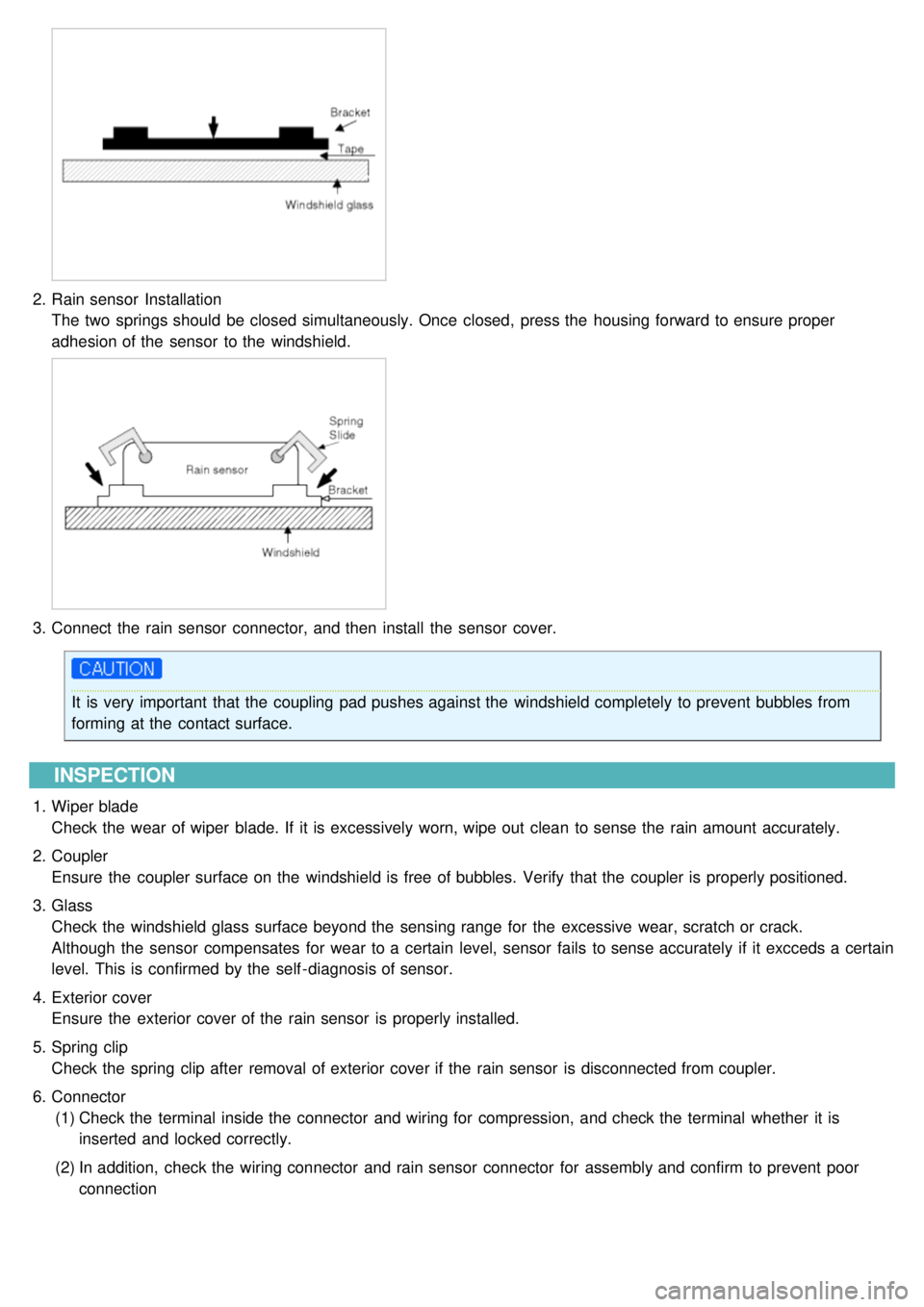
1. Install the rain sensor bracket to the windshield glass using the tape
Page 1437 of 1575
2.Rain sensor Installation
The two springs should be closed simultaneously. Once closed, press the housing forward to ensure proper
adhesion of the sensor to the windshield.
3.Connect the rain sensor connector, and then install the sensor cover.
It is very important that the coupling pad pushes against the windshield completely to prevent bubbles from
forming at the contact surface.
INSPECTION
1.Wiper blade
Check the wear of wiper blade. If it is excessively worn, wipe out clean to sense the rain amount accurately.
2. Coupler
Ensure the coupler surface on the windshield is free of bubbles. Verify that the coupler is properly positioned.
3. Glass
Check the windshield glass surface beyond the sensing range for the excessive wear, scratch or crack.
Although the sensor compensates for wear to a certain level, sensor fails to sense accurately if it excceds a certain
level. This is confirmed by the self - diagnosis of sensor.
4. Exterior cover
Ensure the exterior cover of the rain sensor is properly installed.
5. Spring clip
Check the spring clip after removal of exterior cover if the rain sensor is disconnected from coupler.
6. Connector
(1) Check the terminal inside the connector and wiring for compression, and check the terminal whether it is
inserted and locked correctly.
(2) In addition, check the wiring connector and rain sensor connector for assembly and confirm to prevent poor
connection
Page 1538 of 1575

(3)If a vehicle stays under extremely hot or cold environment, the detection range may be reduced. It will be
restored at the normal temperature.
(4) When heavy cargo is loaded in rear cargo area, it changes the vehicle balance, which reduces the detection
range.
(5) When other vehicle's horn, motor cycle engine noise, or other ultra - sonic wave sources are near.
(6) Under heavy rain.
(7) When reversing towards a vertical wall and the gap between the vehicle and the wall is 15cm. (Alarm may
sound despite the absence of a barrier)
(8) If radio antenna is installed at the rear.
(9) If the vehicle rear wiring is re- routed or electrical component is added at the rear part.
(10) Vehicle balance is changed due to the replacement of the rear spring.
(11) The unit will operate normally when the vehicle speed is 5km/h or less.
Above this speed, the unit may not operate normally
8. Check the rear bumper for installation condition and deformation. If installed improperly or the sensor orientation is
deviated, it may cause malfunction.
9. Be careful not to apply shock during sensor installation on the transmission or reception unit.
10. When adding electrical devices or modifying harness at the rear body of the vehicle, ensure not to change the
transmission and reception unit wiring.
Tagging the transmission side and reception side, it may cause malfunction.
11. High power radio transmitter (above 10W) may cause malfunction. Do not install it on the vehicle.
12. Be careful that excessive heat or sharp objects shall not touch ultrasonic sensor surface.
Do not cover the sensor opening or press the sensor.