CYLINDER 6 KIA CARNIVAL 2007 Repair Manual
[x] Cancel search | Manufacturer: KIA, Model Year: 2007, Model line: CARNIVAL, Model: KIA CARNIVAL 2007Pages: 1575, PDF Size: 44.86 MB
Page 863 of 1575
2007 > 2.7L V6 GASOLINE >
TROUBLESHOOTING
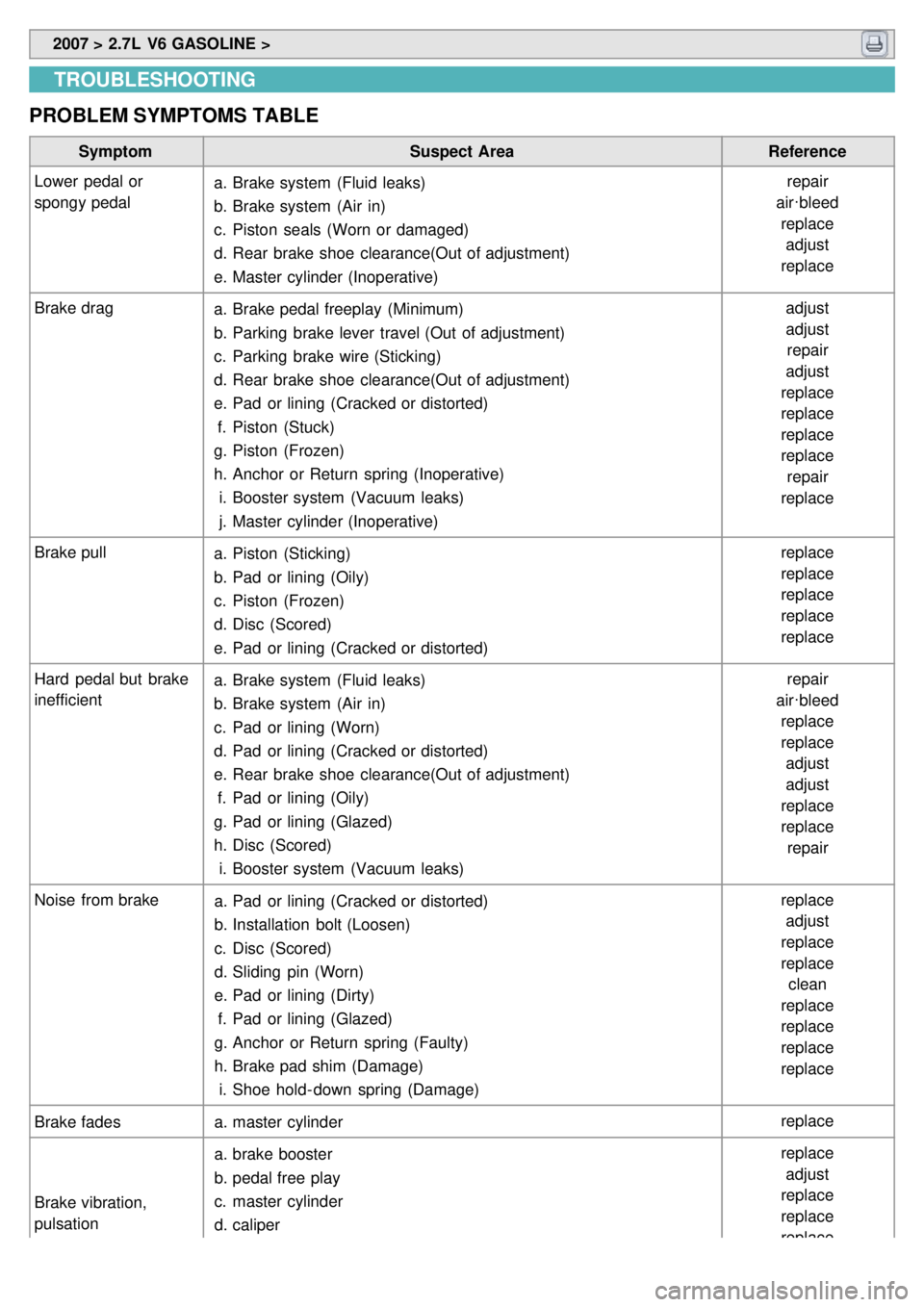
PROBLEM SYMPTOMS TABLE
Symptom Suspect Area Reference
Lower pedal or
spongy pedal a.
Brake system (Fluid leaks)
b. Brake system (Air in)
c. Piston seals (Worn or damaged)
d. Rear brake shoe clearance(Out of adjustment)
e. Master cylinder (Inoperative) repair
air·bleed replaceadjust
replace
Brake drag a.Brake pedal freeplay (Minimum)
b. Parking brake lever travel (Out of adjustment)
c. Parking brake wire (Sticking)
d. Rear brake shoe clearance(Out of adjustment)
e. Pad or lining (Cracked or distorted)
f. Piston (Stuck)
g. Piston (Frozen)
h. Anchor or Return spring (Inoperative)
i. Booster system (Vacuum leaks)
j. Master cylinder (Inoperative) adjust
adjust
repair
adjust
replace
replace
replace
replace repair
replace
Brake pull a.Piston (Sticking)
b. Pad or lining (Oily)
c. Piston (Frozen)
d. Disc (Scored)
e. Pad or lining (Cracked or distorted) replace
replace
replace
replace
replace
Hard pedal but brake
inefficient a.
Brake system (Fluid leaks)
b. Brake system (Air in)
c. Pad or lining (Worn)
d. Pad or lining (Cracked or distorted)
e. Rear brake shoe clearance(Out of adjustment)
f. Pad or lining (Oily)
g. Pad or lining (Glazed)
h. Disc (Scored)
i. Booster system (Vacuum leaks) repair
air·bleed replace
replaceadjust
adjust
replace
replace repair
Noise from brake a.Pad or lining (Cracked or distorted)
b. Installation bolt (Loosen)
c. Disc (Scored)
d. Sliding pin (Worn)
e. Pad or lining (Dirty)
f. Pad or lining (Glazed)
g. Anchor or Return spring (Faulty)
h. Brake pad shim (Damage)
i. Shoe hold- down spring (Damage) replace
adjust
replace
replace clean
replace
replace
replace
replace
Brake fades a.master cylinder replace
Brake vibration,
pulsation a.
brake booster
b. pedal free play
c. master cylinder
d. caliper replace
adjust
replace
replace
replace
Page 864 of 1575
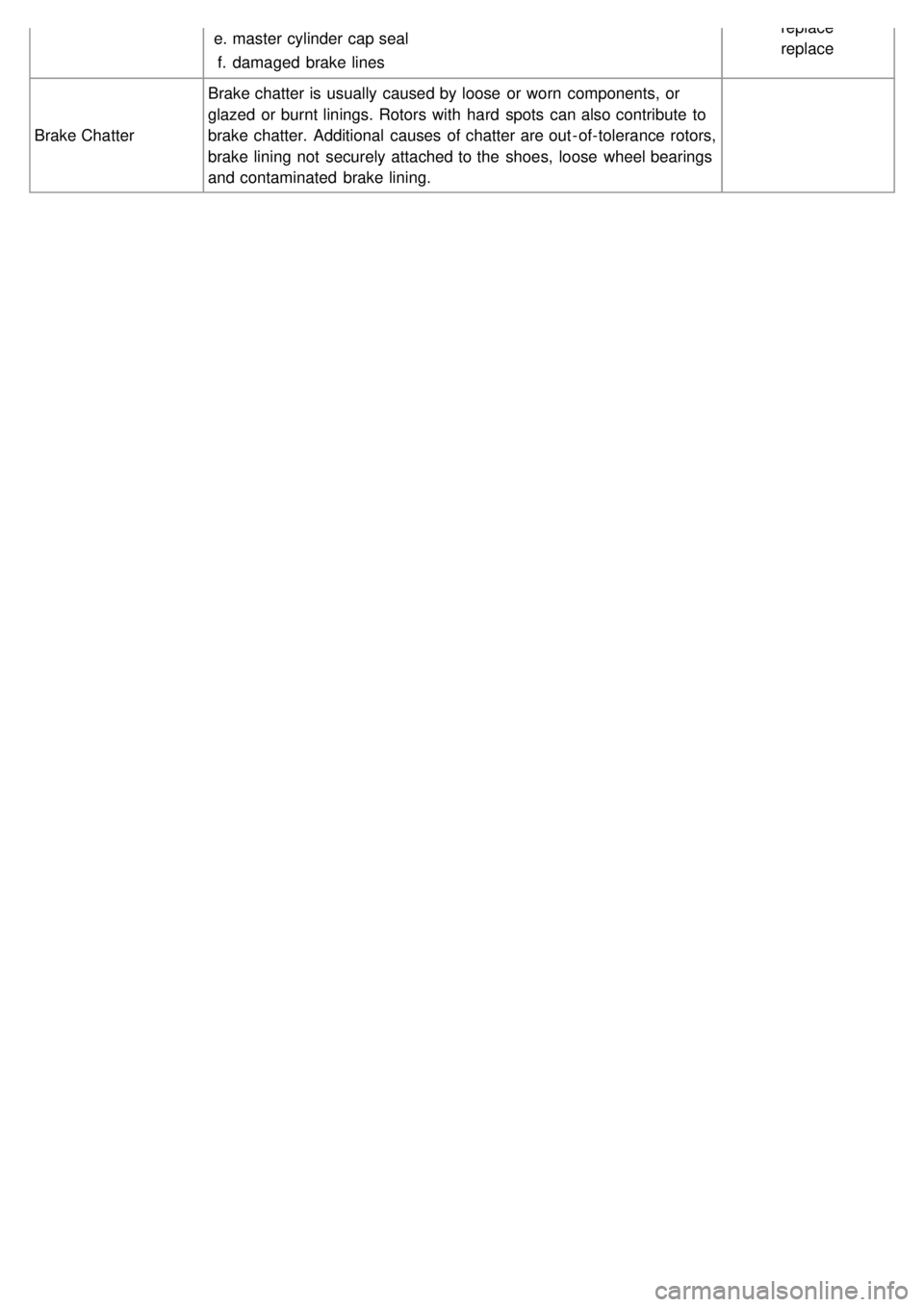
e.master cylinder cap seal
f. damaged brake lines replace
replace
Brake Chatter Brake chatter is usually caused by loose or worn components, or
glazed or burnt linings. Rotors with hard spots can also contribute to
brake chatter. Additional causes of chatter are out - of- tolerance rotors,
brake lining not securely attached to the shoes, loose wheel bearings
and contaminated brake lining.
Page 865 of 1575

2007 > 2.7L V6 GASOLINE >
SPECIFICATIONS
Item Specification
Master cylinder
· Type
· I.D. mm(in)
· Piston stroke mm(in)
· Fluid level warning sensor Tandem type
26.99/(1.063)
30(1.18)
Provided
Brake booster
· Type
· Boosting ratio 8 + 9 in Tandem
9.0 : 1
Front brake(Disc)
· Type
· Disc O.D.
· Disc thickness
· Pad thickness
· Cylinder type
· Cylinder I.D. Floating type with ventilated disc
298 mm (11.73 in)
28 mm (1.10 in)
10.5 mm (0.41 in)
Double piston
Ø48 mm (Ø1.89 in)
Rear brake(Disc)
· Type
· Disc O.D.
· Disc thickness
· Pad thickness
· Cylinder type
· Cylinder I.D Floating type with solid disc
302 mm (11.89 in)
12 mm (0.47 in)
10 mm (0.39 in)
Single piston
Ø42.9 mm (Ø1.69 in)
Parking brake
· Type
· Actuation
· Drum DIH(Drum in hat)
Foot brake
Ø190 mm (Ø7.48 in)
O.D=Outer Diameter
I.D=Inner Diameter
ABS : Anti- lock Brake System
ESP : Electronic Stability Program
SERVICE STANDARD
Items Standard value
Brake pedal height 192.4 mm(7.57 in)
Brake pedal full stroke 122 mm (4.8 in)
Adjust Brake pedal full stroke 60 mm (2.36 in)
Brake pedal free play 3 ~ 8 mm(0.11 ~ 0.31 in)
Stop lamp switch outer case to pedal stopper clearance 1.0 ~ 1.5 mm (0.04 ~ 0.06 in)
Booster push rod to master cylinder piston clearance 0.6 ~ 1.7(0.02 ~ 0.07 in)(at 500 mmHg)
Parking brake pedal stroke when pedal assembly is depressed with
294N (30kgf, 66lb force) 145 mm (5.71 in) above
Front disc brake pad thickness 10.5 mm (0.41 in)
Front disc thickness 28 mm (1.10 in)
Rear disc brake pad thickness 10 mm (0.39 in)
Rear disc brake disc thickness 12 mm (0.47 in)
Rear parking brake liner thickness 4 mm (0.16 in)
Page 866 of 1575

TIGHTENING TORQUE
ItemsNmkgf.m lb - ft
Master cylinder to booster mounting nut 8 ~ 120.8 ~ 1.2 5.8 ~ 8.7
Brake booster mounting nut 13 ~ 161.3 ~ 1.6 9.4 ~ 11.6
Bleeder screw 7 ~ 130.7 ~ 1.3 5.06 ~ 9.4
Brake tube nut, brake hose 13 ~ 171.3 ~ 1.7 9.4 ~ 12.3
Caliper guide rod bolt (Front) 22 ~ 322.2 ~ 3.215.9 ~ 23.1
Caliper guide rod bolt (Rear) 22 ~ 322.2 ~ 3.215.9 ~ 23.1
Caliper assembly to knuckle (Front) 85 ~ 1008.5 ~ 1061.5 ~ 72.3
Caliper assembly to knuckle (Rear) 50 ~ 605.0 ~ 6.036.2 ~ 43.4
Brake hose to front caliper 25 ~ 302.5 ~ 3.018.1 ~ 21.7
Brake pedal assembly bracket mounting nut 10 ~ 151.0 ~ 1.5 7.2 ~ 10.8
Brake pedal mounting nut 13 ~ 161.3 ~ 1.6 9.4 ~ 11.6
Stop lamp switch mounting nut 8 ~ 100.8 ~ 1.0 5.8 ~ 7.23
Active wheel speed sensor mounting bolt on
the brake plate 7 ~ 10
0.7 ~ 1.0 5.1 ~ 7.2
HECU mounting bracket bolt 17 ~ 261.7 ~ 2.612.3 ~ 18.8
HECU mounting nut 6 ~ 100.6 ~ 1.0 4.3 ~ 7.2
Yaw rate & lateral acceleration sensor bolt 5 ~ 80.5 ~ 0.8 3.62 ~ 5.8
SPECIFICATION (ABS)
Part ItemStandard valueRemark
HECU(Hydraulic and
Electronic Control
Unit) System
4 channel 4 sensor
(Solenoid)
·ABS system:ABS &
EBD control
Type
Motor, valve relay
intergrated type
Operating voltage 8 V ~ 16 V(DC)
Operating temperature - 40 ~ 120 °C
( - 40 ~ 248 °F)
Warning lamp Operating voltage
12 V·ABS W/L:ABS failure
·Brake W/L:Parking,
brake oil, EBD failure
Current consumption 80 mA
Acitve wheel speed
sensor Supply voltage
DC 4.5 ~ 2.0 V
Operating temperature - 40 ~ 150 °C
Output current low 5.9 ~ 8.4 mATyp.7 mA
Output current High 11.8 ~ 16.8 mATyp.14 mA
Frequency range 1 ~ 2500 HZ
Air gap Front
0.15 ~ 1.5 mm Typ.0.7 mm
Rear 0.2 ~ 1.2 mm Typ.0.7 mm
Tone wheel 48 teeth
Output duty 30~70 %
SPECIFICATION(ESP)
Page 869 of 1575
2007 > 2.7L V6 GASOLINE >
Operation and Leakage Check
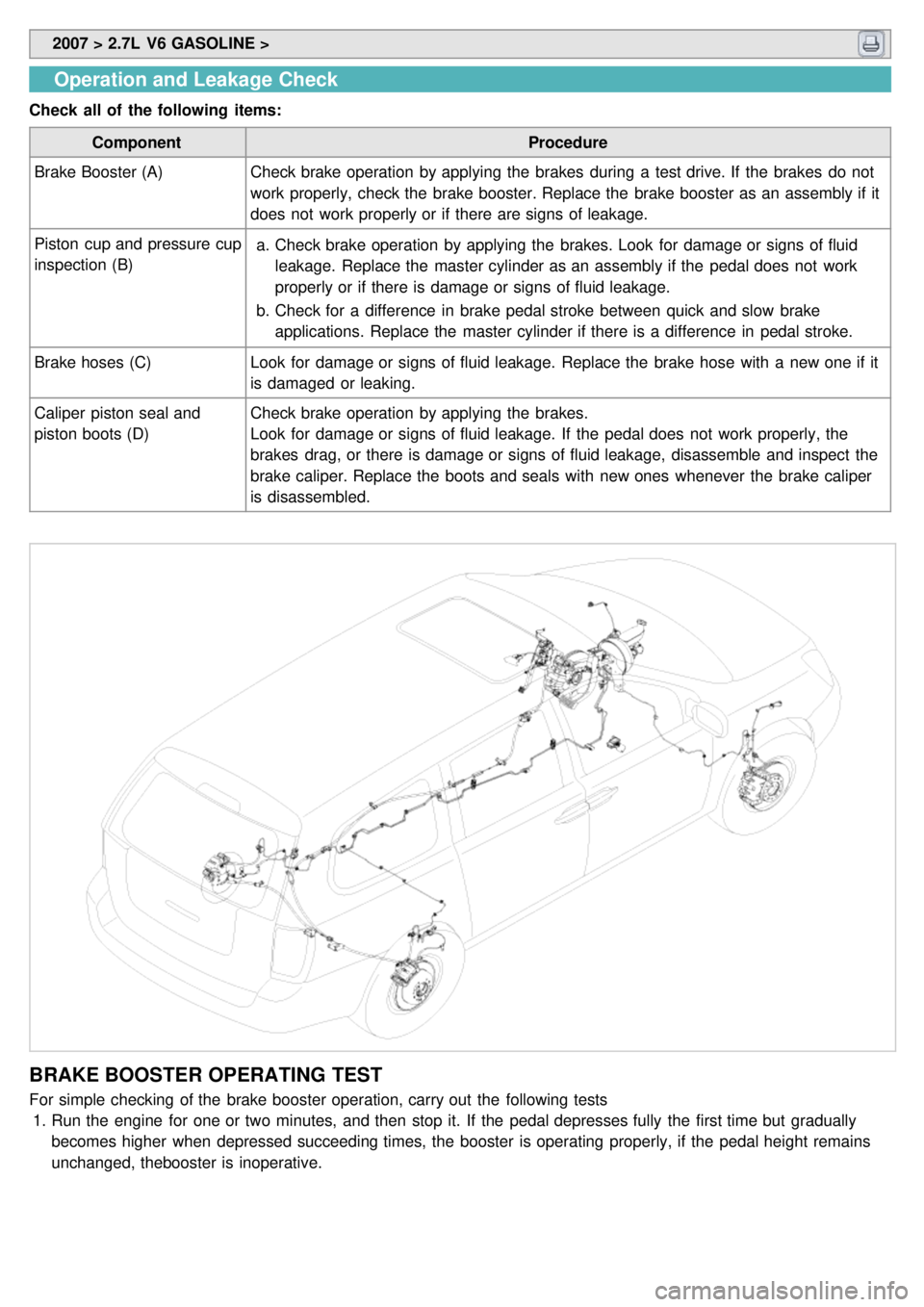
Check all of the following items:
Component Procedure
Brake Booster (A) Check brake operation by applying the brakes during a test drive. If the brakes do not
work properly, check the brake booster. Replace the brake booster as an assembly if it
does not work properly or if there are signs of leakage.
Piston cup and pressure cup
inspection (B) a.
Check brake operation by applying the brakes. Look for damage or signs of fluid
leakage. Replace the master cylinder as an assembly if the pedal does not work
properly or if there is damage or signs of fluid leakage.
b. Check for a difference in brake pedal stroke between quick and slow brake
applications. Replace the master cylinder if there is a difference in pedal stroke.
Brake hoses (C) Look for damage or signs of fluid leakage. Replace the brake hose with a new one if it
is damaged or leaking.
Caliper piston seal and
piston boots (D) Check brake operation by applying the brakes.
Look for damage or signs of fluid leakage. If the pedal does not work properly, the
brakes drag, or there is damage or signs of fluid leakage, disassemble and inspect the
brake caliper. Replace the boots and seals with new ones whenever the brake caliper
is disassembled.
BRAKE BOOSTER OPERATING TEST
For simple checking of the brake booster operation, carry out the following tests
1. Run the engine for one or two minutes, and then stop it. If the pedal depresses fully the first time but gradually
becomes higher when depressed succeeding times, the booster is operating properly, if the pedal height remains
unchanged, thebooster is inoperative.
Page 876 of 1575
![KIA CARNIVAL 2007 Repair Manual 2007 > 2.7L V6 GASOLINE >
Removal
1.Disconnect the vacuum hose (A) from the brake booster (B).
[LHD]
[RHD]
2.Remove the master cylinder (Refer to Master cylinder removal).
3. Remove the](/img/2/57045/w960_57045-875.png "KIA CARNIVAL 2007 Repair Manual 2007 > 2.7L V6 GASOLINE >
Removal
1.Disconnect the vacuum hose (A) from the brake booster (B).
[LHD]
[RHD]
2.Remove the master cylinder (Refer to Master cylinder removal).
3. Remove the")
2007 > 2.7L V6 GASOLINE >
Removal
1.Disconnect the vacuum hose (A) from the brake booster (B).
[LHD]
[RHD]
2.Remove the master cylinder (Refer to 'Master cylinder removal').
3. Remove the snap pin (A) and clevis pin (B).
4.Remove the four booster mounting nuts (C).
5. Remove the brake booster (A).
Page 878 of 1575
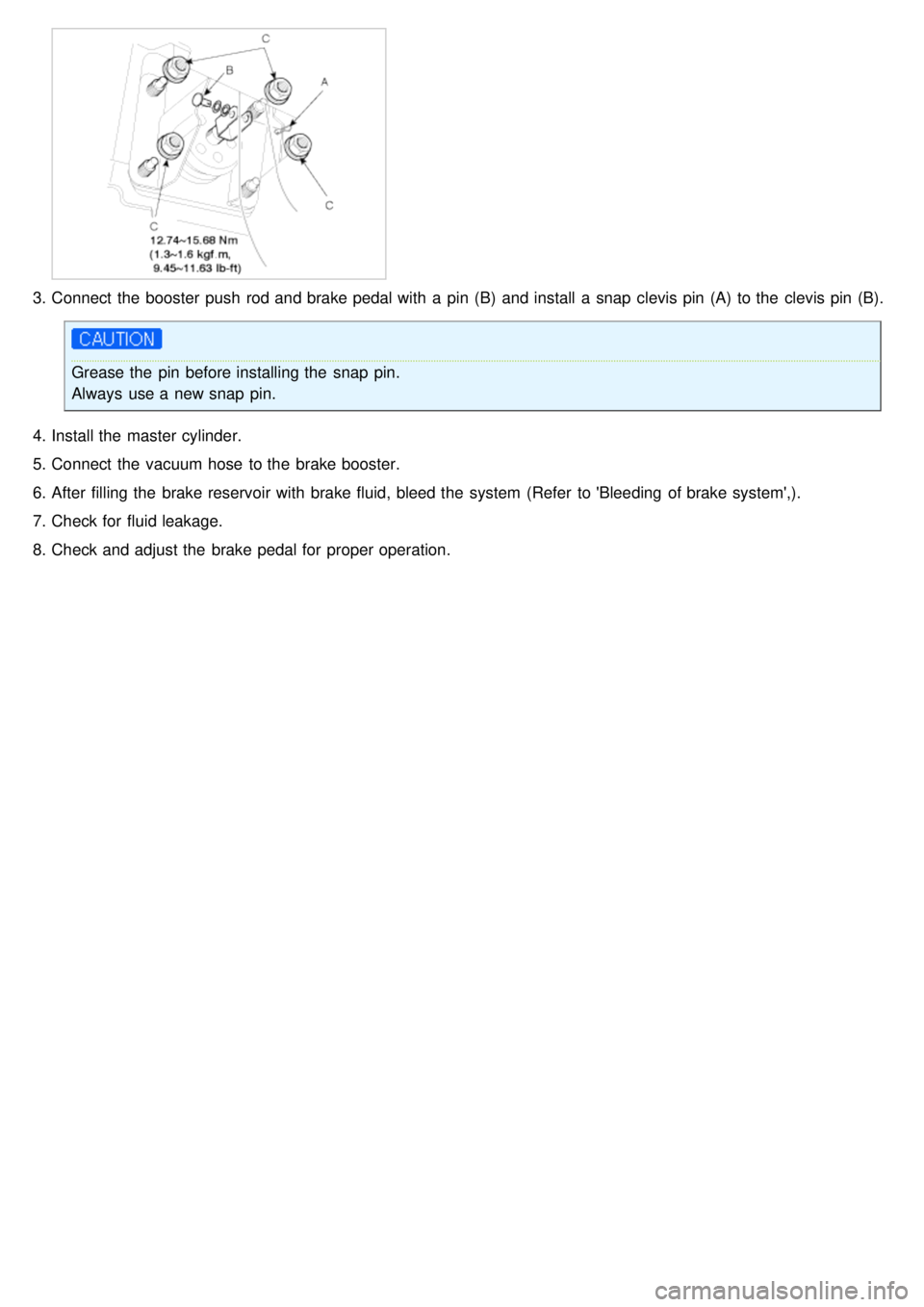
3.Connect the booster push rod and brake pedal with a pin (B) and install a snap clevis pin (A) to the clevis pin (B).
Grease the pin before installing the snap pin.
Always use a new snap pin.
4. Install the master cylinder.
5. Connect the vacuum hose to the brake booster.
6. After filling the brake reservoir with brake fluid, bleed the system (Refer to 'Bleeding of brake system',).
7. Check for fluid leakage.
8. Check and adjust the brake pedal for proper operation.
Page 879 of 1575

Master Cylinder
Page 882 of 1575
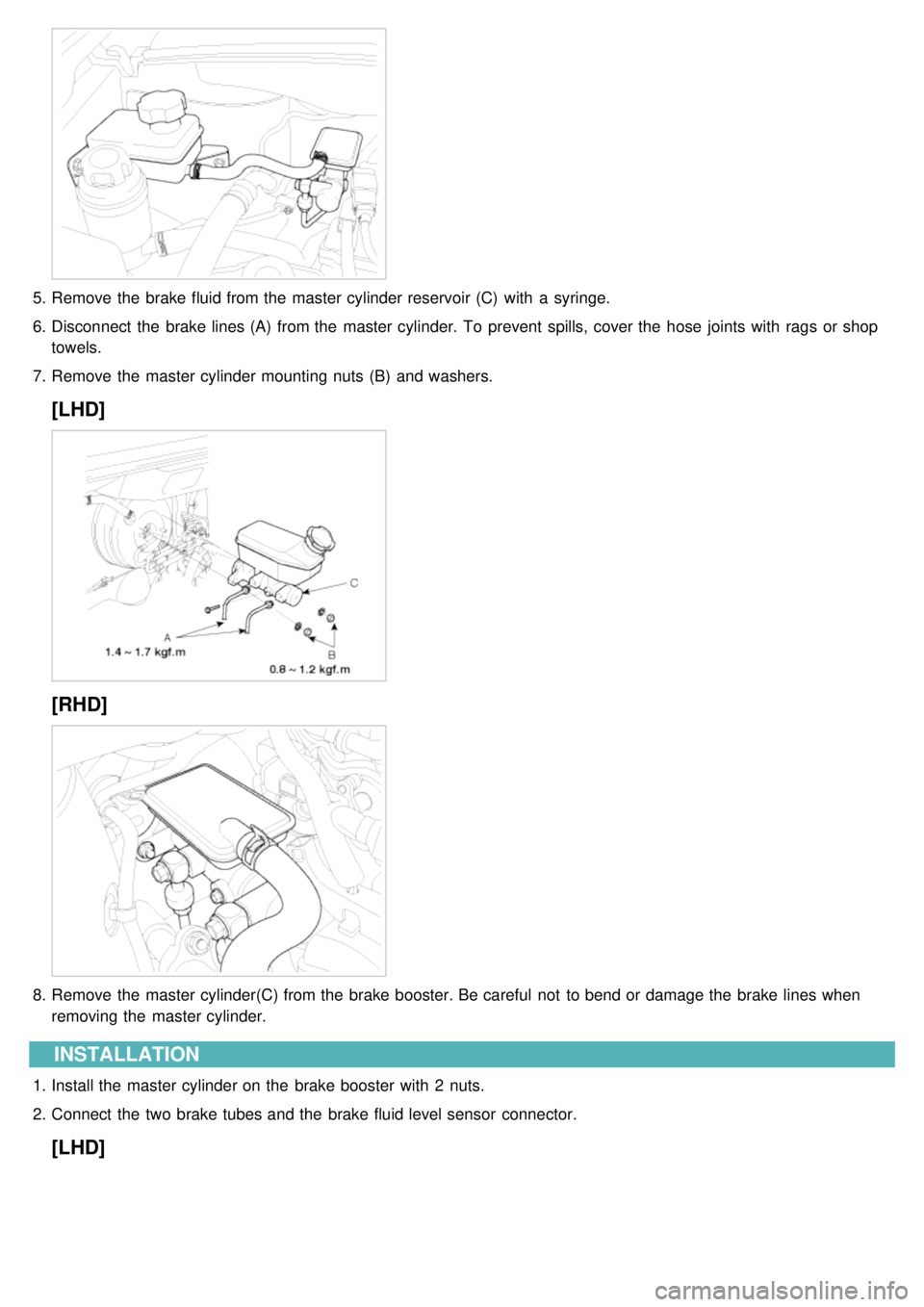
5.Remove the brake fluid from the master cylinder reservoir (C) with a syringe.
6. Disconnect the brake lines (A) from the master cylinder. To prevent spills, cover the hose joints with rags or shop
towels.
7. Remove the master cylinder mounting nuts (B) and washers.
[LHD]
[RHD]
8.Remove the master cylinder(C) from the brake booster. Be careful not to bend or damage the brake lines when
removing the master cylinder.
INSTALLATION
1.Install the master cylinder on the brake booster with 2 nuts.
2. Connect the two brake tubes and the brake fluid level sensor connector.
[LHD]
Page 883 of 1575
![KIA CARNIVAL 2007 Repair Manual [RHD]
3.Fill the brake reservoir with the brake fluid and bleed the brake system (Refer to Bleeding of brake system).
DISASSEMBLY
1.Remove the reservoir cap and drain the brake fluid into a](/img/2/57045/w960_57045-882.png "KIA CARNIVAL 2007 Repair Manual [RHD]
3.Fill the brake reservoir with the brake fluid and bleed the brake system (Refer to Bleeding of brake system).
DISASSEMBLY
1.Remove the reservoir cap and drain the brake fluid into a")
[RHD]
3.Fill the brake reservoir with the brake fluid and bleed the brake system (Refer to 'Bleeding of brake system').
DISASSEMBLY
1.Remove the reservoir cap and drain the brake fluid into a suitable container.
2. Remove the fluid level sensor.
3. Remove the reservoir from the master cylinder, after remove mounting screw (A).
[LHD]
4.Remove the retainer ring (A) by using the snap ring pliers.