engine oil KIA CEED 2015 Owners Manual
[x] Cancel search | Manufacturer: KIA, Model Year: 2015, Model line: CEED, Model: KIA CEED 2015Pages: 1210, PDF Size: 35.92 MB
Page 7 of 1210
Introduction
4
1
Use of MTBE
Kia recommends avoiding fuels contain-
ing MTBE (Methyl Tertiary Butyl Ether)
over 15.0% vol. (Oxygen Content 2.7%
weight) in your vehicle.
Fuel containing MTBE over 15.0% vol.
(Oxygen Content 2.7% weight) may
reduce vehicle performance and produce
vapor lock or hard starting.
Do not use methanol
Fuels containing methanol (wood alco-
hol) should not be used in your vehicle.
This type of fuel can reduce vehicle per-
formance and damage components ofthe fuel system, engine control systemand emission control system.
Fuel Additives
Kia recommends that you use unleaded
gasoline which has an octane rating of
RON (Research Octane Number) 95 / AKI
(Anti Knock Index) 91 or higher (for
Europe) or Octane Rating of RON(Research Octane Number) 91 / AKI (Anti-
Knock Index) 87 or higher (except Europe).
For customers who do not use good
quality gasolines including fuel additives
regularly, and have problems starting or
the engine does not run smoothly, one
bottle of additives added to the fuel tank
at every 15,000km (for Europe)/ 5,000km
(except Europe). Additives are available
from your authorized Kia dealer along
with information on how to use them. Do
not mix other additives.
Operation in foreign countries
If you are going to drive your vehicle in
another country, be sure to:
Observe all regulations regarding reg-
istration and insurance.
Determine that acceptable fuel is avail- able. Diesel engine
Diesel fuel
Diesel engine must be operated only on
commercially available diesel fuel that
complies with EN 590 or comparable
standard. (EN stands for "European
Norm"). Do not use marine diesel fuel,
heating oils, or non-approved fuel addi-
tives, as this will increase wear andcause damage to the engine and fuel
system. The use of non-approved fuels
and / or fuel additives will result in a limi-
tation of your warranty rights.
Diesel fuel of above cetane 51 is used in
your vehicle. If two types of diesel fuel
are available, use summer or winter fuel
properly according to the following tem-
perature conditions.
Above -5°C (23°F) ... Summer type
diesel fuel.
Below -5°C (23°F) ... Winter type diesel fuel.
Watch the fuel level in the tank very care-
fully : If the engine stops through fuel fail-
ure, the circuits must be completely
purged to permit restarting.
CAUTION
Your New Vehicle Limited Warranty may not cover damage to the fuel system and any performance prob-lems that are caused by the use of
fuels containing methanol or fuels containing MTBE (Methyl TertiaryButyl Ether) over 15.0% vol.(Oxygen Content 2.7% weight.)
JD eng 1.QXP 3/4/2015 11:49 AM Page 4
Page 8 of 1210
15
Introduction
Biodiesel
Commercially supplied Diesel blends of no more than 7% biodiesel, commonly
known as "B7 Diesel" may be used in
your vehicle if Biodiesel meets EN 14214
or equivalent specifications. (EN stands
for "European Norm"). The use of biofu-
els exceeding 7% made from rapeseed
methyl ester (RME), fatty acid methyl
ester (FAME), vegetable oil methyl ester
(VME) etc. or mixing diesel exceeding7% with biodiesel will cause increased
wear or damage to the engine and fuel
system. Repair or replacement of worn ordamaged components due to the use of
non approved fuels will not be covered by
the manufactures warranty.No special break-in period is needed. By
following a few simple precautions for the
first 1,000 km (600 miles) you may add to
the performance, economy and life of
your vehicle.
Do not race the engine.
While driving, keep your engine speed
(rpm, or revolutions per minute)
between 2,000 rpm and 4,000 rpm.
Do not maintain a single speed for long periods of time, either fast or slow.
Varying engine speed is needed to
properly break-in the engine.
Avoid hard stops, except in emergen-
cies, to allow the brakes to seat prop-
erly.
Don't tow a trailer during the first 2,000 km (1,200 miles) of operation.CAUTION
Do not let any gasoline or water
enter the tank. This would make it
necessary to drain it out and to bleed the lines to avoid jamming theinjection pump and damaging the engine.
CAUTION - Diesel Fuel
(if equipped with DPF)
It is recommended to use the regu- lated automotive diesel fuel for
diesel vehicle equipped with the DPF system.
If you use diesel fuel including highsulfur (more than 50 ppm sulfur) andunspecified additives, it can cause
the DPF system to be damaged andwhite smoke can be emitted.
CAUTION
Never use any fuel, whether diesel, B7 biodiesel or otherwise,that fails to meet the latest petro-leum industry specification.
Never use any fuel additives or treatments that are not recom-mended or approved by the vehi- cle manufacturer.
VEHICLE BREAK-IN PROCESS
JD eng 1.QXP 3/4/2015 11:49 AM Page 5
Page 14 of 1210
Your vehicle at a glance
6
2
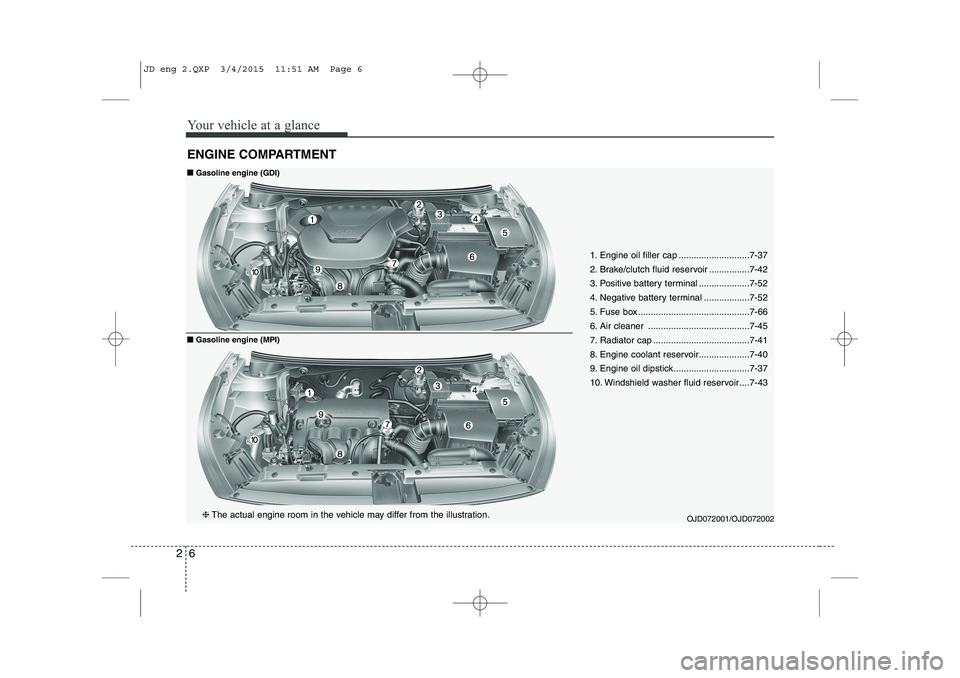
ENGINE COMPARTMENT
OJD072001/OJD072002
❈
The actual engine room in the vehicle may differ from the illustration. 1. Engine oil filler cap ............................7-37
2. Brake/clutch fluid reservoir ................7-42
3. Positive battery terminal ....................7-52
4. Negative battery terminal ..................7-52
5. Fuse box ............................................7-66
6. Air cleaner ........................................7-45
7. Radiator cap ......................................7-41
8. Engine coolant reservoir....................7-40
9. Engine oil dipstick..............................7-37
10. Windshield washer fluid reservoir ....7-43
■■
Gasoline engine (GDI)
■■Gasoline engine (MPI)
JD eng 2.QXP 3/4/2015 11:51 AM Page 6
Page 15 of 1210
27
Your vehicle at a glance
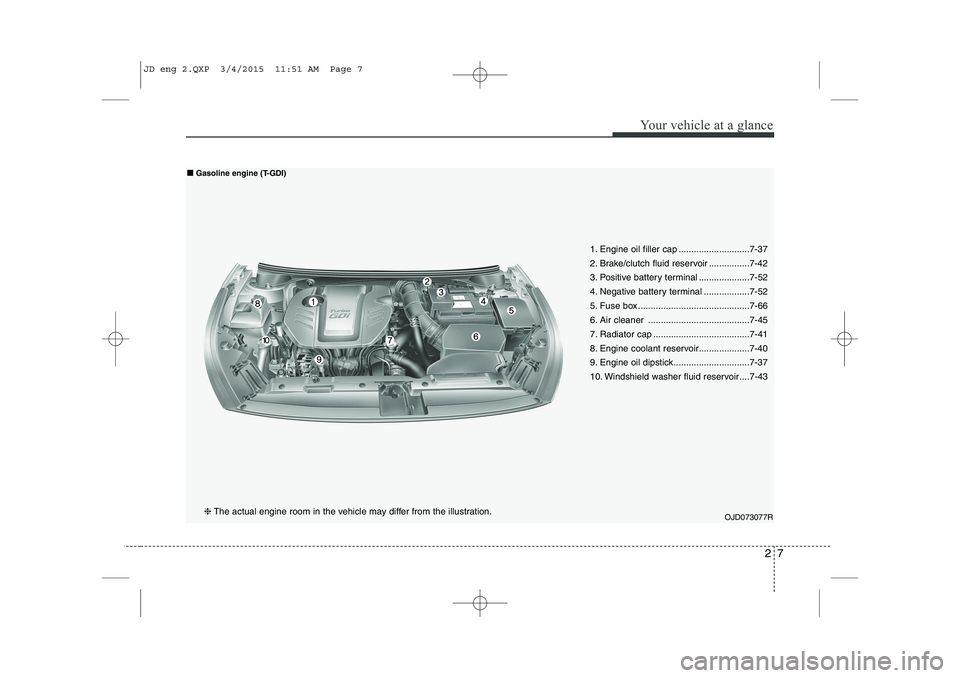
1. Engine oil filler cap ............................7-37
2. Brake/clutch fluid reservoir ................7-42
3. Positive battery terminal ....................7-52
4. Negative battery terminal ..................7-52
5. Fuse box ............................................7-66
6. Air cleaner ........................................7-45
7. Radiator cap ......................................7-41
8. Engine coolant reservoir....................7-40
9. Engine oil dipstick..............................7-37
10. Windshield washer fluid reservoir ....7-43
OJD073077R❈The actual engine room in the vehicle may differ from the illustration.
■
■
Gasoline engine (T-GDI)
JD eng 2.QXP 3/4/2015 11:51 AM Page 7
Page 16 of 1210
OJD072003
❈
The actual engine room in the vehicle may differ from the illustration.
■■
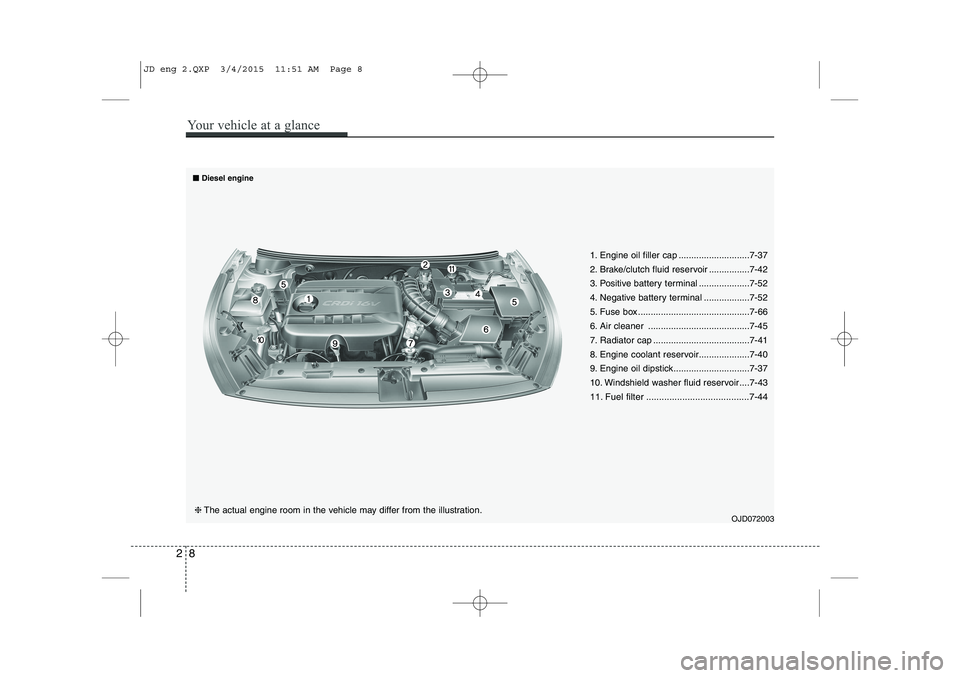
Diesel engine
28
Your vehicle at a glance
1. Engine oil filler cap ............................7-37
2. Brake/clutch fluid reservoir ................7-42
3. Positive battery terminal ....................7-52
4. Negative battery terminal ..................7-52
5. Fuse box ............................................7-66
6. Air cleaner ........................................7-45
7. Radiator cap ......................................7-41
8. Engine coolant reservoir....................7-40
9. Engine oil dipstick..............................7-37
10. Windshield washer fluid reservoir ....7-43
11. Fuel filter ........................................7-44
JD eng 2.QXP 3/4/2015 11:51 AM Page 8
Page 167 of 1210
Features of your vehicle
86
4
Tire Pressure Monitoring System
(TPMS) indicator (if equipped)
Low tire pressure telltale/
TPMS malfunction indicator
The low tire pressure telltale comes on
for 3 seconds after the ignition switch is
turned to the ON position.
The low tire pressure and position tell- tales illuminates when one or more of
your tires is significantly underinflated.
The TPMS malfunction indicator will illu-
minate after it blinks for approximately
one minute when there is a problem with
the Tire Pressure Monitoring System.
If this occurs, we recommend that the
system be checked by an authorized Kia
dealer.
For more details, refer to the TPMS in chapter 6.
The low tire pressure position telltale illu-
minates on the LCD display.
Engine oil pressure warn-ing
This warning light indicates the engine oil
pressure is low.
If the warning light illuminates while driv- ing:
1. Drive safely to the side of the road and stop.
2. With the engine off, check the engine oil level. If the level is low, add oil as required.
If the warning light remains on after
adding oil or if oil is not available, we rec-
ommend that you call an authorized Kia
dealer.
WARNING - Safe stopping
• The TPMS cannot alert you to severe and sudden tire damage caused by external factors.
• If you notice any vehicle instabili- ty, immediately take your foot offthe accelerator pedal, apply thebrakes gradually and with lightforce, and slowly move to a safeposition off the road.
CAUTION
If the engine does not stop immedi-
ately after the engine oil pressurewarning light is illuminated, severe
damage could result.
JD eng 4a.QXP 3/4/2015 4:26 PM Page 86
Page 168 of 1210
487
Features of your vehicle
Engine oil level warninglight (if equipped, for diesel)
The engine oil level warning light illumi-
nates when the engine oil level should be
checked.
If the warning light comes on, check the
engine oil level as soon as possible andadd engine oil as required.
Slowly pour the recommended oil little by
little into a funnel. (Oil refill capacity :
approximately 0.6 ~ 1.0 l)
Use only the specified engine oil. (Refer
to "Recommended lubricants and capac-ities" in chapter 8.)
Do not overfill the engine oil to ensure
the oil level is not above F mark on the
dipstick.
✽NOTICE
• If you travel approximately 50 km~100 km after the engine warms
up, after adding the engine oil, the
warning light will go off.
• Cycle the ignition from OFF to ON 3
times within 10 seconds, the warning
light will go off immediately. However,
when you turn off the warning light
without adding the engine oil, the light
will come on again after traveling
approximately 50 km ~ 100 km after
the engine warms up.CAUTION
If the oil pressure warning light
stays on while the engine is run- ning, serious engine damage may result. The oil pressure warninglight comes on whenever there is
insufficient oil pressure. In normal operation, it should come on whenthe ignition switch is turned on,
then go out when the engine is
started. If the oil pressure warning light stays on while the engine is
running, there is a serious malfunc- tion.
If this happens, stop the car as soonas it is safe to do so, turn off theengine and check the oil level. If theoil level is low, fill the engine oil to the proper level and start the engine again. If the light stays on with the
engine running, turn the engine offimmediately. In any instance where the oil light stays on when the engine is running, we recommend
that the system be checked by an
authorized Kia dealer.
CAUTION
If the light comes on continuously after adding the engine oil and trav-eling approximately 50 km~100 km
after the engine warms up, we rec-
ommend that the system be checkedby an authorized Kia dealer.
Even if this light doesn't come onafter the engine has started, the
engine oil should be checked and
supplied periodically.
JD eng 4a.QXP 3/4/2015 4:26 PM Page 87
Page 215 of 1210
Features of your vehicle
134
4
Operation Tips
• To keep dust or unpleasant fumes from
entering the vehicle through the venti-
lation system, temporarily set the air
intake control to the recirculated air
position. Be sure to return the control
to the fresh air position when the irrita-
tion has passed to keep fresh air in the
vehicle. This will help keep the driver
alert and comfortable.
• Air for the heating/cooling system is drawn in through the grilles just ahead
of the windshield. Care should be
taken that these are not blocked by
leaves, snow, ice or other obstructions.
• To prevent interior fog on the wind- shield, set the air intake control to the
fresh air position and fan speed to the
desired position, turn on the air condi- tioning system, and adjust the temper-
ature control to desired temperature.Air conditioning (if equipped)
Kia Air Conditioning Systems are filled
with environmentally friendly refrigerant*.
1. Start the engine. Push the air condi- tioning button.
2. Set the mode to the position.
3. Set the air intake control to the outside air or recirculated air position.
4. Adjust the fan speed control and tem- perature control to maintain maximum
comfort.
*: Your vehicle is filled with R-134a or R- 1234yf according to the regulation in
your country at the time of producing.
You can find out which air conditioning
refrigerant is applied to your vehicle at
the label inside of hood. Refer to chap-
ter 8 for more detail location of air con-
ditioning refrigerant label.CAUTION
• The refrigerant system should
only be serviced by trained andcertified technicians to insureproper and safe operation.
• The refrigerant system should be serviced in a well-ventilatedplace.
• The air conditioning evaporator (cooling coil) shall never berepaired or replaced with one
removed from a used or salvagedvehicle and new replacementMAC evaporators shall be certi- fied (and labeled) as meeting SAE
Standard J2842.
JD eng 4a.QXP 3/4/2015 4:30 PM Page 134
Page 227 of 1210
Features of your vehicle
146
4
Air conditioning (if equipped)
Kia Air Conditioning Systems are filled
with environmentally friendly refrigerant*.
1. Start the engine. Push the air condi-
tioning button.
2. Set the mode to the position.
3. Set the air intake control to the outside air or recirculated air position.
4. Adjust the fan speed control and tem- perature control to maintain maximum
comfort.
*: Your vehicle is filled with R-134a or R- 1234yf according to the regulation in
your country at the time of producing.
You can find out which air conditioning
refrigerant is applied to your vehicle at
the label inside of hood. Refer to chap-
ter 8 for more detail location of air con-
ditioning refrigerant label.✽NOTICE
• When using the air conditioning sys- tem, monitor the temperature gauge
closely while driving up hills or in
heavy traffic when outside tempera-
tures are high. Air conditioning sys-
tem operation may cause engine over-
heating. Continue to use the blower
fan but turn the air conditioning sys-
tem off if the temperature gauge indi-
cates engine overheating.
• When opening the windows in humid
weather air conditioning may create
water droplets inside the vehicle.
Since excessive water droplets may
cause damage to electrical equipment,
air conditioning should only be used
with the windows closed.CAUTION
• The refrigerant system should
only be serviced by trained andcertified technicians to insureproper and safe operation.
• The refrigerant system should be serviced in a well-ventilatedplace.
• The air conditioning evaporator (cooling coil) shall never berepaired or replaced with one
removed from a used or salvaged vehicle and new replacementMAC evaporators shall be certi-fied (and labeled) as meeting SAE
Standard J2842.
JD eng 4a.QXP 3/4/2015 4:31 PM Page 146
Page 349 of 1210
53
Driving your vehicle
WARNING- ENGINE EXHAUST CAN BE DANGEROUS!
Engine exhaust fumes can be extremely dangerous. If, at any time, you smell exhaust fumes inside the vehicle, open the win-
dows immediately.
• Do not inhale exhaust fumes.
Exhaust fumes contain carbon monoxide, a colorless, odorless gas that can cause unconsciousness and death by asphyxia- tion.
Be sure the exhaust system does not leak. The exhaust system should be checked whenever the vehicle is raised to change the oil or for any other purpose. If you hear
a change in the sound of the exhaust or if you drive over something that strikes the underneath side of the vehicle, we rec-
ommend that the system be checked by an authorized Kia dealer.
Do not run the engine in an enclosed area. Letting the engine idle in your garage, even with the garage door open, is a hazardous practice. Never run the engine in your
garage any longer than it takes to start the engine and back the vehicle out.
Avoid idling the engine for prolonged periods with people inside the vehicle. If it is necessary to idle the engine for a prolonged period with people inside the vehicle, be sure to do so only in an open a rea
with the air intake set at "Fresh" and fan operating at one of the higher speeds so fresh air is drawn into the interior.
If you must drive with the tailgate/trunk open because you are carrying objects that make this necessary:
1. Close all windows.
2. Open side vents.
3. Set the air intake control at "Fresh", the air flow control at "Floor" or "Face" and the fan at one of the higher speeds.
To assure proper operation of the ventilation system, be sure the ventilation air intakes located just in front of the windshield are
kept clear of snow, ice, leaves or other obstructions.
JD eng 5.QXP 3/4/2015 2:50 PM Page 3