service KIA Magnetis 2006 2.G Owner's Guide
[x] Cancel search | Manufacturer: KIA, Model Year: 2006, Model line: Magnetis, Model: KIA Magnetis 2006 2.GPages: 225, PDF Size: 3.77 MB
Page 200 of 225
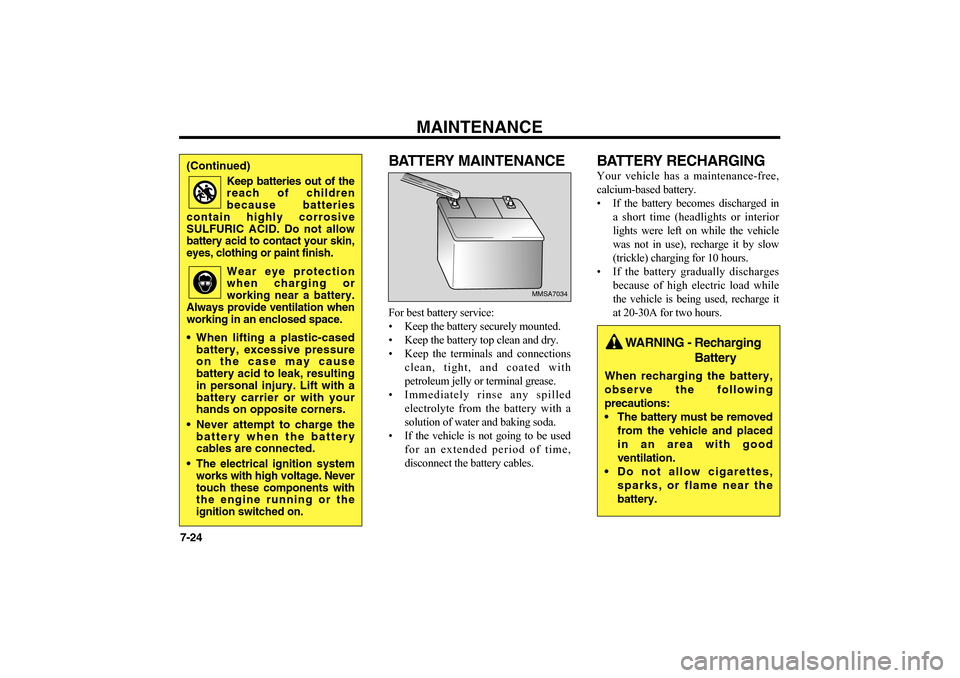
BATTERY MAINTENANCEFor best battery service:
• Keep the battery securely mounted.
• Keep the battery top clean and dry.
• Keep the terminals and connections
clean, tight, and coated with
petroleum jelly or terminal grease.
• Immediately rinse any spilled
electrolyte from the battery with a
solution of water and baking soda.
• If the vehicle is not going to be used
for an extended period of time,
disconnect the battery cables.
BATTERY RECHARGINGYour vehicle has a maintenance-free,
calcium-based battery.
• If the battery becomes discharged in
a short time (headlights or interior
lights were left on while the vehicle
was not in use), recharge it by slow
(trickle) charging for 10 hours.
• If the battery gradually discharges
because of high electric load while
the vehicle is being used, recharge it
at 20-30A for two hours.
MAINTENANCE
7-24
MMSA7034
(Continued)
Keep batteries out of the
reach of children
because batteries
contain highly corrosive
SULFURIC ACID. Do not allow
battery acid to contact your skin,
eyes, clothing or paint finish.
Wear eye protection
when charging or
working near a battery.
Always provide ventilation when
working in an enclosed space.
When lifting a plastic-cased
battery, excessive pressure
on the case may cause
battery acid to leak, resulting
in personal injury. Lift with a
battery carrier or with your
hands on opposite corners.
Never attempt to charge the
battery when the battery
cables are connected.
The electrical ignition system
works with high voltage. Never
touch these components with
the engine running or the
ignition switched on.
WARNING - Recharging
Battery
When recharging the battery,
observe the following
precautions:
The battery must be removed
from the vehicle and placed
in an area with good
ventilation.
Do not allow cigarettes,
sparks, or flame near the
battery.
MS-CNA-Eng 7.QXD 7/25/2005 5:09 PM Page 24
Page 207 of 225
7-31
TREAD WEARThe tread wear grade is a comparative
rating based on the wear rate of the tire
when tested under controlled conditions
on a specified government test course.
For example, a tire graded 150 would
wear one-and-a-half times as well on the
government course as a tire graded 100.
The relative performance of tires
depends upon the actual conditions of
their use. Variations in driving habits,
service practices and differences in road
characteristics and climate may
significantly affect performance.TRACTION - A, B AND CThe traction grades, from highest to
lowest, are A, B and C, and they
represent the tire’s ability to stop on wet
pavement as measured under controlled
conditions on specified government test
surfaces of asphalt and concrete. A tire
marked C may have poor traction
performance.
TEMPERATURE-A, B AND CThe temperature grades are A (the
highest), B and C, representing the tire’s
resistance to generate heat and to
dissipate heat when tested under
controlled conditions on a specified
indoor laboratory test wheel. Sustained
high temperatures can cause the material
of the tire to degenerate and reduce tire
life, and excessive temperature can lead
to sudden tire failure. Grade C
corresponds to a level of performance
that all passenger vehicle tires must meet
under the Canadian Motor Vehicle
Safety Standard No. 109: Grades A and
B represent higher levels of performance
on the laboratory test wheel than the
maximum required by law.
WARNING - Tire
Temperature
The temperature grade for a tire
is established for a tire that is
properly inflated and not
overloaded. Excessive speed,
underinflation, or excessive
loading, either separately or in
combination, can cause heat
build-up and possible sudden tire
failure. This can cause loss of
vehicle control and death or
personal injury.
MS-CNA-Eng 7.QXD 7/25/2005 5:09 PM Page 31
Page 213 of 225
7-37
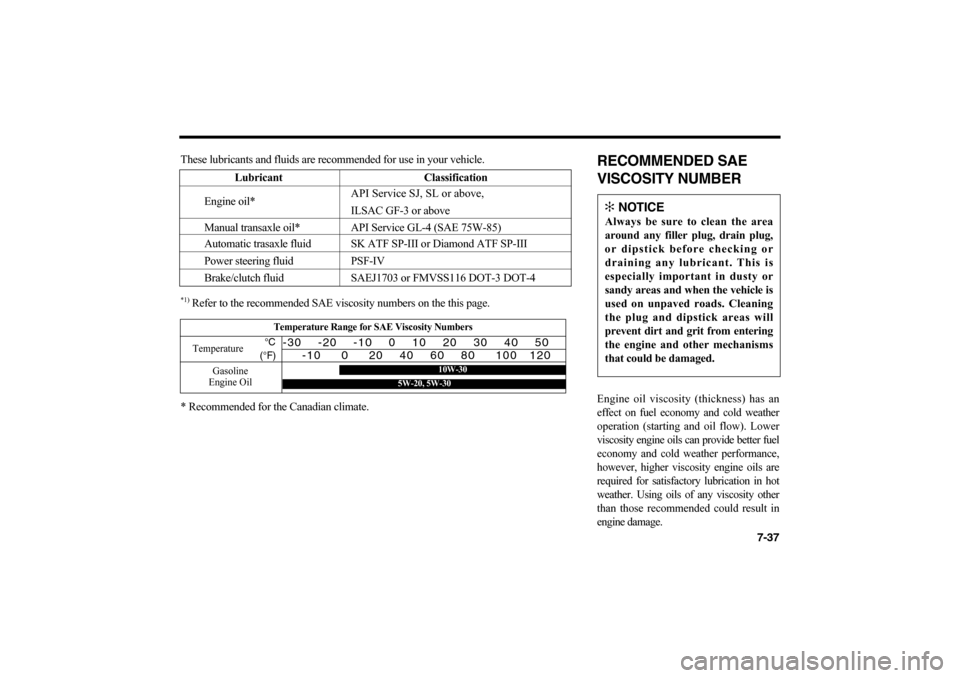
RECOMMENDED SAE
VISCOSITY NUMBEREngine oil viscosity (thickness) has an
effect on fuel economy and cold weather
operation (starting and oil flow). Lower
viscosity engine oils can provide better fuel
economy and cold weather performance,
however, higher viscosity engine oils are
required for satisfactory lubrication in hot
weather. Using oils of any viscosity other
than those recommended could result in
engine damage.
These lubricants and fluids are recommended for use in your vehicle.*1)
Refer to the recommended SAE viscosity numbers on the this page.
* Recommended for the Canadian climate.
Lubricant Classification
Engine oil* API Service SJ, SL or above,
ILSAC GF-3 or above
Manual transaxle oil* API Service GL-4 (SAE 75W-85)
Automatic trasaxle fluid SK ATF SP-III or Diamond ATF SP-III
Power steering fluid PSF-IV
Brake/clutch fluid SAEJ1703 or FMVSS116 DOT-3 DOT-4
✻
NOTICE
Always be sure to clean the area
around any filler plug, drain plug,
or dipstick before checking or
draining any lubricant. This is
especially important in dusty or
sandy areas and when the vehicle is
used on unpaved roads. Cleaning
the plug and dipstick areas will
prevent dirt and grit from entering
the engine and other mechanisms
that could be damaged.
Temperature Range for SAE Viscosity Numbers
Temperature
Gasoline
Engine Oil°C
(°F)
-30 -20 -10 0 10 20 30 40 50
-10 0 20 40 60 80 100 120
10W-30
5W-20, 5W-30
MS-CNA-Eng 7.QXD 7/25/2005 5:09 PM Page 37
Page 225 of 225
INDEX
9-2M
aintenance Schedule ...............................................................7-3
Maintenance Services ...................................................................7-2
Manual Transaxle ..........................................................................4-6
Mirrors ........................................................................................3-58
O
verheating ................................................................................6-2
Overloading .................................................................................5-11
Owner Maintenance ......................................................................7-8
P
arking Brake ...........................................................................7-18
Power Steering ...................................................................4-18, 7-18
R
ear Window Defroster ...........................................................4-32
Road Warning ...............................................................................6-2
Safety Belts ...............................................................................3-22
Seats ............................................................................................3-14
Special Driving Conditions ...........................................................5-7
Specifications ................................................................................8-2
Starting the Engine ........................................................................4-4
Steering Wheel ............................................................................3-58
Suggestions for Economical Operation.........................................5-5
Sunglass Holder ..........................................................................3-64
Sunroof ........................................................................................3-65T
heft-alarm system .....................................................................3-5
Tilt Steering.................................................................................4-18Tires and Wheels .........................................................................7-25
Towing ........................................................................................6-14
Traction control system ...............................................................4-40
Trailer Towing ............................................................................5-11
Trunk Lid ....................................................................................3-52
V
ehicle Break-In Process ...........................................................1-3
W
arnings and Indicators..........................................................4-21
Windows .....................................................................................3-11
Windshield Defrosting and Defogging (Automatic type) ...........4-56
Windshield Defrosting and Defogging (Manual Type) ..............4-54
Wiper Blades ...............................................................................7-22
Wipers and Washers....................................................................4-30
Ms-CNA-Eng-INDEX.qxd 7/25/2005 5:07 PM Page 2