HEV battery KIA OPTIMA 2020 User Guide
[x] Cancel search | Manufacturer: KIA, Model Year: 2020, Model line: OPTIMA, Model: KIA OPTIMA 2020Pages: 589, PDF Size: 11.37 MB
Page 44 of 589
H44
COMPONENTS OF THE HYBRID/PLUG-IN HYBRID VEHICLE (CONT.)
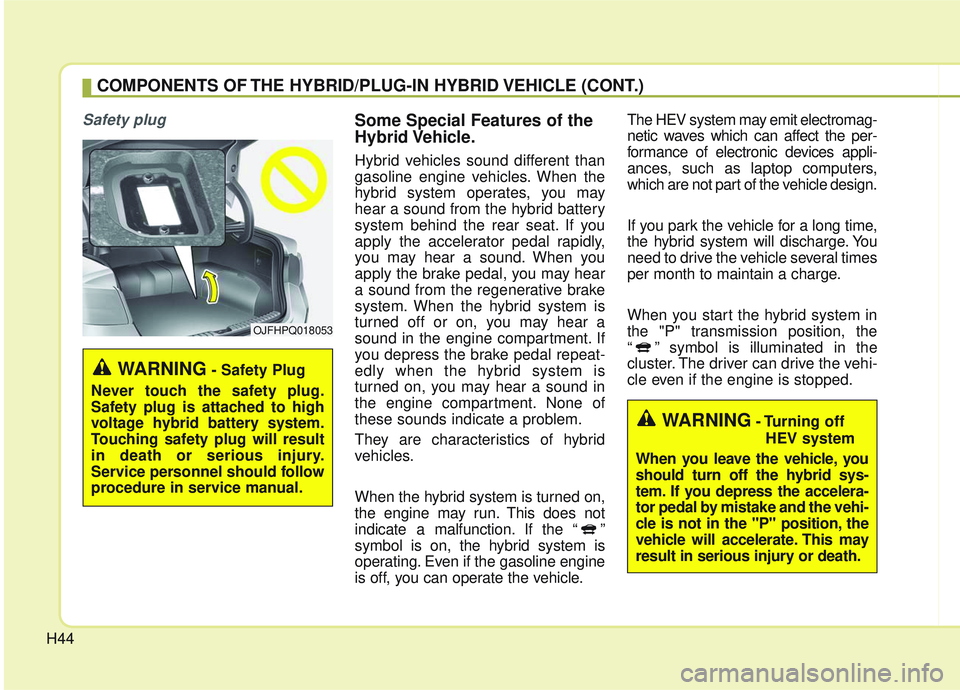
Safety plugSome Special Features of the
Hybrid Vehicle.
Hybrid vehicles sound different than
gasoline engine vehicles. When the
hybrid system operates, you may
hear a sound from the hybrid battery
system behind the rear seat. If you
apply the accelerator pedal rapidly,
you may hear a sound. When you
apply the brake pedal, you may hear
a sound from the regenerative brake
system. When the hybrid system is
turned off or on, you may hear a
sound in the engine compartment. If
you depress the brake pedal repeat-
edly when the hybrid system is
turned on, you may hear a sound in
the engine compartment. None of
these sounds indicate a problem.
They are characteristics of hybrid
vehicles.
When the hybrid system is turned on,
the engine may run. This does not
indicate a malfunction. If the “ ”
symbol is on, the hybrid system is
operating. Even if the gasoline engine
is off, you can operate the vehicle.The HEV system may emit electromag-
netic waves which can affect the per-
formance of electronic devices appli-
ances, such as laptop computers,
which are not part of the vehicle design.
If you park the vehicle for a long time,
the hybrid system will discharge. You
need to drive the vehicle several times
per month to maintain a charge.
When you start the hybrid system in
the "P" transmission position, the
“ ” symbol is illuminated in the
cluster. The driver can drive the vehi-
cle even if the engine is stopped.
OJFHPQ018053
WARNING- Safety Plug
Never touch the safety plug.
Safety plug is attached to high
voltage hybrid battery system.
Touching safety plug will result
in death or serious injury.
Service personnel should follow
procedure in service manual.
WARNING- Turning off HEV system
When you leave the vehicle, you
should turn off the hybrid sys-
tem. If you depress the accelera-
tor pedal by mistake and the vehi-
cle is not in the "P" position, the
vehicle will accelerate. This may
result in serious injury or death.
Page 46 of 589

H46
COMPONENTS OF THE HYBRID/PLUG-IN HYBRID VEHICLE (CONT.)
If An Accident Occurs
Avoid the engine compartment.
Avoid making contact with anyorange or high voltage wires,
cables, or components.
Assume that a high voltage com- ponent is exposed and move away
from the vehicle as promptly as
possible.
Refer to Chapter 6 for towing infor- mation.
✽ ✽ NOTICE
• If a small scale fire occurs, use a
fire extinguisher rated ABC or BC
for electrical fires.
If it is impossible to extinguish the
fire in the early stage, remain a
safe distance from the vehicle and
immediately call 911. Also, advise
them that a hybrid vehicle is
involved.
If the fire spreads to the high volt-
age battery, large amount of water
is needed to put out the fire.
Using small amount of water or
fire extinguishers not meant for
electrical fires could cause serious
injury or death from electrical
shocks.
• If you need towing, refer to chap- ter 6.WARNING - Air Intake
Blocking the air intake behind the rear seats may damage
the HEV battery.
Do not allow any water to enter cleaning. If any water
enters the air intake, the
Hybrid battery may cause an
electric shock which can
cause serious injury or death
due to electrocution.
Page 57 of 589
Introduction
61
This vehicle should not be modified.
Modification of your vehicle could
affect its performance, safety or
durability and may even violate gov-
ernmental safety and emissions reg-
ulations.
In addition, damage or performance
problems resulting from any modifi-
cation may not be covered under
warranty.
If you use unauthorized electronicdevices, it may cause the vehicle to
operate abnormally, wire damage,
battery discharge and fire. For your
safety, do not use unauthorized
electronic devices. No special break-in period is needed.
By following a few simple precautions
for the first 1,000 km (600 miles) you
may add to the performance, econo-
my and life of your vehicle.
Do not race the engine.
While driving, keep your engine
speed (rpm, or revolutions per
minute) between 2,000 rpm and
4,000 rpm.
Do not maintain a single speed for long periods of time, either fast or
slow. Varying engine speed is
needed to properly break-in the
engine.
Avoid hard stops, except in emer- gencies, to allow the brakes to seat
properly. By following a few simple precautions
for the first 1,000 km (600 miles) you
may add to the performance, econo-
my and life of your vehicle.
Do not race the engine.
Avoid hard stops, except in emer-
gencies, to allow the brakes to seat
properly.
VEHICLE BREAK-IN
PROCESS HEV/PHEV POWERTRAIN
VEHICLE MODIFICATIONS
Page 81 of 589
317
Safety features of your vehicle
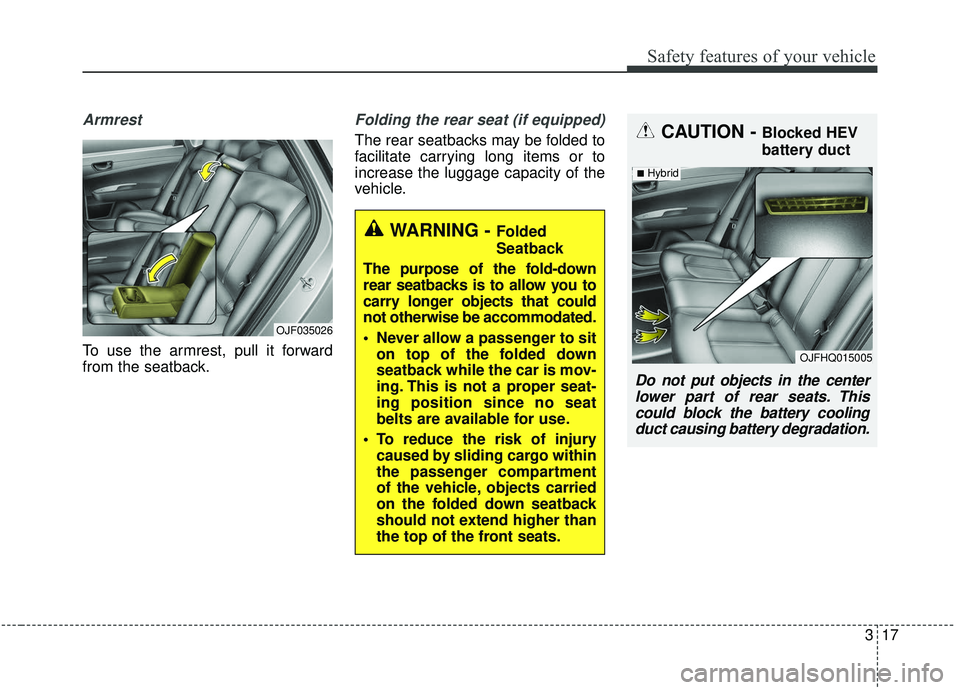
Armrest
To use the armrest, pull it forward
from the seatback.
Folding the rear seat (if equipped)
The rear seatbacks may be folded to
facilitate carrying long items or to
increase the luggage capacity of the
vehicle.
OJF035026
WARNING - Folded
Seatback
The purpose of the fold-down
rear seatbacks is to allow you to
carry longer objects that could
not otherwise be accommodated.
Never allow a passenger to sit on top of the folded down
seatback while the car is mov-
ing. This is not a proper seat-
ing position since no seat
belts are available for use.
To reduce the risk of injury caused by sliding cargo within
the passenger compartment
of the vehicle, objects carried
on the folded down seatback
should not extend higher than
the top of the front seats.
CAUTION - Blocked HEV
battery duct
Do not put objects in the centerlower part of rear seats. Thiscould block the battery coolingduct causing battery degradation.
OJFHQ015005
■Hybrid
Page 82 of 589

Safety features of your vehicle
18
3
To fold down the rear seatback
(for Hybrid, if equipped):
1. Make sure the rear seat belt web-
bing is in the guide to prevent the
seat belt from being damaged.
2. Set the front seatback to the upright position and if necessary,
slide the front seat forward.
3. Lower the rear headrests to the lowest position.
CAUTION - Blocked PHEV
Battery Duct
Do not put objects on the left
side of rear seat. This couldblock the battery cooling ductcausing battery degradation.
OJFHP036114L
■Plug-in hybrid
OJF035081L
WARNING - Objects
Objects carried on the folded
down seatback should not
extend higher than the top of
the front seatbacks. This could
allow cargo to slide forward and
cause injury or damage during
sudden stops.
Page 217 of 589
Features of your vehicle
82
4
EV/HEV (Plug-in hybrid)
A corresponding message is dis-
played when a mode is selected by
pressing the HEV button.
Low battery. Maintaining Hybrid
mode (Plug-in hybrid)
This message is displayed when
unable to convert to EV mode even
when pressing the HEV button dur-
ing HEV mode driving due to insuffi-
cient high-voltage(hybrid) battery
level.
Charger Error! (Plug-in hybrid)
This message is displayed when
there is a problem with the charger.
The purpose of this message is to let
you know an error has occurred in
charger itself not in vehicle.
Low/High System Temp.Maintaining Hybrid (Plug-in hybrid)
This message is displayed when
unable to convert to EV mode even
when pressing the HEV button dur-
ing HEV mode driving due to
low/high system temperature.
Switching to Hybrid mode toallow heating (Plug-in hybrid)
When the coolant temperature is lower than -14°C (57°F), and you
turn the climate control On for
heating, this message will be dis-
played in the cluster. Then, the
vehicle will automatically switch to
HEV mode.
When the coolant temperature is higher than -14°C (57°F), or you
turn the climate control Off, the
vehicle will automatically return to
EV mode.
Wait until fuel door opens
(Plug-in hybrid)
This message is displayed when you
attempt to open the fuel filler lid with
the fuel tank pressurized. Wait until
the fuel tank is depressurized.
✽ ✽ NOTICE
• It may take up to 20 seconds to
open fuel filler lid.
• When the fuel filler lid is frozen and does not open after 20 seconds
at freezing temperature, slightly
tap the fuel filler lid and then
attempt to open it.
Page 312 of 589

519
Driving your vehicle
Power brakes
Your vehicle has power-assisted
brakes that adjust automatically
through normal usage.
If the hybrid system is not on or is
turned off while driving, the power
assist for the brakes will not work.
You can still stop your vehicle by
applying greater force to the brake
pedal than typical. The stopping dis-
tance, however, will be longer than
with power brakes.
When the hybrid system is not on,
the reserve brake power is partially
depleted each time the brake pedal
is applied. Do not pump the brake
pedal when the power assist has
been interrupted.
Pump the brake pedal only when
necessary to maintain steering con-
trol on slippery surfaces.Wet brakes may impair the vehicle’s
ability to safely slow down; the vehi-
cle may also pull to one side when
the brakes are applied. Applying the
brakes lightly will indicate whether
they have been affected in this way.
Always test your brakes in this fash-
ion after driving through deep water.
To dry the brakes, apply them lightly
while maintaining a safe forward
speed until brake performance
returns to normal.
✽ ✽
NOTICE
Do not depress the brake pedal con-
tinuously without the " " indica-
tor ON. The battery may be dis-
charged.
BRAKE SYSTEM
WARNING- Steep hill
braking
Avoid continuous application of
the brakes when descending a
long or steep hill by shifting to a
lower gear. Continuous brake
application will cause the
brakes to overheat and could
result in a temporary loss of
braking performance.
WARNING- HEV driving down hill
Do not turn off the Hybrid sys-
tem while going down a hill. The
brake booster may not work
sufficiently and the braking dis-
tance may be longer.
CAUTION- Brake Pedal
Do not drive with your foot rest- ing on the brake pedal. This willcreate abnormally high braketemperatures which can causeexcessive brake lining and padwear.
Page 477 of 589
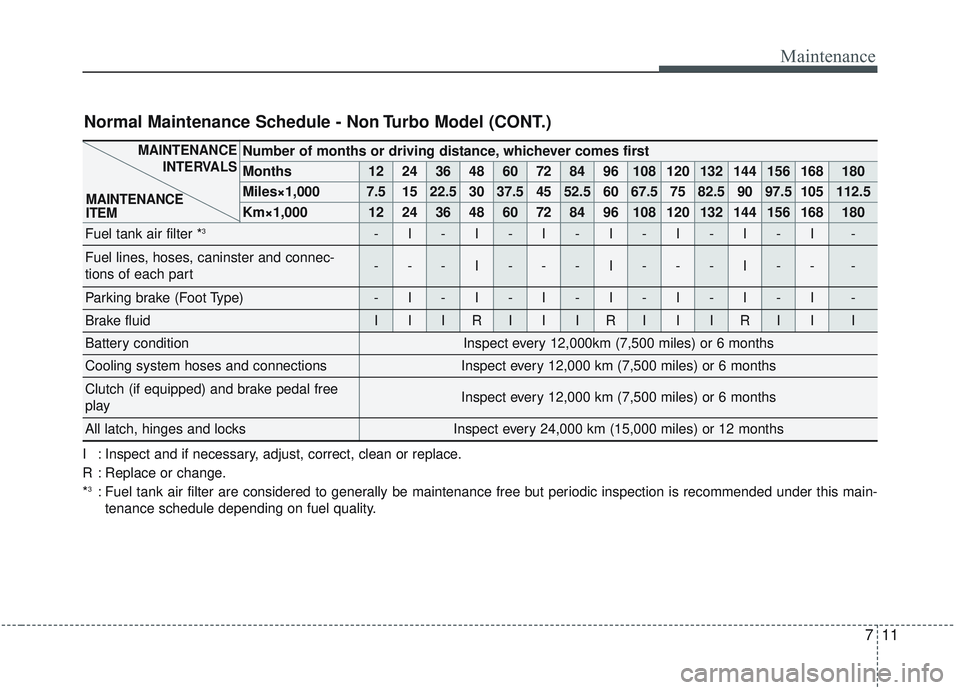
711
Maintenance
Number of months or driving distance, whichever comes first
Months1224364860728496108120132144156168180
Miles×1,0007.51522.530 37.5 45 52.5 60 67.5 75 82.5 90 97.5 105 112.5
Km×1,00012 24 36 48 60 72 84 96 108 120 132 144 156 168 180
Fuel tank air filter *3-I-I-I-I-I-I-I-
Fuel lines, hoses, caninster and connec-
tions of each part---I---I---I---
Parking brake (Foot Type)-I-I-I-I-I-I-I-
Brake fluidIIIRIIIRIIIRIII
Battery conditionInspect every 12,000km (7,500 miles) or 6 months
Cooling system hoses and connectionsInspect every 12,000 km (7,500 miles) or 6 months
Clutch (if equipped) and brake pedal free
playInspect every 12,000 km (7,500 miles) or 6 months
All latch, hinges and locksInspect every 24,000 km (15,000 miles) or 12 months
MAINTENANCEINTERVALS
MAINTENANCE
ITEM
Normal Maintenance Schedule - Non Turbo Model (CONT.)
I : Inspect and if necessary, adjust, correct, clean or replace.
R : Replace or change.
*
3: Fuel tank air filter are considered to generally be maintenance free but periodic inspection is recommended under this main- tenance schedule depending on fuel quality.
Page 520 of 589
Maintenance
54
7
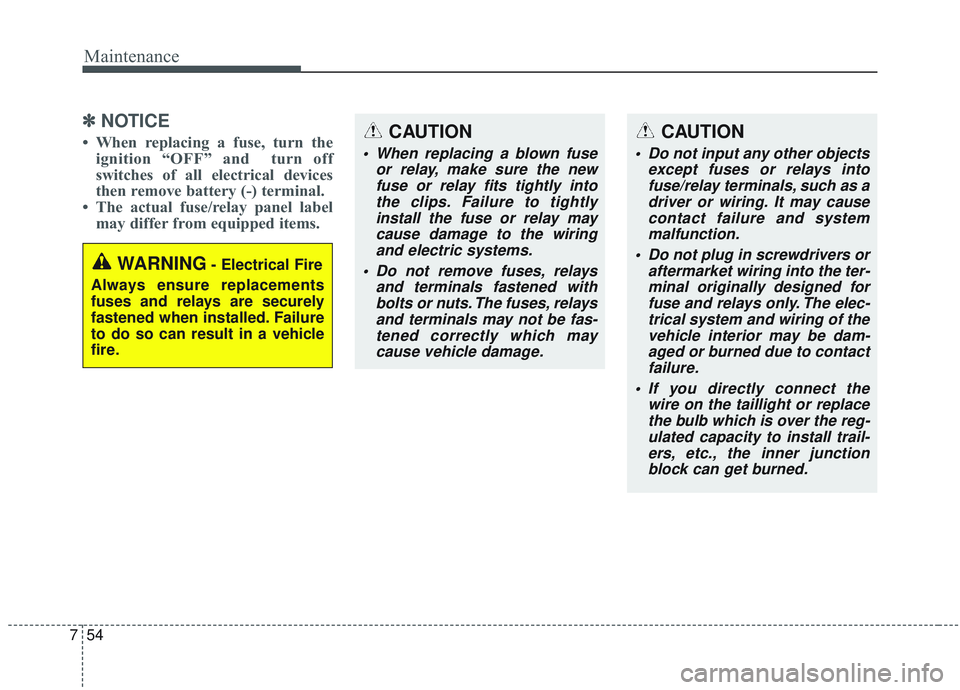
✽ ✽
NOTICE
• When replacing a fuse, turn the
ignition “OFF” and turn off
switches of all electrical devices
then remove battery (-) terminal.
• The actual fuse/relay panel label may differ from equipped items.
WARNING- Electrical Fire
Always ensure replacements
fuses and relays are securely
fastened when installed. Failure
to do so can result in a vehicle
fire.
CAUTION
When replacing a blown fuse or relay, make sure the newfuse or relay fits tightly intothe clips. Failure to tightlyinstall the fuse or relay maycause damage to the wiringand electric systems.
Do not remove fuses, relays and terminals fastened withbolts or nuts. The fuses, relaysand terminals may not be fas-tened correctly which maycause vehicle damage.
CAUTION
Do not input any other objects except fuses or relays intofuse/relay terminals, such as adriver or wiring. It may causecontact failure and systemmalfunction.
Do not plug in screwdrivers or aftermarket wiring into the ter-minal originally designed forfuse and relays only. The elec-trical system and wiring of thevehicle interior may be dam-aged or burned due to contactfailure.
If you directly connect the wire on the taillight or replacethe bulb which is over the reg-ulated capacity to install trail-ers, etc., the inner junctionblock can get burned.
Page 534 of 589

Maintenance
68
7
Fuse NameFuse ratingCircuit Protected
FUSE
EPB130AElectric Parking Brake Module
H/Lamp Washer30ARLY. 9 (H/Lamp Washer Relay)
B+440ASmart Junction Block (Leak Current Autocut Device Fuse - INTERIOR LAMP, MULTI MEDIA, MEM-
ORY2, MEMORY1, Fuse - MODULE1, DR LOCK, SMART KEY, BRAKE SWITCH)
EPB 230AElectric Parking Brake Module
OPCU 120AElectric Oil Pump Unit
DEICER20ARLY. 10 (Deicer Relay)
AMS10ABattery Sensor
HEATED MIRROR10AA/C Control Module, Driver/Passenger Power Outside Mirror
WIPER 210ABCM, PCM
H/LAMP HI20ARLY. 6 (Head Lamp High Relay)
HEV ECU 110AHPCU
OPCU210AElectric Oil Pump Unit
ELECTRICAL
WATER PUMP10AElectric Water Pump (HEV)