ESP KIA OPTIMA 2020 Repair Manual
[x] Cancel search | Manufacturer: KIA, Model Year: 2020, Model line: OPTIMA, Model: KIA OPTIMA 2020Pages: 589, PDF Size: 11.37 MB
Page 511 of 589
745
Maintenance
2. Tire size designation
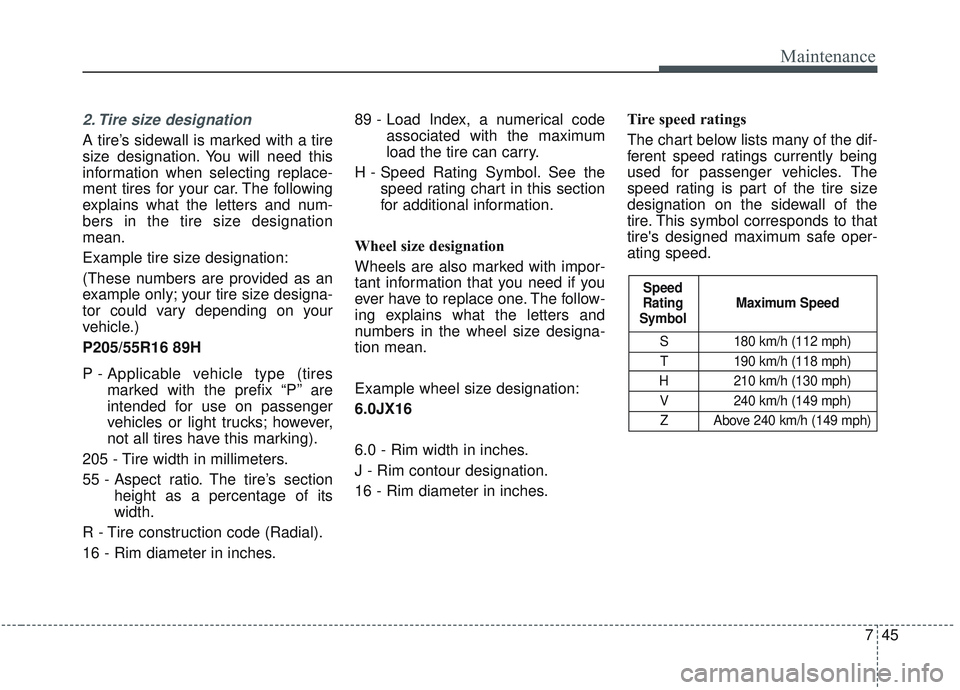
A tire’s sidewall is marked with a tire
size designation. You will need this
information when selecting replace-
ment tires for your car. The following
explains what the letters and num-
bers in the tire size designation
mean.
Example tire size designation:
(These numbers are provided as an
example only; your tire size designa-
tor could vary depending on your
vehicle.)
P205/55R16 89H
P - Applicable vehicle type (tiresmarked with the prefix “P’’ are
intended for use on passenger
vehicles or light trucks; however,
not all tires have this marking).
205 - Tire width in millimeters.
55 - Aspect ratio. The tire’s section height as a percentage of its
width.
R - Tire construction code (Radial).
16 - Rim diameter in inches. 89 - Load Index, a numerical code
associated with the maximum
load the tire can carry.
H - Speed Rating Symbol. See the speed rating chart in this section
for additional information.
Wheel size designation
Wheels are also marked with impor-
tant information that you need if you
ever have to replace one. The follow-
ing explains what the letters and
numbers in the wheel size designa-
tion mean.
Example wheel size designation:
6.0JX16
6.0 - Rim width in inches.
J - Rim contour designation.
16 - Rim diameter in inches. Tire speed ratings
The chart below lists many of the dif-
ferent speed ratings currently being
used for passenger vehicles. The
speed rating is part of the tire size
designation on the sidewall of the
tire. This symbol corresponds to that
tire's designed maximum safe oper-
ating speed.
S 180 km/h (112 mph)
T 190 km/h (118 mph)
H 210 km/h (130 mph) V 240 km/h (149 mph)Z Above 240 km/h (149 mph)
Maximum Speed
Speed
Rating
Symbol
Page 513 of 589
747
Maintenance
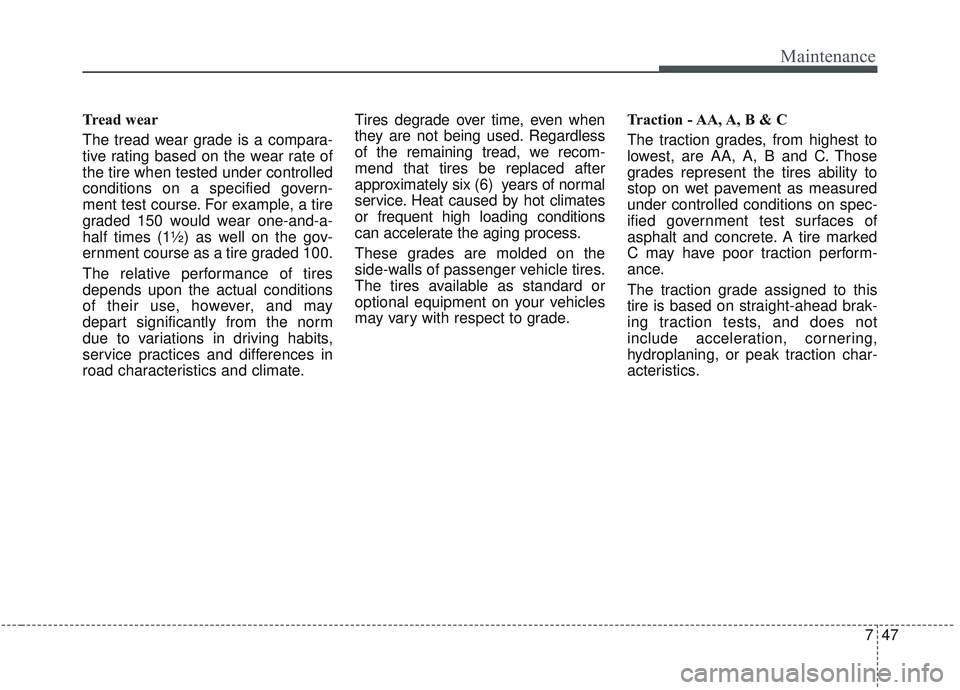
Tread wear
The tread wear grade is a compara-
tive rating based on the wear rate of
the tire when tested under controlled
conditions on a specified govern-
ment test course. For example, a tire
graded 150 would wear one-and-a-
half times (1½) as well on the gov-
ernment course as a tire graded 100.
The relative performance of tires
depends upon the actual conditions
of their use, however, and may
depart significantly from the norm
due to variations in driving habits,
service practices and differences in
road characteristics and climate.Tires degrade over time, even when
they are not being used. Regardless
of the remaining tread, we recom-
mend that tires be replaced after
approximately six (6) years of normal
service. Heat caused by hot climates
or frequent high loading conditions
can accelerate the aging process.
These grades are molded on the
side-walls of passenger vehicle tires.
The tires available as standard or
optional equipment on your vehicles
may vary with respect to grade.
Traction - AA, A, B & C
The traction grades, from highest to
lowest, are AA, A, B and C. Those
grades represent the tires ability to
stop on wet pavement as measured
under controlled conditions on spec-
ified government test surfaces of
asphalt and concrete. A tire marked
C may have poor traction perform-
ance.
The traction grade assigned to this
tire is based on straight-ahead brak-
ing traction tests, and does not
include acceleration, cornering,
hydroplaning, or peak traction char-
acteristics.
Page 521 of 589

755
Maintenance
Inner panel fuse replacement
1. Turn the engine start/stop buttonto the OFF position and all other
switches off.
2. Open the fuse panel cover.
If the switch is located in the “OFF”
position, a caution indicator will be
displayed in the cluster. 3. Pull the suspected fuse straight
out. Use the removal tool provided
on the engine compartment fuse
panel cover.
4. Check the removed fuse; replace it if it is blown.
Spare fuses are provided in theengine compartment fuse panel.
5. Push in a new fuse of the same rating, and make sure it fits tightly
in the clips.
If it fits loosely, consult an authorized
Kia dealer.
OJFH075023
OJF075022
CAUTION - Random
wiring prohibited when
retrofitting equipment
Use of random wiring in the vehicle might cause danger dueto failure and damage of thevehicle’s performance. Usingrandom wires especially whenretrofitting the AVN or theftalarm system, remote enginecontrol, car phone or radio,might damage the vehicle orcause fire.
CAUTION - Remodeling
Prohibited
Do not rewire your vehicle inany way as doing so may affectthe performance of several safe-ty features in your vehicle.Rewiring your vehicle may alsovoid your warranty and causeyou to be responsible for anysubsequent vehicle damagewhich may result.
Page 540 of 589
Maintenance
74
7
✽ ✽
NOTICE
• If the light bulb or lamp connector
is removed while the lamp is still
on, the fuse box's electronic sys-
tem may log it as a malfunction.
Therefore, a lamp malfunction
incident may be recorded as a
Diagnostic Trouble Code (DTC) in
the fuse box.
• It is normal for an operating lamp to flicker momentarily. This is due
to a stabilization function of the
vehicle’s electronic control device.
If the lamp lights up normally
after momentarily blinking, then
it is functioning as normal.
However, if the lamp continues to
flicker several times or turns off
completely, there may be an error
in the vehicle’s electronic control
device. Please have the vehicle
checked by an authorized Kia
dealer immediately.
✽ ✽ NOTICE
You can find moisture inside the lens
of lamps after a car wash or driving
in the rain. It is a natural event
caused by the temperature differ-
ence between the inside and the out-
side of the lamp and does not mean a
problem with its functions. The
moisture inside the lamp would dis-
appear if you drive the vehicle with
the headlamp turned on, however,
the level at which the moisture is
removed may differ depending on
the size/location/condition of the
lamp. If the moisture continues to
stay inside the lamp, have the vehicle
checked by an authorized Kia dealer.
If you don’t have the necessary tools,
the correct bulbs and the expertise,
consult an authorized Kia dealer. In
many cases, it is difficult to replace
vehicle light bulbs because other
parts of the vehicle must be removed
before you can get to the bulb. This is
especially true if you have to remove
the headlamp assembly to get to the
bulb(s).
Removing/installing the headlamp
assembly can result in damage to
the vehicle.
If non-genuine parts or substandard
bulbs are used, it may lead to blow-
ing a fuse or other wiring damages.
Do not install extra lamps or LEDs to
the vehicle. If additional lights are
installed, it may lead to lamp mal-
functions and flickering. Additionally,
the fuse box and other writing may
be damaged.
Page 564 of 589
Maintenance
98
7
Cleaning the upholstery and inte-
rior trim
Vinyl
Remove dust and loose dirt from
vinyl with a whisk broom or vacuum
cleaner. Clean vinyl surfaces with a
vinyl cleaner.
Fabric
Remove dust and loose dirt from fab-
ric with a whisk broom or vacuum
cleaner. Clean with a mild soap solu-
tion recommended for upholstery or
carpets. Remove fresh spots imme-
diately with a fabric spot cleaner. If
fresh spots do not receive immediate
attention, the fabric can be stained
and its color can be affected. Also, its
fire-resistant properties can be
reduced if the material is not proper-
ly maintained.
Using anything but recommended
cleaners and procedures may affect
the fabric’s appearance and fire-
resistant properties.
Cleaning the lap/shoulder beltwebbing
Clean the belt webbing with any mild
soap solution recommended for
cleaning upholstery or carpet. Follow
the instructions provided with the
soap. Do not bleach or re-dye the
webbing because this may weaken it.
Cleaning the interior windowglass
If the interior glass surfaces of the
vehicle become fogged (that is, cov-
ered with an oily, greasy or waxy
film), they should be cleaned with a
glass cleaner. Follow the directions
on the glass cleaner container.
Window tinting precaution
Window tint(especially metallic film)
might cause communication disorder
or poor radio reception, and malfunc-
tion of the automatic lighting system
due to excessive change of illumina-
tion inside the vehicle. The solution
used might also flow into electric,
electronic devices causing disorder
and failure.
CAUTION- Rear window
Do not scrape or scratch theinside of the rear window. Thismay result in damage of the rearwindow defroster grid.
Page 571 of 589
83
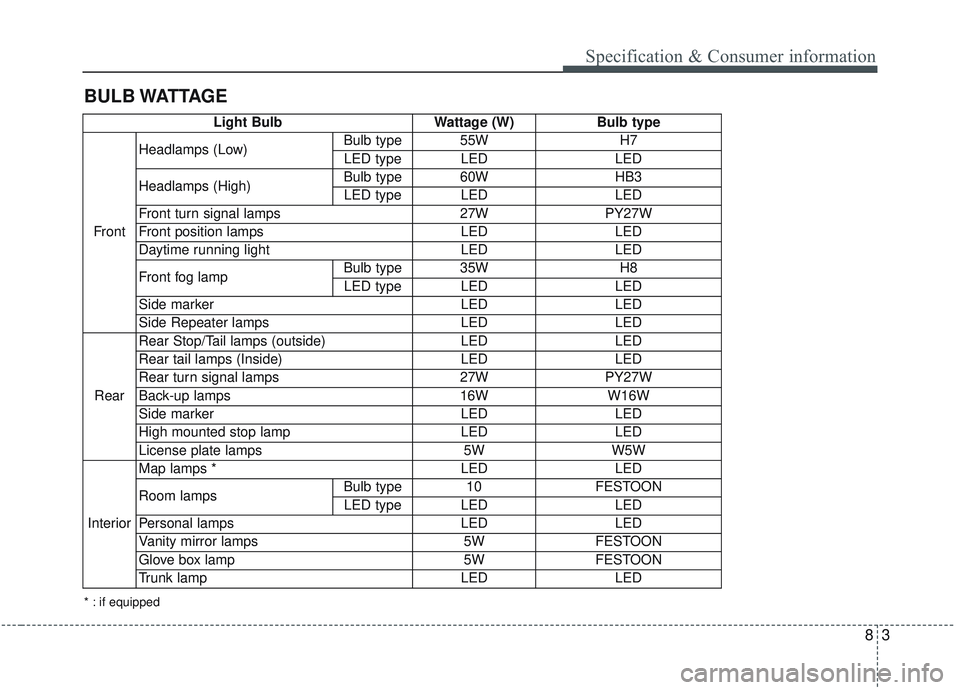
BULB WATTAGESpecification & Consumer information
Light Bulb
Wattage (W)Bulb type
Front Headlamps (Low)
Bulb type 55W
H7
LED type LED LED
Headlamps (High) Bulb type 60W
HB3
LED type LED LED
Front turn signal lamps 27WPY27W
Front position lamps LEDLED
Daytime running light LEDLED
Front fog lamp Bulb type 35W
H8
LED type LED LED
Side marker LEDLED
Side Repeater lamps LEDLED
Rear Rear Stop/Tail lamps (outside)
LEDLED
Rear tail lamps (Inside) LEDLED
Rear turn signal lamps 27WPY27W
Back-up lamps 16WW16W
Side marker LEDLED
High mounted stop lamp LEDLED
License plate lamps 5WW5W
Interior Map lamps *
LEDLED
Room lamps Bulb type 10
FESTOON
LED type LED LED
Personal lamps LEDLED
Vanity mirror lamps 5WFESTOON
Glove box lamp 5WFESTOON
Trunk lamp LEDLED
* : if equipped
Page 585 of 589
I7
Index
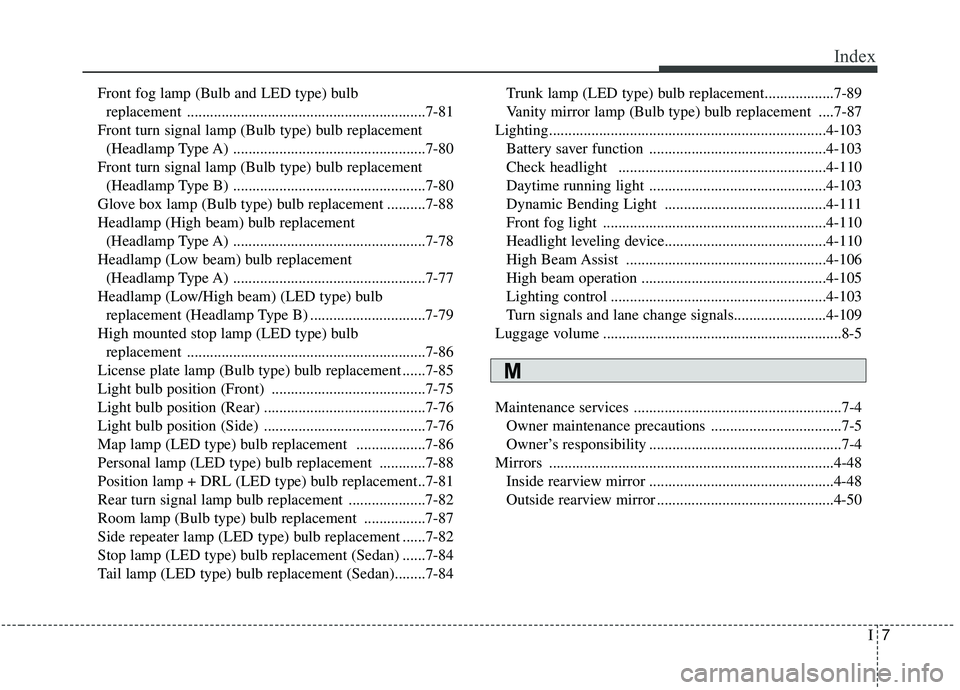
Front fog lamp (Bulb and LED type) bulb replacement ..............................................................7-81
Front turn signal lamp (Bulb type) bulb replacement (Headlamp Type A) ..................................................7-80
Front turn signal lamp (Bulb type) bulb replacement (Headlamp Type B) ..................................................7-80
Glove box lamp (Bulb type) bulb replacement ..........7-88
Headlamp (High beam) bulb replacement (Headlamp Type A) ..................................................7-78
Headlamp (Low beam) bulb replacement (Headlamp Type A) ..................................................7-77
Headlamp (Low/High beam) (LED type) bulb replacement (Headlamp Type B) ..............................7-79
High mounted stop lamp (LED type) bulb replacement ..............................................................7-86
License plate lamp (Bulb type) bulb replacement ......7-85
Light bulb position (Front) ........................................7-75
Light bulb position (Rear) ..........................................7-76
Light bulb position (Side) ..........................................7-76
Map lamp (LED type) bulb replacement ..................7-86
Personal lamp (LED type) bulb replacement ............7-88
Position lamp + DRL (LED type) bulb replacement..7-81
Rear turn signal lamp bulb replacement ....................7-82
Room lamp (Bulb type) bulb replacement ................7-87
Side repeater lamp (LED type) bulb replacement ......7-82
Stop lamp (LED type) bulb replacement (Sedan) ......7-84
Tail lamp (LED type) bulb replacement (Sedan)........7-84 Trunk lamp (LED type) bulb replacement..................7-89
Vanity mirror lamp (Bulb type) bulb replacement ....7-87
Lighting........................................................................\
4-103 Battery saver function ..............................................4-103
Check headlight ......................................................4-110
Daytime running light ..............................................4-103
Dynamic Bending Light ..........................................4-111
Front fog light ..........................................................4-110
Headlight leveling device..........................................4-110
High Beam Assist ....................................................4-106
High beam operation ................................................4-105
Lighting control ........................................................4-103
Turn signals and lane change signals........................4-109
Luggage volume ..............................................................8-5
Maintenance services ......................................................7-4 Owner maintenance precautions ..................................7-5
Owner’s responsibility ..................................................7-4
Mirrors ........................................................................\
..4-48 Inside rearview mirror ................................................4-48
Outside rearview mirror ..............................................4-50
M