hybrid KIA OPTIMA 2020 Owners Manual
[x] Cancel search | Manufacturer: KIA, Model Year: 2020, Model line: OPTIMA, Model: KIA OPTIMA 2020Pages: 589, PDF Size: 11.37 MB
Page 1 of 589
HEV (HYBRID ELECTRIC VEHICLE) SYSTEM / H2
PHEV (PLUG-IN ELECTRIC VEHICLE) SYSTEM / H3 CHARGING THE PLUG-IN HYBRID VEHICLE / H4
DRIVING THE HYBRID/PLUG-IN HYBRID VEHICLE / H25
ENERGY FLOW HYBRID/PLUG-IN HYBRID VEHICLE / H32
STARTING THE HYBRID/PLUG-IN HYBRID VEHICLE (SMART KEY) / H38 COMPONENTS OF THE HYBRID/PLUG-IN HYBRID VEHICLE / H40
Hybrid/Plug-in Hybrid System Overview
Page 2 of 589
H2
HEV (HYBRID ELECTRIC VEHICLE) SYSTEM
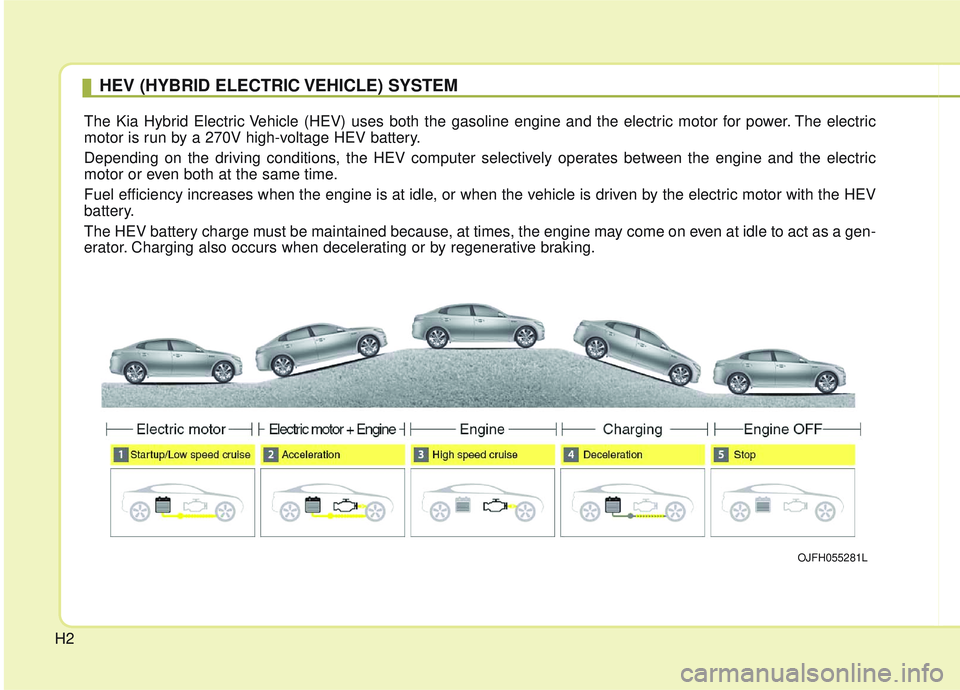
The Kia Hybrid Electric Vehicle (HEV) uses both the gasoline engine and the electric motor for power. The electric
motor is run by a 270V high-voltage HEV battery.
Depending on the driving conditions, the HEV computer selectively operates between the engine and the electric
motor or even both at the same time.
Fuel efficiency increases when the engine is at idle, or when the vehicle is driven by the electric motor with the HEV
battery.
The HEV battery charge must be maintained because, at times, the engine may come on even at idle to act as a gen-
erator. Charging also occurs when decelerating or by regenerative braking.
OJFH055281L
Page 3 of 589
H3
PHEV (PLUG-IN ELECTRIC VEHICLE) SYSTEM
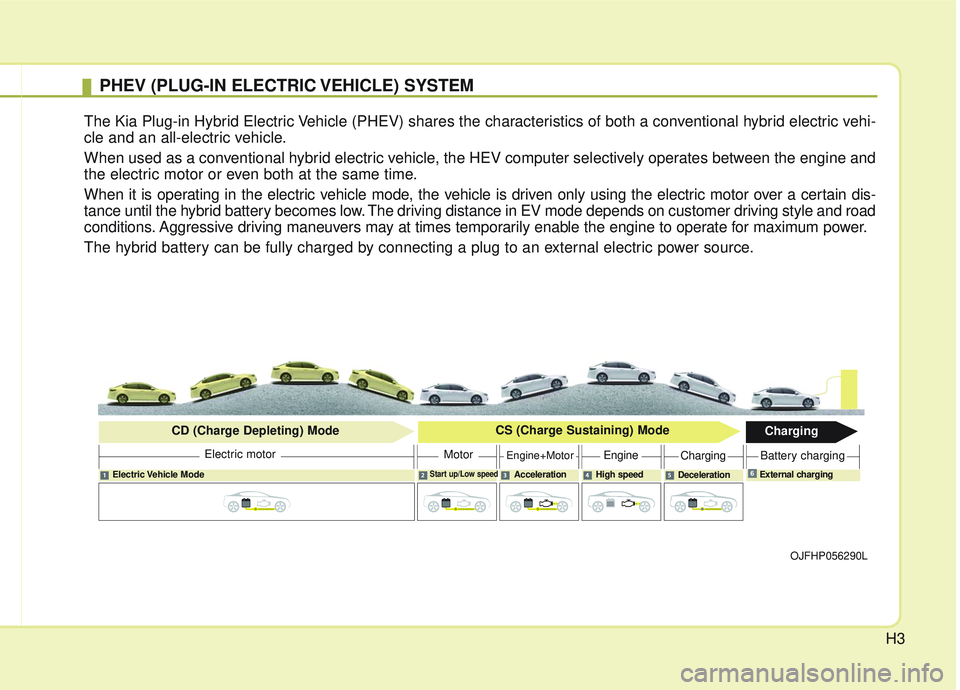
The Kia Plug-in Hybrid Electric Vehicle (PHEV) shares the characteristics of both a conventional hybrid electric vehi-
cle and an all-electric vehicle.
When used as a conventional hybrid electric vehicle, the HEV computer selectively operates between the engine and
the electric motor or even both at the same time.
When it is operating in the electric vehicle mode, the vehicle is driven only using the electric motor over a certain dis-
tance until the hybrid battery becomes low. The driving distance in EV mode depends on customer driving style and road
conditions. Aggressive driving maneuvers may at times temporarily enable the engine to operate for maximum power.
The hybrid battery can be fully charged by connecting a plug to an external electric power source.
OJFHP056290L
Electric Vehicle ModeStart up/Low speedAcceleration High speedDecelerationExternal charging
Electric motor
CD (Charge Depleting) Mode
CS (Charge Sustaining) Mode
Charging
MotorEngine+MotorEngineChargingBattery charging
6
Page 4 of 589
H4
Charging Information
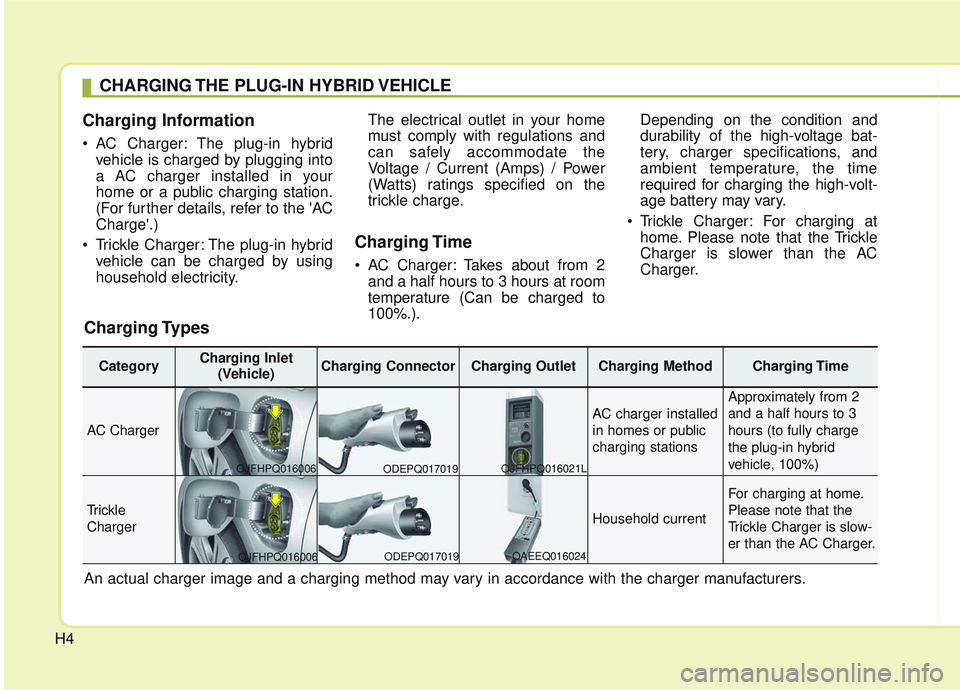
• AC Charger: The plug-in hybridvehicle is charged by plugging into
a AC charger installed in your
home or a public charging station.
(For further details, refer to the 'AC
Charge'.)
Trickle Charger: The plug-in hybrid vehicle can be charged by using
household electricity. The electrical outlet in your home
must comply with regulations and
can safely accommodate the
Voltage / Current (Amps) / Power
(Watts) ratings specified on the
trickle charge.
Charging Time
AC Charger: Takes about from 2
and a half hours to 3 hours at room
temperature (Can be charged to
100%.). Depending on the condition and
durability of the high-voltage bat-
tery, charger specifications, and
ambient temperature, the time
required for charging the high-volt-
age battery may vary.
Trickle Charger: For charging at home. Please note that the Trickle
Charger is slower than the AC
Charger.
CHARGING THE PLUG-IN HYBRID VEHICLE
Charging Types
An actual charger image and a charging method may vary in accordance with the charger manufacturers.
CategoryCharging Inlet
(Vehicle)Charging ConnectorCharging OutletCharging Method Charging Time
AC Charger
AC charger installed
in homes or public
charging stations
Approximately from 2
and a half hours to 3
hours (to fully charge
the plug-in hybrid
vehicle, 100%)
Trickle
ChargerHousehold current
For charging at home.
Please note that the
Trickle Charger is slow-
er than the AC Charger.
OJFHPQ016006 ODEPQ017019
ODEPQ017019 OAEEQ016024
OJFHPQ016021L
OJFHPQ016006
Page 6 of 589
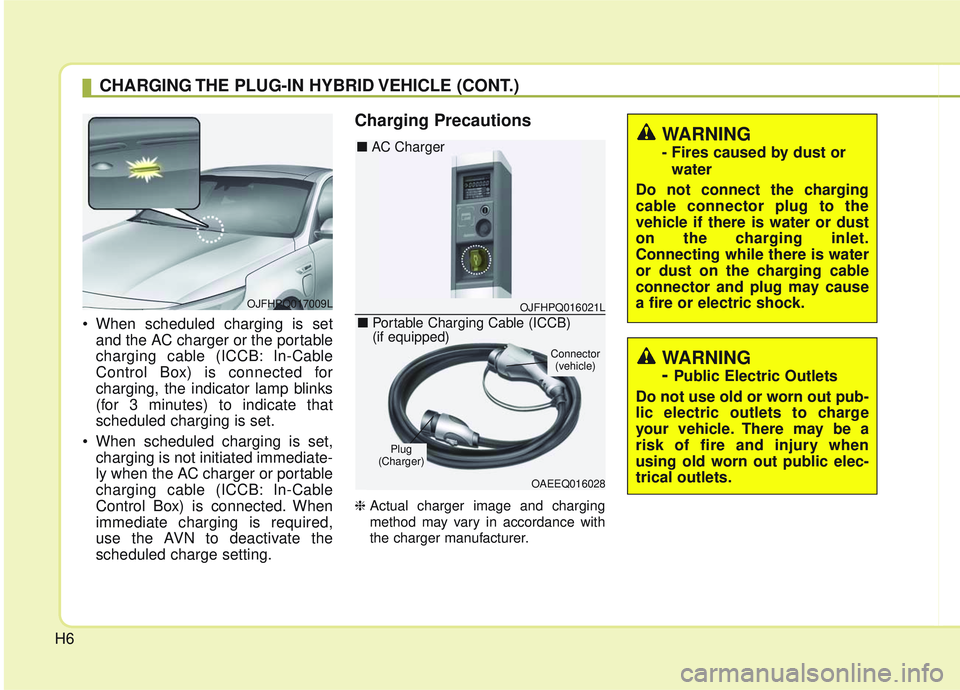
H6 When scheduled charging is set
and the AC charger or the portable
charging cable (ICCB: In-Cable
Control Box) is connected for
charging, the indicator lamp blinks
(for 3 minutes) to indicate that
scheduled charging is set.
When scheduled charging is set, charging is not initiated immediate-
ly when the AC charger or portable
charging cable (ICCB: In-Cable
Control Box) is connected. When
immediate charging is required,
use the AVN to deactivate the
scheduled charge setting.
Charging Precautions
❈ Actual charger image and charging
method may vary in accordance with
the charger manufacturer.
CHARGING THE PLUG-IN HYBRID VEHICLE (CONT.)
OJFHPQ017009L
WARNING
- Fires caused by dust or
water
Do not connect the charging
cable connector plug to the
vehicle if there is water or dust
on the charging inlet.
Connecting while there is water
or dust on the charging cable
connector and plug may cause
a fire or electric shock.
OJFHPQ016021L
OAEEQ016028
■ AC Charger
■ Portable Charging Cable (ICCB)
(if equipped)
Connector
(vehicle)
Plug
(Charger)
WARNING
-
Public Electric Outlets
Do not use old or worn out pub-
lic electric outlets to charge
your vehicle. There may be a
risk of fire and injury when
using old worn out public elec-
trical outlets.
Page 8 of 589
H8 Always keep the charging connec-
tor and charging plug in clean and
dry condition. Be sure to keep the
charging cable in a condition where
there is no water or moisture.
Make sure to use the designated charger for charging the vehicle.
Using any other charger may
cause failure.
Before charging the battery, turn the vehicle OFF.
Be careful not to drop the charging connector. The charging connector
can be damaged.
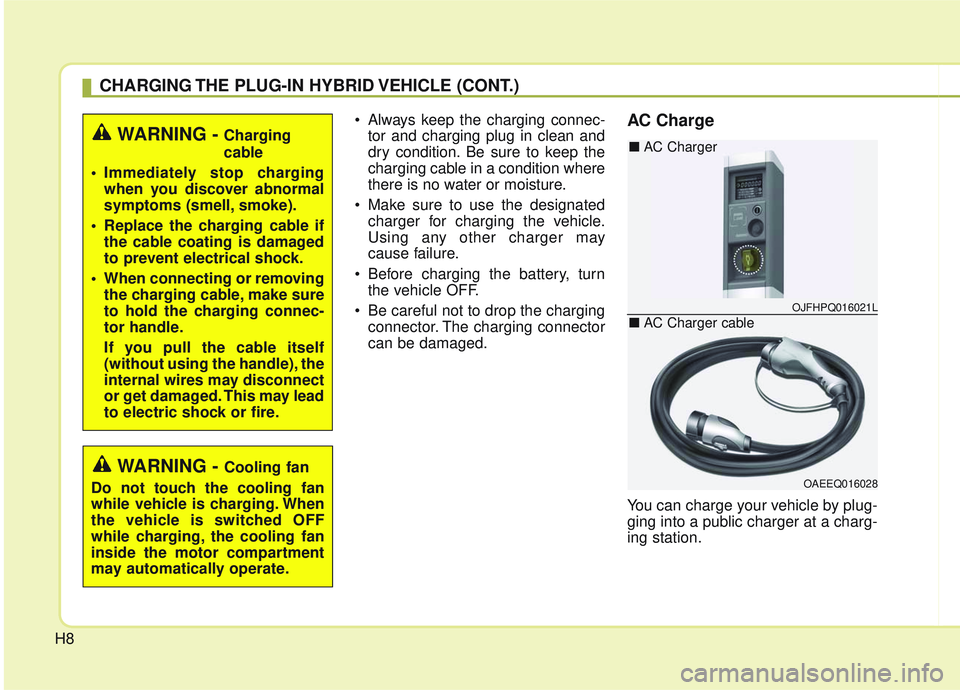
AC Charge
You can charge your vehicle by plug-
ging into a public charger at a charg-
ing station.
CHARGING THE PLUG-IN HYBRID VEHICLE (CONT.)
WARNING - Charging
cable
• Immediately stop charging when you discover abnormal
symptoms (smell, smoke).
Replace the charging cable if the cable coating is damaged
to prevent electrical shock.
When connecting or removing the charging cable, make sure
to hold the charging connec-
tor handle.
If you pull the cable itself
(without using the handle), the
internal wires may disconnect
or get damaged. This may lead
to electric shock or fire.
WARNING - Cooling fan
Do not touch the cooling fan
while vehicle is charging. When
the vehicle is switched OFF
while charging, the cooling fan
inside the motor compartment
may automatically operate.
OJFHPQ016021L
OAEEQ016028
■ AC Charger
■ AC Charger cable
Page 10 of 589
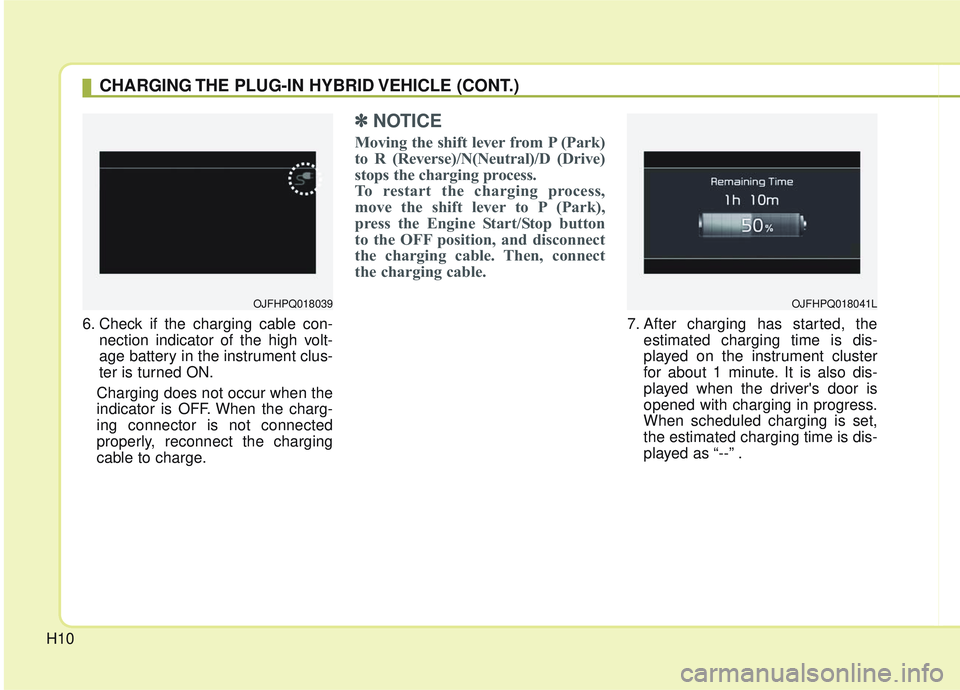
H106. Check if the charging cable con-
nection indicator of the high volt-
age battery in the instrument clus-
ter is turned ON.
Charging does not occur when the
indicator is OFF. When the charg-
ing connector is not connected
properly, reconnect the charging
cable to charge.
✽ ✽ NOTICE
Moving the shift lever from P (Park)
to R (Reverse)/N(Neutral)/D (Drive)
stops the charging process.
To restart the charging process,
move the shift lever to P (Park),
press the Engine Start/Stop button
to the OFF position, and disconnect
the charging cable. Then, connect
the charging cable.
7. After charging has started, the
estimated charging time is dis-
played on the instrument cluster
for about 1 minute. It is also dis-
played when the driver's door is
opened with charging in progress.
When scheduled charging is set,
the estimated charging time is dis-
played as “--” .
CHARGING THE PLUG-IN HYBRID VEHICLE (CONT.)
OJFHPQ018039OJFHPQ018041L
Page 12 of 589
H12
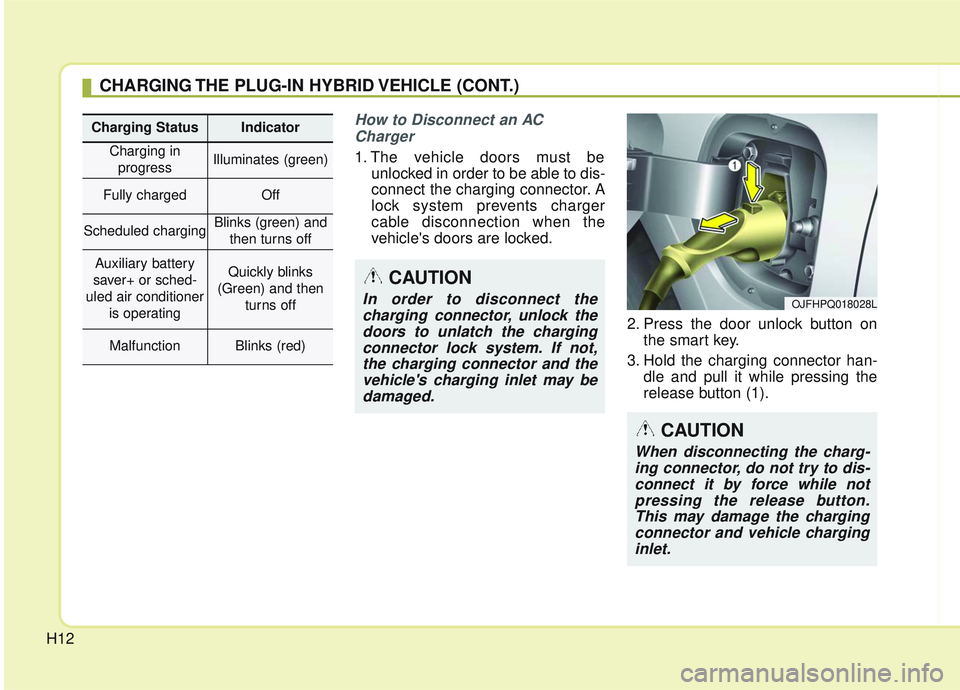
How to Disconnect an ACCharger
1. The vehicle doors must be unlocked in order to be able to dis-
connect the charging connector. A
lock system prevents charger
cable disconnection when the
vehicle's doors are locked.
2. Press the door unlock button onthe smart key.
3. Hold the charging connector han- dle and pull it while pressing the
release button (1).
OJFHPQ018028L
Charging StatusIndicator
Charging in
progressIlluminates (green)
Fully chargedOff
Scheduled chargingBlinks (green) and then turns off
Auxiliary battery
saver+ or sched-
uled air conditioner is operatingQuickly blinks
(Green) and then turns off
MalfunctionBlinks (red)
CHARGING THE PLUG-IN HYBRID VEHICLE (CONT.)
CAUTION
In order to disconnect thecharging connector, unlock thedoors to unlatch the chargingconnector lock system. If not,the charging connector and thevehicle's charging inlet may bedamaged.
CAUTION
When disconnecting the charg-ing connector, do not try to dis-connect it by force while notpressing the release button.This may damage the chargingconnector and vehicle charginginlet.
Page 14 of 589
H14When you cannot drive to a public
charging station due to low battery,
you can charge the car by using the
220V portable charger (ICCB: In
Cable Control Box) which you can
buy as an option.
✽ ✽
NOTICE
This cable is designed to prevent
problems caused by unexpected bat-
tery discharge and when you use
general outlets, it may lead to exces-
sive electricity charges as the elec-
tricity charges for electric vehicles
will not be applied. So refrain from
using it to fully charge your car.
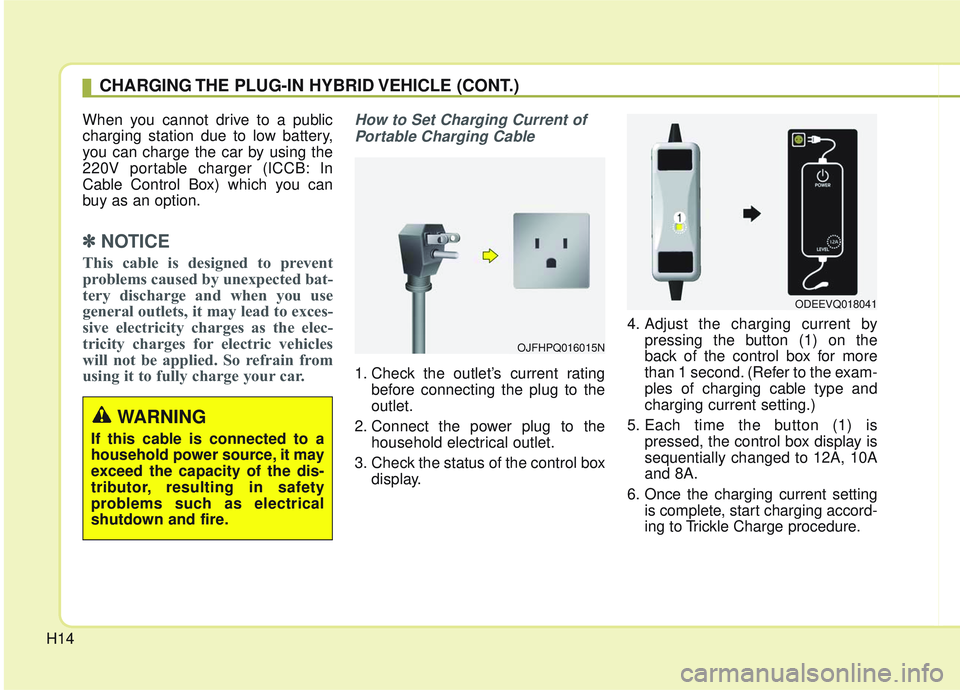
How to Set Charging Current of
Portable Charging Cable
1. Check the outlet’s current rating before connecting the plug to the
outlet.
2. Connect the power plug to the household electrical outlet.
3. Check the status of the control box display. 4. Adjust the charging current by
pressing the button (1) on the
back of the control box for more
than 1 second. (Refer to the exam-
ples of charging cable type and
charging current setting.)
5. Each time the button (1) is pressed, the control box display is
sequentially changed to 12A, 10A
and 8A.
6. Once the charging current setting is complete, start charging accord-
ing to Trickle Charge procedure.
CHARGING THE PLUG-IN HYBRID VEHICLE (CONT.)
OJFHPQ016015N
ODEEVQ018041
WARNING
If this cable is connected to a
household power source, it may
exceed the capacity of the dis-
tributor, resulting in safety
problems such as electrical
shutdown and fire.
Page 16 of 589
H16
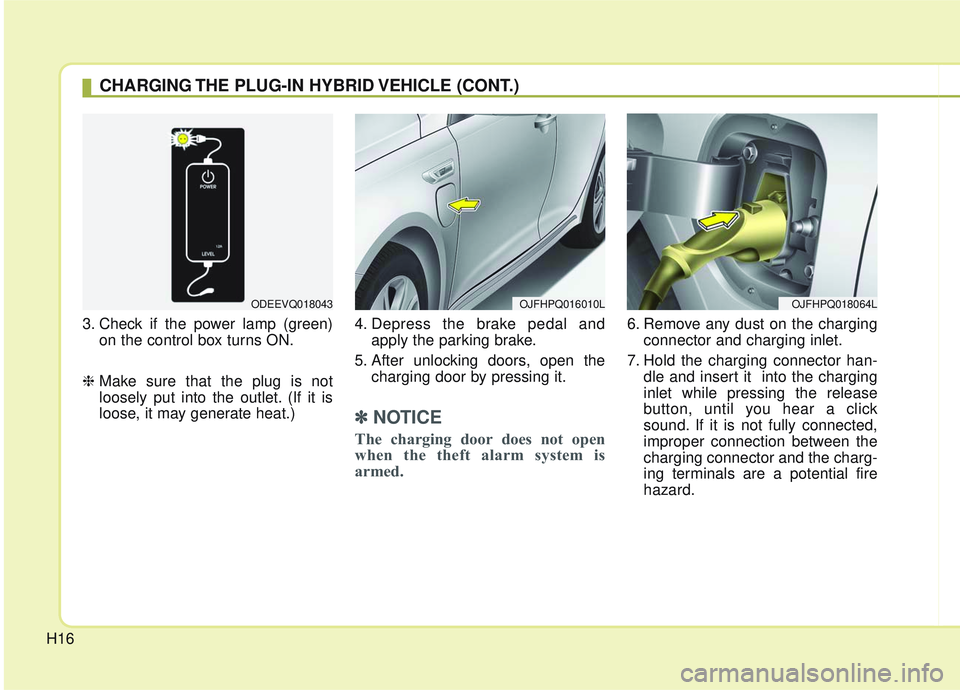
3. Check if the power lamp (green)on the control box turns ON.
❈ Make sure that the plug is not
loosely put into the outlet. (If it is
loose, it may generate heat.) 4. Depress the brake pedal and
apply the parking brake.
5. After unlocking doors, open the charging door by pressing it.
✽ ✽NOTICE
The charging door does not open
when the theft alarm system is
armed.
6. Remove any dust on the charging
connector and charging inlet.
7. Hold the charging connector han- dle and insert it into the charging
inlet while pressing the release
button, until you hear a click
sound. If it is not fully connected,
improper connection between the
charging connector and the charg-
ing terminals are a potential fire
hazard.
OJFHPQ016010L
CHARGING THE PLUG-IN HYBRID VEHICLE (CONT.)
ODEEVQ018043OJFHPQ018064L