air condition KIA Sorento 2006 1.G Owner's Guide
[x] Cancel search | Manufacturer: KIA, Model Year: 2006, Model line: Sorento, Model: KIA Sorento 2006 1.GPages: 312, PDF Size: 5.21 MB
Page 177 of 312
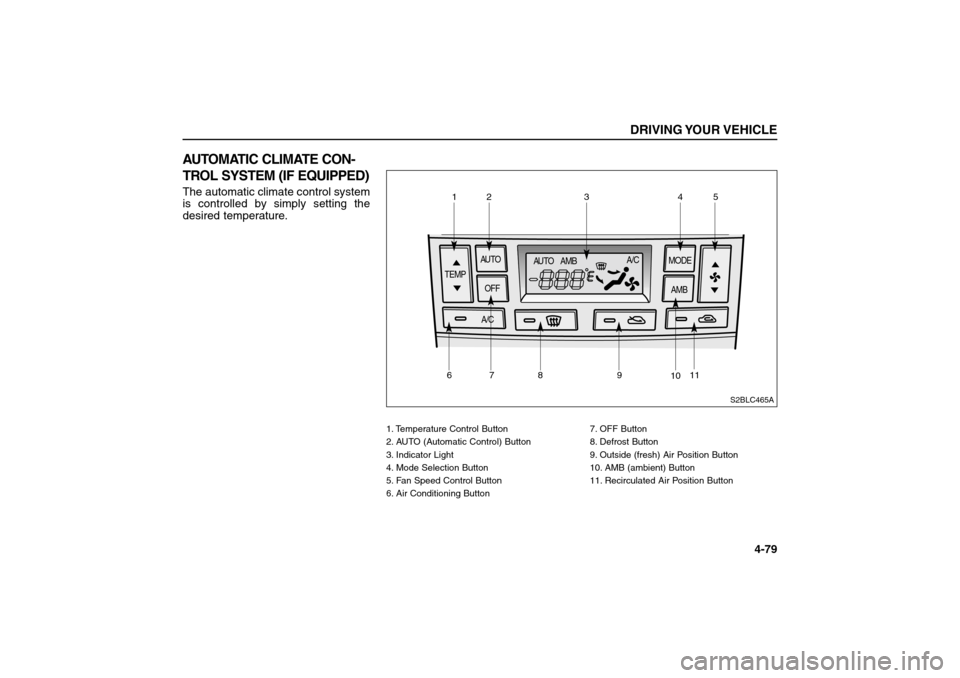
AUTOMATIC CLIMATE CON-
TROL SYSTEM (IF EQUIPPED)The automatic climate control system
is controlled by simply setting the
desired temperature.
DRIVING YOUR VEHICLE
4-79
AUTO
AUTO AMB
OFF TEMPMODE
AMB
A/C
A/C
L
R
S2BLC465A
1. Temperature Control Button
2. AUTO (Automatic Control) Button
3. Indicator Light
4. Mode Selection Button
5. Fan Speed Control Button
6. Air Conditioning Button7. OFF Button
8. Defrost Button
9. Outside (fresh) Air Position Button
10. AMB (ambient) Button
11. Recirculated Air Position Button
16
7
8
9
10
11
2
3
4
5
BL-ENG (CAN)-4.qxd 7/28/05 5:55 PM Page 79
Page 178 of 312
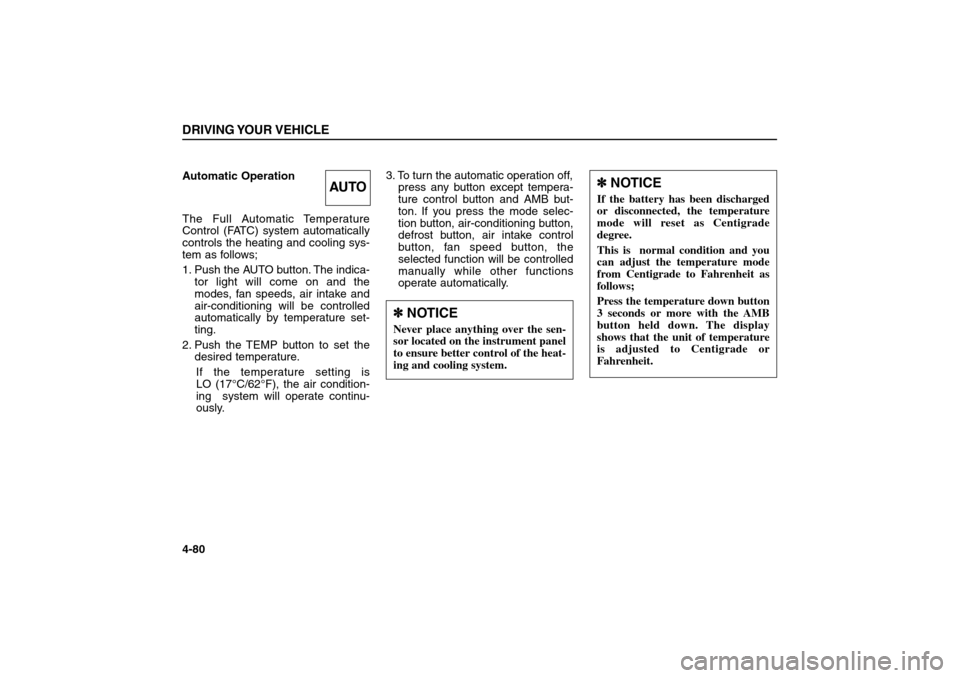
Automatic Operation
The Full Automatic Temperature
Control (FATC) system automatically
controls the heating and cooling sys-
tem as follows;
1. Push the AUTO button. The indica-
tor light will come on and the
modes, fan speeds, air intake and
air-conditioning will be controlled
automatically by temperature set-
ting.
2. Push the TEMP button to set the
desired temperature.
If the temperature setting is
LO (17°C/62°F), the air condition-
ing system will operate continu-
ously.3. To turn the automatic operation off,
press any button except tempera-
ture control button and AMB but-
ton. If you press the mode selec-
tion button, air-conditioning button,
defrost button, air intake control
button, fan speed button, the
selected function will be controlled
manually while other functions
operate automatically.DRIVING YOUR VEHICLE4-80
AUTO
✽ ✽
NOTICENever place anything over the sen-
sor located on the instrument panel
to ensure better control of the heat-
ing and cooling system.
✽ ✽
NOTICEIf the battery has been discharged
or disconnected, the temperature
mode will reset as Centigrade
degree.
This is normal condition and you
can adjust the temperature mode
from Centigrade to Fahrenheit as
follows;
Press the temperature down button
3 seconds or more with the AMB
button held down. The display
shows that the unit of temperature
is adjusted to Centigrade or
Fahrenheit.
BL-ENG (CAN)-4.qxd 7/28/05 5:55 PM Page 80
Page 181 of 312
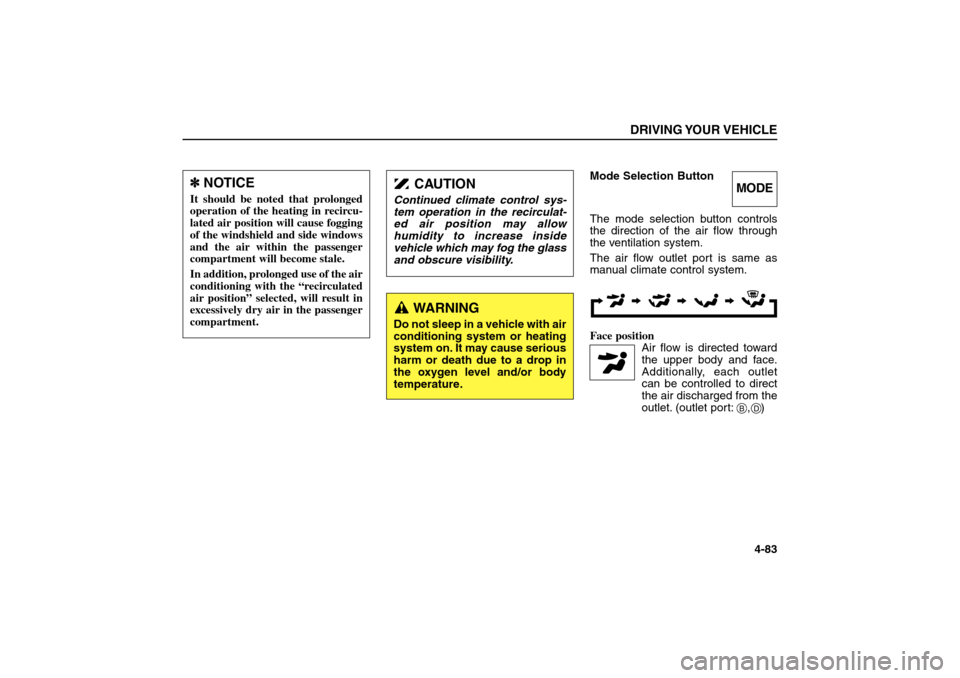
Mode Selection Button
The mode selection button controls
the direction of the air flow through
the ventilation system.
The air flow outlet port is same as
manual climate control system.
Face position
Air flow is directed toward
the upper body and face.
Additionally, each outlet
can be controlled to direct
the air discharged from the
outlet. (outlet port: , )
DRIVING YOUR VEHICLE
4-83
B
D
MODE
✽ ✽
NOTICEIt should be noted that prolonged
operation of the heating in recircu-
lated air position will cause fogging
of the windshield and side windows
and the air within the passenger
compartment will become stale.
In addition, prolonged use of the air
conditioning with the “recirculated
air position” selected, will result in
excessively dry air in the passenger
compartment.
CAUTION
Continued climate control sys-
tem operation in the recirculat-
ed air position may allow
humidity to increase inside
vehicle which may fog the glass
and obscure visibility.
WARNING
Do not sleep in a vehicle with air
conditioning system or heating
system on. It may cause serious
harm or death due to a drop in
the oxygen level and/or body
temperature.
BL-ENG (CAN)-4.qxd 7/28/05 5:56 PM Page 83
Page 182 of 312
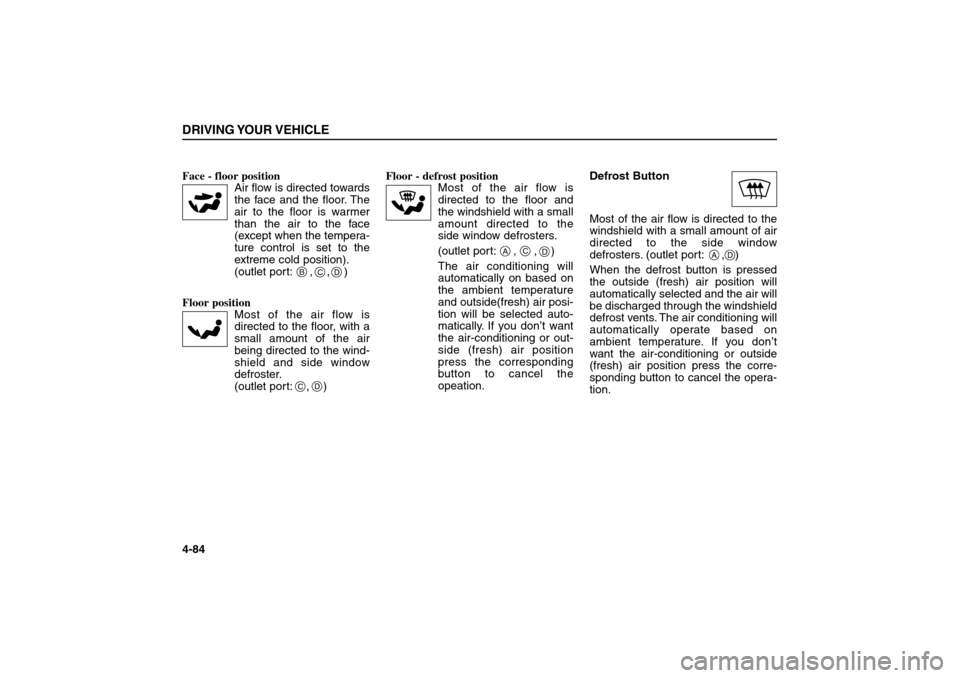
Face - floor position
Air flow is directed towards
the face and the floor. The
air to the floor is warmer
than the air to the face
(except when the tempera-
ture control is set to the
extreme cold position).
(outlet port: , , )
Floor position
Most of the air flow is
directed to the floor, with a
small amount of the air
being directed to the wind-
shield and side window
defroster.
(outlet port: , )Floor - defrost position
Most of the air flow is
directed to the floor and
the windshield with a small
amount directed to the
side window defrosters.
(outlet port: , , )
The air conditioning will
automatically on based on
the ambient temperature
and outside(fresh) air posi-
tion will be selected auto-
matically. If you don’t want
the air-conditioning or out-
side (fresh) air position
press the corresponding
button to cancel the
opeation.Defrost Button
Most of the air flow is directed to the
windshield with a small amount of air
directed to the side window
defrosters. (outlet port: , )
When the defrost button is pressed
the outside (fresh) air position will
automatically selected and the air will
be discharged through the windshield
defrost vents. The air conditioning will
automatically operate based on
ambient temperature. If you don’t
want the air-conditioning or outside
(fresh) air position press the corre-
sponding button to cancel the opera-
tion.DRIVING YOUR VEHICLE4-84
B
A
C
C
C
D
D
D
A
D
BL-ENG (CAN)-4.qxd 7/28/05 5:56 PM Page 84
Page 183 of 312
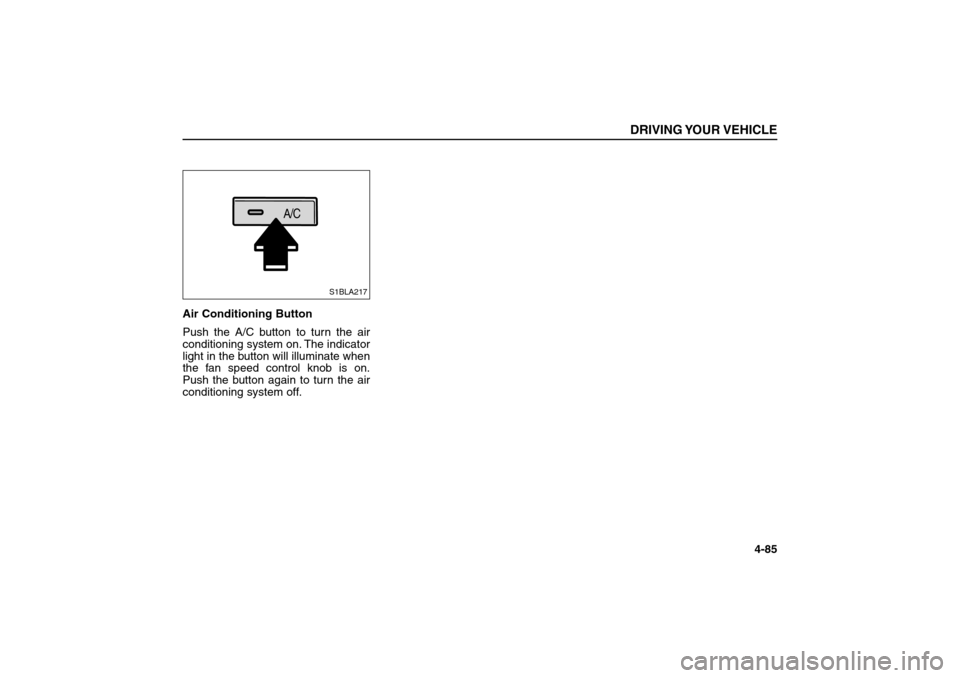
Air Conditioning Button
Push the A/C button to turn the air
conditioning system on. The indicator
light in the button will illuminate when
the fan speed control knob is on.
Push the button again to turn the air
conditioning system off.
DRIVING YOUR VEHICLE
4-85
A/C
S1BLA217
BL-ENG (CAN)-4.qxd 7/28/05 5:56 PM Page 85
Page 186 of 312
WINDSHIELD DEFROSTING
AND DEFOGGING
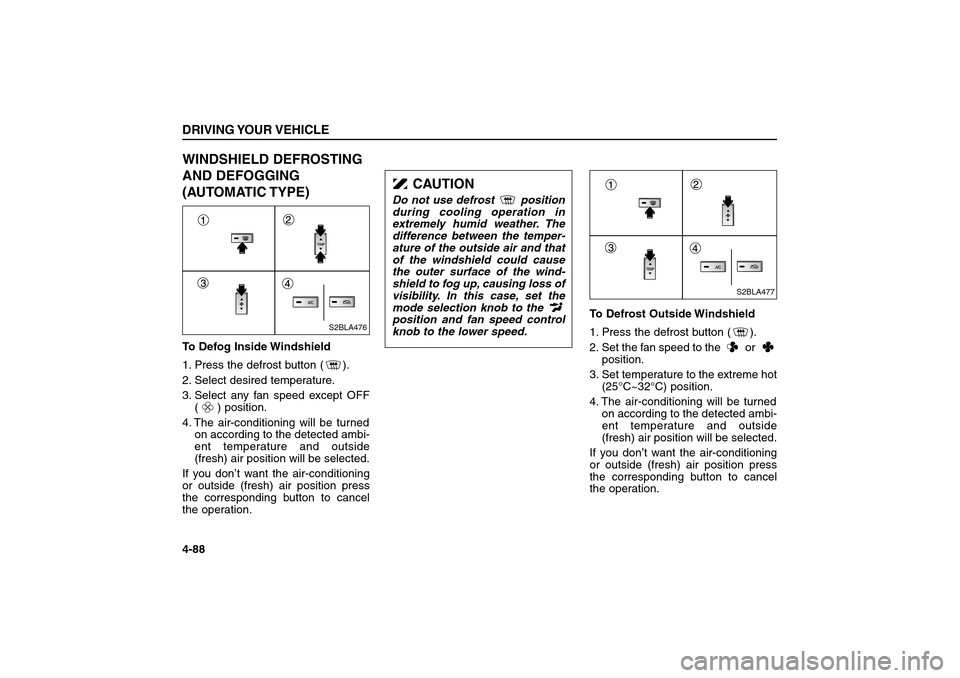
(AUTOMATIC TYPE)To Defog Inside Windshield
1. Press the defrost button ( ).
2. Select desired temperature.
3. Select any fan speed except OFF
( ) position.
4. The air-conditioning will be turned
on according to the detected ambi-
ent temperature and outside
(fresh) air position will be selected.
If you don’t want the air-conditioning
or outside (fresh) air position press
the corresponding button to cancel
the operation.To Defrost Outside Windshield
1. Press the defrost button ( ).
2. Set the fan speed to the or
position.
3. Set temperature to the extreme hot
(25°C~32°C) position.
4. The air-conditioning will be turned
on according to the detected ambi-
ent temperature and outside
(fresh) air position will be selected.
If you don’t want the air-conditioning
or outside (fresh) air position press
the corresponding button to cancel
the operation.DRIVING YOUR VEHICLE4-88
S2BLA476
S2BLA477
CAUTION
Do not use defrost position
during cooling operation in
extremely humid weather. The
difference between the temper-
ature of the outside air and that
of the windshield could cause
the outer surface of the wind-
shield to fog up, causing loss of
visibility. In this case, set the
mode selection knob to the
position and fan speed control
knob to the lower speed.
BL-ENG (CAN)-4.qxd 7/28/05 5:56 PM Page 88
Page 187 of 312
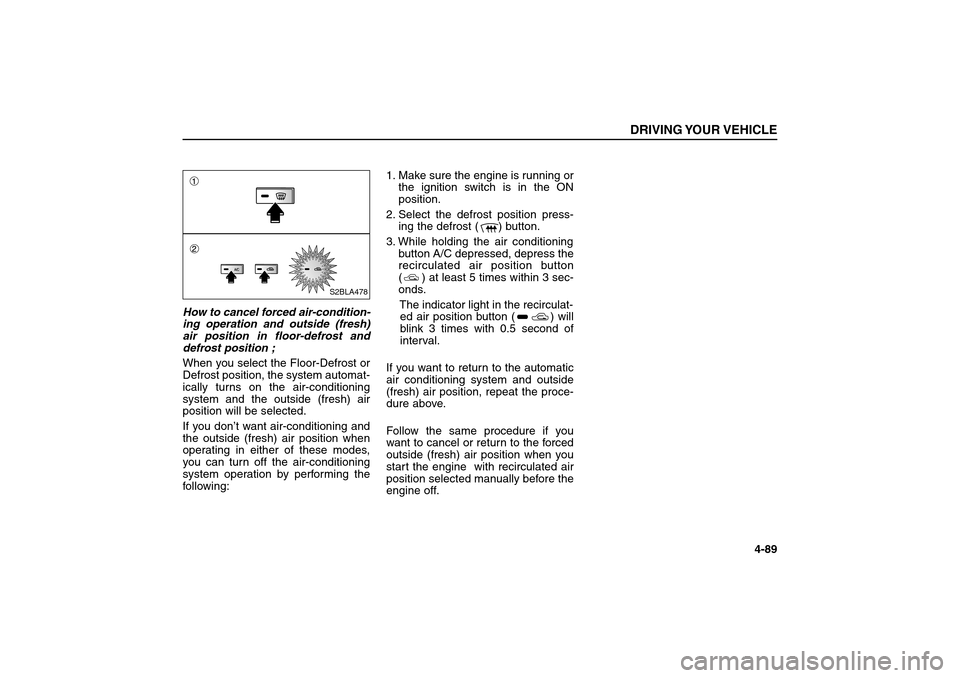
How to cancel forced air-condition-
ing operation and outside (fresh)
air position in floor-defrost and
defrost position ;
When you select the Floor-Defrost or
Defrost position, the system automat-
ically turns on the air-conditioning
system and the outside (fresh) air
position will be selected.
If you don’t want air-conditioning and
the outside (fresh) air position when
operating in either of these modes,
you can turn off the air-conditioning
system operation by performing the
following:1. Make sure the engine is running or
the ignition switch is in the ON
position.
2. Select the defrost position press-
ing the defrost ( ) button.
3. While holding the air conditioning
button A/C depressed, depress the
recirculated air position button
( ) at least 5 times within 3 sec-
onds.
The indicator light in the recirculat-
ed air position button ( ) will
blink 3 times with 0.5 second of
interval.
If you want to return to the automatic
air conditioning system and outside
(fresh) air position, repeat the proce-
dure above.
Follow the same procedure if you
want to cancel or return to the forced
outside (fresh) air position when you
start the engine with recirculated air
position selected manually before the
engine off.
DRIVING YOUR VEHICLE
4-89
S2BLA478
BL-ENG (CAN)-4.qxd 7/28/05 5:56 PM Page 89
Page 193 of 312
SUGGESTIONS FOR
ECONOMICAL OPERATIONYour vehicle’s fuel economy depends
mainly on your style of driving, where
you drive and when you drive.
Each of these factors affects how
many miles (kilometers) you can get
from a gallon (liter) of fuel. To operate
your vehicle as economically as pos-
sible, use the following driving sug-
gestions to help save money in both
fuel and repairs:
Avoid lengthy warm-up idling. Once
the engine is running smoothly,
begin driving. Remember, engine
warm-up may take a little longer on
cold days.
Save fuel by accelerating slowly
after stopping.
Keep the engine in tune and follow
the recommended periodic mainte-
nance schedule. This will increase
the life of all parts and lower your
operating costs. Do not use the air conditioner
unnecessarily.
Slow down when driving on rough
roads.
For longer tire life and better fuel
economy, always keep the tires
inflated to the recommended pres-
sures.
Maintain a safe distance from other
vehicles to avoid sudden stops.
This will reduce wear on brake lin-
ings and pads. Driving in such a
way will also save fuel because
extra fuel is required to accelerate
back to driving speed.
Do not carry unnecessary weight in
the vehicle.
Do not rest your foot on the brake
pedal while driving. This can cause
needless wear, possible damage to
the brakes, and poor fuel economy. Improper wheel alignment results
in faster tire wear and lower fuel
economy.
Open windows at high speeds can
reduce fuel economy.
Fuel economy is less in crosswinds
and headwinds. To help offset
some of this loss, slow down when
driving in these conditions.
Keeping a vehicle in good operating
condition is important both for econo-
my and safety. Therefore, have an
authorized Kia dealer perform sched-
uled inspections and maintenance.DRIVING TIPS5-6
BL-ENG (CAN)-5.qxd 7/28/05 5:56 PM Page 6
Page 221 of 312
TRAILER TOWINGYour vehicle can tow a trailer. To iden-
tify what the vehicle trailering capaci-
ty is for your vehicle, you should read
the information in “Weight of the
Trailer’’ that appears later in this sec-
tion. Remember that trailering is dif-
ferent than just driving your vehicle
by itself. Trailering means changes in
handling, durability, and fuel econo-
my. Successful, safe trailering takes
correct equipment, and it has to be
used properly.This section contains many time-test-
ed, important trailering tips and safe-
ty rules. Many of these are important
for your safety and that of your pas-
sengers. Please read this section
carefully before you pull a trailer.
Load-pulling components such as the
engine, transmission, wheel assem-
blies, and tires are forced to work
harder against the load of the added
weight. The engine is required to
operate at relatively higher speeds
and under greater loads. This addi-
tional burden generates extra heat.
The trailer also adds considerably to
wind resistance, further increasing
the pulling requirements.If You Do Decide to Pull a Trailer
Here are some important points if you
decide to pull a trailer:
State, provincial, county and
municipal government have varying
trailering laws. Make sure your
hitch, mirrors, lights and wiring
arrangements are legal, not only
where you live, but also where
you’ll be driving. A good source for
this information is provincial or local
law enforcement agencies.
Consider using a sway control. You
can ask a hitch dealer about sway
control.
After your odometer indicates 800
km or more, you can tow a trailer.
For the first 800 km that you tow a
trailer, don’t drive over 80 km/h and
don’t make starts at full throttle.
This helps your engine and other
parts of your vehicle “wear” in at the
heavier loads.
Always drive at a safe speed (less
than 100 km/h) commensurate with
road conditions.
Three important considerations
have to do with weight:DRIVING TIPS5-34✽ ✽
NOTICEPulling a trailer improperly can
damage your vehicle and result in
costly repairs not covered by your
warranty. To pull a trailer correct-
ly, follow the advice in this section.
BL-ENG (CAN)-5.qxd 7/28/05 5:56 PM Page 34
Page 235 of 312
OVERHEATINGIf your temperature gauge indicates
overheating, if you experience a loss of
power, or if you hear a loud knocking or
pinging noise, the engine has probably
overheated. Should any of these
symptoms occur, use the following pro-
cedure:
1. Turn on the hazard warning flash-
er, then drive to the nearest safe
location and stop your vehicle; shift
to Neutral (manual transaxle) or
Park (automatic transaxle) and
apply the parking brake.
2. Make sure the air conditioner is off.
3. If coolant or steam is boiling out of
the radiator, stop the engine and call
an authorized Kia dealer for assis-
tance.
If there is no visible coolant, you
may allow the engine to idle and
open the hood to permit the engine
to cool gradually.
If the temperature does not go down
with the engine idling, stop the
engine and allow sufficient time for it
to cool.4. The coolant level should then be
checked. Use the coolant reservoir
dipstick to check the level. If the
level in the reservoir is low, look for
leaks at the radiator hoses and
connections, heater hoses and
connections, radiator, and water
pump. If you find a major leak or
another problem that may have
caused the engine to overheat, do
not operate the engine until it has
been corrected. Call an authorized
Kia dealer for assistance. If you do
not find a leak or other problem,
carefully add coolant to the reser-
voir.If the engine frequently overheats,
have the cooling system checked and
repaired by an Authorized Kia Dealer.
IN CASE OF AN EMERGENCY
6-3
WARNING- Removing Radiator Cap
Never remove the radiator cap
when the engine and radiator
are hot. Scalding hot coolant
and steam may blow out under
pressure. This could cause seri-
ous injury.
BL-ENG (CAN)-6.qxd 7/28/05 5:57 PM Page 3