lock KIA Sportage 2005 JE_ / 2.G Owner's Guide
[x] Cancel search | Manufacturer: KIA, Model Year: 2005, Model line: Sportage, Model: KIA Sportage 2005 JE_ / 2.GPages: 354, PDF Size: 2.78 MB
Page 36 of 354
325
Knowing your vehicle
1
2
3
4
5
6
7
8
9
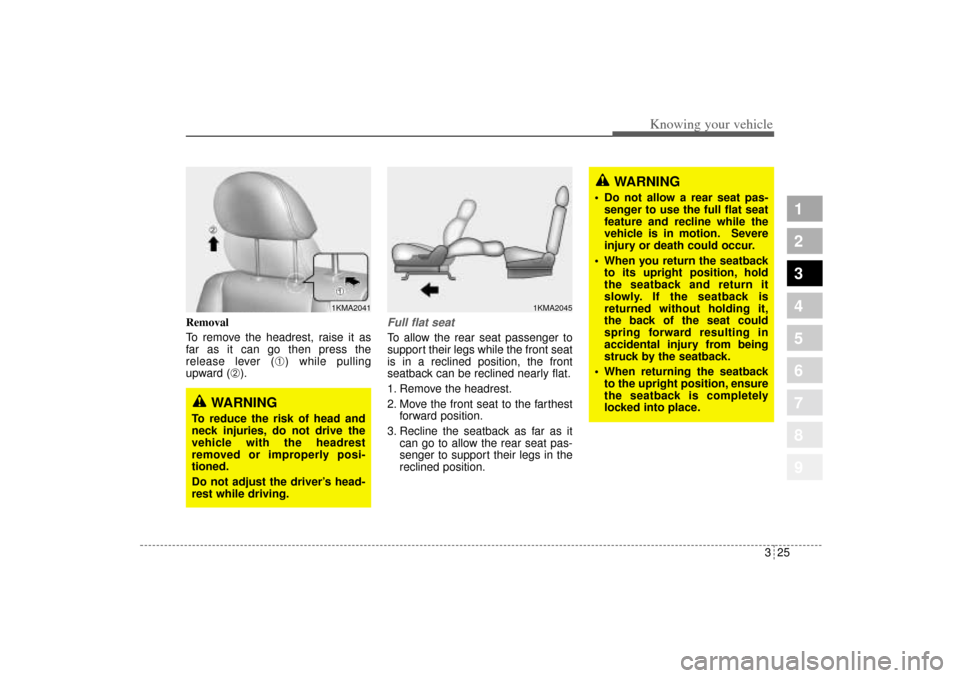
Removal
To remove the headrest, raise it as
far as it can go then press the
release lever (
➀) while pulling
upward (
➁).
Full flat seatTo allow the rear seat passenger to
support their legs while the front seat
is in a reclined position, the front
seatback can be reclined nearly flat.
1. Remove the headrest.
2. Move the front seat to the farthest
forward position.
3. Recline the seatback as far as it
can go to allow the rear seat pas-
senger to support their legs in the
reclined position.
1KMA2041
WARNING
To reduce the risk of head and
neck injuries, do not drive the
vehicle with the headrest
removed or improperly posi-
tioned.
Do not adjust the driver’s head-
rest while driving.
1KMA2045
WARNING
Do not allow a rear seat pas-
senger to use the full flat seat
feature and recline while the
vehicle is in motion. Severe
injury or death could occur.
When you return the seatback
to its upright position, hold
the seatback and return it
slowly. If the seatback is
returned without holding it,
the back of the seat could
spring forward resulting in
accidental injury from being
struck by the seatback.
When returning the seatback
to the upright position, ensure
the seatback is completely
locked into place.
KM CAN (ENG) 3 (~57).qxd 9/13/2004 4:49 PM Page 25
Page 37 of 354
Knowing your vehicle26 3
1
2
3
4
5
6
7
8
9
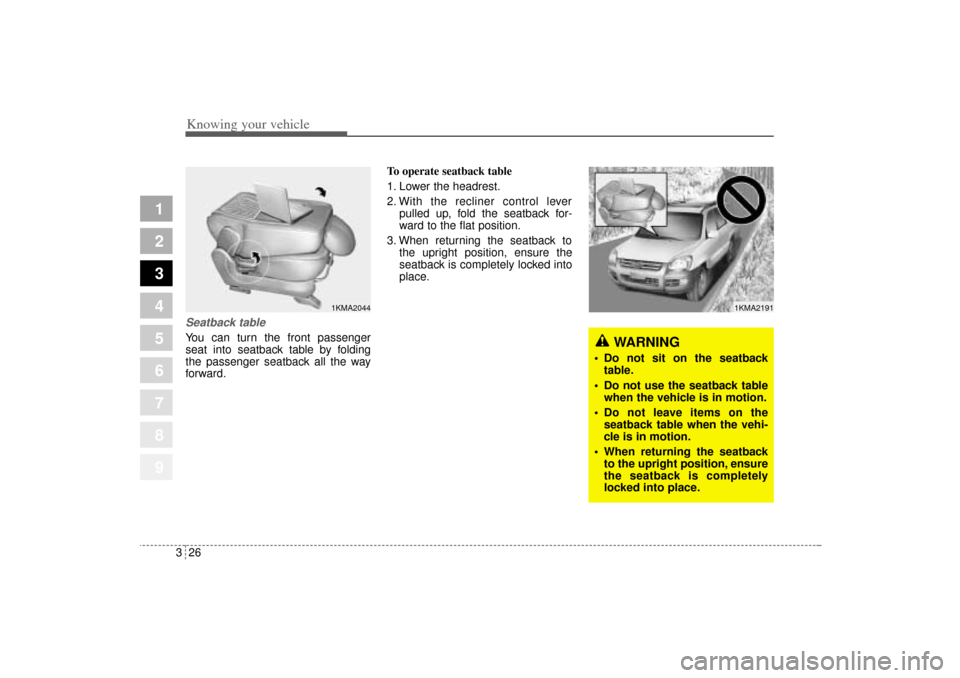
Seatback tableYou can turn the front passenger
seat into seatback table by folding
the passenger seatback all the way
forward.To operate seatback table
1. Lower the headrest.
2. With the recliner control lever
pulled up, fold the seatback for-
ward to the flat position.
3. When returning the seatback to
the upright position, ensure the
seatback is completely locked into
place.
1KMA2044
1KMA2191
WARNING
Do not sit on the seatback
table.
Do not use the seatback table
when the vehicle is in motion.
Do not leave items on the
seatback table when the vehi-
cle is in motion.
When returning the seatback
to the upright position, ensure
the seatback is completely
locked into place.
KM CAN (ENG) 3 (~57).qxd 9/13/2004 4:49 PM Page 26
Page 38 of 354
327
Knowing your vehicle
1
2
3
4
5
6
7
8
9
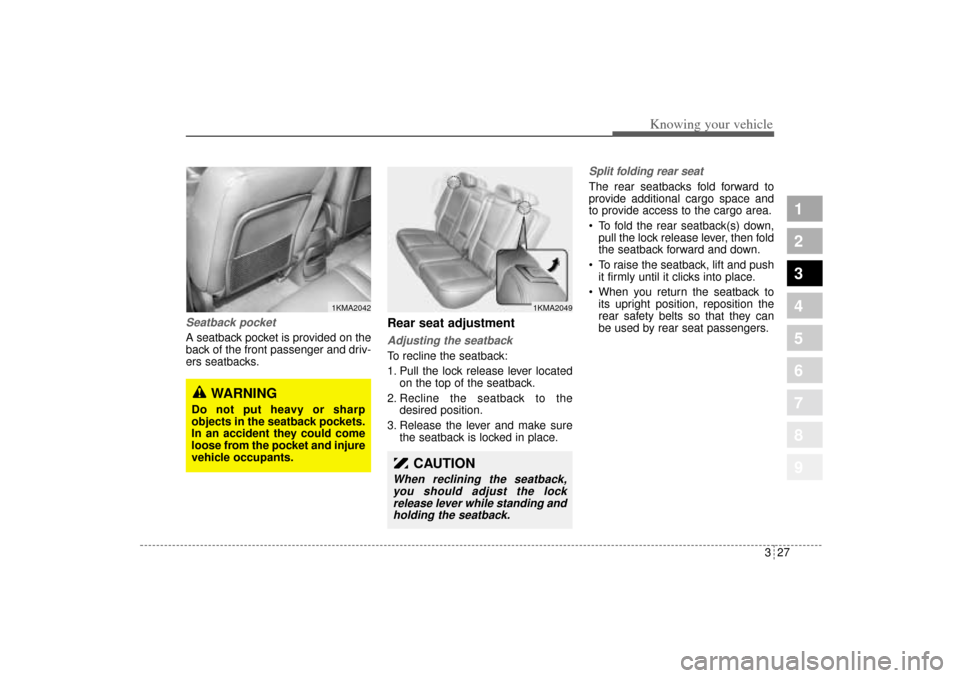
Seatback pocketA seatback pocket is provided on the
back of the front passenger and driv-
ers seatbacks.
Rear seat adjustmentAdjusting the seatback To recline the seatback:
1. Pull the lock release lever located
on the top of the seatback.
2. Recline the seatback to the
desired position.
3. Release the lever and make sure
the seatback is locked in place.
Split folding rear seat The rear seatbacks fold forward to
provide additional cargo space and
to provide access to the cargo area.
To fold the rear seatback(s) down,
pull the lock release lever, then fold
the seatback forward and down.
To raise the seatback, lift and push
it firmly until it clicks into place.
When you return the seatback to
its upright position, reposition the
rear safety belts so that they can
be used by rear seat passengers.
1KMA2042
WARNING
Do not put heavy or sharp
objects in the seatback pockets.
In an accident they could come
loose from the pocket and injure
vehicle occupants.
1KMA2049
CAUTION
When reclining the seatback,
you should adjust the lock
release lever while standing and
holding the seatback.
KM CAN (ENG) 3 (~57).qxd 9/13/2004 4:49 PM Page 27
Page 39 of 354
Knowing your vehicle28 3
1
2
3
4
5
6
7
8
9
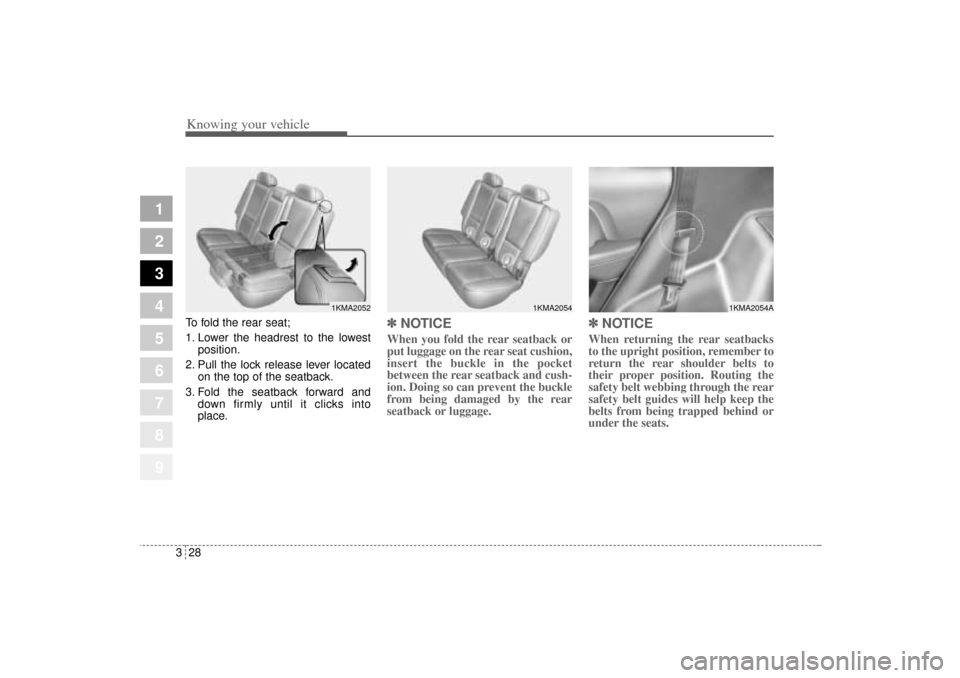
To fold the rear seat;
1. Lower the headrest to the lowest
position.
2. Pull the lock release lever located
on the top of the seatback.
3. Fold the seatback forward and
down firmly until it clicks into
place.
✽ ✽
NOTICEWhen you fold the rear seatback or
put luggage on the rear seat cushion,
insert the buckle in the pocket
between the rear seatback and cush-
ion. Doing so can prevent the buckle
from being damaged by the rear
seatback or luggage.
✽ ✽
NOTICEWhen returning the rear seatbacks
to the upright position, remember to
return the rear shoulder belts to
their proper position. Routing the
safety belt webbing through the rear
safety belt guides will help keep the
belts from being trapped behind or
under the seats.
1KMA2052
1KMA2054
1KMA2054A
KM CAN (ENG) 3 (~57).qxd 9/13/2004 4:49 PM Page 28
Page 40 of 354
329
Knowing your vehicle
1
2
3
4
5
6
7
8
9
To unfold the rear seat;
1. Pull the lock release lever located
on the top of the seatback.
2. Lift and push the seatback back-
ward firmly until it clicks into place.
Make sure the seatback is locked
in place.
3. Return the rear safety belt to the
proper position.
WARNING
- Cargo
Cargo should always be
secured to prevent it from being
thrown about the vehicle in a
collision and causing injury to
the vehicle occupants.
CAUTION
Make sure the engine is off,
the transaxle is in P and the
parking brake is applied
whenever loading or unload-
ing cargo. Vehicle may move if
shift lever is inadvertently
moved to another position.
When cargo is loaded through
the rear passenger seats,
ensure the cargo is properly
secured to prevent it from
moving while driving.
Unsecured cargo in the pas-
senger compartment can
cause damage to the vehicle
or injury to it’s occupants.
CAUTION
When returning the rear seat-
backs to the upright position,
remember to return the rear
shoulder belts to their proper
position.
Do not remove the floor carpet
in your vehicle. Emission con-
trol system components
cause high exhaust tempera-
tures under the floor.
KM CAN (ENG) 3 (~57).qxd 9/13/2004 4:49 PM Page 29
Page 45 of 354
Knowing your vehicle34 3
1
2
3
4
5
6
7
8
9
Safety belt restraint system
We strongly recommend that the
driver and all passengers be proper-
ly restrained at all times by using the
safety belts provided with the vehi-
cle. Proper use of the safety belts
decreases the risk of severe injury or
death in accidents or sudden stops.
In most states, and in Canada, the
law requires their use.
All seats have lap/shoulder belts.
Inertial locks in the safety belt retrac-
tors allow all of the lap/shoulder safe-
ty belts to remain unlocked during
normal vehicle operation. This allows
the occupants some freedom of
movement and increased comfort
while using the safety belts. If a force
is applied to the vehicle, such as a
strong stop, a sharp turn, or a colli-
sion, the safety belt retractors will
automatically lock the safety belts.Since the inertial locks do not require
a collision in order to lock up, you
may become aware of the safety
belts locking while braking or going
around sharp corners.
Always use the rear seat position(s)
to install your child restraint(s).
Never install a child restraint system
in the front passenger position, as an
inflating airbag could cause serious
or fatal injury to a child in that posi-
tion.
WARNING
- Safety belts
To minimize the risk of serious
or fatal injury in an accident, the
driver and all passengers
should use the appropriate
safety restraints for their age
and size. The presence of
airbags does not change the
need to be properly restrained
by a safety belt or size-appropri-
ate child restraint. In fact,
airbags are designed to work
the best when passengers are
correctly restrained in the vehi-
cle. Be sure you are familiar
with the information in this sec-
tion, including the information
on infant and child restraints.
Read the safety warnings on the
sun visors of your vehicle also.
KM CAN (ENG) 3 (~57).qxd 9/13/2004 4:49 PM Page 34
Page 46 of 354
335
Knowing your vehicle
1
2
3
4
5
6
7
8
9
The rear safety belts use a special
auto-lock feature designed to allow a
child restraint to be used in these
positions without an added locking
clip. They normally lock only under
extreme or emergency conditions
(emergency lock mode). However
they can be adjusted so that they
remain in fixed and locked when a
child restraint system is placed in
these positions. (Use this auto-lock
mode only to secure a child restraint,
never for passengers restrained by
the safety belts.) Page 3-49 gives
instructions on placing the safety belt
in the auto lock mode.
The drivers safety belt can only oper-
ate in the emergency lock mode.Safety belts provide the best restraint
when:
The seatback is upright.
The occupant is sitting upright (not
slouched).
The lap belt is snug across the hips.
The shoulder belt is snug across
the chest.
The knees are straight forward.
To help you remember to fasten your
safety belt, a warning light will blink.
See “Safety belt warning light and
chime” on page 3-36.
WARNING
- After a colli-
sion
Lap/shoulder belt assemblies
may be stretched or damaged
when subjected to the stress
and forces of a collision.
The entire restraint system
should be inspected following
any collision. All belts, retrac-
tors, anchors and hardware
damaged by a collision should
be replaced before the vehicle
is operated again.
WARNING -
Cargo area
Passengers should never be
allowed to ride in the cargo area
of a vehicle. No safety belts are
provided for the cargo area.
Persons riding in the vehicle
without a fastened safety belt
are much more likely to suffer
serious bodily injury or death
during an accident.
KM CAN (ENG) 3 (~57).qxd 9/13/2004 4:49 PM Page 35
Page 49 of 354
Knowing your vehicle38 3
1
2
3
4
5
6
7
8
9
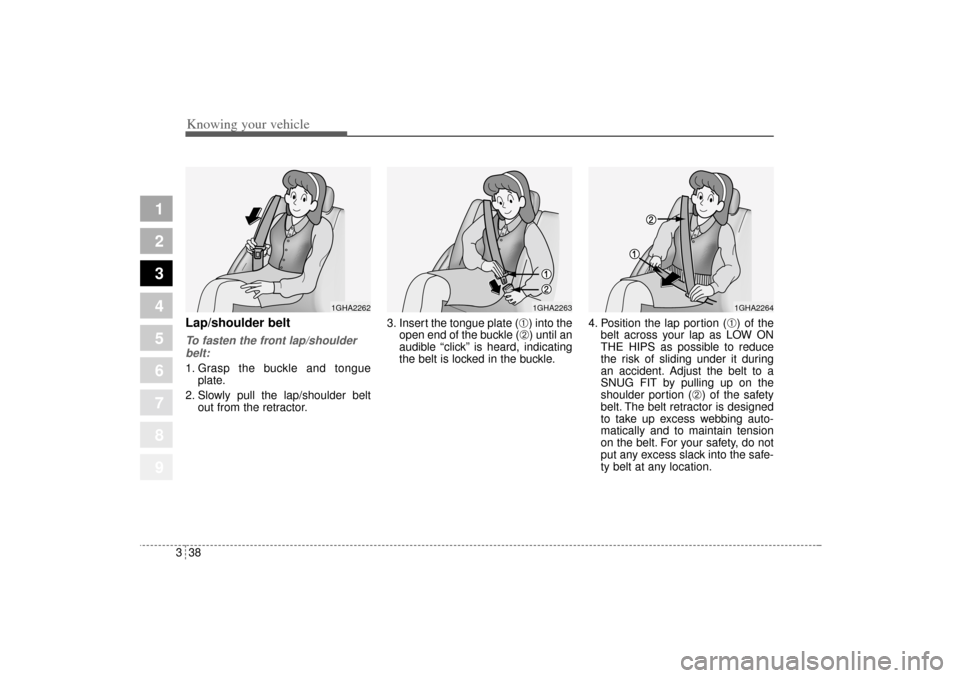
Lap/shoulder beltTo fasten the front lap/shoulder
belt:1. Grasp the buckle and tongue
plate.
2. Slowly pull the lap/shoulder belt
out from the retractor.3. Insert the tongue plate (
➀) into the
open end of the buckle (➁) until an
audible “click” is heard, indicating
the belt is locked in the buckle.4. Position the lap portion (
➀) of the
belt across your lap as LOW ON
THE HIPS as possible to reduce
the risk of sliding under it during
an accident. Adjust the belt to a
SNUG FIT by pulling up on the
shoulder portion (
➁) of the safety
belt. The belt retractor is designed
to take up excess webbing auto-
matically and to maintain tension
on the belt. For your safety, do not
put any excess slack into the safe-
ty belt at any location.
1GHA2263
1GHA2264
1GHA2262
KM CAN (ENG) 3 (~57).qxd 9/13/2004 4:49 PM Page 38
Page 50 of 354
339
Knowing your vehicle
1
2
3
4
5
6
7
8
9
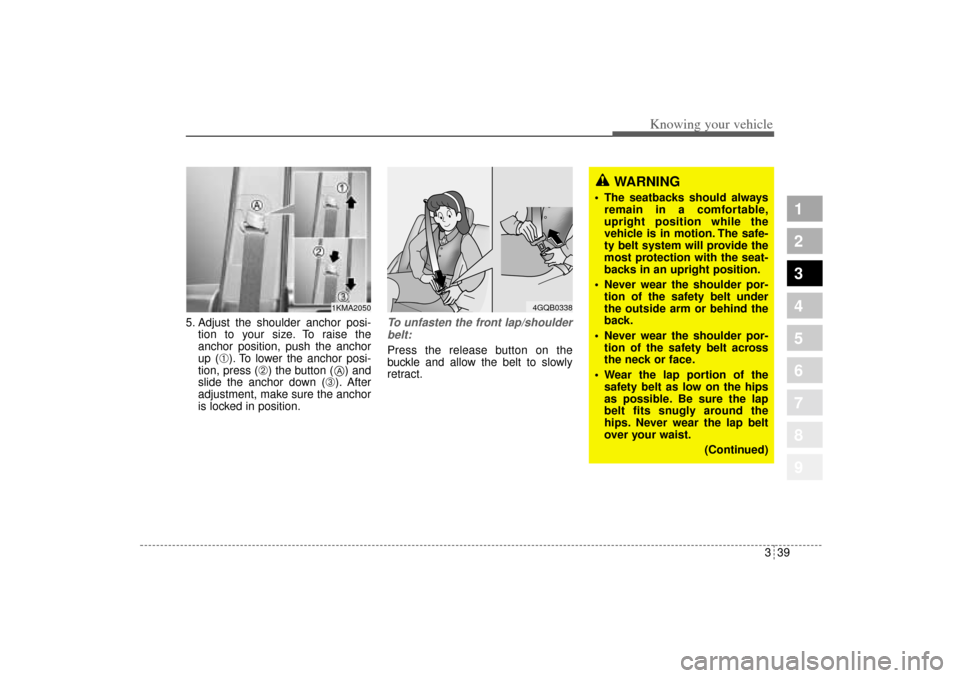
5. Adjust the shoulder anchor posi-
tion to your size. To raise the
anchor position, push the anchor
up (
➀). To lower the anchor posi-
tion, press (
➁) the button ( ) and
slide the anchor down (
➂). After
adjustment, make sure the anchor
is locked in position.
To unfasten the front lap/shoulder
belt:Press the release button on the
buckle and allow the belt to slowly
retract.
4GQB0338
WARNING
The seatbacks should always
remain in a comfortable,
upright position while the
vehicle is in motion. The safe-
ty belt system will provide the
most protection with the seat-
backs in an upright position.
Never wear the shoulder por-
tion of the safety belt under
the outside arm or behind the
back.
Never wear the shoulder por-
tion of the safety belt across
the neck or face.
Wear the lap portion of the
safety belt as low on the hips
as possible. Be sure the lap
belt fits snugly around the
hips. Never wear the lap belt
over your waist.
(Continued)
1KMA2050A
KM CAN (ENG) 3 (~57).qxd 9/13/2004 4:49 PM Page 39
Page 51 of 354
Knowing your vehicle40 3
1
2
3
4
5
6
7
8
9
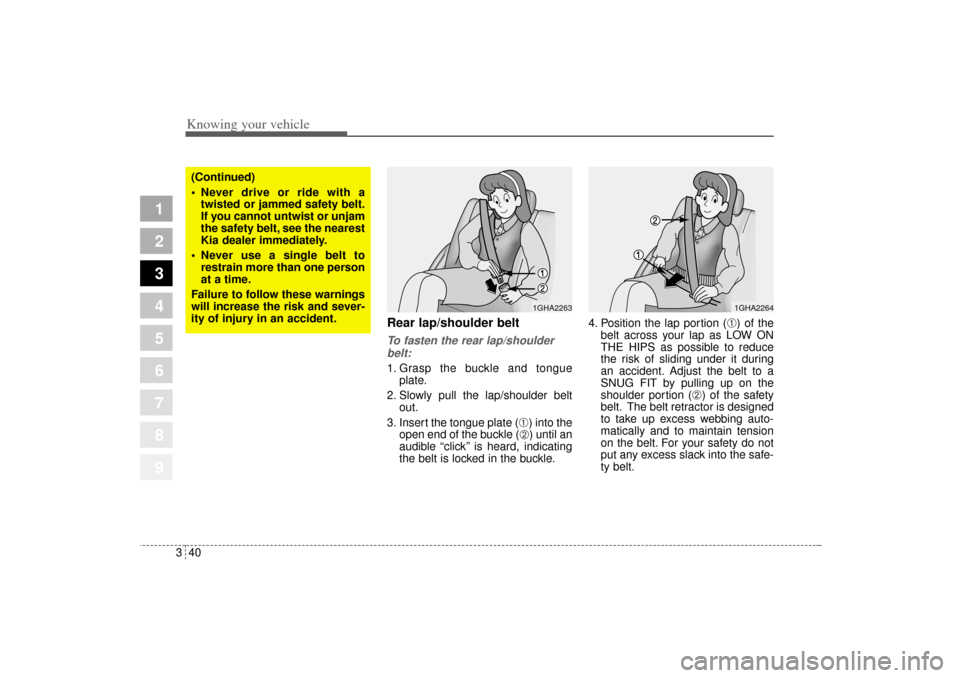
Rear lap/shoulder belt To fasten the rear lap/shoulder
belt:1. Grasp the buckle and tongue
plate.
2. Slowly pull the lap/shoulder belt
out.
3. Insert the tongue plate (
➀) into the
open end of the buckle (➁) until an
audible “click’’ is heard, indicating
the belt is locked in the buckle.4. Position the lap portion (
➀) of the
belt across your lap as LOW ON
THE HIPS as possible to reduce
the risk of sliding under it during
an accident. Adjust the belt to a
SNUG FIT by pulling up on the
shoulder portion (
➁) of the safety
belt. The belt retractor is designed
to take up excess webbing auto-
matically and to maintain tension
on the belt. For your safety do not
put any excess slack into the safe-
ty belt.
1GHA2263
1GHA2264
(Continued)
Never drive or ride with a
twisted or jammed safety belt.
If you cannot untwist or unjam
the safety belt, see the nearest
Kia dealer immediately.
Never use a single belt to
restrain more than one person
at a time.
Failure to follow these warnings
will increase the risk and sever-
ity of injury in an accident.
KM CAN (ENG) 3 (~57).qxd 9/13/2004 4:49 PM Page 40