ece KIA SPORTAGE 2020 Owners Manual
[x] Cancel search | Manufacturer: KIA, Model Year: 2020, Model line: SPORTAGE, Model: KIA SPORTAGE 2020Pages: 624, PDF Size: 15.41 MB
Page 586 of 624
Maintenance
96
7
Finish damage repair
Deep scratches or stone chips in the
painted surface must be repaired
promptly. Exposed metal will quickly
rust and may develop into a major
repair expense.
If your vehicle is damaged and
requires any metal repair or replace-
ment, be sure the body shop applies
anti-corrosion materials to the parts
repaired or replaced.
Bright-metal maintenance
To remove road tar and insects,
use a tar remover, not a scraper or
other sharp object.
To protect the surfaces of bright- metal parts from corrosion, apply a
coating of wax or chrome preser-
vative and rub to a high luster.
During winter weather or in coastal areas, cover the bright metal parts
with a heavier coating of wax or
preservative. If necessary, coat the
parts with non-corrosive petroleum
jelly or other protective compound.
Underbody maintenance
Road salt and other corrosive chemi-
cals are used in cold weather states to
melt snow and prevent ice accumula-
tion. If these chemicals are not regu-
larly removed, they will corrode the
vehicle underbody and over time dam-
age fuel lines, the fuel tank retention
system, the vehicle suspension, the
exhaust system, and even the body
frame. The National Highway Traffic
Safety Administration has warned all
vehicle owners of all brands of the
need to take the following steps:
Wash the undercarriage of yourvehicle regularly during the winter
and whenever your vehicle has
been exposed to such salts or
chemicals.CAUTION - Drying vehicle
Wiping dust or dirt off the body with a dry cloth willscratch the finish.
Do not use steel wool, abra- sive cleaners, acid detergentsor strong detergents contain-ing high alkaline or causticagents on chrome-plated oranodized aluminum parts.This may result in damage tothe protective coating andcause discoloration or paintdeterioration.
Page 589 of 624
799
Maintenance
When cleaning lower door panels,rocker panels and frame members,
be sure that drain holes are kept
open so that moisture can escape
and not be trapped inside to accel-
erate corrosion.
Keep your garage dry
Don't park your vehicle in a damp,
poorly ventilated garage. This cre-
ates a favorable environment for cor-
rosion. This is particularly true if you
wash your vehicle in the garage or
drive it into the garage when it is still
wet or covered with snow, ice or
mud. Even a heated garage can con-
tribute to corrosion unless it is well
ventilated so moisture is dispersed. Keep paint and trim in good con-
dition
Scratches or chips in the finish
should be covered with "touch-up"
paint as soon as possible to reduce
the possibility of corrosion. If bare
metal is showing through, the atten-
tion of a qualified body and paint
shop is recommended.
Bird droppings : Bird droppings are
highly corrosive and may damage
painted surfaces in just a few hours.
Always remove bird droppings as
soon as possible.
Don't neglect the interior
Moisture can collect under the floor
mats and carpeting and cause corro-
sion. Check under the mats periodi-
cally to be sure the carpeting is dry.
Use particular care if you carry fertil-
izers, cleaning materials or chemi-
cals in the vehicle.
These should be carried only in prop-
er containers and any spills or leaks
should be cleaned up, flushed with
clean water and thoroughly dried.Interior care
Interior general precautions
Prevent chemicals such as perfume,
cosmetic oil, sun cream, hand clean-
er, and air freshener from contacting
the interior parts because they may
cause damage or discoloration. If
they do contact the interior parts,
wipe them off immediately. If neces-
sary, use a vinyl cleaner, see product
instructions for correct usage.
CAUTION - Electrical
components
Never allow water or other liq-
uids to come in contact withelectrical/electronic compo-nents inside the vehicle as thismay damage them.
Page 591 of 624
7101
Maintenance
Fabric seat cover (If equipped)
Please clean the fabric seats regu-
larly with a vacuum cleaner in con-
sideration of fabric material charac-
teristics. If they are heavily soiled
with beverage stains, etc., use a suit-
able interior cleaner. To prevent dam-
age to seat covers, wipe off the seat
covers down to the seams with a
large wiping motion and moderate
pressure using a soft sponge or
microfiber cloth.
Velcro closures on clothing or sharp
objects may cause snagging or
scratches on the surface of the
seats.
Make sure not to rub such objects
against the surface.
Cleaning the upholstery and inte-rior trim
Vinyl
Remove dust and loose dirt from
vinyl with a whisk broom or vacuum
cleaner. Clean vinyl surfaces with a
vinyl cleaner.
Fabric
Remove dust and loose dirt from fab-
ric with a whisk broom or vacuum
cleaner. Clean with a mild soap solu-
tion recommended for upholstery or
carpets. Remove fresh spots imme-
diately with a fabric spot cleaner. If
fresh spots do not receive immediate
attention, the fabric can be stained
and its color can be affected. Also, its
fire-resistant properties can be
reduced if the material is not proper-
ly maintained.
Using anything but recommended
cleaners and procedures may affect
the fabric’s appearance and fire-
resistant properties.
Cleaning the lap/shoulder beltwebbing
Clean the belt webbing with any mild
soap solution recommended for
cleaning upholstery or carpet. Follow
the instructions provided with the
soap. Do not bleach or re-dye the
webbing because this may weaken it.
Cleaning the interior windowglass
If the interior glass surfaces of the
vehicle become fogged (that is, cov-
ered with an oily, greasy or waxy
film), they should be cleaned with a
glass cleaner. Follow the directions
on the glass cleaner container.
CAUTION- Rear window
Do not scrape or scratch theinside of the rear window. Thismay result in damage of the rearwindow defroster grid.
Page 594 of 624
Maintenance
104
7
Do not operate the engine in con-
fined or closed areas (such as
garages) any more than what is
necessary to move the vehicle in or
out of the area.
When the vehicle is stopped in an open area for more than a short
time with the engine running,
adjust the ventilation system (as
needed) to draw outside air into the
vehicle.
Never sit in a parked or stopped vehicle for any extended time with
the engine running.
When the engine stalls or fails to start, excessive attempts to restart
the engine may cause damage to
the emission control system.Operating precautions for catalyt-
ic converters (if equipped)
WARNING- Catalytic converter
Keep away from the catalytic
converter and exhaust system
while the vehicle is running or
immediately thereafter. The
exhaust and catalytic systems
are very hot and may burn you.
WARNING- Fire
Do not park, idle or drive the vehicle over or near flamma-
ble objects, such as grass,
vegetation, paper, leaves, etc.
A hot exhaust system can
ignite flammable items under
your vehicle.
Also, do not remove the heat sink around the exhaust sys-
tem, do not seal the bottom of
the vehicle or do not coat the
vehicle for corrosion control.
It may present a fire risk under
certain conditions.
Page 601 of 624
Specifications, Consumer information, Reporting safety defects
68
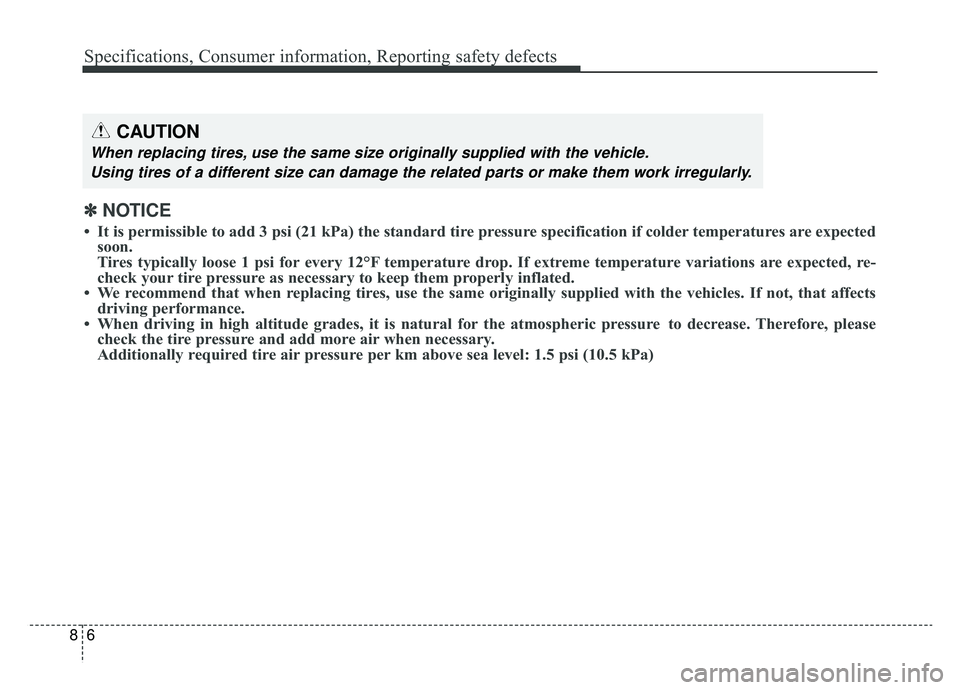
CAUTION
When replacing tires, use the same size originally supplied with the vehicle.Using tires of a different size can damage the related parts or make them work irregularly.
✽ ✽ NOTICE
• It is permissible to add 3 psi (21 kPa) the standard tire pressure specification if colder temperatures are expected
soon.
Tires typically loose 1 psi for every 12°F temperature drop. If extreme temperature variations are expected, re-
check your tire pressure as necessary to keep them properly inflated.
• We recommend that when replacing tires, use the same originally supplied with the vehicles. If not, that aff\
ects driving performance.
• When driving in high altitude grades, it is natural for the atmospheric pressure to decrease. Therefore, please check the tire pressure and add more air when necessary.
Additionally required tire air pressure per km above sea level: 1.5 psi (10.5 kPa)
Page 604 of 624
89
Specifications, Consumer information, Reporting safety defects
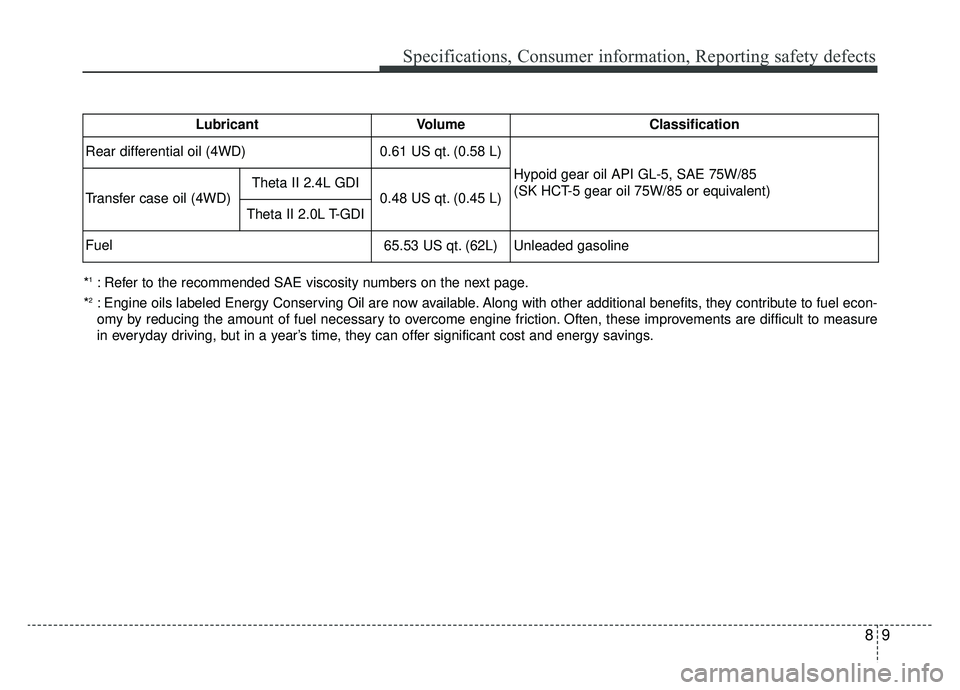
*1: Refer to the recommended SAE viscosity numbers on the next page.
*
2: Engine oils labeled Energy Conserving Oil are now available. Along with other additional benefits, they contribute to fuel econ-
omy by reducing the amount of fuel necessary to overcome engine friction. Often, these improvements are difficult to measure
in everyday driving, but in a year’s time, they can offer significant cost and energy savings. Lubricant
Volume
Classification
Rear differential oil (4WD)
0.61 US qt. (0.58 L) Hypoid gear oil API GL-5, SAE 75W/85
(SK HCT-5 gear oil 75W/85 or equivalent)
Transfer case oil (4WD) Theta II 2.4L GDI
0.48 US qt. (0.45 L)
Theta II 2.0L T-GDI
Fuel
65.53 US qt. (62L) Unleaded gasoline
Page 609 of 624
Specifications, Consumer information, Reporting safety defects
14
8
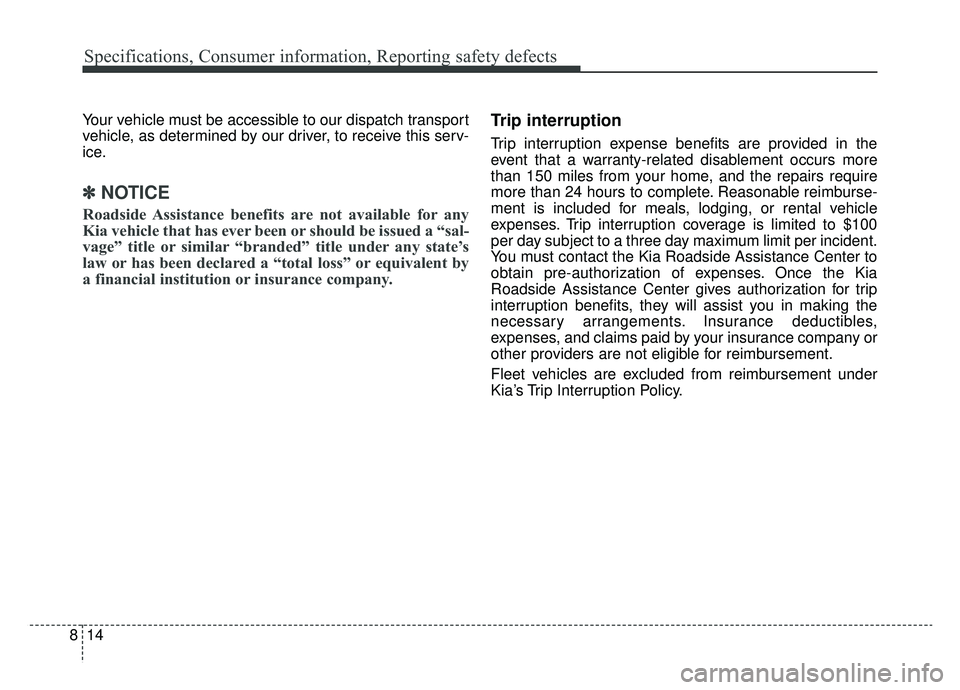
Your vehicle must be accessible to our dispatch transport
vehicle, as determined by our driver, to receive this serv-
ice.
✽ ✽
NOTICE
Roadside Assistance benefits are not available for any
Kia vehicle that has ever been or should be issued a “sal-
vage” title or similar “branded” title under any state’s
law or has been declared a “total loss” or equivalent by
a financial institution or insurance company.
Trip interruption
Trip interruption expense benefits are provided in the
event that a warranty-related disablement occurs more
than 150 miles from your home, and the repairs require
more than 24 hours to complete. Reasonable reimburse-
ment is included for meals, lodging, or rental vehicle
expenses. Trip interruption coverage is limited to $100
per day subject to a three day maximum limit per incident.
You must contact the Kia Roadside Assistance Center to
obtain pre-authorization of expenses. Once the Kia
Roadside Assistance Center gives authorization for trip
interruption benefits, they will assist you in making the
necessary arrangements. Insurance deductibles,
expenses, and claims paid by your insurance company or
other providers are not eligible for reimbursement.
Fleet vehicles are excluded from reimbursement under
Kia’s Trip Interruption Policy.
Page 610 of 624
815
Specifications, Consumer information, Reporting safety defects
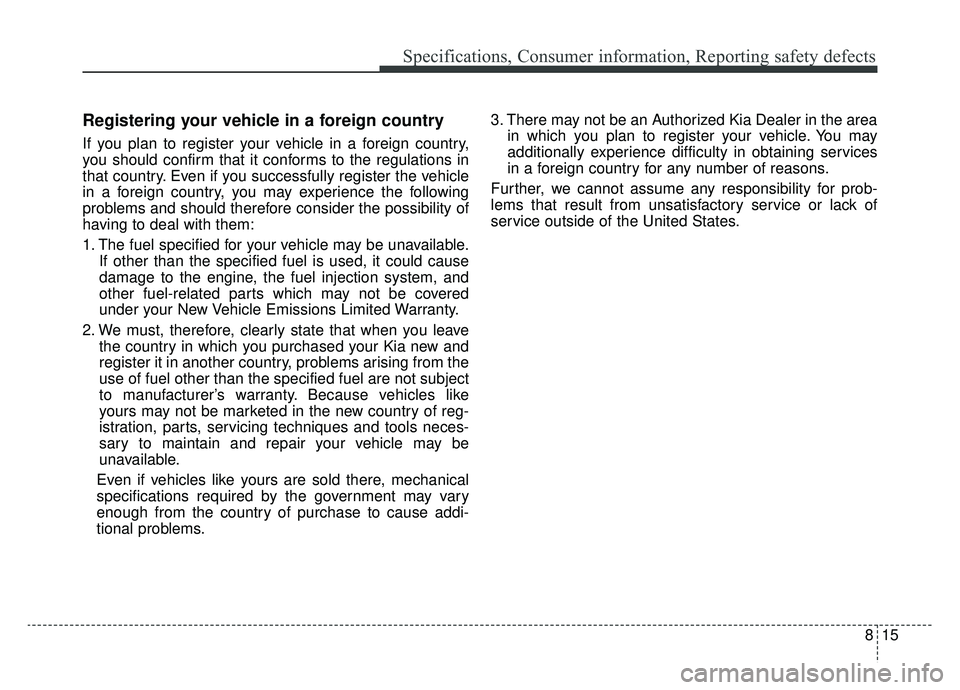
Registering your vehicle in a foreign country
If you plan to register your vehicle in a foreign country,
you should confirm that it conforms to the regulations in
that country. Even if you successfully register the vehicle
in a foreign country, you may experience the following
problems and should therefore consider the possibility of
having to deal with them:
1. The fuel specified for your vehicle may be unavailable.If other than the specified fuel is used, it could cause
damage to the engine, the fuel injection system, and
other fuel-related parts which may not be covered
under your New Vehicle Emissions Limited Warranty.
2. We must, therefore, clearly state that when you leave the country in which you purchased your Kia new and
register it in another country, problems arising from the
use of fuel other than the specified fuel are not subject
to manufacturer’s warranty. Because vehicles like
yours may not be marketed in the new country of reg-
istration, parts, servicing techniques and tools neces-
sary to maintain and repair your vehicle may be
unavailable.
Even if vehicles like yours are sold there, mechanical
specifications required by the government may vary
enough from the country of purchase to cause addi-
tional problems. 3. There may not be an Authorized Kia Dealer in the area
in which you plan to register your vehicle. You may
additionally experience difficulty in obtaining services
in a foreign country for any number of reasons.
Further, we cannot assume any responsibility for prob-
lems that result from unsatisfactory service or lack of
service outside of the United States.
Page 612 of 624
817
Specifications, Consumer information, Reporting safety defects
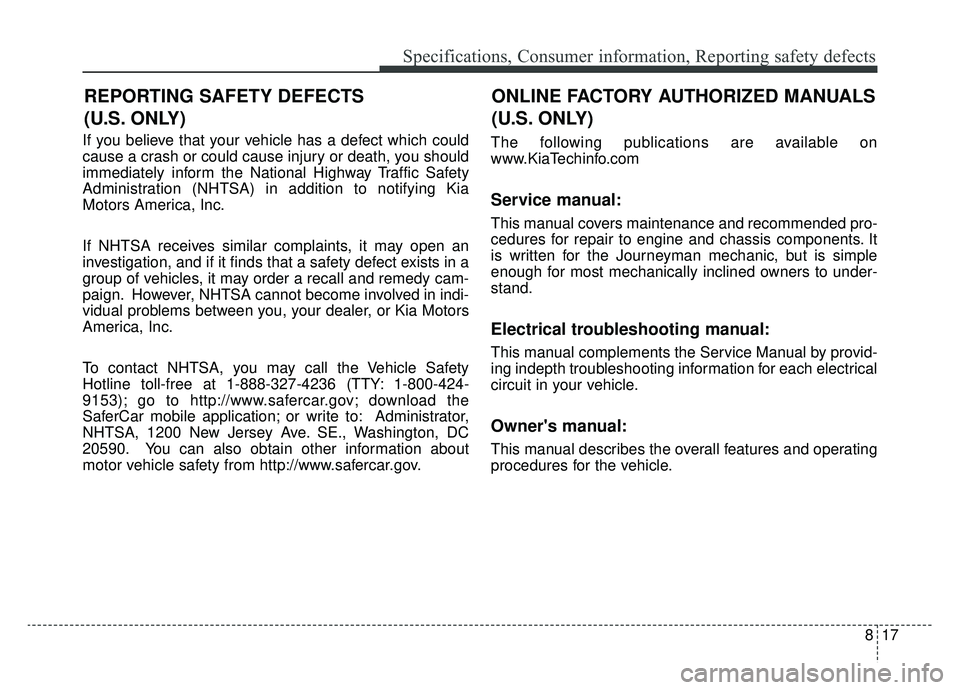
If you believe that your vehicle has a defect which could
cause a crash or could cause injury or death, you should
immediately inform the National Highway Traffic Safety
Administration (NHTSA) in addition to notifying Kia
Motors America, Inc.
If NHTSA receives similar complaints, it may open an
investigation, and if it finds that a safety defect exists in a
group of vehicles, it may order a recall and remedy cam-
paign. However, NHTSA cannot become involved in indi-
vidual problems between you, your dealer, or Kia Motors
America, Inc.
To contact NHTSA, you may call the Vehicle Safety
Hotline toll-free at 1-888-327-4236 (TTY: 1-800-424-
9153); go to http://www.safercar.gov; download the
SaferCar mobile application; or write to: Administrator,
NHTSA, 1200 New Jersey Ave. SE., Washington, DC
20590. You can also obtain other information about
motor vehicle safety from http://www.safercar.gov.The following publications are available on
www.KiaTechinfo.com
Service manual:
This manual covers maintenance and recommended pro-
cedures for repair to engine and chassis components. It
is written for the Journeyman mechanic, but is simple
enough for most mechanically inclined owners to under-
stand.
Electrical troubleshooting manual:
This manual complements the Service Manual by provid-
ing indepth troubleshooting information for each electrical
circuit in your vehicle.
Owner's manual:
This manual describes the overall features and operating
procedures for the vehicle.
REPORTING SAFETY DEFECTS
(U.S. ONLY)
ONLINE FACTORY AUTHORIZED MANUALS
(U.S. ONLY)
Page 614 of 624
Index
2I
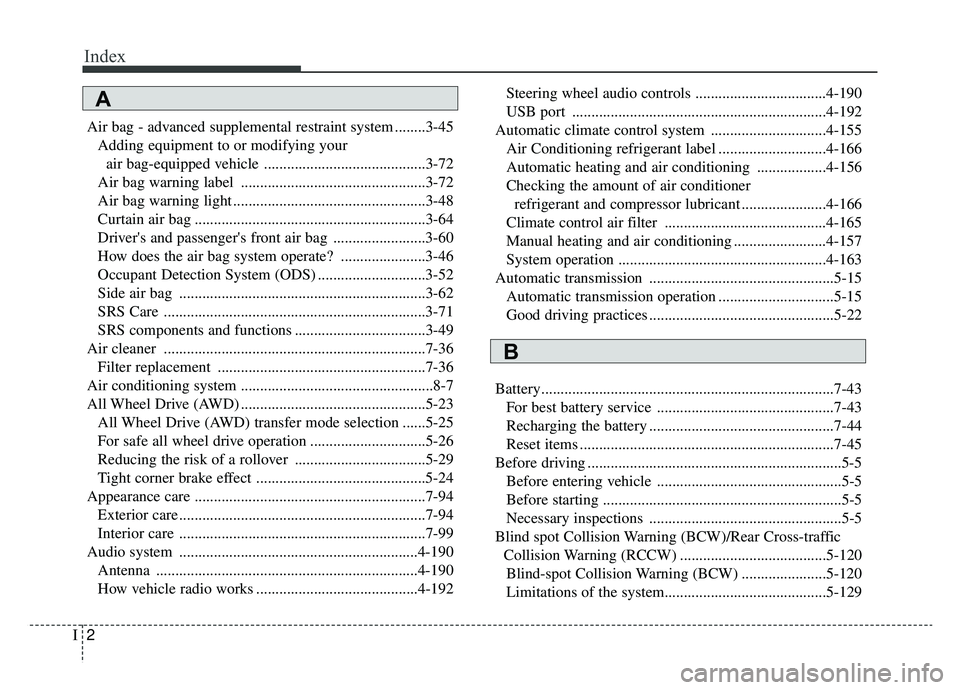
Air bag - advanced supplemental restraint system ........3-45Adding equipment to or modifying your air bag-equipped vehicle ..........................................3-72
Air bag warning label ................................................3-72
Air bag warning light ..................................................3-48
Curtain air bag ............................................................3-64
Driver's and passenger's front air bag ........................3-60
How does the air bag system operate? ......................3-46
Occupant Detection System (ODS) ............................3-52
Side air bag ................................................................3-62
SRS Care ....................................................................3-71\
SRS components and functions ..................................3-49
Air cleaner ....................................................................7-36\
Filter replacement ......................................................7-36
Air conditioning system ..................................................8-7
All Wheel Drive (AWD) ................................................5-23 All Wheel Drive (AWD) transfer mode selection ......5-25
For safe all wheel drive operation ..............................5-26
Reducing the risk of a rollover ..................................5-29
Tight corner brake effect ............................................5-24
Appearance care ............................................................7-94 Exterior care ................................................................7-94
Interior care ................................................................7-99
Audio system ..............................................................4-190 Antenna ....................................................................4-19\
0
How vehicle radio works ..........................................4-192 Steering wheel audio controls ..................................4-190
USB port ..................................................................4-192
Automatic climate control system ..............................4-155 Air Conditioning refrigerant label ............................4-166
Automatic heating and air conditioning ..................4-156
Checking the amount of air conditioner refrigerant and compressor lubricant ......................4-166
Climate control air filter ..........................................4-165
Manual heating and air conditioning ........................4-157
System operation ......................................................4-163
Automatic transmission ................................................5-15 Automatic transmission operation ..............................5-15
Good driving practices ................................................5-22
Battery........................................................................\
....7-43 For best battery service ..............................................7-43
Recharging the battery ................................................7-44
Reset items ..................................................................7-45
Before driving ..................................................................5-5 Before entering vehicle ................................................5-5
Before starting ..............................................................5-5
Necessary inspections ..................................................5-5
Blind spot Collision Warning (BCW)/Rear Cross-traffic Collision Warning (RCCW) ......................................5-120Blind-spot Collision Warning (BCW) ......................5-120
Limitations of the system..........................................5-129\
A
B