check engine KIA SPORTAGE 2020 Manual PDF
[x] Cancel search | Manufacturer: KIA, Model Year: 2020, Model line: SPORTAGE, Model: KIA SPORTAGE 2020Pages: 624, PDF Size: 15.41 MB
Page 554 of 624
Maintenance
64
7
If you do not have a spare, use a
fuse of the same rating from a circuityou may not need for operating thevehicle, such as the power outletfuse.
If the head lamp, turn signal lamp,
stop signal lamp, fog lamp, DRL, tail
lamp, HMSL do not work and the
fuses are not blown, check the fuse
panel in the engine compartment. If a
fuse is blown, it must be replaced.
✽ ✽ NOTICE
If the headlamp, fog lamp, turn sig-
nal lamp, or tail lamp malfunction
even without any problem to the
lamps, have the vehicle checked by
an authorized Kia dealer for assis-
tance.
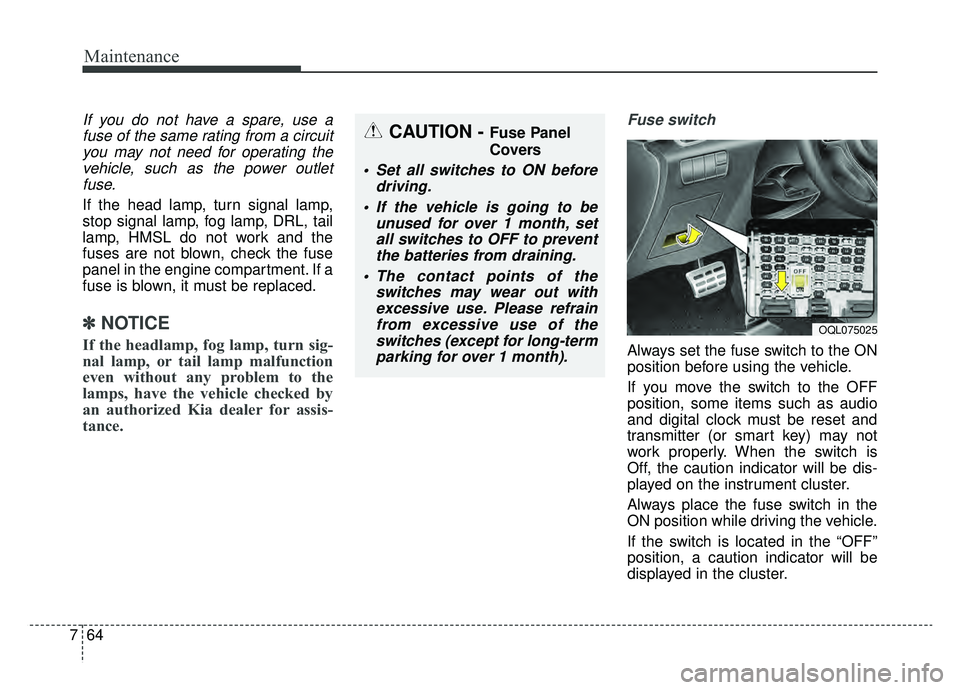
Fuse switch
Always set the fuse switch to the ON
position before using the vehicle.
If you move the switch to the OFF
position, some items such as audio
and digital clock must be reset and
transmitter (or smart key) may not
work properly. When the switch is
Off, the caution indicator will be dis-
played on the instrument cluster.
Always place the fuse switch in the
ON position while driving the vehicle.
If the switch is located in the “OFF”
position, a caution indicator will be
displayed in the cluster.
CAUTION - Fuse Panel
Covers
Set all switches to ON before
driving.
If the vehicle is going to be unused for over 1 month, setall switches to OFF to preventthe batteries from draining.
The contact points of the switches may wear out withexcessive use. Please refrainfrom excessive use of theswitches (except for long-termparking for over 1 month).
OQL075025
Page 555 of 624
765
Maintenance
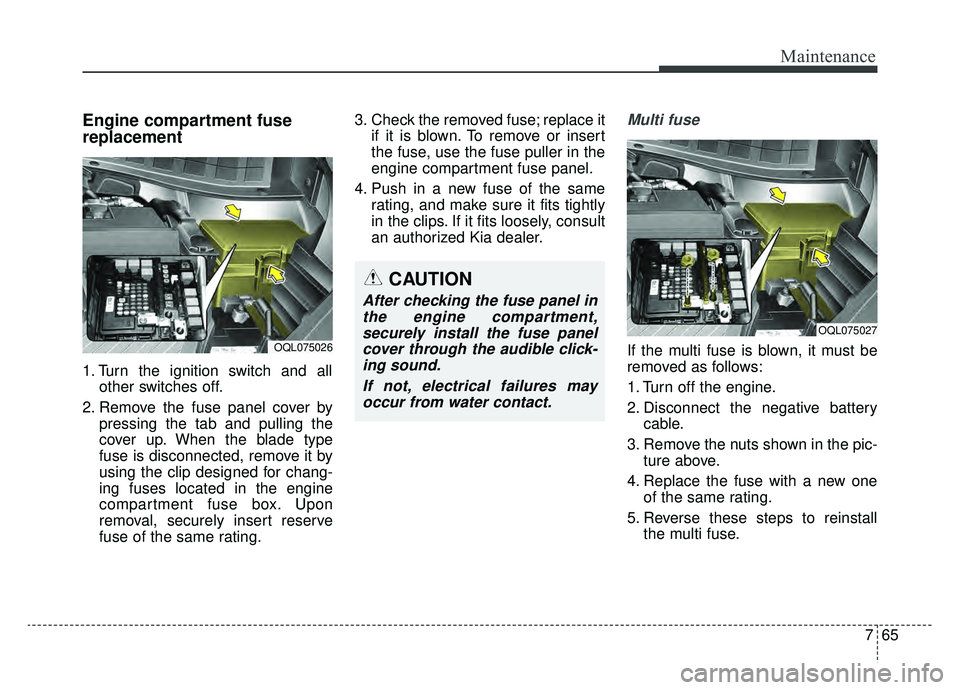
Engine compartment fuse
replacement
1. Turn the ignition switch and allother switches off.
2. Remove the fuse panel cover by pressing the tab and pulling the
cover up. When the blade type
fuse is disconnected, remove it by
using the clip designed for chang-
ing fuses located in the engine
compartment fuse box. Upon
removal, securely insert reserve
fuse of the same rating. 3. Check the removed fuse; replace it
if it is blown. To remove or insert
the fuse, use the fuse puller in the
engine compartment fuse panel.
4. Push in a new fuse of the same rating, and make sure it fits tightly
in the clips. If it fits loosely, consult
an authorized Kia dealer.
Multi fuse
If the multi fuse is blown, it must be
removed as follows:
1. Turn off the engine.
2. Disconnect the negative batterycable.
3. Remove the nuts shown in the pic- ture above.
4. Replace the fuse with a new one of the same rating.
5. Reverse these steps to reinstall the multi fuse.
CAUTION
After checking the fuse panel inthe engine compartment,securely install the fuse panelcover through the audible click-ing sound.
If not, electrical failures mayoccur from water contact.
OQL075026
OQL075027
Page 556 of 624
Maintenance
66
7
✽ ✽
NOTICE
Do not disassemble nor assemble the
multi fuse when it is secured with
nuts and bolts. Incorrect or partial
assembly torque may cause a fire.
Have the vehicle checked by an
authorized Kia dealer.
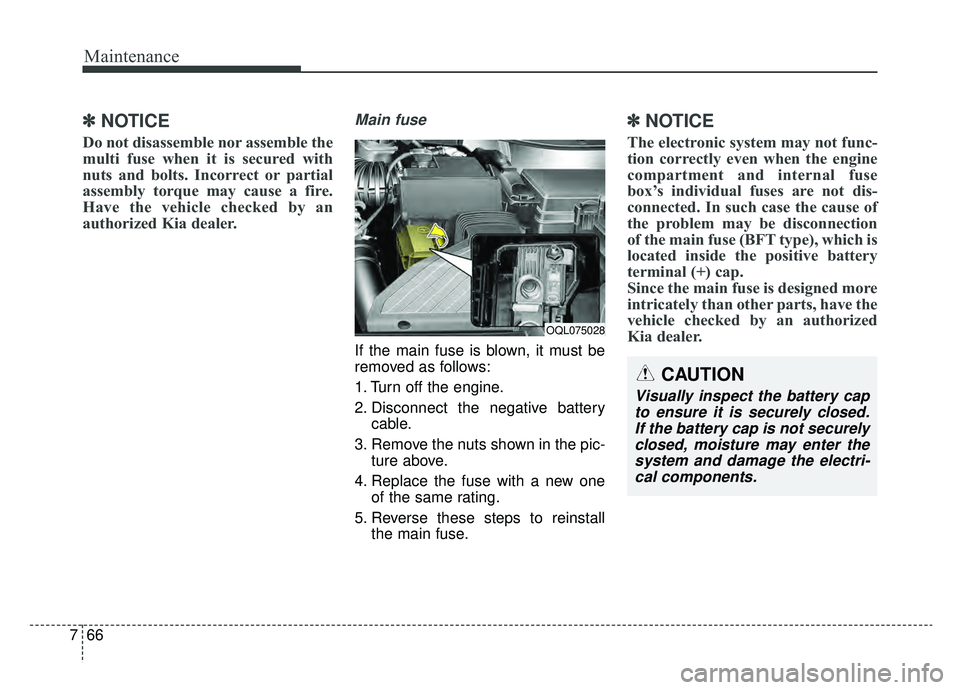
Main fuse
If the main fuse is blown, it must be
removed as follows:
1. Turn off the engine.
2. Disconnect the negative battery
cable.
3. Remove the nuts shown in the pic- ture above.
4. Replace the fuse with a new one of the same rating.
5. Reverse these steps to reinstall the main fuse.
✽ ✽NOTICE
The electronic system may not func-
tion correctly even when the engine
compartment and internal fuse
box’s individual fuses are not dis-
connected. In such case the cause of
the problem may be disconnection
of the main fuse (BFT type), which is
located inside the positive battery
terminal (+) cap.
Since the main fuse is designed more
intricately than other parts, have the
vehicle checked by an authorized
Kia dealer.
OQL075028
CAUTION
Visually inspect the battery cap
to ensure it is securely closed.If the battery cap is not securelyclosed, moisture may enter thesystem and damage the electri-cal components.
Page 593 of 624
7103
Maintenance
Canister
Fuel vapors generated inside the fuel
tank are absorbed and stored in the
onboard canister. When the engine is
running, the fuel vapors absorbed in
the canister are drawn into the surge
tank through the purge control sole-
noid valve.
Purge Control Solenoid Valve(PCSV)
The purge control solenoid valve is
controlled by the Engine Control
Module (ECM); when the engine
coolant temperature is low during
idling, the PCSV closes so that evap-
orated fuel is not taken into the
engine. After the engine warms up
during ordinary driving, the PCSV
opens to introduce evaporated fuel to
the engine.
3. Exhaust emission control system
The Exhaust Emission Control
System is a highly effective system
which controls exhaust emissions
while maintaining good vehicle per-
formance.
Engine exhaust gas precautions
(carbon monoxide)
• Carbon monoxide can be present with other exhaust fumes.
Therefore, if you smell exhaust
fumes of any kind inside your vehi-
cle, have it inspected and repaired
immediately. If you ever suspect
exhaust fumes are coming into
your vehicle, drive it only with all
the windows fully open. Have your
vehicle checked and repaired
immediately.
WARNING - Exhaust
Engine exhaust gases contain
carbon monoxide (CO). Though
colorless and odorless, it is
dangerous and could be lethal if
inhaled. Follow the instructions
on this page to avoid CO poi-
soning.
Page 616 of 624
Index
4I
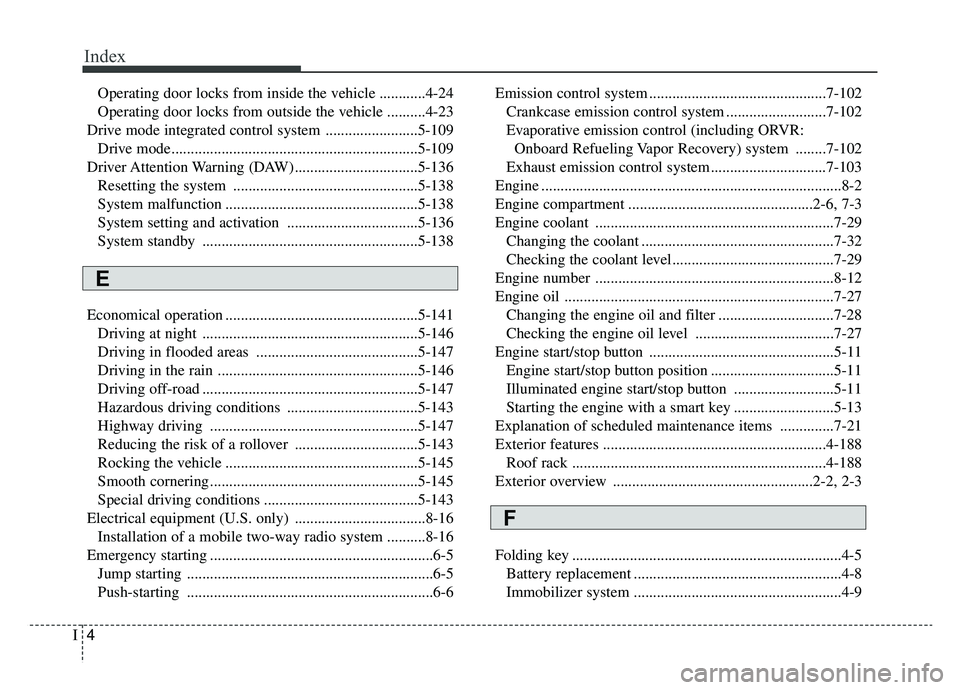
Operating door locks from inside the vehicle ............4-24
Operating door locks from outside the vehicle ..........4-23
Drive mode integrated control system ........................5-109 Drive mode................................................................5-109
Driver Attention Warning (DAW)................................5-136 Resetting the system ................................................5-138
System malfunction ..................................................5-138
System setting and activation ..................................5-136
System standby ........................................................5-138
Economical operation ..................................................5-141 Driving at night ........................................................5-146
Driving in flooded areas ..........................................5-147
Driving in the rain ....................................................5-146
Driving off-road ........................................................5-147
Hazardous driving conditions ..................................5-143
Highway driving ......................................................5-147
Reducing the risk of a rollover ................................5-143
Rocking the vehicle ..................................................5-145
Smooth cornering ......................................................5-145
Special driving conditions ........................................5-143
Electrical equipment (U.S. only) ..................................8-16 Installation of a mobile two-way radio system ..........8-16
Emergency starting ..........................................................6-5 Jump starting ................................................................6-5
Push-starting ................................................................6-6 Emission control system ..............................................7-102
Crankcase emission control system ..........................7-102
Evaporative emission control (including ORVR: Onboard Refueling Vapor Recovery) system ........7-102
Exhaust emission control system ..............................7-103
Engine ........................................................................\
......8-2
Engine compartment ................................................2-6, 7-3
Engine coolant ..............................................................7-29 Changing the coolant ..................................................7-32
Checking the coolant level..........................................7-29
Engine number ..............................................................8-12
Engine oil ......................................................................7-\
27 Changing the engine oil and filter ..............................7-28
Checking the engine oil level ....................................7-27
Engine start/stop button ................................................5-11 Engine start/stop button position ................................5-11
Illuminated engine start/stop button ..........................5-11
Starting the engine with a smart key ..........................5-13
Explanation of scheduled maintenance items ..............7-21
Exterior features ..........................................................4-188 Roof rack ..................................................................4-188
Exterior overview ....................................................2-2, 2-3
Folding key ......................................................................4-\
5 Battery replacement ......................................................4-8
Immobilizer system ......................................................4-9
E
F
Page 618 of 624
Index
6I
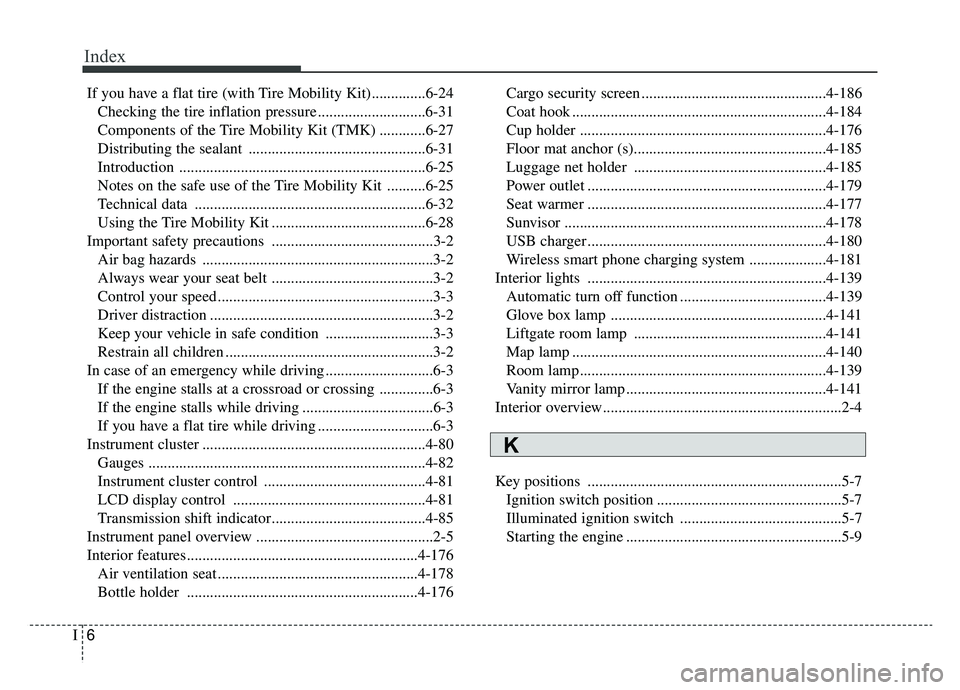
If you have a flat tire (with Tire Mobility Kit)..............6-24Checking the tire inflation pressure ............................6-31
Components of the Tire Mobility Kit (TMK) ............6-27
Distributing the sealant ..............................................6-31
Introduction ................................................................6-25
Notes on the safe use of the Tire Mobility Kit ..........6-25
Technical data ............................................................6-32
Using the Tire Mobility Kit ........................................6-28
Important safety precautions ..........................................3-2 Air bag hazards ............................................................3-2
Always wear your seat belt ..........................................3-2
Control your speed ........................................................3-3
Driver distraction ..........................................................3-2
Keep your vehicle in safe condition ............................3-3
Restrain all children ......................................................3-2
In case of an emergency while driving ............................6-3 If the engine stalls at a crossroad or crossing ..............6-3
If the engine stalls while driving ..................................6-3
If you have a flat tire while driving ..............................6-3
Instrument cluster ..........................................................4-80 Gauges ........................................................................\
4-82
Instrument cluster control ..........................................4-81
LCD display control ..................................................4-81
Transmission shift indicator........................................4-85
Instrument panel overview ..............................................2-5
Interior features............................................................4-176 Air ventilation seat ....................................................4-178
Bottle holder ............................................................4-176 Cargo security screen ................................................4-186
Coat hook ..................................................................4-184
Cup holder ................................................................4-176
Floor mat anchor (s)..................................................\
4-185
Luggage net holder ..................................................4-185
Power outlet ..............................................................4-179
Seat warmer ..............................................................4-177
Sunvisor ....................................................................4-17\
8
USB charger ..............................................................4-180
Wireless smart phone charging system ....................4-181
Interior lights ..............................................................4-139 Automatic turn off function ......................................4-139
Glove box lamp ........................................................4-141
Liftgate room lamp ..................................................4-141
Map lamp ..................................................................4-140
Room lamp ................................................................4-139
Vanity mirror lamp ....................................................4-141
Interior overview..............................................................2-4
Key positions ..................................................................5-7 Ignition switch position ................................................5-7
Illuminated ignition switch ..........................................5-7
Starting the engine ........................................................5-9
K