ece KIA SPORTAGE 2020 Owners Manual
[x] Cancel search | Manufacturer: KIA, Model Year: 2020, Model line: SPORTAGE, Model: KIA SPORTAGE 2020Pages: 611, PDF Size: 15.85 MB
Page 582 of 611
799
Maintenance
When cleaning lower door panels,rocker panels and frame members,
be sure that drain holes are kept
open so that moisture can escape
and not be trapped inside to accel-
erate corrosion.
Keep your garage dry
Don't park your vehicle in a damp,
poorly ventilated garage. This cre-
ates a favorable environment for cor-
rosion. This is particularly true if you
wash your vehicle in the garage or
drive it into the garage when it is still
wet or covered with snow, ice or
mud. Even a heated garage can con-
tribute to corrosion unless it is well
ventilated so moisture is dispersed. Keep paint and trim in good con-
dition
Scratches or chips in the finish
should be covered with "touch-up"
paint as soon as possible to reduce
the possibility of corrosion. If bare
metal is showing through, the atten-
tion of a qualified body and paint
shop is recommended.
Bird droppings : Bird droppings are
highly corrosive and may damage
painted surfaces in just a few hours.
Always remove bird droppings as
soon as possible.
Don't neglect the interior
Moisture can collect under the floor
mats and carpeting and cause corro-
sion. Check under the mats periodi-
cally to be sure the carpeting is dry.
Use particular care if you carry fertil-
izers, cleaning materials or chemi-
cals in the vehicle.
These should be carried only in prop-
er containers and any spills or leaks
should be cleaned up, flushed with
clean water and thoroughly dried.Interior care
Interior general precautions
Prevent chemicals such as perfume,
cosmetic oil, sun cream, hand clean-
er, and air freshener from contacting
the interior parts because they may
cause damage or discoloration. If
they do contact the interior parts,
wipe them off immediately. If neces-
sary, use a vinyl cleaner, see product
instructions for correct usage.
CAUTION - Electrical
components
Never allow water or other liq-
uids to come in contact withelectrical/electronic compo-nents inside the vehicle as thismay damage them.
Page 584 of 611
7101
Maintenance
Fabric seat cover (If equipped)
Please clean the fabric seats regu-
larly with a vacuum cleaner in con-
sideration of fabric material charac-
teristics. If they are heavily soiled
with beverage stains, etc., use a suit-
able interior cleaner. To prevent dam-
age to seat covers, wipe off the seat
covers down to the seams with a
large wiping motion and moderate
pressure using a soft sponge or
microfiber cloth.
Velcro closures on clothing or sharp
objects may cause snagging or
scratches on the surface of the
seats.
Make sure not to rub such objects
against the surface.
Cleaning the upholstery and inte-rior trim
Vinyl
Remove dust and loose dirt from
vinyl with a whisk broom or vacuum
cleaner. Clean vinyl surfaces with a
vinyl cleaner.
Fabric
Remove dust and loose dirt from fab-
ric with a whisk broom or vacuum
cleaner. Clean with a mild soap solu-
tion recommended for upholstery or
carpets. Remove fresh spots imme-
diately with a fabric spot cleaner. If
fresh spots do not receive immediate
attention, the fabric can be stained
and its color can be affected. Also, its
fire-resistant properties can be
reduced if the material is not proper-
ly maintained.
Using anything but recommended
cleaners and procedures may affect
the fabric’s appearance and fire-
resistant properties.
Cleaning the lap/shoulder beltwebbing
Clean the belt webbing with any mild
soap solution recommended for
cleaning upholstery or carpet. Follow
the instructions provided with the
soap. Do not bleach or re-dye the
webbing because this may weaken it.
Cleaning the interior windowglass
If the interior glass surfaces of the
vehicle become fogged (that is, cov-
ered with an oily, greasy or waxy
film), they should be cleaned with a
glass cleaner. Follow the directions
on the glass cleaner container.
CAUTION- Rear window
Do not scrape or scratch theinside of the rear window. Thismay result in damage of the rearwindow defroster grid.
Page 587 of 611
Maintenance
104
7
Do not operate the engine in con-
fined or closed areas (such as
garages) any more than what is
necessary to move the vehicle in or
out of the area.
When the vehicle is stopped in an open area for more than a short
time with the engine running,
adjust the ventilation system (as
needed) to draw outside air into the
vehicle.
Never sit in a parked or stopped vehicle for any extended time with
the engine running.
When the engine stalls or fails to start, excessive attempts to restart
the engine may cause damage to
the emission control system.Operating precautions for catalyt-
ic converters (if equipped)
WARNING- Catalytic converter
Keep away from the catalytic
converter and exhaust system
while the vehicle is running or
immediately thereafter. The
exhaust and catalytic systems
are very hot and may burn you.
WARNING- Fire
Do not park, idle or drive the vehicle over or near flamma-
ble objects, such as grass,
vegetation, paper, leaves, etc.
A hot exhaust system can
ignite flammable items under
your vehicle.
Also, do not remove the heat sink around the exhaust sys-
tem, do not seal the bottom of
the vehicle or do not coat the
vehicle for corrosion control.
It may present a fire risk under
certain conditions.
Page 594 of 611
68
Specification & Consumer information
CAUTION
When replacing tires, use the same size originally supplied with the vehicle.Using tires of a different size can damage the related parts or make them work irregularly.
✽ ✽ NOTICE
• It is permissible to add 21 kPa (3 psi) the standard tire pressure specification if colder temperatures are expected
soon.
Tires typically loose 7 kPa (1 psi) for every -11°C (12°F) temperature drop. If extreme temperature variations are
expected, re-check your tire pressure as necessary to keep them properly inflated.
• We recommend that when replacing tires, use the same originally supplied with the vehicles. If not, that aff\
ects driving performance.
• When driving in high altitude grades, it is natural for the atmospheric pressure to decrease. Therefore, please check the tire pressure and add more air when necessary.
Additionally required tire air pressure per km above sea level: 10.5 kPa (1.5 psi)
Page 597 of 611
89
Specification & Consumer information
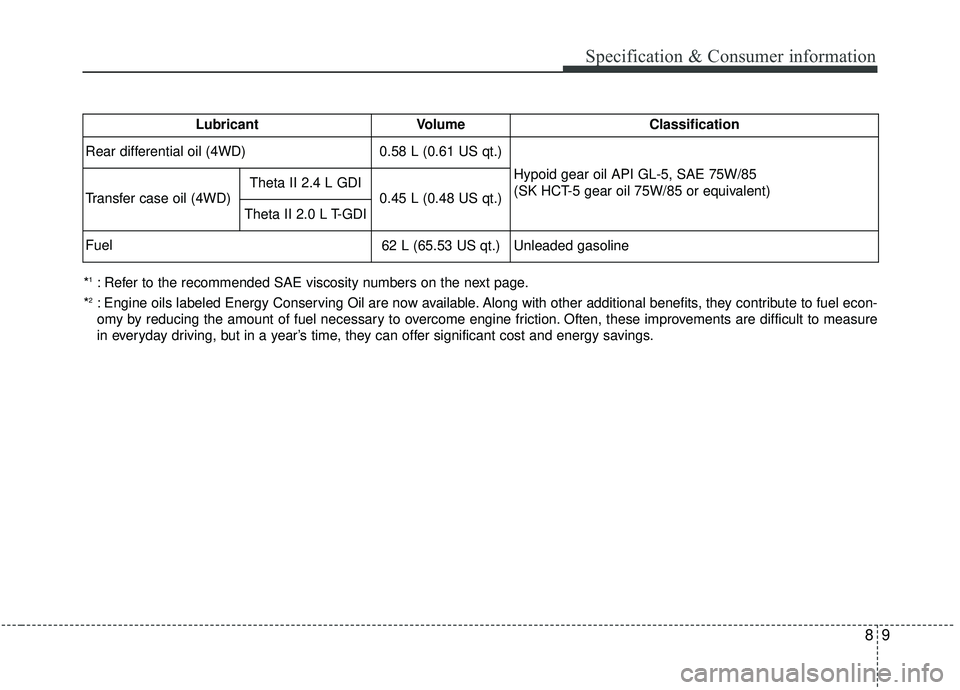
*1: Refer to the recommended SAE viscosity numbers on the next page.
*
2: Engine oils labeled Energy Conserving Oil are now available. Along with other additional benefits, they contribute to fuel econ-
omy by reducing the amount of fuel necessary to overcome engine friction. Often, these improvements are difficult to measure
in everyday driving, but in a year’s time, they can offer significant cost and energy savings. Lubricant
Volume
Classification
Rear differential oil (4WD)
0.58 L (0.61 US qt.) Hypoid gear oil API GL-5, SAE 75W/85
(SK HCT-5 gear oil 75W/85 or equivalent)
Transfer case oil (4WD) Theta II 2.4 L GDI
0.45 L (0.48 US qt.)
Theta II 2.0 L T-GDI
Fuel
62 L (65.53 US qt.) Unleaded gasoline
Page 602 of 611
Index
2I
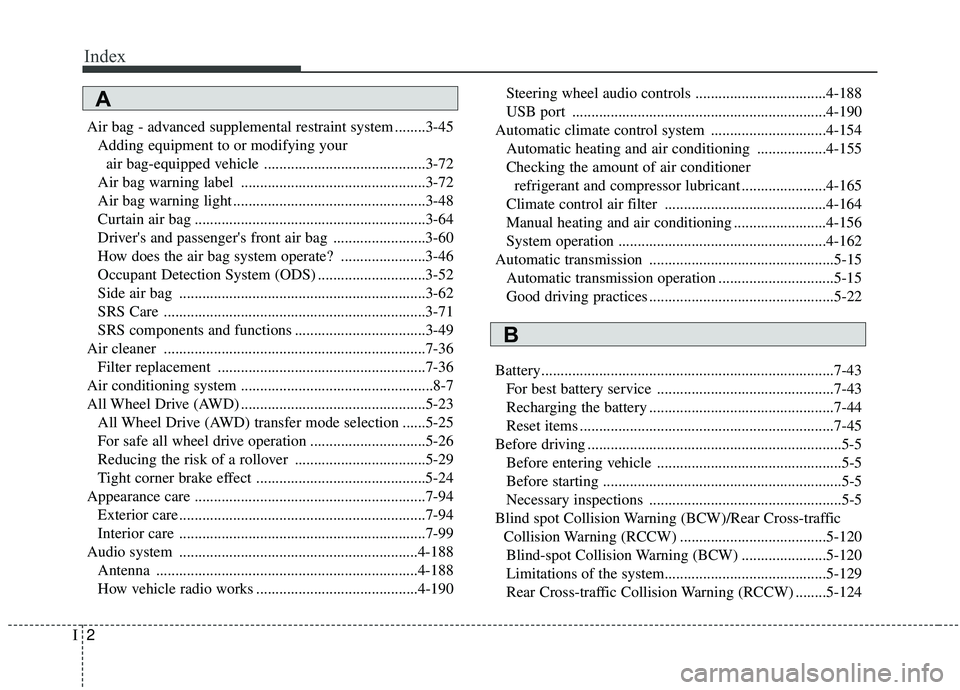
Air bag - advanced supplemental restraint system ........3-45Adding equipment to or modifying your air bag-equipped vehicle ..........................................3-72
Air bag warning label ................................................3-72
Air bag warning light ..................................................3-48
Curtain air bag ............................................................3-64
Driver's and passenger's front air bag ........................3-60
How does the air bag system operate? ......................3-46
Occupant Detection System (ODS) ............................3-52
Side air bag ................................................................3-62
SRS Care ....................................................................3-71\
SRS components and functions ..................................3-49
Air cleaner ....................................................................7-36\
Filter replacement ......................................................7-36
Air conditioning system ..................................................8-7
All Wheel Drive (AWD) ................................................5-23 All Wheel Drive (AWD) transfer mode selection ......5-25
For safe all wheel drive operation ..............................5-26
Reducing the risk of a rollover ..................................5-29
Tight corner brake effect ............................................5-24
Appearance care ............................................................7-94 Exterior care ................................................................7-94
Interior care ................................................................7-99
Audio system ..............................................................4-188 Antenna ....................................................................4-18\
8
How vehicle radio works ..........................................4-190 Steering wheel audio controls ..................................4-188
USB port ..................................................................4-190
Automatic climate control system ..............................4-154 Automatic heating and air conditioning ..................4-155
Checking the amount of air conditioner refrigerant and compressor lubricant ......................4-165
Climate control air filter ..........................................4-164
Manual heating and air conditioning ........................4-156
System operation ......................................................4-162
Automatic transmission ................................................5-15 Automatic transmission operation ..............................5-15
Good driving practices ................................................5-22
Battery........................................................................\
....7-43 For best battery service ..............................................7-43
Recharging the battery ................................................7-44
Reset items ..................................................................7-45
Before driving ..................................................................5-5 Before entering vehicle ................................................5-5
Before starting ..............................................................5-5
Necessary inspections ..................................................5-5
Blind spot Collision Warning (BCW)/Rear Cross-traffic Collision Warning (RCCW) ......................................5-120Blind-spot Collision Warning (BCW) ......................5-120
Limitations of the system..........................................5-129\
Rear Cross-traffic Collision Warning (RCCW) ........5-124
A
B
Page 611 of 611
I11
Index
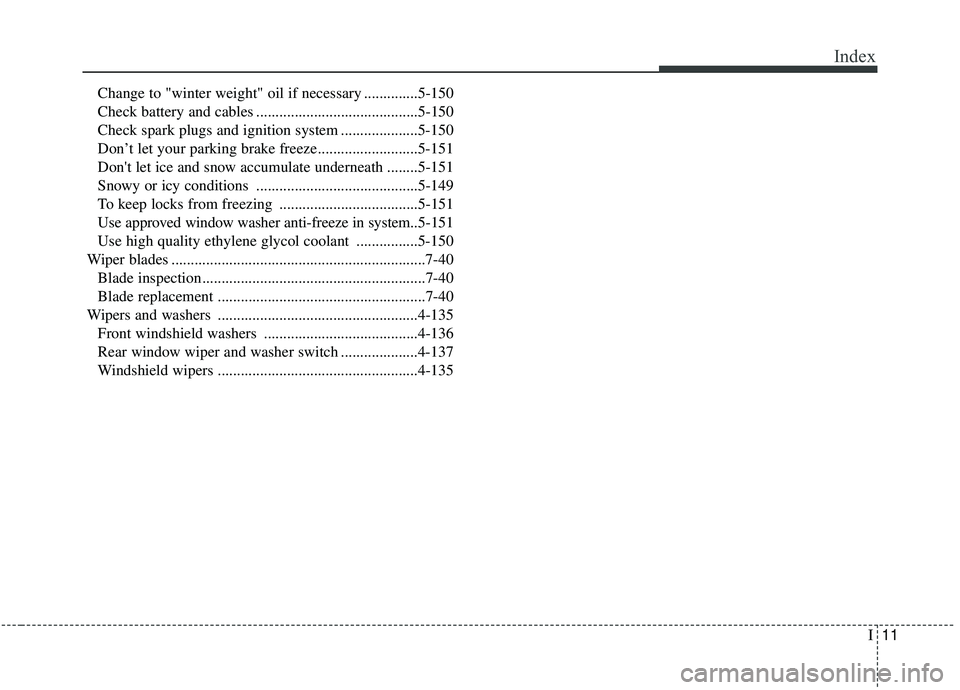
Change to "winter weight" oil if necessary ..............5-150
Check battery and cables ..........................................5-150
Check spark plugs and ignition system ....................5-150
Don’t let your parking brake freeze..........................5-151
Don't let ice and snow accumulate underneath ........5-151
Snowy or icy conditions ..........................................5-149
To keep locks from freezing ....................................5-151
Use approved window washer anti-freeze in system..5-151
Use high quality ethylene glycol coolant ................5-150
Wiper blades ..................................................................7-40 Blade inspection ..........................................................7-40
Blade replacement ......................................................7-40
Wipers and washers ....................................................4-135 Front windshield washers ........................................4-136
Rear window wiper and washer switch ....................4-137
Windshield wipers ....................................................4-135