check engine KIA SPORTAGE 2020 Manual PDF
[x] Cancel search | Manufacturer: KIA, Model Year: 2020, Model line: SPORTAGE, Model: KIA SPORTAGE 2020Pages: 611, PDF Size: 15.85 MB
Page 549 of 611
Maintenance
66
7
✽ ✽
NOTICE
Do not disassemble nor assemble the
multi fuse when it is secured with
nuts and bolts. Incorrect or partial
assembly torque may cause a fire.
Have the vehicle checked by an
authorized Kia dealer.
Main fuse
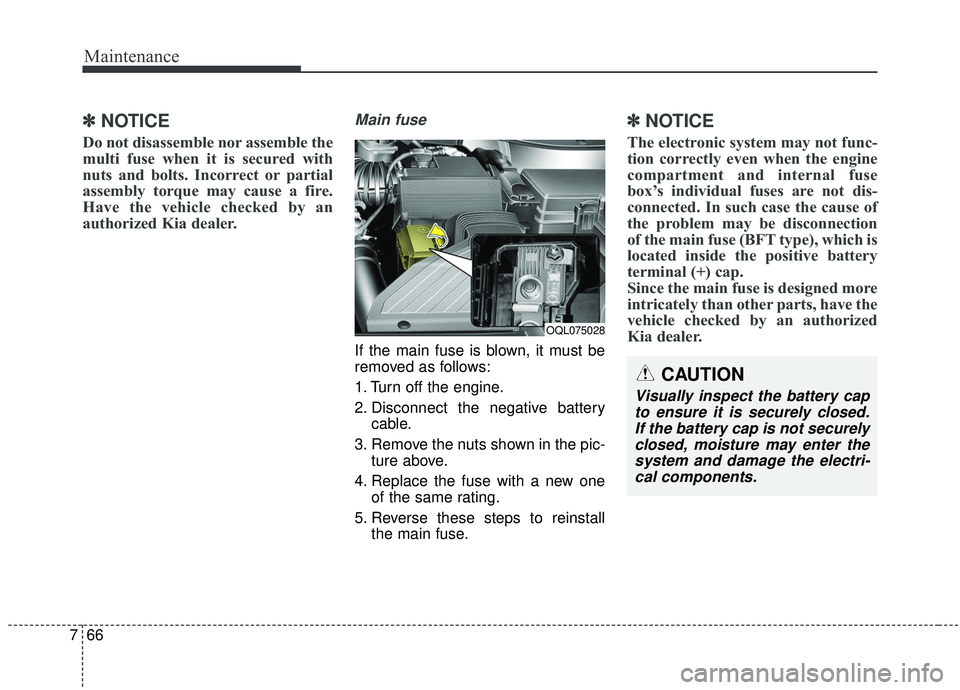
If the main fuse is blown, it must be
removed as follows:
1. Turn off the engine.
2. Disconnect the negative battery
cable.
3. Remove the nuts shown in the pic- ture above.
4. Replace the fuse with a new one of the same rating.
5. Reverse these steps to reinstall the main fuse.
✽ ✽NOTICE
The electronic system may not func-
tion correctly even when the engine
compartment and internal fuse
box’s individual fuses are not dis-
connected. In such case the cause of
the problem may be disconnection
of the main fuse (BFT type), which is
located inside the positive battery
terminal (+) cap.
Since the main fuse is designed more
intricately than other parts, have the
vehicle checked by an authorized
Kia dealer.
OQL075028
CAUTION
Visually inspect the battery cap
to ensure it is securely closed.If the battery cap is not securelyclosed, moisture may enter thesystem and damage the electri-cal components.
Page 586 of 611
7103
Maintenance
Canister
Fuel vapors generated inside the fuel
tank are absorbed and stored in the
onboard canister. When the engine is
running, the fuel vapors absorbed in
the canister are drawn into the surge
tank through the purge control sole-
noid valve.
Purge Control Solenoid Valve(PCSV)
The purge control solenoid valve is
controlled by the Engine Control
Module (ECM); when the engine
coolant temperature is low during
idling, the PCSV closes so that evap-
orated fuel is not taken into the
engine. After the engine warms up
during ordinary driving, the PCSV
opens to introduce evaporated fuel to
the engine.
3. Exhaust emission control system
The Exhaust Emission Control
System is a highly effective system
which controls exhaust emissions
while maintaining good vehicle per-
formance.
Engine exhaust gas precautions
(carbon monoxide)
Carbon monoxide can be present with other exhaust fumes.
Therefore, if you smell exhaust
fumes of any kind inside your vehi-
cle, have it inspected and repaired
immediately. If you ever suspect
exhaust fumes are coming into
your vehicle, drive it only with all
the windows fully open. Have your
vehicle checked and repaired
immediately.
WARNING - Exhaust
Engine exhaust gases contain
carbon monoxide (CO). Though
colorless and odorless, it is
dangerous and could be lethal if
inhaled. Follow the instructions
on this page to avoid CO poi-
soning.
Page 604 of 611
Index
4I
System setting and activation ..................................5-136
System standby ........................................................5-138
Economical operation ..................................................5-141 Driving at night ........................................................5-146
Driving in flooded areas ..........................................5-147
Driving in the rain ....................................................5-146
Driving off-road ........................................................5-147
Hazardous driving conditions ..................................5-143
Highway driving ......................................................5-147
Reducing the risk of a rollover ................................5-143
Rocking the vehicle ..................................................5-145
Smooth cornering ......................................................5-145
Special driving conditions ........................................5-143
Emergency starting ..........................................................6-5 Jump starting ................................................................6-5
Push-starting ................................................................6-6
Emission control system ..............................................7-102 Crankcase emission control system ..........................7-102
Evaporative emission control (including ORVR: Onboard Refueling Vapor Recovery) system ........7-102
Exhaust emission control system ..............................7-103
Engine ........................................................................\
......8-2
Engine compartment ................................................2-6, 7-3 Engine coolant ..............................................................7-29
Changing the coolant ..................................................7-32
Checking the coolant level..........................................7-29
Engine number ..............................................................8-12
Engine oil ......................................................................7-\
27 Changing the engine oil and filter ..............................7-28
Checking the engine oil level ....................................7-27
Engine start/stop button ................................................5-11 Engine start/stop button position ................................5-11
Illuminated engine start/stop button ..........................5-11
Starting the engine with a smart key ..........................5-13
Explanation of scheduled maintenance items ..............7-21
Exterior features ..........................................................4-186 Roof rack ..................................................................4-186
Exterior overview ....................................................2-2, 2-3
Folding key ......................................................................4-\
5 Battery replacement ......................................................4-8
Immobilizer system ......................................................4-9
Key operations ..............................................................4-5
Record your key number ..............................................4-5
Transmitter precautions ................................................4-7
Forward Collision-avoidance Assist (FCA) system camera type..................................................................5-54Brake operation ..........................................................5-58
FCA sensor (Front view camera)................................5-58
E
F
Page 605 of 611
I5
Index
FCA warning message and system control ................5-56
Limitation of the system ............................................5-61
System malfunction ....................................................5-60
System setting and activation ....................................5-54
Forward Collision-avoidance Assist (FCA) system sensor fusion type (front radar+front view camera) ..............5-67Brake operation ..........................................................5-71
Downhill Brake Control (DBC)..................................5-81
FCA sensor (front radar + front view Ccamera) ........5-71
FCA warning message and system control ................5-69
Good braking practices ..............................................5-83
Limitation of the system ............................................5-75
System malfunction ....................................................5-74
System setting and activation ....................................5-67
Fuel filler lid ..................................................................4-48 Closing the fuel filler lid ............................................4-49
Opening the fuel filler lid ..........................................4-48
Fuel requirements ............................................................1-2 Do not use methanol ....................................................1-4
Fuel Additives ..............................................................1-5
Gasoline containing alcohol and methanol ..................1-3
Operation in foreign countries ......................................1-5
Fuses ........................................................................\
......7-61 Engine compartment fuse replacement ......................7-65
Fuse/relay panel description ......................................7-67
Inner panel fuse replacement ......................................7-63 Gross vehicle weight........................................................8-7\
Hood ........................................................................\
......4-46
Closing the hood ........................................................4-47
Opening the hood ........................................................4-46
How to use this manual ..................................................1-2
If the engine overheats ....................................................6-7
If the engine will not start ..............................................6-4 If engine doesn't turn over or turns over slowly ..........6-4
If engine turns over normally but does not start ..........6-4
If you have a flat tire (with spare tire) ..........................6-15 Changing tires ............................................................6-17
Jack and tools ..............................................................6-15
Removing and storing the spare tire ..........................6-16
If you have a flat tire (with Tire Mobility Kit)..............6-24 Checking the tire inflation pressure ............................6-31
Components of the Tire Mobility Kit (TMK) ............6-27
Distributing the sealant ..............................................6-31
Introduction ................................................................6-25
Notes on the safe use of the Tire Mobility Kit ..........6-25
H
G
I