automatic KIA VENGA 2015 User Guide
[x] Cancel search | Manufacturer: KIA, Model Year: 2015, Model line: VENGA, Model: KIA VENGA 2015Pages: 480, PDF Size: 23.15 MB
Page 33 of 480

33
Jack label1. Model Name
2. Maximum allowable load
3. When using the jack, set yourparking brake.
4. When using the jack, stop the engine.
5. Do not get under a vehicle that is supported by a jack.
6. The designated locations under the frame
7. When supporting the vehicle, the base plate of jack must be vertical under the lifting point.
8. Shift into Reverse gear on vehicles with manual transmission or move
the shift lever to the P position on
vehicles with automatic transmis-sion.
9. The jack should be used on firm level ground.
10. Jack manufacturer
11. Production date
12. Representative company and address
❈ The actual Jack label in the vehicle may differ from the illustration. For
more detailed specifications, refer to the label attached to the jack.
OHYK064001
OHYK064005
OHYK064002
Type A
■
Example
Type B
Type C
YN leaflet-ENG(RHD)-A1PO-EA48A(L).qxp 11/6/2014 5:13 PM Page 33
Page 39 of 480
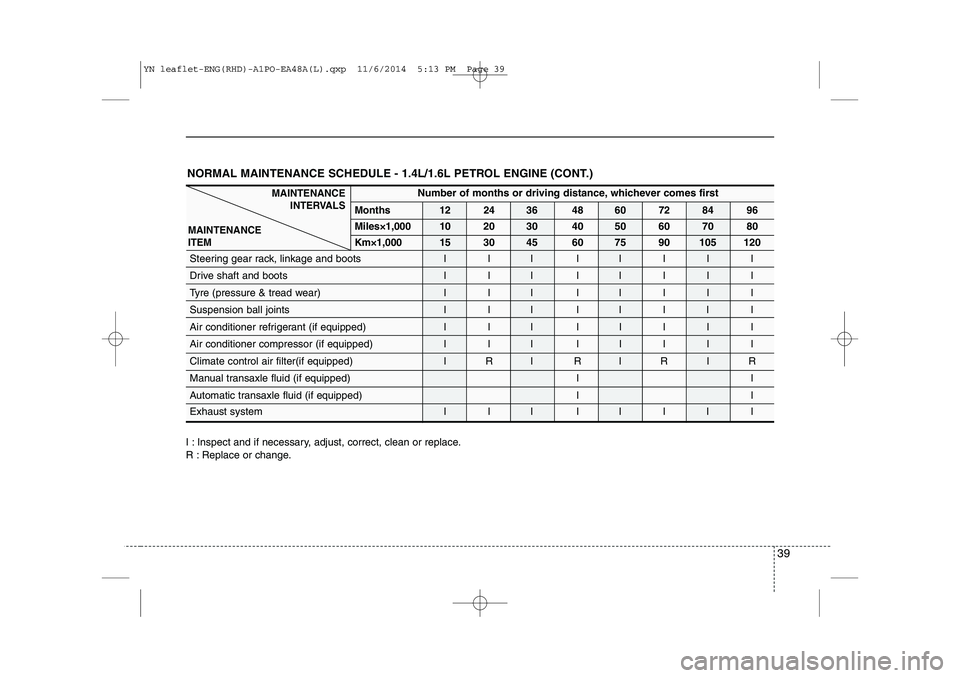
I : Inspect and if necessary, adjust, correct, clean or replace.
R : Replace or change.
Number of months or driving distance, whichever comes first
Months 12 24 36 48 60 72 84 96 Miles×1,000
10 20 30 40 50 60 70 80
Km×1,00015 30 45 60 75 90 105 120
Steering gear rack, linkage and boots I I I I I I I I
Drive shaft and boots I I I I I I I I
Tyre (pressure & tread wear) I I I I I I I I
Suspension ball jointsIII IIIII
Air conditioner refrigerant (if equipped) I I I I I I I I
Air conditioner compressor (if equipped) I I I I I I I IClimate control air filter(if equipped)
IRI RIRIR
Manual transaxle fluid (if equipped) II
Automatic transaxle fluid (if equipped) II
Exhaust systemIII IIIII
MAINTENANCE INTERVALS
MAINTENANCE ITEM
NORMAL MAINTENANCE SCHEDULE - 1.4L/1.6L PETROL ENGINE (CONT.)
39
YN leaflet-ENG(RHD)-A1PO-EA48A(L).qxp 11/6/2014 5:13 PM Page 39
Page 40 of 480
40
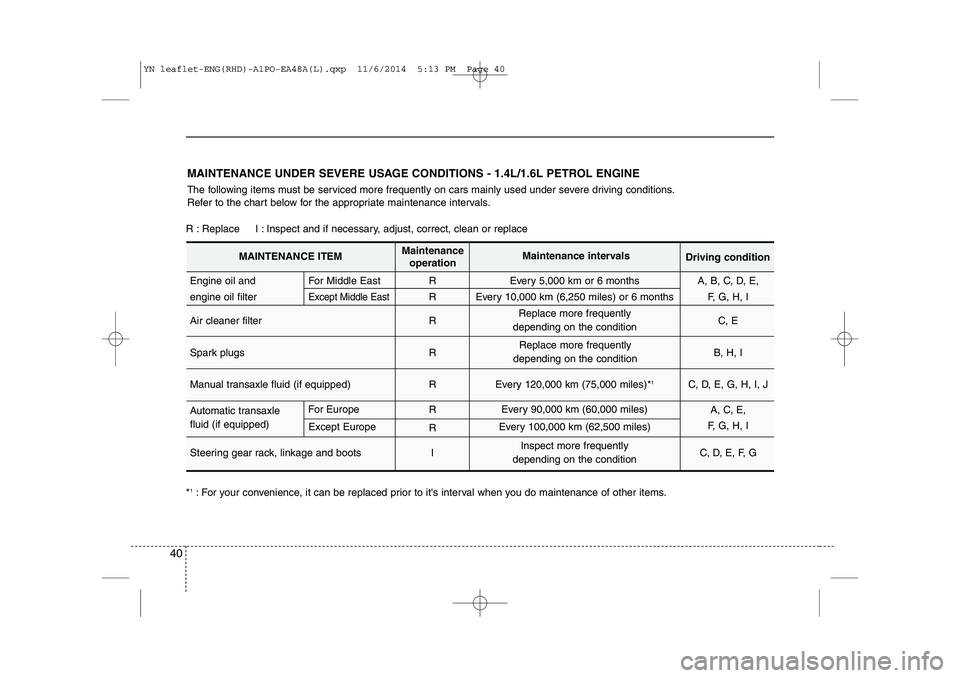
The following items must be serviced more frequently on cars mainly used under severe driving conditions.
Refer to the chart below for the appropriate maintenance intervals.
R : Replace I : Inspect and if necessary, adjust, correct, clean or replaceEngine oil and For Middle East R Every 5,000 km or 6 months A, B, C, D, E, engine oil filter
Except Middle EastR Every 10,000 km (6,250 miles) or 6 months F, G, H, I
Air cleaner filter R C, E
Spark plugs R B, H, I
Manual transaxle fluid (if equipped) R Every 120,000 km (75,000 miles)* 1
C, D, E, G, H, I, J
Automatic transaxle
R
fluid (if equipped)R
Steering gear rack, linkage and boots I C, D, E, F, G
MAINTENANCE ITEMMaintenance
operation Maintenance intervals
Driving condition
Replace more frequently
depending on the condition
Inspect more frequently
depending on the condition Replace more frequently
depending on the condition
* 1
: For your convenience, it can be replaced prior to it's interval when you do maintenance of other items.
MAINTENANCE UNDER SEVERE USAGE CONDITIONS - 1.4L/1.6L PETROL ENGINE
For EuropeA, C, E,
F, G, H, IEvery 90,000 km (60,000 miles)
Except Europe Every 100,000 km (62,500 miles)
YN leaflet-ENG(RHD)-A1PO-EA48A(L).qxp 11/6/2014 5:13 PM Page 40
Page 45 of 480
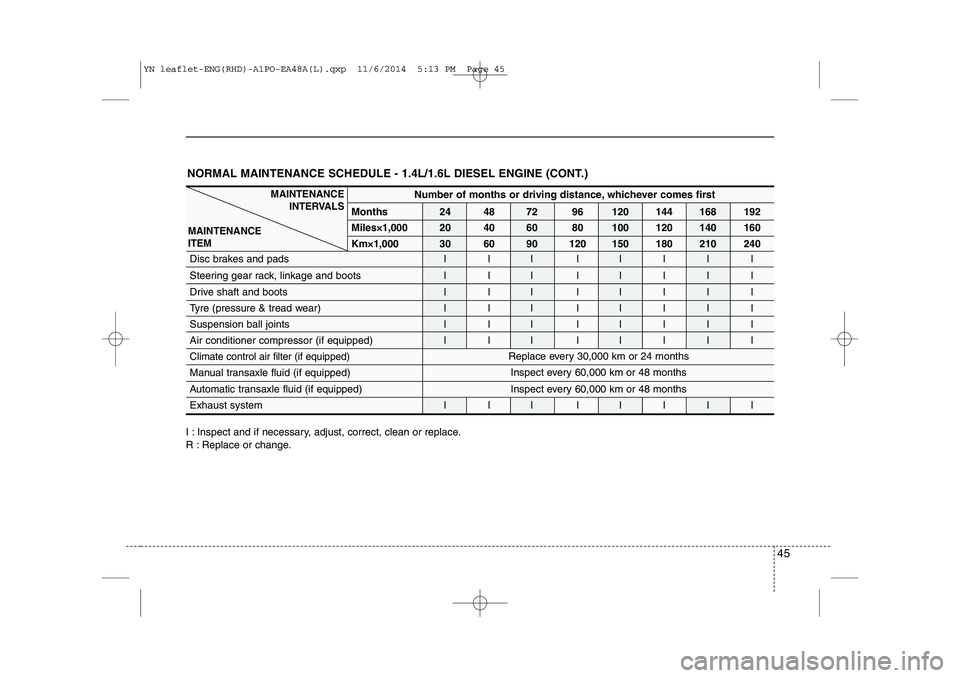
NORMAL MAINTENANCE SCHEDULE - 1.4L/1.6L DIESEL ENGINE (CONT.)
I : Inspect and if necessary, adjust, correct, clean or replace.
R : Replace or change.
MAINTENANCEINTERVALS
MAINTENANCE ITEMNumber of months or driving distance, whichever comes first
Months
24 48 72 96 120 144 168 192
Miles×1,000 20 40 60 80 100 120 140 160
Km×1,000 30 60 90 120 150 180 210 240
Disc brakes and pads I I I I I I I I
Steering gear rack, linkage and boots I I I I I I I I
Drive shaft and boots I I I I I I I I
Tyre (pressure & tread wear) I I I I I I I I
Suspension ball jointsIII IIIII
Air conditioner compressor (if equipped)
III II I I I
Climate control air filter (if equipped)
Manual transaxle fluid (if equipped)
Automatic transaxle fluid (if equipped)
Exhaust system I I I I I I I IReplace every 30,000 km or 24 months
Inspect every 60,000 km or 48 months
Inspect every 60,000 km or 48 months
45
YN leaflet-ENG(RHD)-A1PO-EA48A(L).qxp 11/6/2014 5:13 PM Page 45
Page 46 of 480
46
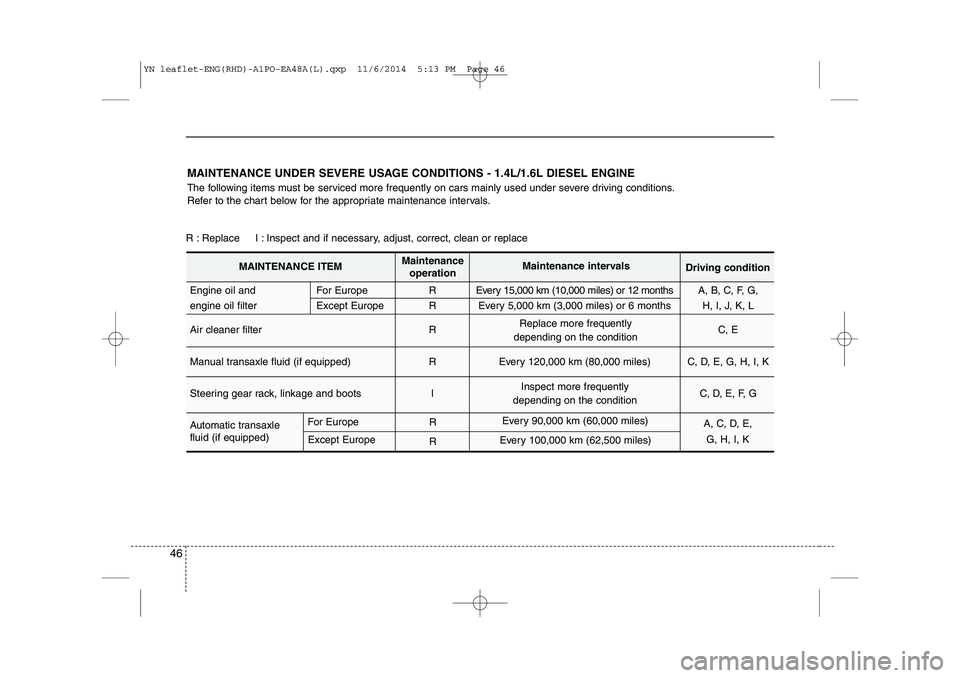
MAINTENANCE UNDER SEVERE USAGE CONDITIONS - 1.4L/1.6L DIESEL ENGINE
The following items must be serviced more frequently on cars mainly used under severe driving conditions.
Refer to the chart below for the appropriate maintenance intervals.
R : Replace I : Inspect and if necessary, adjust, correct, clean or replace
MAINTENANCE ITEMMaintenance
operation Maintenance intervals
Driving condition
Engine oil and For Europe R Every 15,000 km (10,000 miles) or
12months A, B, C, F, G,
engine oil filter Except Europe R Every 5,000 km (3,000 miles) or 6 months H, I, J, K, L
Air cleaner filter R C, E
Manual transaxle fluid (if equipped) R Every 120,000 km (80,000 miles) C, D, E, G, H, I, K
Steering gear rack, linkage and boots I C, D, E, F, G
Inspect more frequently
depending on the condition
Replace more frequently
depending on the condition
For Europe
Automatic transaxle fluid (if equipped) A, C, D, E,
G, H, I, K
Except Europe Every 90,000 km (60,000 miles)
Every 100,000 km (62,500 miles)
R
R
YN leaflet-ENG(RHD)-A1PO-EA48A(L).qxp 11/6/2014 5:13 PM Page 46
Page 62 of 480
62
❖❖Please see this page instead of page 7-78 in owner's manual.
Diesel Particulate Filter (if equipped)
The Diesel Particulate Filter (DPF) sys-
tem removes the soot in the exhaust gas.
Unlike a disposable air filter, the DPF
system automatically burns (oxidizes)
and removes the accumulated soot
according to the driving condition. In
other words, the active burning by engine
control system and high exhaust gas
temperature caused by normal/high driv-
ing condition burns and removes the
accumulated soot.
However, if the vehicle continues to be
driven at repeated short distance or driv-
en at low speed for long time, the accu-
mulated soot may not be automatically
removed because of low exhaust gas
temperature. More than a certain amountof soot deposited, the malfunction indica-
tor light ( ) illuminates. When the malfunction indicator light
blinks, it may stop blinking by driving the
vehicle at more than 60km/h (37 mph) orat more than second gear with 1500 ~
2500 engine rpm for a certain time (for
about 25 minutes). If the malfunction indicator light contin-
ues to be blinked in spite of the proce-
dure, we recommend that the system be
checked by an authorised Kia dealer.
If you continue to drive with the malfunc-
tion indicator light blinking for a long
time, the DPF system can be damaged
and fuel consumption can be worsen.
Lean NOx Trap (if equipped)
The Lean NOx Trap (LNT) system
removes the nitrogen oxide in the
exhaust gas. The smell can occur in the
exhaust gas depending on the quality of
the fuel and it can degrade NOx reduc-
tion performance, please use the regulat-
ed automotive diesel fuel.
EMISSION CONTROL SYSTEM
CAUTION
- Diesel Fuel
(if equipped with DPF)
It is recommended to use the regu- lated automotive diesel fuel for
diesel vehicle equipped with theDPF system.
If you use diesel fuel including highsulfur (more than 50 ppm sulfur) and
unspecified additives, it can causethe DPF system to be damaged and white smoke can be emitted.
YN leaflet-ENG(RHD)-A1PO-EA48A(L).qxp 11/6/2014 5:14 PM Page 62
Page 66 of 480

66
❖❖Please see this page instead of page 8-4 in owner's manual.
RECOMMENDED LUBRICANTS AND CAPACITIES
To help achieve proper engine and powertrain performance and durability, use only lubricants of the proper quality.
The correct lubricants also help promote engine efficiency that results in improved fuel economy.
* 1
Refer to the recommended SAE viscosity numbers on the next page.
* 2
Engine oils labeled Energy Conserving Oil are now available. Along with other additional benefits, they contribute to fuel economy by reducing
the amount of fuel necessary to overcome engine friction. Often, these improvements are difficult to measure in everyday driving, but in a year’s
time, they can offer significant cost and energy savings.
* 3
If the API service SM engine oil is not available in your country, you are able to use API service SL.
LubricantVolumeClassification
Engine oil *1 *2
(drain and refill) Recommends -
For Europe
Petrol Engine3.3 l(3.5 US qt.)
For Europe
API Service SL or SM, ACEA A3 or above
Use the engine oils approved by Kia Motors.
Consult an authorised Kia dealer for details.
Except Europe
API Service SM* 3
, ILSAC GF-4 or above
Diesel Engine5.3 l(5.6 US qt.)
With DPF (Diesel Particulate filter) ;
ACEA C3 or C2
Without DPF (Diesel Particulate filter) ;
ACEA B4
Engine oil consumptionNormal driving conditionMAX. 1 l/ 1,500 km-
Severe driving conditionMAX. 1 l/ 1,000 km-
Manual transaxle fluid
Petrol Engine
1.9 l~ 2.0 l
(2.0 ~ 2.1 US qt.)
Kia Genuine Transaxle Oil,
API GL-4, SAE 70W1.8 l~ 1.9 l
(1.9 ~ 2.0 US qt.)
Diesel Engine1.7 l~ 1.8 l
(1.8 ~ 1.9 US qt.)
Automatic transaxle fluid6.8 l(7.2 US qt.)DIAMOND ATF SP-III, SK ATF SP-III
1.4L
1.6L
YN leaflet-ENG(RHD)-A1PO-EA48A(L).qxp 11/6/2014 5:14 PM Page 66
Page 74 of 480
13
Introduction
Leaded (if equipped)
For some countries, your vehicle is
designed to use leaded petrol. When you
are going to use leaded petrol, we rec-
ommend that you ask to an authorised
Kia dealer. Octane Rating of leaded petrol is same
with unleaded one.
Petrol containing alcohol andmethanol
Gasohol, a mixture of petrol and ethanol
(also known as grain alcohol), and petrolor gasohol containing methanol (also
known as wood alcohol) are being mar-
keted along with or instead of leaded orunleaded petrol. Do not use gasohol containing more than 10% ethanol, and do not use petrol or
gasohol containing any methanol. Either
of these fuels may cause drivability prob-lems and damage to the fuel system,engine control system and emission con-trol system.
Discontinue using gasohol of any kind if
drivability problems occur.
Vehicle damage or drivability problems
may not be covered by the manufacturer’s
warranty if they result from the use of: 1. Gasohol containing more than 10%
ethanol.
2. Petrol or gasohol containing methanol.
3. Leaded fuel or leaded gasohol.Other fuels
Using fuels such as
- Silicone (Si) contained fuel,
- MMT (Manganese, Mn) contained fuel,
- Ferrocene (Fe) contained fuel, and
- Other metalic additives contained fuels,
may cause vehicle and engine damage
or cause plugging, misfiring, poor accel-
eration, engine stalling, catalyst melting,
abnormal corrosion, life cycle reduction,etc.
Also, the Malfunction Indicator Lamp
(MIL) may illuminate.
✽✽
NOTICE
Damage to the fuel system or perform-
ance problem caused by the use of these
fuels may not be covered by your New
Vehicle Limited Warranty.
WARNING
• Do not "top off" after the nozzle automatically shuts off when refuelling.
Always check that the fuel cap is installed securely to prevent fuel
spillage in the event of an acci-dent.
CAUTION
NEVER USE LEADED FUEL. The
use of leaded fuel is detrimental to
the catalytic converter and willdamage the engine control sys-tem’s oxygen sensor and affect emission control.
Never add any fuel system cleaningagents to the fuel tank other thanwhat has been specified. (We rec-ommend that you consult an
authorised Kia.)
CAUTION
Never use gasohol which contains methanol. Discontinue use of anygasohol product which impairs dri-
vability.
YN RHD 1.QXP 11/20/2014 6:12 PM Page 3
Page 92 of 480
39
Safety features of your vehicle
Seat warmer (if equipped)
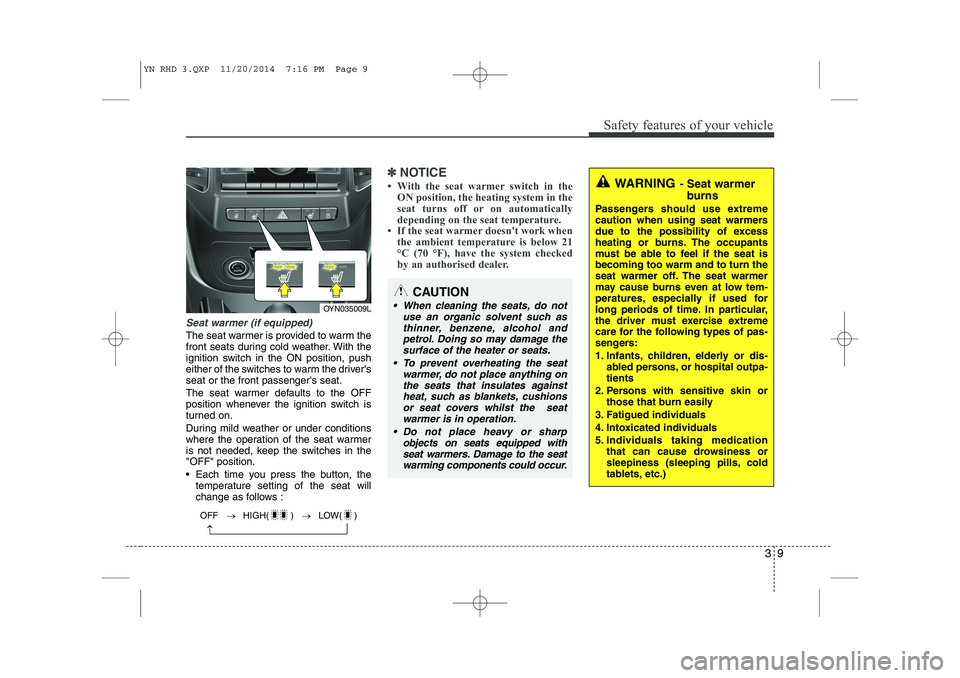
The seat warmer is provided to warm the
front seats during cold weather. With the
ignition switch in the ON position, push
either of the switches to warm the driver'sseat or the front passenger's seat.
The seat warmer defaults to the OFF
position whenever the ignition switch is
turned on.
During mild weather or under conditions
where the operation of the seat warmer
is not needed, keep the switches in the"OFF" position.
Each time you press the button, thetemperature setting of the seat will
change as follows :
✽✽ NOTICE
With the seat warmer switch in the ON position, the heating system in the
seat turns off or on automatically
depending on the seat temperature.
If the seat warmer doesn't work when
the ambient temperature is below 21
°C (70 °F), have the system checked
by an authorised dealer.WARNING - Seat warmer
burns
Passengers should use extreme
caution when using seat warmers
due to the possibility of excess
heating or burns. The occupants
must be able to feel if the seat isbecoming too warm and to turn the
seat warmer off. The seat warmer
may cause burns even at low tem-
peratures, especially if used for
long periods of time. In particular,
the driver must exercise extreme
care for the following types of pas-
sengers:
1. Infants, children, elderly or dis- abled persons, or hospital outpa- tients
2. Persons with sensitive skin or those that burn easily
3. Fatigued individuals
4. Intoxicated individuals
5. Individuals taking medication that can cause drowsiness or
sleepiness (sleeping pills, cold
tablets, etc.)
OYN035009L
CAUTION
When cleaning the seats, do not
use an organic solvent such asthinner, benzene, alcohol andpetrol. Doing so may damage the surface of the heater or seats.
To prevent overheating the seat warmer, do not place anything onthe seats that insulates against heat, such as blankets, cushions
or seat covers whilst the seatwarmer is in operation.
Do not place heavy or sharp objects on seats equipped withseat warmers. Damage to the seat
warming components could occur.
OFF HIGH( ) LOW( )
YN RHD 3.QXP 11/20/2014 7:16 PM Page 9
Page 95 of 480
Safety features of your vehicle
12
3
Headrest
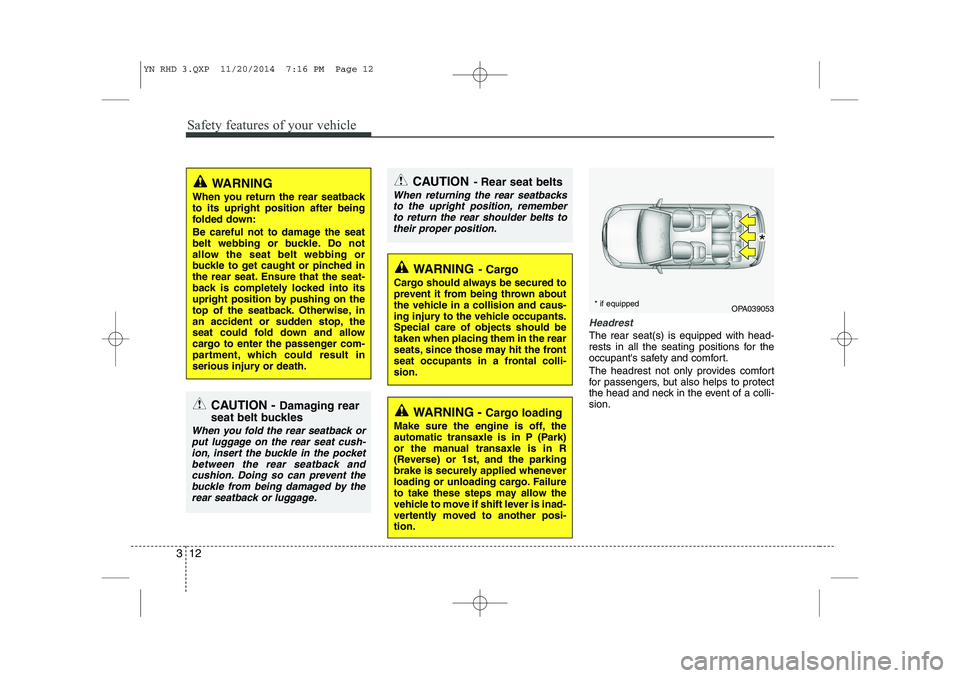
The rear seat(s) is equipped with head-
rests in all the seating positions for the
occupant's safety and comfort.
The headrest not only provides comfort
for passengers, but also helps to protect
the head and neck in the event of a colli-sion.
OPA039053
* if equipped
*
WARNING -
Cargo loading
Make sure the engine is off, the
automatic transaxle is in P (Park)
or the manual transaxle is in R
(Reverse) or 1st, and the parking
brake is securely applied whenever
loading or unloading cargo. Failure
to take these steps may allow the
vehicle to move if shift lever is inad-
vertently moved to another posi-tion.
WARNING - Cargo
Cargo should always be secured to
prevent it from being thrown about
the vehicle in a collision and caus-
ing injury to the vehicle occupants.Special care of objects should betaken when placing them in the rear
seats, since those may hit the front
seat occupants in a frontal colli-sion.
CAUTION - Rear seat belts
When returning the rear seatbacks
to the upright position, remember
to return the rear shoulder belts totheir proper position.WARNING
When you return the rear seatback to its upright position after being
folded down:
Be careful not to damage the seat
belt webbing or buckle. Do not
allow the seat belt webbing or
buckle to get caught or pinched in
the rear seat. Ensure that the seat-
back is completely locked into its
upright position by pushing on the
top of the seatback. Otherwise, in
an accident or sudden stop, the
seat could fold down and allow
cargo to enter the passenger com-
partment, which could result in
serious injury or death.
CAUTION - Damaging rear
seat belt buckles
When you fold the rear seatback or put luggage on the rear seat cush-ion, insert the buckle in the pocket
between the rear seatback and cushion. Doing so can prevent thebuckle from being damaged by therear seatback or luggage.
YN RHD 3.QXP 11/20/2014 7:16 PM Page 12