fuel Lancia Musa 2009 Owner handbook (in English)
[x] Cancel search | Manufacturer: LANCIA, Model Year: 2009, Model line: Musa, Model: Lancia Musa 2009Pages: 218, PDF Size: 3.7 MB
Page 170 of 218
169
WARNING
LIGHTS AND
MESSAGES
TECHNICALSPECIFICATIONS
INDEX
DASHBOARD
AND CONTROLS
SAFETY
DEVICES
STARTING
AND
DRIVING
IN AN
EMERGENCY
MAINTENANCE
AND CARE
ANNUAL
INSPECTION
SCHEDULE
For cars with an annual mileage of
below 20,000 km (for example about
15.000 km) the following yearly in-
spection programme is advised:
❒check tyre conditions/wear and
adjust pressure if required (in-
cluding the spare wheel);
❒check light system operation
(headlights, direction indicators,
hazard lights, boot lights, passen-
ger compartment lights, warning
lights, etc.);
❒wiper and windscreen washer sys-
tem check (adjustment of spray
nozzles/wear on wiper blades)
❒check front disk brake pad condi-
tions and wear;
❒visually inspect the conditions of:
engine, gearbox, transmission,
pipes and hoses (exhaust - fuel
feed - brakes), rubber parts
(boots, sleeves, bushes, etc.);❒check cleanness of bonnet and
boot locks and lever cleanness and
lubrication;
❒check battery charge;
❒visual check on various drive belt
conditions;
❒check and top up, if required, fluid
levels (engine coolant, brake fluid,
windscreen washer fluid, battery
fluid, etc);
❒replace engine oil;
❒replace engine oil filter;
❒replace pollen filter (where pro-
vided).
ADDITIONAL
CHECKS
Every 1,000 km or before long jour-
neys, check and top up if required:
❒engine coolant fluid level;
❒brake fluid level;
❒windscreen washer fluid level;
❒tyre pressure and conditions.
Every 3,000 km check the following
and top-up, if required: engine oil
level.
You are recommended to use FL Se-
lenia products, designed and pro-
duced specifically for Lancia cars (see
table “Capacities” in section “Techni-
cal specifications”).
IMPORTANT - Engine oil
Should prevailing use of the car be
under one of the following specially
heavy conditions:
❒trailer or caravan towing;
❒dusty roads;
❒short distances (less than 7-8 km)
repeated and with external tem-
peratures below zero;
165-186 MUSA 1ed GB 10-07-2008 9:39 Pagina 169
Page 171 of 218
170
WARNING
LIGHTS AND
MESSAGES
TECHNICALSPECIFICATIONS
INDEX
DASHBOARD
AND CONTROLS
SAFETY
DEVICES
STARTING
AND
DRIVING
IN AN
EMERGENCY
MAINTENANCE
AND CARE
❒frequently idling engines or long
distance low speed driving (e.g.
taxis or door-to-door deliveries) or
in case of a long term inactivity;
❒replace engine oil more frequently
than required on “Service sched-
ule”.
IMPORTANT - Air cleaner
If the car is used on dusty roads
change the air cleaner more fre-
quently than the indications in the
“Service schedule”. If in doubt as to
how often the engine oil and air
cleaner should be changed according
to how you use the car, contact a Lan-
cia Dealership.IMPORTANT - Pollen filter
If the car is used frequently in dusty
or heavily polluted environments it is
advisable to replace the filtering ele-
ment more frequently; in particular it
should be replaced if a reduction of
the amount of air admitted to the pas-
senger compartment is noted.
IMPORTANT - Diesel filter
The possibility of topping up with
diesel fuel not complying with EN590
European Norm might make it neces-
sary to replace the filter more fre-
quently than indicated in the “Service
schedule”.IMPORTANT - Battery
The charge in the battery should be
checked at the start of winter to limit
the risk of electrolyte freezing.
Perform this inspection more fre-
quently if the car is mainly used for
short distances or if electrical devices
running with the key off are installed,
particularly after-market. If the car is
used in hot climates or in particularly
heavy duty conditions, it is advisable
to check the battery fluid (electrolyte)
level at more frequent intervals com-
pared to those provided for in the
“Service Schedule”.
Car maintenance should be
entrusted to Lancia Dealer-
ship. For routine and minor
maintenance operations you
wish to carry out yourself, always
make sure you have the proper equip-
ment, genuine Lancia spare parts and
the necessary fluids; do not however
carry out these operations if you have
no experience.
165-186 MUSA 1ed GB 10-07-2008 9:39 Pagina 170
Page 178 of 218
177
WARNING
LIGHTS AND
MESSAGES
TECHNICALSPECIFICATIONS
INDEX
DASHBOARD
AND CONTROLS
SAFETY
DEVICES
STARTING
AND
DRIVING
IN AN
EMERGENCY
MAINTENANCE
AND CARE
DIESEL FILTER
(green filter)
DISCHARGE OF THE
CONDENSATE (Multijet versions)
The presence of water in
the feeding circuit may
cause severe damage to the injection
system and irregular engine opera-
tion. If the warning lightcon the
display lights up (on some versions
with the message on the reconfig-
urable multifunctional display), go
to a Lancia Dealership as soon as
possible to have the system bled.
Water may have been introduced in
the tank if this appears immediately
after refuelling: in this case, stop the
engine immediately and contact a
Lancia Dealership.
WARNING
INSPECTING THE CHARGE
AND THE ELECTROLYTE
LEVEL
Inspection operations must be carried
out by specialised personnel, follow-
ing the prescriptions contained in the
Owner Handbook.
Any top-up operations must be carried
out exclusively by specialised person-
nel and by the Lancia Dealership.
Battery liquid is poisonous
and corrosive. Avoid contact
with the skin and eyes. Keep naked
flames or possible sources of sparks
away from the battery: risk of ex-
plosion or fire.
WARNING
BATTERY
The battery is of the “Limited main-
tenance” type: under normal condi-
tions of use the electrolyte does not
need topping up with distilled water.
165-186 MUSA 1ed GB 10-07-2008 9:39 Pagina 177
Page 181 of 218
180
WARNING
LIGHTS AND
MESSAGES
TECHNICALSPECIFICATIONS
INDEX
DASHBOARD
AND CONTROLS
SAFETY
DEVICES
STARTING
AND
DRIVING
IN AN
EMERGENCY
MAINTENANCE
AND CARE
❒the tyre ages even if rarely used.
Cracks in the tread and on the
sidewalls are a sign of ageing.
Have the tyres checked by spe-
cialised personnel if they have
been fitted for longer than 6 years.
Remember to check the spare
wheel very carefully;
❒In the case of replacement, always
fit new tyres, avoiding those of du-
bious origin;
❒If a tyre is changed, also change
the inflation valve;
❒to allow even wear between the
front and rear tyres, it is advisable
to change them over every 10-15
thousand kilometres, keeping
them on the same side of the car
so as not to reverse the direction of
rotation.
Remember that road hold-
ing depends also on the cor-
rect tyre inflation pressure.
WARNING
If the pressure is too low the
tyre overheats and this can
cause it serious damage.
WARNING
Do not cross switch the tyres,
moving them from the right
of the car to the left and vice versa.
WARNING
Never subject alloy rims to
repainting treatments re-
quiring the use of temperatures ex-
ceeding 150°C. The mechanical
properties of the wheels could be im-
paired.
WARNING
RUBBER HOSES
As far as the brake system and fuel
rubber hoses are concerned, carefully
follow the “Service schedule” in this
section.
Ozone, high temperatures and pro-
longed lack of fluid in the system may
cause hardening and cracking of the
hoses, with possible leaks. Careful in-
spections are therefore necessary.
165-186 MUSA 1ed GB 10-07-2008 9:39 Pagina 180
Page 188 of 218

187
WARNING
LIGHTS AND
MESSAGES
INDEX
DASHBOARD
AND CONTROLS
SAFETY
DEVICES
STARTING
AND
DRIVING
IN AN
EMERGENCY
MAINTENANCE
AND CARE
TECHNICALSPECIFICATIONS
TECHNICAL SPECIFICATIONS
IDENTIFICATION DATA .................................. 188
ENGINE CODES -
BODYWORK VERSIONS .................................. 190
ENGINE........................................................... 191
FUEL FEED/IGNITION ................................... 192
TRANSMISSION............................................... 192
BRAKES........................................................... 193
SUSPENSIONS................................................. 193
STEERING....................................................... 193
WHEELS.......................................................... 194
DIMENSIONS................................................... 198
PERFORMANCE.............................................. 199
WEIGHTS........................................................ 200
CAPACITIES .................................................... 201
FLUIDS AND LUBRICANTS ............................ 202
FUEL CONSUMPTION .................................... 204
CO
2EMISSIONS............................................... 205
187-205 MUSA 1ed GB 10-07-2008 9:40 Pagina 187
Page 192 of 218

191
WARNING
LIGHTS AND
MESSAGES
INDEX
DASHBOARD
AND CONTROLS
SAFETY
DEVICES
STARTING
AND
DRIVING
IN AN
EMERGENCY
MAINTENANCE
AND CARE
TECHNICALSPECIFICATIONS
1.3 Multijet 70HP
188A9000
Diesel
4 in line
4
69.6 x 82
1248
18±0.4
51
70
4000
180
18,3
1750
–
Diesel fuel for
motor vehicles
(Specification
EN590)
1.48V(▲)
350A1000
Otto
4 in line
2
72 x 84
1368
11±0.2
57
77
6000
115
11,7
3000
NGK ZKR7A-10
Unleaded petrol
95 RON
(Specification
EN228)1.416V
843A1000
Otto
4 in line
4
72 x 84
1368
11±0.2
70
95
5800
128
13
4500
NGK ZKR7A-10
Unleaded petrol
95 RON
(Specification
EN228)
ENGINE
INTRODUCTION
Engine code:
Cycle:
Number and layout of cylinders:
Number of valves per cylinder:
Piston bore and stroke mm:
Total displacement cm3:
Compression ratio:
Maximum power (EEC) kW
HP
corresponding ratio: rpm
Maximum torque (EEC) Nm
kgm
corresponding ratio: rpm
Spark plugs:
Fuel:
(▲)Engine provided for some versions/markets only
1.6 Multijet
350A200
Diesel
4 in line
4
79.5 x 80.5
1598
16,5±1
88
120
3500
300
30,5
1500
–
Diesel fuel for
motor vehicles
(EN590
specifications) 1.3 Multijet 90HP
199A3000
Diesel
4 in line
4
69.6 x 82
1248
17,6±0.4
66
90
4000
200
20
1750
–
Diesel fuel for
motor vehicles
(Specification
EN590)
187-205 MUSA 1ed GB 10-07-2008 9:40 Pagina 191
Page 193 of 218

192
WARNING
LIGHTS AND
MESSAGES
INDEX
DASHBOARD
AND CONTROLS
SAFETY
DEVICES
STARTING
AND
DRIVING
IN AN
EMERGENCY
MAINTENANCE
AND CARE
TECHNICALSPECIFICATIONS
Modifications or repairs to the fuel feed system that are not carried out properly or do not take the system’s
technical specifications into account can cause malfunctions leading to the risk of fire.
(▲) Engine provided for some versions/markets only
FUEL FEED/IGNITION
Fuel feed/ignition
1.48V(▲)-1.416V
Multipoint phased sequential electronic injection,
integrated with ignition,
returnless system1.3 Multijet - 1.6 Multijet
Electronically controlled Multijet “Common Rail”
direct injection, with turbo
and intercooler
TRANSMISSION
Gearbox
Clutch
Drive1.4
16V
Five or six forward gears plus reverse
with synchronisers for forward gears
Self-adjusting external hydraulic control
with pedal without loadless stroke
Fr
ont
1.48V(▲)-1.3 Multijet - 1.6 Multijet
Five forward gears plus reverse
with synchronisers for forward gears
Self-adjusting external hydraulic control
with pedal without loadless stroke
Fr
ont
187-205 MUSA 1ed GB 10-07-2008 9:40 Pagina 192
Page 201 of 218
200
WARNING
LIGHTS AND
MESSAGES
INDEX
DASHBOARD
AND CONTROLS
SAFETY
DEVICES
STARTING
AND
DRIVING
IN AN
EMERGENCY
MAINTENANCE
AND CARE
TECHNICALSPECIFICATIONS
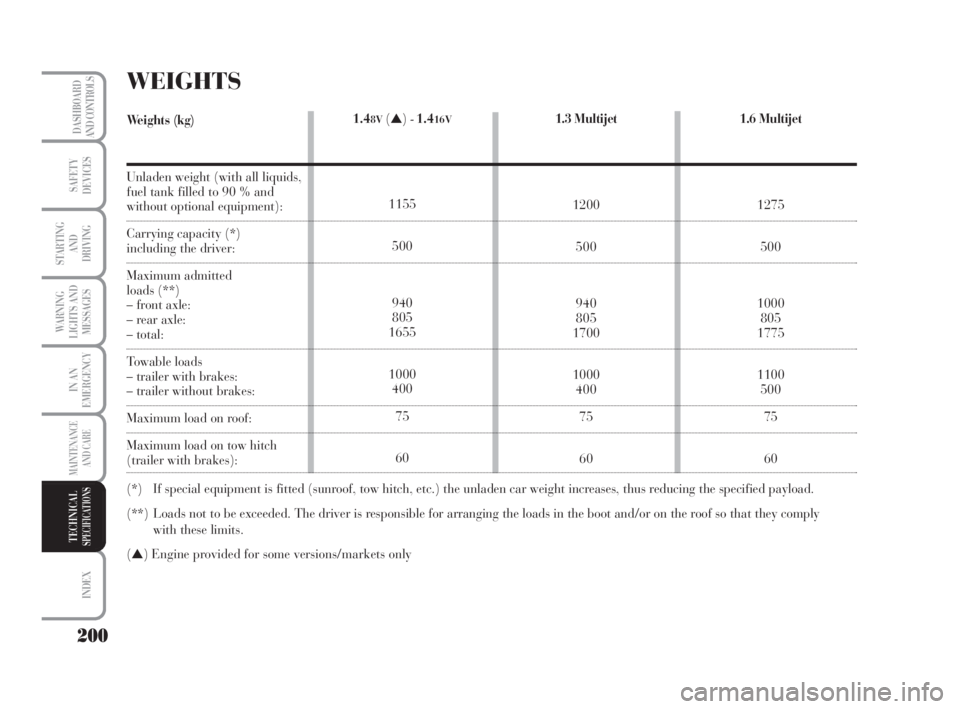
1.48V(▲)-1.416V
1155
500
940
805
1655
1000
400
75
601.3 Multijet
1200
500
940
805
1700
1000
400
75
601.6 Multijet
1275
500
1000
805
1775
1100
500
75
60
WEIGHTS
Weights (kg)
Unladen weight (with all liquids,
fuel tank filled to 90 % and
without optional equipment):
Carrying capacity (*)
including the driver:
Maximum admitted
loads (**)
– front axle:
– rear axle:
– total:
Towable loads
– trailer with brakes:
– trailer without brakes:
Maximum load on roof:
Maximum load on tow hitch
(trailer with brakes):
(*) If special equipment is fitted (sunroof, tow hitch, etc.) the unladen car weight increases, thus reducing the specified payload.
(**) Loads not to be exceeded. The driver is responsible for arranging the loads in the boot and/or on the roof so that they comply
with these limits.
(
▲) Engine provided for some versions/markets only
187-205 MUSA 1ed GB 10-07-2008 9:40 Pagina 200
Page 202 of 218
201
WARNING
LIGHTS AND
MESSAGES
INDEX
DASHBOARD
AND CONTROLS
SAFETY
DEVICES
STARTING
AND
DRIVING
IN AN
EMERGENCY
MAINTENANCE
AND CARE
TECHNICALSPECIFICATIONS
1.6 Multijet
litres
–
–
47
5 - 7
6.0
–
–
2.85
3.0
1.98
0.45
1.5kg
–
–
–
–
–
–
–
2.54
2.65
1.8
–
– 1.416V1.48V(▲)
litres
47
5 - 7
–
–
4.5
2.5
2.7
–
–
1.65
0.45
1.5 litres
47
5 - 7
–
–
4.5
2.4
2.6
–
–
1.65
0.45
1.5kg
–
–
–
–
–
2.2
2.35
–
–
1.5
–
– kg
–
–
–
–
–
2.1
2.25
–
–
1.5
–
–1.3 MultijetSpecified fuels
Original products
Unleaded petrol with no
less than 95 R.O.N.
(EN228 Specification)
Diesel fuel for motor vehicles
(EN590 specifications)
50-50 mixture of demineralised
water and PARAFLU UP
(❐)
SELENIA 20K
SELENIA WR
TUTELA CAR TECHNYX
TUTELA TOP 4
Mixture of water and
TUTELA PROFESSIONAL
SC 35
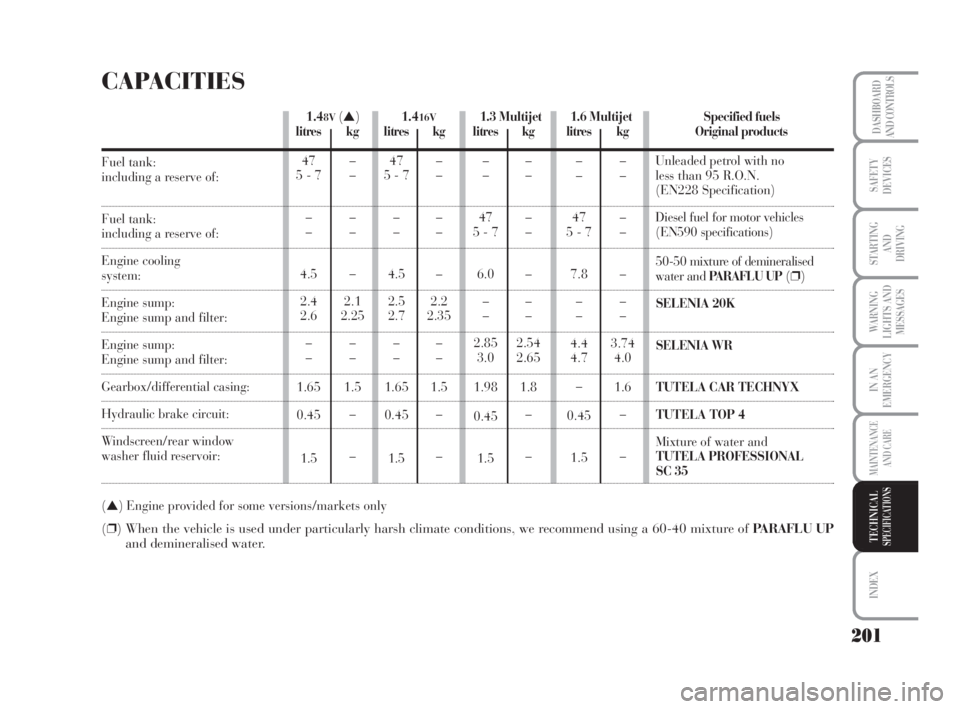
CAPACITIES
Fuel tank:
including a reserve of:
Fuel tank: including a reserve of:
Engine cooling
system:
Engine sump:
Engine sump and filter:
Engine sump:
Engine sump and filter:
Gearbox/differential casing:
Hydraulic brake circuit:
Windscreen/rear window
washer fluid reservoir:
(▲) Engine provided for some versions/markets only
(❐) When the vehicle is used under particularly harsh climate conditions, we recommend using a 60-40 mixture of PARAFLU UP
and demineralised water.
kg
–
–
–
–
–
–
–
3.74
4.0
1.6
–
– litres
–
–
47
5 - 7
7.8
–
–
4.4
4.7
–
0.45
1.5
187-205 MUSA 1ed GB 10-07-2008 9:40 Pagina 201
Page 205 of 218

204
WARNING
LIGHTS AND
MESSAGES
INDEX
DASHBOARD
AND CONTROLS
SAFETY
DEVICES
STARTING
AND
DRIVING
IN AN
EMERGENCY
MAINTENANCE
AND CARE
TECHNICALSPECIFICATIONS
FUEL CONSUMPTION
The fuel consumption figures given in the table below are determined on the basis of the homologation tests set down
by specific European Directives.
The procedures below are followed for measuring consumption:
❒urban cycle: cold starting followed by driving that simulates urban use of the car;
❒extraurban cycle: frequent accelerations in all gears, simulating extraurban use of the car: speed varies between 0
and 120 km/h;
❒combined consumption: calculated weighing about 37% of urban cycle consumption and about 63% of extraurban
consumption.
IMPORTANT The type of route, traffic situations, weather conditions, driving style, general conditions of the car, trim
level/equipment/accessories, load, climate control system, roof rack, other situations that affect air drag may lead to
different fuel consumption levels than those measured.
Fuel consumption according to Directive 1999/100/EC(litres x 100 km)Urban Extraurban Combined
1.48V(▲) 7.9 5.2 6.5
1.416V(5 gears) 8.5 5.5 6.6
1.416V(6 gears) 8.7 5.4 6.6
1.3 Multijet 70HP 5.7 4.0 4,6
1.3 Multijet 90HP 5.8 3.9 4.6
1.6 Multijet 6.2 4.2 4.9
(
▲) Engine provided for some versions/markets only
187-205 MUSA 1ed GB 10-07-2008 9:40 Pagina 204