fuel Lancia Musa 2009 Owner handbook (in English)
[x] Cancel search | Manufacturer: LANCIA, Model Year: 2009, Model line: Musa, Model: Lancia Musa 2009Pages: 218, PDF Size: 3.7 MB
Page 32 of 218
31
SAFETY
DEVICES
STARTING
AND
DRIVING
WARNING
LIGHTS AND
MESSAGES
IN AN
EMERGENCY
MAINTENANCE
AND CARE
TECHNICALSPECIFICATIONS
INDEX
DASHBOARD
AND CONTROLS
Unit - “distance” (Dist. unit)
With this function it is possible to set
the units for distance covered (km or
mi).
To set the required unit proceed as
follows:
– briefly press button MODE: km or
mi will flash on the display (accord-
ing to previous setting);
– press button +or–for setting;
– briefly press button MODEto go
back to the menu screen or press the
button for long to go back to the stan-
dard screen without storing settings.Set this value as follows:
– briefly press button MODE: either
km/l or l/100 starts flashing on the
display (depending on the previously
set parameter);
– press button +or–for selecting the
desired value;
– briefly press button MODEto go
back to the menu screen or press the
button for a prolonged time to go
back to the standard screen without
storing the settings. Setting the consumption unit
(Consumption)
This function enables setting the unit
for the amount of fuel consumed
(km/l, l/100 or mpg) depending on
the distance unit selected (either km
or miles - see previous paragraph
“Distance Unit”).
If the distance unit set is “km”, the
display enables setting of the fuel con-
sumption unit (km/l or l/100) de-
pending on the amount of fuel con-
sumed. If the distance unit set is “mi”,
the display shows the fuel consump-
tion unit in “mpg”.
007-037 MUSA 1ed GB 10-07-2008 9:36 Pagina 31
Page 37 of 218
36
SAFETY
DEVICES
STARTING
AND
DRIVING
WARNING
LIGHTS AND
MESSAGES
IN AN
EMERGENCY
MAINTENANCE
AND CARE
TECHNICALSPECIFICATIONS
INDEX
DASHBOARD
AND CONTROLS
New mission
The new mission begins after:
– “manual” resetting by the user, by
pressing the relevant button;
– “automatic” resetting, when the
“Trip distance” reaches 9999.9 km or
when the “Travel time” reaches 99.59
(99 hours and 59 minutes);
– disconnection/reconnection of the
battery.
IMPORTANT The reset operations
performed after the “General Trip”
message appears are used to also re-
set the “Trip B”, which, on its turn, is
used to reset the values of the corre-
sponding function. Travel time
This value shows the time elapsed
since the start of a new mission.
IMPORTANT If information is not
available, the message “----” will ap-
pear instead of the Trip Computer
values. Displaying of the values will
be resumed regularly when normal
operation is restored without resetting
the values displayed before the failure
nor starting a new mission.
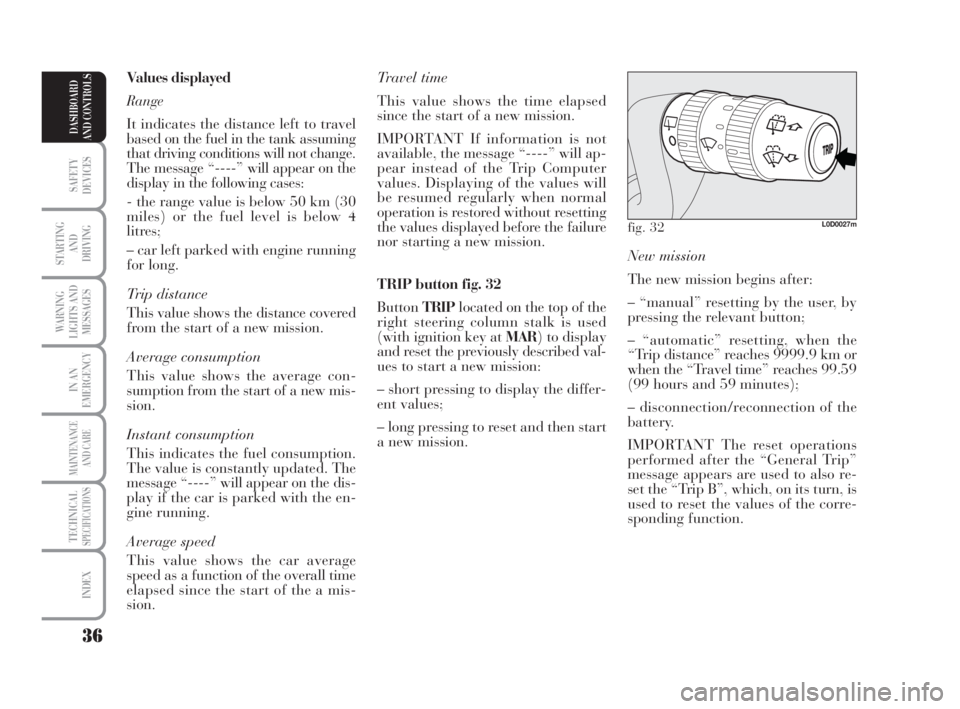
TRIP button fig. 32
ButtonTRIPlocated on the top of the
right steering column stalk is used
(with ignition key at MAR) to display
and reset the previously described val-
ues to start a new mission:
– short pressing to display the differ-
ent values;
– long pressing to reset and then start
a new mission. Values displayed
Range
It indicates the distance left to travel
based on the fuel in the tank assuming
that driving conditions will not change.
The message “----” will appear on the
display in the following cases:
- the range value is below 50 km (30
miles) or the fuel level is below 4
litres;
– car left parked with engine running
for long.
Trip distance
This value shows the distance covered
from the start of a new mission.
Average consumption
This value shows the average con-
sumption from the start of a new mis-
sion.
Instant consumption
This indicates the fuel consumption.
The value is constantly updated. The
message “----” will appear on the dis-
play if the car is parked with the en-
gine running.
Average speed
This value shows the car average
speed as a function of the overall time
elapsed since the start of the a mis-
sion.
fig. 32L0D0027m
007-037 MUSA 1ed GB 10-07-2008 9:36 Pagina 36
Page 73 of 218
72
SAFETY
DEVICES
STARTING
AND
DRIVING
WARNING
LIGHTS AND
MESSAGES
IN AN
EMERGENCY
MAINTENANCE
AND CARE
TECHNICALSPECIFICATIONS
INDEX
DASHBOARD
AND CONTROLS
INERTIAL FUEL
CUT-OFF SWITCH
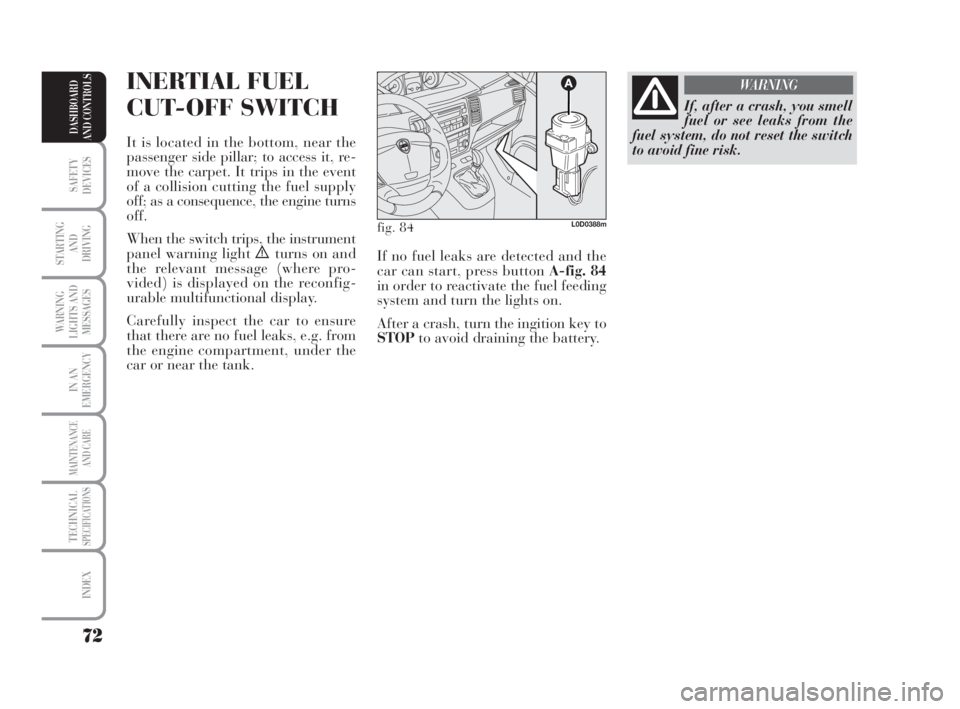
It is located in the bottom, near the
passenger side pillar; to access it, re-
move the carpet. It trips in the event
of a collision cutting the fuel supply
off; as a consequence, the engine turns
off.
When the switch trips, the instrument
panel warning light
èturns on and
the relevant message (where pro-
vided) is displayed on the reconfig-
urable multifunctional display.
Carefully inspect the car to ensure
that there are no fuel leaks, e.g. from
the engine compartment, under the
car or near the tank.
If, after a crash, you smell
fuel or see leaks from the
fuel system, do not reset the switch
to avoid fine risk.
WARNING
fig. 84L0D0388m
If no fuel leaks are detected and the
car can start, press button A-fig. 84
in order to reactivate the fuel feeding
system and turn the lights on.
After a crash, turn the ingition key to
STOPto avoid draining the battery.
038-094 MUSA 1ed GB 11-07-2008 14:10 Pagina 72
Page 93 of 218
92
SAFETY
DEVICES
STARTING
AND
DRIVING
WARNING
LIGHTS AND
MESSAGES
IN AN
EMERGENCY
MAINTENANCE
AND CARE
TECHNICALSPECIFICATIONS
INDEX
DASHBOARD
AND CONTROLS
CAR REFUELLING
PETROL ENGINES
Use only unleaded petrol.
To avoid mistakes, the diameter of the
fuel filler is too small to introduce the
beak of a leaded petrol pump. The
petrol octane rating (RON) must not
be lower than 95.
IMPORTANT An inefficient catalyst
leads to harmful exhaust emissions,
thus contributing to air pollution.
IMPORTANT Never use leaded petrol,
even in small amounts or in an emer-
gency, as this would damage the cat-
alyst beyond repair.MULTIJET ENGINES
Operation at low temperatures
If the outside temperature is very low,
the diesel thickens due to the forma-
tion of paraffin clots with consequent
anomalous operation of the fuel sup-
ply system.
In order to avoid these problems, dif-
ferent types of diesel are distributed
according to the season: summer type,
winter type and arctic type (cold,
mountain areas). If refuelling with
diesel fuel whose features are not suit-
able to the temperature of use, it is
advisable to mix TUTELA DIESEL
ART additive in the proportions
shown on the container with the fuel.
Pour the additive into the tank before
the fuel.
When using or parking the car for a
long time in the mountains or cold ar-
eas, it is advisable to refuel using lo-
cally available fuel.
In this case, it is also advisable to keep
the tank over 50% full. To guarantee the effective
operation of the system, the
sensors must be kept clean at
all times. Be careful not to
scratch or damage the sensors while
cleaning them. Avoid using dry, rough
or hard cloths. Clean the sensors with
clean water with the addition of car
shampoo if necessary. At car wash
centres that use steam or high pres-
sure water jets, clean the sensors
quickly keeping the nozzle more than
10 cm away.
The driver is, however, al-
ways held responsible for
parking and other dangerous ma-
noeuvres. When carrying out this
manoeuvre, ensure that there are no
people, animals or object within the
manoeuvring area. Parking sensors
are designed to assist drivers: in all
cases, you must always pay the ut-
most attention during potentially
dangerous manoeuvres.
WARNING
038-094 MUSA 1ed GB 11-07-2008 14:11 Pagina 92
Page 94 of 218
93
SAFETY
DEVICES
STARTING
AND
DRIVING
WARNING
LIGHTS AND
MESSAGES
IN AN
EMERGENCY
MAINTENANCE
AND CARE
TECHNICALSPECIFICATIONS
INDEX
DASHBOARD
AND CONTROLS
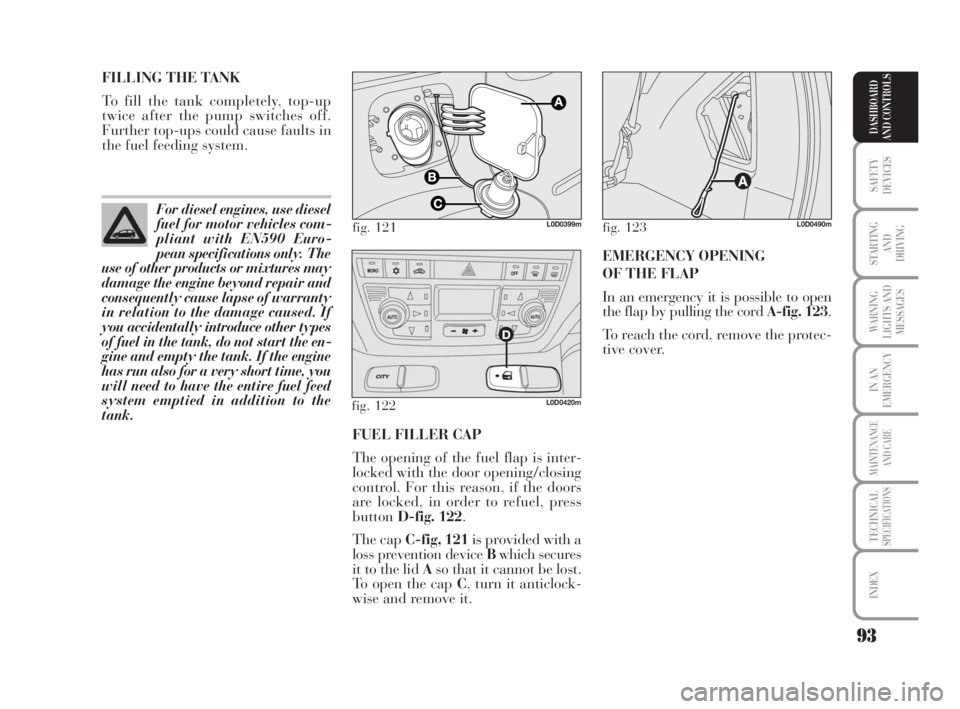
FUEL FILLER CAP
The opening of the fuel flap is inter-
locked with the door opening/closing
control. For this reason, if the doors
are locked, in order to refuel, press
buttonD-fig. 122.
The cap C-fig, 121is provided with a
loss prevention device Bwhich secures
it to the lid Aso that it cannot be lost.
To open the cap C, turn it anticlock-
wise and remove it. FILLING THE TANK
To fill the tank completely, top-up
twice after the pump switches off.
Further top-ups could cause faults in
the fuel feeding system.
For diesel engines, use diesel
fuel for motor vehicles com-
pliant with EN590 Euro-
pean specifications only. The
use of other products or mixtures may
damage the engine beyond repair and
consequently cause lapse of warranty
in relation to the damage caused. If
you accidentally introduce other types
of fuel in the tank, do not start the en-
gine and empty the tank. If the engine
has run also for a very short time, you
will need to have the entire fuel feed
system emptied in addition to the
tank.
fig. 121L0D0399m
fig. 122L0D0420m
EMERGENCY OPENING
OF THE FLAP
In an emergency it is possible to open
the flap by pulling the cord A-fig. 123.
To reach the cord, remove the protec-
tive cover.
fig. 123L0D0490m
038-094 MUSA 1ed GB 11-07-2008 14:11 Pagina 93
Page 95 of 218
94
SAFETY
DEVICES
STARTING
AND
DRIVING
WARNING
LIGHTS AND
MESSAGES
IN AN
EMERGENCY
MAINTENANCE
AND CARE
TECHNICALSPECIFICATIONS
INDEX
DASHBOARD
AND CONTROLS
peratures, etc.) and it will then calcu-
late the amount of particulates trapped
by the filter. Since this filter physically
traps particulates, it shall be cleaned
(reclaimed) at regular intervals by
burning carbon particles. The regener-
ation procedure is controlled automat-
ically by the engine control unit ac-
cording to the filter conditions and the
conditions of use of the car. During the
regeneration procedure, the following
situations may occur: limited increase
of idle speed, activation of electric fan,
limited increase of smoke, high tem-
peratures at the exhaust. These are not
anomalies; they do not impair car be-
haviour and the environment. If the
dedicated message is displayed, refer to
section “Warning lights and messages”.PROTECTING THE
ENVIRONMENT
The devices for curtailing petrol engine
emissions are the following:
❒three-way catalytic converter;
❒Lambda sensors;
❒fuel evaporation prevention system.
In addition, do not let the engine run,
even for a test, with one or more spark
plugs disconnected.
The devices for curtailing diesel fuel en-
gine emissions are the following:
❒oxidising catalytic converter;
❒exhaust gas recirculation system
(E.G.R.);
❒diesel particulate filter (DPF)
DIESEL PARTICULATE
FILTER (DPF)
(for 1.3 Multijet 90 CV versions)
The Diesel Particulate Filter is a me-
chanical filter, integral with the exhaust
system, that physically traps particu-
lates present in the exhaust gases of
Diesel engines. The diesel particulate
filter has been adopted to eliminate al-
most totally particulates in compliance
with current / future law regulations.
During normal use of the car, the en-
gine control unit records a set of data
(e.g.: travel time, type of route, tem- During refuelling, attach the cap to
the device on the inside of the flap, as
shown in the figure.
IMPORTANT The sealing of the tank
may cause light pressuring in the
tank. A little breathing off, while
slackening the cap, is absolutely nor-
mal.
After refuelling, tighten the cap by
turning it clockwise until you hear one
or more clicks. Then turn the key
clockwise and remove it and close the
flap.
Do not place naked flames
or lit cigarettes near to the
fuel filler: fire risk. Keep your face
away from the fuel filler to prevent
breathing in harmful vapours.
WARNING
The catalytic converter de-
velops high temperature
during operation. Do not park on
grass, dry leaves, pine needles or
other flammable material: fire risk.
WARNING
038-094 MUSA 1ed GB 11-07-2008 14:11 Pagina 94
Page 116 of 218
115
WARNING
LIGHTS AND
MESSAGES
IN AN
EMERGENCY
MAINTENANCE
AND CARE
TECHNICALSPECIFICATIONS
INDEX
DASHBOARD
AND CONTROLS
SAFETY
DEVICES
STARTING
AND
DRIVING
❒turn on; wait for the warning light
Yand
mto turn off (the hot-
ter the engine the shorter the time
it takes to turn off);
❒press the clutch pedal down to the
floor without touching the accel-
erator;
❒turn the ignition key to AV Vas
soon as the warning light
mturns
off. Waiting too long will waste the
work done by the glow plugs. Re-
lease the key as soon as the engine
starts.
IMPORTANT When the engine is
cold, rotating the ignition key to AV V,
the accelerator pedal must be com-
pletely released.
If the engine does not start at the first
attempt, return the ignition key to
STOP before repeating starting.
If, when the ignition key is on MAR,
the instrument panel warning light
Yremains on, turn the key to STOP
and then back to MAR; if the warning
light remains on, try with the other
keys provided with the car.
If you still cannot start the engine,
contact the Lancia Dealership.HOW TO WARM UP THE ENGINE
AFTER IT HAS JUST STARTED
(petrol and Multijet engines)
Proceed as follows:
❒drive off slowly, letting the engine
turn at medium speed. Do not ac-
celerate abruptly;
❒do not demand maximum perfor-
mance for the first few kilometres.
Wait until the engine coolant
gauge starts moving.Warning light
mwill blink
for 60 seconds after starting
or during prolonged crank-
ing to indicate a fault to the
glow plug heating system. Use the car
normally if the engine starts and con-
tact the Lancia Dealership as soon as
possible.
EMERGENCY START
If the instrument panel warning light
Ystays on steadily, you can perform
emergency start using the code on the
CODE card (see chapter “In an emer-
gency”).
STOPPING THE ENGINE
Turn the ignition to STOPwhile the en-
gine is idling.
IMPORTANT After a taxing drive,
you should allow the engine to “catch
its breath” before turning it off by let-
ting it idle to allow the temperature in
the engine compartment to fall.
Never jump start the engine
by pushing, towing or dri-
ving downhill. These actions
could cause the fuel to flow
into the catalytic converter and dam-
age it beyond repair.
Revving up before stopping
the engine is useless, it
causes unnecessary fuel con-
sumption and can damage
the engine, in particular engines
equipped with turbocharger.
IMPORTANT With engine off, do not
leave the key in the ignition switch on
MAR.
113-124 MUSA 1ed GB 10-07-2008 9:37 Pagina 115
Page 119 of 218
118
WARNING
LIGHTS AND
MESSAGES
IN AN
EMERGENCY
MAINTENANCE
AND CARE
TECHNICALSPECIFICATIONS
INDEX
DASHBOARD
AND CONTROLS
SAFETY
DEVICES
STARTING
AND
DRIVING
CONTAINING
RUNNING COSTS
Here are some suggestions which may
help you to keep the running costs of
your car down and lower the amount
of toxic emissions released into the at-
mosphere.
GENERAL CONSIDERATIONS
Car maintenance
Have checks and adjustments carried
out in accordance with the “Service
schedule”.
Tyres
Check tyre pressure regularly at least
once every four weeks: excessively low
pressure will increase consumption
because rolling resistance will be
higher.
Unnecessary loads
Do not travel with an overloaded
boot. The weight of the car (especially
when driving in town) and its trim
greatly affect consumption and sta-
bility.Roof rack/ski rack
Remove the roof rack or the ski rack
from the roof after use. These acces-
sories decrease aerodynamic penetra-
tion of the car and have a negative ef-
fect on consumption. It is better to use
a trailer to transport particularly
bulky objects.
Electric devices
Use electric devices only for the
amount of time needed. Rear heated
window, additional headlights, wind-
screen wipers and heater fan need a
considerable amount of energy, there-
fore increasing the requirement of
current increases fuel consumption
(up to +25% in the urban cycle).
Climate control
The climate control system requires
higher fuel consumption (up to +20%
in average): use the air vents when the
external temperature allows to.
Spoilers
The use of non-certified aerodynamic
items may adversely affect air drag
and consumption levels.DRIVING STYLE
Starting
Do not warm the engine up with the
car standing: the engine warms up
very slowly in these conditions, in-
creasing consumption and emissions.
It is advisable to start off immediately
and slowly keeping the engine speed
down: the engine will warm up much
faster this way.
Unnecessary actions
Avoid revving up when starting at
traffic lights or before stopping the
engine. The latter action, like dou-
bling the clutch, is unnecessary and
causes increase of consumption and
pollution.
Gear selection
Use a higher gear as soon as traffic
and road conditions allow. Using a
low gear for faster acceleration will in-
crease consumption.
In the same way improper use of a
high gear increases consumption,
emissions an engine wear.
113-124 MUSA 1ed GB 10-07-2008 9:37 Pagina 118
Page 120 of 218
119
WARNING
LIGHTS AND
MESSAGES
IN AN
EMERGENCY
MAINTENANCE
AND CARE
TECHNICALSPECIFICATIONS
INDEX
DASHBOARD
AND CONTROLS
SAFETY
DEVICES
STARTING
AND
DRIVING
Top speed
Fuel consumption considerably in-
creases as speed increases. Keep your
speed as even as possible, avoiding
unnecessary braking and acceleration
which cause excessive fuel consump-
tion and increase emissions.
Acceleration
Sudden acceleration has a very nega-
tive effect on consumptions and emis-
sions: accelerate gradually and do not
go over the maximum torque ratio.CONDITIONS OF USE
Cold starting
Short distances and frequent cold
start-ups will prevent the engine from
reaching optimal running tempera-
ture. Consequently, both consumption
(from +15 to +30% on urban cycle )
and emissions will increase.
Traffic and road conditions
Rather high consumption is caused by
heavy traffic, for instance when trav-
elling in a queue with frequent use of
low gears or in cities with many traf-
fic lights. Mountain and rough roads
also have a negative effect on con-
sumption.
Traffic hold-ups
During prolonged hold-ups (level
crossings) the engine should be
switched off.TOWING TRAILERS
IMPORTANT NOTES
The car must be provided with a
type-approved tow hitch and ade-
quate electrical system to tow cara-
vans or trailers. Installation must be
performed by specialised personnel
who will issue the required papers for
travelling on roads.
Install any specific and/or additional
rear-view mirrors as specified by law.
Remember that when towing a trailer,
steep hills are harder to climb, the
braking spaces increase and overtak-
ing takes longer depending on the
overall weight.
When driving downhill engage a low
gear, rather than constantly using the
brake.
113-124 MUSA 1ed GB 10-07-2008 9:37 Pagina 119
Page 126 of 218
125
IN AN
EMERGENCY
MAINTENANCE
AND CARE
TECHNICALSPECIFICATIONS
INDEX
DASHBOARD
AND CONTROLS
SAFETY
DEVICES
STARTING
AND
DRIVING
USE OF
THE CAR
WARNING
LIGHTS AND
MESSAGES
WARNING LIGHTS AND MESSAGES
GENERAL WARNINGS..................................... 126
LOW BRAKE FLUID......................................... 126
HANDBRAKE ON.............................................. 126
AIRBAG FAILURE............................................ 126
HOT ENGINE COOLANT................................. 127
LOW BATTERY CHARGE................................ 127
LOW ENGINE OIL PRESSURE .......................... 128
EXHAUSTED OIL ............................................ 128
“DUALDRIVE” ELECTRIC
POWER STEERING FAILURE ........................ 128
INCOMPLETE DOOR LOCKING...................... 128
SEAT BELTS NOT FASTENED ........................... 128
EBD SYSTEM FAILURE................................... 129
INJECTION SYSTEM FAILURE........................ 129
EOBD ENGINE CONTROL
SYSTEM FAILURE .......................................... 129
FRONT PASSENGER AIRBAG DEACTIVATED 130
ABS SYSTEM FAILURE.................................... 130
FUEL RESERVE............................................... 130
GLOW PLUG HEATING.................................. 131
GLOW PLUG HEATING FAILURE................... 131
WATER IN DIESEL FUEL FILTER.................. 131LANCIA CODE PROTECTION
SYSTEM FAILURE........................................... 131
REAR FOG LIGHTS.......................................... 131
GENERIC FAILURE INDICATION ................... 132
BRAKE PAD WEAR ......................................... 133
PARTICULATE TRAP CLOGGED ................... 133
TAIL LIGHTS AND LOW BEAMS..................... 133
FOLLOW ME HOME........................................ 133
FRONT FOG LIGHTS ...................................... 133
LEFT-HAND DIRECTION INDICATOR............ 134
RIGHT-HAND DIRECTION INDICATOR.......... 134
“DUALDRIVE” ELECTRIC
POWER STEERING ......................................... 134
CRUISE CONTROL .......................................... 134
MAIN BEAM HEADLIGHTS.............................. 134
POSSIBLE ICE ON THE ROAD ........................ 134
LIMITED RANGE ............................................. 134
125-134 MUSA 1ed GB 10-07-2008 9:38 Pagina 125