lock Lancia Voyager 2012 Owner handbook (in English)
[x] Cancel search | Manufacturer: LANCIA, Model Year: 2012, Model line: Voyager, Model: Lancia Voyager 2012Pages: 344, PDF Size: 3.95 MB
Page 38 of 344
2. Slide the Child Protection Door
Lock control outward (away from the
vehicle) to disengage the Child Pro-
tection Door Lock.
3. Repeat Steps 1 and 2 on the oppo-
site sliding door (for versions/
markets, where provided).
NOTE:
After setting the Child Protec-tion Door Lock system, always
test the door from the inside to
make certain it is in the desired
position.
The power sliding side door switches will not open the power
sliding doors if the vehicle is in
gear or the vehicle speed is
above 0 km/h.
The power sliding door will op- erate from the outside door
handle, the RKE transmitter, the
switches on the overhead con-
sole, or the switches located on
the trim panel just in front of the
power sliding door when the
shift lever is in PARK, regardless
of the child lock lever position. LIFTGATE
On vehicles equipped with power
locks, the liftgate can be unlocked
using the Remote Keyless Entry
(RKE) transmitter button, or by acti-
vating the power door lock switches
located on the front doors.
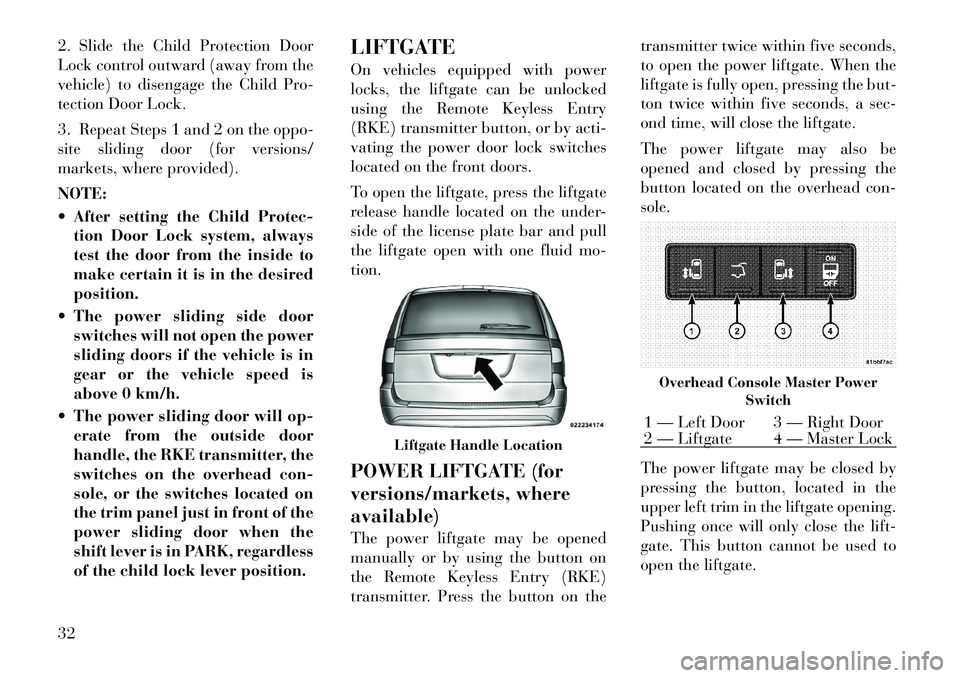
To open the liftgate, press the liftgate
release handle located on the under-
side of the license plate bar and pull
the liftgate open with one fluid mo-
tion.
POWER LIFTGATE (for
versions/markets, where
available)
The power liftgate may be opened
manually or by using the button on
the Remote Keyless Entry (RKE)
transmitter. Press the button on the transmitter twice within five seconds,
to open the power liftgate. When the
liftgate is fully open, pressing the but-
ton twice within five seconds, a sec-
ond time, will close the liftgate.
The power liftgate may also be
opened and closed by pressing the
button located on the overhead con-
sole.
The power liftgate may be closed by
pressing the button, located in the
upper left trim in the liftgate opening.
Pushing once will only close the lift-
gate. This button cannot be used to
open the liftgate.
Liftgate Handle Location
Overhead Console Master Power
Switch1 — Left Door 3 — Right Door
2 — Liftgate 4 — Master Lock
32
Page 40 of 344

Gas props support the liftgate in the
open position. However, because the
gas pressure drops with temperature,
it may be necessary to assist the props
when opening the liftgate in cold
weather.
OCCUPANT RESTRAINTS
Some of the most important safety
features in your vehicle are the re-
straint systems:
Three-point lap and shoulder beltsfor all seating positions
Advanced Front Air Bags for driver and front passenger
Supplemental Active Head Re- straints (AHR) located on top of the
front seats (integrated into the head
restraint)
Supplemental Side Air Bag Inflat- able Curtains (SABIC) that span
the front, second, and third row
seating for the driver and passen-
gers seated next to a window
Supplemental Seat-Mounted Side Air Bags (SAB)
An energy-absorbing steering col- umn and steering wheel Knee bolsters/blockers for front
seat occupants (for versions/
markets, where provided)
Front seat belts incorporate preten- sioners that may enhance occupant
protection by managing occupant
energy during an impact event
All seat belt systems (except the driver’s) include Automatic Lock-
ing Retractors (ALRs), which lock
the seat belt webbing into position
by extending the belt all the way
out and then adjusting the belt to
the desired length to restrain a child
seat or secure a large item in a seat
If you will be carrying children too
small for adult-sized seat belts, the
seat belts or the ISOFIX feature also
can be used to hold infant and child
restraint systems. For more informa-
tion on ISOFIX, see ISOFIX — Child
Seat Anchorage System.
NOTE:
The Advanced Front Air Bags have
a multistage inflator design. This
allows the air bag to have different
rates of inflation based on several
factors, including the severity and
type of collision. Please pay close attention to the infor-
mation in this section. It tells you how
to use your restraint system properly,
to keep you and your passengers as
safe as possible.
WARNING!
In a collision, you and your passen-
gers can suffer much greater injuries
if you are not properly buckled up.
You can strike the interior of your
vehicle or other passengers, or you
can be thrown out of the vehicle.
Always be sure you and others in
your vehicle are buckled up prop-
erly.
Buckle up even though you are an
excellent driver, even on short trips.
Someone on the road may be a poor
driver and cause a collision that in-
cludes you. This can happen far away
from home or on your own street.
Research has shown that seat belts
save lives, and they can reduce the
seriousness of injuries in a collision.
Some of the worst injuries happen
when people are thrown from the ve-
hicle. Seat belts reduce the possibility
of ejection and the risk of injury
34
Page 41 of 344

caused by striking the inside of the
vehicle. Everyone in a motor vehicle
should be belted at all times.
LAP/SHOULDER BELTS
All seating positions in your vehicle
are equipped with combination lap/
shoulder belts.
The belt webbing in the retractor is
designed to lock during very sudden
stops or collisions. This feature allows
the shoulder part of the belt to move
freely with you under normal condi-
tions. However, in a collision the belt
will lock and reduce the risk of you
striking the inside of the vehicle or
being thrown out.WARNING!
It is dangerous to ride in a cargoarea, inside or outside of a vehicle.
In a collision, people riding in
these areas are more likely to be
seriously injured or killed.
Do not allow people to ride in any
area of your vehicle that is not
equipped with seats and seat
belts.
(Continued)
WARNING!(Continued)
Be sure everyone in your vehicle is
in a seat and using a seat belt
properly.
Wearing a seat belt incorrectly is
dangerous. Seat belts are designed
to go around the large bones of
your body. These are the strongest
parts of your body and can take
the forces of a collision the best.
Wearing your belt in the wrong
place could make your injuries in
a collision much worse. You might
suffer internal injuries, or you
could even slide out of part of the
belt. Follow these instructions to
wear your seat belt safely and to
keep your passengers safe, too.
Two people should never be belted
into a single seat belt. People
belted together can crash into one
another in a collision, hurting one
another badly. Never use a lap/
shoulder belt or lap belt for more
than one person, no matter what
their size. Lap/Shoulder Belt Operating
Instructions
1. Enter the vehicle and close the
door. Sit back and adjust the seat.
2. The seat belt latch plate is near the
seatback of the front seats and next to
your arm in the rear seats. Grasp the
latch plate and pull out the belt. Slide
the latch plate up the webbing as far
as necessary to allow the belt to go
around your lap.
Pulling Out Belt and Latch Plate
35
Page 44 of 344

3. Slide the latch plate upward over
the folded webbing. The folded web-
bing must enter the slot at the top of
the latch plate.
4. Continue to slide the latch plate up
until it clears the folded webbing.
Adjustable Upper Shoulder Belt
Anchorage
In the front seats and the second row
outboard seats, the shoulder belt an-
chorage can be adjusted upward or
downward to help position the belt
away from your neck. The upper an-
chorage can be adjusted upward by
pushing anywhere on the anchorage.
To move the anchorage downward,
squeeze the actuation buttons while
simultaneously pushing down on the
anchorage assembly.
As a guide, if you are shorter than
average you will prefer a lower posi-
tion, and if you are taller than average
you will prefer a higher position.
When you release the anchorage, try
to move it up or down to make sure
that it is locked in position.SEAT BELTS IN
PASSENGER SEATING
POSITIONS
The seat belts in the passenger seating
positions are equipped with Auto-
matic Locking Retractors (ALR)
which are used to secure a child re-
straint system. For additional infor-
mation, refer to “Installing Child Re-
straints Using The Vehicle Seat Belt”
under the “Child Restraints” section.
The chart below defines the type of
feature for each seating position.
Driver Center Passen-
ger
First
Row N/A N/A ALR
Second Row ALR N/A ALR
Third Row ALR Cinch ALR
N/A — Not Applicable
ALR — Automatic Locking Retrac- tor
If the passenger seating position is
equipped with an ALR and is being
used for normal usage: Only pull the belt webbing out far
enough to comfortably wrap around
the occupant's mid-section so as to
not activate the ALR. If the ALR is
activated, you will hear a ratcheting
sound as the belt retracts. Allow the
webbing to retract completely in this
case and then carefully pull out only
the amount of webbing necessary to
comfortably wrap around the occu-
pant's mid-section. Slide the latch
plate into the buckle until you hear a
"click."
AUTOMATIC LOCKING
RETRACTOR MODE (ALR)
In this mode, the shoulder belt is au-
tomatically pre-locked. The belt will
still retract to remove any slack in the
shoulder belt. The Automatic Locking
Mode is available on all passenger-
seating positions with a combination
lap/shoulder belt. Use the Automatic
Locking Mode anytime a child safety
seat is installed in a seating position
that has a belt with this feature. Chil-
dren 12 years old and under should
always be properly restrained in the
rear seat.
38
Page 45 of 344

How To Engage The Automatic
Locking Mode
1. Buckle the combination lap and
shoulder belt.
2. Grasp the shoulder portion and
pull downward until the entire belt is
extracted.
3. Allow the belt to retract. As the
belt retracts, you will hear a clicking
sound. This indicates the safety belt is
now in the Automatic Locking Mode.
How To Disengage The Automatic
Locking Mode
Unbuckle the combination lap/
shoulder belt and allow it to retract
completely to disengage the Auto-
matic Locking Mode and activate the
vehicle sensitive (emergency) locking
mode.
WARNING!
The belt and retractor assemblymust be replaced if the seat belt
assembly Automatic Locking Re-
tractor (ALR) feature or any other
seat belt function is not working
properly when checked according
to the procedures in the Service
Manual.
Failure to replace the belt and re-
tractor assembly could increase
the risk of injury in collisions.
ENERGY MANAGEMENT
FEATURE
This vehicle has a safety belt system
with an energy management feature
in the front seating positions to help
further reduce the risk of injury in the
event of a head-on collision. This
safety belt system has a retractor as-
sembly that is designed to release
webbing in a controlled manner. This
feature is designed to help reduce the
belt force acting on the occupant’s
chest.
WARNING!
The belt and retractor assembly must be replaced if the seat belt
assembly “automatic locking re-
tractor” feature or any other seat
belt function is not working prop-
erly when checked according to
the procedures in the Service
Manual.
Failure to replace the belt and re-
tractor assembly could increase
the risk of injury in collisions.
SEAT BELT
PRETENSIONERS
The seat belts for both front seating
positions are equipped with preten-
sioning devices that are designed to
remove slack from the seat belt in the
event of a collision. These devices may
improve the performance of the seat
belt by assuring that the belt is tight
about the occupant early in a colli-
sion. Pretensioners work for all size
occupants, including those in child
restraints.
39
Page 47 of 344

NOTE:
For more information on properly
adjusting and positioning the head
restraint, refer to “Adjusting Ac-
tive Head Restraints” in “Under-
standing The Features Of Your Ve-
hicle”.
Resetting Active Head Restraints
(AHR)
If the Active Head Restraints are trig-
gered in a collision, you must reset the
head restraint on the driver’s and
front passenger seat. You can recog-
nize when the Active Head Restraint
has been triggered by the fact that
they have moved forward (as shown
in step three of the resetting proce-
dure).
1. Grasp the deployed AHR from the
rear seat.2. Position the hands on the top of the
deployed AHR at a comfortable posi-
tion.
3. Pull
downthenrearward to-
wards the rear of the vehicle then
down to engage the locking mecha-
nism. 4. The AHR front soft foam and trim
half should lock into the back decora-
tive plastic half.
NOTE:
If you have difficulties or prob-
lems resetting the Active Head
Restraints, see an authorized
dealer.
For safety reasons, have the Ac- tive Head Restraints checked by
a qualified specialist at an au-
thorized dealer.
ACTIVE HOOD SYSTEM
The Active Hood system is intended to
enhance pedestrian protection by el-
evating the vehicle’s hood upon an
impact with a pedestrian or other ob-
ject. The system is automatically acti-
vated when the vehicle is moving
Hand Positioning Points On AHR
1 — Downward Movement
2 — Rearward Movement3 — Final Downward Movement To
Engage Locking Mechanism
AHR In Reset Position
41
Page 48 of 344
within a specified vehicle speed range.
In order to detect a range of pedestri-
ans, other objects that are impacted
may result in an Active Hood deploy-
ment.
Deployment Sensors And Controls
The Electronic Pedestrian Protection
Module (EPPM) determines if deploy-
ment of the actuators in a frontal im-
pact is required. Based on the impact
sensors signals, the EPPM determines
when to deploy the actuators. The
impact sensors are located within the
front bumper area.
The EPPM monitors the readiness of
the electronic parts of the Active Hood
system whenever the ignition switch is
in the START or ON/RUN position. If
the key is in the LOCK position, in the
ACC position, or not in the ignition,
the Active Hood system is not on and
the Active Hood will not deploy.
The EPPM contains a backup power
supply system that may deploy the
actuators even if the battery loses
power or it becomes disconnected
prior to deployment.Service Active Hood System
If the EPPM has deployed the Active
Hood, or if it detects a malfunction in
any part of the system, it turns on the
Air Bag Warning Light and it will
display the “SERVICE ACTIVE
HOOD” message in the Electronic Ve-
hicle Information Center (EVIC), for
versions/markets, where provided. A
single chime will sound if the Air Bag
Warning Light comes on again after
initial startup. It also includes diag-
nostics that will illuminate the Air Bag
Warning Light if a malfunction is
noted that could affect the Active
Hood system. The diagnostics also re-
cord the nature of the malfunction. If
the Air Bag Warning Light is illumi-
nated, or if “SERVICE ACTIVE
HOOD” appears in the EVIC, see
your authorized dealer.
In the event of an Active Hood deploy-
ment, the vehicle should be serviced
by an authorized dealer. The hood
hinges must be serviced and the ac-
tuator assemblies replaced to restore
system functionality.
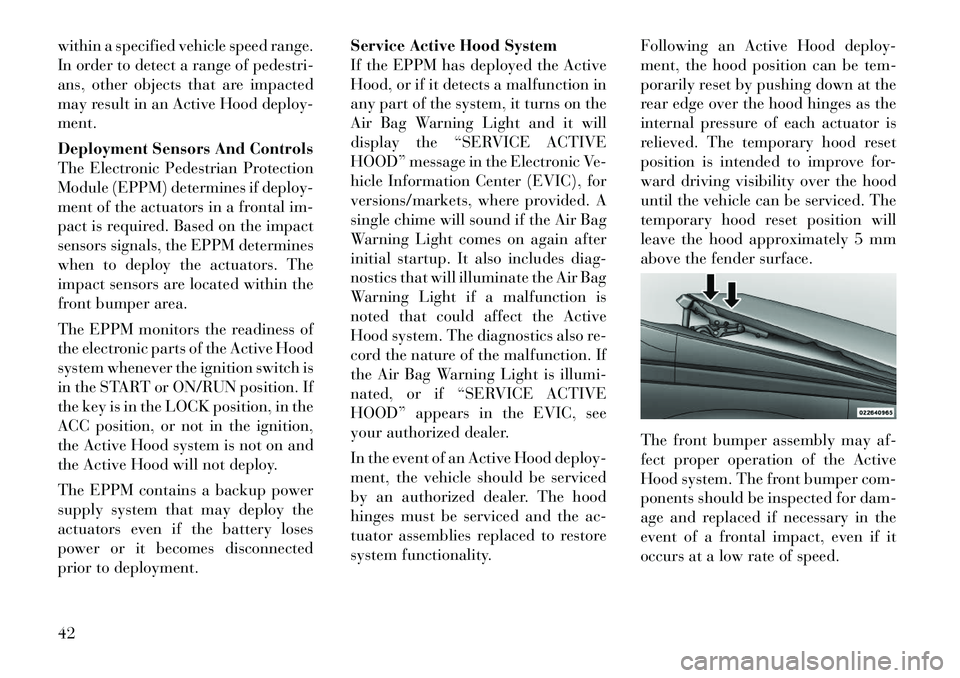
Following an Active Hood deploy-
ment, the hood position can be tem-
porarily reset by pushing down at the
rear edge over the hood hinges as the
internal pressure of each actuator is
relieved. The temporary hood reset
position is intended to improve for-
ward driving visibility over the hood
until the vehicle can be serviced. The
temporary hood reset position will
leave the hood approximately 5 mm
above the fender surface.
The front bumper assembly may af-
fect proper operation of the Active
Hood system. The front bumper com-
ponents should be inspected for dam-
age and replaced if necessary in the
event of a frontal impact, even if it
occurs at a low rate of speed.42
Page 53 of 344
WARNING!
Your vehicle is equipped with leftand right Supplemental Side Air
Bag Inflatable Curtain (SABIC),
do not stack luggage or other
cargo up high enough to block the
location of the SABIC. The area
where the SABIC is located should
remain free from any obstruc-
tions.
Do not use accessory seat covers
or place objects between you and
the side air bags; the performance
could be adversely affected
and/or objects could be pushed
into you, causing serious injury.
Knee Impact Bolsters (for
versions/markets, where
provided)
The Knee Impact Bolsters help pro-
tect the knees of the driver and the
front passenger, and position front oc-
cupants for the best interaction with
the Advanced Front Air Bags. Along with seat belts and pretension-
ers, Advanced Front Air Bags work
with the knee bolsters to provide im-
proved protection for the driver and
front passenger. Side air bags also
work with seat belts to improve occu-
pant protection.
Here are some simple steps you can
take to minimize the risk of harm
from a deploying air bag:
Children 12 years old and under
should always ride buckled up in a
rear seat.
WARNING!
Infants in rear-facing child re-
straints should never ride in the
front seat of a vehicle with a passen-
ger Advanced Front Air Bag. An air
bag deployment can cause severe in-
jury or death to infants in that posi-
tion.
Children that are not big enough to
wear the vehicle seat belt properly
(see Section on Child Restraints)
should be secured in the rear seat in
child restraints or belt-positioning
booster seats. Older children who do not use child restraints or belt-
positioning booster seats should ride
properly buckled up in the rear seat.
Never allow children to slide the
shoulder belt behind them or under
their arm.
You should read the instructions pro-
vided with your child restraint to
make sure that you are using it prop-
erly.
All occupants should always wear
their lap and shoulder belts properly.
The driver and front passenger seats
should be moved back as far as prac-
tical to allow the Advanced Front Air
Bags room to inflate.
Do not lean against the door or win-
dow. If your vehicle has side air bags,
and deployment occurs, the side air
bags will inflate forcefully into the
space between you and the door.
If the air bag system in this vehicle
needs to be modified to accommodate
a disabled person, contact the Cus-
tomer Center.
47
Page 56 of 344
occupant and the door. The SAB fully
inflate in about 10 milliseconds. The
side air bag moves at a very high
speed and with such a high force that
it could injure you if you are not
seated properly, or if items are posi-
tioned in the area where the side air
bag inflates. This especially applies to
children.
Supplemental Side Air Bag
Inflatable Curtain (SABIC)
Inflator Units
During collisions where the impact is
confined to a particular area of the
side of the vehicle, the ORC may de-
ploy the SABIC air bags, depending
on the severity and type of collision. In
these events, the ORC will deploy the
SABIC only on the impact side of the
vehicle.
A quantity of non-toxic gas is gener-
ated to inflate the side curtain air bag.
The inflating side curtain air bag
pushes the outside edge of the head-
liner out of the way and covers the
window. The air bag inflates in about
30 milliseconds (about one-quarter of
the time that it takes to blink your
eyes) with enough force to injure youif you are not belted and seated prop-
erly, or if items are positioned in the
area where the side curtain air bag
inflates. This especially applies to
children. The side curtain air bag is
only about 9 cm thick when it is in-
flated.
Because air bag sensors estimate de-
celeration over time, vehicle speed
and damage are not good indicators of
whether or not an air bag should have
deployed.
NOTE:
In a rollover the pretensioners
and/or SAB and SABIC air bags
may deploy on both sides of the
vehicle.
Front And Side Impact Sensors
In front and side impacts, impact sen-
sors can aid the ORC in determining
appropriate response to impact
events.
Enhanced Accident Response
System
In the event of an impact causing air
bag deployment, if the communica-
tion network remains intact, and the
power remains intact, depending on
the nature of the event the ORC will
determine whether to have the En-
hanced Accident Response System
perform the following functions:
Cut off fuel to the engine.
Flash hazard lights as long as the
battery has power or until the igni-
tion key is turned off.
Turn on the interior lights, which remain on as long as the battery has
power or until the ignition key is
removed.
Unlock the doors automatically.
In order to reset the Enhanced Acci-
dent Response System functions after
an event, the ignition switch must be
changed from IGN ON to IGN OFF.
If A Deployment Occurs
The Advanced Front Air Bags are de-
signed to deflate immediately after
deployment.
NOTE:
Front and/or side air bags will not
deploy in all collisions. This does
not mean something is wrong with
the air bag system.
50
Page 58 of 344

WARNING!(Continued)
Do not attempt to modify any part
of your air bag system. The air
bag may inflate accidentally or
may not function properly if
modifications are made. Take
your vehicle to an authorized
dealer for any air bag system ser-
vice. If your seat including your
trim cover and cushion needs to
be serviced in any way (including
removal or loosening/tightening
of seat attachment bolts), take the
vehicle to your authorized dealer.
Only manufacturer approved seat
accessories may be used. If it is
necessary to modify the air bag
system for persons with disabili-
ties, contact your authorized
dealer.
Air Bag Warning Light You will want to have the
air bags ready to inflate for
your protection in a colli-
sion. The Air Bag Warning
Light monitors the internal circuits
and interconnecting wiring associated
with air bag system electrical compo- nents. While the air bag system is
designed to be maintenance free, if
any of the following occurs, have an
authorized dealer service the air bag
system immediately.
The Air Bag Warning Light does
not come on during the four to eight
seconds when the ignition switch is
first turned to the ON/RUN posi-
tion.
The Air Bag Warning Light remains on after the four to eight-second
interval.
The Air Bag Warning Light comes on intermittently or remains on
while driving.
NOTE:
If the speedometer, tachometer, or
any engine related gauges are not
working, the Occupant Restraint
Controller (ORC) may also be dis-
abled. The air bags may not be
ready to inflate for your protec-
tion. Promptly check the fuse
block for blown fuses. Refer to the
label located on the inside of the
fuse block cover for the proper air bag fuses. See your authorized
dealer if the fuse is good.
EVENT DATA RECORDER
(EDR)
This vehicle is equipped with an event
data recorder (EDR). The main pur-
pose of an EDR is to record, in certain
crash or near crash-like situations,
such as an air bag deployment or hit-
ting a road obstacle, data that will
assist in understanding how a vehi-
cle’s systems performed. The EDR is
designed to record data related to ve-
hicle dynamics and safety systems for
a short period of time, typically
30 seconds or less. The EDR in this
vehicle is designed to record such data
as:
How various systems in your ve-
hicle were operating;
Whether or not the driver and pas- senger safety belts were buckled/
fastened;
How far (if at all) the driver was depressing the accelerator and/or
brake pedal; and,
How fast the vehicle was traveling.52