ECU Lancia Voyager 2012 Owner handbook (in English)
[x] Cancel search | Manufacturer: LANCIA, Model Year: 2012, Model line: Voyager, Model: Lancia Voyager 2012Pages: 344, PDF Size: 3.95 MB
Page 174 of 344

17. Vehicle Security Light (for
versions/markets, where provided)This light will flash at a fast
rate for approximately
15 seconds, when the ve-
hicle security alarm is arm-
ing, and then will flash slowly until
the vehicle is disarmed.
18. Brake Warning Light This light monitors various
brake functions, including
brake fluid level and parking
brake application. If the brake light
turns on it may indicate that the park-
ing brake is applied, that the brake
fluid level is low, or that there is a
problem with the anti-lock brake sys-
tem reservoir.
If the light remains on when the park-
ing brake has been disengaged, and
the fluid level is at the full mark on the
master cylinder reservoir, it indicates
a possible brake hydraulic system
malfunction or that a problem with
the Brake Booster has been detected
by the Anti-Lock Brake System (ABS)
/ Electronic Stability Control (ESC)
system. In this case, the light will re-
main on until the condition has been corrected. If the problem is related to
the brake booster, the ABS pump will
run when applying the brake and a
brake pedal pulsation may be felt dur-
ing each stop.
The dual brake system provides a re-
serve braking capacity in the event of
a failure to a portion of the hydraulic
system. A leak in either half of the
dual brake system is indicated by the
Brake Warning Light, which will turn
on when the brake fluid level in the
master cylinder has dropped below a
specified level.
The light will remain on until the
cause is corrected.
NOTE:
The light may flash momentarily
during sharp cornering maneu-
vers, which change fluid level con-
ditions. The vehicle should have
service performed, and the brake
fluid level checked.
If brake failure is indicated, immedi-
ate repair is necessary.
WARNING!
Driving a vehicle with the red brake
light on is dangerous. Part of the
brake system may have failed. It will
take longer to stop the vehicle. You
could have a collision. Have the ve-
hicle checked immediately.
Vehicles equipped with the Anti-Lock
Brake System (ABS), are also
equipped with Electronic Brake Force
Distribution (EBD). In the event of an
EBD failure, the Brake Warning Light
will turn on along with the ABS Light.
Immediate repair to the ABS system is
required.
Operation of the Brake Warning Light
can be checked by turning the ignition
switch from the OFF position to the
ON/RUN position. The light should
illuminate for approximately two sec-
onds. The light should then turn off
unless the parking brake is applied or
a brake fault is detected. If the light
does not illuminate, have the light
inspected by an authorized dealer.
168
Page 232 of 344
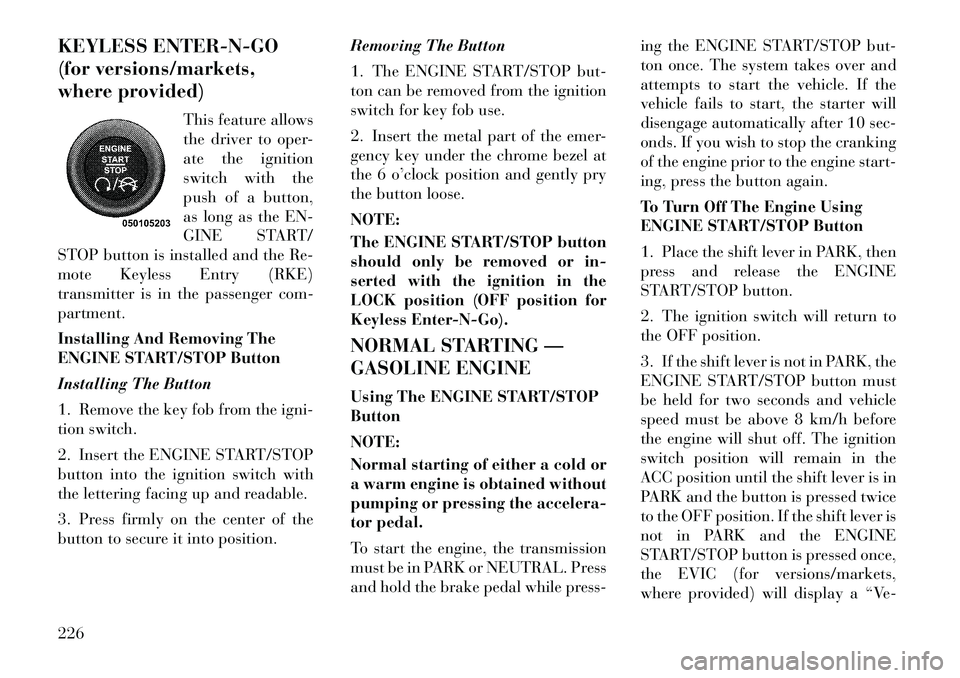
KEYLESS ENTER-N-GO
(for versions/markets,
where provided)This feature allows
the driver to oper-
ate the ignition
switch with the
push of a button,
as long as the EN-
GINE START/
STOP button is installed and the Re-
mote Keyless Entry (RKE)
transmitter is in the passenger com-
partment.
Installing And Removing The
ENGINE START/STOP Button
Installing The Button
1. Remove the key fob from the igni-
tion switch.
2. Insert the ENGINE START/STOP
button into the ignition switch with
the lettering facing up and readable.
3. Press firmly on the center of the
button to secure it into position. Removing The Button
1. The ENGINE START/STOP but-
ton can be removed from the ignition
switch for key fob use.
2. Insert the metal part of the emer-
gency key under the chrome bezel at
the 6 o’clock position and gently pry
the button loose.
NOTE:
The ENGINE START/STOP button
should only be removed or in-
serted with the ignition in the
LOCK position (OFF position for
Keyless Enter-N-Go).
NORMAL STARTING —
GASOLINE ENGINE
Using The ENGINE START/STOP
Button
NOTE:
Normal starting of either a cold or
a warm engine is obtained without
pumping or pressing the accelera-
tor pedal.
To start the engine, the transmission
must be in PARK or NEUTRAL. Press
and hold the brake pedal while press-ing the ENGINE START/STOP but-
ton once. The system takes over and
attempts to start the vehicle. If the
vehicle fails to start, the starter will
disengage automatically after 10 sec-
onds. If you wish to stop the cranking
of the engine prior to the engine start-
ing, press the button again.
To Turn Off The Engine Using
ENGINE START/STOP Button
1. Place the shift lever in PARK, then
press and release the ENGINE
START/STOP button.
2. The ignition switch will return to
the OFF position.
3. If the shift lever is not in PARK, the
ENGINE START/STOP button must
be held for two seconds and vehicle
speed must be above 8 km/h before
the engine will shut off. The ignition
switch position will remain in the
ACC position until the shift lever is in
PARK and the button is pressed twice
to the OFF position. If the shift lever is
not in PARK and the ENGINE
START/STOP button is pressed once,
the EVIC (for versions/markets,
where provided) will display a “Ve-226
Page 240 of 344

through underdrive first, second,
third, and fourth gears, direct fifth
gear and overdrive sixth gear. The
DRIVE position provides optimum
driving characteristics under all nor-
mal operating conditions.
When frequent transmission shifting
occurs (such as when operating the
vehicle under heavy loading condi-
tions, in hilly terrain, traveling into
strong head winds, or while towing
heavy trailers), use the Electronic
Range Select (ERS) shift control (de-
scribed below) to select a lower gear
range. Under these conditions, using a
lower gear range will improve perfor-
mance and extend transmission life
by reducing excessive shifting and
heat buildup.
During cold temperatures, transmis-
sion operation may be modified de-
pending on engine and transmission
temperature as well as vehicle speed.
This feature improves warm up time
of the engine and transmission to
achieve maximum efficiency. Engage-
ment of the torque converter clutch is
inhibited until the transmission fluid
is warm (refer to the “Note” under“Torque Converter Clutch” in this
section). During extremely cold tem-
peratures (27°C or below), operation
may briefly be limited to third gear
only. Normal operation will resume
once the transmission temperature
has risen to a suitable level.
Transmission Limp Home Mode
Transmission function is monitored
electronically for abnormal condi-
tions. If a condition is detected that
could result in transmission damage,
Transmission Limp Home Mode is ac-
tivated. In this mode, the transmis-
sion remains in third gear regardless
of which forward gear is selected.
PARK, REVERSE, and NEUTRAL
will continue to operate. The Mal-
function Indicator Light (MIL) may
be illuminated. Limp Home Mode al-
lows the vehicle to be driven to an
authorized dealer for service without
damaging the transmission.
In the event of a momentary problem,
the transmission can be reset to regain
all forward gears by performing the
following steps:
1. Stop the vehicle.
2. Shift the transmission into PARK.
3. Turn the engine OFF.
4. Wait approximately 10 seconds.
5. Restart the engine.
6. Shift into the desired gear range. If
the problem is no longer detected, the
transmission will return to normal op-
eration.
NOTE:
Even if the transmission can be
reset, we recommend that you visit
your authorized dealer at your
earliest possible convenience.
Your authorized dealer has diag-
nostic equipment to determine if
the problem could recur.
If the transmission cannot be reset,
authorized dealer service is required.
Electronic Range Select (ERS)
Operation
The Electronic Range Select (ERS)
shift control allows the driver to limit
the highest available gear when the
shift lever is in the DRIVE position.
For example, if you shift the transmis-
sion into 3 (third gear), the transmis-
sion will never shift above third gear,
234
Page 255 of 344

REPLACEMENT TIRES
The tires on your new vehicle provide
a balance of many characteristics.
They should be inspected regularly
for wear and correct cold tire inflation
pressure. The manufacturer strongly
recommends that you use tires
equivalent to the originals in size,
quality and performance when re-
placement is needed. Please see
“Tread Wear Indicators” and “Tire
and Loading Information” placard
for the size designation of your tire.
The Load Index and Speed Symbol
for your tire will be found on the
original equipment tire sidewall. See
the Tire Sizing Chart example found
in the Tire Safety Information section
of this manual for more information
relating to the Load Index and Speed
Symbol of a tire.
It is recommended to replace the two
front tires or two rear tires as a pair.
Replacing just one tire can seriously
affect your vehicle’s handling. If you
ever replace a wheel, make sure that
the wheel’s specifications match those
of the original wheels.It is recommended you contact your
original equipment or an authorized
tire dealer with any questions you
may have on tire specifications or ca-
pability. Failure to use equivalent re-
placement tires may adversely affect
the safety, handling, and ride of your
vehicle.
WARNING!
Do not use a tire, wheel size or
rating other than that specified
for your vehicle. Some combina-
tions of unapproved tires and
wheels may change suspension di-
mensions and performance char-
acteristics, resulting in changes to
steering, handling, and braking of
your vehicle. This can cause un-
predictable handling and stress to
steering and suspension compo-
nents. You could lose control and
have a collision resulting in seri-
ous injury or death. Use only the
tire and wheel sizes with load rat-
ings approved for your vehicle.
(Continued)
WARNING!(Continued)
Never use a tire with a smaller
load index or capacity, than what
was originally equipped on your
vehicle. Using a tire with a smaller
load index could result in tire
overloading and failure. You
could lose control and have a col-
lision.
Failure to equip your vehicle with
tires having adequate speed capa-
bility can result in sudden tire fail-
ure and loss of vehicle control.CAUTION!
Replacing original tires with tires of
a different size may result in false
speedometer and odometer read-
ings.
TIRE CHAINS
Use of Security Chain Company
(SCC) Super Z6 SZ-143 or Iceman
Z6 IZ-643 cables or equivalent are
recommended on 225/65R17 tires.
NOTE:
Do not use tire chains on a com-
pact spare tire.
249
Page 273 of 344

6
WHAT TO DO IN EMERGENCIES
HAZARD WARNING FLASHERS . . . . . . . . . . . . 268
IF YOUR ENGINE OVERHEATS . . . . . . . . . . . . . 268
JACKING AND TIRE CHANGING . . . . . . . . . . . . 269 JACK LOCATION . . . . . . . . . . . . . . . . . . . . . . 269
SPARE TIRE REMOVAL . . . . . . . . . . . . . . . . . 269
TO ACCESS SPARE TIRE WINCH DRIVENUT . . . . . . . . . . . . . . . . . . . . . . . . . . . . . . . . 270
SPARE TIRE TOOLS . . . . . . . . . . . . . . . . . . . 271
SPARE TIRE REMOVAL INSTRUCTIONS . . . 271
PREPARATIONS FOR JACKING . . . . . . . . . . . 272
JACKING INSTRUCTIONS . . . . . . . . . . . . . . . 272
SECURING THE SPARE TIRE . . . . . . . . . . . . 275
ROAD TIRE INSTALLATION . . . . . . . . . . . . . 276
JUMP-STARTING PROCEDURE . . . . . . . . . . . . . 277 PREPARATIONS FOR JUMP-START . . . . . . . 278
JUMP-STARTING PROCEDURE . . . . . . . . . . . 278
FREEING A STUCK VEHICLE . . . . . . . . . . . . . . 279
SHIFT LEVER OVERRIDE . . . . . . . . . . . . . . . . . 280
TOWING A DISABLED VEHICLE . . . . . . . . . . . 281 WITHOUT THE IGNITION KEY . . . . . . . . . . . 282
267
Page 279 of 344
WARNING!(Continued)
If working on or near a roadway,
be extremely careful of motor
traffic.
To assure that spare tires, flat or
inflated, are securely stowed,
spares must be stowed with the
valve stem facing the ground.CAUTION!
Do not attempt to raise the vehicle
by jacking on locations other than
those indicated in the Jacking In-
structions for this vehicle.
NOTE:
Refer to the “Compact Spare Tire”
section of “Tires – General Infor-
mation” for information about the
spare tire, its use, and operation.
1. Loosen (but do not remove) the
wheel lug nuts by turning them to the
left one turn while the wheel is still on
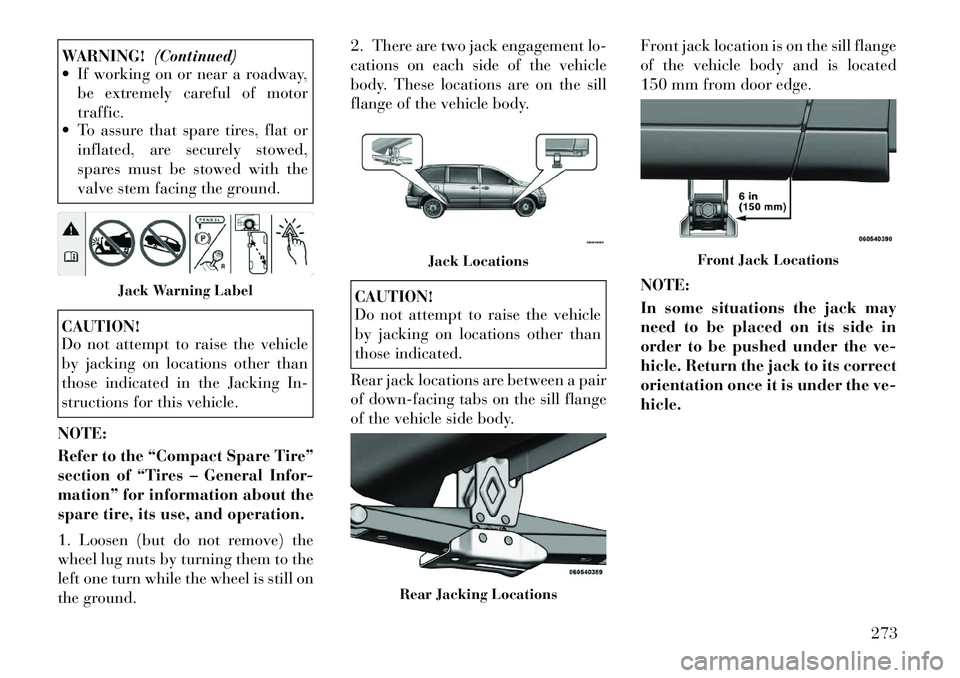
the ground. 2. There are two jack engagement lo-
cations on each side of the vehicle
body. These locations are on the sill
flange of the vehicle body.
CAUTION!
Do not attempt to raise the vehicle
by jacking on locations other than
those indicated.
Rear jack locations are between a pair
of down-facing tabs on the sill flange
of the vehicle side body. Front jack location is on the sill flange
of the vehicle body and is located
150 mm from door edge.
NOTE:
In some situations the jack may
need to be placed on its side in
order to be pushed under the ve-
hicle. Return the jack to its correct
orientation once it is under the ve-
hicle.
Jack Warning Label
Jack Locations
Rear Jacking Locations
Front Jack Locations
273
Page 280 of 344

WARNING!
Being under a jacked-up vehicle is
dangerous. The vehicle could slip off
the jack and fall on you. You could
be crushed. Never get any part of
your body under a vehicle that is on
a jack. If you need to get under a
raised vehicle, take it to a service
center where it can be raised on a
lift.
3. Place the wrench on the jack screw
and turn to the right until the jack
head is properly engaged in the de-
scribed location. Do not raise the
vehicle until you are sure the jack
is securely engaged.
4. Raise the vehicle by turning the
jack screw to the right, using the
swivel wrench. Raise the vehicle only
until the tire just clears the surface
and enough clearance is obtained to
install the spare tire. Minimum tire lift
provides maximum stability.
WARNING!
Raising the vehicle higher than nec-
essary can make the vehicle less
stable. It could slip off the jack and
hurt someone near it. Raise the ve-
hicle only enough to remove the tire.
5. Remove the wheel lug nuts, for
vehicles with wheel covers, remove
the cover from the wheel by hand. Do
not pry the wheel cover off. Then pull
the wheel off the hub.
6. Install the compact spare tire.
Lightly tighten the lug nuts.CAUTION!
Be sure to mount the spare tire with
the valve stem facing outward. The
vehicle could be damaged if the
spare tire is mounted incorrectly.
WARNING!
To avoid the risk of forcing the ve-
hicle off the jack, do not tighten the
wheel nuts fully until the vehicle has
been lowered. Failure to follow this
warning may result in personal in-
jury.
NOTE:
Do not install the wheel cover on
the compact spare.
7. Lower the vehicle by turning the
jack screw to the left.
Mounting Spare Tire
274
Page 281 of 344

8. Finish tightening the lug nuts.
Push down on the wrench while at the
end of the handle for increased lever-
age. Tighten the lug nuts in a star
pattern until each nut has been tight-
ened twice. The correct wheel nut
tightness is 138 N·m. If in doubt
about the correct tightness, have them
checked with a torque wrench by your
authorized dealer or at a service sta-
tion.
9. Lower the jack to its fully-closed
position.WARNING!
A loose tire or jack thrown forward
in a collision or hard stop could en-
danger the occupants of the vehicle.
Always stow the jack parts and the
spare tire in the places provided.
Have the deflated (flat) tire repaired
or replaced immediately.
10. Place the deflated (flat) tire and
compact spare tire cover assembly in
the rear cargo area. Do not stow the
deflated tire in the spare tire loca-
tion. Have the full-sized tire repaired
or replaced, as soon as possible. 11. Stow the cable and wheel spacer
before driving the vehicle. Reas-
semble the winch handle extensions to
form a “T” and fit the winch T-handle
over the drive nut. Rotate the nut to
the right until the winch mechanism
clicks at least three times.
NOTE:
Refer to the “Spare Tire Tools”
section for instructions on assem-
bling the T-handle.
12. Stow the jack, jack handle and
winch handle tools back in the stow-
age compartment.
13. Check the compact spare tire
pressure as soon as possible. Correct
the tire pressure, as required.
SECURING THE SPARE
TIRE
1. Assemble the winch handle exten-
sions to form a T-handle and fit the
winch T-handle over the drive nut.
Rotate the nut to the left until the
winch mechanism stops turning
freely. This will allow enough slack in
the cable to allow you to pull the
wheel spacer out from under the ve-
hicle.
WARNING!
A loose compact spare tire/cover as-
sembly, thrown forward in a colli-
sion or hard stop could endanger the
occupants of the vehicle. Always
stow the compact spare tire with the
cover assembly in the place pro-
vided.CAUTION!
The winch mechanism is designed
for use with the winch T-handle
only. Use of an air wrench or other
power tools is not recommended and
can damage the winch.
2. Assemble the winch handle exten-
sions to form the spare tire hook, and
pull the wheel spacer from under the
vehicle.
3. Turn the compact spare tire so that
the valve stem is down, and place the
tire into the spare tire/cover assembly.
Slide the wheel spacer through the
center of the wheel and spare tire/
cover assembly, so that the two re-
tainer tabs snap out and engage the
spare tire cover on the opposite side.
275
Page 287 of 344
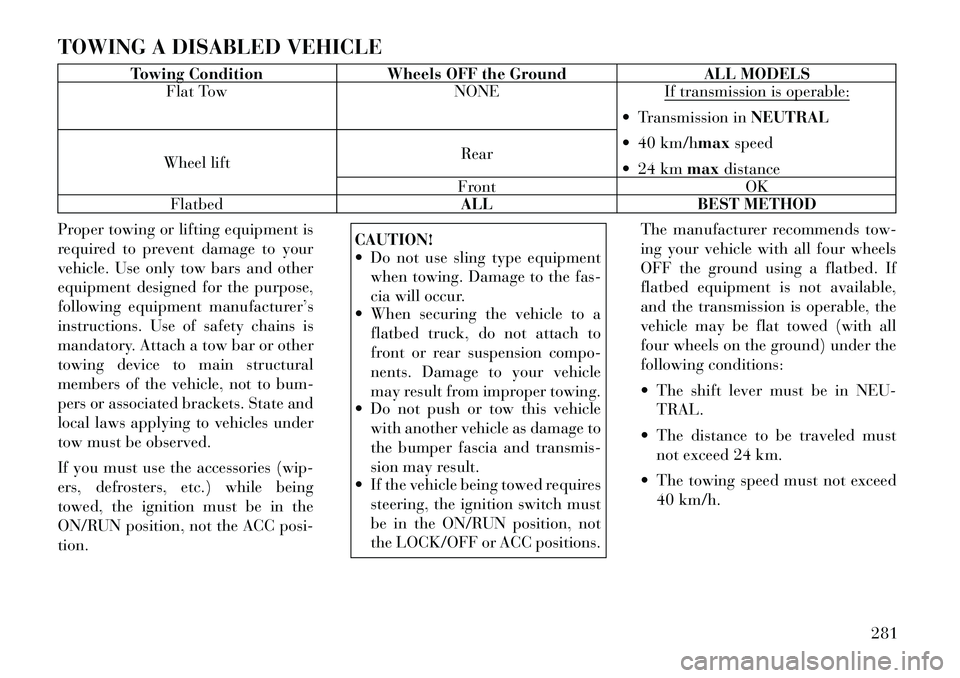
TOWING A DISABLED VEHICLE
Towing ConditionWheels OFF the Ground ALL MODELS
Flat Tow NONEIf transmission is operable:
Transmission inNEUTRAL
40 km/hmax speed
24 km maxdistance
Wheel lift Rear
Front OK
Flatbed ALLBEST METHOD
Proper towing or lifting equipment is
required to prevent damage to your
vehicle. Use only tow bars and other
equipment designed for the purpose,
following equipment manufacturer’s
instructions. Use of safety chains is
mandatory. Attach a tow bar or other
towing device to main structural
members of the vehicle, not to bum-
pers or associated brackets. State and
local laws applying to vehicles under
tow must be observed.
If you must use the accessories (wip-
ers, defrosters, etc.) while being
towed, the ignition must be in the
ON/RUN position, not the ACC posi-
tion.
CAUTION!
Do not use sling type equipment when towing. Damage to the fas-
cia will occur.
When securing the vehicle to a
flatbed truck, do not attach to
front or rear suspension compo-
nents. Damage to your vehicle
may result from improper towing.
Do not push or tow this vehicle
with another vehicle as damage to
the bumper fascia and transmis-
sion may result.
If the vehicle being towed requires
steering, the ignition switch must
be in the ON/RUN position, not
the LOCK/OFF or ACC positions. The manufacturer recommends tow-
ing your vehicle with all four wheels
OFF the ground using a flatbed. If
flatbed equipment is not available,
and the transmission is operable, the
vehicle may be flat towed (with all
four wheels on the ground) under the
following conditions:
The shift lever must be in NEU-
TRAL.
The distance to be traveled must not exceed 24 km.
The towing speed must not exceed 40 km/h.
281
Page 299 of 344

A/C Air Filter (for versions/
markets, where provided)CAUTION!
Car maintenance should be done at
a LANCIA Dealership. For routine
and minor maintenance operations
you wish to carry out yourself, we do
recommend you have the proper
equipment, genuine LANCIA spare
parts and the necessary fluids; do
not however carry out these opera-
tions if you have no experience.
Refer to the “Maintenance Schedule”
for the proper maintenance intervals.WARNING!
Do not remove the A/C air filter
while the blower is operating or per-
sonal injury may result.
The A/C air filter is located in the
fresh air inlet behind the glove box.
Perform the following procedure to
replace the filter:
1. Open the glove compartment and
remove all contents.
2. Push in on the sides of the glove
compartment and lower the door. 3. Pivot the glove compartment
downward.
4. Disengage the two retaining tabs
that secure the filter cover to the
HVAC housing, and remove the cover.
5. Remove the A/C air filter by pull-
ing it straight out of the housing.
6. Install the A/C air filter with the
arrow on the filter pointing toward
the floor. When installing the filter
cover, make sure the retaining tabs
fully engage the cover.
CAUTION!
The A/C air filter is identified with
an arrow to indicate airflow direc-
tion through the filter. Failure to
properly install the filter will result
in the need to replace it more often.
7. Rotate the glove compartment
door back into position.
BODY LUBRICATION
Locks and all body pivot points, in-
cluding such items as seat tracks, door
hinge pivot points and rollers, liftgate,
tailgate, sliding doors and hood
hinges, should be lubricated periodi-
cally with a lithium-based grease or
equivalent, to assure quiet, easy op-
eration and to protect against rust and
wear. Prior to the application of any
lubricant, the parts concerned should
be wiped clean to remove dust and
grit; after lubricating excess oil and
grease should be removed. Particular
attention should also be given to hood
latching components to ensure proper
function. When performing other un-
derhood services, the hood latch, re-
lease mechanism and safety catch
should be cleaned and lubricated.
The external lock cylinders should be
lubricated twice a year, preferably in
the Fall and Spring. Apply a small
amount of a high quality lubricant
directly into the lock cylinder.
A/C Air Filter Replacement
293