sport mode Lancia Voyager 2012 Owner handbook (in English)
[x] Cancel search | Manufacturer: LANCIA, Model Year: 2012, Model line: Voyager, Model: Lancia Voyager 2012Pages: 344, PDF Size: 3.95 MB
Page 68 of 344

Installing The Child Restraint
System
We urge you to carefully follow the
directions of the manufacturer when
installing your child restraint. Many,
but not all, restraint systems will be
equipped with separate straps on each
side, with each having a hook or con-
nector, and a means for adjusting the
tension in the strap. Forward-facing
toddler restraints and some rearward-
facing infant restraints will also be
equipped with a tether strap, a hook
and means for adjusting the tension in
the strap. Not all child restraint sys-
tems will be installed as described
here. Again, carefully follow the in-
stallation instructions that are pro-
vided with the child restraint system.
In general, you will first loosen the
child seat adjusters on the lower
straps and tether straps so that you
can more easily attach the hook or
connector to the lower anchorages
and tether anchorages. Then tighten
all three straps as you push the child
restraint rearward and downward
into the seat.Not all child restraint systems will be
installed as we have described here.
Again, carefully follow the instruc-
tions that come with the child re-
straint system.
WARNING!
Improper installation of a child re-
straint to the ISOFIX anchorages
can lead to failure of an infant or
child restraint. The child could be
badly injured or killed. Follow the
manufacturer's directions exactly
when installing an infant or child
restraint.
Transporting Pets
Air Bags deploying in the front seat
could harm your pet. An unrestrained
pet could be thrown about and possi-
bly injured, or injure a passenger dur-
ing panic braking or in a collision.
Pets should be restrained in the rear
seat in pet harnesses or pet carriers
that are secured by seat belts. ENGINE BREAK-IN
RECOMMENDATIONS
A long break-in period is not required
for the engine and drivetrain (trans-
mission and axle) in your vehicle.
Drive moderately during the first
500 km. After the initial 100 km,
speeds up to 80 or 90 km/h are desir-
able.
While cruising, brief full-throttle ac-
celeration within the limits of local
traffic laws contributes to a good
break-in. Wide-open throttle accel-
eration in low gear can be detrimental
and should be avoided.
The engine oil installed in the engine
at the factory is a high-quality energy
conserving type lubricant. Oil
changes should be consistent with an-
ticipated climate conditions under
which vehicle operations will occur.
For the recommended viscosity and
quality grades, refer to “Maintenance
Procedures” in “Maintaining Your Ve-
hicle”. NON-DETERGENT OR
STRAIGHT MINERAL OILS MUST
NEVER BE USED.
62
Page 69 of 344

A new engine may consume some oil
during its first few thousand kilome-
ters of operation. This should be con-
sidered a normal part of the break-in
and not interpreted as an indication of
difficulty.
Additional Requirements
For Diesel Engine (for
versions/markets, where
provided)
During the first 1500 km avoid heavy
loads, e.g. driving at full throttle. Do
not exceed 2/3 of the maximum per-
missible engine speed for each gear.
Change gear in good time. Do not shift
down a gear manually in order to
brake.
SAFETY TIPS
Transporting Passengers
NEVER TRANSPORT PASSEN-
GERS IN THE CARGO AREA.
WARNING!
Do not leave children or animalsinside parked vehicles in hot
weather. Interior heat build-up
may cause serious injury or death.
It is extremely dangerous to ride in
a cargo area, inside or outside of a
vehicle. In a collision, people rid-
ing in these areas are more likely
to be seriously injured or killed.
Do not allow people to ride in any
area of your vehicle that is not
equipped with seats and seat
belts.
Be sure everyone in your vehicle is
in a seat and using a seat belt
properly.
Exhaust GasWARNING!
Exhaust gases can injure or kill.
They contain carbon monoxide
(CO), which is colorless and odor-
less. Breathing it can make you un-
conscious and can eventually poison
you. To avoid breathing (CO), fol-
low these safety tips: (Continued)
WARNING!(Continued)
Do not run the engine in a closed
garage or in confined areas any
longer than needed to move your
vehicle in or out of the area.
If you are required to drive with
the trunk/liftgate open, make sure
that all windows are closed and
the climate control BLOWER
switch is set at high speed. DO
NOT use the recirculation mode.
If it is necessary to sit in a parked
vehicle with the engine running,
adjust your heating or cooling
controls to force outside air into
the vehicle. Set the blower at high
speed.
The best protection against carbon
monoxide entry into the vehicle body
is a properly maintained engine ex-
haust system.
Whenever a change is noticed in the
sound of the exhaust system, when
exhaust fumes can be detected inside
the vehicle, or when the underside or
rear of the vehicle is damaged, have a
competent mechanic inspect the com-
plete exhaust system and adjacent
63
Page 84 of 344

BLIND SPOT
MONITORING (for
versions/markets, where
provided)
The Blind Spot Monitoring (BSM)
system uses two radar-based sensors,
located inside the rear bumper fascia,
to detect highway licensable vehicles
(automobiles, trucks, motorcycles,
etc.) that enter the blind spot zones
from the rear/front/side of the ve-
hicle.
When the vehicle is started, the BSM
warning light will momentarily illu-
minate in both outside rear view mir-
rors to let the driver know that the
system is operational. The BSM sys-
tem sensors operate when the vehicle
is in any forward gear or REVERSEand enters stand-by mode when the
vehicle is in PARK.
The BSM detection zone covers ap-
proximately one lane on both sides of
the vehicle or 3.35 m. The zone starts
at the outside rear view mirror and
extends approximately 6 m to the rear
of the vehicle. The BSM system moni-
tors the detection zones on both sides
of the vehicle when the vehicle speed
reaches approximately 10 km/h or
higher and will alert the driver of ve-
hicles in these areas.
NOTE:
The BSM system does NOT alert
the driver about rapidly ap-
proaching vehicles that are out-
side the detection zones.
The BSM system detection zone DOES NOT change if your ve-
hicle is towing a trailer. There-
fore, visually verify the adjacent
lane is clear for both your ve-
hicle and trailer before making
a lane change. If the trailer or
other object (i.e., bicycle, sports
equipment) extends beyond the
side of your vehicle, this may re-
sult in the BSM warning light remaining illuminated the en-
tire time the vehicle is in a for-
ward gear.
The area on the rear fascia where the
radar sensors are located must remain
free of snow, ice, and dirt/road con-
tamination so that the BSM system
can function properly. Do not block
the area of the rear fascia where the
radar sensors are located with foreign
objects (bumper stickers, bicycle
racks, etc.).
The BSM system notifies the driver of
objects in the detection zones by illu-
minating the BSM warning light lo-
cated in the outside mirrors in addi-
tion to sounding an audible (chime)
alert and reducing the radio volume.
Refer to “Modes Of Operation” for
further information.
Rear Detection Zones
Sensor Locations
78
Page 337 of 344
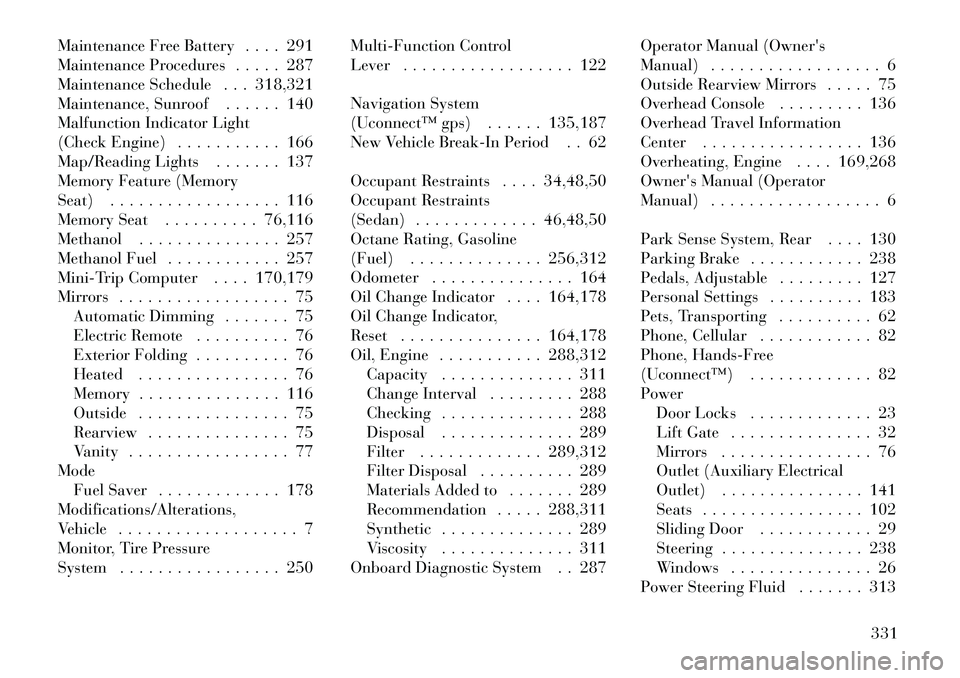
Maintenance Free Battery . . . . 291
Maintenance Procedures . . . . . 287
Maintenance Schedule . . . 318,321
Maintenance, Sunroof . . . . . . 140
Malfunction Indicator Light
(Check Engine) . . . . . . . . . . . 166
Map/Reading Lights . . . . . . . 137
Memory Feature (Memory
Seat) . . . . . . . . . . . . . . . . . . 116
Memory Seat . . . . . . . . . . 76,116
Methanol . . . . . . . . . . . . . . . 257
Methanol Fuel . . . . . . . . . . . . 257
Mini-Trip Computer . . . . 170,179
Mirrors . . . . . . . . . . . . . . . . . . 75Automatic Dimming . . . . . . . 75
Electric Remote . . . . . . . . . . 76
Exterior Folding . . . . . . . . . . 76
Heated . . . . . . . . . . . . . . . . 76
Memory . . . . . . . . . . . . . . . 116
Outside . . . . . . . . . . . . . . . . 75
Rearview . . . . . . . . . . . . . . . 75
Vanity . . . . . . . . . . . . . . . . . 77
Mode
Fuel Saver . . . . . . . . . . . . . 178
Modifications/Alterations,
Vehicle . . . . . . . . . . . . . . . . . . . 7
Monitor, Tire Pressure
System . . . . . . . . . . . . . . . . . 250 Multi-Function Control
Lever . . . . . . . . . . . . . . . . . . 122
Navigation System
(Uconnect™ gps) . . . . . . 135,187
New Vehicle Break-In Period . . 62
Occupant Restraints . . . . 34,48,50
Occupant Restraints
(Sedan) . . . . . . . . . . . . . 46,48,50
Octane Rating, Gasoline
(Fuel) . . . . . . . . . . . . . . 256,312
Odometer . . . . . . . . . . . . . . . 164
Oil Change Indicator . . . . 164,178
Oil Change Indicator,
Reset . . . . . . . . . . . . . . . 164,178
Oil, Engine . . . . . . . . . . . 288,312
Capacity . . . . . . . . . . . . . . 311
Change Interval . . . . . . . . . 288
Checking . . . . . . . . . . . . . . 288
Disposal . . . . . . . . . . . . . . 289
Filter . . . . . . . . . . . . . 289,312
Filter Disposal . . . . . . . . . . 289
Materials Added to . . . . . . . 289
Recommendation . . . . . 288,311
Synthetic . . . . . . . . . . . . . . 289
Viscosity . . . . . . . . . . . . . . 311
Onboard Diagnostic System . . 287 Operator Manual (Owner's
Manual) . . . . . . . . . . . . . . . . . . 6
Outside Rearview Mirrors . . . . . 75
Overhead Console . . . . . . . . . 136
Overhead Travel Information
Center . . . . . . . . . . . . . . . . . 136
Overheating, Engine . . . . 169,268
Owner's Manual (Operator
Manual) . . . . . . . . . . . . . . . . . . 6
Park Sense System, Rear . . . . 130
Parking Brake . . . . . . . . . . . . 238
Pedals, Adjustable . . . . . . . . . 127
Personal Settings . . . . . . . . . . 183
Pets, Transporting . . . . . . . . . . 62
Phone, Cellular . . . . . . . . . . . . 82
Phone, Hands-Free
(Uconnect™) . . . . . . . . . . . . . 82
Power
Door Locks . . . . . . . . . . . . . 23
Lift Gate . . . . . . . . . . . . . . . 32
Mirrors . . . . . . . . . . . . . . . . 76
Outlet (Auxiliary Electrical
Outlet) . . . . . . . . . . . . . . . 141
Seats . . . . . . . . . . . . . . . . . 102
Sliding Door . . . . . . . . . . . . 29
Steering . . . . . . . . . . . . . . . 238
Windows . . . . . . . . . . . . . . . 26
Power Steering Fluid . . . . . . . 313
331