service LAND ROVER DISCOVERY 1999 User Guide
[x] Cancel search | Manufacturer: LAND ROVER, Model Year: 1999, Model line: DISCOVERY, Model: LAND ROVER DISCOVERY 1999Pages: 1529, PDF Size: 34.8 MB
Page 60 of 1529
GENERAL INFORMATION
03-25
Service precautions
Observe the following precautions when handling
components used in the air conditioning system:
lAir conditioning units must not be lifted by their
hoses, pipes or capillary lines.
lHoses and lines must not be subjected to any
twist or stress; the efficiency of the system will
be impaired by kinks or restrictions. Ensure that
hoses are correctly positioned before tightening
couplings, and ensure that all clips and supports
are utilised.
lFlexible hoses should not be positioned close to
the exhaust manifold (less than 100mm) unless
protected by heat shielding.
lCompleted assemblies must be checked for
refrigeration lines touching metal panels. Any
direct contact of components and panels may
transmit noise and so must be eliminated.
lThe appropriate torque wrench must be used
when tightening refrigerant connections to the
stipulated value. An additional spanner must be
used to hold the union to prevent twisting of the
pipe when tightening connections.
lBefore connecting any hose or pipe, ensure that
refrigerant oil is applied to the seat of the new 'O'
rings, BUT NOT to the threads of the
connection.
lAll protective plugs must remain in place to seal
the component until immediately prior to
connection.
lEnsure components are at room temperature
before uncapping, to prevent condensation of
moisture from the air that enters it.
lComponents must not remain uncapped for
longer than 15 minutes. In the event of a delay,
the caps must be fitted.
lWhen disconnecting, immediately cap all air
conditioning pipes to prevent ingress of dirt and
moisture into the system.
lThe receiver/drier contains desiccant which
absorbs moisture. It must be positively sealed at
all times. A receiver/drier that has been left
uncapped must not be used, fit a new unit.
lThe receiver/drier should be the last component
connected to the system to ensure optimum
dehydration and maximum moisture protection
of the system.
lWhenever the refrigerant system is opened, the
receiver/drier must be renewed immediately
before evacuating and recharging the system.
lUse alcohol and a clean lint-free cloth to clean
dirty connections.
lEnsure that all new parts fitted are marked for
use with R134a.
When a major repair has been completed, a leak test
should be conducted; refer to the Air Conditioning
section of this manual for the correct procedure.Refrigerant oil
Refrigerant oil easily absorbs water and must not
be stored for long periods. Do not pour unused
refrigerant oil back into the container. Always
use an approved refrigerant oil.
+ CAPACITIES, FLUIDS, LUBRICANTS
AND SEALANTS, Lubrication.
When replacing components in the A/C system,
drain the refrigerant oil from the component being
replaced into a graduated container. On assembly,
add the quantity of refrigerant oil drained to the new
component.
Compressor
A new compressor is sealed and pressurised with
Nitrogen gas. When fitting a new compressor, slowly
release the sealing cap; gas pressure should be
heard to vent as the seal is broken.
CAUTION: A new compressor should always be
sealed and could be pressurised with nitrogen
gas. To avoid possible oil loss, release the
sealing cap(s) slowly. Do not remove the cap(s)
until immediately prior to connecting the air
conditioning pipes to the compressor.
Rapid refrigerant discharge
If the air conditioning system is involved in accident
damage and the system is punctured, the refrigerant
will discharge rapidly. The rapid discharge of
refrigerant will also result in the loss of most of the oil
from the system. The compressor must be removed
and all the remaining oil in the compressor drained
and refilled as instructed in the air conditioning
section of this manual.
Page 74 of 1529

GENERAL DATA
04-11
Clutch - Td5
Type Diaphragm spring, hydraulically operated with self-centering,
preloaded release bearing
Drive plate diameter 267 mm (10.5118 in)
Pressure plate diameter 267 mm (10.5118 in)
Clutch plate friction material Verto F202
Diaphragm finger height when clamped on a 8.5 mm
(0.33 in) thick gauge plate42.5 to 48.5 mm (1.673 to 1.904 in)
Diaphragm finger clearance (service limit) 1.00 mm (0.040 in)
Clutch plate thickness under 6500 N (1461 lb) axial
load:
⇒ New 8.2 to 8.8 mm (0.33 to 0.34 in)
⇒ Service limit 7.0 mm (0.27 in)
Page 75 of 1529

GENERAL DATA
04-12
Clutch - V8
Type Diaphragm spring, hydraulically operated with self-centering,
preloaded release bearing
Clutch plate friction material APTEC 385
Drive plate diameter 267 mm (10.5118 in)
Pressure plate diameter 268 mm (10.5512 in)
Clutch plate thickness (clamped state)
⇒ New 8.4-8.9 mm (0.33-0.35 in)
⇒ Service limit 7.1 mm (0.28 in)
Rivet depth:
⇒ New 1.73 mm (0.07 in)
⇒ Service limit 0.25 mm (0.01 in)
Clutch plate runout:
⇒ New 0.5 mm (0.02 in)
⇒ Service limit 0.5 mm (0.02 in)
Page 76 of 1529

GENERAL DATA
04-13
Manual gearbox - R380
Type Single helical constant mesh
Gears 5 forward, 1 reverse, all synchromesh
Gear ratios: Td5 Diesel
⇒ First 3.692 : 1
⇒ Second 2.132 : 1
⇒ Third 1.397 : 1
⇒ Fourth 1.0 : 1
⇒ Fifth 0.770 : 1
⇒ Reverse 3.536 : 1
Gear ratios: V8 Petrol
⇒ First 3.321:1
⇒ Second 2.132:1
⇒ Third 1.397:1
⇒ Fourth 1.0:1
⇒ Fifth 0.732:1
⇒ Reverse 3.536:1
Baulk ring clearance:
⇒ New 0.500 mm (0.0197 in)
⇒ Service limit 0.500 mm (0.0197 in)
⇒ Selector fork pad widths - minimum 6.5 mm (0.255 in)
First gear end float:
⇒ New 0.050 - 0.200 mm (0.0020 - 0.0079 in)
⇒ Service limit 0.327 mm (0.0129 in)
Second gear end float:
⇒ New 0.040 - 0.210 mm (0.0016 - 0.0083 in)
⇒ Service limit 0.337 mm (0.0133 in)
Third gear end float:
⇒ New 0.110 - 0.210 mm (0.0043 - 0.0083 in)
⇒ Service limit 0.337 mm (0.0133 in)
Adjust fifth / reverse hub - shim to
⇒ New 0.005 - 0.055 mm (0.0002 - 0.0022 in)
⇒ Service limit 0.055 mm (0.0022 in)
Reverse gear idler shaft clearance
⇒ New 0.040 - 0.380 mm (0.0016 - 0.0150 in)
⇒ Service limit 0.380 mm (0.0150 in)
Mainshaft end float:
⇒ New 0.000 - 0.050 mm (0.0000 - 0.0020 in)
⇒ Service limit 0.000 - 0.050 mm (0.0000 - 0.0020 in)
Layshaft end float:
⇒ New 0.000 - 0.050 mm (0.0000 - 0.0020 in)
⇒ Service limit 0.000 - 0.050 mm (0.0000 - 0.0020 in)
Page 82 of 1529

GENERAL DATA
04-19
Brakes
Type Servo assisted, diagonally split hydraulic on outboard discs, with four
channel electronic control ABS
Disc diameter:
⇒ Front 297.0 - 297.4 mm (11.693 - 11.709 in)
⇒ Rear 303.8 - 304.2 mm (11.961 - 11.976 in)
Front disc minimum thickness:
⇒ New 24.9 - 25.1 mm (0.980 – 0.988 in)
⇒ Service limit 22.0 mm (0.866 in)
Rear disc minimum thickness:
⇒ New 12.5 – 12.7 mm (0.492 – 0.500 in)
⇒ Service limit 11.7 mm (0.461 in)
Maximum disc runout 0.15 mm (0.006 in)
Minimum pad material thickness 2.0 mm (0.079 in)
Handbrake Cable operated drum on transfer box rear output shaft
Page 119 of 1529

CAPACITIES, FLUIDS, LUBRICANTS AND SEALANTS
09-2
Fluids
Anti-freeze
Use Havoline Extended Life Coolant (XLC), or any
ethylene glycol based anti-freeze (containing no
methanol) with only Organic Acid Technology (OAT)
corrosion inhibitors, to protect the cooling system
CAUTION: No other anti-freeze should be used
with Havoline Extended Life Coolant.
The cooling system should be drained, flushed and
refilled with the correct amount of anti-freeze solution
at the intervals given on the Service Maintenance
Check Sheet.
After filling with anti-freeze solution, attach a warning
label to a prominent position on the vehicle stating
the type of anti-freeze contained in the cooling
system to ensure that the correct type is used for
topping-up.
Brake/Clutch fluid
Use only DOT 4 brake fluid.
PAS fluid
Use Texaco cold climate power assisted steering
fluid PSF 14315.
ACE fluid
Where ambient temperature falls below -20° C (-4°
F), use only Texaco cold climate power assisted
steering fluid PSF 14315. Where ambient
temperature remains above -20° C (-4° F), use either
Texaco cold climate power assisted steering fluid ,
Dexron 11 or Dexron 111 non-synthetic fluid.
Air conditioning
Use only refrigerant R134a.
Refrigerant oil
Use only Nippon Denso ND-oil 8.
Refrigerant oil absorbs water and must not be stored
for long periods. Do not pour unused oil back into the
container.
NOTE: The total quantity of refrigerant oil in the
system is 180 ml.
CAUTION: Do not use any other type of
refrigerant oil.
Anti-Freeze Concentration
The overall anti-freeze concentration should not fall,
by volume, below 50% to ensure that the anti-
corrosion properties of the coolant are maintained.
Anti-freeze concentrations greater than 60% are not
recommended as cooling efficiency will be impaired.
The following recommended quantities of anti-freeze
will provide frost protection to -48°C (-53°F):
Engine - TD5
Engine - V8
Concentration 50%
Amount of Anti-freeze 4 litres
Concentration 50%
Amount of Anti-freeze 6.5 litres
13.5 pts (US)
Page 220 of 1529
ENGINE - V8
OVERHAUL 12-2-65
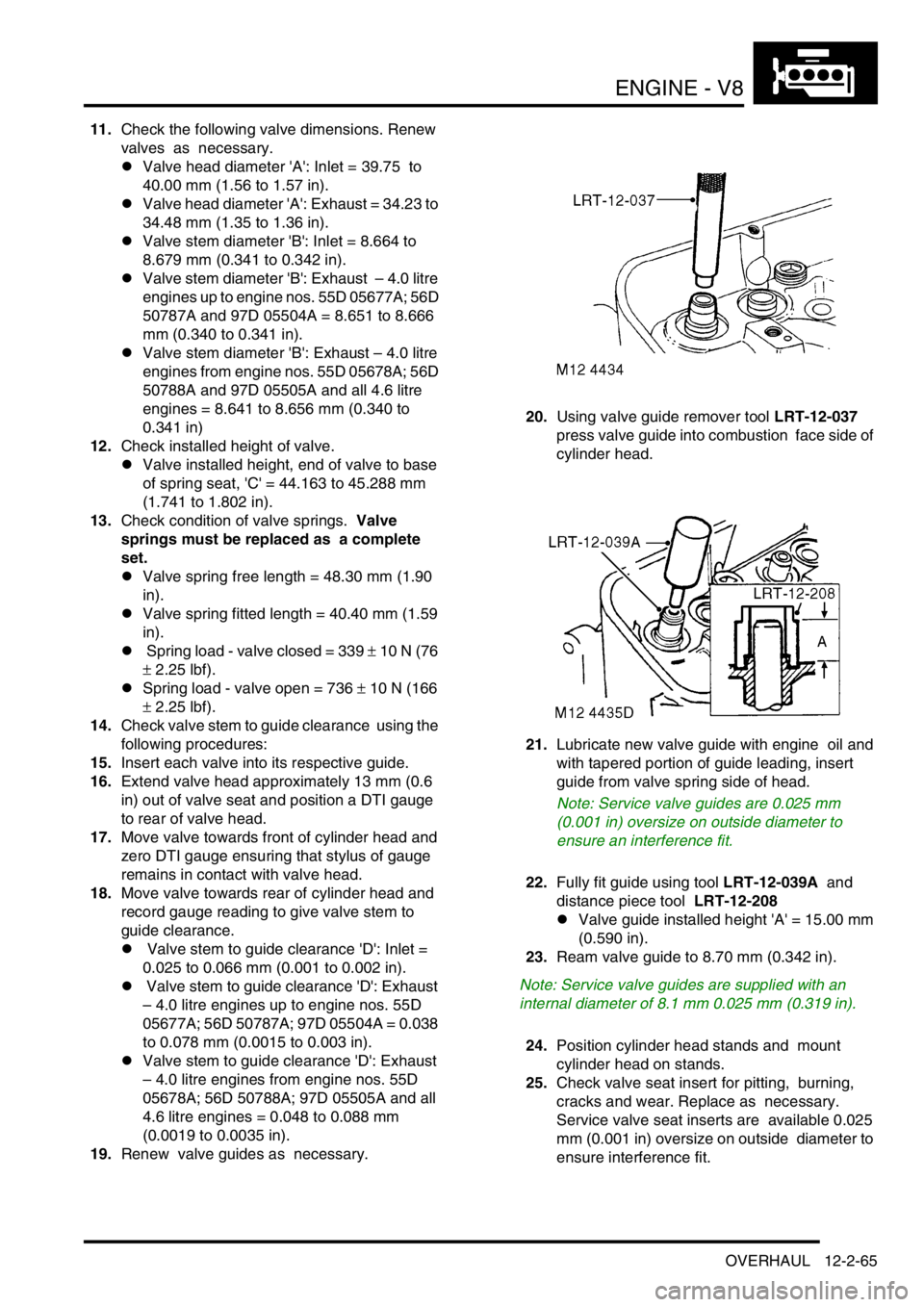
11.Check the following valve dimensions. Renew
valves as necessary.
lValve head diameter 'A': Inlet = 39.75 to
40.00 mm (1.56 to 1.57 in).
lValve head diameter 'A': Exhaust = 34.23 to
34.48 mm (1.35 to 1.36 in).
lValve stem diameter 'B': Inlet = 8.664 to
8.679 mm (0.341 to 0.342 in).
lValve stem diameter 'B': Exhaust – 4.0 litre
engines up to engine nos. 55D 05677A; 56D
50787A and 97D 05504A = 8.651 to 8.666
mm (0.340 to 0.341 in).
lValve stem diameter 'B': Exhaust – 4.0 litre
engines from engine nos. 55D 05678A; 56D
50788A and 97D 05505A and all 4.6 litre
engines = 8.641 to 8.656 mm (0.340 to
0.341 in)
12.Check installed height of valve.
lValve installed height, end of valve to base
of spring seat, 'C' = 44.163 to 45.288 mm
(1.741 to 1.802 in).
13.Check condition of valve springs. Valve
springs must be replaced as a complete
set.
lValve spring free length = 48.30 mm (1.90
in).
lValve spring fitted length = 40.40 mm (1.59
in).
l Spring load - valve closed = 339 ± 10 N (76
± 2.25 lbf).
lSpring load - valve open = 736 ± 10 N (166
± 2.25 lbf).
14.Check valve stem to guide clearance using the
following procedures:
15.Insert each valve into its respective guide.
16.Extend valve head approximately 13 mm (0.6
in) out of valve seat and position a DTI gauge
to rear of valve head.
17.Move valve towards front of cylinder head and
zero DTI gauge ensuring that stylus of gauge
remains in contact with valve head.
18.Move valve towards rear of cylinder head and
record gauge reading to give valve stem to
guide clearance.
l Valve stem to guide clearance 'D': Inlet =
0.025 to 0.066 mm (0.001 to 0.002 in).
l Valve stem to guide clearance 'D': Exhaust
– 4.0 litre engines up to engine nos. 55D
05677A; 56D 50787A; 97D 05504A = 0.038
to 0.078 mm (0.0015 to 0.003 in).
lValve stem to guide clearance 'D': Exhaust
– 4.0 litre engines from engine nos. 55D
05678A; 56D 50788A; 97D 05505A and all
4.6 litre engines = 0.048 to 0.088 mm
(0.0019 to 0.0035 in).
19.Renew valve guides as necessary. 20.Using valve guide remover tool LRT-12-037
press valve guide into combustion face side of
cylinder head.
21.Lubricate new valve guide with engine oil and
with tapered portion of guide leading, insert
guide from valve spring side of head.
Note: Service valve guides are 0.025 mm
(0.001 in) oversize on outside diameter to
ensure an interference fit.
22.Fully fit guide using tool LRT-12-039A and
distance piece tool LRT-12-208
lValve guide installed height 'A' = 15.00 mm
(0.590 in).
23.Ream valve guide to 8.70 mm (0.342 in).
Note: Service valve guides are supplied with an
internal diameter of 8.1 mm 0.025 mm (0.319 in).
24.Position cylinder head stands and mount
cylinder head on stands.
25.Check valve seat insert for pitting, burning,
cracks and wear. Replace as necessary.
Service valve seat inserts are available 0.025
mm (0.001 in) oversize on outside diameter to
ensure interference fit.
Page 223 of 1529
ENGINE - V8
12-2-68 OVERHAUL
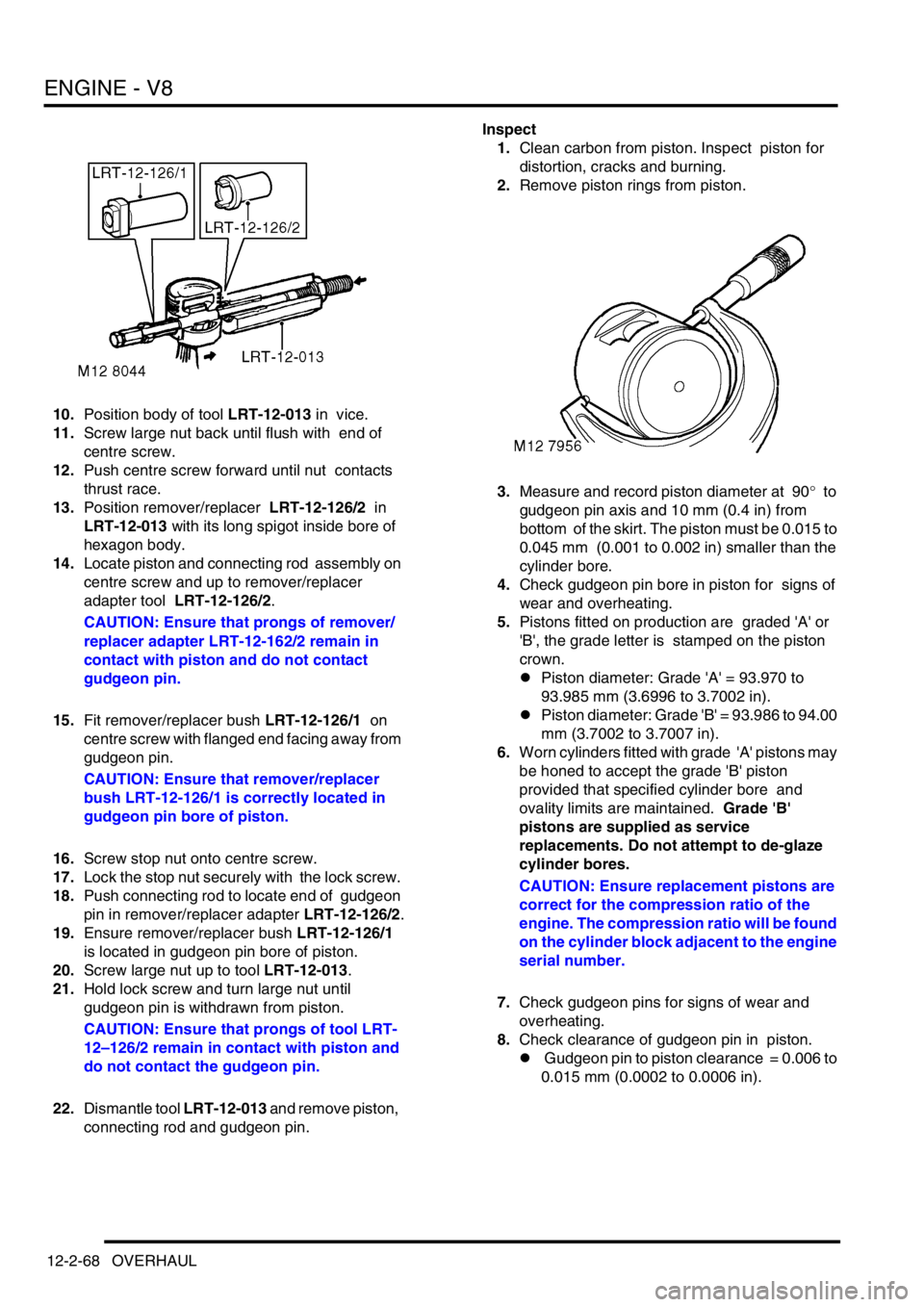
10.Position body of tool LRT-12-013 in vice.
11.Screw large nut back until flush with end of
centre screw.
12.Push centre screw forward until nut contacts
thrust race.
13.Position remover/replacer LRT-12-126/2 in
LRT-12-013 with its long spigot inside bore of
hexagon body.
14.Locate piston and connecting rod assembly on
centre screw and up to remover/replacer
adapter tool LRT-12-126/2.
CAUTION: Ensure that prongs of remover/
replacer adapter LRT-12-162/2 remain in
contact with piston and do not contact
gudgeon pin.
15.Fit remover/replacer bush LRT-12-126/1 on
centre screw with flanged end facing away from
gudgeon pin.
CAUTION: Ensure that remover/replacer
bush LRT-12-126/1 is correctly located in
gudgeon pin bore of piston.
16.Screw stop nut onto centre screw.
17.Lock the stop nut securely with the lock screw.
18.Push connecting rod to locate end of gudgeon
pin in remover/replacer adapter LRT-12-126/2.
19.Ensure remover/replacer bush LRT-12-126/1
is located in gudgeon pin bore of piston.
20.Screw large nut up to tool LRT-12-013.
21.Hold lock screw and turn large nut until
gudgeon pin is withdrawn from piston.
CAUTION: Ensure that prongs of tool LRT-
12–126/2 remain in contact with piston and
do not contact the gudgeon pin.
22.Dismantle tool LRT-12-013 and remove piston,
connecting rod and gudgeon pin. Inspect
1.Clean carbon from piston. Inspect piston for
distortion, cracks and burning.
2.Remove piston rings from piston.
3.Measure and record piston diameter at 90° to
gudgeon pin axis and 10 mm (0.4 in) from
bottom of the skirt. The piston must be 0.015 to
0.045 mm (0.001 to 0.002 in) smaller than the
cylinder bore.
4.Check gudgeon pin bore in piston for signs of
wear and overheating.
5.Pistons fitted on production are graded 'A' or
'B', the grade letter is stamped on the piston
crown.
lPiston diameter: Grade 'A' = 93.970 to
93.985 mm (3.6996 to 3.7002 in).
lPiston diameter: Grade 'B' = 93.986 to 94.00
mm (3.7002 to 3.7007 in).
6.Worn cylinders fitted with grade 'A' pistons may
be honed to accept the grade 'B' piston
provided that specified cylinder bore and
ovality limits are maintained. Grade 'B'
pistons are supplied as service
replacements. Do not attempt to de-glaze
cylinder bores.
CAUTION: Ensure replacement pistons are
correct for the compression ratio of the
engine. The compression ratio will be found
on the cylinder block adjacent to the engine
serial number.
7.Check gudgeon pins for signs of wear and
overheating.
8.Check clearance of gudgeon pin in piston.
l Gudgeon pin to piston clearance = 0.006 to
0.015 mm (0.0002 to 0.0006 in).
Page 236 of 1529
EMISSION CONTROL - V8
DESCRIPTION AND OPERATION 17-2-3
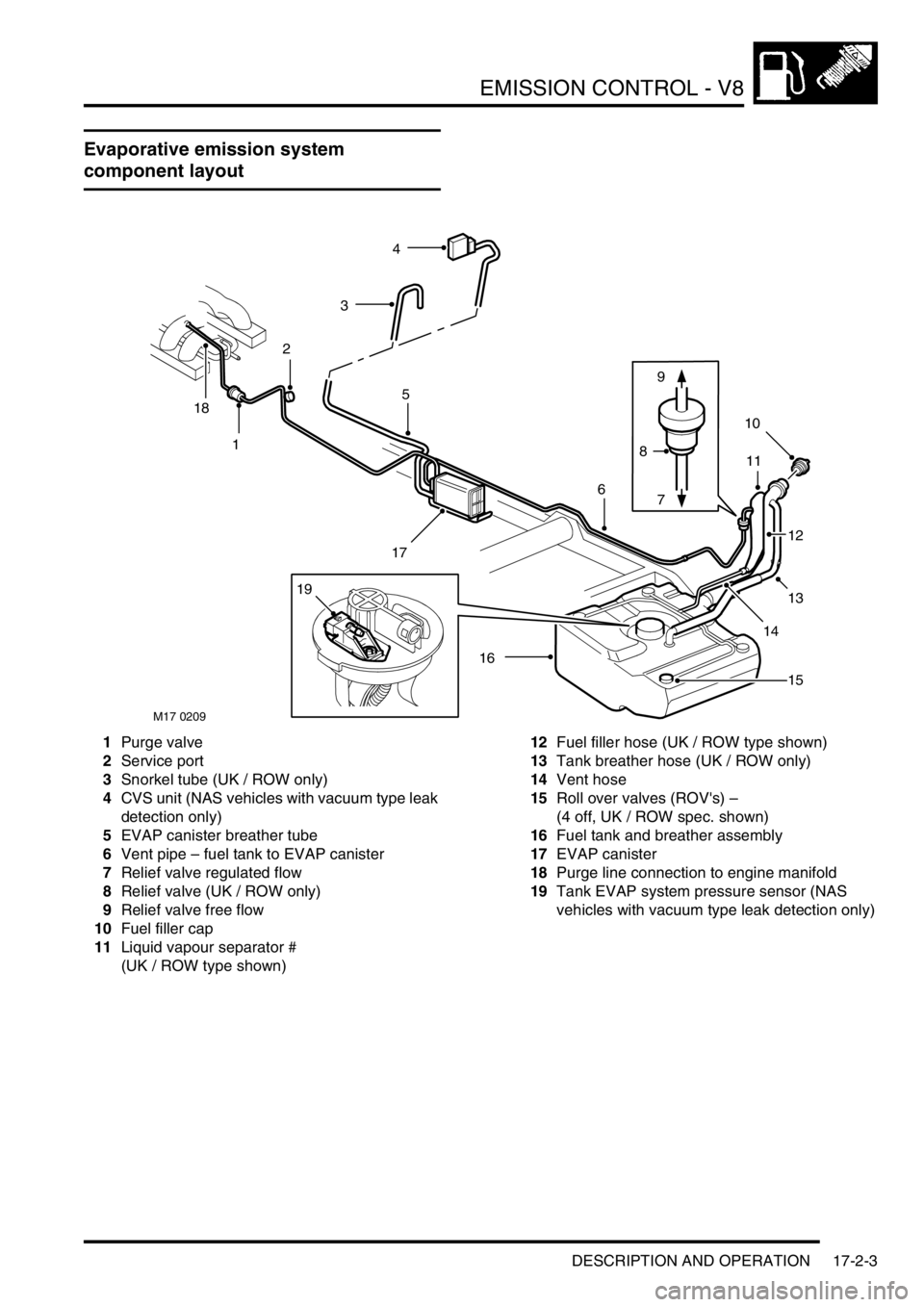
Evaporative emission system
component layout
1Purge valve
2Service port
3Snorkel tube (UK / ROW only)
4CVS unit (NAS vehicles with vacuum type leak
detection only)
5EVAP canister breather tube
6Vent pipe – fuel tank to EVAP canister
7Relief valve regulated flow
8Relief valve (UK / ROW only)
9Relief valve free flow
10Fuel filler cap
11Liquid vapour separator #
(UK / ROW type shown)12Fuel filler hose (UK / ROW type shown)
13Tank breather hose (UK / ROW only)
14Vent hose
15Roll over valves (ROV's) –
(4 off, UK / ROW spec. shown)
16Fuel tank and breather assembly
17EVAP canister
18Purge line connection to engine manifold
19Tank EVAP system pressure sensor (NAS
vehicles with vacuum type leak detection only)
M17 0209
4
3
1
6
5
16
10
8
13
17
9
7
11
12
15
14
18
2
19
Page 237 of 1529

EMISSION CONTROL - V8
17-2-4 DESCRIPTION AND OPERATION
Evaporative emission system (with
positive pressure leak detection)
component layout (NAS only)
1Purge valve
2Service port
3Air filter canister
4EVAP canister breather tube
5Leak detection pump
6EVAP canister
7Vent pipe – fuel tank to EVAP canister
8Liquid vapour separator (metal)9Fuel filler cap
10Fuel filler
11Fuel tank breather assembly
12Vent hose
13Roll over valves (inside fuel tank)
14Fuel tank
15Purge line connection to engine manifold
M17 0208
3
1
7
4
14
11
6
8
10
13
12
15
2
5
9