earth LAND ROVER DISCOVERY 2002 Workshop Manual
[x] Cancel search | Manufacturer: LAND ROVER, Model Year: 2002, Model line: DISCOVERY, Model: LAND ROVER DISCOVERY 2002Pages: 1672, PDF Size: 46.1 MB
Page 749 of 1672

TRANSFER BOX - LT230SE
41-16 DESCRIPTION AND OPERATION
Functionality – Vehicles from 03 model year only
The differential lock must be engaged for 2 wheel rolling road testing. It will also be necessary to disconnect the
propeller shaft from the transfer box output shaft driving the axle whose wheels are NOT on the rolling road. In
addition, the ETC system must be deactivated by either, removing a fuse (10A fuse 28 in the passenger compartment
fusebox, labelled ABS) or disconnecting the ABS modulator pump. This must be done with the ignition switched off.
Note that the SLABS ECU may record a system fault.
The lock can be engaged or disengaged using the selector lever. Vehicles not fitted with a differential lock can be
identified by a high/low range selector lever with no differential lock functionality and the cover and selector shaft
(arrowed), not visible on the front output housing.
WARNING: VEHICLES NOT FITTED WITH A DIFFERENTIAL LOCK MUST NOT BE TESTED ON A ROLLING
ROAD WHERE THE ROLLERS ARE DRIVEN BY THE VEHICLE.
Differential lock warning lamp switch - if fitted - Vehicles up to 03 model year
A differential lock warning lamp switch connected to the SLABS ECU and operated by movement of the selector fork
and shaft is screwed into the top of the output housing. The switch connects to earth when the differential lock is
engaged.
Differential lock warning lamp switches - if fitted - Vehicles from 03 model year
Vehicles from 03 model year are fitted with two differential lock warning lamp switches.
One switch is of a new design and is fitted into the top of the front output housing in the same position as on previous
models. The switch is connected to the SLABS ECU and is operated by movement of the selector fork and shaft.
The second switch is located in a threaded hole on the forward face of the front output housing. The switch is also
connected to the SLABS ECU and is operated by movement of the selector shaft.
Both switches have an aluminium washer which seals the switch to the casing and also sets the switch position,
removing the requirement for a setting procedure.
Both switches are connected in parallel to earth when the differential lock is engaged. This earth is sensed by the
SLABS ECU which illuminates the differential lock warning lamp in the instrument pack.
Differential lock warning lamp - Vehicles up to 03 model year – if fitted
The differential lock warning lamp is located in the instrument pack and provides a warning to the driver when the
ignition is switched on that the differential lock is engaged. The warning lamp illuminates in a Red colour.
With the lock engaged, the traction control and electronic brake distribution warning lamps will also be illuminated.
Disengagement of the differential lock should be carried out with the ignition switched off. The warning lamps must
be extinguished when the ignition is switched on again.
Differential lock warning lamp – vehicles from 03 model year – if fitted
The differential lock warning lamp is located in the instrument pack and provides a visual warning to the driver, when
the ignition is on, the differential lock is engaged. The warning lamp illuminates in an amber colour.
When the lock is engaged, the warning lamp is illuminated and the instrument pack sounder emits three audible
chimes. When the lock is disengaged, the warning lamp is extinguished and the instrument pack sounder emits three
audible chimes.
Rear output housing
The rear output housing carries the output shaft and flange. A cable operated transmission brake is attached to the
housing, the brake drum being attached to the output flange.
The rear output shaft is supported in the housing by a single bearing and is splined into the differential rear sun gear.
Page 802 of 1672

AUTOMATIC GEARBOX - ZF4HP22 - 24
DESCRIPTION AND OPERATION 44-5
1Release button
2Mode switch
3Electrical connector
4Interlock solenoid (where fitted)
5Base6Gasket
7Securing bolt
8Lever
9Cover
10Position indicators
The selector lever assembly consists of a lever and a cover attached to a base. The base is located on a gasket and
secured to the transmission tunnel. The lever is hinged to the base. A latch in the lever engages with detents in the
base to provide the lever positions P, R, N, D, 3, 2, 1. The latch is disengaged by pressing a release button on the
lever knob. Except for lever movement between positions D and 3, the button must be pressed before the lever can
be moved. In some markets, vehicles incorporate an interlock solenoid at the bottom of the lever, which prevents the
lever being moved from P unless the ignition switch is in position II and the foot brake is applied. If the battery
becomes flat, the interlock system will prevent selector lever movement and removal of the ignition key.
The cover incorporates lever position indicators and the mode switch. The lever position indicators illuminate to show
the position of the selector lever. Illumination is controlled by the Body Control Unit (BCU). The mode switch is a non-
latching hinged switch that, when pressed, connects an earth to the EAT ECU to request a change of mode.
An electrical connector at the rear of the cover connects the selector lever assembly to the vehicle wiring.
Selector cable
The selector cable is a Bowden type cable that connects the selector lever assembly to a selector lever on the
gearbox. 'C' clips secure the ends of the outer cable to brackets on the selector lever assembly and the selector lever.
The inner cable is adjustable at the connection of the inner cable with the gearbox selector lever.
Page 809 of 1672
AUTOMATIC GEARBOX - ZF4HP22 - 24
44-12 DESCRIPTION AND OPERATION
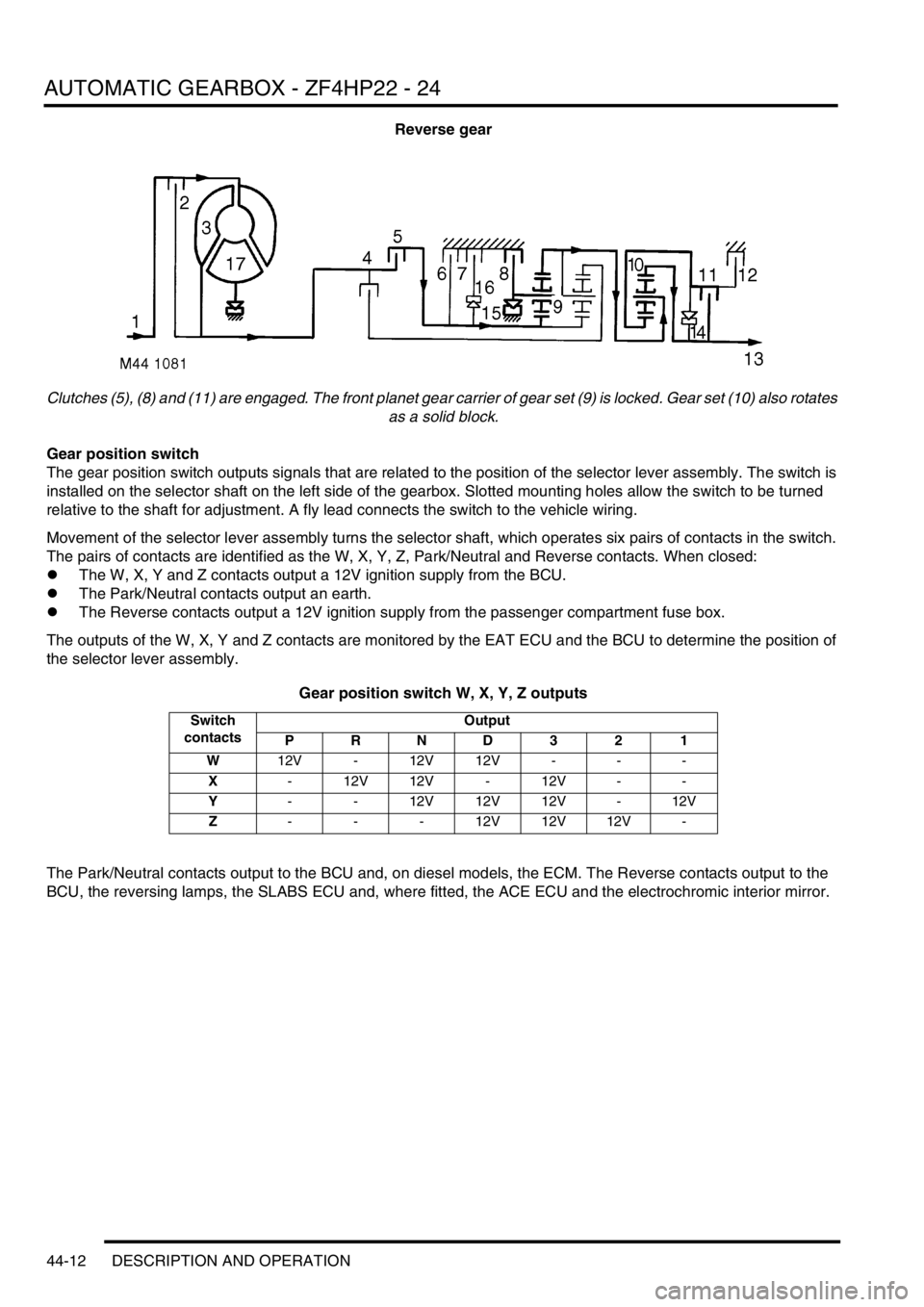
Reverse gear
Clutches (5), (8) and (11) are engaged. The front planet gear carrier of gear set (9) is locked. Gear set (10) also rotates
as a solid block.
Gear position switch
The gear position switch outputs signals that are related to the position of the selector lever assembly. The switch is
installed on the selector shaft on the left side of the gearbox. Slotted mounting holes allow the switch to be turned
relative to the shaft for adjustment. A fly lead connects the switch to the vehicle wiring.
Movement of the selector lever assembly turns the selector shaft, which operates six pairs of contacts in the switch.
The pairs of contacts are identified as the W, X, Y, Z, Park/Neutral and Reverse contacts. When closed:
lThe W, X, Y and Z contacts output a 12V ignition supply from the BCU.
lThe Park/Neutral contacts output an earth.
lThe Reverse contacts output a 12V ignition supply from the passenger compartment fuse box.
The outputs of the W, X, Y and Z contacts are monitored by the EAT ECU and the BCU to determine the position of
the selector lever assembly.
Gear position switch W, X, Y, Z outputs
The Park/Neutral contacts output to the BCU and, on diesel models, the ECM. The Reverse contacts output to the
BCU, the reversing lamps, the SLABS ECU and, where fitted, the ACE ECU and the electrochromic interior mirror.
Switch
contactsOutput
PRND 3 2 1
W12V - 12V 12V - - -
X- 12V 12V - 12V - -
Y- - 12V 12V 12V - 12V
Z- - - 12V 12V 12V -
Page 811 of 1672
AUTOMATIC GEARBOX - ZF4HP22 - 24
44-14 DESCRIPTION AND OPERATION
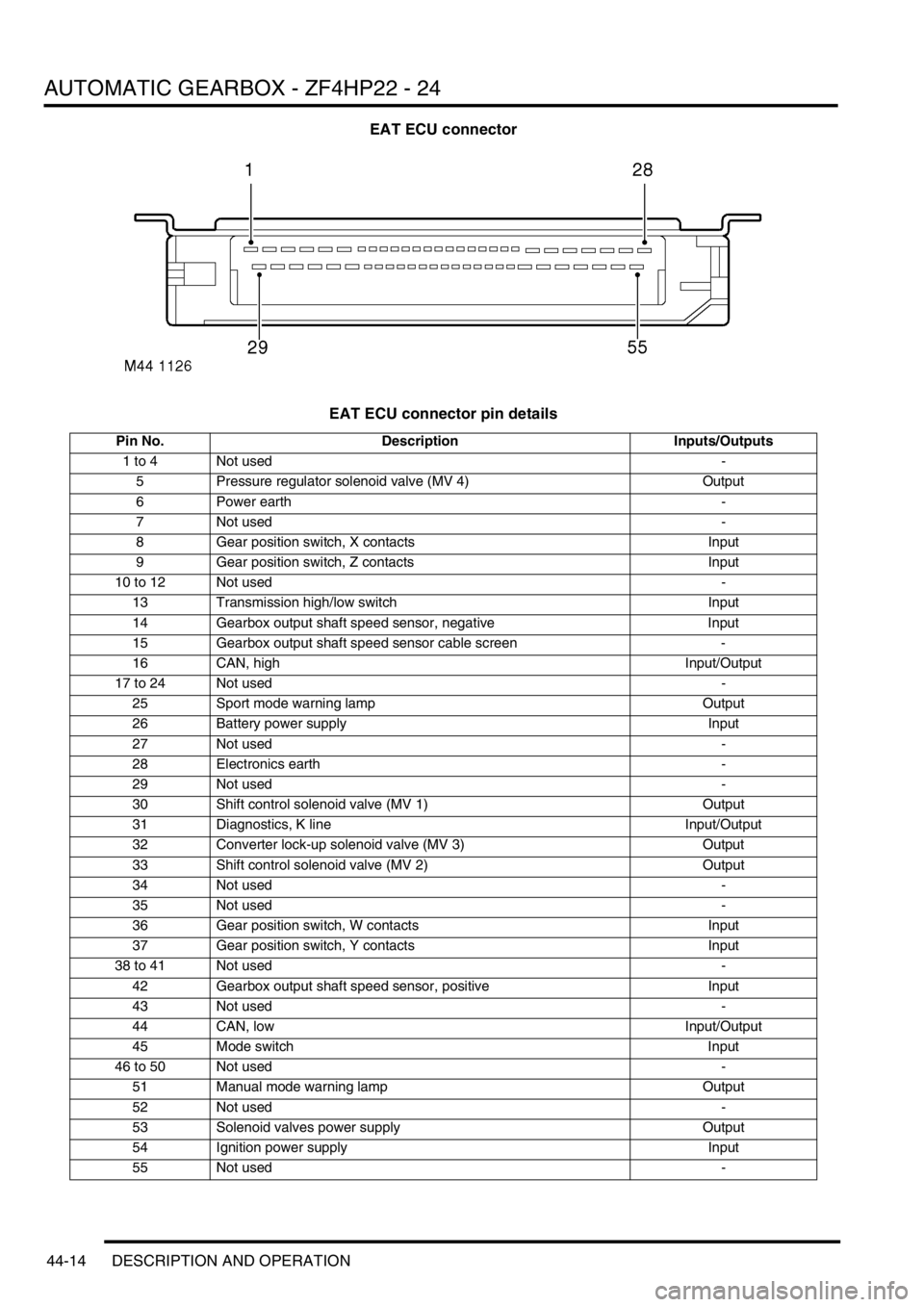
EAT ECU connector
EAT ECU connector pin details
Pin No. Description Inputs/Outputs
1 to 4 Not used-
5 Pressure regulator solenoid valve (MV 4) Output
6 Power earth -
7 Not used-
8 Gear position switch, X contacts Input
9 Gear position switch, Z contacts Input
10 to 12 Not used-
13 Transmission high/low switch Input
14 Gearbox output shaft speed sensor, negative Input
15 Gearbox output shaft speed sensor cable screen -
16 CAN, high Input/Output
17 to 24 Not used-
25 Sport mode warning lamp Output
26 Battery power supply Input
27 Not used-
28 Electronics earth -
29 Not used-
30 Shift control solenoid valve (MV 1) Output
31 Diagnostics, K line Input/Output
32 Converter lock-up solenoid valve (MV 3) Output
33 Shift control solenoid valve (MV 2) Output
34 Not used-
35 Not used-
36 Gear position switch, W contacts Input
37 Gear position switch, Y contacts Input
38 to 41 Not used-
42 Gearbox output shaft speed sensor, positive Input
43 Not used-
44 CAN, low Input/Output
45 Mode switch Input
46 to 50 Not used-
51 Manual mode warning lamp Output
52 Not used-
53 Solenoid valves power supply Output
54 Ignition power supply Input
55 Not used-
Page 815 of 1672

AUTOMATIC GEARBOX - ZF4HP22 - 24
44-18 DESCRIPTION AND OPERATION
With time, the components in a gearbox wear and the duration of the gear shifts tends to increase, which has an
adverse effect on the brake clutches. To counteract this, the EAT ECU applies a pressure adaptation to each shift.
To calculate the adaptations, the EAT ECU monitors the pressure modulation used, and time taken, for each shift. If
a subsequent shift of the same type, in terms of throttle position and engine speed, has a longer duration, the EAT
ECU stores an adaptation for that type of shift in a volatile memory. The adaptation is then included in future pressure
calculations for that type of shift, to restore shift duration to the nominal.
Kickdown
The EAT ECU monitors the input of the throttle position sensor to determine when kickdown is required. When it
detects a kickdown situation, the EAT ECU immediately initiates a down shift provided the target gear will not cause
the engine speed limit to be exceeded.
Torque converter lock-up
The EAT ECU energises the lock-up solenoid valve to engage the lock-up clutch. Lock-up clutch operation is
dependent on throttle position, engine speed, operating mode and the range selected on the transfer box.
High range
Unique lock-up maps, similar to the shift maps, are incorporated in the economy and sport modes for all forward gears.
Engagement and disengagement of the lock-up clutch is dependent on throttle position and engine speed.
Low range
To enhance off road control, particularly when manoeuvring at low speeds, torque converter lock-up does not occur
when there is any degree of throttle opening. When the throttle is closed above a preset engine speed, the lock-up
clutch engages to provide maximum engine braking.
Increased load/reduced torque compensation
To aid performance and driveability in the high range economy mode, the EAT ECU has three adaptive shift and lock-
up maps. These maps delay upshifts and torque converter lock-up similar to the sport mode if the inputs from the
engine indicate:
lA sustained high load on the engine, such as occurs when the vehicle is ascending a steep gradient or towing a
trailer.
lA lower than normal engine torque, such as occurs at altitude or high ambient temperatures.
The EAT ECU monitors the engine inputs and selects the most appropriate adaptive map for the prevailing conditions.
Diagnostics
While the ignition is on, the EAT ECU diagnoses the system for faults. The extent of the diagnostic capability at any
particular time depends on the prevailing operating conditions, e.g. it is not possible to check torque converter lock-
up while the vehicle is stationary, or to check for a short circuit to earth if the circuit concerned is already at a low
potential.
If a fault is detected, the EAT ECU immediately stores a fault code and the values of three operating parameters
associated with the fault. Depending on the fault, there are four possible effects:
lThe fault has little effect on gearbox operation or vehicle emissions. The driver will probably not notice any
change and the warning lamps remain extinguished.
lThe fault has little effect on gearbox operation but may effect vehicle emissions. On NAS vehicles, if the fault is
detected on a second consecutive drive cycle, the MIL illuminates.
lAll gears are available but kickdown does not function. The sport and manual warning lamps flash. The MIL
remains extinguished.
lLimp home mode is selected and vehicle performance is greatly reduced. The sport and manual warning lamps
flash. In all markets, if the fault is detected on a second consecutive drive cycle, the MIL illuminates.
Page 823 of 1672

AUTOMATIC GEARBOX - ZF4HP22 - 24
44-26 REPAIRS
Refit
1.Clean shaft and seal housing.
2.Using a suitable adapter, fit new seal.
3.Position selector quadrant and connecting rod.
4.Position selector shaft and secure to quadrant
using new roll pin.
5.Fit valve body assembly.
+ AUTOMATIC GEARBOX - ZF4HP22
- 24, REPAIRS, Valve body assembly.
Gearbox - convertor and transfer
gearbox - Diesel
$% 44.20.04.99
Remove
1.Release fixings and remove battery cover.
2.Disconnect battery earth lead.
3.Raise vehicle on a ramp.
4.Remove starter motor
+ CHARGING AND STARTING,
REPAIRS, Starter motor - diesel.
5.Remove 2 upper bolts securing gearbox
housing to engine.
6.Remove bolt securing closing plate to gearbox
housing.
7.Remove exhaust front pipe.
+ MANIFOLDS AND EXHAUST
SYSTEMS - Td5, REPAIRS, Pipe - front.
8.Remove 3 nuts securing intermediate silencer
to tail pipe.
9.Release and remove silencer from rubber
mountings.
10.Drain automatic gearbox oil.
+ MAINTENANCE, PROCEDURES,
Automatic gearbox.
Page 827 of 1672
AUTOMATIC GEARBOX - ZF4HP22 - 24
44-30 REPAIRS
14.Secure gearbox breather pipes to bulkhead
clip.
15.Connect multiplugs to high/low ratio switch and
neutral sensor. Connect Lucars to differential
lock switch.
16.Position cable tie and multi plug to transfer box
bracket.
17.Connect high/low ratio cable to transfer box
and secure with retaining clips.
18.Position hand brake back plate and tighten
bolts to 75 Nm (55 lbf.ft).
19.Fit hand brake drum and tighten screw.
20.Remove bolts securing tool LRT-99-008A to
gearbox.
21.Rotate engine to align torque converter, fit new
bolts and tighten to 50 Nm (37 lbf.ft).
22.Fit rear propeller shaft.
+ PROPELLER SHAFTS, REPAIRS,
Propeller shaft - rear.
23.Fit front propeller shaft.
+ PROPELLER SHAFTS, REPAIRS,
Propeller shaft - front.
24.Fill transfer gearbox with oil.
+ MAINTENANCE, PROCEDURES,
Transfer box.
25.Fill automatic gearbox with oil.
+ MAINTENANCE, PROCEDURES,
Automatic gearbox.
26.Position intermediate silencer and secure to
mounting rubbers.
27.Clean silencer and tail pipe mating faces.
28.Position new gasket to tail pipe and tighten
nuts to 25 Nm (18 lbf.ft).
29.Fit exhaust front pipe.
+ MANIFOLDS AND EXHAUST
SYSTEMS - Td5, REPAIRS, Pipe - front.
30.Fit bolt securing closing plate to gearbox
housing and tighten to 7 Nm (5.2 lbf.ft).
31.Fit upper bolts securing gearbox housing to
engine and tighten to 50 Nm (37 lbf.ft).
32.Fit starter motor.
+ CHARGING AND STARTING,
REPAIRS, Starter motor - diesel.
33.Tighten remaining gearbox housing to engine
bolts to 50 Nm (37 lbf.ft).
34.Connect battery earth lead.
35.Fit battery cover and secure with fixings.
36.Check and adjust selector cable.
+ AUTOMATIC GEARBOX - ZF4HP22
- 24, ADJUSTMENTS, Cable - selector.
Gearbox - convertor and transfer
gearbox - V8
$% 44.20.04.99
Remove
1.Release fixings and remove battery cover.
2.Disconnect battery earth lead.
3.Raise vehicle on a ramp.
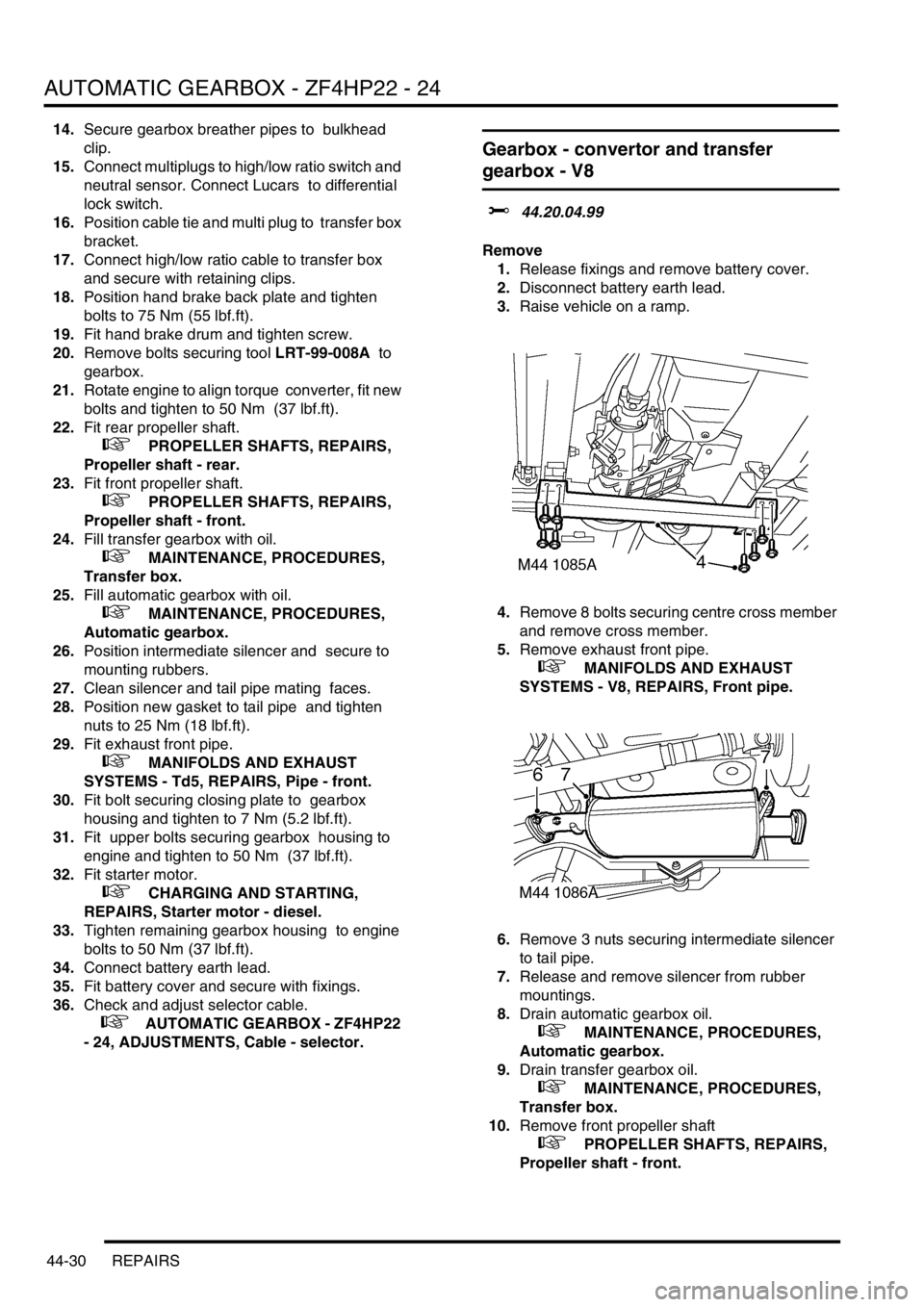
4.Remove 8 bolts securing centre cross member
and remove cross member.
5.Remove exhaust front pipe.
+ MANIFOLDS AND EXHAUST
SYSTEMS - V8, REPAIRS, Front pipe.
6.Remove 3 nuts securing intermediate silencer
to tail pipe.
7.Release and remove silencer from rubber
mountings.
8.Drain automatic gearbox oil.
+ MAINTENANCE, PROCEDURES,
Automatic gearbox.
9.Drain transfer gearbox oil.
+ MAINTENANCE, PROCEDURES,
Transfer box.
10.Remove front propeller shaft
+ PROPELLER SHAFTS, REPAIRS,
Propeller shaft - front.
Page 831 of 1672

AUTOMATIC GEARBOX - ZF4HP22 - 24
44-34 REPAIRS
24.Fit front propeller shaft.
+ PROPELLER SHAFTS, REPAIRS,
Propeller shaft - front.
25.Fill transfer gearbox with oil.
+ MAINTENANCE, PROCEDURES,
Transfer box.
26.Fill automatic gearbox with oil.
+ MAINTENANCE, PROCEDURES,
Automatic gearbox.
27.Position intermediate silencer and secure to
mounting rubbers.
28.Clean silencer and tail pipe mating faces.
29.Position new gasket to tail pipe and tighten nuts
to 40 Nm (30 lbf.ft).
30.Fit exhaust front pipe.
+ MANIFOLDS AND EXHAUST
SYSTEMS - V8, REPAIRS, Front pipe.
31.Position centre cross member, fit bolts and
tighten to 26 Nm (19 lbf.ft).
32.Connect battery earth lead.
33.Fit battery cover and secure fixings.
34.Check and adjust selector cable.
+ AUTOMATIC GEARBOX - ZF4HP22
- 24, ADJUSTMENTS, Cable - selector.
Torque converter and oil seal
$% 44.17.07
Remove
1.Remove automatic gearbox.
l
+ AUTOMATIC GEARBOX -
ZF4HP22 - 24, REPAIRS, Gearbox -
convertor and transfer gearbox - Diesel.
l
+ AUTOMATIC GEARBOX -
ZF4HP22 - 24, REPAIRS, Gearbox -
convertor and transfer gearbox - V8.
2.Remove retaining strap from torque convertor.
3.Fit tool LRT-44-010 to torque converter and
remove torque converter from gearbox.
4.Remove tool LRT-44-010 from converter.
5.Remove oil seal from converter housing.
Page 850 of 1672
AUTOMATIC GEARBOX - ZF4HP22 - 24
REPAIRS 44-53
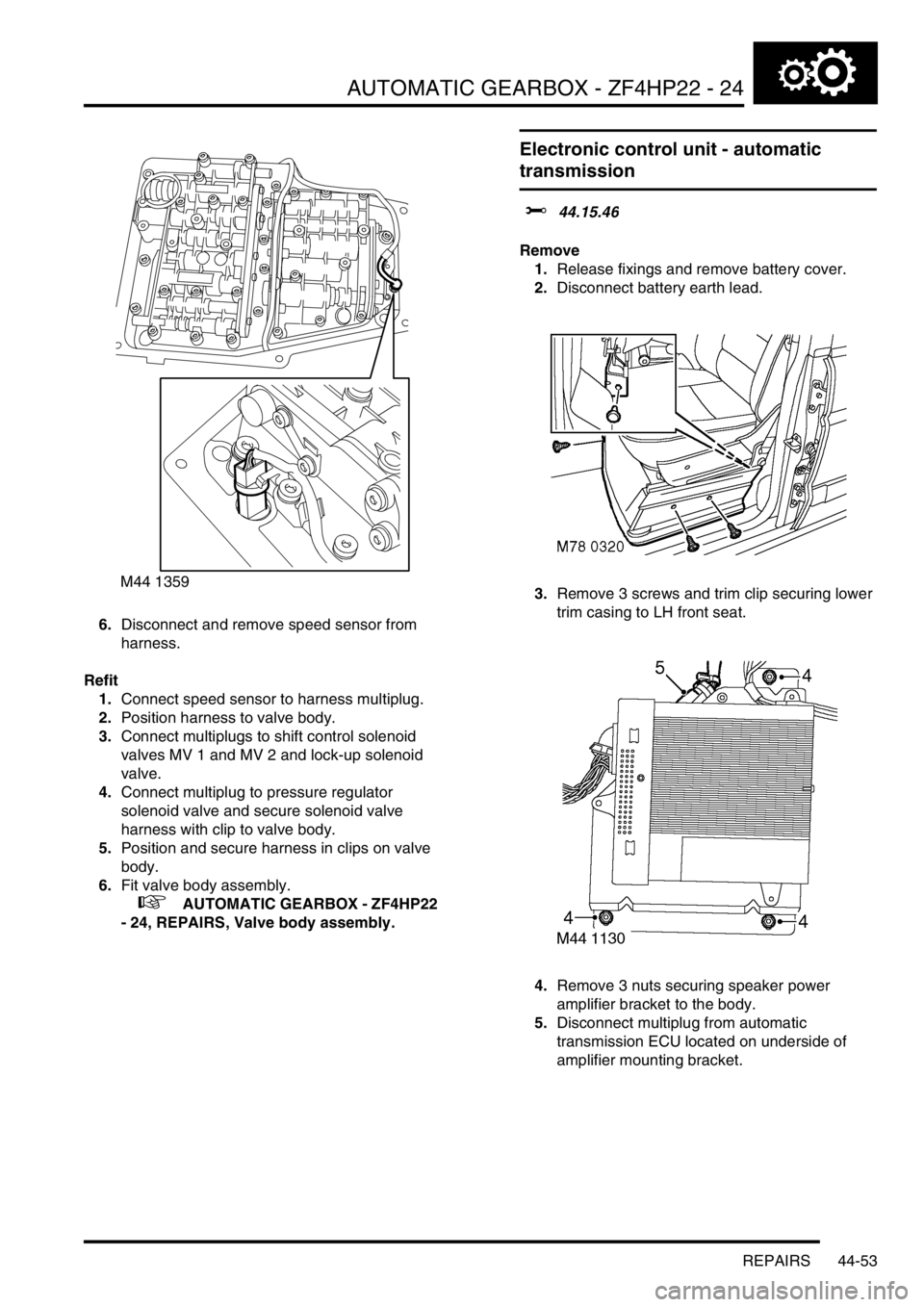
6.Disconnect and remove speed sensor from
harness.
Refit
1.Connect speed sensor to harness multiplug.
2.Position harness to valve body.
3.Connect multiplugs to shift control solenoid
valves MV 1 and MV 2 and lock-up solenoid
valve.
4.Connect multiplug to pressure regulator
solenoid valve and secure solenoid valve
harness with clip to valve body.
5.Position and secure harness in clips on valve
body.
6.Fit valve body assembly.
+ AUTOMATIC GEARBOX - ZF4HP22
- 24, REPAIRS, Valve body assembly.
Electronic control unit - automatic
transmission
$% 44.15.46
Remove
1.Release fixings and remove battery cover.
2.Disconnect battery earth lead.
3.Remove 3 screws and trim clip securing lower
trim casing to LH front seat.
4.Remove 3 nuts securing speaker power
amplifier bracket to the body.
5.Disconnect multiplug from automatic
transmission ECU located on underside of
amplifier mounting bracket.
M44 1359
Page 851 of 1672
AUTOMATIC GEARBOX - ZF4HP22 - 24
44-54 REPAIRS
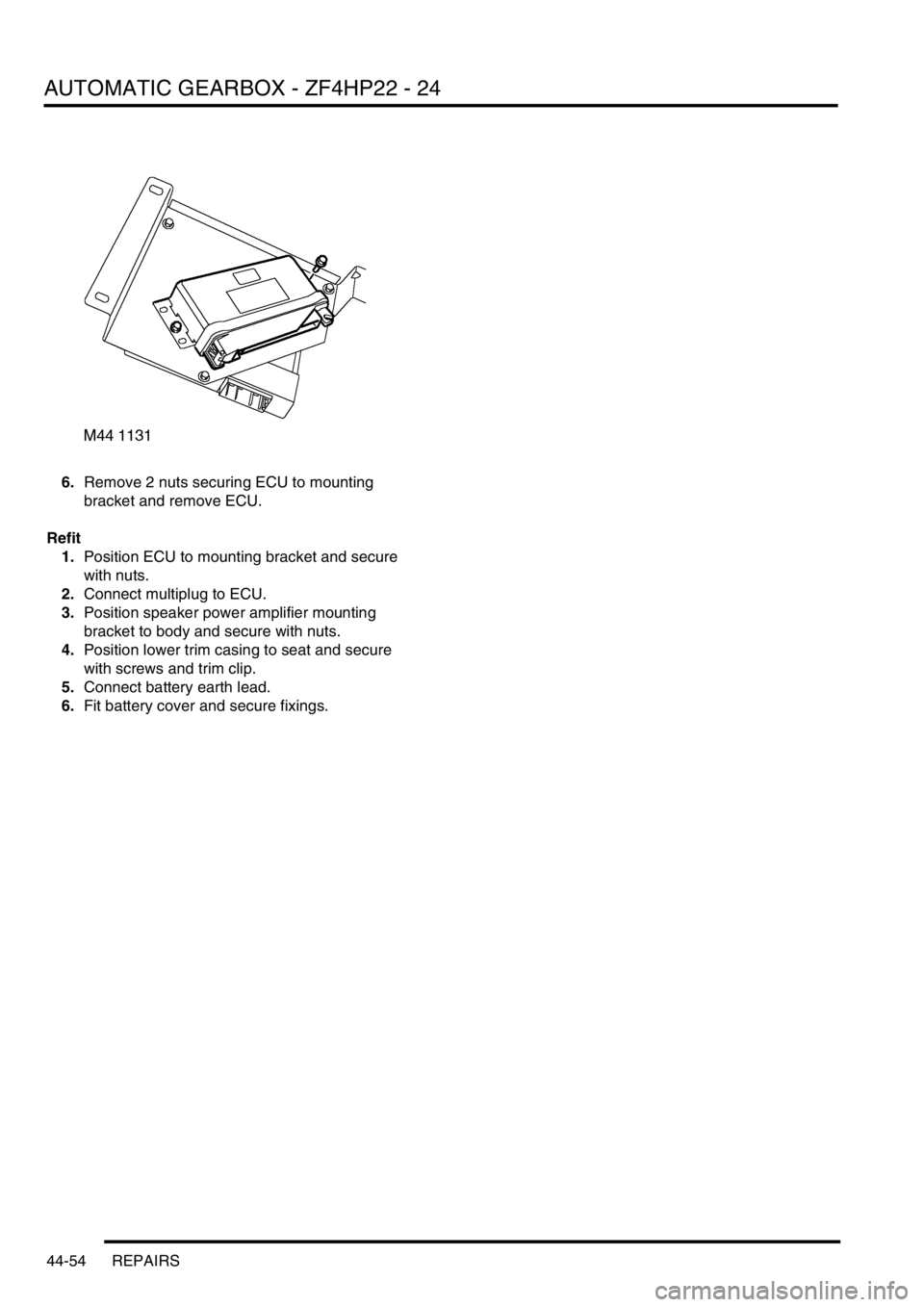
6.Remove 2 nuts securing ECU to mounting
bracket and remove ECU.
Refit
1.Position ECU to mounting bracket and secure
with nuts.
2.Connect multiplug to ECU.
3.Position speaker power amplifier mounting
bracket to body and secure with nuts.
4.Position lower trim casing to seat and secure
with screws and trim clip.
5.Connect battery earth lead.
6.Fit battery cover and secure fixings.