lock LAND ROVER DISCOVERY 2002 Workshop Manual
[x] Cancel search | Manufacturer: LAND ROVER, Model Year: 2002, Model line: DISCOVERY, Model: LAND ROVER DISCOVERY 2002Pages: 1672, PDF Size: 46.1 MB
Page 625 of 1672

MANIFOLDS AND EXHAUST SYSTEMS - TD5
30-1-4 DESCRIPTION AND OPERATION
Front pipe assembly
The front pipe is of welded and fabricated tubular construction. The front pipe is connected to a flange on the
turbocharger and secured with three flanged nuts and sealed with a metal laminated gasket. The front pipe
incorporates a flexible pipe near the connection with the turbocharger and terminates in a flanged connection with the
intermediate pipe.
The flexible pipe is formed into a concertina shape with woven metal strands around its outer diameter. The flexible
pipe allows for ease of exhaust system alignment and also absorbs engine vibration. The woven metal strands also
increase the longevity of the flexible pipe.
The front pipe is attached via a bracket and a mounting rubber to the chassis. The mounting rubber allows ease of
alignment and vibration absorption.
Intermediate pipe and silencer
The intermediate pipe is of welded and fabricated tubular construction. It connects at its forward end to the front pipe
flange. Two captive studs on the intermediate pipe flange allow for attachment to the front pipe with locknuts. The rear
section of intermediate pipe connects to the tail pipe assembly via a flanged joint, sealed with a metal gasket and
secured with locknuts and studs.
The forward and rear sections are joined by a silencer. The silencer is fabricated from stainless steel sheet to form
the body of the silencer. An end plate closes each end of the silencer and is attached to the body with seam joints.
Perforated baffle tubes, inside the silencer, are connected to the inlet and outlet pipes on each end plate. Internal
baffle plates support the baffle tubes and, together with a stainless steel fibre packing, absorb combustion noise as
the exhaust gases pass through the silencer.
The intermediate pipe is attached by two brackets, positioned at each end of the silencer, and two mounting rubbers
to the chassis. The mounting rubber allows for ease of alignment and vibration absorption.
Tail pipe assembly
The tail pipe is of welded and fabricated construction. The tail pipe connects to the intermediate pipe with a flanged
joint secured with locknuts and sealed with a metal gasket. The pipe is shaped to locate above the rear axle allowing
clearance for axle articulation. The pipe is also curved to clear the left hand side of the fuel tank which has a reflective
shield to protect the tank from heat generated from the pipe.
A fabricated silencer is located at the rear of the tail pipe. The silencer is circular in section and is constructed from
stainless steel sheet. A baffle tube is located inside the silencer and the space around the baffle tube is packed with
a stainless steel fibre. The holes in the baffle tube allow the packing to further reduce combustion noise from the
engine. The tail pipe from the silencer is curved downwards at the rear of the vehicle and directs exhaust gases
towards the ground. The curved pipe allows the exhaust gases to be dissipated by the airflow under the vehicle and
prevents the gases from being drawn behind the vehicle.
The tail pipe is attached by a bracket, positioned forward of the silencer, and a mounting rubber to the chassis. The
mounting rubber allows ease of alignment and vibration absorption.
Page 634 of 1672

MANIFOLDS AND EXHAUST SYSTEMS - V8
DESCRIPTION AND OPERATION 30-2-5
Description
General
The inlet manifold on the V8 engine is located on the top of the engine, between the cylinders. The manifold directs
intake air into the cylinders. The intake air is mixed with fuel delivered by the injectors prior to ignition in the cylinders.
The inlet manifold comprises three separate aluminium castings.
Two exhaust manifolds are used, one for each bank of four cylinders. Each exhaust manifold allows combustion
gases from the cylinders to leave the engine and directs them into the exhaust system.
The exhaust system is connected to each exhaust manifold and merges into one pipe midway along the underside of
the vehicle. A catalytic converter (where fitted) is located in the front pipe from each manifold. A silencer is installed
midway along the system and a second tail silencer is located at the rear of the vehicle.
Inlet manifold
The inlet manifold comprises three aluminium castings; a lower manifold, an upper manifold and a plenum. The inlet
manifold is located on the top of the engine and feeds air into the cylinders.
Lower manifold
The lower manifold is a one piece machined aluminium casting which locates in the vee on the top of the engine and
is secured to each cylinder head with six bolts per head. A one piece coated metal gasket seals the lower manifold to
each cylinder head and also serves as a cover for the cylinder block.
Eight injectors are fitted into the lower manifold, four on each side. Each injector is sealed in the manifold with O-ring
seals and retained in position by the fuel rails. A fuel rail is attached to each side of the manifold and secured with two
bolts.
Eight air intake ports are cast and machined on the top of the manifold, each port directing intake air into one cylinder.
These ports mate with matching ports in the upper manifold and are sealed with a coated metal gasket between the
two manifolds.
A cavity at the front of the manifold collects coolant flow from the engine. A coolant outlet pipe is sealed and attached
to the front of the manifold and provides for coolant to flow through the cavity in the casting to the radiator top hose.
A smaller port in the manifold also allows coolant to flow from the cavity to the heater matrix. The lower manifold also
locates the Engine Coolant Temperature (ECT) sensor in a port in the front of the manifold.
Upper manifold
The upper manifold is a one piece machined aluminium casting. The manifold has eight ports on its lower face which
mate with the eight ports on the lower manifold. The joint between the upper and lower manifolds is sealed with a
coated metal gasket and secured with six bolts.
The manifold divides from the eight ports into eight branches, four on each side. Each set of four branches merge into
one gallery on each side of the manifold. Each gallery has an opening at its forward end which mates with the intake
plenum.
The upper manifold provides attachment for the Idle Air Control (IAC) valve and for brackets which retain pipes, plug
leads and throttle cables.
Page 635 of 1672

MANIFOLDS AND EXHAUST SYSTEMS - V8
30-2-6 DESCRIPTION AND OPERATION
Inlet plenum
The plenum is mounted transversely on the front of the upper manifold. The plenum divides into two galleries which
connect with the galleries on the upper manifold. The plenum is secured to the upper manifold with four bolts and
sealed with a coated metal gasket.
The plenum provides attachment for the throttle housing, which is secured with four bolts and sealed with a coated
metal gasket. The plenum also has vacuum connections for brake servo, rocker cover breather and fuel vapour from
the charcoal canister. A port on the top of the plenum connects via a hose to the IAC valve.
Exhaust manifolds
Two handed, cast iron exhaust manifolds are used on the V8 engine. Each manifold has four ports which merge into
one flanged outlet positioned centrally on the manifold.
Each manifold is attached to its cylinder head with eight Torx bolts. Each bolt is fitted with a 'cotton reel' shaped spacer
which allows for a longer bolt resulting in increased torque loading on each bolt. Two laminated metal gaskets seal
each manifold to its cylinder head. The flanged outlet on each manifold provides the attachment for the front pipe of
the exhaust system.
Exhaust system
The exhaust system comprises a front pipe assembly with two front pipes each incorporating a catalytic converter, an
intermediate pipe incorporating a silencer and a tail pipe assembly which also has a silencer. The exhaust system is
constructed mainly of 63 mm (2.48 in) diameter extruded pipe with a 1.5 mm (0.06 in) wall thickness. All pipes are
aluminized to resist corrosion and the silencers are fabricated from stainless steel sheet.
Front pipe assembly
The front pipe assembly is of welded and fabricated construction. A front pipe from each exhaust manifold merges
into one flanged connection. Two captive studs on the flange provide attachment to the intermediate pipe with
locknuts. Each front pipe has a welded flange which is attached to each manifold and secured with three studs and
flanged nuts and sealed with a metal laminated gasket. The gasket comprises a heat resistant fibre between two thin
metallic layers to enhance the sealing properties of the gasket.
A catalytic converter is located in each front pipe. The catalytic converters are different shapes to allow clearance
between the body and transmission. Both catalytic converters are of similar internal construction.
+ EMISSION CONTROL - V8, DESCRIPTION AND OPERATION, Emission Control Systems.
CAUTION: Ensure the exhaust system is free from leaks. Exhaust gas leaks upstream of the catalytic
converter could cause internal damage to the catalytic converter.
From the catalytic converters, the front pipes merge into one pipe which terminates at a flanged joint. The flange
connects with the intermediate pipe, sealed with an olive and secured with studs and locknuts.
Intermediate pipe and silencer
The intermediate pipe is of welded and fabricated tubular construction. It connects at its forward end with a flange on
the front pipe assembly and is secured with locknuts to captive studs in the front pipe assembly flange. The rear
section of the intermediate pipe connects to the tail pipe assembly via a flanged joint, sealed with a metal gasket and
secured with locknuts and studs.
The forward and rear sections are joined by a silencer. The silencer is fabricated from stainless steel sheet to form
the body of the silencer. An end plate closes each end of the silencer and is attached to the body with seam joints.
Perforated baffle tubes inside the silencer are connected to the inlet and outlet pipes on each end plate. Internal baffle
plates support the baffle tubes and together with a stainless steel fibre absorb combustion noise as the exhaust gases
pass through the silencer.
The intermediate pipe is attached by two brackets, positioned at each end of the silencer, and mounting rubbers to
the chassis. The mounting rubbers allow ease of alignment and vibration absorption. The two mounting rubbers are
fitted with removable heat deflectors to prevent heat from the silencer damaging the material.
Page 636 of 1672

MANIFOLDS AND EXHAUST SYSTEMS - V8
DESCRIPTION AND OPERATION 30-2-7
Tail pipe assembly
The tail pipe is of welded and fabricated construction. It connects to the intermediate pipe with a flanged joint secured
with studs and locknuts and sealed with a metal gasket. The pipe is shaped to locate above the rear axle allowing
clearance for axle articulation. The pipe is also curved to clear the left hand side of the fuel tank which has a reflective
shield to protect the tank from heat generated from the pipe.
A fabricated silencer is located at the rear of the tail pipe. The silencer is circular in section and is constructed from
stainless steel sheet. A baffle tube is located inside the silencer and the space around the baffle tube is packed with
a stainless steel fibre. The holes in the baffle tube allow the packing to further reduce combustion noise from the
engine. The tail pipe from the silencer is curved downwards at the rear of the vehicle and directs exhaust gases
towards the ground. The curved pipe allows the exhaust gases to be dissipated by the airflow under the vehicle and
prevents gases being drawn behind the vehicle.
The tail pipe is attached by a bracket, positioned forward of the silencer, and a mounting rubber to the chassis. The
mounting rubber allows ease of alignment and vibration absorption.
Page 644 of 1672

MANIFOLDS AND EXHAUST SYSTEMS - V8
REPAIRS 30-2-15
Refit
1.Clean old RTV sealant from cylinder head and
cylinder block notches.
2.Clean mating faces of cylinder block, cylinder
head and inlet manifold.
3.Apply RTV sealant to cylinder head and
cylinder block notches.
4.Fit new gasket seals, ensuring ends engage
correctly in notches.
5.Fit new inlet manifold gasket.
6.Position gasket clamps and fit bolts, but do not
tighten at this stage.
7.Position inlet manifold to engine. Fit manifold
bolts and, working in the sequence shown,
tighten bolts initially to 10 Nm (7 lbf.ft) then to
51 Nm (38 lbf.ft).
8.Tighten gasket clamp bolts to 18 Nm (13 lbf.ft).
9.Connect fuel pipe.
10.Clean top hose outlet pipe mating faces.
11.Fit new 'O' ring to outlet pipe.
12.Position outlet pipe, fit bolts and tighten to 22
Nm (16 lbf.ft).
13.Position alternator, fit bolts and tighten to 45
Nm (33 lbf.ft).
14.Position PAS pump to auxiliary housing and
locate housing on engine. Fit bolts and tighten
to 40 Nm (30 lbf.ft).
15.Fit and tighten auxiliary housing nut to 10 Nm (7
lbf.ft).
16.Fit bolts securing PAS pump and tighten to 22
Nm (16 lbf.ft). 17.Position oil cooling pipe bracket fit bolt and
tighten to 22 Nm (16 lbf.ft).
18.Fit and tighten PAS pump high pressure pipe.
19.Position jockey pulley and tighten bolt to 50 Nm
(37 lbf.ft).
20.Clean PAS pump pulley mating faces.
21.Position PAS pump pulley, fit bolts and tighten
to 22 Nm (16 lbf.ft).
22.Clean ACE pump dowels and dowel holes.
23.Position ACE pump, fit bolts and tighten to 22
Nm (16 lbf.ft).
24.Fit auxiliary drive belt.
+ CHARGING AND STARTING,
REPAIRS, Belt - auxiliary drive.
25.Secure injector harness and connect injector
multiplugs.
26.Position top hose and secure clips.
27.Fit rocker covers.
l
+ ENGINE - V8, REPAIRS, Gasket
- rocker cover - LH.
l
+ ENGINE - V8, REPAIRS, Gasket
- rocker cover - RH.
28.Check and top up PAS fluid
Page 649 of 1672
MANIFOLDS AND EXHAUST SYSTEMS - V8
30-2-20 REPAIRS
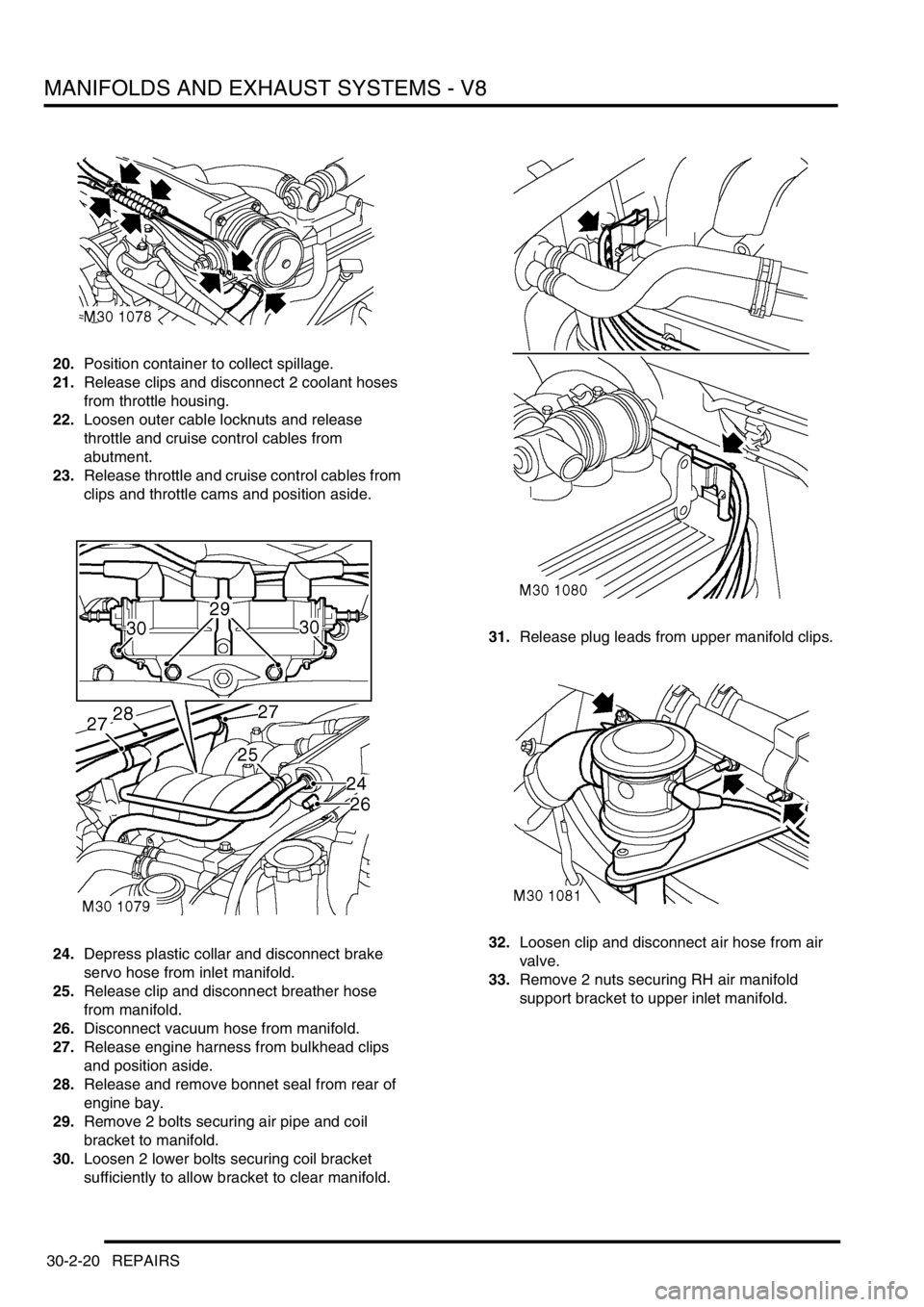
20.Position container to collect spillage.
21.Release clips and disconnect 2 coolant hoses
from throttle housing.
22.Loosen outer cable locknuts and release
throttle and cruise control cables from
abutment.
23.Release throttle and cruise control cables from
clips and throttle cams and position aside.
24.Depress plastic collar and disconnect brake
servo hose from inlet manifold.
25.Release clip and disconnect breather hose
from manifold.
26.Disconnect vacuum hose from manifold.
27.Release engine harness from bulkhead clips
and position aside.
28.Release and remove bonnet seal from rear of
engine bay.
29.Remove 2 bolts securing air pipe and coil
bracket to manifold.
30.Loosen 2 lower bolts securing coil bracket
sufficiently to allow bracket to clear manifold.31.Release plug leads from upper manifold clips.
32.Loosen clip and disconnect air hose from air
valve.
33.Remove 2 nuts securing RH air manifold
support bracket to upper inlet manifold.
Page 686 of 1672

MANUAL GEARBOX - R380
DESCRIPTION AND OPERATION 37-3
1Front cover
2Input shaft oil seal
3Oil filler/level plug
4Sealing washer
5Oil drain plug
6Gear case
7Interlock spool retainer, bolt and 'O' ring
8Centre plate
9Locating dowels
10Selector plug, detent balls and spring
11Splash shield and retaining bolt
12Extension housing
13Gate plate and retaining bolt
14Interlock spool retainer, retaining bolt and 'O'
ring – if fitted – extension housing
15Inhibitor cam spring
16Inhibitor cam
17Reverse inhibitor shaft
18Output shaft oil seal
19Oil seal collar
20Oil pump and retaining bolt
21'O' ring
22Reverse lamp switch23Oil by-pass block - UK and European models
24Bolt - oil by-pass block
25'O' ring - oil by-pass block
26Thermostat and housing - non UK and non
European models
27'O' ring - thermostat housing
28Bolt - thermostat housing
29Oil pick-up pipe
30Oil filter
31Oil pick-up ring
32Rubber gaiter
33Cable tie
34Upper gear lever
35Clamp bolt
36Bias springs
37Bolts and washers - bias adjusting plate and
housing
38Bias adjusting plate
39Lower gear lever and ball
40Railko bush
41Oil seal
42Gear change housing
Page 688 of 1672

MANUAL GEARBOX - R380
DESCRIPTION AND OPERATION 37-5
13rd/4th gear selector fork
2Interlock spool
31st/2nd gear selector fork
4Selector shaft yoke pins
5Selector shaft
6Reverse/5th gear selector fork
7Selector yoke
8Setscrew
9Input shaft front taper bearing
10Input shaft
11 4th gear synchromesh ring
12Pilot taper bearing
13Spacer
143rd/4th gear synchromesh hub and sleeve
153rd gear synchromesh rings
163rd gear
17Needle roller bearings
18Output shaft
19Roll pin
20Needle bearing
212nd gear
222nd gear synchromesh rings
232nd/1st gear synchromesh hub and sleeve
241st gear synchromesh rings
251st gear
26Needle roller bearing
27Bush
28Output shaft taper bearing 29Selective shim
30Selective washer
31Bush
32Needle roller bearing
33Reverse gear
34Reverse gear synchromesh ring
35Reverse/5th gear synchromesh hub and sleeve
36Circlip
37Needle roller bearings
385th gear synchromesh ring
395th gear
405th gear segments
415th gear segment retaining ring
42Output shaft rear support bearing
43Layshaft support bearing
44Layshaft
45Layshaft support bearing
46Selective shim
47Layshaft reverse gear
48Layshaft 5th gear
49Split collar
505th gear nut
51Layshaft rear support bearing
52Spacer
53Reverse idler gear
54Needle roller bearing
55Reverse idler shaft
Page 690 of 1672

MANUAL GEARBOX - R380
DESCRIPTION AND OPERATION 37-7
Description
General
The R380 all synchromesh gearbox has five forward speeds and reverse and is mounted in line with the engine. The
clutch bell housing is bolted to the front of the gearbox and the transfer box is mounted at the rear.
Gearbox casings
Gearbox casings consist of a front cover, gearcase, centre plate and extension housing. All casings with the exception
of the front cover are located to each other by dowels and sealed. Gearbox filler/level and drain plugs are located in
the gearcase.
Reverse lamp switch
A reverse lamp switch is inserted into the extension housing. Selection of reverse gear will close the switch allowing
current from fuse 25 to flow through the switch to illuminate the reverse lamps. The switch also provides a feed to the
BCU and the automatic interior mirror - if fitted; the mirror moving to the dimming position.
Gearchange assembly
The gearchange assembly is bolted to the top of the gearcase, the upper gear lever being attached to the lower gear
lever by means of a clamp bolt. The lower gear lever ball is housed in a Railko bush inserted in the gear change
housing, the end of the lever locating in the selector yoke which is attached to the end of the selector shaft. Bias
springs provide a positive return of the gear lever to the neutral position with selection of 1st/2nd and 5th/reverse gears
being against bias spring pressure. Spring loaded detent balls fitted in the centre plate locate in grooves in the selector
shaft to provide positive gear and neutral selection.
Lubrication
Lubrication is by an oil pump located in the extension housing and driven by the layshaft with additional lubrication
being provided by splash. The pump directs oil via a filter and internal drillings in the output shaft to lubricate the
components. On non UK and non European models, provision for oil cooling is by means of a thermostat housed in
a cover bolted to the side of the extension housing. The cover incorporates tappings for connections to an oil cooler.
On UK and European models, the thermostat and cover are replaced by an oil by-pass block.
Internal pressures produced within the gearbox are vented to atmosphere via a plastic breather pipe. The pipe is
attached to the extension housing and is routed across the top of the gearcase and secured at the open end by a clip
attached to the engine cylinder block.
Selector shaft and forks
Selector forks for 1st/2nd, 3rd/4th and 5th/reverse gears are located on a single selector shaft; the 1st/2nd and 3rd/
4th selector forks are inside the main gearcase whilst the 5th/reverse selector fork is inside the extension housing.
Each of the selector forks locates inside its corresponding synchromesh hub.
Synchromesh assemblies
Each synchromesh assembly is located on the output shaft adjacent to its corresponding gears and comprises a
synchromesh ring, hub, slippers and sleeve. The hubs and slippers are retained in the sleeves by means of spring
clips. 1st/2nd and 3rd synchromesh assemblies are fitted with double synchromesh rings whilst 4th, 5th and reverse
assemblies are fitted with single rings.
Page 697 of 1672
MANUAL GEARBOX - R380
37-14 REPAIRS
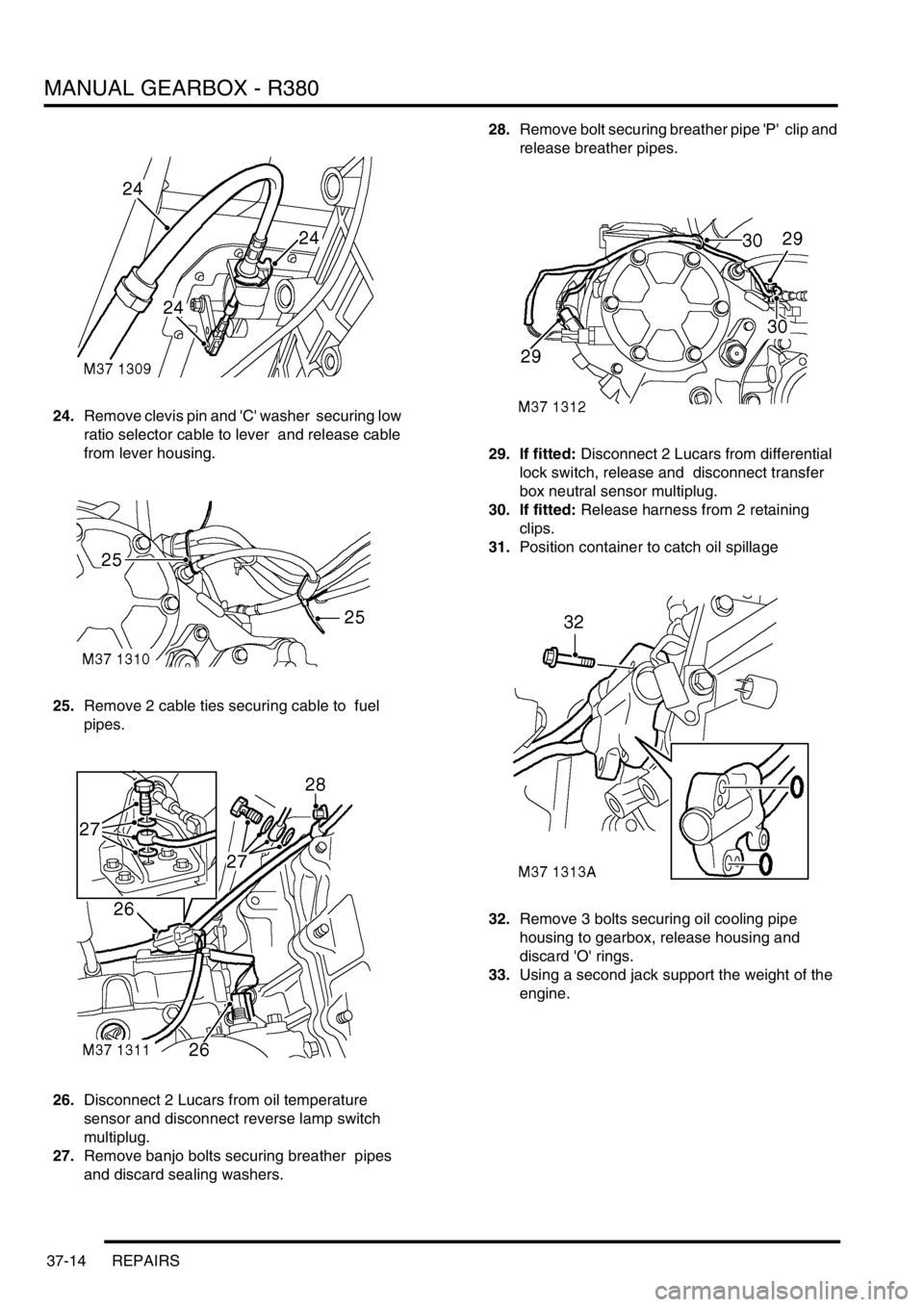
24.Remove clevis pin and 'C' washer securing low
ratio selector cable to lever and release cable
from lever housing.
25.Remove 2 cable ties securing cable to fuel
pipes.
26.Disconnect 2 Lucars from oil temperature
sensor and disconnect reverse lamp switch
multiplug.
27.Remove banjo bolts securing breather pipes
and discard sealing washers. 28.Remove bolt securing breather pipe 'P' clip and
release breather pipes.
29. If fitted: Disconnect 2 Lucars from differential
lock switch, release and disconnect transfer
box neutral sensor multiplug.
30. If fitted: Release harness from 2 retaining
clips.
31.Position container to catch oil spillage
32.Remove 3 bolts securing oil cooling pipe
housing to gearbox, release housing and
discard 'O' rings.
33.Using a second jack support the weight of the
engine.