ABS LAND ROVER DISCOVERY 2002 Owner's Guide
[x] Cancel search | Manufacturer: LAND ROVER, Model Year: 2002, Model line: DISCOVERY, Model: LAND ROVER DISCOVERY 2002Pages: 1672, PDF Size: 46.1 MB
Page 399 of 1672

ENGINE MANAGEMENT SYSTEM - TD5
18-1-6 DESCRIPTION AND OPERATION
Description
General
An engine control module (ECM) controls the five-cylinder direct injection diesel engine, and works on the drive by
wire principle. This means there is no throttle cable, the ECM controls the drivers needs via a signal from the Throttle
Position (TP) sensor on the throttle pedal.
The ECM is a full authoritative diesel specific microprocessor that also incorporates features for cruise control and air
conditioning control. In addition, the ECM supplies output control for the exhaust gas recirculation and turbocharger
boost pressure. The ECM has a self-diagnostic function, which is able to provide backup strategies for most sensor
failures.
The ECM processes information from the following input sources:
lMass air flow sensor.
lAmbient air pressure sensor.
lManifold absolute pressure/inlet air temperature sensor.
lEngine coolant temperature sensor.
lCrankshaft speed and position sensor.
lThrottle position sensor.
lFuel temperature sensor.
lAir conditioning request.
lAir conditioning fan request.
lBrake pedal switch.
lClutch switch.
lCruise control master switch.
lCruise control SET+ switch.
lCruise control RES switch.
lHigh/low ratio switch.
The input from the sensors constantly updates the ECM with the current operating condition of the engine. Once the
ECM has compared current information with stored information within its memory, it can make any adjustment it
requires to the operation of the engine via the following:
lAir conditioning clutch relay.
lAir conditioning cooling fan relay.
lElectronic vacuum regulator solenoid.
lMalfunction indicator lamp.
lFuel pump relay.
lGlow plug warning lamp.
lGlow plugs.
lFuel injectors.
lMain relay.
lTurbocharger wastegate modulator.
lTemperature gauge.
The ECM interfaces with the following:
lElectronic Automatic Transmission (EAT).
lSelf Levelling and Anti-lock Brakes System (SLABS).
lSerial communication link.
lInstrument cluster.
lBody Control Unit (BCU).
Page 401 of 1672

ENGINE MANAGEMENT SYSTEM - TD5
18-1-8 DESCRIPTION AND OPERATION
Input/Output
ECM inputs and outputs are detailed below:
Connector C0158
Pin No. Input/Output Function Signal type Value Interfaces
A1 Output Injector 5 Analogue 0
A2 Not used
A3 Output EGR modulator Digital 0-12
A4 Not used
A5 Input FT sensor earth 0 volts 0
A6 Input MAP sensor Analogue 0-5 volts
A7 Input ECT sensor Analogue 0-5 volts
A8 Sensor supply Sensor supply 5 volts 5 volts
A9 HT pin
A10 Input AAP sensor Analogue 0-5 volts
A11 Input MAF sensor Analogue 0-5 volts
A12 Not used
A13 Input CKP sensor positive Analogue
A14 Not used
A15 Input Sensor earth 5 0 volts 0 volts
A16 Input CKP sensor screened earth 0 volts 0 volts
A17 Input Sensor earth 6 0 volts 0 volts
A18 Input Sensor earth 3 0 volts 0 volts
A19 Input FT sensor Analogue 0-5 volts
A20 Input Sensor earth 2 0 volts 0 volts
A21 Output Turbocharger wastegate
modulatorDigital 0-12 volts
A22 Output Injector common 2 Analogue 0-85 volts
A23 Output Injector common 1 Analogue 0-85 volts
A24 Output Injector 4 Analogue 0 volts
A25 Output Injector 1 Analogue 0 volts
A26 Output Injector 2 Analogue 0 volts
A27 Output Injector 3 Analogue 0 volts
A28 Not used
A29 Output Glow plug relay Analogue 0-90 volts
A30 Input Sensor earth 4 0 volts 0 volts
A31 Not used
A32 Input/Output CAN negative Digital 2.5-5 volts EAT
A33 Input High/low ratio switch Digital 0-5 volts EAT, SLABS
A34 Input IAT sensor Analogue 0-5 volts
A35 Input/Output Can positive Digital 2.5-5 volts EAT
A36 Input CKP sensor negative 0 volts 0 volts
Page 402 of 1672

ENGINE MANAGEMENT SYSTEM - TD5
DESCRIPTION AND OPERATION 18-1-9
Connector C0658
Pin No. Input/Output Function Signal type Value Interfaces
B1 Input Earth 1 0 volts 0 volts
B2 Input Earth 4 0 volts 0 volts
B3 Input Supply battery voltage 12 volts 12 volts
B4 Output Cooling fan relay Switch 12-0 volts A/C ECU
B5 Output Fuel pump relay Switch 12-0 volts
B6 Output MIL Switch 12-0 volts Instruments
B7 Output Temperature gauge Digital 0-12 volts Instruments
B8 Not used
B9 Input A/C clutch request Switch 12-0 volts A/C ECU
B10 Input Normally closed brake
switchSwitch 12-0 volts
B11 Input Cruise control SET+ switch Switch 12-0 volts
B12 Input TP sensor 1 Analogue 0- 5 volts
B13 Input Vehicle speed Digital 0-12 volts
B14 Input TP sensor supply 5 volts 5 volts
B15 Input Cruise control master switch Switch 12-0 volts
B16 Input Normally open brake switch Switch 0-12 volts
B17 Input Cruise control RES switch Switch 12-0 volts
B18 Input/Output Serial communication link Digital 0-12 volts All ECU's
B19 Output Tachometer engine speed Digital 0-12 volts Instrument
Cluster
B20 Not used
B21 Output Main relay Switch 0-12 volts
B22 Input Supply battery voltage 12 volts 12 volts
B23 Input A/C fan request Switch 12-0 volts
B24 Input Earth 3 0 volts 0 volt
B25 Input Earth 2 0 volts 0 volts
B26 Input TP sensor earth 0 volts 0 volts
B27 Input Supply 2 12 volts 12 volts
B28 Not used
B29 Output A/C relay Switch 12-0 volts
B30 Output Glow plug warning light Switch 12-0 volts Instrument
Cluster
B31 Not used
B32 Output ABS digital 0-5 volts SLABS
B33 Input Ignition Switch 0-12 volts
B34 Input Security code digital 0-5 volts
B35 Input Clutch switch Switch 12-0 volts
B36 Input TP sensor 2 Analogue 5-0 volts
Page 405 of 1672
ENGINE MANAGEMENT SYSTEM - TD5
18-1-12 DESCRIPTION AND OPERATION
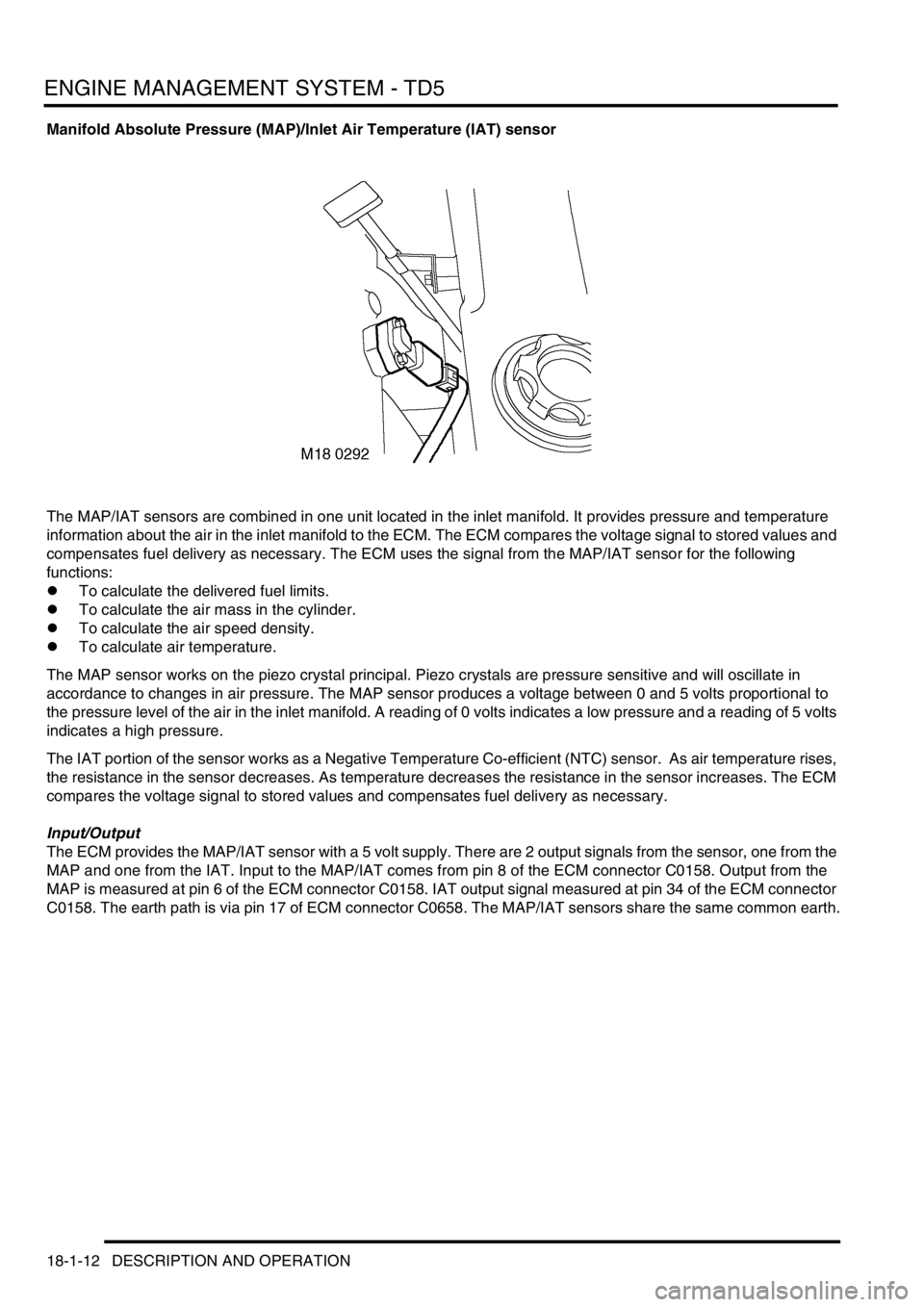
Manifold Absolute Pressure (MAP)/Inlet Air Temperature (IAT) sensor
The MAP/IAT sensors are combined in one unit located in the inlet manifold. It provides pressure and temperature
information about the air in the inlet manifold to the ECM. The ECM compares the voltage signal to stored values and
compensates fuel delivery as necessary. The ECM uses the signal from the MAP/IAT sensor for the following
functions:
lTo calculate the delivered fuel limits.
lTo calculate the air mass in the cylinder.
lTo calculate the air speed density.
lTo calculate air temperature.
The MAP sensor works on the piezo crystal principal. Piezo crystals are pressure sensitive and will oscillate in
accordance to changes in air pressure. The MAP sensor produces a voltage between 0 and 5 volts proportional to
the pressure level of the air in the inlet manifold. A reading of 0 volts indicates a low pressure and a reading of 5 volts
indicates a high pressure.
The IAT portion of the sensor works as a Negative Temperature Co-efficient (NTC) sensor. As air temperature rises,
the resistance in the sensor decreases. As temperature decreases the resistance in the sensor increases. The ECM
compares the voltage signal to stored values and compensates fuel delivery as necessary.
Input/Output
The ECM provides the MAP/IAT sensor with a 5 volt supply. There are 2 output signals from the sensor, one from the
MAP and one from the IAT. Input to the MAP/IAT comes from pin 8 of the ECM connector C0158. Output from the
MAP is measured at pin 6 of the ECM connector C0158. IAT output signal measured at pin 34 of the ECM connector
C0158. The earth path is via pin 17 of ECM connector C0658. The MAP/IAT sensors share the same common earth.
Page 433 of 1672

ENGINE MANAGEMENT SYSTEM - TD5
18-1-40 DESCRIPTION AND OPERATION
Controller Area Network (CAN) system
The CAN system is a high speed serial interface between the ECM and the Electronic Automatic Transmission (EAT)
ECU. The CAN system uses a data bus to transmit information messages between the ECM and the EAT ECU.
Because there are only two components in this CAN system, one will transmit information messages and the other
will receive information messages, and vice-versa.
The CAN system is used by the EAT ECU and the ECM for the following:
lGearshift torque control information.
lEAT OBD information.
lMIL request.
lVehicle speed signal.
lEngine temperature.
lEngine torque and speed.
lGear selected.
lGear change information.
The CAN system uses a twisted pair of wires to form the data bus to minimise electrical interference. This method of
serial interface is very reliable and very fast. The information messages are structured so that each of the receivers
(ECM or EAT ECU) is able to interpret and react to the messages sent.
The CAN data bus is connected directly between pin 32 of connector C0158 of the ECM and pin 44 of connector
C0193 at the EAT ECU, and pin 35 of connector C0158 of the ECM and pin 16 of connector C0193 at the EAT ECU.
The CAN system can fail in the following ways:
lCAN data bus wiring open circuit.
lCAN data bus wiring short circuit.
In the event of a CAN data bus failure any of the following symptoms may be observed:
lEAT defaults to reverse and 4th gear if the vehicle is moving, 3rd gear if the vehicle is stationary.
lHarsh gearshifts.
lSport and manual warning lamps flash alternately.
Vehicle Speed Signal (VSS)
The VSS is an integral part of the ECM's overall adaptive strategy. The ECM receives the signal direct from the
SLABS ECU. The SLABS ECU is not connected to the controller area network (CAN) so therefore is hard wired.
Vehicles fitted with automatic transmission have two vehicle speed input signals to the ECM. One signal is from the
SLABS ECU and the other is from the automatic transmission ECU. The ECU compares these speed signals.
The ECM also receives transfer gearbox information. This allows the ECM to take in to account the vehicle being
driven using low range gearing and compensate as necessary. The signals generated by the SLABS ECU for manual
transmission, and by the EAT ECU for automatic transmission are received by the ECM in the form of a PWM signal.
The frequency of this signal changes in accordance with road speed.
The input signal for the SLABS is measured via pin 13 of connector C0658 of the ECM. The SLABS ECU generates
a PWM signal switching between 0 and 12 volts at a frequency of 8000 pulses per mile.
For vehicles with automatic transmission the input signal for the EAT ECU is measured via pins 32 and 35 of
connector C0158 of the ECM. These pin numbers provide a bi-directional communications link using the CAN data
bus.
Page 434 of 1672

ENGINE MANAGEMENT SYSTEM - TD5
DESCRIPTION AND OPERATION 18-1-41
In the case of a VSS failure on vehicles with automatic transmissions the ECM applies default values derived from
the EAT ECU. There is no default value for manual transmission vehicle.
The VSS can fail in the following ways:
lWiring short circuit to vehicle supply.
lWiring short circuit to vehicle earth.
lWiring open circuit.
In the event of a VSS failure any of the following symptoms may be observed:
lVehicle speed limiting disabled (manual transmission only).
lHill Descent Control (HDC) warning lamp on and audible warning.
Cruise control
All markets have a common cruise control system. The cruise control system, when activated, regulates vehicle
speed. The ECM controls the cruise control system.
Cruise control activation
Cruise control is a passive system, and must be activated by the driver. Cruise control is activated by switching on
the cruise control master switch located on the instrument panel. A LED in the switch illuminates indicating cruise
control is available. The driver must accelerate the vehicle to the desired speed using the accelerator pedal. When
the desired speed is reached, cruise control can be activated by pressing the SET+ switch.
Cruise control will only activate if the following conditions are met:
lVehicle speed is above 22 mph (35 km/h).
lThe brake pedal is not pressed.
lThe clutch pedal is not pressed (manual transmission only).
lThe transmission is not in Park, Reverse or Neutral (automatic transmission only).
The ECM receives the set signal and determines the vehicle speed provided by the SLABS ECU. The ECM then
maintains current road speed.
Cruise control cancellation
Cancelling cruise control enables the driver to regain control of the vehicle speed by using the accelerator pedal.
Cruise control is cancelled if any of the following conditions occur:
lThe brake pedal is pressed.
lThe RES switch is pressed.
lThe clutch pedal is pressed (manual transmission only).
lThe cruise control master switch is switched off.
lThe transmission is placed in Park, Neutral, or Reverse (automatic transmission only).
The ECM cancels cruise control operation and returns it to the control of the accelerator pedal.
The set speed will be stored in the ECM unless:
lThe cruise control master switch is switched off.
lThe ignition is switched off.
If cruise control is deactivated using either of the above methods, the set speed will be erased from the memory of
the ECM.
Page 452 of 1672

ENGINE MANAGEMENT SYSTEM - TD5
REPAIRS 18-1-59
Regulator - fuel pressure
$% 19.45.06
Remove
1.Release turnbuckles and remove battery cover
2.Disconnect battery earth lead.
3.Remove 3 bolts and remove engine acoustic
cover.
4.Remove 2 bolts and remove engine lifting eye.
5.Position cloth to absorb fuel spillage.
6.Release and disconnect hose from fuel cooler. 7.Release and disconnect fuel hose from
pressure regulator.
Always fit plugs to open connections to
prevent contamination.
8.Disconnect multiplug from fuel temperature
sensor.
9.Remove 3 bolts, remove pressure regulator
from cylinder head and collect gasket.
10.Remove and discard 'O' ring and fuel filter.
Page 462 of 1672

ENGINE MANAGEMENT SYSTEM - V8
DESCRIPTION AND OPERATION 18-2-5
1Engine control module
2Crankshaft speed and position sensor
3Camshaft position sensor
4Engine coolant temperature sensor
5Mass air flow/ inlet air temperature sensor
6Throttle position sensor
7Heated oxygen sensors
8Fuel injectors
9Idle air control valve
10Fuel pump relay
11EVAP canister
12EVAP canister vent valve
13EVAP canister purge valve
14Fuel tank pressure sensor
15Ignition coils
16Knock sensor
17Spark plugs
18High/ Low ratio switch
19Malfunction indication lamp
20Diagnostic connector
21Air temperature control clutch relay
22Air temperature control cooling fan relay
23ATC ECU
24CAN link to EAT
25SLABS ECU
26BCU
27Instrument cluster
28Thermostat monitoring sensor (where fitted)
Page 464 of 1672
ENGINE MANAGEMENT SYSTEM - V8
DESCRIPTION AND OPERATION 18-2-7
The ECM controls the following outputs:
lFuel injectors (1 per cylinder).
lIgnition coils/ high tension leads/ spark plugs.
lFuel pump relay.
lIdle air control valve.
lHeated oxygen sensors.
lEVAP canister purge valve.
lEVAP canister vent solenoid (CVS) valve (where fitted).
lMalfunction Indicator Lamp (MIL)/ service engine soon lamp (where fitted).
lHill descent control (via SLABS interface).
lEVAP system fuel leak detection pump (where fitted)
lSecondary air injection pump (where fitted)
The ECM also interfaces with the following:
lDiagnostics via diagnostic connector with TestBook.
lController Area Network (CAN) link to EAT ECU.
lAir conditioning system.
lSelf Levelling & Anti-lock Braking System (SLABS) ECU.
lImmobilisation system via the body control unit (BCU).
lInstrument cluster.
lCruise control ECU
lActive Cornering Enhancement (ACE) ECU
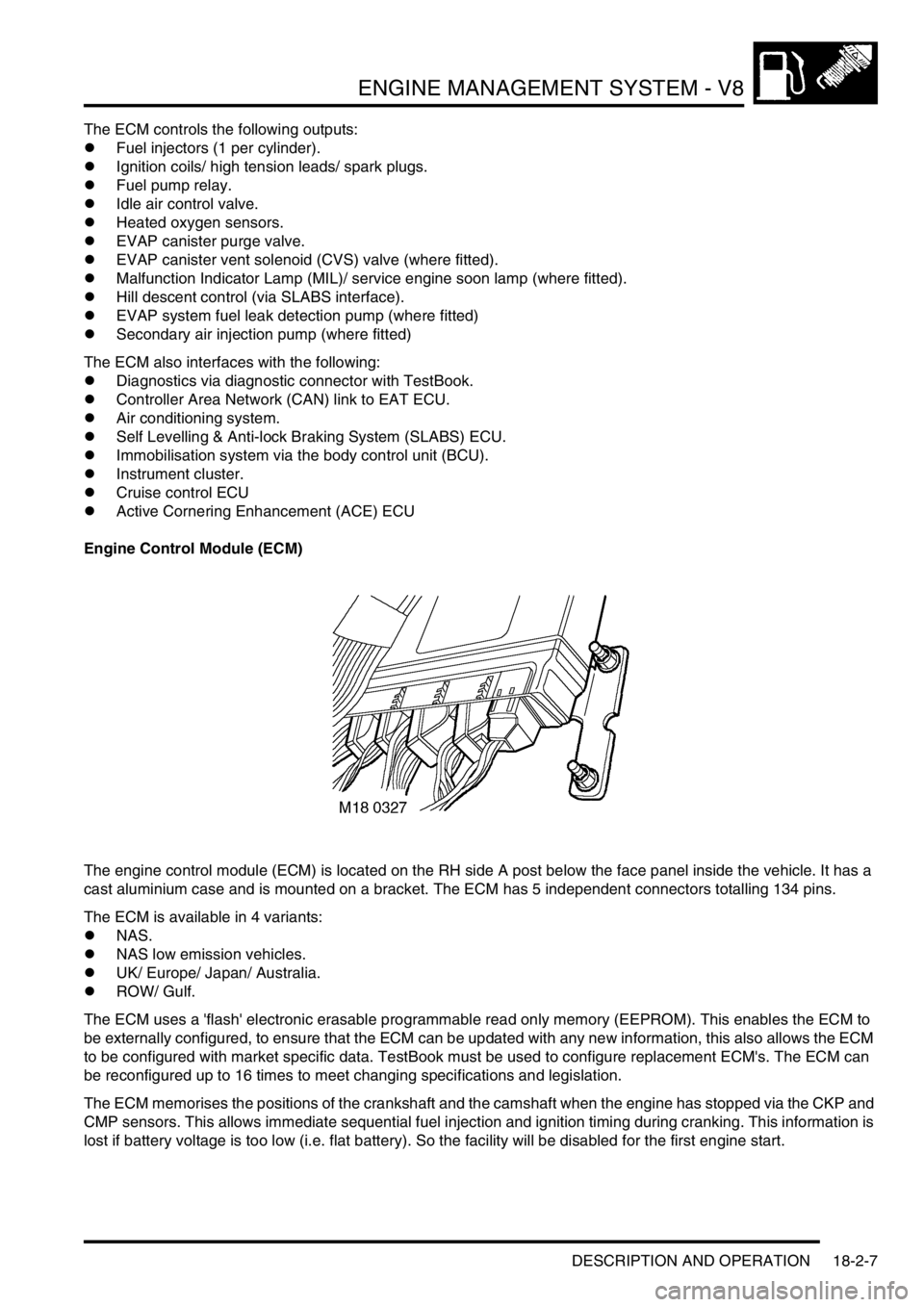
Engine Control Module (ECM)
The engine control module (ECM) is located on the RH side A post below the face panel inside the vehicle. It has a
cast aluminium case and is mounted on a bracket. The ECM has 5 independent connectors totalling 134 pins.
The ECM is available in 4 variants:
lNAS.
lNAS low emission vehicles.
lUK/ Europe/ Japan/ Australia.
lROW/ Gulf.
The ECM uses a 'flash' electronic erasable programmable read only memory (EEPROM). This enables the ECM to
be externally configured, to ensure that the ECM can be updated with any new information, this also allows the ECM
to be configured with market specific data. TestBook must be used to configure replacement ECM's. The ECM can
be reconfigured up to 16 times to meet changing specifications and legislation.
The ECM memorises the positions of the crankshaft and the camshaft when the engine has stopped via the CKP and
CMP sensors. This allows immediate sequential fuel injection and ignition timing during cranking. This information is
lost if battery voltage is too low (i.e. flat battery). So the facility will be disabled for the first engine start.
Page 482 of 1672
ENGINE MANAGEMENT SYSTEM - V8
DESCRIPTION AND OPERATION 18-2-25
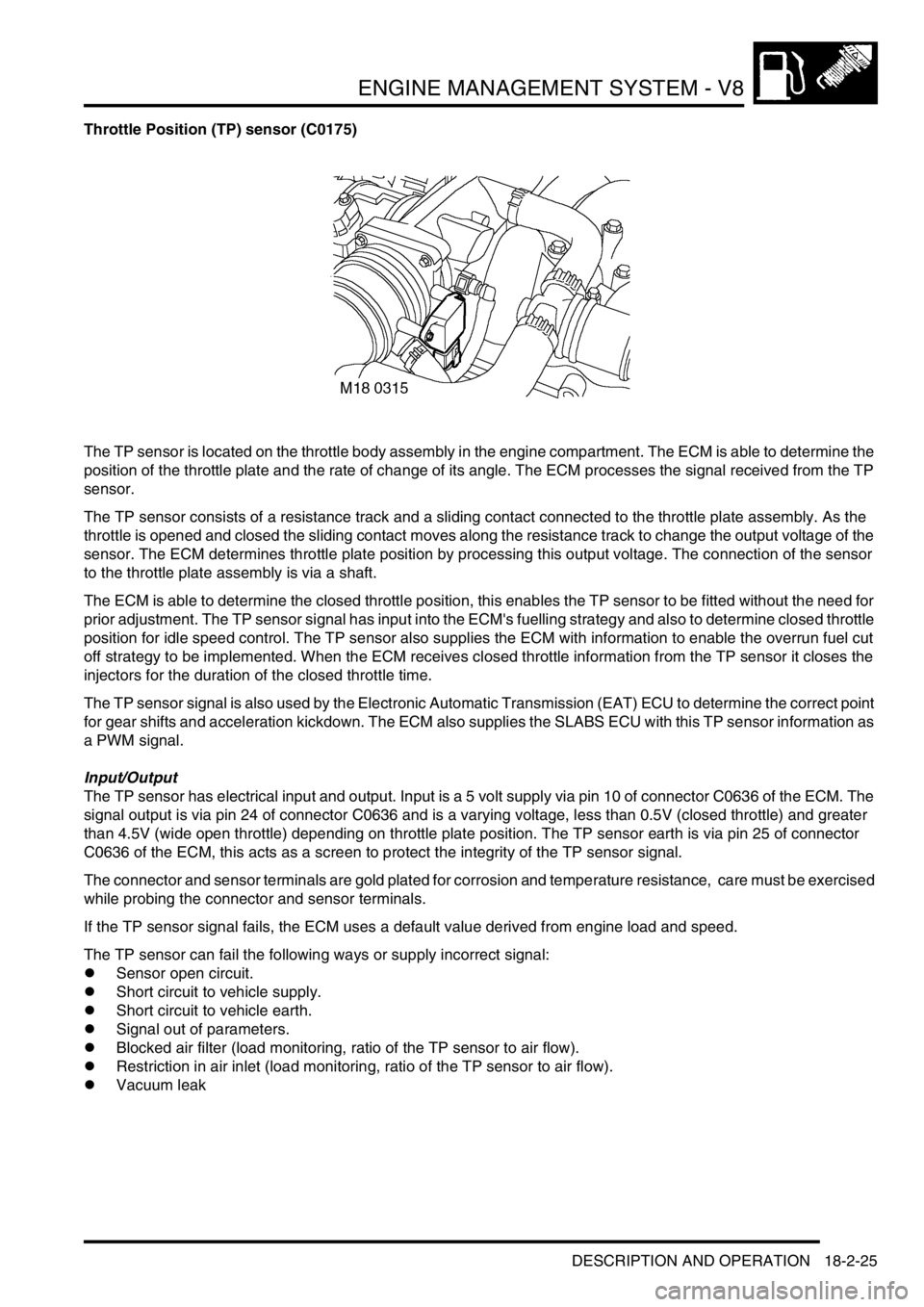
Throttle Position (TP) sensor (C0175)
The TP sensor is located on the throttle body assembly in the engine compartment. The ECM is able to determine the
position of the throttle plate and the rate of change of its angle. The ECM processes the signal received from the TP
sensor.
The TP sensor consists of a resistance track and a sliding contact connected to the throttle plate assembly. As the
throttle is opened and closed the sliding contact moves along the resistance track to change the output voltage of the
sensor. The ECM determines throttle plate position by processing this output voltage. The connection of the sensor
to the throttle plate assembly is via a shaft.
The ECM is able to determine the closed throttle position, this enables the TP sensor to be fitted without the need for
prior adjustment. The TP sensor signal has input into the ECM's fuelling strategy and also to determine closed throttle
position for idle speed control. The TP sensor also supplies the ECM with information to enable the overrun fuel cut
off strategy to be implemented. When the ECM receives closed throttle information from the TP sensor it closes the
injectors for the duration of the closed throttle time.
The TP sensor signal is also used by the Electronic Automatic Transmission (EAT) ECU to determine the correct point
for gear shifts and acceleration kickdown. The ECM also supplies the SLABS ECU with this TP sensor information as
a PWM signal.
Input/Output
The TP sensor has electrical input and output. Input is a 5 volt supply via pin 10 of connector C0636 of the ECM. The
signal output is via pin 24 of connector C0636 and is a varying voltage, less than 0.5V (closed throttle) and greater
than 4.5V (wide open throttle) depending on throttle plate position. The TP sensor earth is via pin 25 of connector
C0636 of the ECM, this acts as a screen to protect the integrity of the TP sensor signal.
The connector and sensor terminals are gold plated for corrosion and temperature resistance, care must be exercised
while probing the connector and sensor terminals.
If the TP sensor signal fails, the ECM uses a default value derived from engine load and speed.
The TP sensor can fail the following ways or supply incorrect signal:
lSensor open circuit.
lShort circuit to vehicle supply.
lShort circuit to vehicle earth.
lSignal out of parameters.
lBlocked air filter (load monitoring, ratio of the TP sensor to air flow).
lRestriction in air inlet (load monitoring, ratio of the TP sensor to air flow).
lVacuum leak