traction control LAND ROVER FRELANDER 2 2006 User Guide
[x] Cancel search | Manufacturer: LAND ROVER, Model Year: 2006, Model line: FRELANDER 2, Model: LAND ROVER FRELANDER 2 2006Pages: 3229, PDF Size: 78.5 MB
Page 2860 of 3229
Stability control
140
L
Stability controlPRINCIPLE OF OPERATION
Dynamic Stability Control (DSC)
DSC has two main functions.
Firstly, if a wheel, or wheels, loose traction
when accelerating, it enhances Traction
Control by reducing engine torque, and
applying braking force to individual wheels.
This further improves the vehicle's ability to
pull away on slippery, or loose surfaces, and
reduces the likelihood of wheel spin when
cornering.
Secondly, DSC will apply braking force to
individual wheels in orde r to maintain vehicle
stability when cornering, changing lanes
suddenly, or manoeuvring in an emergency.
This will help to keep the vehicle on the driver's
intended path, rather than over, or under
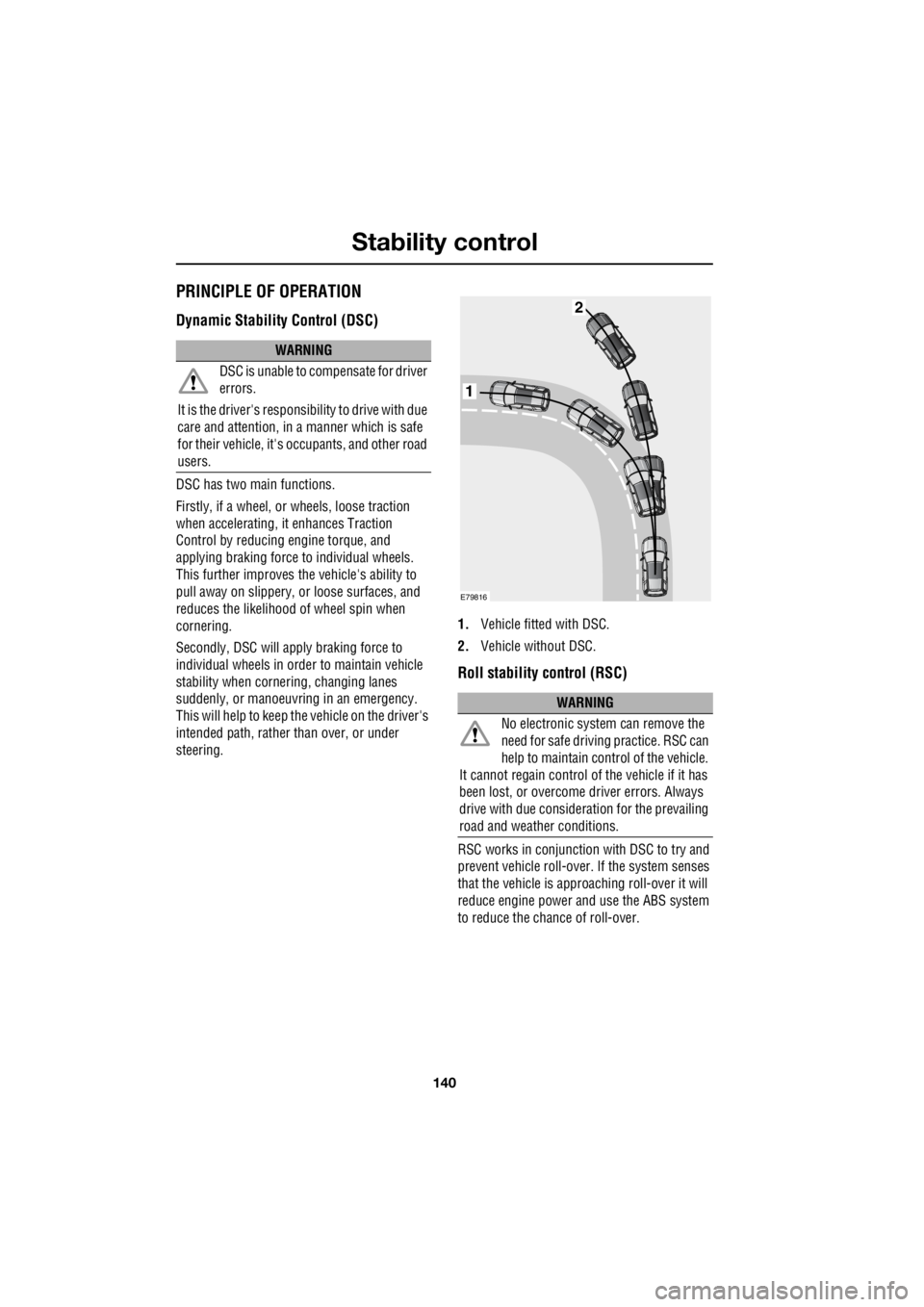
steering. 1.
Vehicle fitted with DSC.
2. Vehicle without DSC.
Roll stability control (RSC)
RSC works in conjunction with DSC to try and
prevent vehicle roll-over. If the system senses
that the vehicle is approaching roll-over it will
reduce engine power and use the ABS system
to reduce the chance of roll-over.
WARNING
DSC is unable to compensate for driver
errors.
It is the driver's responsibility to drive with due
care and attention, in a manner which is safe
for their vehicle, it's oc cupants, and other road
users.
WARNING
No electronic system can remove the
need for safe drivin g practice. RSC can
help to maintain control of the vehicle.
It cannot regain control of the vehicle if it has
been lost, or overcome driver errors. Always
drive with due consideration for the prevailing
road and weather conditions.
1
2
E79816
Page 2861 of 3229
141
Stability control
R
USING STABILITY CONTROL
DSC
DSC is activated automatically each time the
engine is started, and is automatically selected
by some of the Terrain Response Special
programs.
Note: In the majority of dr iving situations, and
particularly on-road, it is recommended that
you do not turn DSC off.
Deactivating DSC
In some driving conditions it may prove helpful
to deactivate DSC to improve traction. These
conditions include :-
• Rocking the vehicle out of a hollow.
• Rocking the vehicle out when the wheels
have sunk into the surface.
• Pulling away in deep snow, or a loose
surface.
• Driving along deep ruts.
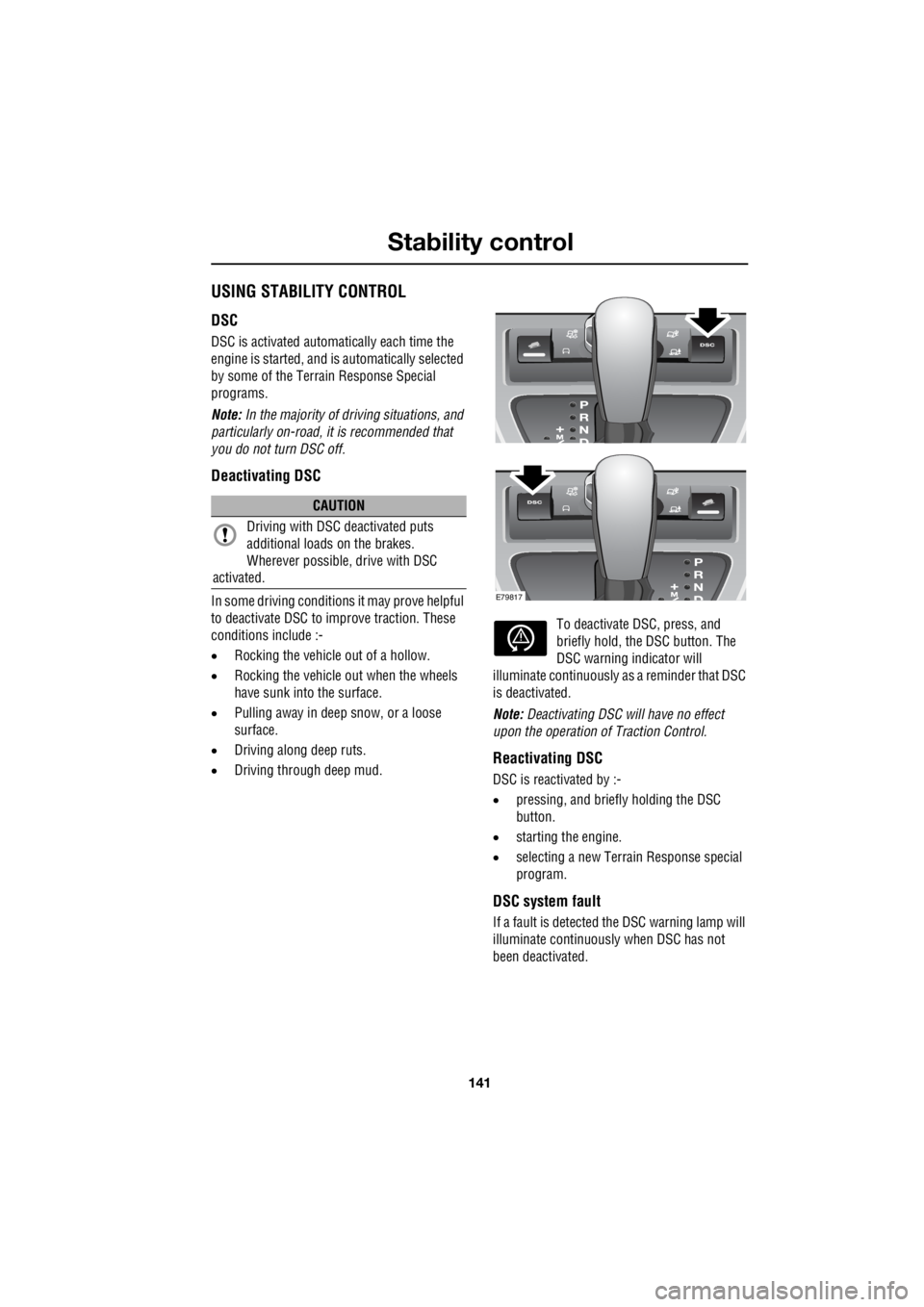
• Driving through deep mud. To deactivate DS
C, press, and
briefly hold, the DSC button. The
DSC warning indicator will
illuminate continuously as a reminder that DSC
is deactivated.
Note: Deactivating DSC will have no effect
upon the operation of Traction Control.
Reactivating DSC
DSC is reactivated by :-
• pressing, and briefly holding the DSC
button.
• starting the engine.
• selecting a new Terra in Response special
program.
DSC system fault
If a fault is detected the DSC warning lamp will
illuminate continuously when DSC has not
been deactivated.
CAUTION
Driving with DSC deactivated puts
additional loads on the brakes.
Wherever possible, drive with DSC
activated.
E79817
Page 2912 of 3229

Wheels and tyres
192
L
9. To check the tyre pressure turn off the
compressor then read the pressure from
the gauge.
10. When the compressor is off, if the tyre
pressure is too high, release the required
amount of pressure using the pressure
relief valve.
11. Once the tyre is inflated to the correct
pressure, switch off the compressor and
remove the power plug from the auxiliary
socket.
12. Unscrew the inflation hose connector from
the tyre valve, replace the tyre valve cap
and the inflation hose connector protective
cap.
13. Do not remove the sealant bottle from the
receiver.
14. Ensure that the tyre repair kit (including
the bottle, and receiver caps) are placed
securely in the vehicle.
15. Drive to the nearest tyre repair centre, or
Land Rover Dealer/Autho rised repairer for
a replacement tyre to be fitted. Ensure that
you make the repair centre aware that the
tyre repair kit has been used before the tyre
is removed.
16. Both the tyre inflation hose, and the sealant
bottle should be replac ed once a new tyre
has been fitted.
Only sealant bottles which are
completely empty should be
disposed of with normal household
waste. Sealant bottles which contain some
sealant, and the tyre in flation hose, should be
disposed of by a tyre specialist, or your Land
Rover Dealer/Authorised repairer in
compliance with local waste disposal
regulations.USING SNOW CHAINS
Land Rover approved trac tion devices may be
used to improve traction on a hard road surface
in heavy snow conditions . They should not be
used in off-road conditions.
If it becomes necessary to fit traction devices,
the following points should be observed:-
• Single sided Spike-spyder traction devices
can only be fitted to the front wheels of
vehicles fitted with 17 or 18 inch diameter
wheels.
• The wheels and tyres fitted must
conform to the specifications of the
original equipment.
• No traction devices should be fitted to the
rear wheels.
• Only Land Rover approved traction devices
should be used on the vehicle. Only Land
Rover approved tracti on devices have been
tested to ensure that they do not cause
damage to the vehicl e. Contact your Land
Rover Dealer/Authorised repairer for
information.
• Always read, understa nd, and follow the
snow chain manufacturer's instructions.
Pay particular attention to the maximum
speed, and fitti ng instructions.
WARNING
Only use traction devices in heavy snow
conditions, on hard road surfaces.
Dynamic Stability Control (DSC) must be
switched off when using traction devices. DSC
limits wheel spin which is required to maintain
traction in deep snow conditions.
Never exceed 50 km/h (30 mph) when traction
devices are fitted.
Never fit traction devices to a temporary use
spare wheel.
Page 2997 of 3229

Index
277
R
Track selection . . . . . . . . . . . . . . . . . . . . 246
Traction control . . . . . . . . . . . . . . . . . . . . 139
Traffic information control . . . . . . . . . . . 226 Traffic Programme (TP) preference . . 227
Transmission Technical specifications . . . . . . . . . . . 122
Transporting the vehicle . . . . . . . . . . . . . 208
Trip computer . . . . . . . . . . . . . . . . . . . . . . 99
Type approvals . . . . . . . . . . . . . . . . . . . . 215
Declarations of conformity . . . . . . . . . 215
Tyre care . . . . . . . . . . . . . . . . . . . . . . . . . 177 Age degradation . . . . . . . . . . . . . . . . . 178
Directional tyres . . . . . . . . . . . . . . . . . 180
Flat spots . . . . . . . . . . . . . . . . . . . . . . 182
Pressure compensation for ambient
temperature changes . . . . . . . . . . . 182
Punctured tyres . . . . . . . . . . . . . . . . . 178
Replacement tyres . . . . . . . . . . . . . . . 179
Tyre checks. . . . . . . . . . . . . . . . . . . . . 179
Tyre pressures . . . . . . . . . . . . . . . . . . 180
Tyre wear . . . . . . . . . . . . . . . . . . . . . . 178
Tyre glossary. . . . . . . . . . . . . . . . . . . . . . 193 Terms used . . . . . . . . . . . . . . . . . . . . . 193
Tyre repair kit . . . . . . . . . . . . . . . . . . . . . 187
Checking the tyre pressure after a repair . . 191
Land Rover tyre repair kit . . . . . . . . . . 189
Land Rover tyre repair kit safety information 188
Using the Land Rover tyre repair kit . . 190
U
Using booster cables. . . . . . . . . . . . . . . . 173 Disconnecting the cables . . . . . . . . . . 173
Using cruise control . . . . . . . . . . . . . . . . 130 Engaging cruise control . . . . . . . . . . . 130
Increasing the cruise speed . . . . . . . . 131
Reducing the cruise speed . . . . . . . . . 130
Suspending cruise control . . . . . . . . . 130
Using HDC. . . . . . . . . . . . . . . . . . . . . . . . 137
HDC operation . . . . . . . . . . . . . . . . . . 137
Selecting HDC . . . . . . . . . . . . . . . . . . . 137
Warning messages . . . . . . . . . . . . . . . 138
Using seat belts during pregnancy . . . . . . 57
Using snow chains . . . . . . . . . . . . . . . . . 192 Using stability control. . . . . . . . . . . . . . . . 141
Deactivating DSC . . . . . . . . . . . . . . . . . 141
DSC . . . . . . . . . . . . . . . . . . . . . . . . . . . 141
DSC system fault . . . . . . . . . . . . . . . . . 141
Reactivating DSC . . . . . . . . . . . . . . . . . 141
Using terrain response . . . . . . . . . . . . . . . 132
Before driving off-road . . . . . . . . . . . . . 132
Driver override options . . . . . . . . . . . . 132
Terrain response messages . . . . . . . . . 134
Terrain Response operation . . . . . . . . . 133
Using the key . . . . . . . . . . . . . . . . . . . . . . . 40
Using the parking aid . . . . . . . . . . . . . . . . 127
Front PDC deactivation. . . . . . . . . . . . . 127
PDC activation . . . . . . . . . . . . . . . . . . . 127
Sensor care . . . . . . . . . . . . . . . . . . . . . 127
System fault . . . . . . . . . . . . . . . . . . . . . 127
Using the remote control . . . . . . . . . . . . . . 41 Approach lighting. . . . . . . . . . . . . . . . . . 42
Emergency alarm . . . . . . . . . . . . . . . . . . 43
Locking . . . . . . . . . . . . . . . . . . . . . . . . . 42
Remote battery . . . . . . . . . . . . . . . . . . . 43
Remote control . . . . . . . . . . . . . . . . . . . 41
Single and double locking . . . . . . . . . . . 42
Tailgate . . . . . . . . . . . . . . . . . . . . . . . . . 43
Unlocking . . . . . . . . . . . . . . . . . . . . . . . . 41
Using the telephone . . . . . . . . . . . . . . . . . 261 Ending telephone calls . . . . . . . . . . . . . 263
Making telephone calls. . . . . . . . . . . . . 262
Receiving telephone calls . . . . . . . . . . . 264
Selecting telephone mode . . . . . . . . . . 261
Telephone in-call menu . . . . . . . . . . . . 265
Voice mail . . . . . . . . . . . . . . . . . . . . . . 266
Using traction control . . . . . . . . . . . . . . . . 139
Before driving off-road . . . . . . . . . . . . . 139
Electronic Traction Control (ETC). . . . . 139
Using winter tyres . . . . . . . . . . . . . . . . . . 183
V
Vehicle build date plate . . . . . . . . . . . . . . . 210
Vehicle identification number (VIN) . . . . . 210
Vehicle identification plate . . . . . . . . . . . . 210
Vents . . . . . . . . . . . . . . . . . . . . . . . . . . . . 101
VIN . . . . . . . . . . . . . . . . . . . . . . . . . . . . . . 210
Volume control . . . . . . . . . . . . . . . . . . . . . 223 Automatic Volume Control (AVC). . . . . 223
Reset volume settings . . . . . . . . . . . . . 223