weight LAND ROVER FRELANDER 2 2006 Service Manual
[x] Cancel search | Manufacturer: LAND ROVER, Model Year: 2006, Model line: FRELANDER 2, Model: LAND ROVER FRELANDER 2 2006Pages: 3229, PDF Size: 78.5 MB
Page 2894 of 3229
Vehicle battery
174
L
CHARGING THE VEHICLE BATTERY
1. Disconnect the battery and remove it from
the vehicle.
2. Connect the battery charger in accordance
with the charger manufacturer's
instructions.
3. Once the charge is complete switch off the
power to the charger.
4. Disconnect the charger cables from the
battery.
5. Allow the battery to stand for an hour
before connecting to the vehicle. This will
allow any explosive gasses to dissipate,
and reduce the risk of explosion.
CHANGING THE VEHICLE BATTERY
Disconnecting
1. Ensure that all electrical circuits are
switched off, all windows are closed, and
the alarm is disarmed.
2. Remove the remote control from the
vehicle and wait two minutes to allow the
systems to power down fully.
3. Undo the negative clam p, and lift the cable
and clamp clear of th e battery terminal.
4. Undo the positive clamp, and lift the cable
and clamp clear of th e battery terminal.
5. Undo the battery clamp and lift the battery
clear of the vehicle.
WARNINGS
Ensure that the charger used is of the
correct type and rating for the battery.
Using an unsuitable charger may damage the
battery, and could cause the battery to
explode.
Always charge the battery in a well
ventilated area away from any naked
flames, sparks or ot her ignition sources.
During charging the battery can produce a
highly explosive a nd flammable gas.
CAUTIONS
The battery must be disconnected and
removed from the vehicle before
charging. Failure to do so could result in
damage to the vehicle's electrical system.
Always follow the instructions supplied
with the battery charger. Failure to do so
may result in damage to the battery.
WARNINGS
Use caution when lifting the battery out
of, or into, the vehicl e. It is heavy, and
may cause injury when lifting, or if dropped.
Do not tip the battery when lifting or
moving as tilting the battery more than
45 degrees may damage the battery, and may
cause the electrolyte to leak out. Battery
electrolyte is highly corrosive, and toxic.
CAUTIONS
Do not rest the battery on any part of the
vehicle as it may ca use damage due to
it's weight.
Do not run the engine with the battery
disconnected. Doing so may damage the
charging system.
Page 2905 of 3229
185
Wheels and tyres
R
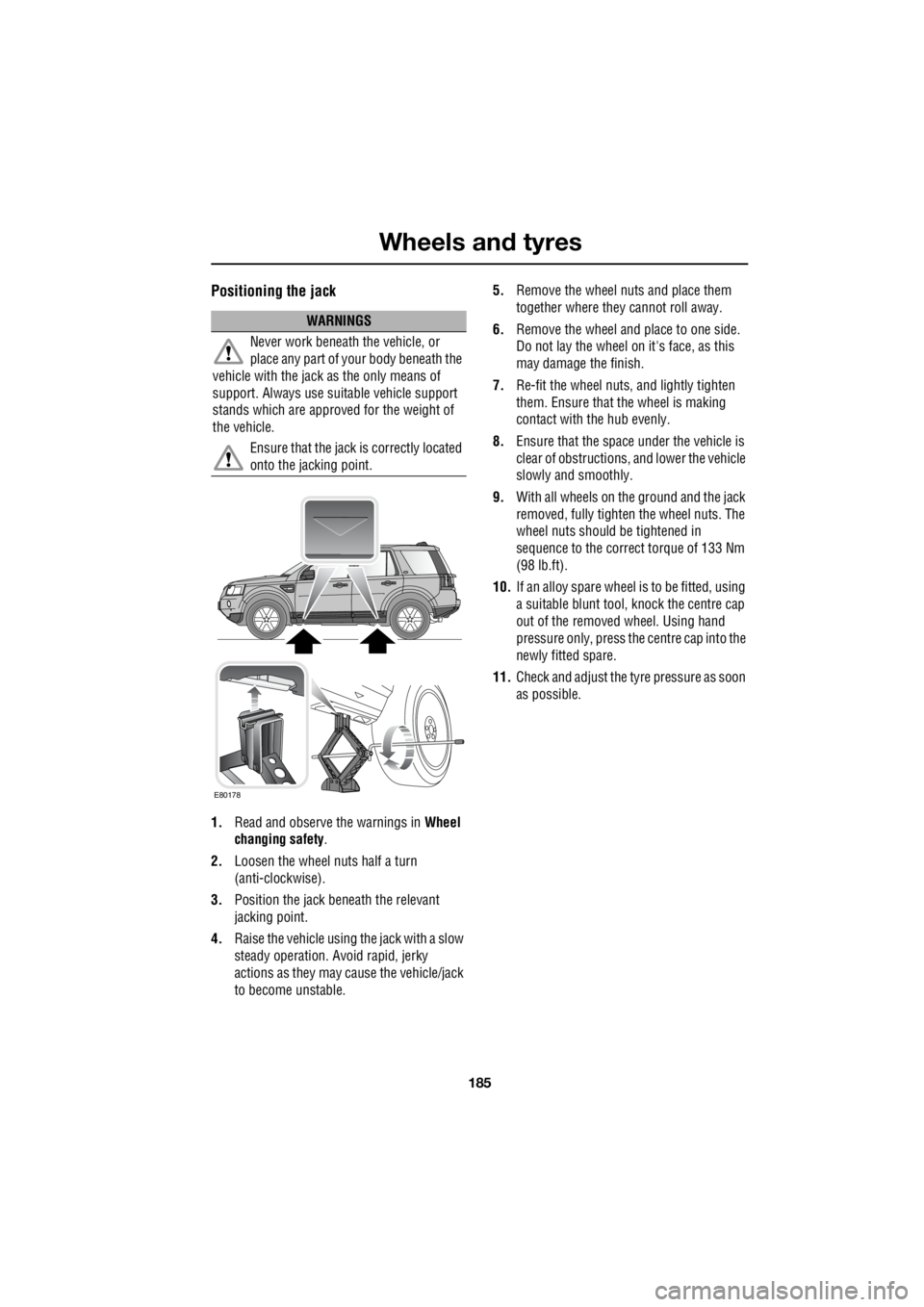
Positioning the jack
1. Read and observe the warnings in Wheel
changing safety .
2. Loosen the wheel nuts half a turn
(anti-clockwise).
3. Position the jack be neath the relevant
jacking point.
4. Raise the vehicle using the jack with a slow
steady operation. Avoid rapid, jerky
actions as they may cause the vehicle/jack
to become unstable. 5.
Remove the wheel nuts and place them
together where they cannot roll away.
6. Remove the wheel and place to one side.
Do not lay the wheel on it's face, as this
may damage the finish.
7. Re-fit the wheel nuts, and lightly tighten
them. Ensure that the wheel is making
contact with the hub evenly.
8. Ensure that the space under the vehicle is
clear of obstructions, and lower the vehicle
slowly and smoothly.
9. With all wheels on the ground and the jack
removed, fully tighte n the wheel nuts. The
wheel nuts should be tightened in
sequence to the correct torque of 133 Nm
(98 lb.ft).
10. If an alloy spare wheel is to be fitted, using
a suitable blunt tool, knock the centre cap
out of the removed wheel. Using hand
pressure only, press the centre cap into the
newly fitted spare.
11. Check and adjust the tyre pressure as soon
as possible.
WARNINGS
Never work beneath the vehicle, or
place any part of yo ur body beneath the
vehicle with the jack as the only means of
support. Always use su itable vehicle support
stands which are approved for the weight of
the vehicle.
Ensure that the jack is correctly located
onto the jacking point.
E80178
Page 2913 of 3229

193
Wheels and tyres
R
• Avoid tyre/vehicle damage by removing
the traction devices as soon as the
conditions allow.
TYRE GLOSSARY
Terms used
lbf/in² or psi
Pounds per square inch, an imperial unit of
measure for pressure.
kPa
Kilo Pascal, a metric unit of measure for
pressure.
Cold tyre pressure
The air pressure in a tyre which has been
standing in excess of th ree hours, or driven for
less than one mile.
Maximum inflation pressure
The maximum pressure to which the tyre
should be inflated. This pressure is given on
the tyre side wall in lbf/in² (psi) and kPa.
Note: This pressure is the maximum allowed
by the tyre manufacturer. It is not the pressure
recommended for use. See TECHNICAL
SPECIFICATIONS (page 194).
Kerb weight
The weight of a standa rd vehicle, including a
full tank of fuel, any optional equipment fitted,
and with the correct coolant and oil levels.
Gross vehicle weight
The maximum permissible weight of a vehicle
with driver, passengers, load, luggage,
equipment, and towbar load.
Accessory weight
The combined weight (in excess of those items
replaced) of items available as factory installed
equipment. Production options weight
The combined weight of options installed
which weigh in excess of 1.4 kg (3 lb) more
than the standard items that they replaced, and
are not already considered in kerb or accessory
weights. Items such as heavy duty brakes, high
capacity battery, special trim etc.
Vehicle capacity weight
The number of seats multiplied by 68 kg (150
lb) plus the rated amount of load/luggage.
Maximum loaded vehicle weight
The sum of kerb wei ght, accessory weight,
vehicle capacity weig ht, plus any production
option weights.
Rim
The metal support for a ty re, or tyre and tube,
upon which the tyre beads are seated.
Bead
The inner edge of a tyre th at is shaped to fit to
the rim and form an air tight seal. The bead is
constructed of steel wires which are wrapped,
or reinforced, by the ply cords.
Page 2930 of 3229
Vehicle identification
210
L
Vehicle identificationVEHICLE IDENTIFICATION PLATE
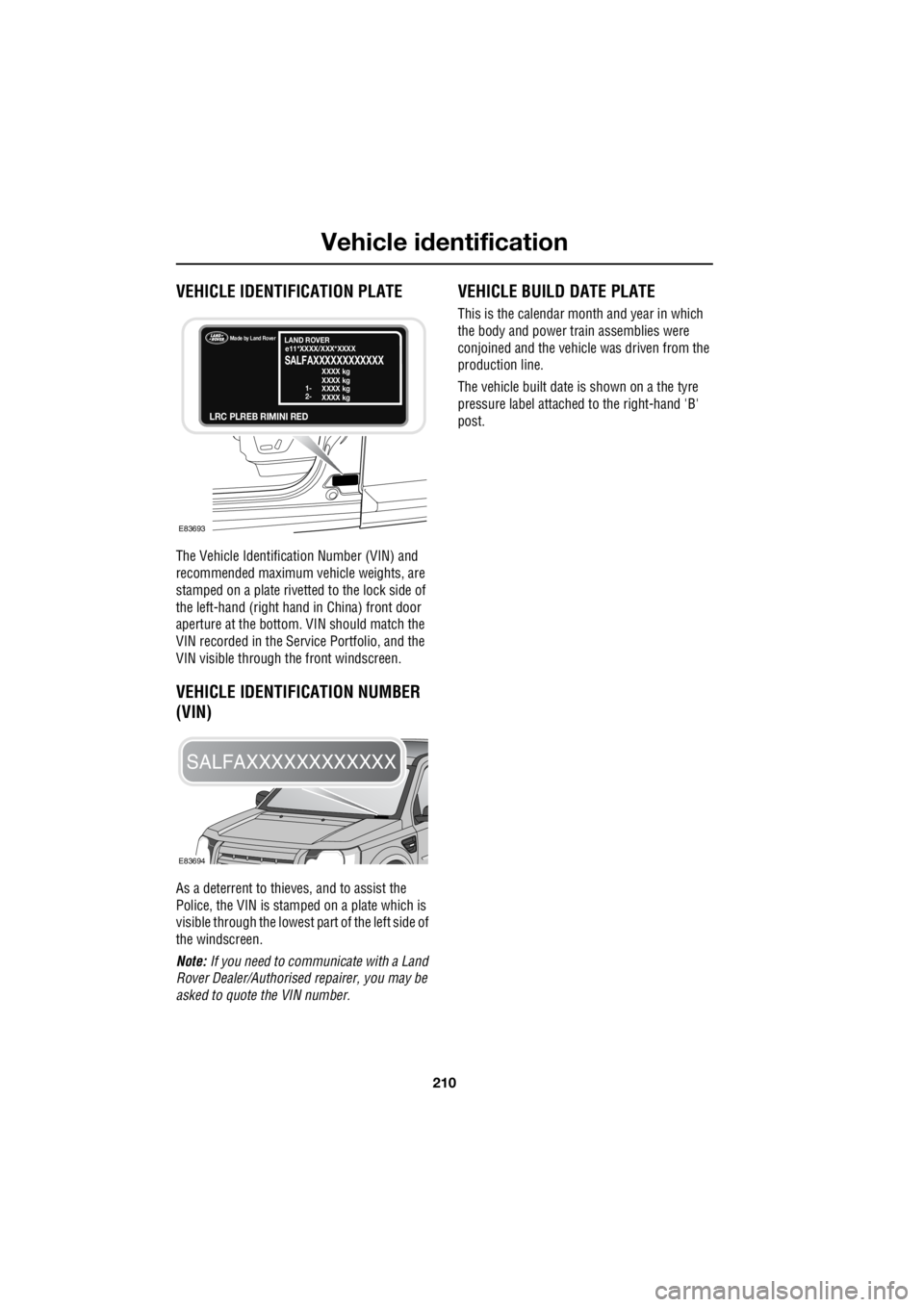
The Vehicle Identification Number (VIN) and
recommended maximum vehicle weights, are
stamped on a plate rivetted to the lock side of
the left-hand (right hand in China) front door
aperture at the bottom. VIN should match the
VIN recorded in the Serv ice Portfolio, and the
VIN visible through the front windscreen.
VEHICLE IDENTIFICATION NUMBER
(VIN)
As a deterrent to thieves, and to assist the
Police, the VIN is stam ped on a plate which is
visible through the lowest pa rt of the left side of
the windscreen.
Note: If you need to communicate with a Land
Rover Dealer/Authorised repairer, you may be
asked to quote the VIN number.
VEHICLE BUILD DATE PLATE
This is the calendar mont h and year in which
the body and power train assemblies were
conjoined and the vehicle was driven from the
production line.
The vehicle built date is shown on a the tyre
pressure label attached to the right-hand 'B'
post.
E83693
Made by Land Rover
LRC PLREB RIMINI RED
LAND ROVER
SALFAXXXXXXXXXXXXe11*XXXX/XXX*XXXX
XXXX kg
XXXX kg
1-
2- XXXX kg
XXXX kg
E83694
SALFAXXXXXXXXXXXX
Page 2932 of 3229

Technical specifications
212
L
WEIGHTS
¹ This figure includes the tool kit, all fluids to
the correct levels, and spare wheel, but
excludes the driver and passengers.
² The maximum permissi ble weight of the
vehicle including passengers and load. ³ The maximum permissi
ble weight of the
vehicle and braked trailer including their
respective loads.
Note: ¹ The front and rear axle maximum loads
can not be reached simult aneously as this will
exceed the GVW limit.
² This figure includes the weight of the roof
rack. Variant Approximate unladen
weight¹ Gross Vehicle Weight
(GVW)² Gross Train Weight³
Petrol 1825 kg 4020 lbs 2505 kg
5520 lbs 4505 kg
9930 lbs
Diesel 1820 kg 4010 lbs 2505 kg
5520 lbs 4505 kg
9935 lbs
Variant Maximum front axle load¹ Maximum rear
axle load¹ Maximum roof
rack load² Maximum
payload
Petrol and Diesel 1310 kg 2885 lbs 1360 kg
2995 lbs 75 kg
165 lbs 500 kg
1100 lbs
Page 2996 of 3229

Index
276
L
Rear seat controls . . . . . . . . . . . . . . . . . . 252
Rear seats . . . . . . . . . . . . . . . . . . . . . . . . . 51 Folding the rear seats . . . . . . . . . . . . . . 52
Raising the rear seats . . . . . . . . . . . . . . 53
Rear window wiper and washers . . . . . . . . 89 Reversing . . . . . . . . . . . . . . . . . . . . . . . 89
Wash/wipe . . . . . . . . . . . . . . . . . . . . . . 89
Wiper . . . . . . . . . . . . . . . . . . . . . . . . . . 89
Recommended towing weights . . . . . . . . 152
Reduced engine performance . . . . . . . . . 128 Check engine - petrol models only . . . 128
Engine management syst em (EMS) fault . .
128
Refuelling . . . . . . . . . . . . . . . . . . . . . . . . 145 Fuel filler . . . . . . . . . . . . . . . . . . . . . . . 145
Regional mode (REG) . . . . . . . . . . . . . . . 228 Regional mode - Premium audio . . . . 228
Regional mode - Standard audio. . . . . 229
Remote control . . . . . . . . . . . . . . . . . . . . . 41
Repairing minor paint damage . . . . . . . . 156
Repeat compact disc tracks. . . . . . . . . . . 248
Resetting the audio unit. . . . . . . . . . . . . . 233
Running out of fuel . . . . . . . . . . . . . . . . . 144
Running-in . . . . . . . . . . . . . . . . . . . . . . . 128
S
Safety . . . . . . . . . . . . . . . . . . . . . . . . . . . . 36
Safety precautions . . . . . . . . . . . . . . . . . . 142
Seat belt height adjustment . . . . . . . . . . . . 56
Seat belt reminder . . . . . . . . . . . . . . . . . . . 55
Seat belts
Principle of operation . . . . . . . . . . . . . . 54
Settings . . . . . . . . . . . . . . . . . . . . . . . . . . 240 Advanced settings . . . . . . . . . . . . . . . . 242
Auto-tune . . . . . . . . . . . . . . . . . . . . . . 241
DAB radio text . . . . . . . . . . . . . . . . . . . 241
DAB search . . . . . . . . . . . . . . . . . . . . . 240
FM traffic and news. . . . . . . . . . . . . . . 244
Shuffle/random . . . . . . . . . . . . . . . . . . . . 247 Random selection - Premium audio . . 248
Random selection - Standard audio . . 248
Sitting in the correct position . . . . . . . . . . 47
Snow chains . . . . . . . . . . . . . . . . . . . . . . 192
Stability control . . . . . . . . . . . . . . . . . . . . 141 Principle of operation . . . . . . . . . . . . . 140 Starting a diesel engine. . . . . . . . . . . . . . . 115
Automatic transmission . . . . . . . . . . . . 115
Manual transmission . . . . . . . . . . . . . . 115
Stopping the engine . . . . . . . . . . . . . . . 116
Starting a petrol engine. . . . . . . . . . . . . . . 114 Starting . . . . . . . . . . . . . . . . . . . . . . . . 114
Stopping the engine . . . . . . . . . . . . . . . 114
Starting the engine General information . . . . . . . . . . . . . . . 113
Station preset buttons . . . . . . . . . . . . . . . 226
Storage compartments . . . . . . . . . . . . . . . 112
Sun visors. . . . . . . . . . . . . . . . . . . . . . . . . 107
Sunroof. . . . . . . . . . . . . . . . . . . . . . . . . . . 105
Supplementary restraints system Principle of operation . . . . . . . . . . . . . . . 58
T
Technical specificationsAccessory wheels and tyres . . . . . . . . . 194
Capacities . . . . . . . . . . . . . . . . . . . . . . . 170
Fuel consumption . . . . . . . . . . . . . . . . . 146
Fuel specification . . . . . . . . . . . . . . . . . 146
Lubricants and fluids . . . . . . . . . . . . . . 169
Transmission fluids a nd capacities. . . . 122
Telephone . . . . . . . . . . . . . . . . . . . . . . . . . 261
General information . . . . . . . . . . . . . . . 254
Telephone controls . . . . . . . . . . . . . . . . . . 255 Telephone controls - Steering wheel . . 256
Telephone setup . . . . . . . . . . . . . . . . . . . . 258 Dialled calls . . . . . . . . . . . . . . . . . . . . . 259
Missed calls . . . . . . . . . . . . . . . . . . . . . 258
Phone settings . . . . . . . . . . . . . . . . . . . 259
Received calls. . . . . . . . . . . . . . . . . . . . 258
Telephone main menu . . . . . . . . . . . . . 258
Telephone voice control . . . . . . . . . . . . . . 270
Terrain response . . . . . . . . . . . . . . . . . . . . 132 Principle of operation . . . . . . . . . . . . . . 132
Tow bar. . . . . . . . . . . . . . . . . . . . . . . . . . . 153 Tow bar dimensions a nd mounting points .
153
Towing a trailer . . . . . . . . . . . . . . . . . . . . . 150 Trailer electrical connection . . . . . . . . . 150
Towing points . . . . . . . . . . . . . . . . . . . . . . 207
Front and rear towing eyes . . . . . . . . . . 207
Towing the vehicle on four wheels . . . . . . 208 Towing procedure . . . . . . . . . . . . . . . . 208
Page 2998 of 3229

Index
278
L
W
Warning triangle . . . . . . . . . . . . . . . . . . . 204
Washer fluid check . . . . . . . . . . . . . . . . . 167 Topping up the fluid . . . . . . . . . . . . . . 168
Washing . . . . . . . . . . . . . . . . . . . . . . . . . 154
Waveband button . . . . . . . . . . . . . . . . . . 224
Weights . . . . . . . . . . . . . . . . . . . . . . . . . . 212
Wheels and tyres General information . . . . . . . . . . . . . . 176
Technical specifications . . . . . . . . . . . 194
Windscreen washers . . . . . . . . . . . . . . . . . 88
Windscreen wipers . . . . . . . . . . . . . . . . . . 87
Intermittent variable delay . . . . . . . . . . . 87
Speed-dependent mode . . . . . . . . . . . . 87
Wiper operation . . . . . . . . . . . . . . . . . . 87
Winter tyres . . . . . . . . . . . . . . . . . . . . . . . 183