remote control LAND ROVER FRELANDER 2 2006 Manual PDF
[x] Cancel search | Manufacturer: LAND ROVER, Model Year: 2006, Model line: FRELANDER 2, Model: LAND ROVER FRELANDER 2 2006Pages: 3229, PDF Size: 78.5 MB
Page 2834 of 3229
Starting the engine
114
L
STARTING A PETROL ENGINE
Starting
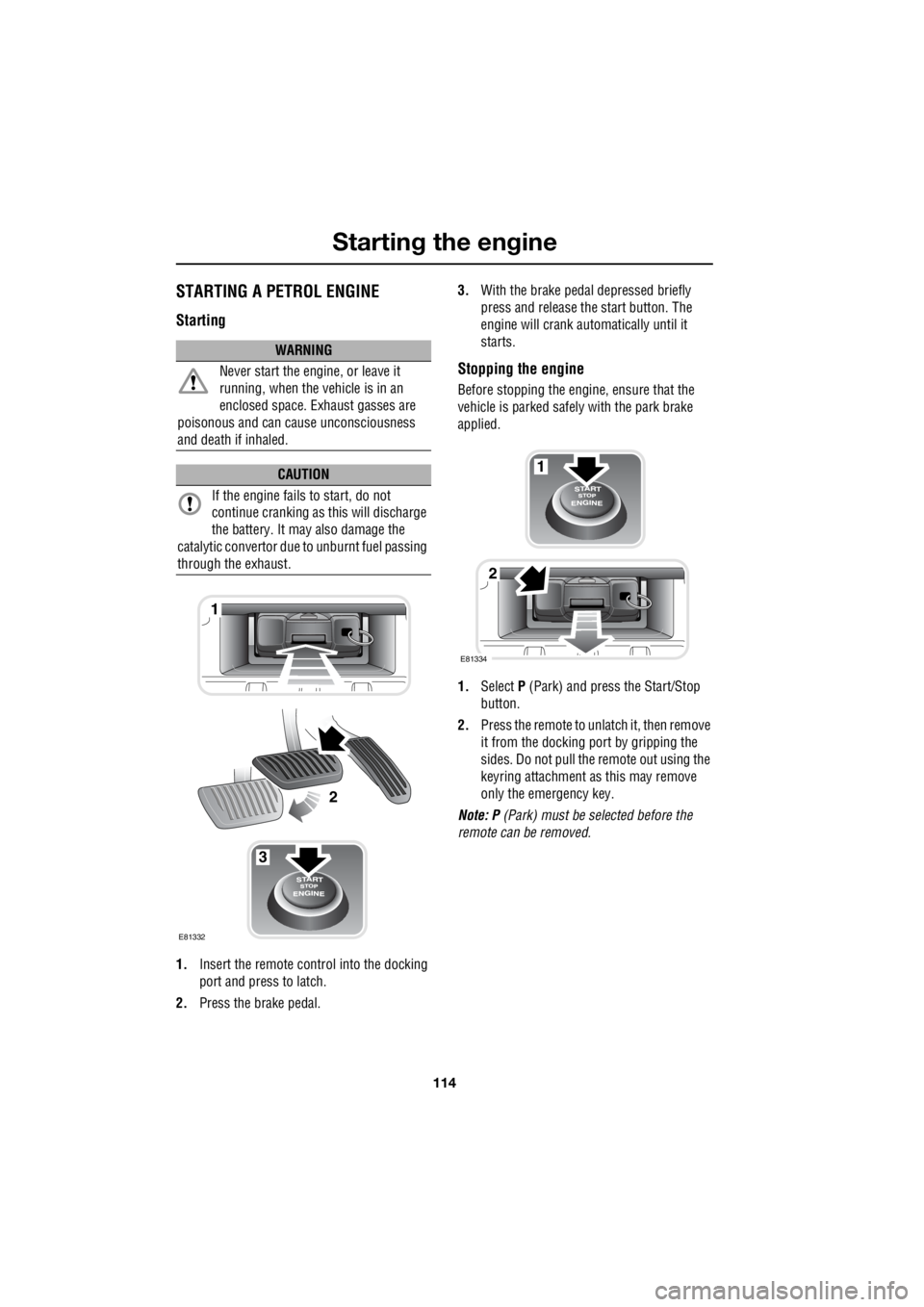
1. Insert the remote control into the docking
port and press to latch.
2. Press the brake pedal. 3.
With the brake peda l depressed briefly
press and release the start button. The
engine will crank auto matically until it
starts.
Stopping the engine
Before stopping the engine, ensure that the
vehicle is parked safely with the park brake
applied.
1. Select P (Park) and press the Start/Stop
button.
2. Press the remote to unlatch it, then remove
it from the docking port by gripping the
sides. Do not pull the remote out using the
keyring attachment as this may remove
only the emergency key.
Note: P (Park) must be selected before the
remote can be removed.
WARNING
Never start the engine, or leave it
running, when the vehicle is in an
enclosed space. Exhaust gasses are
poisonous and can cau se unconsciousness
and death if inhaled.
CAUTION
If the engine fails to start, do not
continue cranking as this will discharge
the battery. It may also damage the
catalytic conver tor due to unburnt fuel passing
through the exhaust.
3
1
2
E81332
1
2
E81334
Page 2835 of 3229
115
Starting the engine
R
STARTING A DIESEL ENGINE
Manual transmission
Note: Do not press the accelerator pedal when
starting the engine.
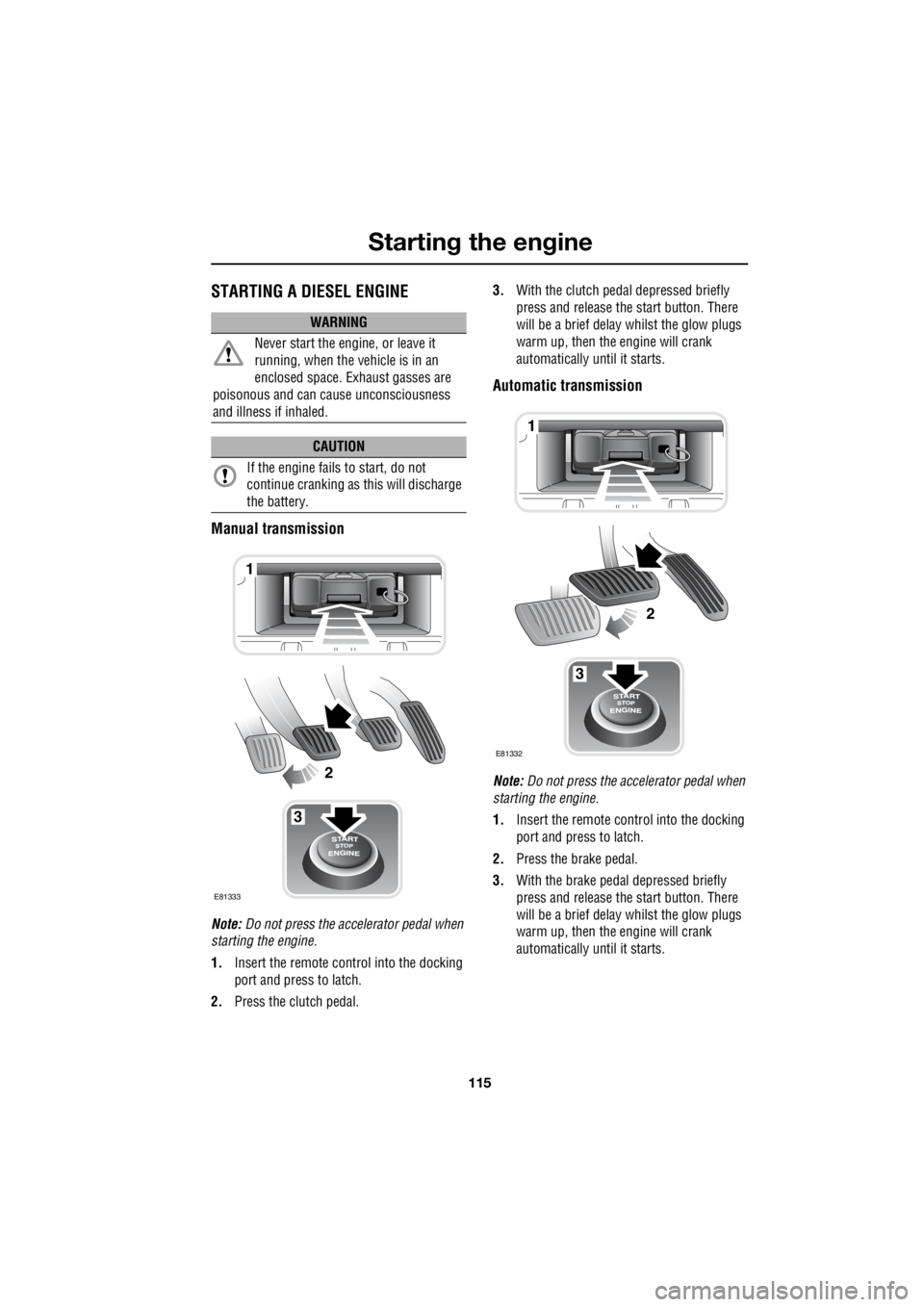
1. Insert the remote control into the docking
port and press to latch.
2. Press the clutch pedal. 3.
With the clutch peda l depressed briefly
press and release the start button. There
will be a brief delay whilst the glow plugs
warm up, then the engine will crank
automatically until it starts.
Automatic transmission
Note: Do not press the accelerator pedal when
starting the engine.
1. Insert the remote control into the docking
port and press to latch.
2. Press the brake pedal.
3. With the brake pedal depressed briefly
press and release the start button. There
will be a brief delay whilst the glow plugs
warm up, then the engine will crank
automatically until it starts.
WARNING
Never start the engine, or leave it
running, when the vehicle is in an
enclosed space. Exhaust gasses are
poisonous and can cause unconsciousness
and illness if inhaled.
CAUTION
If the engine fails to start, do not
continue cranking as this will discharge
the battery.
3
1
2
E81333
3
1
2
E81332
Page 2894 of 3229
Vehicle battery
174
L
CHARGING THE VEHICLE BATTERY
1. Disconnect the battery and remove it from
the vehicle.
2. Connect the battery charger in accordance
with the charger manufacturer's
instructions.
3. Once the charge is complete switch off the
power to the charger.
4. Disconnect the charger cables from the
battery.
5. Allow the battery to stand for an hour
before connecting to the vehicle. This will
allow any explosive gasses to dissipate,
and reduce the risk of explosion.
CHANGING THE VEHICLE BATTERY
Disconnecting
1. Ensure that all electrical circuits are
switched off, all windows are closed, and
the alarm is disarmed.
2. Remove the remote control from the
vehicle and wait two minutes to allow the
systems to power down fully.
3. Undo the negative clam p, and lift the cable
and clamp clear of th e battery terminal.
4. Undo the positive clamp, and lift the cable
and clamp clear of th e battery terminal.
5. Undo the battery clamp and lift the battery
clear of the vehicle.
WARNINGS
Ensure that the charger used is of the
correct type and rating for the battery.
Using an unsuitable charger may damage the
battery, and could cause the battery to
explode.
Always charge the battery in a well
ventilated area away from any naked
flames, sparks or ot her ignition sources.
During charging the battery can produce a
highly explosive a nd flammable gas.
CAUTIONS
The battery must be disconnected and
removed from the vehicle before
charging. Failure to do so could result in
damage to the vehicle's electrical system.
Always follow the instructions supplied
with the battery charger. Failure to do so
may result in damage to the battery.
WARNINGS
Use caution when lifting the battery out
of, or into, the vehicl e. It is heavy, and
may cause injury when lifting, or if dropped.
Do not tip the battery when lifting or
moving as tilting the battery more than
45 degrees may damage the battery, and may
cause the electrolyte to leak out. Battery
electrolyte is highly corrosive, and toxic.
CAUTIONS
Do not rest the battery on any part of the
vehicle as it may ca use damage due to
it's weight.
Do not run the engine with the battery
disconnected. Doing so may damage the
charging system.
Page 2895 of 3229

175
Vehicle battery
R
Effects of disconnecting
Disconnecting the battery can affect a number
of vehicle systems, especially if there is
insufficient battery power prior to
disconnection. For example, the alarm may
trigger depending on it's state when the battery
was disconnected. If the alarm does sound,
use the remote control in the normal way to
disarm the security system. The windows may
need resetting to enable the one-shot feature to
operate correctly. See ELECTRIC WINDOWS
(page 93).
Replacement batteries
Battery disposal
Note: Used batteries must be disposed of
correctly as they contain a number of harmful
substances. Seek advice on disposal from your
Land Rover Dealer/Authoris ed Repairer, and/or
your local authority.
Refitting
A new battery should be supplied with plastic
terminal covers. Leave the covers in place
when fitting the battery, and remove them one
at a time to fit the battery cable clamps.
Refitting is an exact reversal of the removal
procedure. If you are in any doubt about fitting
a battery seek qualified assistance before
attempting to fit the battery.
WARNING
Only fit a battery of the correct type and
rating. Fitting an in correct battery may
result in a fire, or damage to the electrical
system. If you are in any doubt when fitting a
battery seek qualified assistance.
WARNING
When refitting the battery ensure that
no metal objects , or vehicle
components, come into contact with the
battery terminals. Metal objects can cause a
spark or short circuit, both of which may result
in an explosion.
CAUTIONS
Ensure that when fitting a battery to the
vehicle, the terminals and battery clamps
are clean, and lightly coated with petroleum
jelly. This will ensure good electrical
connections are made, and help to prevent
corrosion.
Always follow the battery manufacturers
instructions. Failure to do so may result
in damage to the vehicl e and/or the electrical
system.
Page 2928 of 3229
Vehicle recovery
208
L
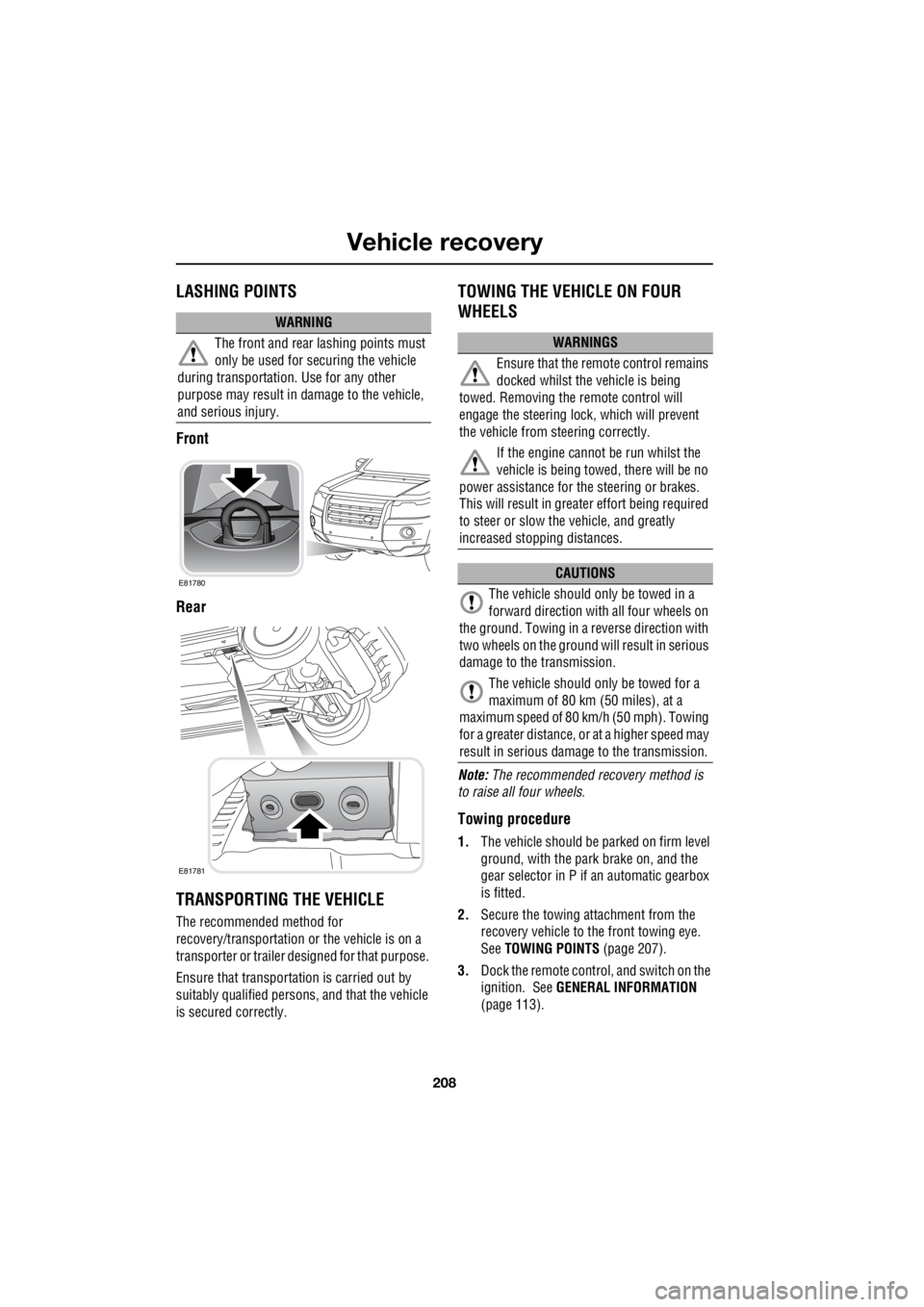
LASHING POINTS
Front
Rear
TRANSPORTING THE VEHICLE
The recommended method for
recovery/transportation or the vehicle is on a
transporter or trailer de signed for that purpose.
Ensure that transporta tion is carried out by
suitably qualified persons , and that the vehicle
is secured correctly.
TOWING THE VEHICLE ON FOUR
WHEELS
Note: The recommended recovery method is
to raise all four wheels.
Towing procedure
1. The vehicle should be parked on firm level
ground, with the park brake on, and the
gear selector in P if an automatic gearbox
is fitted.
2. Secure the towing attachment from the
recovery vehicle to the front towing eye.
See TOWING POINTS (page 207).
3. Dock the remote control, and switch on the
ignition. See GENERAL INFORMATION
(page 113).
WARNING
The front and rear lashing points must
only be used for securing the vehicle
during transportation. Use for any other
purpose may result in da mage to the vehicle,
and serious injury.
E81780
E81781
WARNINGS
Ensure that the remote control remains
docked whilst the vehicle is being
towed. Removing the remote control will
engage the steering lo ck, which will prevent
the vehicle from steering correctly.
If the engine cannot be run whilst the
vehicle is being towed, there will be no
power assistance for the steering or brakes.
This will result in grea ter effort being required
to steer or slow the vehicle, and greatly
increased stopping distances.
CAUTIONS
The vehicle should only be towed in a
forward direction with all four wheels on
the ground. Towing in a reverse direction with
two wheels on the ground will result in serious
damage to the transmission.
The vehicle should only be towed for a
maximum of 80 km (50 miles), at a
maximum speed of 80 k m/h (50 mph). Towing
for a greater distance, or at a higher speed may
result in serious dama ge to the transmission.
Page 2929 of 3229

209
Vehicle recovery
R
4. Apply the foot brake, and select neutral.
5. With the footbrake still applied, release the
park brake.
6. The vehicle can now be towed a maximum
of 80 km (50 miles) at a maximum speed
of 80 kmh (50 mph).
7. Upon arrival at the destination, ensure
wherever possible that the vehicle is
parked on firm level ground.
8. Apply the park brake, and place the
selector lever into the P (park) position.
9. Switch off the ignition, and remove the
remote control.
10. Remove the towing attachment from the
towing eye.
CAUTION
Leaving the ignition switched on for
extended periods will ca use the battery to
drain.
WARNING
Use extreme caution when detaching
towing equipment. Vehicle movement
is possible which can resu lt in serious injuries.
Page 2974 of 3229

Telephone
254
L
TelephoneGENERAL INFORMATION
Note: The vehicle tele phone system is
designed to function with a wide variety of
Bluetooth telephones. As these telephones
have a wide range of audio and echo
performance characteristics, it may take a few
seconds for the vehicl e telephone system to
adapt and deliver optimum audio performance.
It may be necessary to reduce the in-vehicle
volume slightly to fully optimise audio
performance and reduce echo. Note:
The vehicle's Bluetooth telephone
system can be used with an appropriate
Bluetooth-equipped mobile telephone.
Note: Please refer to your Land Rover
Dealer/Authorised Repairer for a list of
compatible telephones.
Telephone networks
The Telephone netw ork standard allows you to
use your telephone in many countries.
However, telephone reception may be poor or
unavailable in remote re gions. This may be due
to the inadequate power of the transmitter,
which results in a weak signal or incomplete
coverage.
WARNINGS
Using the telephone ne ar the car: do not
telephone inside a garage or near an
open car bonnet. The air may contain fuel
vapours and the tele phone could produce
sparks and start a fire.
Unusual ambient conditions: Switch off
the telephone in areas where high
explosives are being used. High frequency
remote controls could be interfered with and
cause an explosion. Switch off your telephone
in areas with a high explosion risk. This
includes filling stations, fuel storage areas or
chemical factories, as well as places where the
air contains fuel vapour, chemicals or metal
dust. The telephone might possibly produce
sparks and cause a fire or explosion.
Medical equipment: The functioning of
cardiac pacemakers or hearing aids
may be impaired when the phone is in use.
Check with a doctor or manufacturer whether
any such devices you or your passengers are
using are sufficiently protected against
high-frequency energy.
Always stow your mobile phone
securely. In an accident loose items can
cause injury.
Page 2995 of 3229

Index
275
R
Preset buttons . . . . . . . . . . . . . . . . . . . . . 238 Recalling a preset channel . . . . . . . . . 239
Scrolling through presets . . . . . . . . . . 239
Storing channels as presets . . . . . . . . 238
Principle of operation Airbag deployment effects . . . . . . . . . . 61
Airbag operation . . . . . . . . . . . . . . . . . . 60
Airbags . . . . . . . . . . . . . . . . . . . . . . . . . 59
Before driving off-road . . . . . . . . . . . . 136
Brake pads . . . . . . . . . . . . . . . . . . . . . 123
Deployment and deflation . . . . . . . . . . . 60
Dynamic Stability Control (DSC) . . . . . 140
Gradient release control (GRC) . . . . . . 136
Introduction . . . . . . . . . . . . . . . . . . . . . 58
Roll stability control (RSC) . . . . . . . . . 140
Seat belt checks . . . . . . . . . . . . . . . . . . 55
Seat belt safety . . . . . . . . . . . . . . . . . . . 54
Seat belts . . . . . . . . . . . . . . . . . . . . . . . 54
Wet conditions . . . . . . . . . . . . . . . . . . 123
Priority programme type (PTY) . . . . . . . . 231 PTY search - Premium audio . . . . . . . 232
PTY seek - Standard audio . . . . . . . . . 233
PTY selection - Premium audio . . . . . 231Q
Quick start . . . . . . . . . . . . . . . . . . . . . . . . . . 7 Audio system . . . . . . . . . . . . . . . . . . . . . 27
Automatic transmission . . . . . . . . . . . . . 23
Bonnet . . . . . . . . . . . . . . . . . . . . . . . . . . . 9
CD autochanger . . . . . . . . . . . . . . . . . . . 30
CD OPERATION . . . . . . . . . . . . . . . . . . . 30
Clock setting . . . . . . . . . . . . . . . . . . . . . 31
Cruise control . . . . . . . . . . . . . . . . . . . . 24
DAB radio. . . . . . . . . . . . . . . . . . . . . . . . 29
Driving position memory . . . . . . . . . . . . 10
Engine starting . . . . . . . . . . . . . . . . . . . . . 8
Exterior lighting . . . . . . . . . . . . . . . . . . . 22
Facia. . . . . . . . . . . . . . . . . . . . . . . . . . . . 17
Gearshift interlocks . . . . . . . . . . . . . . . . 23
Heating and ventilation. . . . . . . . . . . . . . 14
Hill Descent Control (HDC) . . . . . . . . . . 25
Instrument pack . . . . . . . . . . . . . . . . . . . 19
Manual seat adjustment . . . . . . . . . . . . . 11
Master lock and unlock switches . . . . . . . 9
Overhead console . . . . . . . . . . . . . . . . . 12
Parking aid . . . . . . . . . . . . . . . . . . . . . . . 26
Passenger airbag deactivation . . . . . . . . 13
Power operated seat adjustment . . . . . . 10
Radio operation . . . . . . . . . . . . . . . . . . . 29
Remote control . . . . . . . . . . . . . . . . . . . . 7
Seat belts and Child restraints . . . . . . . . 13
Single CD player. . . . . . . . . . . . . . . . . . . 30
Steering column adjustment . . . . . . . . . 12
Steering column lock . . . . . . . . . . . . . . . 12
Tailgate . . . . . . . . . . . . . . . . . . . . . . . . . . 9
Telephone - Bluetooth system . . . . . . . . 31
Terrain Response system. . . . . . . . . . . . 25
Warning indicators (attention) . . . . . . . . 21
Warning indicators (information) . . . . . . 21
Windows and Door mirrors . . . . . . . . . . 11
Wipers and washers. . . . . . . . . . . . . . . . 22
R
Radio data system (RDS) . . . . . . . . . . . . . 228 Selecting RDS . . . . . . . . . . . . . . . . . . . 228
Radio reception . . . . . . . . . . . . . . . . . . . . 218
Rain sensor . . . . . . . . . . . . . . . . . . . . . . . . 87
Operation . . . . . . . . . . . . . . . . . . . . . . . . 88
Rear fog lamps . . . . . . . . . . . . . . . . . . . . . . 73
Page 2996 of 3229

Index
276
L
Rear seat controls . . . . . . . . . . . . . . . . . . 252
Rear seats . . . . . . . . . . . . . . . . . . . . . . . . . 51 Folding the rear seats . . . . . . . . . . . . . . 52
Raising the rear seats . . . . . . . . . . . . . . 53
Rear window wiper and washers . . . . . . . . 89 Reversing . . . . . . . . . . . . . . . . . . . . . . . 89
Wash/wipe . . . . . . . . . . . . . . . . . . . . . . 89
Wiper . . . . . . . . . . . . . . . . . . . . . . . . . . 89
Recommended towing weights . . . . . . . . 152
Reduced engine performance . . . . . . . . . 128 Check engine - petrol models only . . . 128
Engine management syst em (EMS) fault . .
128
Refuelling . . . . . . . . . . . . . . . . . . . . . . . . 145 Fuel filler . . . . . . . . . . . . . . . . . . . . . . . 145
Regional mode (REG) . . . . . . . . . . . . . . . 228 Regional mode - Premium audio . . . . 228
Regional mode - Standard audio. . . . . 229
Remote control . . . . . . . . . . . . . . . . . . . . . 41
Repairing minor paint damage . . . . . . . . 156
Repeat compact disc tracks. . . . . . . . . . . 248
Resetting the audio unit. . . . . . . . . . . . . . 233
Running out of fuel . . . . . . . . . . . . . . . . . 144
Running-in . . . . . . . . . . . . . . . . . . . . . . . 128
S
Safety . . . . . . . . . . . . . . . . . . . . . . . . . . . . 36
Safety precautions . . . . . . . . . . . . . . . . . . 142
Seat belt height adjustment . . . . . . . . . . . . 56
Seat belt reminder . . . . . . . . . . . . . . . . . . . 55
Seat belts
Principle of operation . . . . . . . . . . . . . . 54
Settings . . . . . . . . . . . . . . . . . . . . . . . . . . 240 Advanced settings . . . . . . . . . . . . . . . . 242
Auto-tune . . . . . . . . . . . . . . . . . . . . . . 241
DAB radio text . . . . . . . . . . . . . . . . . . . 241
DAB search . . . . . . . . . . . . . . . . . . . . . 240
FM traffic and news. . . . . . . . . . . . . . . 244
Shuffle/random . . . . . . . . . . . . . . . . . . . . 247 Random selection - Premium audio . . 248
Random selection - Standard audio . . 248
Sitting in the correct position . . . . . . . . . . 47
Snow chains . . . . . . . . . . . . . . . . . . . . . . 192
Stability control . . . . . . . . . . . . . . . . . . . . 141 Principle of operation . . . . . . . . . . . . . 140 Starting a diesel engine. . . . . . . . . . . . . . . 115
Automatic transmission . . . . . . . . . . . . 115
Manual transmission . . . . . . . . . . . . . . 115
Stopping the engine . . . . . . . . . . . . . . . 116
Starting a petrol engine. . . . . . . . . . . . . . . 114 Starting . . . . . . . . . . . . . . . . . . . . . . . . 114
Stopping the engine . . . . . . . . . . . . . . . 114
Starting the engine General information . . . . . . . . . . . . . . . 113
Station preset buttons . . . . . . . . . . . . . . . 226
Storage compartments . . . . . . . . . . . . . . . 112
Sun visors. . . . . . . . . . . . . . . . . . . . . . . . . 107
Sunroof. . . . . . . . . . . . . . . . . . . . . . . . . . . 105
Supplementary restraints system Principle of operation . . . . . . . . . . . . . . . 58
T
Technical specificationsAccessory wheels and tyres . . . . . . . . . 194
Capacities . . . . . . . . . . . . . . . . . . . . . . . 170
Fuel consumption . . . . . . . . . . . . . . . . . 146
Fuel specification . . . . . . . . . . . . . . . . . 146
Lubricants and fluids . . . . . . . . . . . . . . 169
Transmission fluids a nd capacities. . . . 122
Telephone . . . . . . . . . . . . . . . . . . . . . . . . . 261
General information . . . . . . . . . . . . . . . 254
Telephone controls . . . . . . . . . . . . . . . . . . 255 Telephone controls - Steering wheel . . 256
Telephone setup . . . . . . . . . . . . . . . . . . . . 258 Dialled calls . . . . . . . . . . . . . . . . . . . . . 259
Missed calls . . . . . . . . . . . . . . . . . . . . . 258
Phone settings . . . . . . . . . . . . . . . . . . . 259
Received calls. . . . . . . . . . . . . . . . . . . . 258
Telephone main menu . . . . . . . . . . . . . 258
Telephone voice control . . . . . . . . . . . . . . 270
Terrain response . . . . . . . . . . . . . . . . . . . . 132 Principle of operation . . . . . . . . . . . . . . 132
Tow bar. . . . . . . . . . . . . . . . . . . . . . . . . . . 153 Tow bar dimensions a nd mounting points .
153
Towing a trailer . . . . . . . . . . . . . . . . . . . . . 150 Trailer electrical connection . . . . . . . . . 150
Towing points . . . . . . . . . . . . . . . . . . . . . . 207
Front and rear towing eyes . . . . . . . . . . 207
Towing the vehicle on four wheels . . . . . . 208 Towing procedure . . . . . . . . . . . . . . . . 208
Page 2997 of 3229

Index
277
R
Track selection . . . . . . . . . . . . . . . . . . . . 246
Traction control . . . . . . . . . . . . . . . . . . . . 139
Traffic information control . . . . . . . . . . . 226 Traffic Programme (TP) preference . . 227
Transmission Technical specifications . . . . . . . . . . . 122
Transporting the vehicle . . . . . . . . . . . . . 208
Trip computer . . . . . . . . . . . . . . . . . . . . . . 99
Type approvals . . . . . . . . . . . . . . . . . . . . 215
Declarations of conformity . . . . . . . . . 215
Tyre care . . . . . . . . . . . . . . . . . . . . . . . . . 177 Age degradation . . . . . . . . . . . . . . . . . 178
Directional tyres . . . . . . . . . . . . . . . . . 180
Flat spots . . . . . . . . . . . . . . . . . . . . . . 182
Pressure compensation for ambient
temperature changes . . . . . . . . . . . 182
Punctured tyres . . . . . . . . . . . . . . . . . 178
Replacement tyres . . . . . . . . . . . . . . . 179
Tyre checks. . . . . . . . . . . . . . . . . . . . . 179
Tyre pressures . . . . . . . . . . . . . . . . . . 180
Tyre wear . . . . . . . . . . . . . . . . . . . . . . 178
Tyre glossary. . . . . . . . . . . . . . . . . . . . . . 193 Terms used . . . . . . . . . . . . . . . . . . . . . 193
Tyre repair kit . . . . . . . . . . . . . . . . . . . . . 187
Checking the tyre pressure after a repair . . 191
Land Rover tyre repair kit . . . . . . . . . . 189
Land Rover tyre repair kit safety information 188
Using the Land Rover tyre repair kit . . 190
U
Using booster cables. . . . . . . . . . . . . . . . 173 Disconnecting the cables . . . . . . . . . . 173
Using cruise control . . . . . . . . . . . . . . . . 130 Engaging cruise control . . . . . . . . . . . 130
Increasing the cruise speed . . . . . . . . 131
Reducing the cruise speed . . . . . . . . . 130
Suspending cruise control . . . . . . . . . 130
Using HDC. . . . . . . . . . . . . . . . . . . . . . . . 137
HDC operation . . . . . . . . . . . . . . . . . . 137
Selecting HDC . . . . . . . . . . . . . . . . . . . 137
Warning messages . . . . . . . . . . . . . . . 138
Using seat belts during pregnancy . . . . . . 57
Using snow chains . . . . . . . . . . . . . . . . . 192 Using stability control. . . . . . . . . . . . . . . . 141
Deactivating DSC . . . . . . . . . . . . . . . . . 141
DSC . . . . . . . . . . . . . . . . . . . . . . . . . . . 141
DSC system fault . . . . . . . . . . . . . . . . . 141
Reactivating DSC . . . . . . . . . . . . . . . . . 141
Using terrain response . . . . . . . . . . . . . . . 132
Before driving off-road . . . . . . . . . . . . . 132
Driver override options . . . . . . . . . . . . 132
Terrain response messages . . . . . . . . . 134
Terrain Response operation . . . . . . . . . 133
Using the key . . . . . . . . . . . . . . . . . . . . . . . 40
Using the parking aid . . . . . . . . . . . . . . . . 127
Front PDC deactivation. . . . . . . . . . . . . 127
PDC activation . . . . . . . . . . . . . . . . . . . 127
Sensor care . . . . . . . . . . . . . . . . . . . . . 127
System fault . . . . . . . . . . . . . . . . . . . . . 127
Using the remote control . . . . . . . . . . . . . . 41 Approach lighting. . . . . . . . . . . . . . . . . . 42
Emergency alarm . . . . . . . . . . . . . . . . . . 43
Locking . . . . . . . . . . . . . . . . . . . . . . . . . 42
Remote battery . . . . . . . . . . . . . . . . . . . 43
Remote control . . . . . . . . . . . . . . . . . . . 41
Single and double locking . . . . . . . . . . . 42
Tailgate . . . . . . . . . . . . . . . . . . . . . . . . . 43
Unlocking . . . . . . . . . . . . . . . . . . . . . . . . 41
Using the telephone . . . . . . . . . . . . . . . . . 261 Ending telephone calls . . . . . . . . . . . . . 263
Making telephone calls. . . . . . . . . . . . . 262
Receiving telephone calls . . . . . . . . . . . 264
Selecting telephone mode . . . . . . . . . . 261
Telephone in-call menu . . . . . . . . . . . . 265
Voice mail . . . . . . . . . . . . . . . . . . . . . . 266
Using traction control . . . . . . . . . . . . . . . . 139
Before driving off-road . . . . . . . . . . . . . 139
Electronic Traction Control (ETC). . . . . 139
Using winter tyres . . . . . . . . . . . . . . . . . . 183
V
Vehicle build date plate . . . . . . . . . . . . . . . 210
Vehicle identification number (VIN) . . . . . 210
Vehicle identification plate . . . . . . . . . . . . 210
Vents . . . . . . . . . . . . . . . . . . . . . . . . . . . . 101
VIN . . . . . . . . . . . . . . . . . . . . . . . . . . . . . . 210
Volume control . . . . . . . . . . . . . . . . . . . . . 223 Automatic Volume Control (AVC). . . . . 223
Reset volume settings . . . . . . . . . . . . . 223