Can Lexus IS300h 2015 Owners Manual
[x] Cancel search | Manufacturer: LEXUS, Model Year: 2015, Model line: IS300h, Model: Lexus IS300h 2015Pages: 628, PDF Size: 137.89 MB
Page 217 of 628

2174-2. Driving procedures
4
Driving
IS300h_EE(OM53D56E)
Turns EV drive mode on/off
When EV drive mode is turned on, “EV
MODE” will be displayed on the multi-
information display. Pressing the switch
when in EV drive mode will return the
vehicle to normal driving (using the gas-
oline engine and electric motor [traction
motor]).
■Situations in which EV drive mode cannot be turned on
It may not be possible to turn EV drive mode on in the following situations. If it cannot be
turned on, a buzzer will sound and a message will be shown on the multi-information dis-
play.
●The temperature of the hybrid system is high.
The vehicle has been left in the sun, driven on a hill, driven at high speeds, etc.
●The temperature of the hybrid system is low.
The vehicle has been left in temperatures lower than about 0 °C (32 °F) for a long
period of time etc.
●The gasoline engine is warming up.
●The hybrid battery (traction battery) is low.
The remaining battery level indicated in the “Energy monitor” display is low.
(→ P. 1 2 2 )
●Vehicle speed is about 45 km/h (28 mph) or more.
●The accelerator pedal is depressed firmly or the vehicle is on a hill, etc.
●The windshield defogger is in use.
EV drive mode
In EV drive mode the electric motor (traction motor), powered by the hybrid
battery (traction battery), is used to drive the vehicle.
This mode allows you to drive in residential areas early in the morning and late
at night, or in indoor parking lots etc. without concern for noises and gas emis-
sions.
Page 218 of 628

2184-2. Driving procedures
IS300h_EE(OM53D56E)
■Switching to EV drive mode when the gasoline engine is cold
If the hybrid system is started while the gasoline engine is cold, the gasoline engine will
start automatically after a short period of time in order to warm up. In this case, you will
become unable to switch to EV drive mode.
After the hybrid system has started and the “READY” indicator has illuminated, press the
EV drive mode switch before the gasoline en gine starts to switch to EV drive mode.
■Automatic cancelation of EV drive mode
When driving in EV drive mode, the gasoline engine may automatically restart in the fol-
lowing situations. When EV drive mode is ca nceled, a buzzer will sound and the EV drive
mode indicator will flash and go off.
●The hybrid battery (traction battery) becomes low.
The remaining battery level indicated in the “Energy monitor” display is low.
( → P. 1 2 2 )
●Vehicle speed becomes more than about 45 km/h (28 mph).
●The accelerator pedal is depressed firmly or the vehicle is on a hill, etc.
When it is possible to info rm the driver of automatic cancelation in advance, a prior
notice screen will appear on the multi-information display.
■Possible driving distance when driving in EV drive mode
EV drive mode’s possible driving distance ranges from a few hundred meters to approxi-
mately 2 km (1.2 mile). Driving is possible at speeds of less than approximately 45 km/h
(28 mph). However, depending on vehicle conditions, there are situations when EV drive
mode cannot be used.
(The distance that is possible depends on the hybrid battery [traction battery] level and
driving conditions.)
■Fuel economy
Your Lexus is designed to achieve the best possible fuel economy during normal driving
(using the gasoline engine and electric motor [traction motor]). Driving in EV drive
mode more than necessary may lower fuel economy.
CAUTION
■Caution while driving
When driving in EV drive mode, pay special attention to the area around the vehicle.
Because there is no engine noise, pedestrians, people riding bicycles or other people
and vehicles in the area may not be aware of the vehicle starting off or approaching
them, so take extra care while driving.
Page 220 of 628
2204-2. Driving procedures
IS300h_EE(OM53D56E)
*1: To improve fuel efficiency and reduce noise, shift the shift lever to D for normal driv-ing.
*2: By selecting shift ranges using S mode, you can control accelerating force and enginebraking force.
■Sport mode/Eco drive mode
→ P. 2 9 3
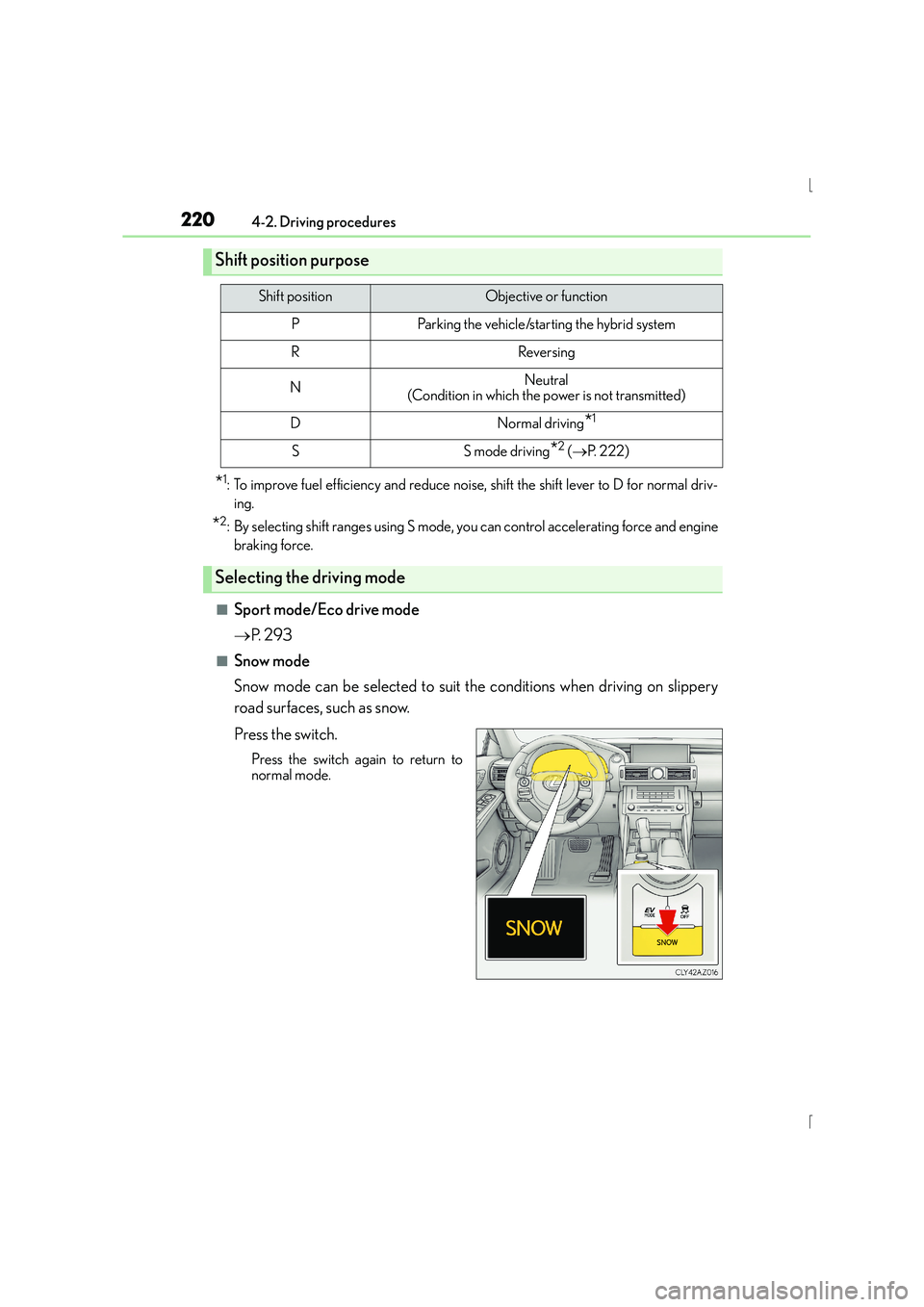
■Snow mode
Snow mode can be selected to suit the conditions when driving on slippery
road surfaces, such as snow.
Press the switch.
Press the switch again to return to
normal mode.
Shift position purpose
Shift positionObjective or function
PParking the vehicle/starting the hybrid system
RReversing
NNeutral
(Condition in which the power is not transmitted)
DNormal driving*1
SS mode driving*2 ( → P. 222)
Selecting the driving mode
Page 221 of 628
2214-2. Driving procedures
4
Driving
IS300h_EE(OM53D56E)
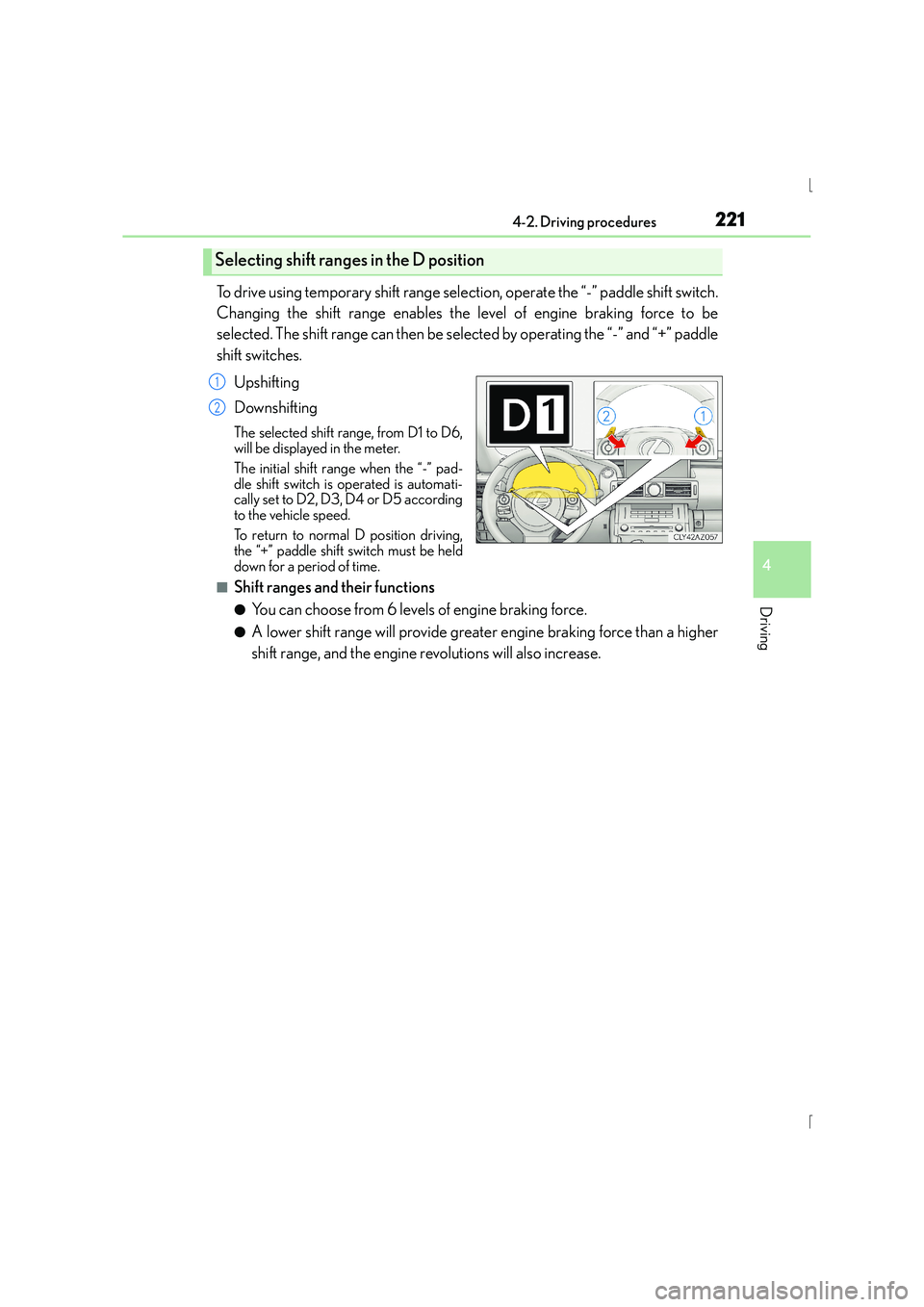
To drive using temporary shift range selection, operate the “-” paddle shift switch.
Changing the shift range enables the level of engine braking force to be
selected. The shift range can then be selected by operating the “-” and “+” paddle
shift switches.Upshifting
Downshifting
The selected shift range, from D1 to D6,
will be displayed in the meter.
The initial shift range when the “-” pad-
dle shift switch is operated is automati-
cally set to D2, D3, D4 or D5 according
to the vehicle speed.
To return to normal D position driving,
the “+” paddle shift switch must be held
down for a period of time.
■Shift ranges and their functions
●You can choose from 6 levels of engine braking force.
●A lower shift range will provide greater engine braking force than a higher
shift range, and the engine revolutions will also increase.
Selecting shift ranges in the D position
1
2
Page 222 of 628
2224-2. Driving procedures
IS300h_EE(OM53D56E)
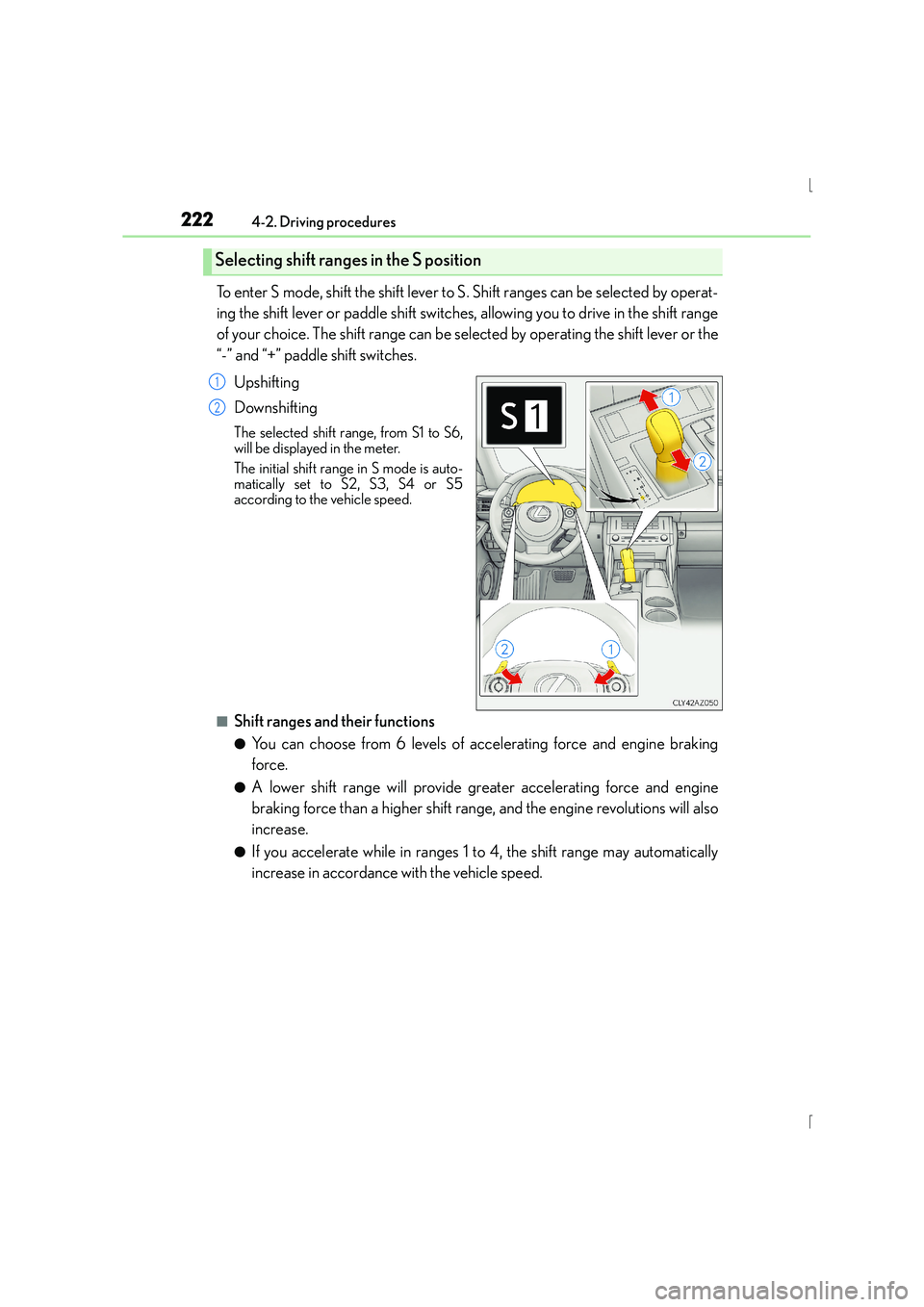
To enter S mode, shift the shift lever to S. Shift ranges can be selected by operat-
ing the shift lever or paddle shift switches, allowing you to drive in the shift range
of your choice. The shift range can be selected by operating the shift lever or the
“-” and “+” paddle shift switches. Upshifting
Downshifting
The selected shift range, from S1 to S6,
will be displayed in the meter.
The initial shift range in S mode is auto-
matically set to S2, S3, S4 or S5
according to the vehicle speed.
■Shift ranges and their functions
●You can choose from 6 levels of accelerating force and engine braking
force.
●A lower shift range will provide greater accelerating force and engine
braking force than a higher shift range, and the engine revolutions will also
increase.
●If you accelerate while in ranges 1 to 4, the shift range may automatically
increase in accordance with the vehicle speed.
Selecting shift ranges in the S position
1
2
Page 223 of 628
2234-2. Driving procedures
4
Driving
IS300h_EE(OM53D56E)
■When the “-” paddle shift switch is operated with the shift lever in the D position
The shift range is downshifted to a range that enables engine braking force that is suit-
able to driving conditions.
■Automatic deactivation of shift range selection in the D position
Shift range selection in the D position will be deactivated in the following situations:
●When the vehicle comes to a stop
●If the accelerator pedal is depressed for more than a certain period of time
●When the shift lever is shifted to a position other than D
■Downshifting restriction warning buzzer
To help ensure safety and driving performa nce, downshifting operation may sometimes
be restricted. In some circumstances, downsh ifting may not be possible even when the
shift lever or paddle shift switch is operated. (A buzzer will sound twice.)
■Snow mode automatic deactivation
Snow mode is automatically deactivated if the power switch is turned off after driving in
snow mode.
■When driving with cruise control or dynamic radar cruise control activated
Even when performing the following actions with the intent of enabling engine braking,
engine braking will not activate because cruise control or dynamic radar cruise control
will not be canceled.
●While driving in D or S mode, downshifting to 5 or 4. ( →P. 250, 254)
●When switching the driving mode to sport mode while driving in D position. ( →P. 2 9 3 )
■If the shift lever cannot be shifted from P
→P. 5 6 2
Page 226 of 628
2264-2. Driving procedures
IS300h_EE(OM53D56E)
■Turn signals can be operated when
The power switch is in ON mode.
■If the indicator flashes faster than usual
Check that a light bulb in the front or rear turn signal lights has not burned out.
■If the turn signals stop flashing before a lane change has been performed
Operate the lever again.
■Customization
The number of times the turn signals flash during a lane change can be changed.
(Customizable feature →P. 5 9 1 )
Page 229 of 628
229
4
Driving
IS300h_EE(OM53D56E)4-3. Operating the lights and wipers
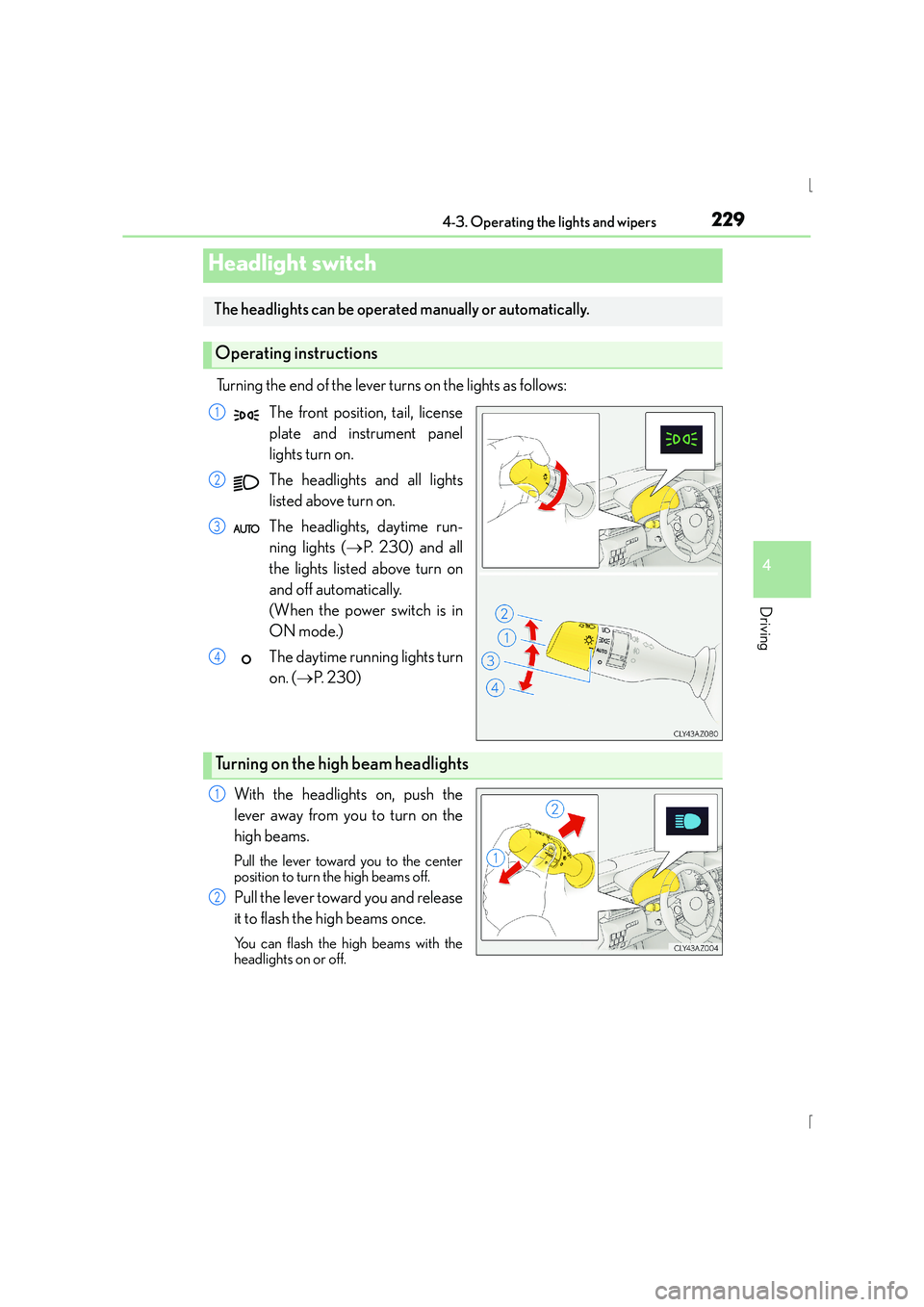
Turning the end of the lever turns on the lights as follows:
The front position, tail, license
plate and instrument panel
lights turn on.
The headlights and all lights
listed above turn on.
The headlights, daytime run-
ning lights ( →P. 2 3 0 ) a n d a l l
the lights listed above turn on
and off automatically.
(When the power switch is in
ON mode.)
The daytime running lights turn
on. ( →P. 2 3 0 )
With the headlights on, push the
lever away from you to turn on the
high beams.
Pull the lever toward you to the center
position to turn the high beams off.
Pull the lever toward you and release
it to flash the high beams once.
You can flash the high beams with the
headlights on or off.
Headlight switch
The headlights can be operated manually or automatically.
Operating instructions
1
2
3
4
Turning on the high beam headlights
1
2
Page 231 of 628
2314-3. Operating the lights and wipers
4
Driving
IS300h_EE(OM53D56E)
■Light reminder buzzer
A buzzer sounds when the power switch is turned off or turned to ACCESSORY mode
and the driver’s door is opened while the lights are turned on.
■Automatic headlight leveling system
The level of the headlights is automatically adjusted according to the number of passen-
gers and the loading condition of the vehicle to ensure that the headlights do not inter-
fere with other road users.
■Customization
Settings (e.g. light sensor se nsitivity) can be changed.
(Customizable features: →P. 5 9 7 )
NOTICE
■To prevent 12-volt battery discharge
Do not leave the lights on longer than necessary when the hybrid system is off.
Page 234 of 628

2344-3. Operating the lights and wipers
IS300h_EE(OM53D56E)
■The Automatic High Beam can be operated when
The power switch is in ON mode.
■Camera sensor detection information
●High beam may not be automatically turned off in the following situations:
• When oncoming vehicles suddenly appear from a curve
• When the vehicle is cut in front of by another vehicle
• When oncoming or preceding vehicles are hidden from sight due to repeatedcurves, road dividers or roadside trees
●High beam may be turned off if an oncomi ng vehicle that is using fog lights without
using the headlights is detected.
●House lights, street lights, red traffic sign als, and illuminated billboards or signs may
cause the high beam to turn off.
●The following factors may affect the amount of time taken to turn high beam on or off:
• The brightness of headlights, fog lights, and tail lights of oncoming and preceding
vehicles
• The movement and direction of oncoming and preceding vehicles
• When an oncoming or preceding vehicle only has operational lights on one side
• When an oncoming or preceding vehicle is a two-wheeled vehicle
• The condition of the road (gradient, curve, condition of the road surface etc.)
• The number of passengers and amount of luggage
●High beam may be turned on or off when unexpected by the driver.
●Small vehicles, such as bicycles, may not be detected.
●In the situations below, the system may not be able to correctly detect the surrounding
brightness levels, and may flash or expose nearby pedestrians to the high beam. There-
fore, you should consider turning the high be ams on or off manually rather than relying
on the Automatic High Beam system.
• In bad weather (rain, snow, fog, sandstorms etc.)
• The windshield is obscured by fog, mist, ice, dirt etc.
• The windshield is cracked or damaged.
• The camera sensor is deformed or dirty.
• Surrounding brightness levels are equal to th ose of headlights, tail lights or fog lights.
• Vehicles ahead have headlights or tail lights that are either switched off, dirty, chang-
ing color, or have improperly adjusted aim.
• When driving through an area of intermittently changing brightness and darkness.
• When frequently and repeatedly driving ascending/descending roads, or roads with
rough, bumpy or uneven surfaces (such as stone-paved roads, gravel tracks etc.).
• When frequently and repeatedly taking curves or driving on a winding road.
• There is a highly reflective object ahead of the vehicle, such as a sign or a mirror.
• The vehicle’s headlights are damaged or dirty.
• The vehicle is listing or titling, due to a flat tire, a trailer being towed etc.
• The driver believes that the high beam may be causing problems or distress to other drivers or pedestrians nearby.
• The vehicle is used in a territory in which vehicles travel on the opposite side of the
road of the country for which the vehicle is approved, for example using a vehicle
designed for right-hand traffic in a left-hand traffic territory, or vice versa.