ignition LEXUS LS430 2003 Factory Manual PDF
[x] Cancel search | Manufacturer: LEXUS, Model Year: 2003, Model line: LS430, Model: LEXUS LS430 2003Pages: 4500, PDF Size: 87.45 MB
Page 292 of 4500
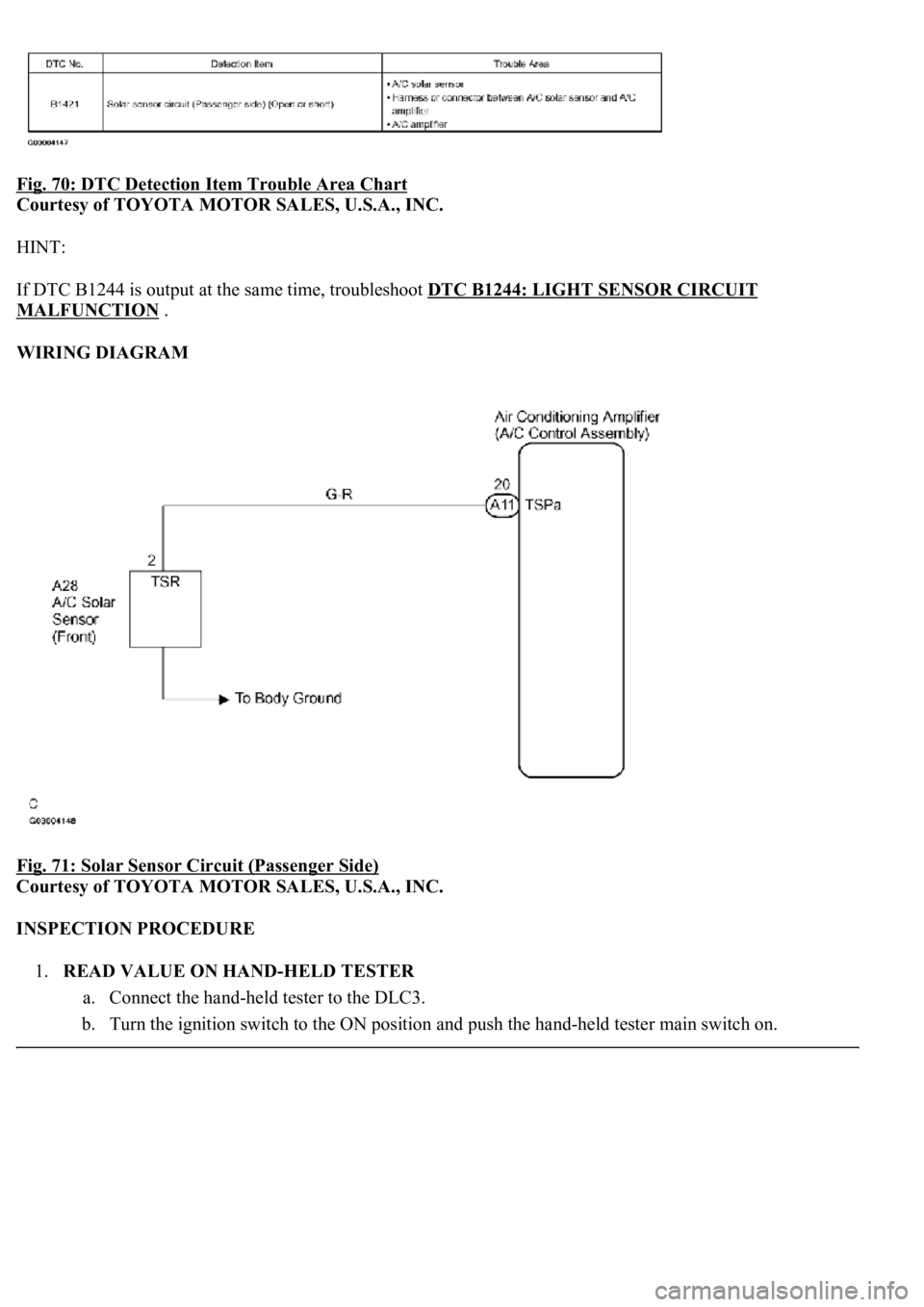
Fig. 70: DTC Detection Item Trouble Area Chart
Courtesy of TOYOTA MOTOR SALES, U.S.A., INC.
HINT:
If DTC B1244 is output at the same time, troubleshoot DTC B1244: LIGHT SENSOR CIRCUIT
MALFUNCTION .
WIRING DIAGRAM
Fig. 71: Solar Sensor Circuit (Passenger Side)
Courtesy of TOYOTA MOTOR SALES, U.S.A., INC.
INSPECTION PROCEDURE
1.READ VALUE ON HAND-HELD TESTER
a. Connect the hand-held tester to the DLC3.
b. Turn the ignition switch to the ON position and push the hand-held tester main switch on.
Page 293 of 4500
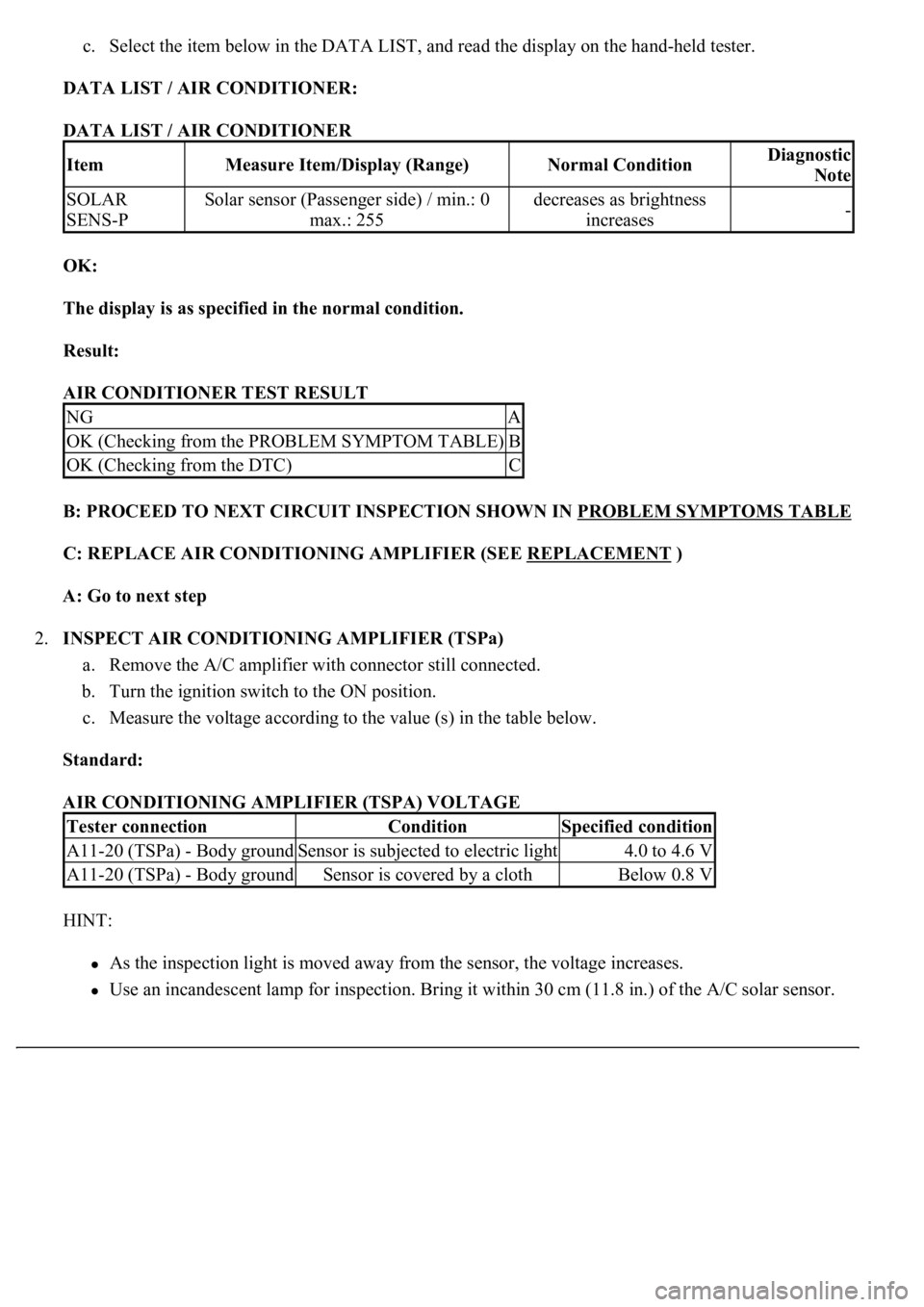
c. Select the item below in the DATA LIST, and read the display on the hand-held tester.
DATA LIST / AIR CONDITIONER:
DATA LIST / AIR CONDITIONER
OK:
The display is as specified in the normal condition.
Result:
AIR CONDITIONER TEST RESULT
B: PROCEED TO NEXT CIRCUIT INSPECTION SHOWN IN PROBLEM SYMPTOMS TABLE
C: REPLACE AIR CONDITIONING AMPLIFIER (SEE REPLACEMENT )
A: Go to next step
2.INSPECT AIR CONDITIONING AMPLIFIER (TSPa)
a. Remove the A/C amplifier with connector still connected.
b. Turn the ignition switch to the ON position.
c. Measure the voltage according to the value (s) in the table below.
Standard:
AIR CONDITIONING AMPLIFIER (TSPA) VOLTAGE
HINT:
As the inspection light is moved away from the sensor, the voltage increases.
Use an incandescent lamp for inspection. Bring it within 30 cm (11.8 in.) of the A/C solar sensor.
ItemMeasure Item/Display (Range)Normal ConditionDiagnostic
Note
SOLAR
SENS-PSolar sensor (Passenger side) / min.: 0
max.: 255decreases as brightness
increases-
NGA
OK (Checking from the PROBLEM SYMPTOM TABLE)B
OK (Checking from the DTC)C
Tester connectionConditionSpecified condition
A11-20 (TSPa) - Body groundSensor is subjected to electric light4.0 to 4.6 V
A11-20 (TSPa) - Body groundSensor is covered by a clothBelow 0.8 V
Page 301 of 4500
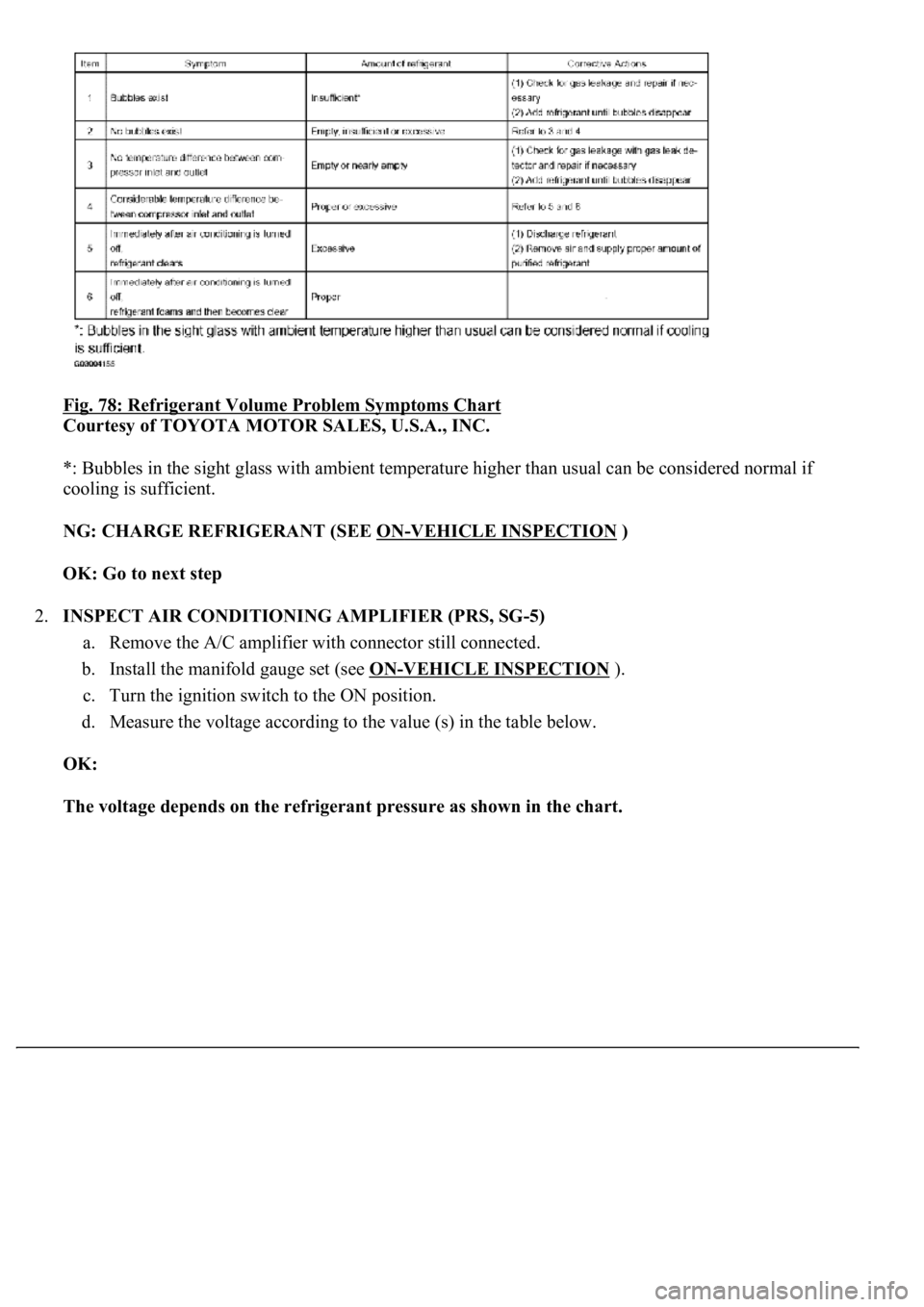
Fig. 78: Refrigerant Volume Problem Symptoms Chart
Courtesy of TOYOTA MOTOR SALES, U.S.A., INC.
*: Bubbles in the sight glass with ambient temperature higher than usual can be considered normal if
cooling is sufficient.
NG: CHARGE REFRIGERANT (SEE ON
-VEHICLE INSPECTION )
OK: Go to next step
2.INSPECT AIR CONDITIONING AMPLIFIER (PRS, SG-5)
a. Remove the A/C amplifier with connector still connected.
b. Install the manifold gauge set (see ON
-VEHICLE INSPECTION ).
c. Turn the ignition switch to the ON position.
d. Measure the voltage according to the value (s) in the table below.
OK:
The voltage depends on the refrigerant pressure as shown in the chart.
Page 309 of 4500
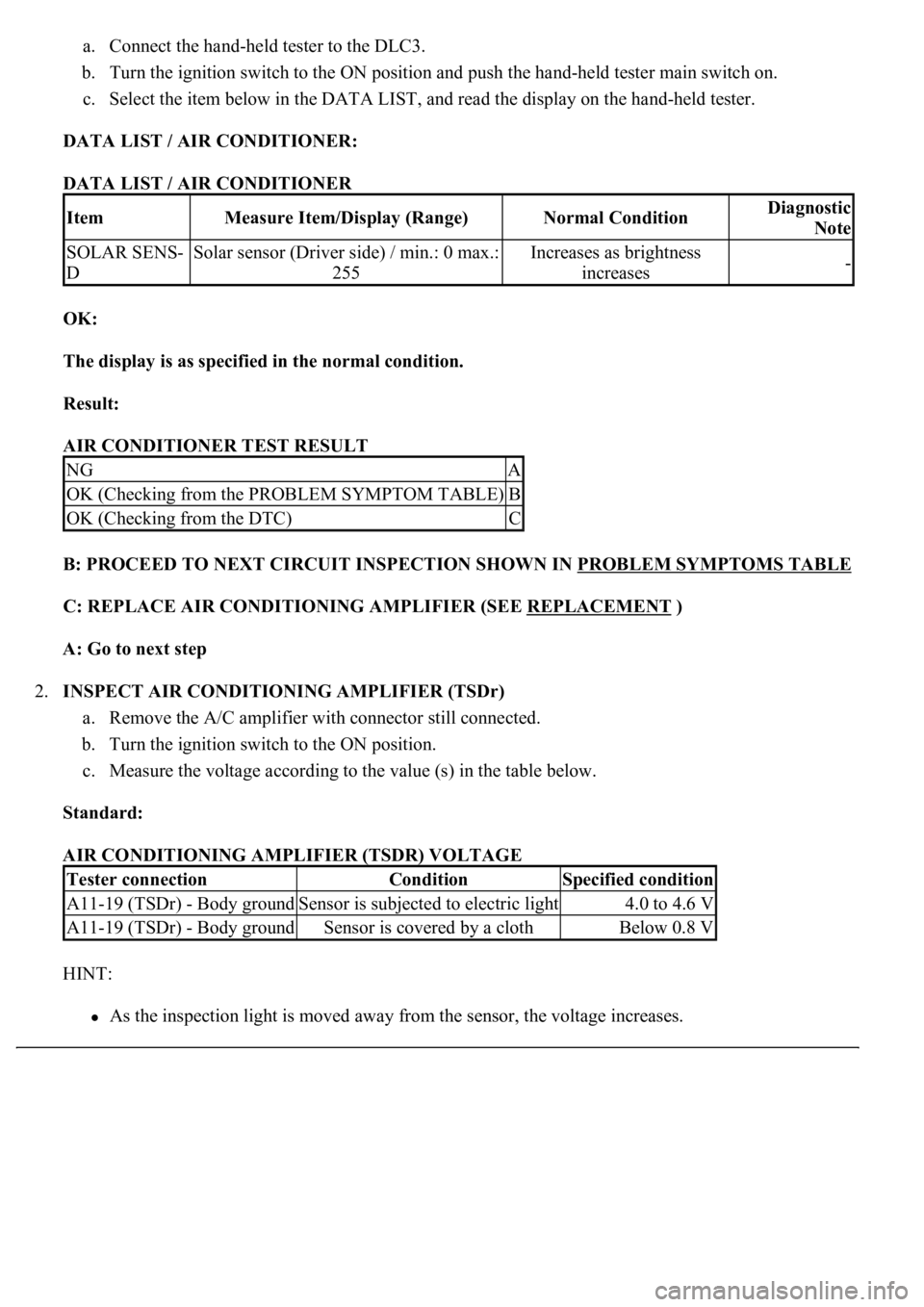
a. Connect the hand-held tester to the DLC3.
b. Turn the ignition switch to the ON position and push the hand-held tester main switch on.
c. Select the item below in the DATA LIST, and read the display on the hand-held tester.
DATA LIST / AIR CONDITIONER:
DATA LIST / AIR CONDITIONER
OK:
The display is as specified in the normal condition.
Result:
AIR CONDITIONER TEST RESULT
B: PROCEED TO NEXT CIRCUIT INSPECTION SHOWN IN PROBLEM SYMPTOMS TABLE
C: REPLACE AIR CONDITIONING AMPLIFIER (SEE REPLACEMENT )
A: Go to next step
2.INSPECT AIR CONDITIONING AMPLIFIER (TSDr)
a. Remove the A/C amplifier with connector still connected.
b. Turn the ignition switch to the ON position.
c. Measure the voltage according to the value (s) in the table below.
Standard:
AIR CONDITIONING AMPLIFIER (TSDR) VOLTAGE
HINT:
As the inspection light is moved away from the sensor, the voltage increases.
ItemMeasure Item/Display (Range)Normal ConditionDiagnostic
Note
SOLAR SENS-
DSolar sensor (Driver side) / min.: 0 max.:
255Increases as brightness
increases-
NGA
OK (Checking from the PROBLEM SYMPTOM TABLE)B
OK (Checking from the DTC)C
Tester connectionConditionSpecified condition
A11-19 (TSDr) - Body groundSensor is subjected to electric light4.0 to 4.6 V
A11-19 (TSDr) - Body groundSensor is covered by a clothBelow 0.8 V
Page 315 of 4500
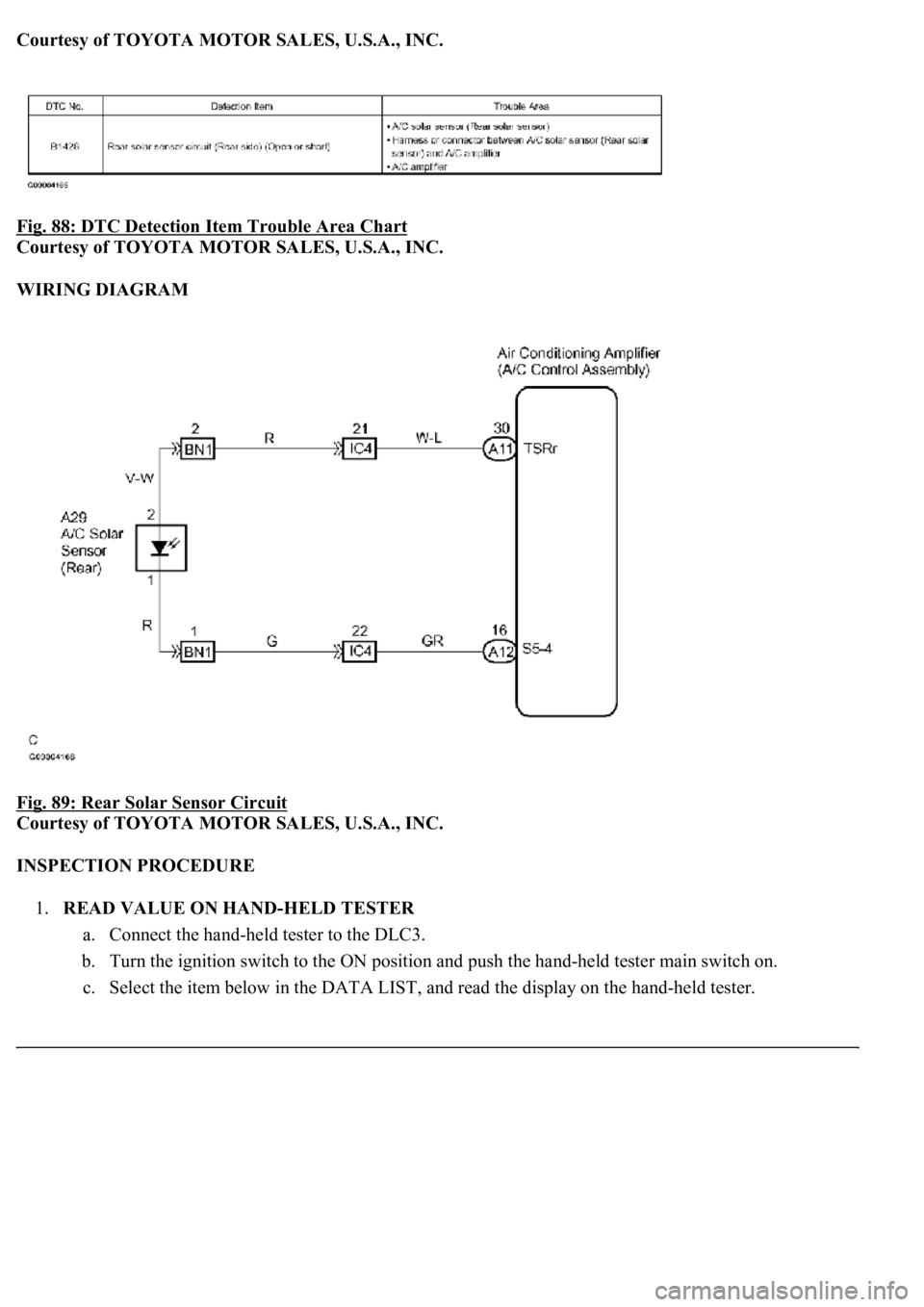
Courtesy of TOYOTA MOTOR SALES, U.S.A., INC.
Fig. 88: DTC Detection Item Trouble Area Chart
Courtesy of TOYOTA MOTOR SALES, U.S.A., INC.
WIRING DIAGRAM
Fig. 89: Rear Solar Sensor Circuit
Courtesy of TOYOTA MOTOR SALES, U.S.A., INC.
INSPECTION PROCEDURE
1.READ VALUE ON HAND-HELD TESTER
a. Connect the hand-held tester to the DLC3.
b. Turn the ignition switch to the ON position and push the hand-held tester main switch on.
c. Select the item below in the DATA LIST, and read the displa
y on the hand-held tester.
Page 316 of 4500
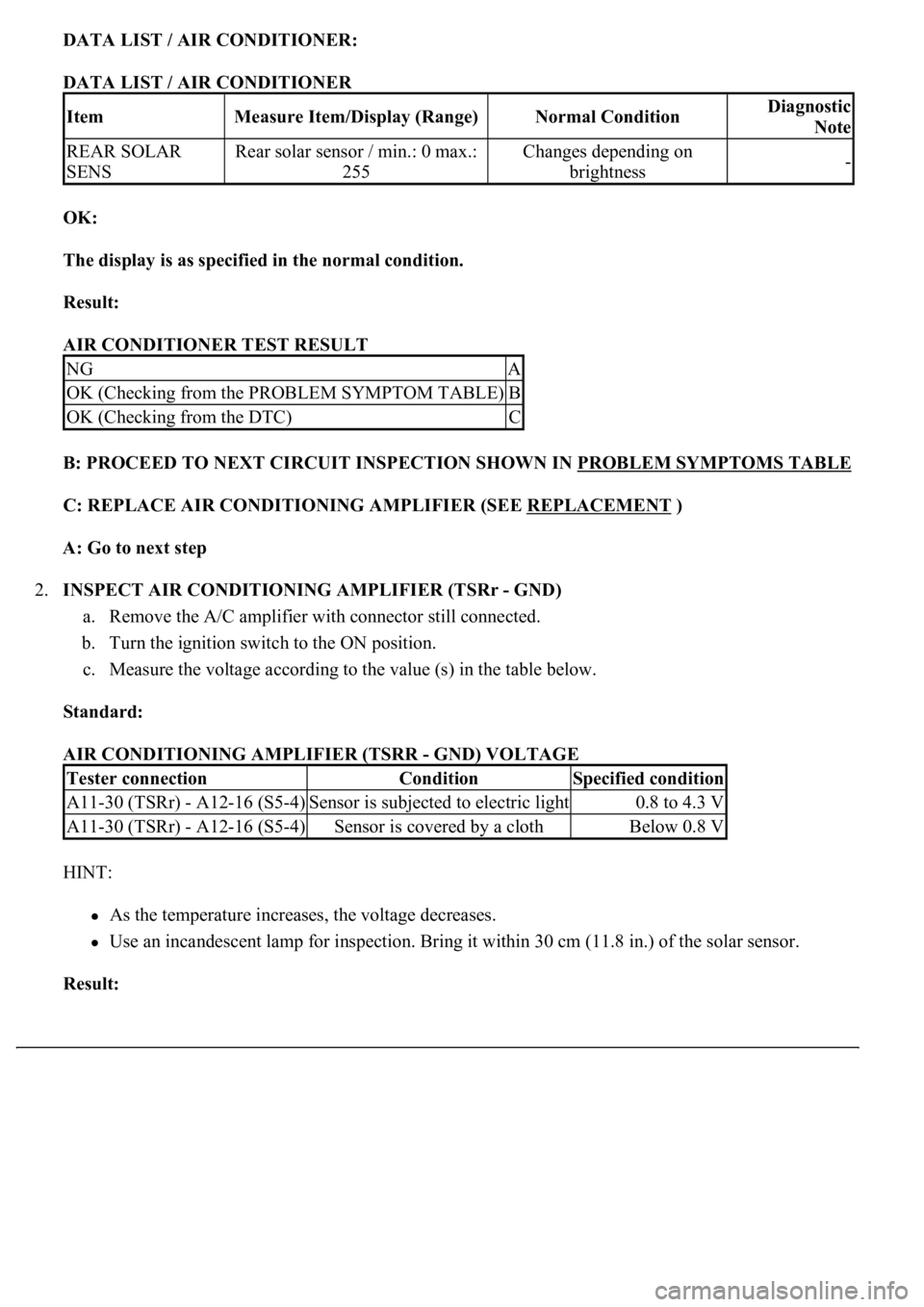
DATA LIST / AIR CONDITIONER:
DATA LIST / AIR CONDITIONER
OK:
The display is as specified in the normal condition.
Result:
AIR CONDITIONER TEST RESULT
B: PROCEED TO NEXT CIRCUIT INSPECTION SHOWN IN PROBLEM SYMPTOMS TABLE
C: REPLACE AIR CONDITIONING AMPLIFIER (SEE REPLACEMENT )
A: Go to next step
2.INSPECT AIR CONDITIONING AMPLIFIER (TSRr - GND)
a. Remove the A/C amplifier with connector still connected.
b. Turn the ignition switch to the ON position.
c. Measure the voltage according to the value (s) in the table below.
Standard:
AIR CONDITIONING AMPLIFIER (TSRR - GND) VOLTAGE
HINT:
As the temperature increases, the voltage decreases.
Use an incandescent lamp for inspection. Bring it within 30 cm (11.8 in.) of the solar sensor.
Result:
ItemMeasure Item/Display (Range)Normal ConditionDiagnostic
Note
REAR SOLAR
SENSRear solar sensor / min.: 0 max.:
255Changes depending on
brightness-
NGA
OK (Checking from the PROBLEM SYMPTOM TABLE)B
OK (Checking from the DTC)C
Tester connectionConditionSpecified condition
A11-30 (TSRr) - A12-16 (S5-4)Sensor is subjected to electric light0.8 to 4.3 V
A11-30 (TSRr) - A12-16 (S5-4)Sensor is covered by a clothBelow 0.8 V
Page 323 of 4500
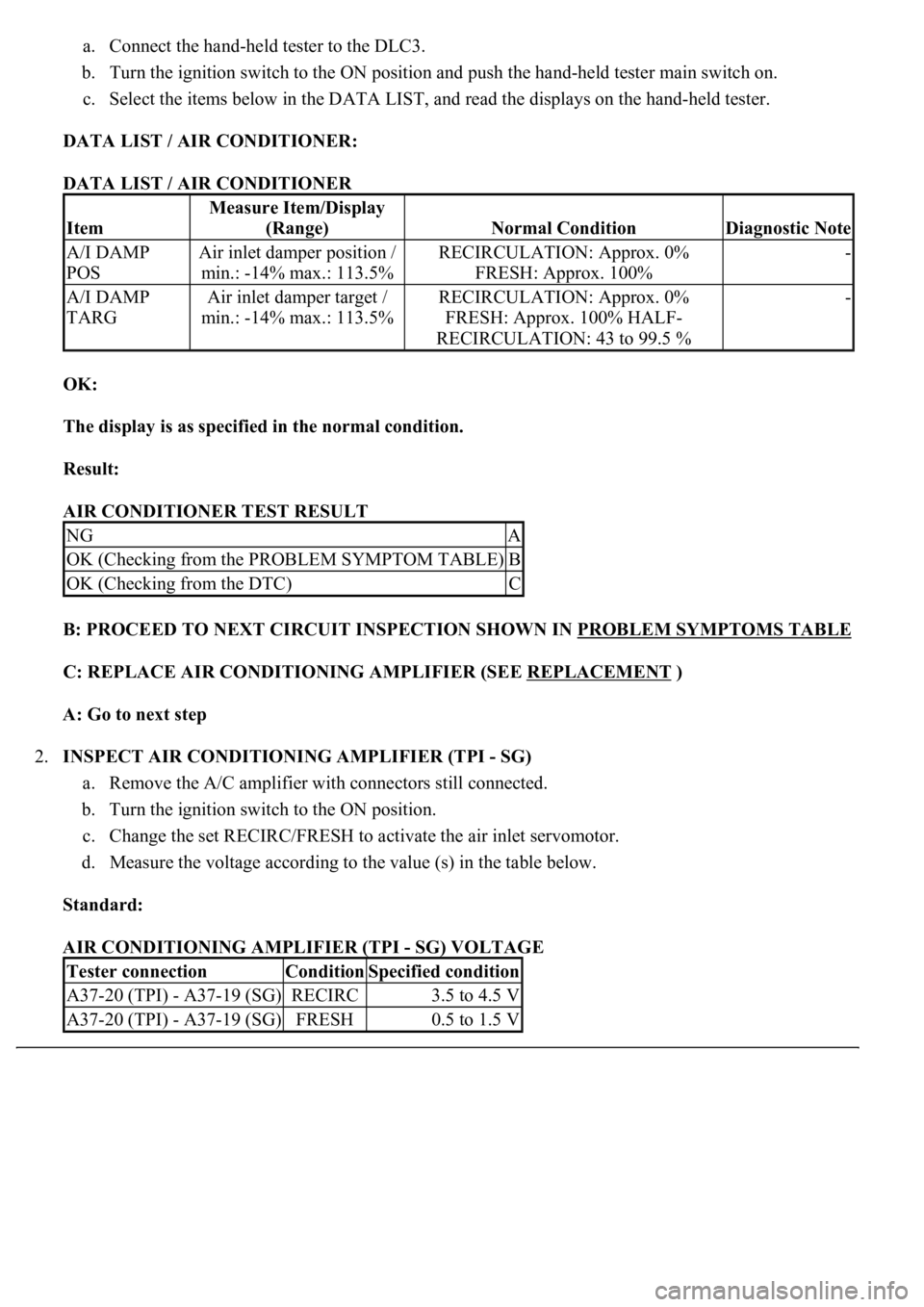
a. Connect the hand-held tester to the DLC3.
b. Turn the ignition switch to the ON position and push the hand-held tester main switch on.
c. Select the items below in the DATA LIST, and read the displays on the hand-held tester.
DATA LIST / AIR CONDITIONER:
DATA LIST / AIR CONDITIONER
OK:
The display is as specified in the normal condition.
Result:
AIR CONDITIONER TEST RESULT
B: PROCEED TO NEXT CIRCUIT INSPECTION SHOWN IN PROBLEM SYMPTOMS TABLE
C: REPLACE AIR CONDITIONING AMPLIFIER (SEE REPLACEMENT )
A: Go to next step
2.INSPECT AIR CONDITIONING AMPLIFIER (TPI - SG)
a. Remove the A/C amplifier with connectors still connected.
b. Turn the ignition switch to the ON position.
c. Change the set RECIRC/FRESH to activate the air inlet servomotor.
d. Measure the voltage according to the value (s) in the table below.
Standard:
AIR CONDITIONING AMPLIFIER (TPI - SG) VOLTAGE
Item
Measure Item/Display
(Range)
Normal ConditionDiagnostic Note
A/I DAMP
POSAir inlet damper position /
min.: -14% max.: 113.5%RECIRCULATION: Approx. 0%
FRESH: Approx. 100%-
A/I DAMP
TARGAir inlet damper target /
min.: -14% max.: 113.5%RECIRCULATION: Approx. 0%
FRESH: Approx. 100% HALF-
RECIRCULATION: 43 to 99.5 %-
NGA
OK (Checking from the PROBLEM SYMPTOM TABLE)B
OK (Checking from the DTC)C
Tester connectionConditionSpecified condition
A37-20 (TPI) - A37-19 (SG)RECIRC3.5 to 4.5 V
A37-20 (TPI) - A37-19 (SG)FRESH0.5 to 1.5 V
Page 331 of 4500
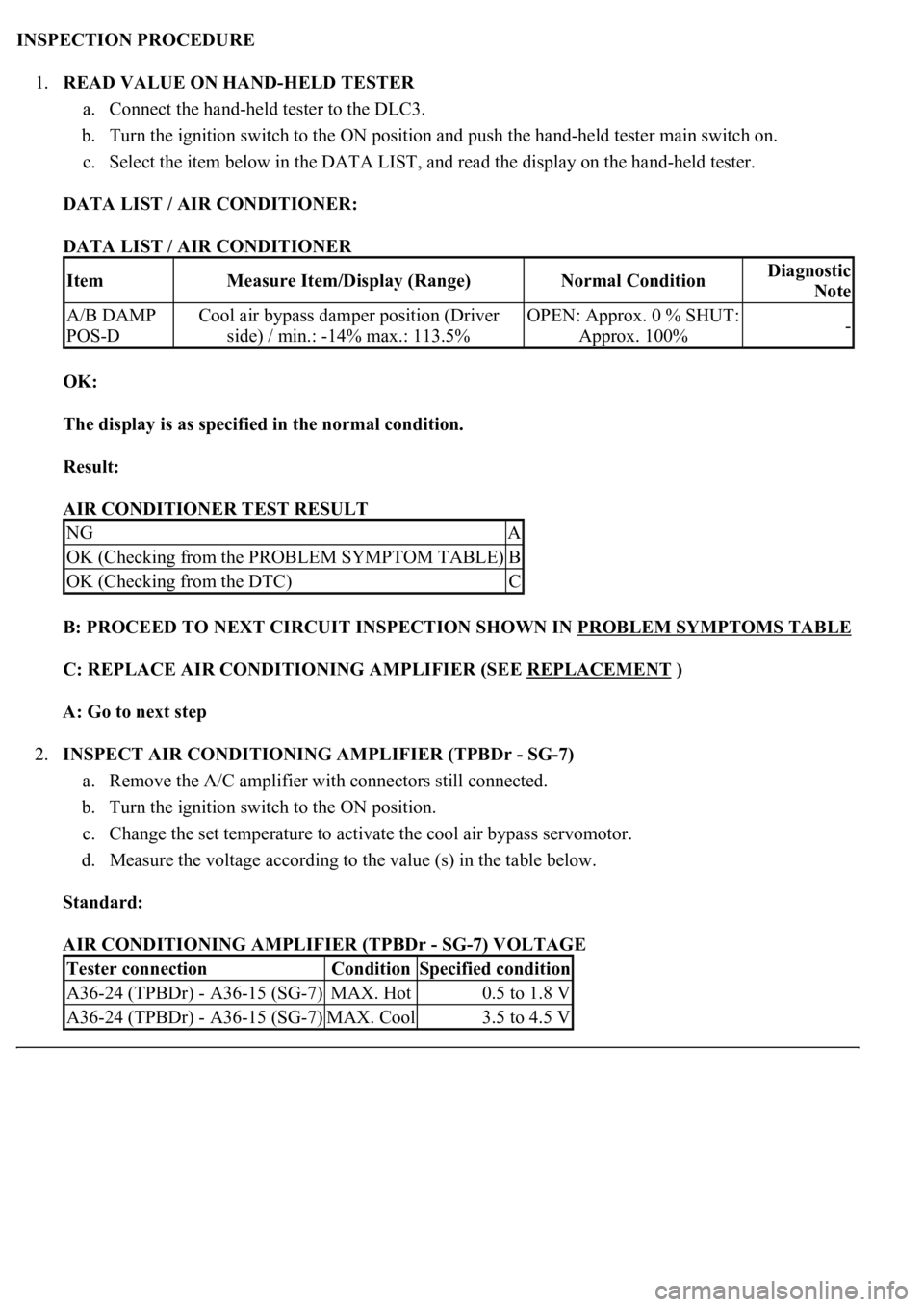
INSPECTION PROCEDURE
1.READ VALUE ON HAND-HELD TESTER
a. Connect the hand-held tester to the DLC3.
b. Turn the ignition switch to the ON position and push the hand-held tester main switch on.
c. Select the item below in the DATA LIST, and read the display on the hand-held tester.
DATA LIST / AIR CONDITIONER:
DATA LIST / AIR CONDITIONER
OK:
The display is as specified in the normal condition.
Result:
AIR CONDITIONER TEST RESULT
B: PROCEED TO NEXT CIRCUIT INSPECTION SHOWN IN PROBLEM SYMPTOMS TABLE
C: REPLACE AIR CONDITIONING AMPLIFIER (SEE REPLACEMENT )
A: Go to next step
2.INSPECT AIR CONDITIONING AMPLIFIER (TPBDr - SG-7)
a. Remove the A/C amplifier with connectors still connected.
b. Turn the ignition switch to the ON position.
c. Change the set temperature to activate the cool air bypass servomotor.
d. Measure the voltage according to the value (s) in the table below.
Standard:
AIR CONDITIONING AMPLIFIER (TPBDr - SG-7) VOLTAGE
ItemMeasure Item/Display (Range)Normal ConditionDiagnostic
Note
A/B DAMP
POS-DCool air bypass damper position (Driver
side) / min.: -14% max.: 113.5%OPEN: Approx. 0 % SHUT:
Approx. 100%-
NGA
OK (Checking from the PROBLEM SYMPTOM TABLE)B
OK (Checking from the DTC)C
Tester connectionConditionSpecified condition
A36-24 (TPBDr) - A36-15 (SG-7)MAX. Hot0.5 to 1.8 V
A36-24 (TPBDr) - A36-15 (SG-7)MAX. Cool3.5 to 4.5 V
Page 339 of 4500

Fig. 107: Max Cool Damper Position Sensor Circuit (Passenger Side)
Courtesy of TOYOTA MOTOR SALES, U.S.A., INC.
INSPECTION PROCEDURE
1.READ VALUE ON HAND-HELD TESTER
a. Connect the hand-held tester to the DLC3.
b. Turn the ignition switch to the ON position and push the hand-held tester main switch on.
c. Select the item below in the DATA LIST, and read the display on the hand-held tester.
DATA LIST / AIR CONDITIONER:
DATA LIST / AIR CONDITIONER
ItemMeasure Item/Display (Range)Normal ConditionDiagnostic
Note
A/B DAMP
POS-PCool air bypass damper position (Passenger
side) / min.: -14% max.: 113.5%OPEN: Approx. 0 %
SHUT: Approx. 100%-
Page 340 of 4500
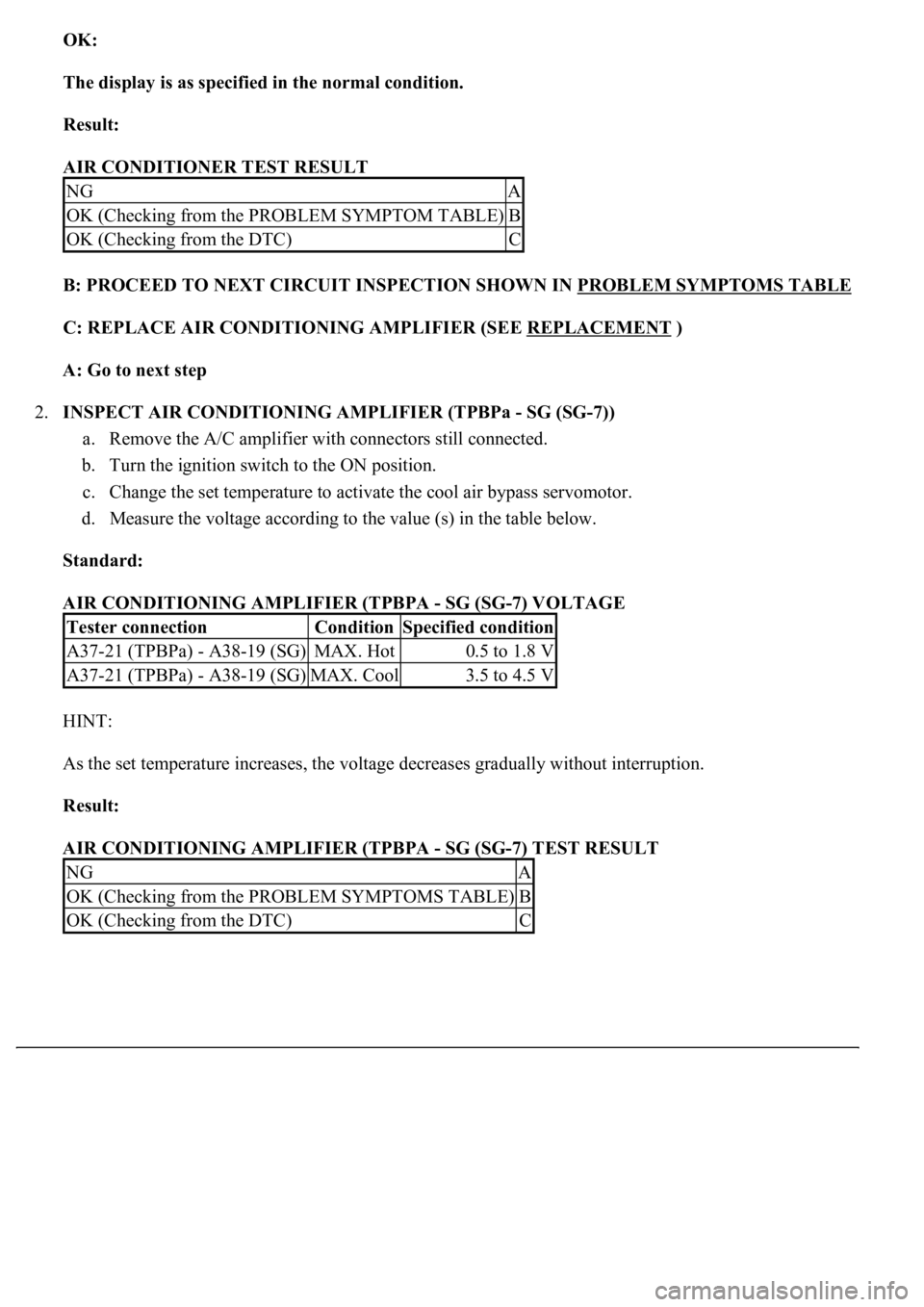
OK:
The display is as specified in the normal condition.
Result:
AIR CONDITIONER TEST RESULT
B: PROCEED TO NEXT CIRCUIT INSPECTION SHOWN IN PROBLEM SYMPTOMS TABLE
C: REPLACE AIR CONDITIONING AMPLIFIER (SEE REPLACEMENT )
A: Go to next step
2.INSPECT AIR CONDITIONING AMPLIFIER (TPBPa - SG (SG-7))
a. Remove the A/C amplifier with connectors still connected.
b. Turn the ignition switch to the ON position.
c. Change the set temperature to activate the cool air bypass servomotor.
d. Measure the voltage according to the value (s) in the table below.
Standard:
AIR CONDITIONING AMPLIFIER (TPBPA - SG (SG-7) VOLTAGE
HINT:
As the set temperature increases, the voltage decreases gradually without interruption.
Result:
AIR CONDITIONING AMPLIFIER (TPBPA - SG (SG-7) TEST RESULT
NGA
OK (Checking from the PROBLEM SYMPTOM TABLE)B
OK (Checking from the DTC)C
Tester connectionConditionSpecified condition
A37-21 (TPBPa) - A38-19 (SG)MAX. Hot0.5 to 1.8 V
A37-21 (TPBPa) - A38-19 (SG)MAX. Cool3.5 to 4.5 V
NGA
OK (Checking from the PROBLEM SYMPTOMS TABLE)B
OK (Checking from the DTC)C