pcv LEXUS LS430 2003 Factory Repair Manual
[x] Cancel search | Manufacturer: LEXUS, Model Year: 2003, Model line: LS430, Model: LEXUS LS430 2003Pages: 4500, PDF Size: 87.45 MB
Page 2010 of 4500
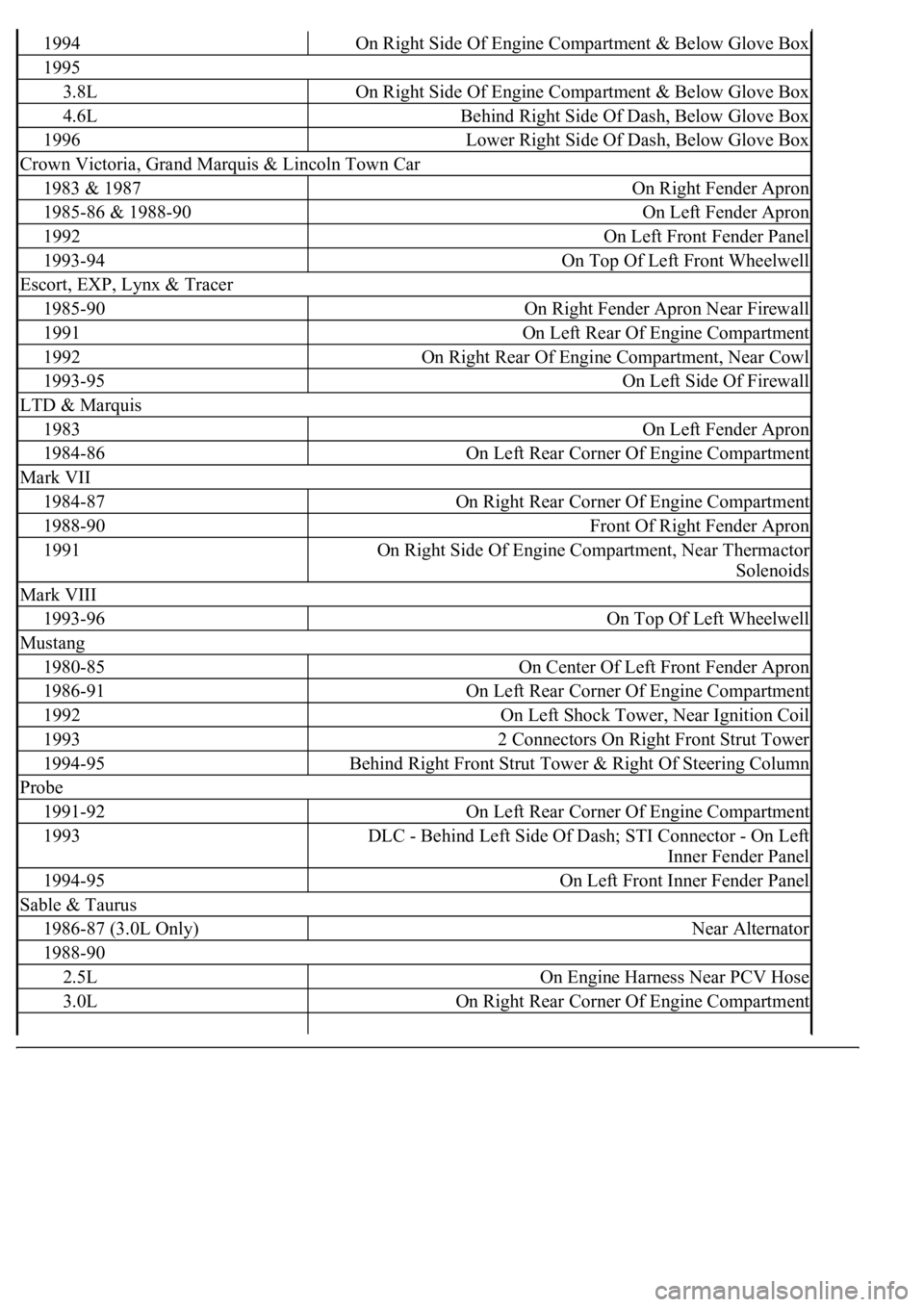
1994On Right Side Of Engine Compartment & Below Glove Box
1995
3.8LOn Right Side Of Engine Compartment & Below Glove Box
4.6LBehind Right Side Of Dash, Below Glove Box
1996Lower Right Side Of Dash, Below Glove Box
Crown Victoria, Grand Marquis & Lincoln Town Car
1983 & 1987On Right Fender Apron
1985-86 & 1988-90On Left Fender Apron
1992On Left Front Fender Panel
1993-94On Top Of Left Front Wheelwell
Escort, EXP, Lynx & Tracer
1985-90On Right Fender Apron Near Firewall
1991On Left Rear Of Engine Compartment
1992On Right Rear Of Engine Compartment, Near Cowl
1993-95On Left Side Of Firewall
LTD & Marquis
1983On Left Fender Apron
1984-86On Left Rear Corner Of Engine Compartment
Mark VII
1984-87On Right Rear Corner Of Engine Compartment
1988-90Front Of Right Fender Apron
1991On Right Side Of Engine Compartment, Near Thermactor
Solenoids
Mark VIII
1993-96On Top Of Left Wheelwell
Mustang
1980-85On Center Of Left Front Fender Apron
1986-91On Left Rear Corner Of Engine Compartment
1992On Left Shock Tower, Near Ignition Coil
19932 Connectors On Right Front Strut Tower
1994-95Behind Right Front Strut Tower & Right Of Steering Column
Probe
1991-92On Left Rear Corner Of Engine Compartment
1993DLC - Behind Left Side Of Dash; STI Connector - On Left
Inner Fender Panel
1994-95On Left Front Inner Fender Panel
Sable & Taurus
1986-87 (3.0L Only)Near Alternator
1988-90
2.5LOn Engine Harness Near PCV Hose
3.0LOn Right Rear Corner Of Engine Compartment
Page 2905 of 4500
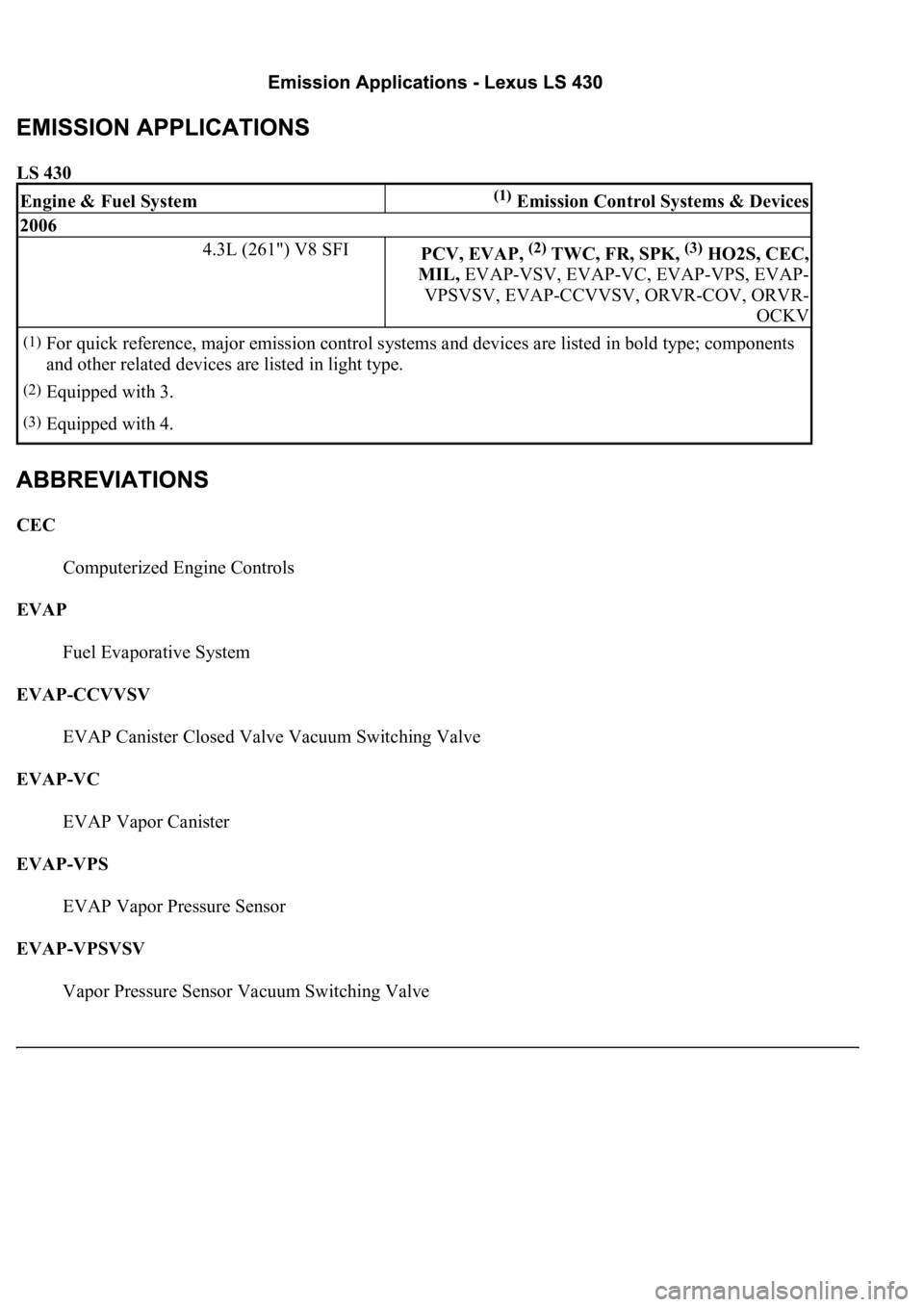
LS 430
CEC
Computerized Engine Controls
EVAP
Fuel Evaporative System
EVAP-CCVVSV
EVAP Canister Closed Valve Vacuum Switching Valve
EVAP-VC
EVAP Vapor Canister
EVAP-VPS
EVAP Vapor Pressure Sensor
EVAP-VPSVSV
Vapor Pressure Sensor Vacuum Switching Valve
Engine & Fuel System(1) Emission Control Systems & Devices
2006
4.3L (261") V8 SFIPCV, EVAP, (2) TWC, FR, SPK, (3) HO2S, CEC,
MIL, EVAP-VSV, EVAP-VC, EVAP-VPS, EVAP-
VPSVSV, EVAP-CCVVSV, ORVR-COV, ORVR-
OCKV
(1)For quick reference, major emission control systems and devices are listed in bold type; components
and other related devices are listed in light type.
(2)Equipped with 3.
(3)Equipped with 4.
Page 2906 of 4500
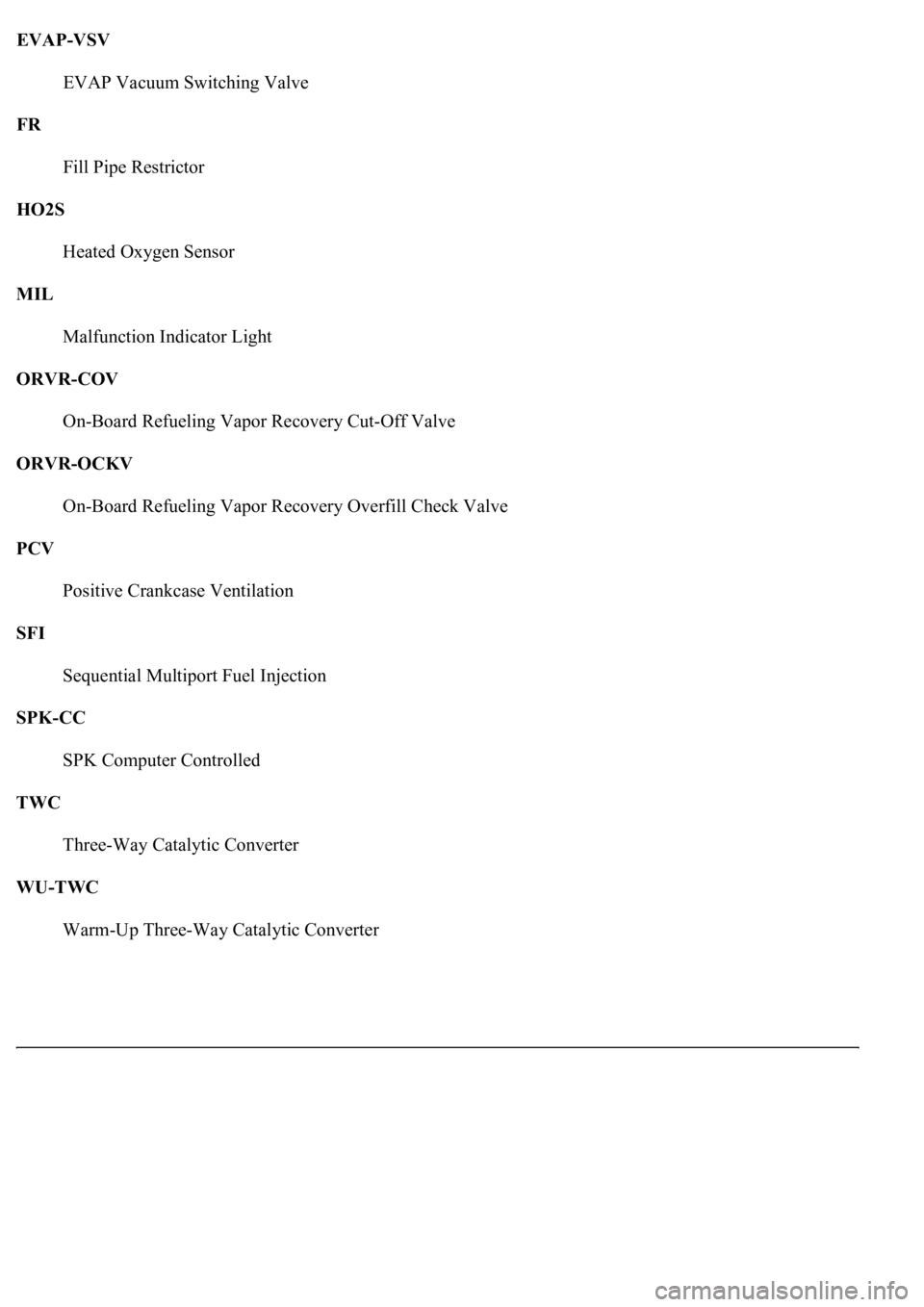
EVAP-VSV
EVAP Vacuum Switching Valve
FR
Fill Pipe Restrictor
HO2S
Heated Oxygen Sensor
MIL
Malfunction Indicator Light
ORVR-COV
On-Board Refueling Vapor Recovery Cut-Off Valve
ORVR-OCKV
On-Board Refueling Vapor Recovery Overfill Check Valve
PCV
Positive Crankcase Ventilation
SFI
Sequential Multiport Fuel Injection
SPK-CC
SPK Computer Controlled
TWC
Three-Way Catalytic Converter
WU-TWC
Warm-Up Three-Wa
y Catalytic Converter
Page 2913 of 4500
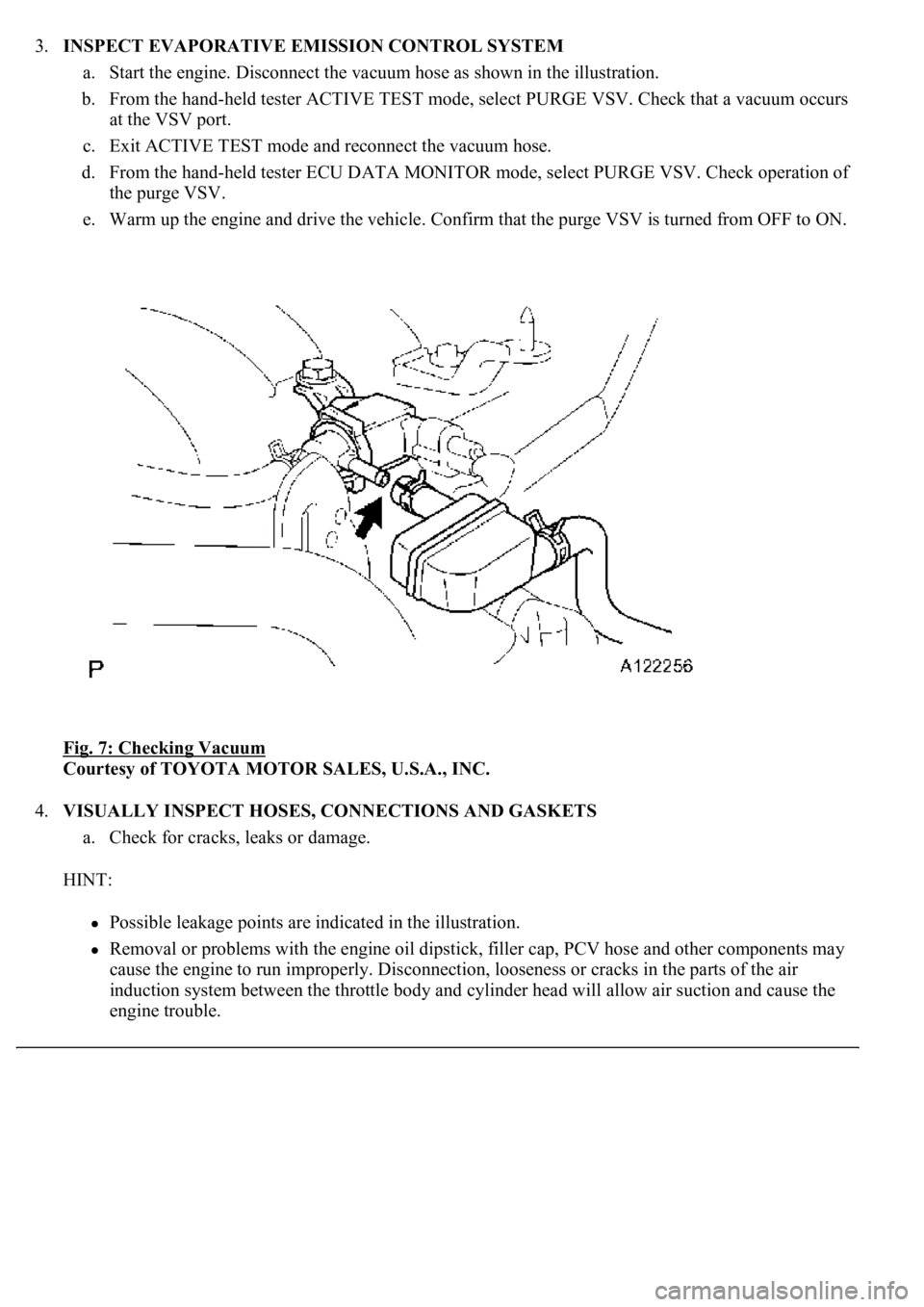
3.INSPECT EVAPORATIVE EMISSION CONTROL SYSTEM
a. Start the engine. Disconnect the vacuum hose as shown in the illustration.
b. From the hand-held tester ACTIVE TEST mode, select PURGE VSV. Check that a vacuum occurs
at the VSV port.
c. Exit ACTIVE TEST mode and reconnect the vacuum hose.
d. From the hand-held tester ECU DATA MONITOR mode, select PURGE VSV. Check operation of
the purge VSV.
e. Warm up the engine and drive the vehicle. Confirm that the purge VSV is turned from OFF to ON.
Fig. 7: Checking Vacuum
Courtesy of TOYOTA MOTOR SALES, U.S.A., INC.
4.VISUALLY INSPECT HOSES, CONNECTIONS AND GASKETS
a. Check for cracks, leaks or damage.
HINT:
Possible leakage points are indicated in the illustration.
Removal or problems with the engine oil dipstick, filler cap, PCV hose and other components may
cause the engine to run improperly. Disconnection, looseness or cracks in the parts of the air
induction system between the throttle body and cylinder head will allow air suction and cause the
engine trouble.
Page 4408 of 4500
6.REMOVE THROTTLE BODY ASSY
a. Disconnect the connector from the throttle body.
b. Disconnect the PCV hose.
c. Disconnect the 2 water by-pass hoses.
HINT:
It is not necessary to disconnect the water by-pass hose that has both ends connected to the throttle
body.
d. Remove the 2 bolts, 2 nuts and throttle body.
7.REMOVE V-BANK COVER BRACKET NO. 1
a. Remove the bolt and cover bracket.
8.REMOVE V-BANK COVER BRACKET NO. 2
a. Remove the bolt and cover bracket.
9.REMOVE V-BANK COVER BRACKET NO. 3
a. Remove the bolt and cover bracket.
10.REMOVE V-BANK COVER BRACKET NO. 4
a. Remove the 2 nuts and cover bracket.
11.REMOVE VACUUM SWITCHING VALVE ASSY FOR EVAP
a. Disconnect the VSV connector.
b. Disconnect the 2 hoses from the VSV.
c. Remove the bolt and VSV.
12.DISCONNECT FUEL PIPE SUB-ASSY NO. 2
a. Using SST, disconnect the fuel main hose.
SST 09023-38401
Page 4412 of 4500
a. Install the cover bracket with the bolt.
Torque: 7.5 N.m (76 kgf.cm, 66 in.lbf)
23.INSTALL THROTTLE BODY ASSY
a. Install the throttle body with the 2 bolts and 2 nuts.
b. Connect the water by-pass hose.
c. Connect the PCV hose.
d. Connect the connector to the throttle body.
24.INSTALL INTAKE AIR CONNECTOR PIPE
a. Install the intake air connector pipe with the bolt and hose clamp.
Torque:
4.0 N.m (40 kgf.cm, 35 in.lbf) for hose clamp
5.0 N.m (50 kgf.cm, 44 in.lbf) for bolt
b. Connect the air hose and ventilation hose No. 1 together.
25.INSTALL AIR CLEANER INLET NO. 1
26.INSPECT FUEL PUMP OPERATION AND CHECK FOR FUEL LEAKS
27.INSTALL V-BANK COVER
a. Install the V-bank cover with the 2 nuts.
Torque: 5.0 N.m (50 kgf.cm, 44 in.lbf)
28.REFILL ENGINE COOLANT
29.CHECK FOR ENGINE COOLANT LEAKS
a. Check for engine coolant leaks.
If leaks are present, find the leak and repair or replace parts as necessar
y.