tow LEXUS RX350 2011 Owner's Manual
[x] Cancel search | Manufacturer: LEXUS, Model Year: 2011, Model line: RX350, Model: LEXUS RX350 2011Pages: 821, PDF Size: 13.27 MB
Page 290 of 821
218
2-4. Using other driving systems
CAUTION
nSituations unsuitable for dynamic radar cruise control
Do not use dynamic radar cruise control in any of the following situations.
Doing so may result in inappropriate speed control and could cause an accident
resulting in death or serious injury.
lIn heavy traffic
lOn roads with sharp bends
lOn winding roads
lOn slippery roads, such as those covered with rain, ice and snow
lOn steep downhills, or where there are sudden changes between sharp up and
down gradients
lAt entrances to expressways
lWhen weather conditions are bad enough that they may prevent the sensors
from functioning correctly (fog, snow, sandstorm, heavy rain, etc.)
lWhen a buzzer is heard often
lWhen your vehicle is towing anything
nWhen the sensor may not be correctly detecting the vehicle ahead
Apply the brakes as necessary when any of the following types of vehicles are in
front of you.
As the sensor may not be able to correctly detect these types of vehicles, the
approach warning (→P. 213) will not be activated, and an accident may result.
lVehicles that cut in suddenly
lVehicles traveling at low speeds
lVehicles that are not moving
lVehicles with small rear ends (trailers with no load on board etc.)
lMotorcycles traveling in the same lane
Page 321 of 821
249
2-5. Driving information
2
When driving
Cargo and luggage
Capacity and distribution
Cargo capacity depends on the total weight of the occupants.
(Cargo capacity) = (Total load capacity) — (Total weight of occupants)
Steps for Determining Correct Load Limit ⎯
(1) Locate the statement “The combined weight of occupants and cargo
should never exceed XXX kg or XXX lbs.” on your vehicle’s placard.
(2) Determine the combined weight of the driver and passengers that will
be riding in your vehicle.
(3)Subtract the combined weight of the driver and passengers from
XXX kg or XXX lbs.
(4)The resulting figure equals the available amount of cargo and luggage
load capacity.
For example, if the “XXX” amount equals 1400 lbs. and there will be
five 150 lb passengers in your vehicle, the amount of available cargo
and luggage load capacity is 650 lbs. (1400 − 750 (5 × 150) = 650
lbs.)
(5)Determine the combined weight of luggage and cargo being loaded
on the vehicle. That weight may not safely exceed the available cargo
and luggage load capacity calculated in Step 4.
Take notice of the following information about storage precautions, cargo
capacity and load:
lStow cargo and luggage in the luggage compartment whenever
possible.
lBe sure all items are secured in place.
lBe careful to keep the vehicle level. Placing the weight as far for-
ward as possible helps maintain vehicle balance.
lFor better fuel economy, do not carry unnecessary weight.
Page 322 of 821
250
2-5. Driving information
(6)If your vehicle will be towing a trailer, load from your trailer will be
transferred to your vehicle. Consult this manual to determine how this
reduces the available cargo and luggage load capacity of your vehi-
cle.
(→P. 5 9 4 )
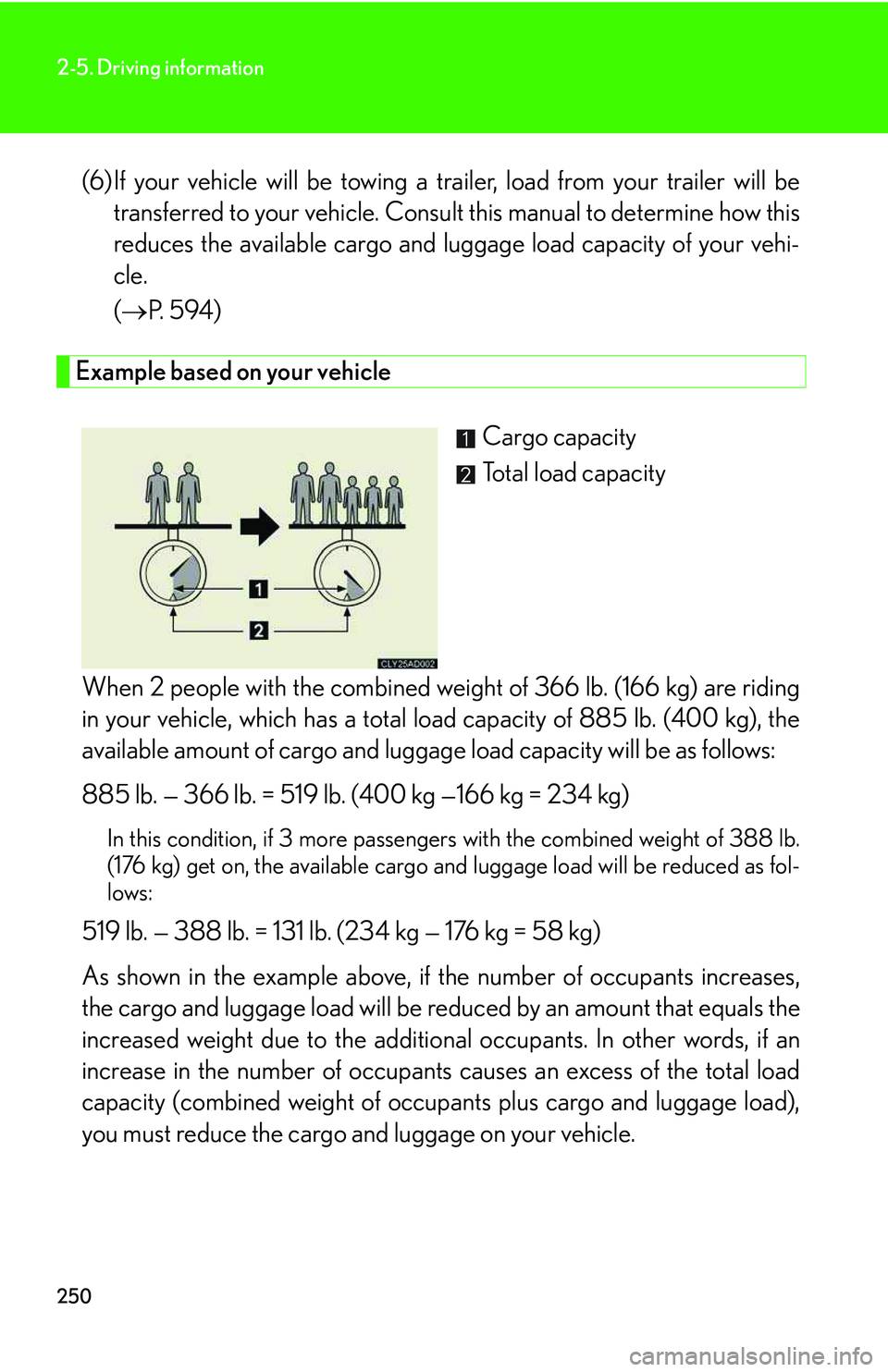
Example based on your vehicle
Cargo capacity
Total load capacity
When 2 people with the combined weight of 366 lb. (166 kg) are riding
in your vehicle, which has a total load capacity of 885 lb. (400 kg), the
available amount of cargo and luggage load capacity will be as follows:
885 lb. — 366 lb. = 519 lb. (400 kg —166 kg = 234 kg)
In this condition, if 3 more passengers with the combined weight of 388 lb.
(176 kg) get on, the available cargo and luggage load will be reduced as fol-
lows:
519 lb. — 388 lb. = 131 lb. (234 kg — 176 kg = 58 kg)
As shown in the example above, if the number of occupants increases,
the cargo and luggage load will be reduced by an amount that equals the
increased weight due to the additional occupants. In other words, if an
increase in the number of occupants causes an excess of the total load
capacity (combined weight of occupants plus cargo and luggage load),
you must reduce the cargo and luggage on your vehicle.
Page 323 of 821
251
2-5. Driving information
2
When driving
CAUTION
nThings that must not be carried in the luggage compartment
The following things may cause a fire if loaded in the luggage compartment:
lReceptacles containing gasoline
lAerosol cans
nStorage precautions
Observe the following precautions.
Failure to do so may result in death or serious injury.
lStow cargo and luggage in the luggage compartment whenever possible.
lDo not stack cargo and luggage in the luggage compartment higher than the
seatbacks.
Such items may be thrown about and possibly injure people in the vehicle in the
event of sudden braking or in an accident.
lDo not place cargo or luggage in or on the following locations as the item may
get under the brake or accelerator pedal and prevent pedals from being
depressed properly, block the driver’s vision, or hit the driver or passengers,
causing an accident:
Page 325 of 821
253
2-5. Driving information
2
When driving
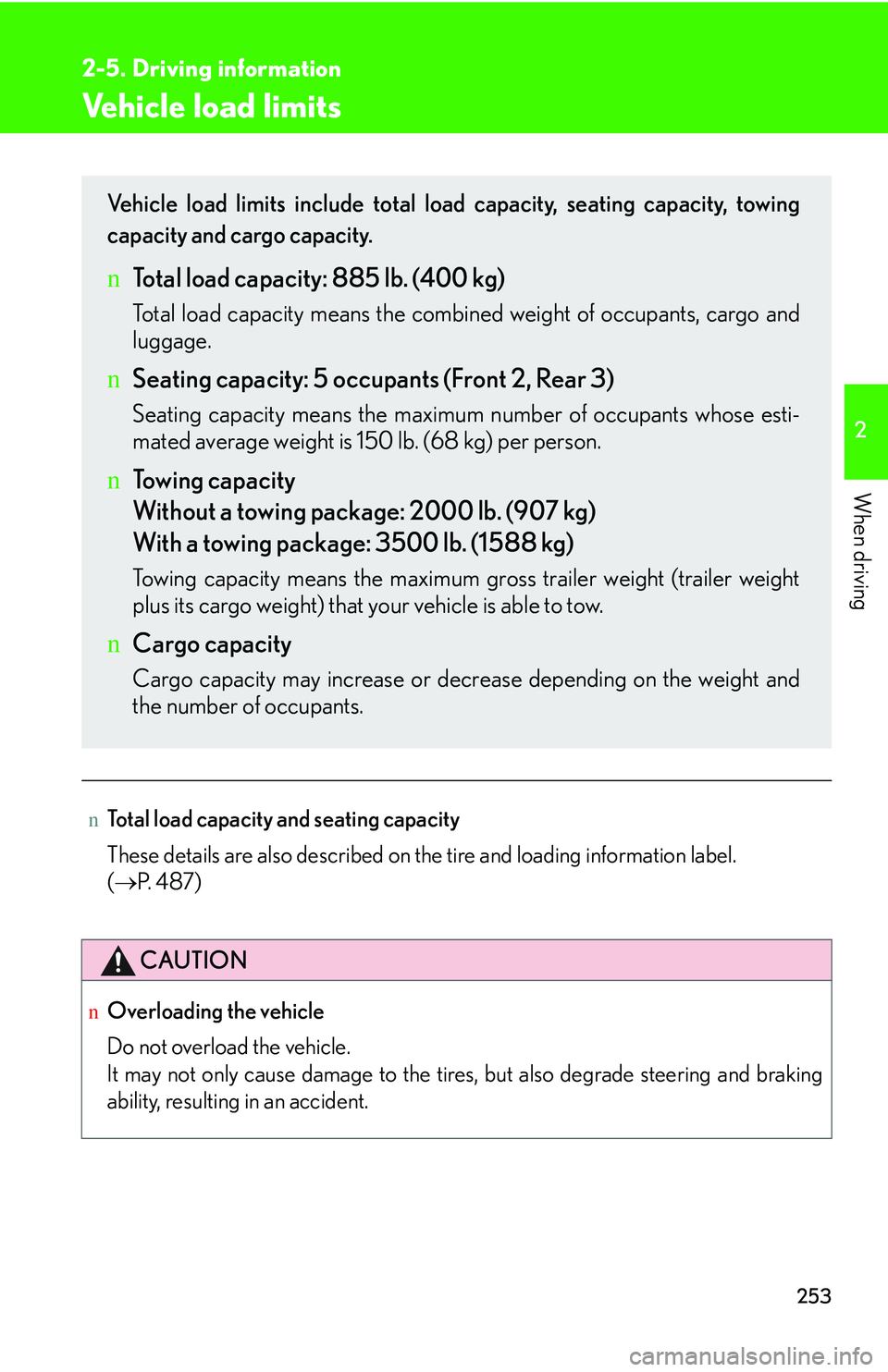
Vehicle load limits
nTotal load capacity and seating capacity
These details are also described on the tire and loading information label.
(→P. 4 8 7 )
CAUTION
nOverloading the vehicle
Do not overload the vehicle.
It may not only cause damage to the tires, but also degrade steering and braking
ability, resulting in an accident.
Vehicle load limits include total load capacity, seating capacity, towing
capacity and cargo capacity.
nTotal load capacity: 885 lb. (400 kg)
Total load capacity means the combined weight of occupants, cargo and
luggage.
nSeating capacity: 5 occupants (Front 2, Rear 3)
Seating capacity means the maximum number of occupants whose esti-
mated average weight is 150 lb. (68 kg) per person.
nTowing capacity
Without a towing package: 2000 lb. (907 kg)
With a towing package: 3500 lb. (1588 kg)
Towing capacity means the maximum gross trailer weight (trailer weight
plus its cargo weight) that your vehicle is able to tow.
nCargo capacity
Cargo capacity may increase or decrease depending on the weight and
the number of occupants.
Page 330 of 821
258
2-5. Driving information
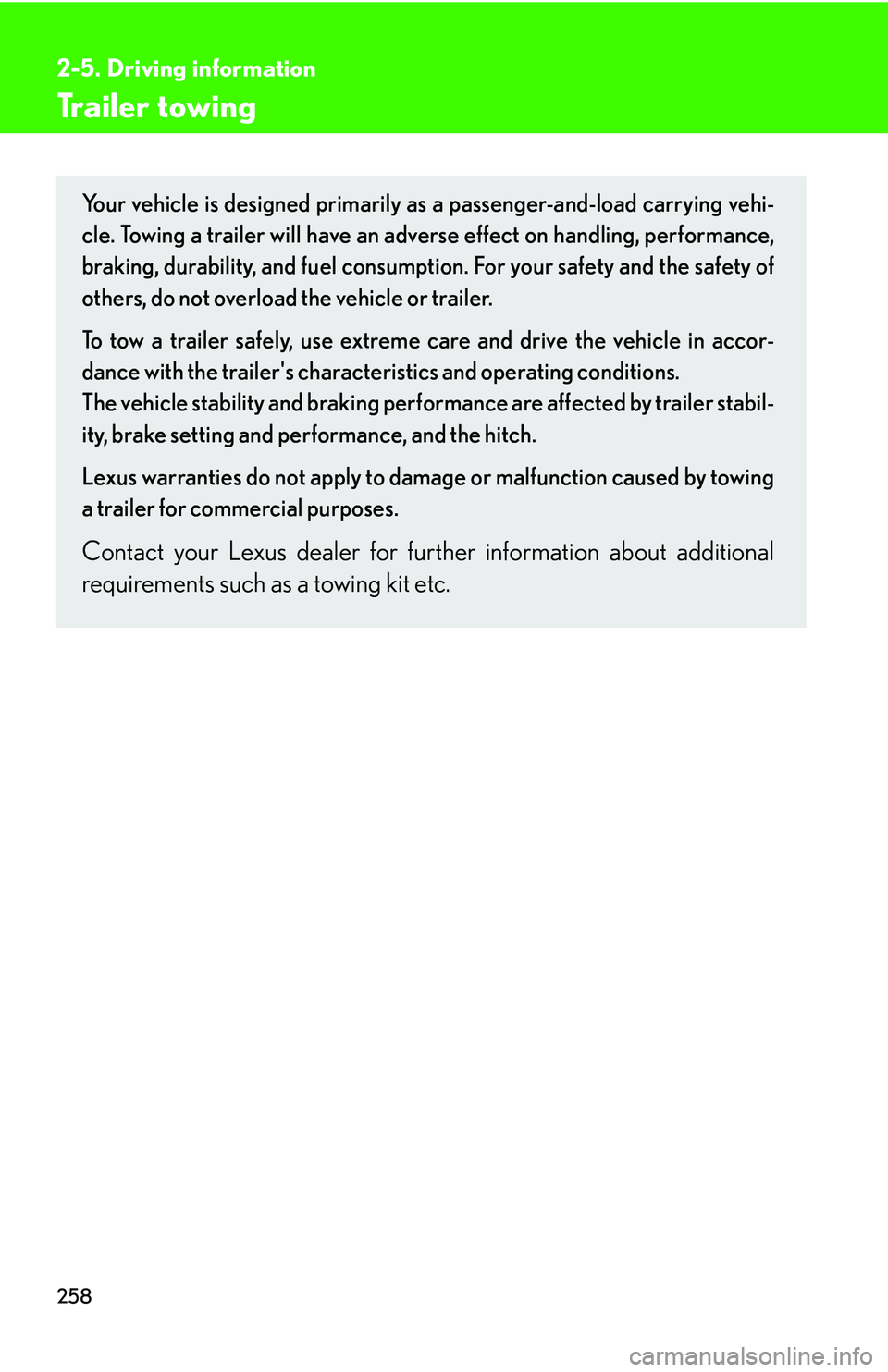
Trailer towing
Your vehicle is designed primarily as a passenger-and-load carrying vehi-
cle. Towing a trailer will have an adverse effect on handling, performance,
braking, durability, and fuel consumption. For your safety and the safety of
others, do not overload the vehicle or trailer.
To tow a trailer safely, use extreme care and drive the vehicle in accor-
dance with the trailer's characteristics and operating conditions.
The vehicle stability and braking performance are affected by trailer stabil-
ity, brake setting and performance, and the hitch.
Lexus warranties do not apply to damage or malfunction caused by towing
a trailer for commercial purposes.
Contact your Lexus dealer for further information about additional
requirements such as a towing kit etc.
Page 331 of 821

259
2-5. Driving information
2
When driving
Weight limits
Confirm that the gross trailer weight, gross vehicle weight, gross axle
weight and trailer tongue load are all within the limits.
lThe gross trailer weight must never exceed the following:
Without towing package: 2000 lb. (907 kg)
With towing package: 3500 lb. (1588 kg)
lThe gross combined weight must never exceed the following:
Without towing package
2WD: 7560 lb. (3429 kg)
AWD: 7650 lb. (3470 kg)
With towing package
2WD: 9060 lb. (4109 kg)
AWD: 9150 lb. (4150 kg)
lThe gross vehicle weight must
never exceed the GVWR indi-
cated the Certification Label.
lThe gross axle weight on each
axle must never exceed the
GAWR indicated the Certifica-
tion Label.
Page 332 of 821
260
2-5. Driving information
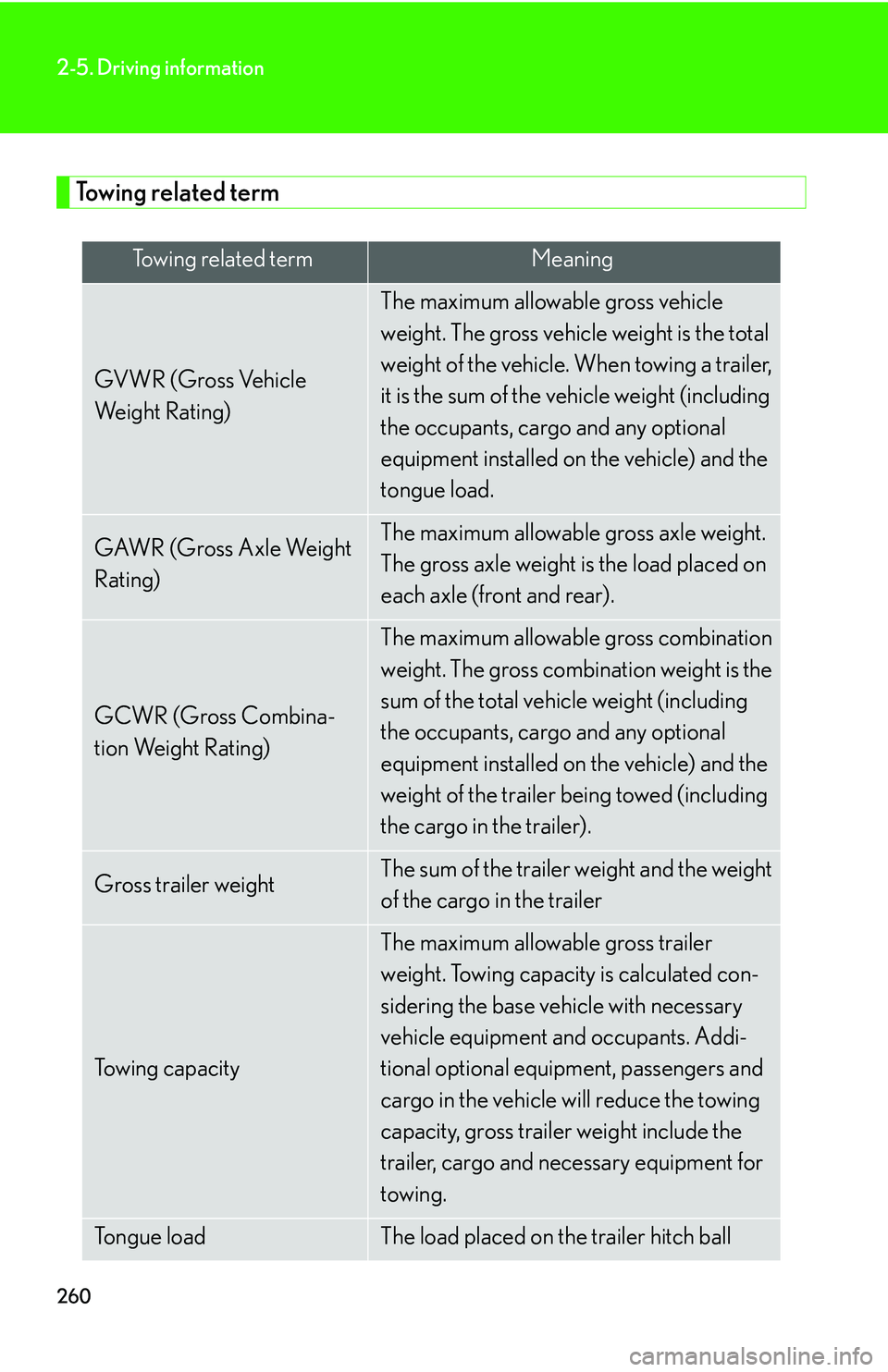
Towing related term
Towing related termMeaning
GVWR (Gross Vehicle
Weight Rating)
The maximum allowable gross vehicle
weight. The gross vehicle weight is the total
weight of the vehicle. When towing a trailer,
it is the sum of the vehicle weight (including
the occupants, cargo and any optional
equipment installed on the vehicle) and the
tongue load.
GAWR (Gross Axle Weight
Rating)
The maximum allowable gross axle weight.
The gross axle weight is the load placed on
each axle (front and rear).
GCWR (Gross Combina-
tion Weight Rating)
The maximum allowable gross combination
weight. The gross combination weight is the
sum of the total vehicle weight (including
the occupants, cargo and any optional
equipment installed on the vehicle) and the
weight of the trailer being towed (including
the cargo in the trailer).
Gross trailer weightThe sum of the trailer weight and the weight
of the cargo in the trailer
Towing capacity
The maximum allowable gross trailer
weight. Towing capacity is calculated con-
sidering the base vehicle with necessary
vehicle equipment and occupants. Addi-
tional optional equipment, passengers and
cargo in the vehicle will reduce the towing
capacity, gross trailer weight include the
trailer, cargo and necessary equipment for
towing.
Tongue loadThe load placed on the trailer hitch ball
Page 333 of 821
261
2-5. Driving information
2
When driving
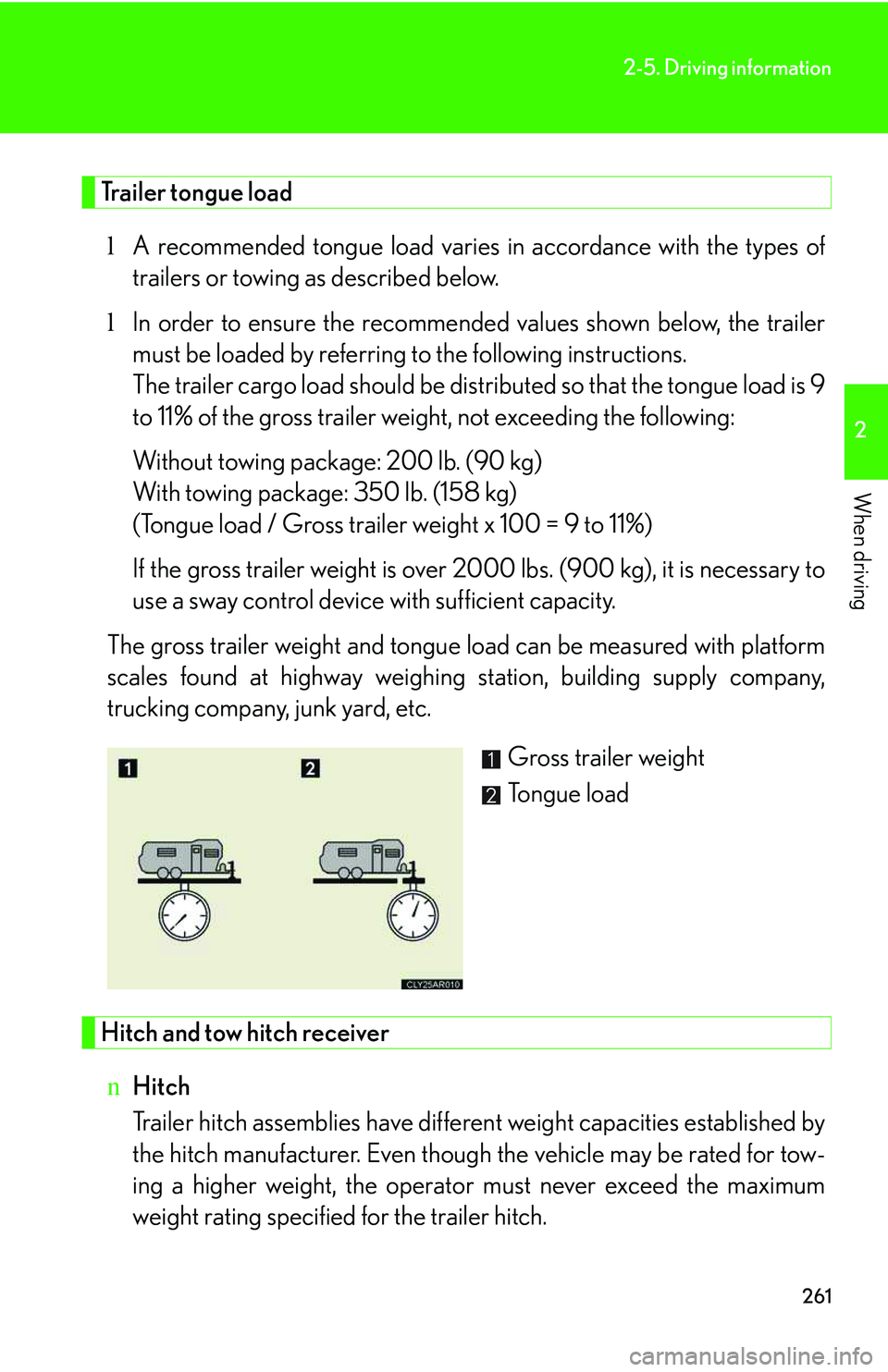
Trailer tongue load
lA recommended tongue load varies in accordance with the types of
trailers or towing as described below.
lIn order to ensure the recommended values shown below, the trailer
must be loaded by referring to the following instructions.
The trailer cargo load should be distributed so that the tongue load is 9
to 11% of the gross trailer weight, not exceeding the following:
Without towing package: 200 lb. (90 kg)
With towing package: 350 lb. (158 kg)
(Tongue load / Gross trailer weight x 100 = 9 to 11%)
If the gross trailer weight is over 2000 lbs. (900 kg), it is necessary to
use a sway control device with sufficient capacity.
The gross trailer weight and tongue load can be measured with platform
scales found at highway weighing station, building supply company,
trucking company, junk yard, etc.
Gross trailer weight
Tongue load
Hitch and tow hitch receiver
nHitch
Trailer hitch assemblies have different weight capacities established by
the hitch manufacturer. Even though the vehicle may be rated for tow-
ing a higher weight, the operator must never exceed the maximum
weight rating specified for the trailer hitch.
Page 334 of 821
262
2-5. Driving information
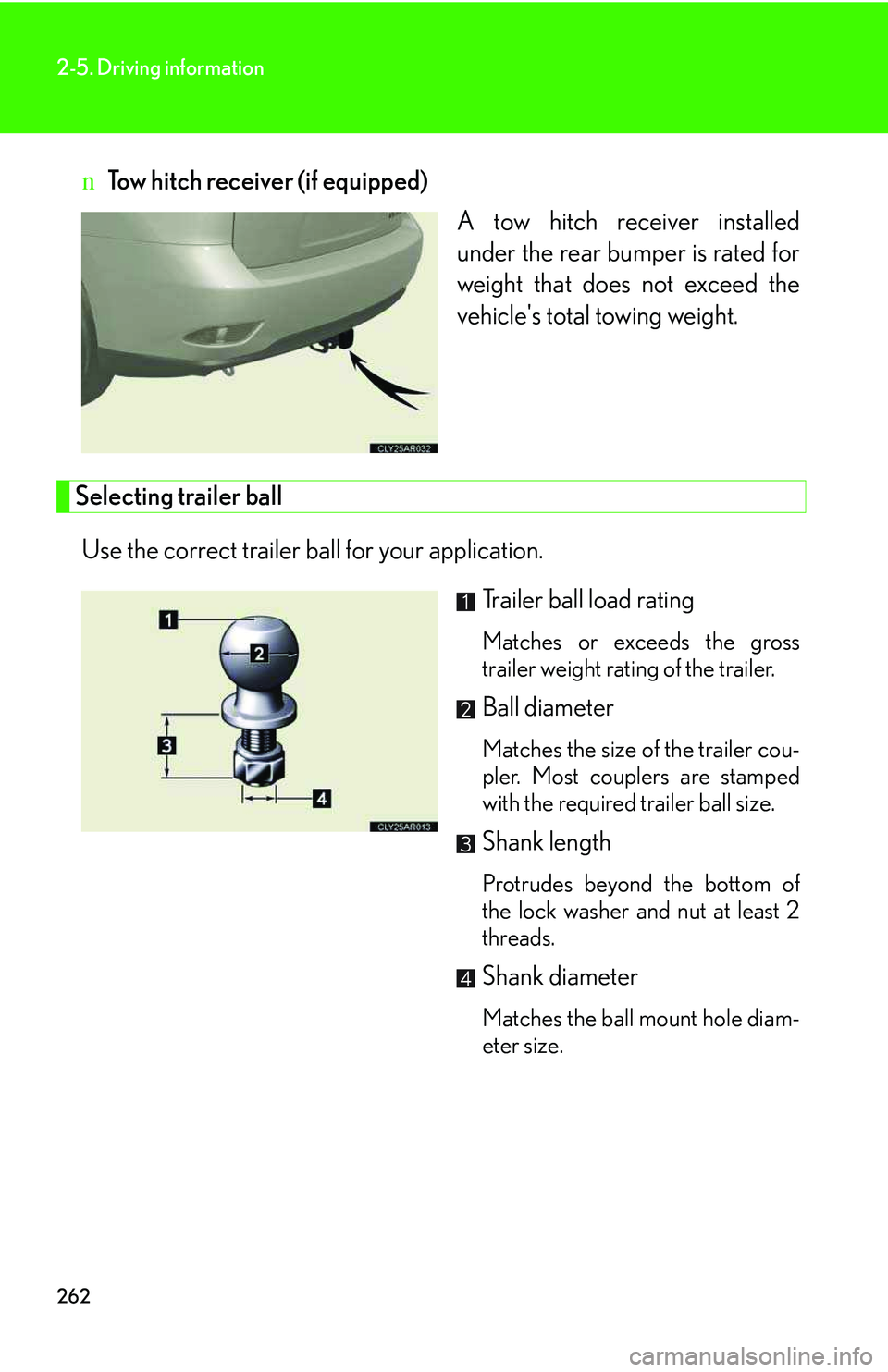
nTow hitch receiver (if equipped)
A tow hitch receiver installed
under the rear bumper is rated for
weight that does not exceed the
vehicle's total towing weight.
Selecting trailer ball
Use the correct trailer ball for your application.
Trailer ball load rating
Matches or exceeds the gross
trailer weight rating of the trailer.
Ball diameter
Matches the size of the trailer cou-
pler. Most couplers are stamped
with the required trailer ball size.
Shank length
Protrudes beyond the bottom of
the lock washer and nut at least 2
threads.
Shank diameter
Matches the ball mount hole diam-
eter size.