Ring LINCOLN MARK VIII 1997 Workshop Manual
[x] Cancel search | Manufacturer: LINCOLN, Model Year: 1997, Model line: MARK VIII, Model: LINCOLN MARK VIII 1997Pages: 315, PDF Size: 2.18 MB
Page 239 of 315
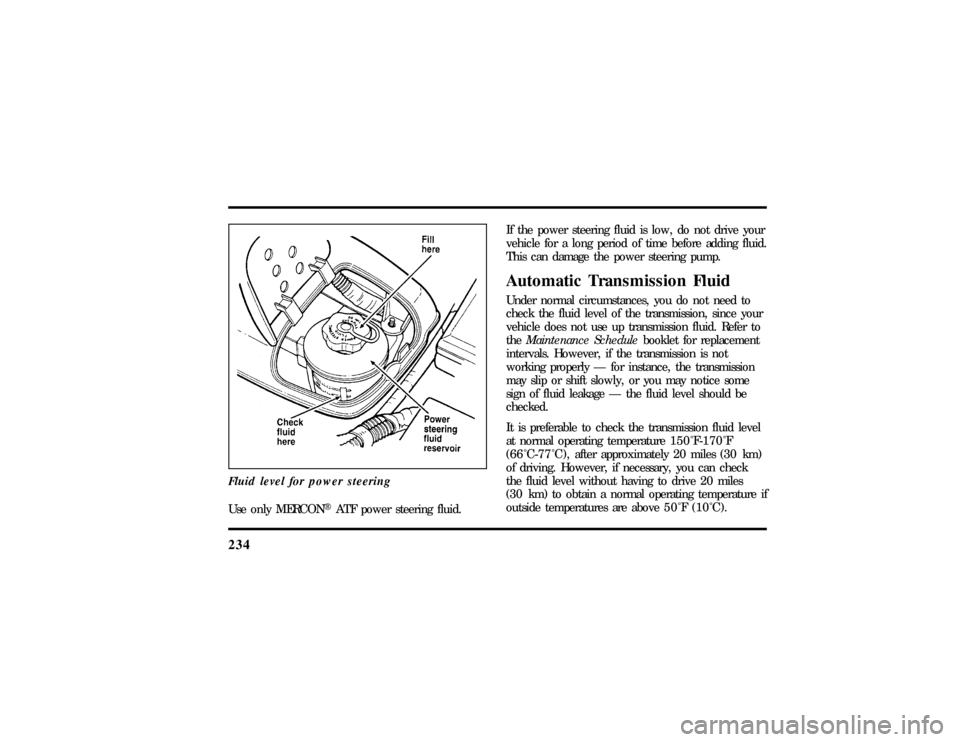
234Fluid level for power steeringUse only MERCONHATF power steering fluid.If the power steering fluid is low, do not drive your
vehicle for a long period of time before adding fluid.
This can damage the power steering pump.
Automatic Transmission FluidUnder normal circumstances, you do not need to
check the fluid level of the transmission, since your
vehicle does not use up transmission fluid. Refer to
theMaintenance Schedulebooklet for replacement
intervals. However, if the transmission is not
working properly Ð for instance, the transmission
may slip or shift slowly, or you may notice some
sign of fluid leakage Ð the fluid level should be
checked.
It is preferable to check the transmission fluid level
at normal operating temperature150ÊF-170ÊF
(66ÊC-77ÊC),after approximately 20 miles (30 km)
of driving. However, if necessary, you can check
the fluid level without having to drive 20 miles
(30 km) to obtain a normal operating temperature if
outside temperatures are above50ÊF(10ÊC).
File:11fnmc8.ex
Update:Thu Jun 20 14:28:32 1996
Page 240 of 315

235
NOTE:If the vehicle has been operated for an
extended period at high speeds or in city traffic
during hot weather, or pulling a trailer, the vehicle
should be turned off for about 30 minutes to allow
the fluid to cool before checking.Checking the Automatic Transmission
FluidWith the vehicle on a level surface and the brake
fully applied, start the engine and move the gear
shift selector through all of the gears allowing
sufficient time for each position to engage. Securely
latch the gear shift selector in the P (Park) position.
Fully set the parking brake and leave the engine
running.
NOTE:Your vehicle should not be driven if the
fluid level does not appear on the dipstick tip and
outside temperatures are above50ÊF(10ÊC).
Wipe off the dipstick cap and pull the dipstick out.
Wipe the indicator end clean. Put the dipstick back
into the filler tube and make sure it is fully seated.Pull the dipstick out and read the fluid level.
When checking fluid at normal operating
temperatures150ÊF-170ÊF (66ÊC-77ÊC), thefluid
level should be within the ªHOTº notched area on
the dipstick. When the vehicle has not been driven,
and outside temperatures are above68ÊF(20ÊC),
the fluid levels should be between the ªHOTº
notch and the tip end of the dipstick.
Adding Automatic Transmission FluidBefore adding any fluid, be sure that the correct
type will be used. Use only MerconHFluid, as
shown on handle.
Add fluid in 1/2 pint (250ML) increments through
the filler tube to bring the level to the correct area
on the dipstick. DO NOT OVERFILL. If the level is
above the top hole on the dipstick, excess fluid
should be removed by a qualified technician.
File:11fnmc8.ex
Update:Thu Jun 20 14:28:32 1996
Page 258 of 315

253
How to Prepare Your Vehicle for
Inspection/Maintenance (I/M) TestingIn some localities it may become a legal
requirement to pass an Inspection/Maintenance
(I/M) test of the On-Board Diagnostic (OBD) II
system. If the vehicle's powertrain system or its
battery has just been serviced, the OBD II system is
reset to a not ready for I/M testing condition. To
prepare for I/M testing, the law specifies that
additional mixed city and highway driving is
required to complete the check of the OBD II
system.
The driving modes required to reach the ready
condition consist of a minimum of 30 minutes of
city and highway driving as described below:q
At least twenty minutes driving in stop and go,
city type traffic with at least four idle periods.
q
At least ten minutes of driving on an
expressway or highway.Before completing the above driving modes, the
engine must be warmed up and at operating
temperature. Once started, the vehicle must not be
turned off during these driving modes.
Lights and Bulb ReplacementIt is a good idea to check the operation of the
following lights frequently:q
headlamps
q
high-mount brakelamp
q
tail lamps
q
brakelamps
q
hazard flasher
q
turn signals
q
license plate lamps
File:11fnmc8.ex
Update:Thu Jun 20 14:28:32 1996
Page 260 of 315
255
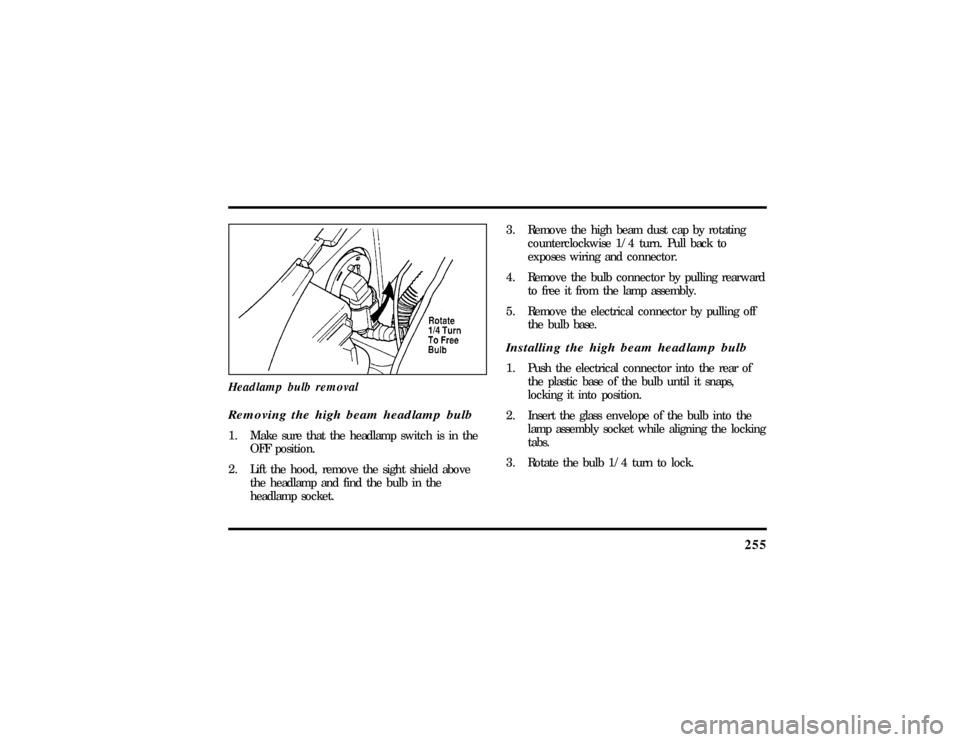
Headlamp bulb removalRemoving the high beam headlamp bulb1. Make sure that the headlamp switch is in the
OFF position.
2. Lift the hood, remove the sight shield above
the headlamp and find the bulb in the
headlamp socket.3. Remove the high beam dust cap by rotating
counterclockwise 1/4 turn. Pull back to
exposes wiring and connector.
4. Remove the bulb connector by pulling rearward
to free it from the lamp assembly.
5. Remove the electrical connector by pulling off
the bulb base.
Installing the high beam headlamp bulb1. Push the electrical connector into the rear of
the plastic base of the bulb until it snaps,
locking it into position.
2. Insert the glass envelope of the bulb into the
lamp assembly socket while aligning the locking
tabs.
3. Rotate the bulb 1/4 turn to lock.
File:11fnmc8.ex
Update:Thu Jun 20 14:28:32 1996
Page 261 of 315

2564. Replace the high beam dust cap by aligning
tabs and rotating clockwise 1/4 turn.
5. Replace the sight shield.Aiming HeadlampsYour vehicle is equipped with a Vehicle Headlamp
Aim Device (VHAD) on each headlamp body. Each
headlamp may be properly aimed in the horizontal
direction (left/right) and the vertical position
(up/down).
NOTE:A non-zero bubble reading does not
necessarily indicate out-of-aim headlamps. If your
vehicle is not positioned on a level surface, the
slope will be included in the level indicator.
Therefore, vertical headlamp adjustment should be
performed only when beam direction appears to be
incorrect or a level surface can be verified.Tools required: One 6mm socket and ratchet.
The Horizontal aim must be adjusted first.
NOTE:The following procedure assumes that the
vehicle's front structure is in factory alignment
condition. If the vehicle has been in an accident
requiring the front end of the vehicle to be
repaired, the horizontal indicator should be
recalibrated by the servicing facility.
File:11fnmc8.ex
Update:Thu Jun 20 14:28:32 1996
Page 265 of 315

260Cleaning Your VehicleWashing and Polishing Your VehicleWash the outside of your vehicle, including the
underside, with a mild detergent.
DO NOT:q
Wash your vehicle with hot water
q
Wash your vehicle while it sits in direct
sunlight
q
Wash your vehicle while the body is hot
Pollen, bird droppings and tree sap can damage the
paint, especially in hot weather. Wash your vehicle
as often as necessary to keep it clean.
Take similar precautions if your vehicle is exposed
to chemical industrial fallout.Paint damage resulting from fallout is not related to
a defect inpaint materials or workmanship and
therefore is not covered by warranty. Ford,
however, believes that continual improvement in
customer satisfaction is a high priority. For this
reason, Ford has authorized its dealers to repair, at
no charge to the owner, the surfaces of new
vehicles damaged by environmental fallout within
12 months or 12,000 miles (20,000 km) of
purchase, whichever comes first. Customers may be
required to bring their vehicle in for inspection by a
Ford representative.
Polish your vehicle to remove harmful deposits and
protect the finish.
Cleaning Chrome and Aluminum PartsWash chrome and aluminum parts with a mild
detergent. Do not use steel wool, abrasive cleaners,
fuel, or strong detergents.
File:11fnmc8.ex
Update:Thu Jun 20 14:28:32 1996
Page 271 of 315

266NOTE:Rear axle lube quantities must be replaced
every 100,000 miles (160,000 km) or if the axle
has been submerged in water. Otherwise, the lube
should not be checked or changed unless a leak is
suspected or repair required.Vehicle StorageMaintenance TipsIf you plan on storing your vehicle for an extended
period of time (60 days or more), refer to the
following maintenance recommendations to ensure
your vehicle stays in good operating condition.Generalq
Store all vehicles in a dry, ventilated place.
q
Protect from sunlight, if possible.
q
If vehicles are stored outside, they require
regular maintenance to protect against rust and
damage.
Bodyq
Wash vehicle thoroughly to remove dirt, grease,
oil, tar or mud from exterior surfaces, rear
wheel housing and underside of front fenders.
q
Periodically wash vehicles stored in exposed
locations.
q
Touch-up raw or primed metal to prevent rust.
q
Cover chrome and stainless steel parts with a
thick coat of auto wax to prevent discoloration.
Re-wax as necessary when the vehicle is
washed.
q
Lubricate all hood, door and trunk lid hinges
and latches with a light grade oil.
q
Cover interior soft trim to prevent fading.
q
Keep all rubber parts free from oil and solvents.
File:12fncs8.ex
Update:Thu Jun 20 14:28:48 1996
Page 272 of 315

267
Engineq
Start engine every 15 days. Run at fast idle
until it reaches normal operating temperature.
q
With your foot on the brake, shift through all
the gears while the engine is running.
Fuel systemq
Fill fuel tank with high-quality, premium
unleaded fuel until the first automatic shutoff of
the fuel pump nozzle.
NOTE:During extended periods of vehicle storage
(60 days or more), fuel may deteriorate due to
oxidation. This can damage rubber and other
polymers in the fuel system and may also clog small
orifices.Ford Gas Stabilizer should be added whenever
actual or expected storage periods exceed 60 days.
Follow the instructions on the label. The vehicle
should then be operated at idle speed to circulate
the additive throughout the fuel system.
A volatile corrosion inhibitor added to the fuel
system will protect the fuel system's inner surfaces
from corrosion. Follow the instructions packaged
with the product.
Cooling systemq
Protect against freezing temperatures.
File:12fncs8.ex
Update:Thu Jun 20 14:28:48 1996
Page 273 of 315

268Batteryq
Check and recharge as necessary.
q
Keep connections clean and covered with a
light coat of grease.
q
If storing your vehicle for more than 30 days
without recharging the battery, disconnect the
battery cables to ensure battery charge is
maintained for quick starting. NOTE: If battery
cables are disconnected, it will be necessary to
reset any memory features (eg. radio presets).
Brakesq
Make sure brakes and parking brake are fully
released.
Tiresq
Maintain recommended air pressures.
Miscellaneousq
Make sure all linkages, cables, levers and clevis
pins under vehicle are covered with grease to
prevent rust.
q
Move vehicles at least 25 feet (8 m) every 15
days to lubricate working parts and prevent
corrosion.
File:12fncs8.ex
Update:Thu Jun 20 14:28:48 1996
Page 276 of 315

272If you have any questions or concerns that the
dealership cannot answer, contact the Customer
Assistance Center.
If you still have a complaint involving a warranty
dispute, you may wish to contact the Dispute
Settlement Board (U.S. only) or the Canadian Motor
Vehicle Arbitration Plan (CAMVAP) in Canada.
A warranty dispute must be submitted to the
Dispute Settlement Board before taking action under
the Magnuson-Moss Warranty Act, or to the extent
allowed by state law, before pursuing replacement
or repurchase remedies provided by certain state
laws. This dispute handling procedure is not
required prior to enforcing state created rights or
other rights which are independent of the
Magnuson-Moss Warranty Act or state replacement
or repurchase laws.
The Dispute Settlement Board
(U.S. Only)The Dispute Settlement Board is:q
an independent, third-party arbitration program
for warranty disputes
q
available free to owners and lessees of qualifying
Ford Motor Company vehicles
The Dispute Settlement Board may not be available
in all states. Ford Motor Company reserves the right
to change eligibility limitations, modify procedures
and/or to discontinue this service without notice
and without incurring obligations.
File:14fnhs8.ex
Update:Wed Jun 19 15:06:24 1996