wheel LINCOLN MKS 2015 Owner's Guide
[x] Cancel search | Manufacturer: LINCOLN, Model Year: 2015, Model line: MKS, Model: LINCOLN MKS 2015Pages: 424, PDF Size: 3.96 MB
Page 166 of 424
PRINCIPLE OF OPERATION
Cruise control lets you maintain a set speed
without keeping your foot on the accelerator
pedal. You can use cruise control when your
vehicle speed is greater than 20 mph
(30 km/h).
USING CRUISE CONTROL WARNINGS
Do not use cruise control in heavy
traffic, on winding roads or when the
road surface is slippery. This could
result in loss of vehicle control, serious injury
or death. When you are going downhill, your
vehicle speed may increase above the
set speed. The system will not apply
the brakes. Change down a gear to assist the
system in maintaining the set speed. Failure
to do so could result in loss of vehicle control,
serious injury or death. Note:
Cruise control will disengage if the
vehicle speed decreases more than 10 mph
(16 km/h) below your set speed while driving
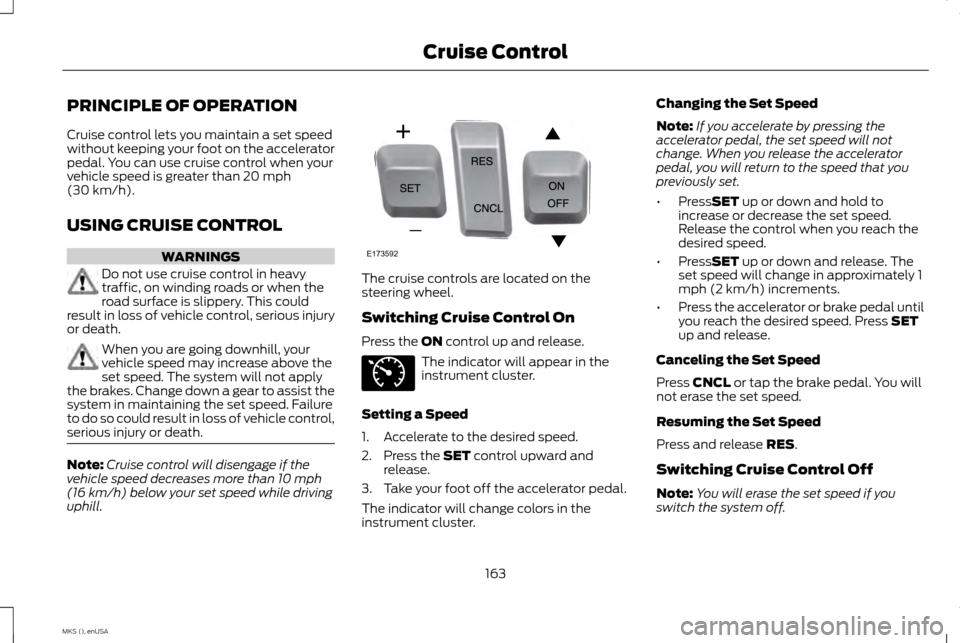
uphill. The cruise controls are located on the
steering wheel.
Switching Cruise Control On
Press the
ON control up and release.
The indicator will appear in the
instrument cluster.
Setting a Speed
1. Accelerate to the desired speed.
2. Press the
SET control upward and
release.
3. Take your foot off the accelerator pedal.
The indicator will change colors in the
instrument cluster. Changing the Set Speed
Note:
If you accelerate by pressing the
accelerator pedal, the set speed will not
change. When you release the accelerator
pedal, you will return to the speed that you
previously set.
• Press
SET up or down and hold to
increase or decrease the set speed.
Release the control when you reach the
desired speed.
• Press
SET up or down and release. The
set speed will change in approximately 1
mph (2 km/h) increments.
• Press the accelerator or brake pedal until
you reach the desired speed. Press
SET
up and release.
Canceling the Set Speed
Press
CNCL or tap the brake pedal. You will
not erase the set speed.
Resuming the Set Speed
Press and release
RES.
Switching Cruise Control Off
Note: You will erase the set speed if you
switch the system off.
163
MKS (), enUSA Cruise ControlE173592 E71340
Page 167 of 424
Press the OFFcontrol down and release or
turn off the ignition.
USING ADAPTIVE CRUISE
CONTROL
(If Equipped) WARNINGS
Always pay close attention to changing
road conditions, especially when using
adaptive cruise control. Adaptive cruise
control cannot replace attentive driving.
Failing to follow any of the warnings below
or failing to pay attention to the road may
result in a crash, serious injury or death. Adaptive cruise control is not a crash
warning or avoidance system.
Adaptive cruise control will not detect
stationary or slow moving vehicles
below 6 mph (10 km/h).
Adaptive cruise control will not detect
pedestrians or objects in the roadway.
Adaptive cruise control will not detect
oncoming vehicles in the same lane.
Do not use the adaptive cruise control
when entering or leaving a highway, in
heavy traffic or on roads that are
winding, slippery or unpaved. WARNINGS
Do not use in poor visibility, specifically
fog, rain, spray or snow.
Note:
It is your responsibility to stay alert, drive
safely and be in control of the vehicle at all
times.
The system adjusts your speed to maintain
a proper distance between you and the
vehicle in front of you in the same lane. You
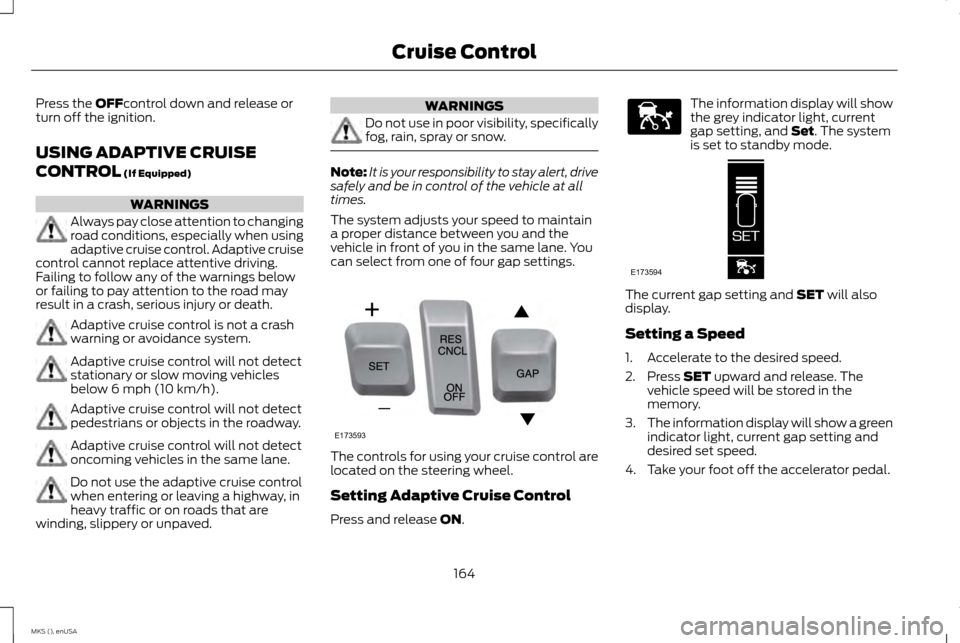
can select from one of four gap settings. The controls for using your cruise control are
located on the steering wheel.
Setting Adaptive Cruise Control
Press and release
ON. The information display will show
the grey indicator light, current
gap setting, and
Set. The system
is set to standby mode. The current gap setting and
SET will also
display.
Setting a Speed
1. Accelerate to the desired speed.
2. Press
SET upward and release. The
vehicle speed will be stored in the
memory.
3. The information display will show a green
indicator light, current gap setting and
desired set speed.
4. Take your foot off the accelerator pedal.
164
MKS (), enUSA Cruise ControlE173593 E144529 E173594
Page 174 of 424
DRIVER ALERT (If Equipped)
WARNING
The driver alert system is designed to
aid you. It is not intended to replace
your attention and judgment. You are
still responsible to drive with due care and
attention. Note:
The system will store the on or off
setting in the information display menu
through ignition cycles.
Note: If enabled in the menu, the system will
be active at speeds above 40 mph (64 km/h).
When below the activation speed, the
information display will inform you that the
system is unavailable.
Note: The system works as long as one lane
marking can be detected by the camera.
Note: If the camera is blocked or if the
windshield is damaged, the system may not
function.
Note: The system may not be available in
poor weather or other low visibility conditions.
The system automatically monitors your
driving behavior using various inputs including
the front camera sensor. If the system detects that your driving
alertness is reduced below a certain
threshold, the system will alert you using a
chime and a message in the information
display.
Using Driver Alert
Switching the system on and off
You may switch the system on or off through
the information display by selecting Settings
then Driver Assist then Driver Alert in the
menu. When activated, the system will
monitor your alertness level based upon your
driving behavior in relation to the lane
markings, and other factors.
System Warnings
Note:
The system will not issue warnings
below approximately 40 mph (64 km/h).
The warning system is in two stages. At first
the system issues a temporary warning that
you need to take a rest. This message will
only appear for a short time. If the system
detects further reduction in driving alertness,
another warning may be issued which will
remain in the information display for a longer
time. Press OK on the steering wheel control
to clear the warning System Display
When active the system will run
automatically in the background and only
issue a warning if required. You can view the
status at any time using the information
display. See
General Information (page
88).
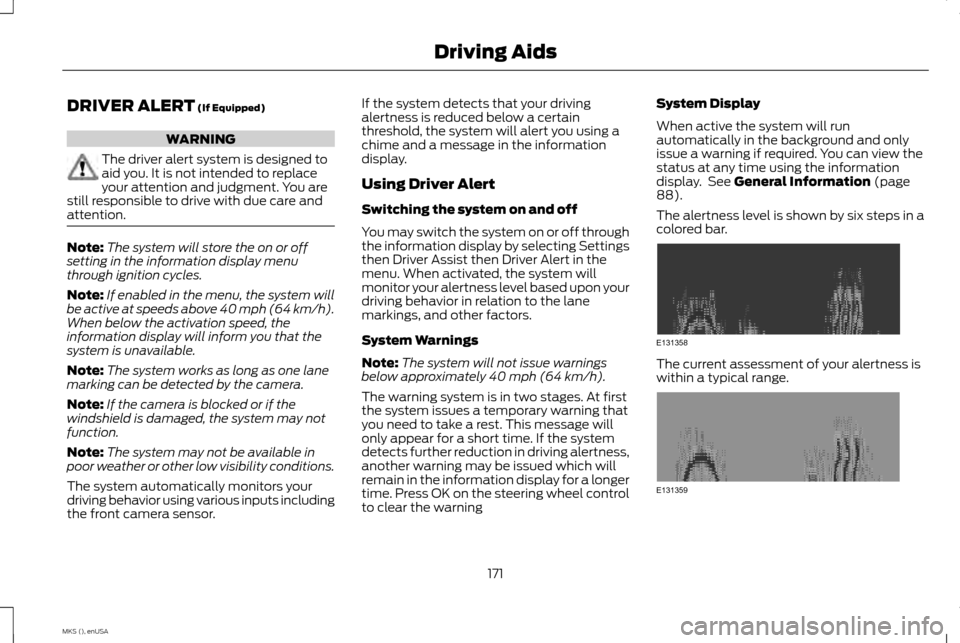
The alertness level is shown by six steps in a
colored bar. The current assessment of your alertness is
within a typical range.
171
MKS (), enUSA Driving AidsE131358 E131359
Page 175 of 424
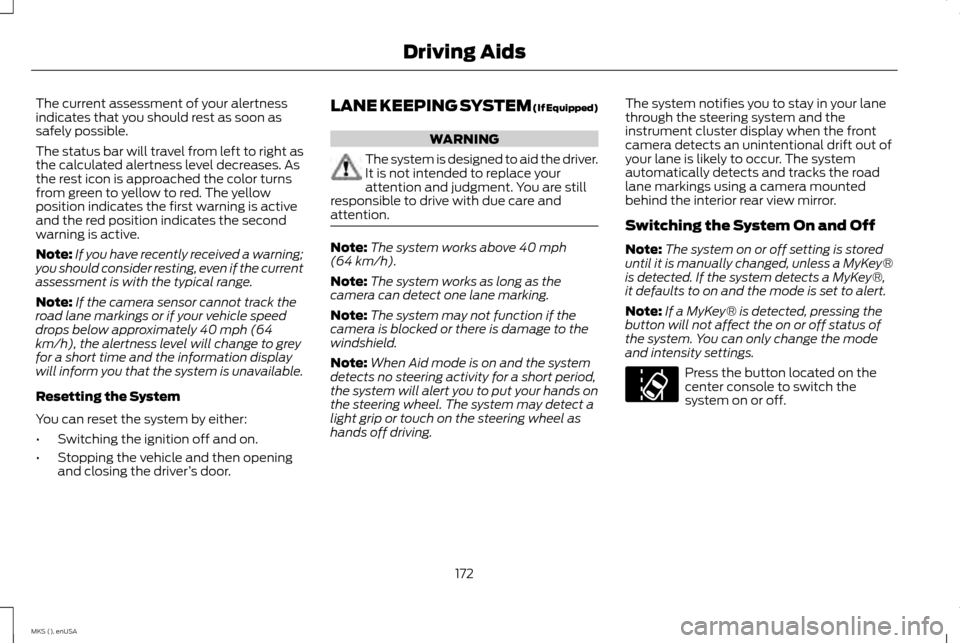
The current assessment of your alertness
indicates that you should rest as soon as
safely possible.
The status bar will travel from left to right as
the calculated alertness level decreases. As
the rest icon is approached the color turns
from green to yellow to red. The yellow
position indicates the first warning is active
and the red position indicates the second
warning is active.
Note:
If you have recently received a warning;
you should consider resting, even if the current
assessment is with the typical range.
Note: If the camera sensor cannot track the
road lane markings or if your vehicle speed
drops below approximately 40 mph (64
km/h), the alertness level will change to grey
for a short time and the information display
will inform you that the system is unavailable.
Resetting the System
You can reset the system by either:
• Switching the ignition off and on.
• Stopping the vehicle and then opening
and closing the driver ’s door. LANE KEEPING SYSTEM (If Equipped) WARNING
The system is designed to aid the driver.
It is not intended to replace your
attention and judgment. You are still
responsible to drive with due care and
attention. Note:
The system works above 40 mph
(64 km/h).
Note: The system works as long as the
camera can detect one lane marking.
Note: The system may not function if the
camera is blocked or there is damage to the
windshield.
Note: When Aid mode is on and the system
detects no steering activity for a short period,
the system will alert you to put your hands on
the steering wheel. The system may detect a
light grip or touch on the steering wheel as
hands off driving. The system notifies you to stay in your lane
through the steering system and the
instrument cluster display when the front
camera detects an unintentional drift out of
your lane is likely to occur. The system
automatically detects and tracks the road
lane markings using a camera mounted
behind the interior rear view mirror.
Switching the System On and Off
Note:
The system on or off setting is stored
until it is manually changed, unless a MyKey®
is detected. If the system detects a MyKey®,
it defaults to on and the mode is set to alert.
Note: If a MyKey® is detected, pressing the
button will not affect the on or off status of
the system. You can only change the mode
and intensity settings. Press the button located on the
center console to switch the
system on or off.
172
MKS (), enUSA Driving AidsE173233
Page 176 of 424
System Settings
The system has one standard feature setting
and one optional setting menu available. To
view or adjust the settings, See General
Information (page 88). The system stores
the last known selection for each of these
settings. You do not need to readjust your
settings each time you turn on the system.
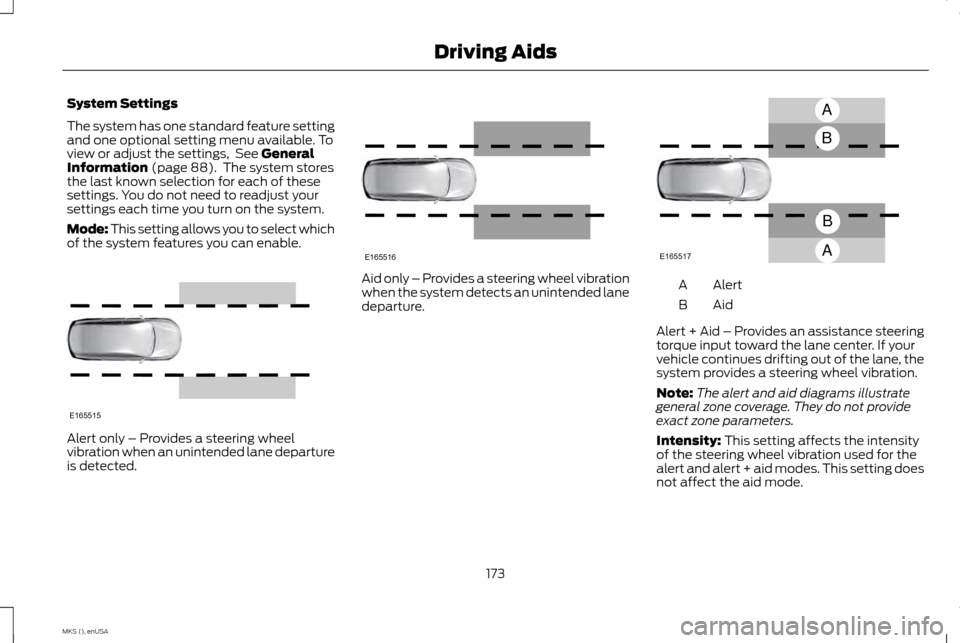
Mode: This setting allows you to select which
of the system features you can enable. Alert only – Provides a steering wheel
vibration when an unintended lane departure
is detected. Aid only – Provides a steering wheel vibration
when the system detects an unintended lane
departure.
Alert
A
AidB
Alert + Aid – Provides an assistance steering
torque input toward the lane center. If your
vehicle continues drifting out of the lane, the
system provides a steering wheel vibration.
Note: The alert and aid diagrams illustrate
general zone coverage. They do not provide
exact zone parameters.
Intensity:
This setting affects the intensity
of the steering wheel vibration used for the
alert and alert + aid modes. This setting does
not affect the aid mode.
173
MKS (), enUSA Driving AidsE165515 E165516 A
B
A
B
E165517
Page 187 of 424
Action
Cause
Clean the grille surface in front of the radar or remove the objectcausing the obstruction
The surface of the radar in the grille is dirty or obstructed in some way
Wait a short time. It may take several minutes for the radar to detectthat it is no longer obstructed
The surface of the radar in the grille is clean but the message remains
in the display
The collision warning system is temporarily disabled. Collision warning
should automatically reactivate a short time after the weather condi-tions improve
Heavy rain, spray, snow, or fog is interfering with the radar signals
The collision warning system is temporarily disabled. Collision warning
should automatically reactivate a short time after the weather condi-tions improve
Swirling water, or snow or ice on the surface of the road may interfere
with the radar signals
System Limitations WARNING
The collision warning system
’s brake
support can only help reduce the speed
at which a collision occurs if the driver
applies the vehicle ’s brakes. The brake pedal
must be pressed just like any typical braking
situation. Due to the nature of radar technology, there
may be certain instances where vehicles do
not provide a collision warning. These include: •
Stationary vehicles or vehicles moving
below 6 mph (10 km/h).
• Pedestrians or objects in the roadway.
• Oncoming vehicles in the same lane.
• Severe weather conditions (see blocked
sensor section).
• Debris build-up on the grille near the
headlamps (see blocked sensor section).
• Small distance to vehicle ahead.
• Steering wheel and pedal movements
are large (very active driving style). If the front end of the vehicle is hit or
damaged, the radar sensing zone may be
altered causing missed or false collision
warnings. See your authorized dealer to have
your collision warning radar checked for
proper coverage and operation.
184
MKS (), enUSA Driving Aids
Page 197 of 424
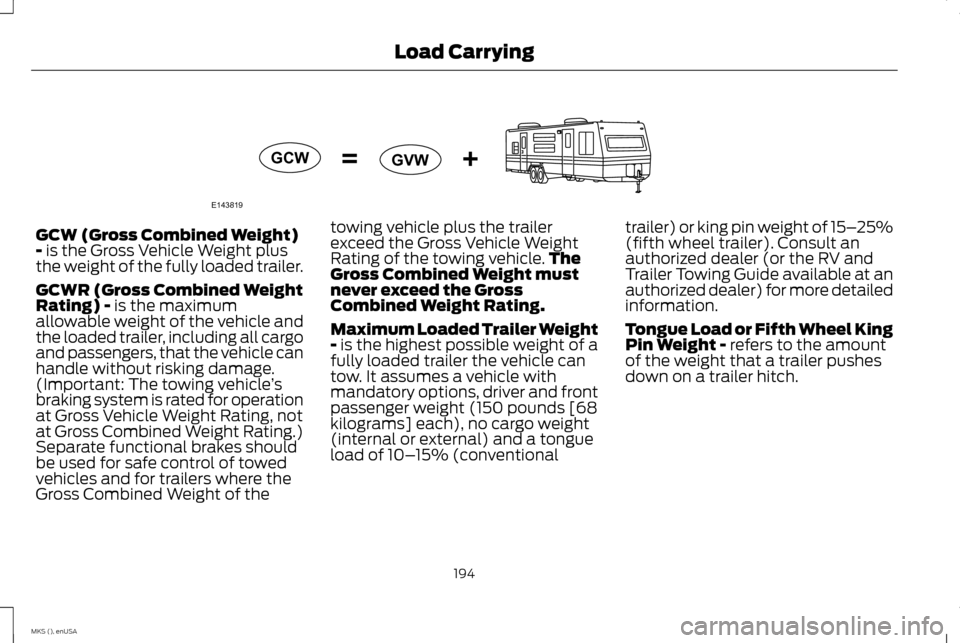
GCW (Gross Combined Weight)
- is the Gross Vehicle Weight plus
the weight of the fully loaded trailer.
GCWR (Gross Combined Weight
Rating) -
is the maximum
allowable weight of the vehicle and
the loaded trailer, including all cargo
and passengers, that the vehicle can
handle without risking damage.
(Important: The towing vehicle ’s
braking system is rated for operation
at Gross Vehicle Weight Rating, not
at Gross Combined Weight Rating.)
Separate functional brakes should
be used for safe control of towed
vehicles and for trailers where the
Gross Combined Weight of the towing vehicle plus the trailer
exceed the Gross Vehicle Weight
Rating of the towing vehicle.
The
Gross Combined Weight must
never exceed the Gross
Combined Weight Rating.
Maximum Loaded Trailer Weight
-
is the highest possible weight of a
fully loaded trailer the vehicle can
tow. It assumes a vehicle with
mandatory options, driver and front
passenger weight (150 pounds [68
kilograms] each), no cargo weight
(internal or external) and a tongue
load of 10– 15% (conventional trailer) or king pin weight of 15–
25%
(fifth wheel trailer). Consult an
authorized dealer (or the RV and
Trailer Towing Guide available at an
authorized dealer) for more detailed
information.
Tongue Load or Fifth Wheel King
Pin Weight - refers to the amount
of the weight that a trailer pushes
down on a trailer hitch.
194
MKS (), enUSA Load CarryingE143819GCW
GVW
Page 198 of 424
Examples: For a 5000 pound
(2268 kilogram) conventional
trailer, multiply 5000 by 0.10 and
0.15 to obtain a proper tongue load
range of 500 to 750 pounds (227 to
340 kilograms). For an 11500 pound
(5216 kilogram) fifth wheel trailer,
multiply by 0.15 and 0.25 to obtain
a proper king pin load range of 1725
to 2875 pounds (782 to 1304
kilograms). WARNINGS
Do not exceed the GVWR or the
GAWR specified on the Safety
Compliance Certification Label. Do not use replacement tires
with lower load carrying
capacities than the original tires
because they may lower the
vehicle ’s GVWR and GAWR
limitations. Replacement tires with
a higher limit than the original tires
do not increase the GVWR and
GAWR limitations. WARNINGS
Exceeding any vehicle weight
rating limitation could result in
serious damage to the vehicle
and/or personal injury. Steps for determining the correct
load limit:
1. Locate the statement "The
combined weight of occupants
and cargo should never exceed
XXX kg or XXX lb." on your
vehicle ’s placard.
2. Determine the combined weight
of the driver and passengers that
will be riding in your vehicle.
3. Subtract the combined weight of
the driver and passengers from
XXX kg or XXX lb. 4.
The resulting figure equals the
available amount of cargo and
luggage load capacity. For
example, if the “XXX” amount
equals 1,400 lb. and there will be
five 150 lb. passengers in your
vehicle, the amount of available
cargo and luggage load capacity
is 650 lb. (1400-750 (5 x 150) =
650 lb.)
5. Determine the combined weight
of luggage and cargo being
loaded on the vehicle. That
weight may not safely exceed the
available cargo and luggage load
capacity calculated in Step 4.
6. If your vehicle will be towing a
trailer, load from your trailer will
be transferred to your vehicle.
Consult this manual to determine
how this reduces the available
cargo and luggage load capacity
of your vehicle.
195
MKS (), enUSA Load Carrying
Page 202 of 424
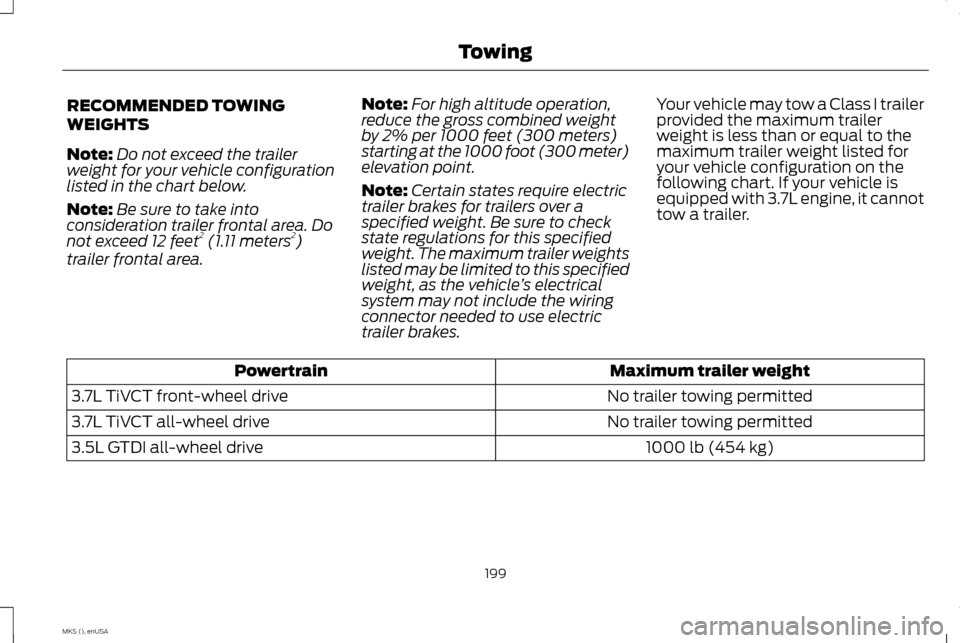
RECOMMENDED TOWING
WEIGHTS
Note:
Do not exceed the trailer
weight for your vehicle configuration
listed in the chart below.
Note: Be sure to take into
consideration trailer frontal area. Do
not exceed 12 feet 2
(1.11 meters 2
)
trailer frontal area. Note:
For high altitude operation,
reduce the gross combined weight
by 2% per 1000 feet (300 meters)
starting at the 1000 foot (300 meter)
elevation point.
Note: Certain states require electric
trailer brakes for trailers over a
specified weight. Be sure to check
state regulations for this specified
weight. The maximum trailer weights
listed may be limited to this specified
weight, as the vehicle ’s electrical
system may not include the wiring
connector needed to use electric
trailer brakes. Your vehicle may tow a Class I trailer
provided the maximum trailer
weight is less than or equal to the
maximum trailer weight listed for
your vehicle configuration on the
following chart. If your vehicle is
equipped with 3.7L engine, it cannot
tow a trailer. Maximum trailer weight
Powertrain
No trailer towing permitted
3.7L TiVCT front-wheel drive
No trailer towing permitted
3.7L TiVCT all-wheel drive
1000 lb (454 kg)
3.5L GTDI all-wheel drive
199
MKS (), enUSA Towing
Page 204 of 424
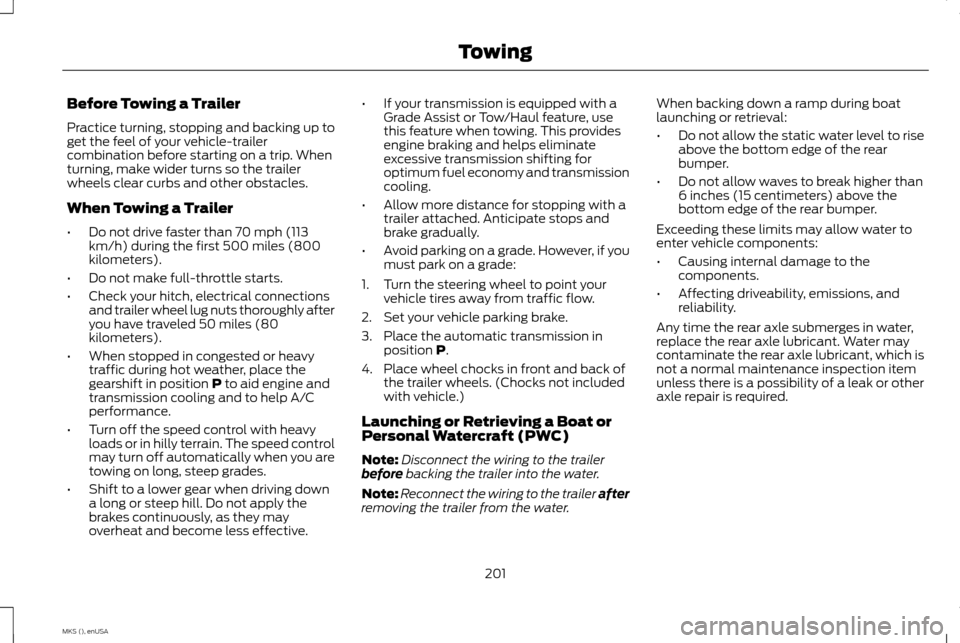
Before Towing a Trailer
Practice turning, stopping and backing up to
get the feel of your vehicle-trailer
combination before starting on a trip. When
turning, make wider turns so the trailer
wheels clear curbs and other obstacles.
When Towing a Trailer
•
Do not drive faster than 70 mph (113
km/h) during the first 500 miles (800
kilometers).
• Do not make full-throttle starts.
• Check your hitch, electrical connections
and trailer wheel lug nuts thoroughly after
you have traveled 50 miles (80
kilometers).
• When stopped in congested or heavy
traffic during hot weather, place the
gearshift in position P to aid engine and
transmission cooling and to help A/C
performance.
• Turn off the speed control with heavy
loads or in hilly terrain. The speed control
may turn off automatically when you are
towing on long, steep grades.
• Shift to a lower gear when driving down
a long or steep hill. Do not apply the
brakes continuously, as they may
overheat and become less effective. •
If your transmission is equipped with a
Grade Assist or Tow/Haul feature, use
this feature when towing. This provides
engine braking and helps eliminate
excessive transmission shifting for
optimum fuel economy and transmission
cooling.
• Allow more distance for stopping with a
trailer attached. Anticipate stops and
brake gradually.
• Avoid parking on a grade. However, if you
must park on a grade:
1. Turn the steering wheel to point your vehicle tires away from traffic flow.
2. Set your vehicle parking brake.
3. Place the automatic transmission in position
P.
4. Place wheel chocks in front and back of the trailer wheels. (Chocks not included
with vehicle.)
Launching or Retrieving a Boat or
Personal Watercraft (PWC)
Note: Disconnect the wiring to the trailer
before
backing the trailer into the water.
Note: Reconnect the wiring to the trailer after
removing the trailer from the water. When backing down a ramp during boat
launching or retrieval:
•
Do not allow the static water level to rise
above the bottom edge of the rear
bumper.
• Do not allow waves to break higher than
6 inches (15 centimeters) above the
bottom edge of the rear bumper.
Exceeding these limits may allow water to
enter vehicle components:
• Causing internal damage to the
components.
• Affecting driveability, emissions, and
reliability.
Any time the rear axle submerges in water,
replace the rear axle lubricant. Water may
contaminate the rear axle lubricant, which is
not a normal maintenance inspection item
unless there is a possibility of a leak or other
axle repair is required.
201
MKS (), enUSA Towing