warning light LINCOLN MKZ 2013 Workshop Manual
[x] Cancel search | Manufacturer: LINCOLN, Model Year: 2013, Model line: MKZ, Model: LINCOLN MKZ 2013Pages: 474, PDF Size: 3.79 MB
Page 297 of 474
•
Only use the sealing compound
before the use by date. The use by
date is on the lower right hand
corner of the label located on the
sealant canister (bottle). Check
the use by date regularly and
replace the canister after four
years.
• Do not store the kit unsecured
inside the passenger compartment
of the vehicle as it may cause injury
during a sudden stop or collision.
Always store the kit in its original
location.
• After sealant use, the tire pressure
monitoring system sensor and
valve stem on the wheel must be
replaced by an authorized Ford
dealer.
• When inflating a tire or other
objects, use the black air hose only.
Do not use the transparent hose
which is designed for sealant
application only.
• Operating the kit could cause an
electrical disturbance in radio, CD,
and DVD player operation.
What to do when a Tire Is
Punctured
A tire puncture within the tire's tread
area can be repaired in two stages
with the kit. •
In the first stage, the tire will be
reinflated with a sealing
compound and air. After the tire
has been reinflated, you will need
to drive the vehicle a short
distance (approximately 4 miles
[6 km]) to distribute the sealant
in the tire.
• In the second stage, you will need
to check the tire pressure and
adjust, if necessary, to the vehicle's
tire inflation pressure.
First Stage: Reinflating the Tire
with Sealing Compound and Air WARNINGS
Do not stand directly over the kit
while inflating the tire. If you
notice any unusual bulges or
deformations in the tire's sidewall
during inflation, stop and call roadside
assistance. If the tire doesn't inflate to the
recommended tire pressure
within 15 minutes, stop and call
roadside assistance. Preparation: Park the vehicle in a safe,
level and secure area, away from
moving traffic. Turn the hazard lights
on. Apply the parking brake and turn
the engine off. Inspect the flat tire for
visible damage.
Sealant compound contains latex. To
avoid any allergic reactions, use the
non-latex gloves located in the
accessory box on the underside of the
kit housing.
294
Wheels and Tires
Page 301 of 474
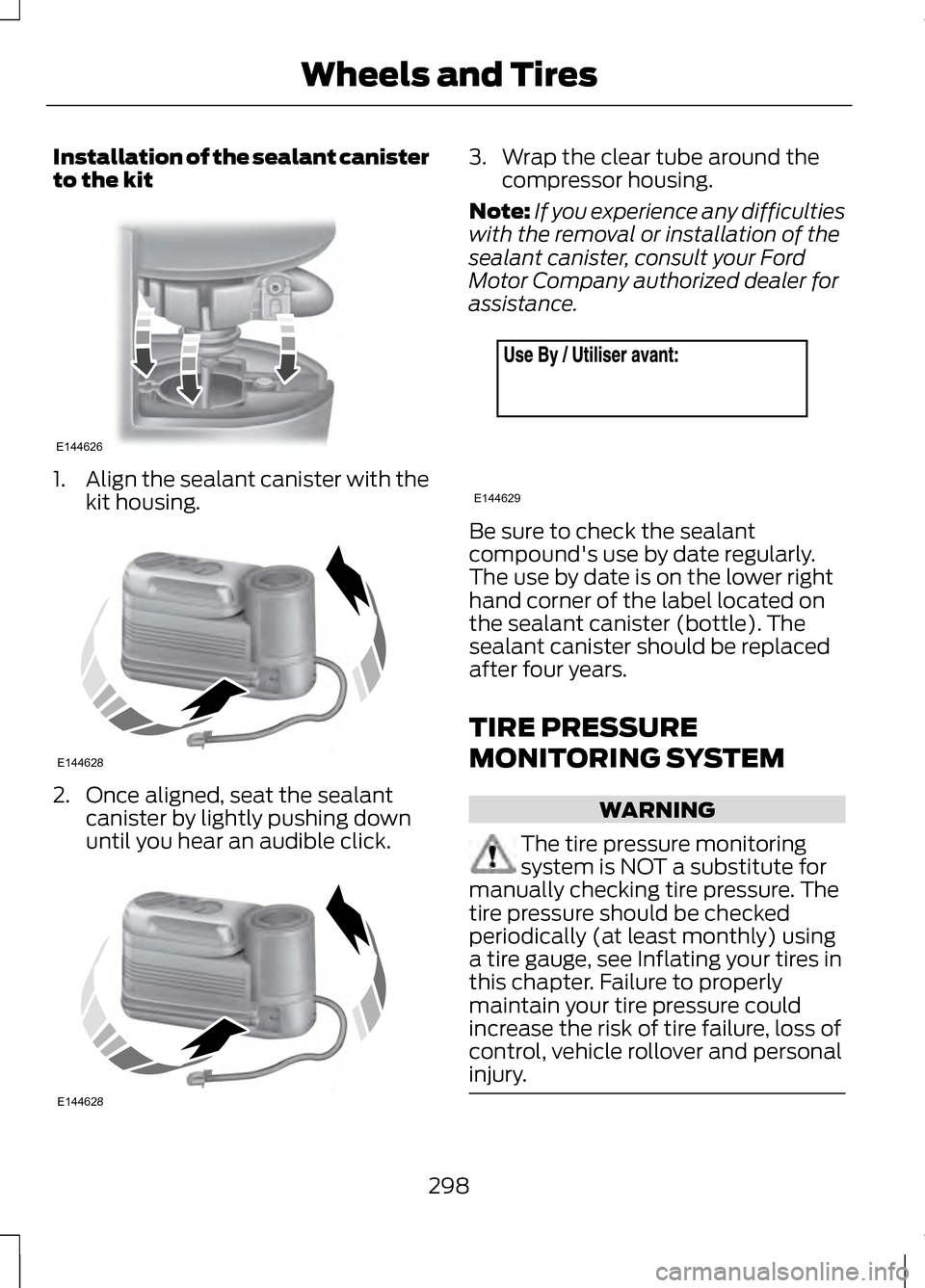
Installation of the sealant canister
to the kit
1.
Align the sealant canister with the
kit housing. 2. Once aligned, seat the sealant
canister by lightly pushing down
until you hear an audible click. 3. Wrap the clear tube around the
compressor housing.
Note: If you experience any difficulties
with the removal or installation of the
sealant canister, consult your Ford
Motor Company authorized dealer for
assistance. Be sure to check the sealant
compound's use by date regularly.
The use by date is on the lower right
hand corner of the label located on
the sealant canister (bottle). The
sealant canister should be replaced
after four years.
TIRE PRESSURE
MONITORING SYSTEM
WARNING
The tire pressure monitoring
system is NOT a substitute for
manually checking tire pressure. The
tire pressure should be checked
periodically (at least monthly) using
a tire gauge, see Inflating your tires in
this chapter. Failure to properly
maintain your tire pressure could
increase the risk of tire failure, loss of
control, vehicle rollover and personal
injury. 298
Wheels and TiresE144626 E144628 E144628 E144629
Page 303 of 474
Changing Tires with a Tire
Pressure Monitoring System
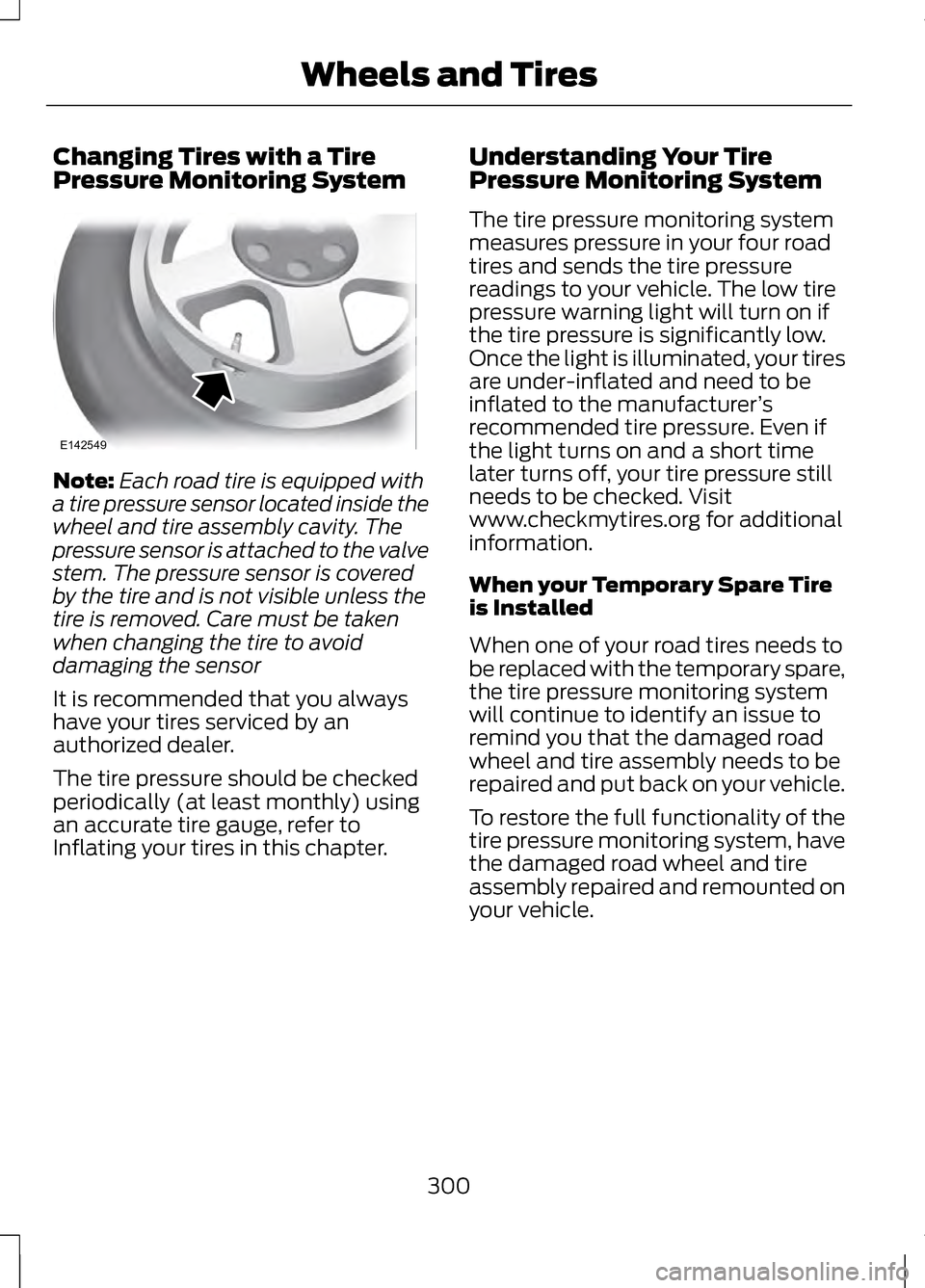
Note:
Each road tire is equipped with
a tire pressure sensor located inside the
wheel and tire assembly cavity. The
pressure sensor is attached to the valve
stem. The pressure sensor is covered
by the tire and is not visible unless the
tire is removed. Care must be taken
when changing the tire to avoid
damaging the sensor
It is recommended that you always
have your tires serviced by an
authorized dealer.
The tire pressure should be checked
periodically (at least monthly) using
an accurate tire gauge, refer to
Inflating your tires in this chapter. Understanding Your Tire
Pressure Monitoring System
The tire pressure monitoring system
measures pressure in your four road
tires and sends the tire pressure
readings to your vehicle. The low tire
pressure warning light will turn on if
the tire pressure is significantly low.
Once the light is illuminated, your tires
are under-inflated and need to be
inflated to the manufacturer
’s
recommended tire pressure. Even if
the light turns on and a short time
later turns off, your tire pressure still
needs to be checked. Visit
www.checkmytires.org for additional
information.
When your Temporary Spare Tire
is Installed
When one of your road tires needs to
be replaced with the temporary spare,
the tire pressure monitoring system
will continue to identify an issue to
remind you that the damaged road
wheel and tire assembly needs to be
repaired and put back on your vehicle.
To restore the full functionality of the
tire pressure monitoring system, have
the damaged road wheel and tire
assembly repaired and remounted on
your vehicle.
300
Wheels and TiresE142549
Page 305 of 474
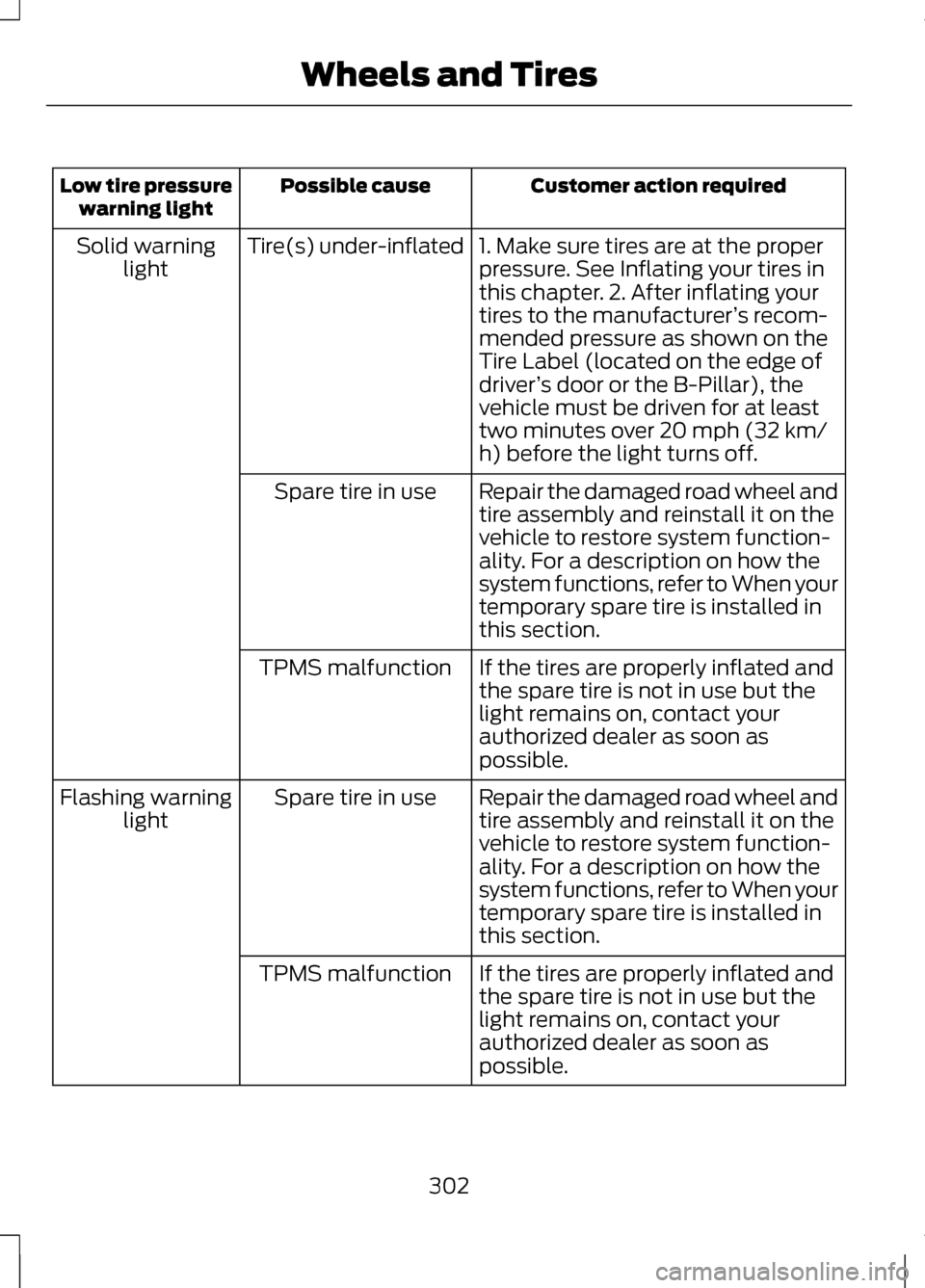
Customer action required
Possible cause
Low tire pressure
warning light
1. Make sure tires are at the proper
pressure. See Inflating your tires in
this chapter. 2. After inflating your
tires to the manufacturer’s recom-
mended pressure as shown on the
Tire Label (located on the edge of
driver ’s door or the B-Pillar), the
vehicle must be driven for at least
two minutes over 20 mph (32 km/
h) before the light turns off.
Tire(s) under-inflated
Solid warning
light
Repair the damaged road wheel and
tire assembly and reinstall it on the
vehicle to restore system function-
ality. For a description on how the
system functions, refer to When your
temporary spare tire is installed in
this section.
Spare tire in use
If the tires are properly inflated and
the spare tire is not in use but the
light remains on, contact your
authorized dealer as soon as
possible.
TPMS malfunction
Repair the damaged road wheel and
tire assembly and reinstall it on the
vehicle to restore system function-
ality. For a description on how the
system functions, refer to When your
temporary spare tire is installed in
this section.
Spare tire in use
Flashing warning
light
If the tires are properly inflated and
the spare tire is not in use but the
light remains on, contact your
authorized dealer as soon as
possible.
TPMS malfunction
302
Wheels and Tires
Page 306 of 474
When Inflating your Tires
When putting air into your tires (such
as at a gas station or in your garage),
the tire pressure monitoring system
may not respond immediately to the
air added to your tires.
It may take up to two minutes of
driving over 20 mph (32 km/h) for the
light to turn off after you have filled
your tires to the recommended
inflation pressure
How Temperature Affects your
Tire Pressure
The tire pressure monitoring system
monitors tire pressure in each
pneumatic tire. While driving in a
normal manner, a typical passenger
tire inflation pressure may increase
approximately 2 to 4 psi (14 to 28
kPa) from a cold start situation. If the
vehicle is stationary overnight with the
outside temperature significantly
lower than the daytime temperature,
the tire pressure may decrease
approximately 3 psi (21 kPa) for a drop
of 30°F (17°C) in ambient
temperature. This lower pressure
value may be detected by the TPMS
as being significantly lower than the
recommended inflation pressure and
activate the TPMS warning light for
low tire pressure. If the low tire
pressure warning light is on, visually
check each tire to verify that no tire is
flat. (If one or more tires are flat, repair
as necessary.) Check air pressure in
the road tires. If any tire is
under-inflated, carefully drive the
vehicle to the nearest location where
air can be added to the tires. Inflate
all the tires to the recommended
inflation pressure.
303
Wheels and Tires
Page 313 of 474
M.
Maximum Inflation Pressure:
Indicates the tire manufacturers'
maximum permissible pressure or the
pressure at which the maximum load
can be carried by the tire. This
pressure is normally higher than the
vehicle manufacturer's recommended
cold inflation pressure which can be
found on the Safety Compliance
Certification Label (affixed to either
the door hinge pillar, door-latch post,
or the door edge that meets the
door-latch post, next to the driver's
seating position), or Tire Label which
is located on the B-Pillar or the edge
of the driver ’s door. The cold inflation
pressure should never be set lower
than the recommended pressure on
the vehicle label.
The tire suppliers may have additional
markings, notes or warnings such as
standard load, radial tubeless, etc.
Additional Information Contained
on the Tire Sidewall for LT Type
Tires
Note: Tire Quality Grades do not apply
to this type of tire. LT type tires have some additional
information beyond those of P type
tires; these differences are described
below.
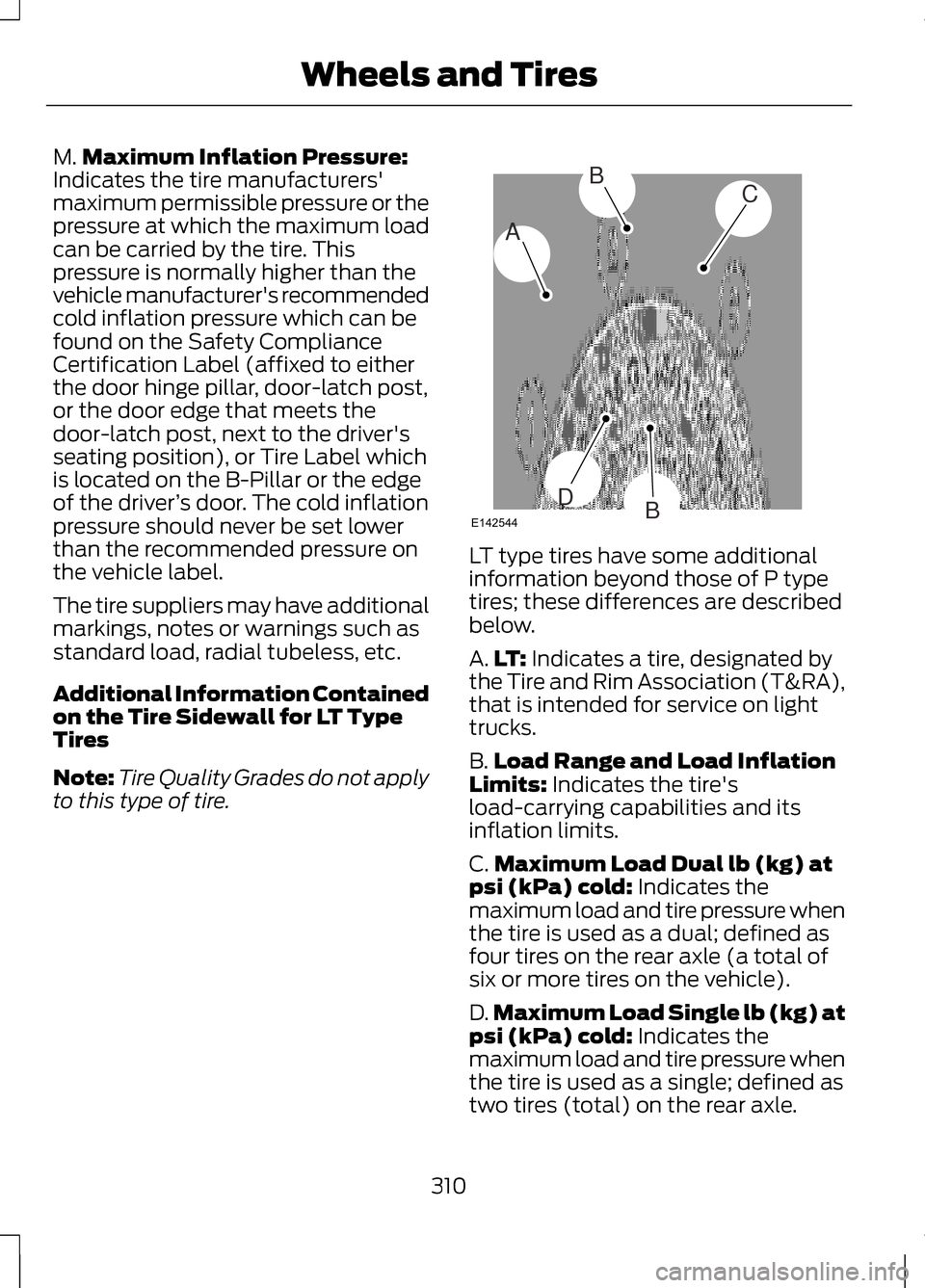
A.
LT: Indicates a tire, designated by
the Tire and Rim Association (T&RA),
that is intended for service on light
trucks.
B. Load Range and Load Inflation
Limits:
Indicates the tire's
load-carrying capabilities and its
inflation limits.
C. Maximum Load Dual lb (kg) at
psi (kPa) cold:
Indicates the
maximum load and tire pressure when
the tire is used as a dual; defined as
four tires on the rear axle (a total of
six or more tires on the vehicle).
D. Maximum Load Single lb (kg) at
psi (kPa) cold:
Indicates the
maximum load and tire pressure when
the tire is used as a single; defined as
two tires (total) on the rear axle.
310
Wheels and TiresA
BC
BDE142544
Page 322 of 474
USING SNOW CHAINS
Snow chains have not been approved
for use on your vehicle.
WARNINGS
If you choose to install snow tires
on your vehicle, they must be the
same size, construction, and load
range as the original tires listed on the
tire placard, and they must be
installed on all four wheels. Mixing
tires of different size or construction
on your vehicle can adversely affect
your vehicle's handling and braking,
and may lead to loss of vehicle
control. Do not use snow chains or cables
on this vehicle as they may cause
damage to your vehicle which may
lead to loss of vehicle control. The original equipment tires on your
vehicle may have an all-weather tread
design to provide traction, handling,
and braking performance in
year-round driving. You may install
snow tires for improved traction when
driving in areas with sustained periods
of snow or icy driving conditions. CHANGING A ROAD WHEEL WARNINGS
The use of tire sealants may
damage your tire pressure
monitoring system and should not be
used. However, if you must use a
sealant, the tire pressure monitoring
system sensor and valve stem on the
wheel must be replaced by an
authorized Ford dealer. See Tire Pressure Monitoring
System (page 298). for
important information. If the tire
pressure monitor sensor becomes
damaged, it will no longer function. Note:
The tire pressure monitoring
system indicator light will illuminate
when the spare tire is in use. To restore
the full function of the monitoring
system, all road wheels equipped with
tire pressure monitoring sensors must
be mounted on the vehicle.
If you get a flat tire while driving, do
not apply the brake heavily. Instead,
gradually decrease your speed. Hold
the steering wheel firmly and slowly
move to a safe place on the side of
the road.
319
Wheels and Tires
Page 466 of 474
Hints on Controlling the Interior
Climate..................................................127
Cooling the Interior Quickly..................128
General Hints.............................................. 127
Heating the Interior Quickly..................128
Recommended Settings for Cooling ..................................................................... 128
Recommended Settings for Heating..................................................... 128
Side Window Defogging in Cold Weather................................................... 128
Hints on Driving With Anti-Lock Brakes....................................................178
Hood Lock See: Opening and Closing the
Hood........................................................ 264
I
In California (U.S. Only)...................244
Information Display Control..............77 Cluster Display Control Features..........77
Information Displays.........................100
General Information...............................100
Information...........................................392 911 Assist®................................................. 399
Alerts............................................................ 399
Calendar..................................................... 399
SIRIUS Travel Link...................................396
SYNC Services (If Equipped, U.S. Only)........................................................ 392
Vehicle Health Report...........................402 Information Messages
......................105
Active Park.................................................. 105
Adaptive Cruise Control........................106
AdvanceTrac®........................................... 107
Airbag............................................................ 107
Alarm............................................................. 107
Automatic Engine Shutdown...............107
AWD.............................................................. 108
Battery and Charging System.............109
Blind Spot Information and Cross Traffic Alert System.............................110
Collision Warning System......................110
Doors and Locks.......................................... 111
Driver Alert..................................................... 111
Engine.............................................................. 111
Fuel.................................................................. 112
Hill Start Assist........................................... 112
Keys and Intelligent Access...................112
Lane Keeping System..............................113
Maintenance................................................ 114
MyKey............................................................. 115
Park Aid......................................................... 116
Park Brake.................................................... 116
Power Steering............................................ 117
Remote Start............................................... 117
Starting System ........................................118
Tire Pressure Monitoring System........118
Traction Control......................................... 119
Transmission............................................... 119
Installing Child Seats
............................21
Child Seats..................................................... 21
Using Lap and Shoulder Belts................21
Using Lower Anchors and Tethers for CHildren (LATCH)..................................26
Using Tether Straps...................................28
Instrument Cluster...............................94
Instrument Lighting Dimmer............83
Interior Lamps
........................................85
Front Interior Lamp...................................86
Rear Interior Lamp.....................................86
Interior Luggage Compartment Release...................................................70
463
Index