lock LINCOLN MKZ 2014 Manual Online
[x] Cancel search | Manufacturer: LINCOLN, Model Year: 2014, Model line: MKZ, Model: LINCOLN MKZ 2014Pages: 468, PDF Size: 4.49 MB
Page 280 of 468
3. With the parking brake engagedand your foot on the brake pedal,
start the engine and move the
gearshift lever through all of the
gear ranges. Allow a minimum of
10 seconds for each gear to
engage.
4. Put the gearshift lever in P (Park) and leave the engine running.
Note: You will need to move the air
filter assembly to access the
transmission dipstick.
5. Remove the dipstick, wiping it clean with a clean, dry lint free rag.
If necessary, refer to Under hood
overview in this chapter for the
location of the dipstick.
6. Install the dipstick making sure it is fully seated in the filler tube by
turning it to the locked position.
7. Remove the dipstick and inspect the fluid level. The fluid should be
in the designated areas for normal
operating temperature.
Moving the Air Filter Assembly
(Accessing the Dipstick)
WARNING
Do not run engine with the air
filter disconnected.
E158839
A
BCD
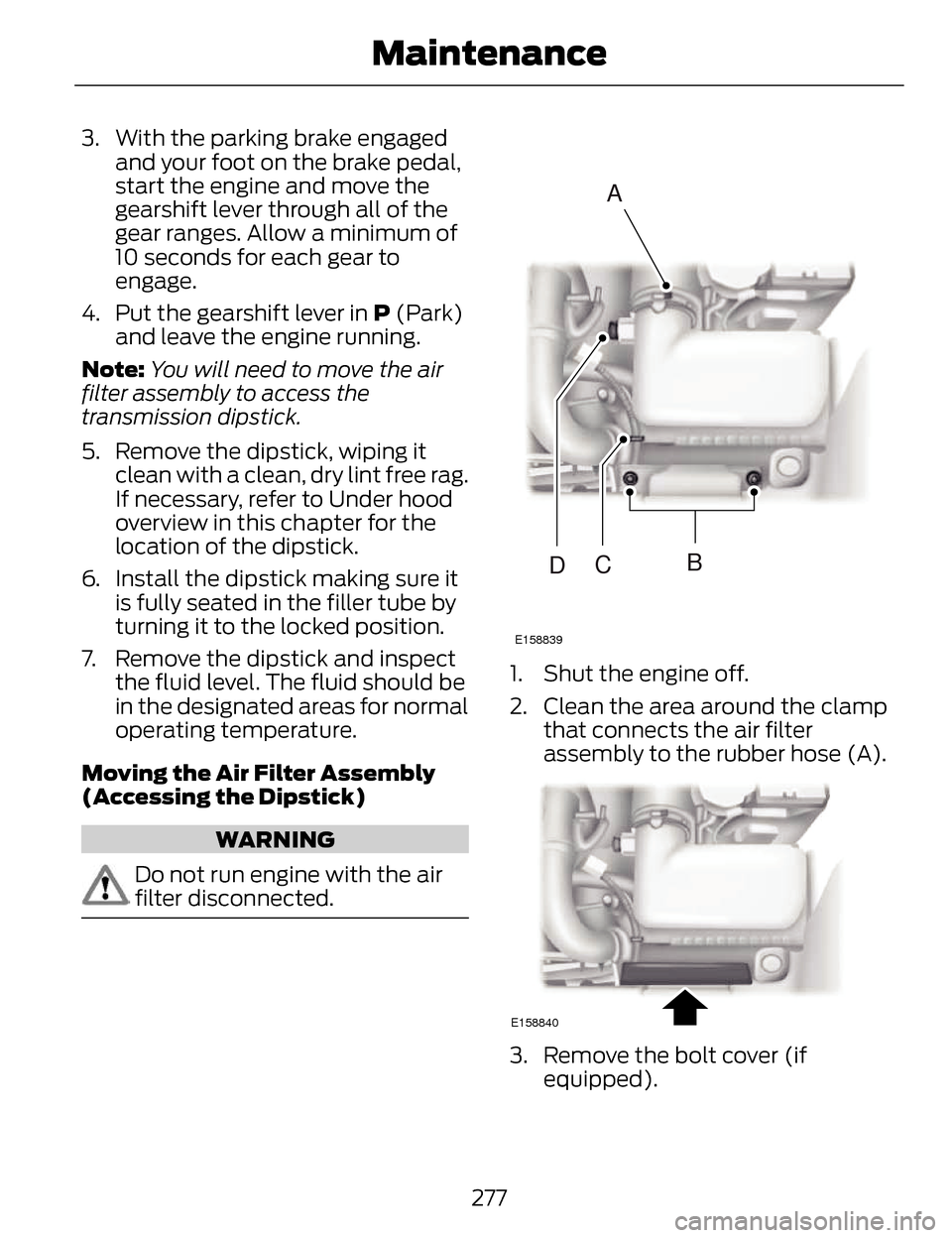
1. Shut the engine off.
2. Clean the area around the clamp that connects the air filter
assembly to the rubber hose (A).
E158840
3. Remove the bolt cover (ifequipped).
277
Maintenance
Page 281 of 468
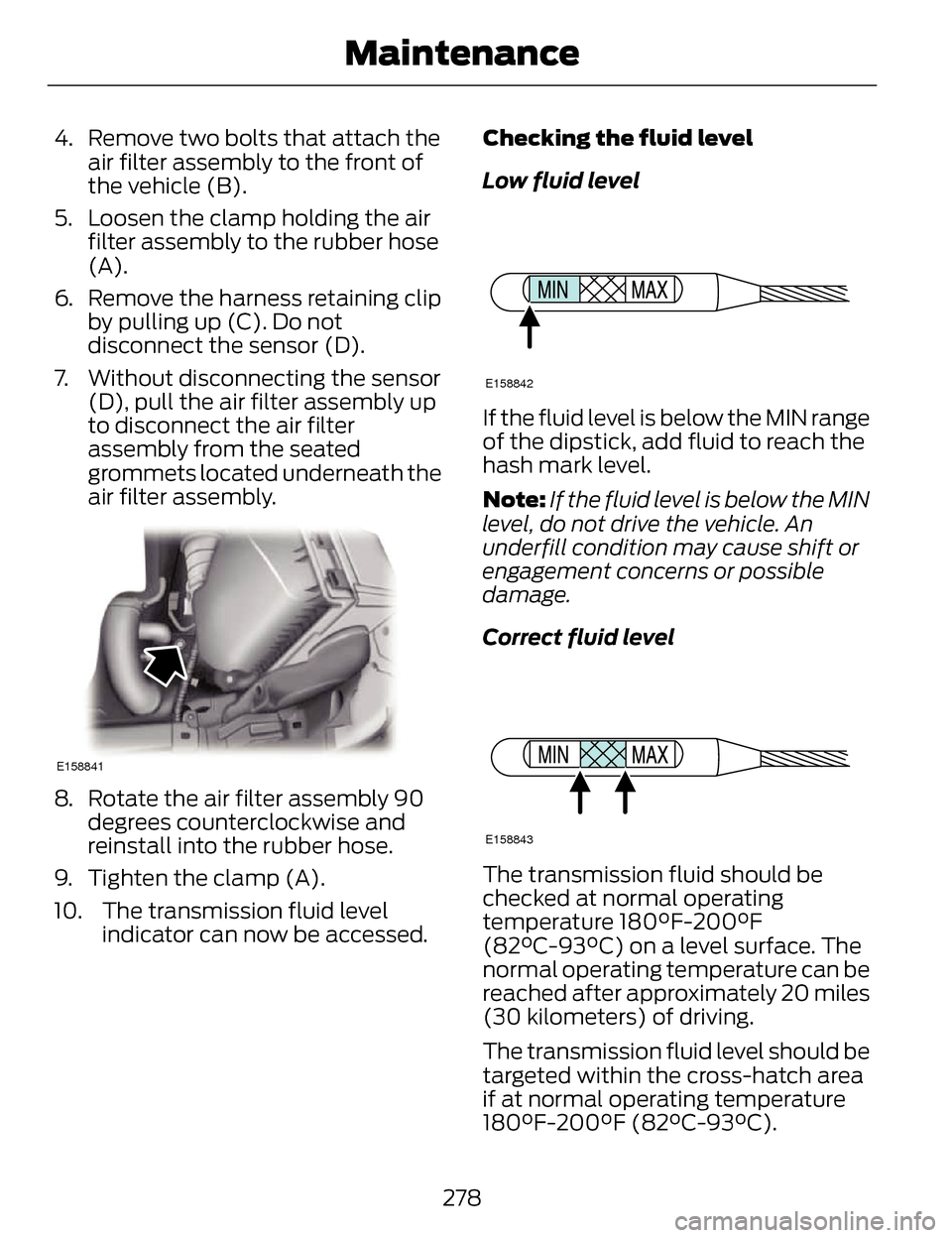
4. Remove two bolts that attach theair filter assembly to the front of
the vehicle (B).
5. Loosen the clamp holding the air filter assembly to the rubber hose
(A).
6. Remove the harness retaining clip by pulling up (C). Do not
disconnect the sensor (D).
7. Without disconnecting the sensor (D), pull the air filter assembly up
to disconnect the air filter
assembly from the seated
grommets located underneath the
air filter assembly.
E158841
8. Rotate the air filter assembly 90degrees counterclockwise and
reinstall into the rubber hose.
9. Tighten the clamp (A).
10. The transmission fluid level indicator can now be accessed. Checking the fluid level
Low fluid level
E158842
If the fluid level is below the MIN range
of the dipstick, add fluid to reach the
hash mark level.
Note:
If the fluid level is below the MIN
level, do not drive the vehicle. An
underfill condition may cause shift or
engagement concerns or possible
damage.
Correct fluid level
E158843
The transmission fluid should be
checked at normal operating
temperature 180°F-200°F
(82°C-93°C) on a level surface. The
normal operating temperature can be
reached after approximately 20 miles
(30 kilometers) of driving.
The transmission fluid level should be
targeted within the cross-hatch area
if at normal operating temperature
180°F-200°F (82°C-93°C).
278
Maintenance
Page 282 of 468
High fluid level
E158844
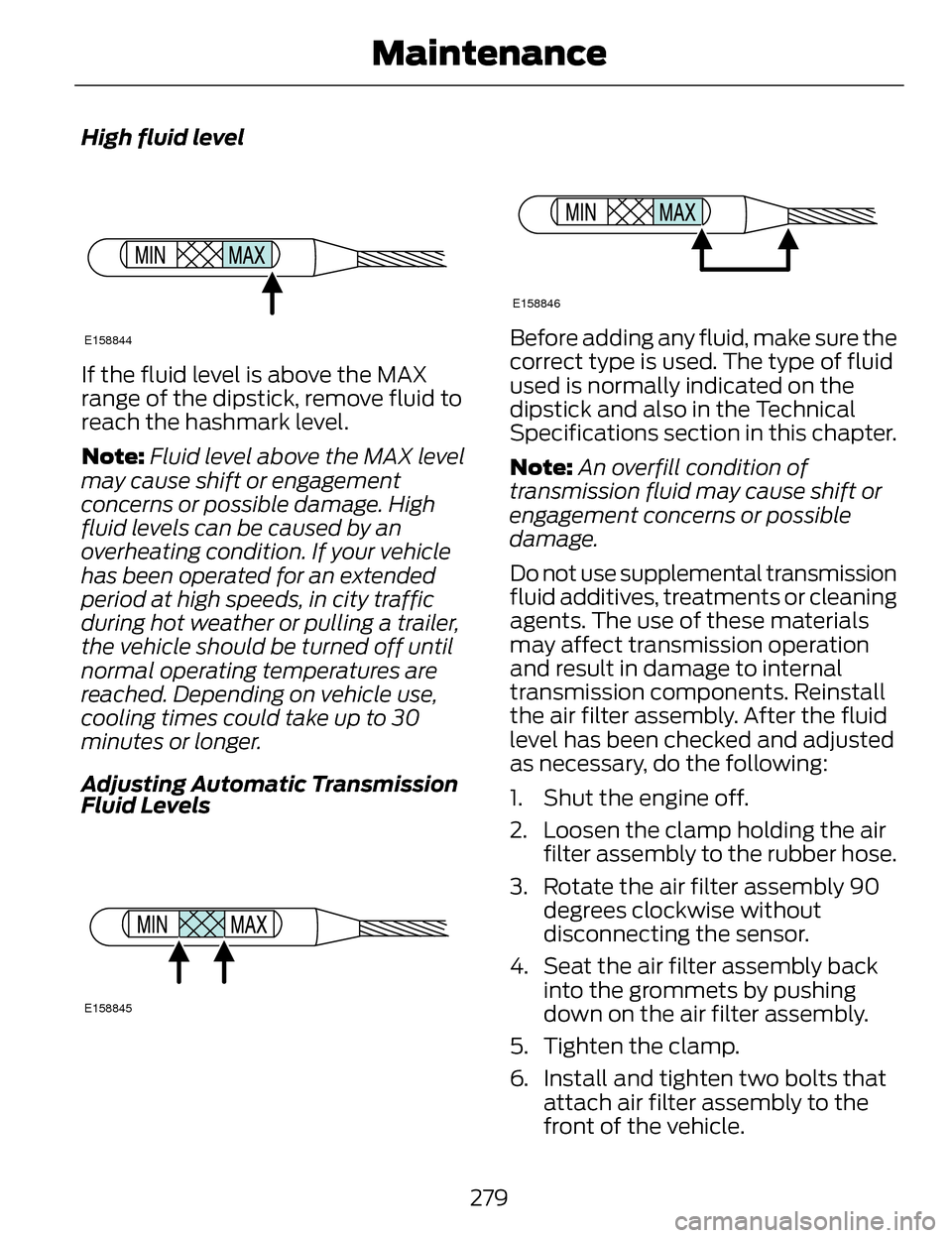
If the fluid level is above the MAX
range of the dipstick, remove fluid to
reach the hashmark level.
Note:Fluid level above the MAX level
may cause shift or engagement
concerns or possible damage. High
fluid levels can be caused by an
overheating condition. If your vehicle
has been operated for an extended
period at high speeds, in city traffic
during hot weather or pulling a trailer,
the vehicle should be turned off until
normal operating temperatures are
reached. Depending on vehicle use,
cooling times could take up to 30
minutes or longer.
Adjusting Automatic Transmission
Fluid Levels
E158845
E158846
Before adding any fluid, make sure the
correct type is used. The type of fluid
used is normally indicated on the
dipstick and also in the Technical
Specifications section in this chapter.
Note: An overfill condition of
transmission fluid may cause shift or
engagement concerns or possible
damage.
Do not use supplemental transmission
fluid additives, treatments or cleaning
agents. The use of these materials
may affect transmission operation
and result in damage to internal
transmission components. Reinstall
the air filter assembly. After the fluid
level has been checked and adjusted
as necessary, do the following:
1. Shut the engine off.
2. Loosen the clamp holding the air filter assembly to the rubber hose.
3. Rotate the air filter assembly 90 degrees clockwise without
disconnecting the sensor.
4. Seat the air filter assembly back into the grommets by pushing
down on the air filter assembly.
5. Tighten the clamp.
6. Install and tighten two bolts that attach air filter assembly to the
front of the vehicle.
279
Maintenance
Page 285 of 468
If you see any corrosion on the battery
or terminals, remove the cables from
the terminals and clean with a wire
brush. You can neutralize the acid with
a solution of baking soda and water.
When a battery replacement is
required, the battery should only be
replaced with a Ford recommended
replacement battery that matches
the electrical requirements of the
vehicle.
Because your vehicle’s engine is
electronically-controlled by a
computer, some engine control
settings are maintained by power
from the low voltage battery. Some
engine computer settings, like the idle
trim and fuel trim strategy, optimize
the driveability and performance of
the engine. Some other computer
settings, like the clock and radio
station presets, are also maintained
in memory by power from the low
voltage battery. When a technician
disconnects and connects the low
voltage battery, these settings are
erased. Complete the following
procedure in order to restore the
settings:
1. With the vehicle at a completestop, set the parking brake.
2. Shift the transmission into P.
3. Turn off all accessories.
4. Step on the brake pedal and start the vehicle. 5. Run the engine until it reaches
normal operating temperature.
While the engine is warming up,
complete the following: Reset the
clock. See Audio System (page
124). Reset the power windows
bounce-back feature. See
Windows and Mirrors (page 88).
Reset the radio station presets.
See Audio System (page 124).
6. Allow the engine to idle for at least one minute. If the engine turns off,
step on the accelerator to start the
engine.
7. While the engine is running, step on the brake pedal and shift the
transmission to N.
8. Allow the engine to run for at least one minute by pressing on the
accelerator pedal.
9. Drive the vehicle at least 10 miles (16 kilometers) to completely
relearn the idle and fuel trim
strategy.
Note: If you do not allow the engine to
relearn the idle and fuel trim strategy,
the idle quality of your vehicle may be
adversely affected until the engine
computer eventually relearns the idle
trim and fuel trim strategy.
Note: Always dispose of automotive
batteries in a responsible manner.
Follow your local authorized standards
for disposal. Call your local authorized
recycling center to find out more about
recycling automotive batteries.
282
Maintenance
Page 286 of 468
Note:It is recommended that the
negative battery cable terminal be
disconnected from the battery if you
plan to store your vehicle for an
extended period of time.
CHECKING THE WIPER
BLADES
E142463
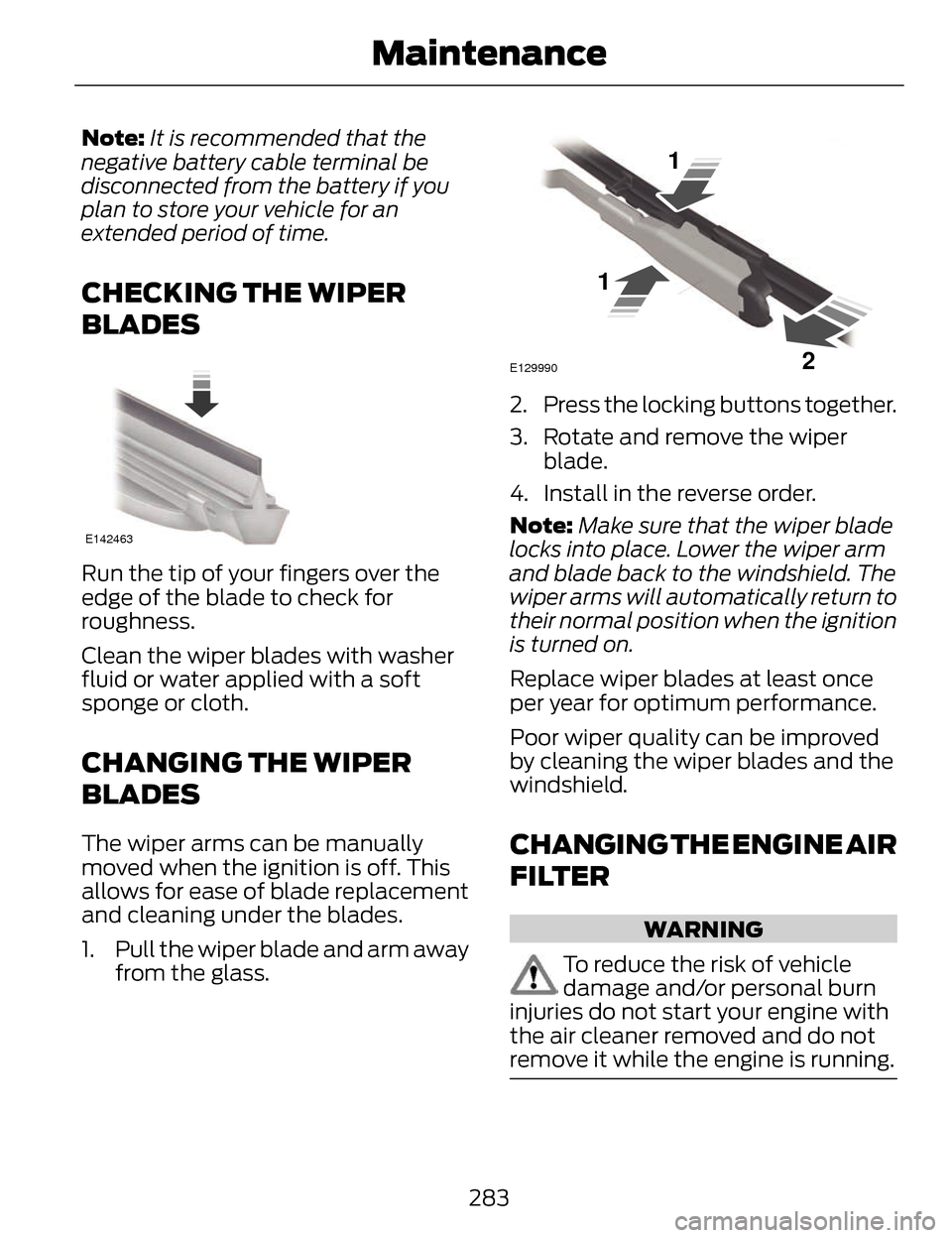
Run the tip of your fingers over the
edge of the blade to check for
roughness.
Clean the wiper blades with washer
fluid or water applied with a soft
sponge or cloth.
CHANGING THE WIPER
BLADES
The wiper arms can be manually
moved when the ignition is off. This
allows for ease of blade replacement
and cleaning under the blades.
1. Pull the wiper blade and arm away from the glass.
E129990
1
1 2
2. Press the locking buttons together.
3. Rotate and remove the wiperblade.
4. Install in the reverse order.
Note: Make sure that the wiper blade
locks into place. Lower the wiper arm
and blade back to the windshield. The
wiper arms will automatically return to
their normal position when the ignition
is turned on.
Replace wiper blades at least once
per year for optimum performance.
Poor wiper quality can be improved
by cleaning the wiper blades and the
windshield.
CHANGING THE ENGINE AIR
FILTER
WARNING
To reduce the risk of vehicle
damage and/or personal burn
injuries do not start your engine with
the air cleaner removed and do not
remove it while the engine is running.
283
Maintenance
Page 288 of 468
ADJUSTING THE
HEADLAMPS
Vertical Aim Adjustment
The headlamps on your vehicle are
properly aimed at the assembly plant.
If your vehicle has been in an accident,
the alignment of your headlamps
should be checked by your authorized
dealer.
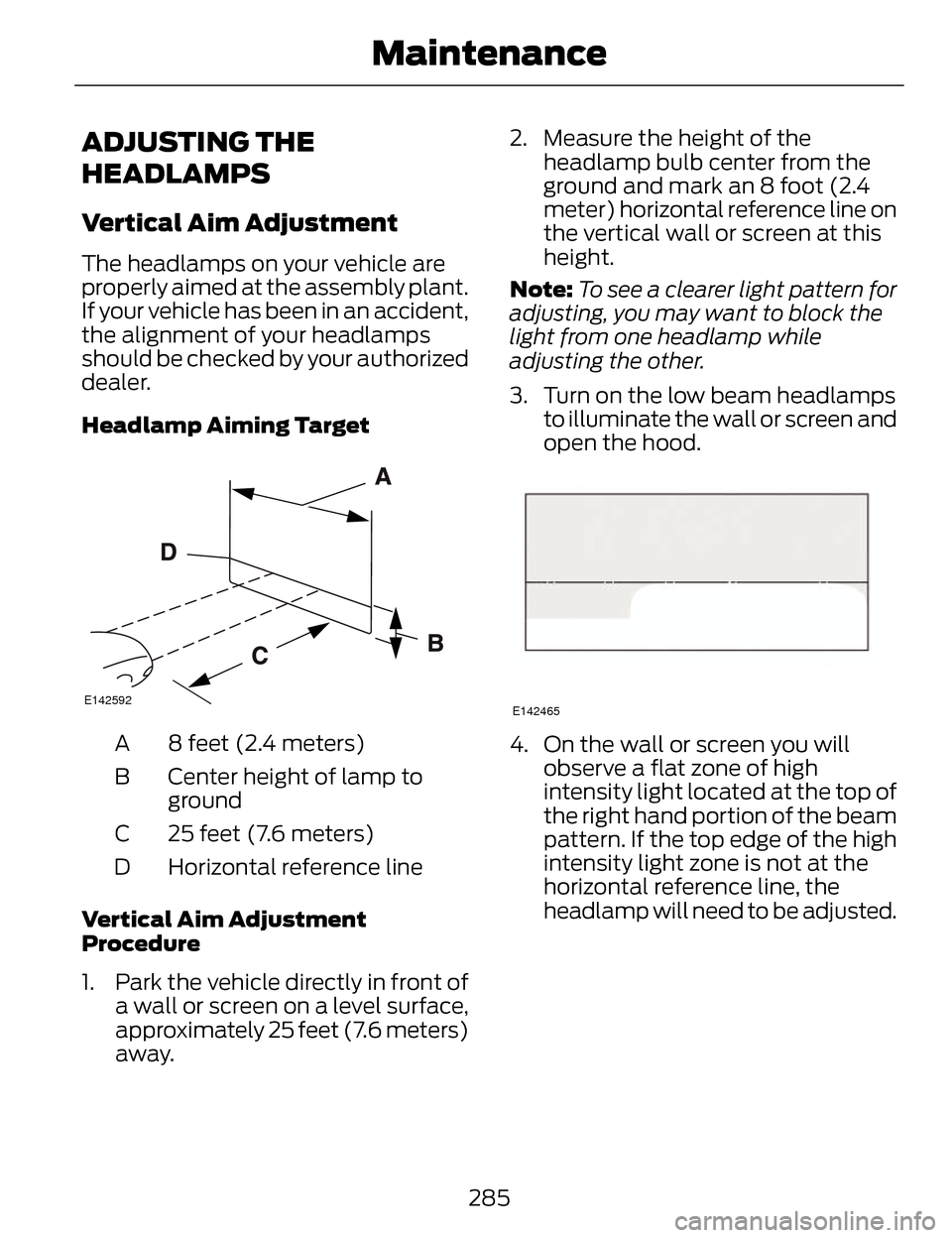
Headlamp Aiming Target
E142592
8 feet (2.4 meters)
A
Center height of lamp to
ground
B
25 feet (7.6 meters)
C
Horizontal reference line
D
Vertical Aim Adjustment
Procedure
1. Park the vehicle directly in front of a wall or screen on a level surface,
approximately 25 feet (7.6 meters)
away. 2. Measure the height of the
headlamp bulb center from the
ground and mark an 8 foot (2.4
meter) horizontal reference line on
the vertical wall or screen at this
height.
Note: To see a clearer light pattern for
adjusting, you may want to block the
light from one headlamp while
adjusting the other.
3. Turn on the low beam headlamps to illuminate the wall or screen and
open the hood.
E142465
4. On the wall or screen you willobserve a flat zone of high
intensity light located at the top of
the right hand portion of the beam
pattern. If the top edge of the high
intensity light zone is not at the
horizontal reference line, the
headlamp will need to be adjusted.
285
Maintenance
Page 289 of 468
E150095
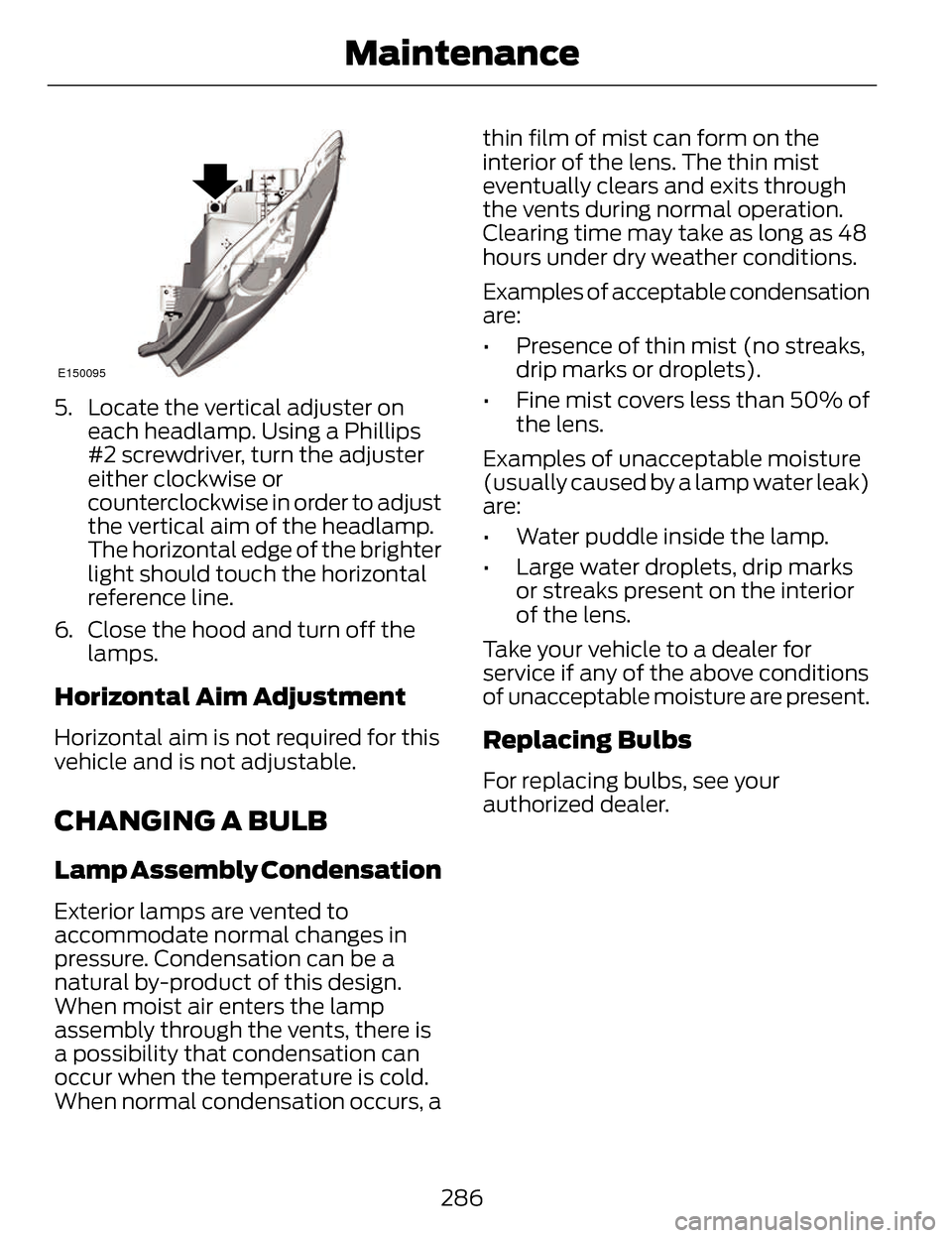
5. Locate the vertical adjuster oneach headlamp. Using a Phillips
#2 screwdriver, turn the adjuster
either clockwise or
counterclockwise in order to adjust
the vertical aim of the headlamp.
The horizontal edge of the brighter
light should touch the horizontal
reference line.
6. Close the hood and turn off the lamps.
Horizontal Aim Adjustment
Horizontal aim is not required for this
vehicle and is not adjustable.
CHANGING A BULB
Lamp Assembly Condensation
Exterior lamps are vented to
accommodate normal changes in
pressure. Condensation can be a
natural by-product of this design.
When moist air enters the lamp
assembly through the vents, there is
a possibility that condensation can
occur when the temperature is cold.
When normal condensation occurs, a thin film of mist can form on the
interior of the lens. The thin mist
eventually clears and exits through
the vents during normal operation.
Clearing time may take as long as 48
hours under dry weather conditions.
Examples of acceptable condensation
are:
• Presence of thin mist (no streaks,
drip marks or droplets).
• Fine mist covers less than 50% of the lens.
Examples of unacceptable moisture
(usually caused by a lamp water leak)
are:
• Water puddle inside the lamp.
• Large water droplets, drip marks or streaks present on the interior
of the lens.
Take your vehicle to a dealer for
service if any of the above conditions
of unacceptable moisture are present.
Replacing Bulbs
For replacing bulbs, see your
authorized dealer.
286
Maintenance
Page 293 of 468
When washing and waxing, park your
vehicle in a shaded area out of direct
sunlight. Always wash your vehicle
before applying wax.
• Use a quality wax that does notcontain abrasives.
• Follow the manufacturer’s instructions to apply and remove
the wax.
• Apply a small amount of wax in a back-and-forth motion, not in
circles.
• Do not allow wax to come in contact with any non-body
(low-gloss black) colored trim.
The wax will discolor or stain the
parts over time.
• Roof racks.
• Bumpers.
• Grained door handles.
• Side mouldings.
• Mirror housings.
• Windshield cowl area.
• Do not apply wax to glass areas.
• After waxing, your car's paint should feel smooth, and be free of
streaks and smudges.
CLEANING THE ENGINE
Engines are more efficient when they
are clean because grease and dirt
buildup keep the engine warmer than
normal. When washing:
• Take care when using a power
washer to clean the engine. The
high-pressure fluid could penetrate
the sealed parts and cause
damage.
• Do not spray a hot engine with cold water to avoid cracking the engine
block or other engine components.
• Spray Motorcraft® Engine Shampoo and Degreaser on all
parts that require cleaning and
pressure rinse clean. In Canada,
use Motorcraft® Engine Shampoo.
• Never wash or rinse the engine while it is hot or running; water in
the running engine may cause
internal damage.
• Never wash or rinse any ignition coil, spark plug wire or spark plug
well, or the area in and around
these locations.
• Cover the battery, power distribution box, and air filter
assembly to prevent water
damage when cleaning the engine.
CLEANING THE WINDOWS
AND WIPER BLADES
Clean your windows and wiper blades
regularly. If the wipers do not wipe
properly, substances on the vehicle’s
glass or the wiper blades may cause
squeaking or chatter noise from the
blades, and streaking and smearing
of the windshield.
290
Vehicle Care
Page 303 of 468
Do not remove any foreign object that
has pierced the tire. If a puncture is
located in the tire sidewall, stop and
call roadside assistance.
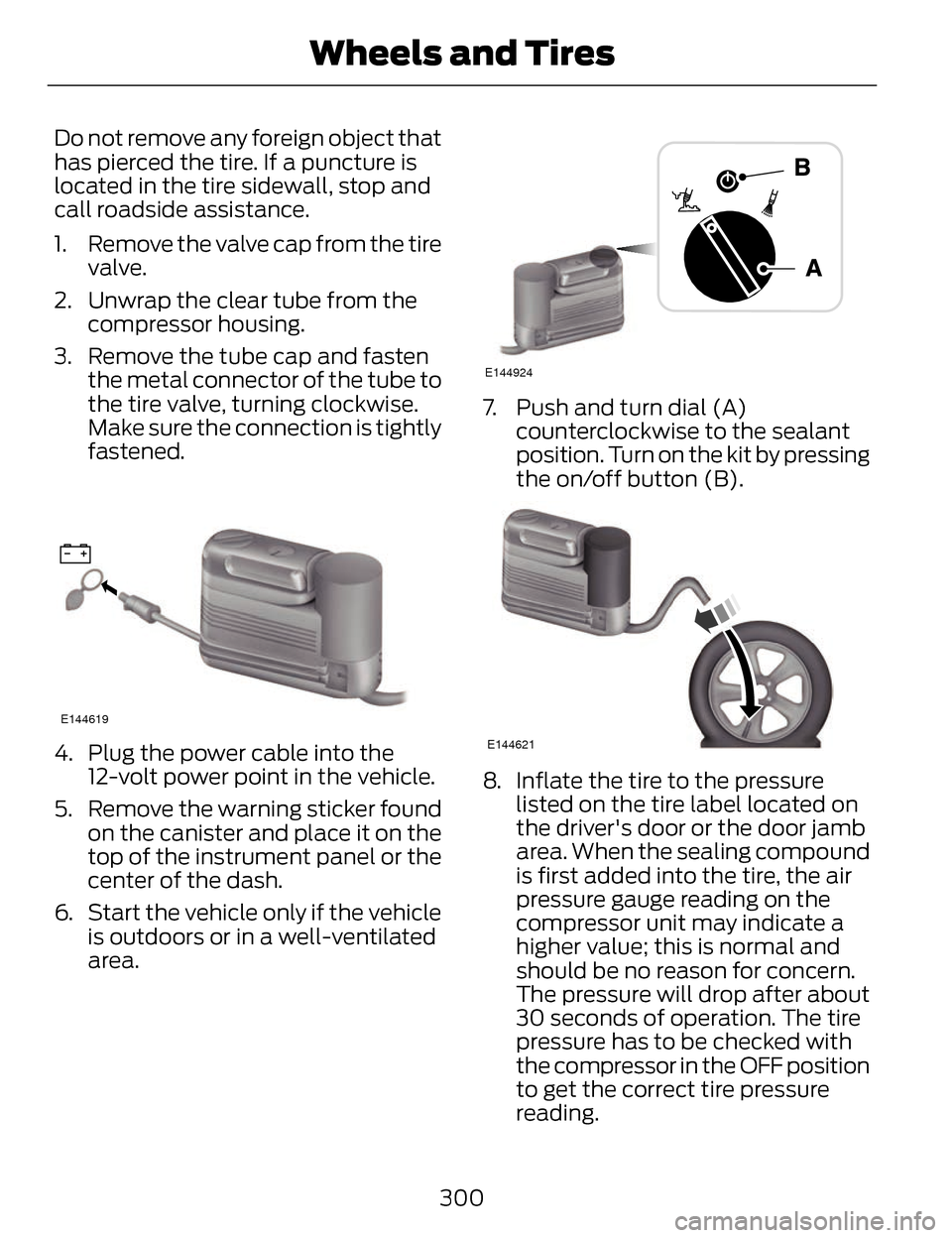
1. Remove the valve cap from the tirevalve.
2. Unwrap the clear tube from the compressor housing.
3. Remove the tube cap and fasten the metal connector of the tube to
the tire valve, turning clockwise.
Make sure the connection is tightly
fastened.
E144619
4. Plug the power cable into the12-volt power point in the vehicle.
5. Remove the warning sticker found on the canister and place it on the
top of the instrument panel or the
center of the dash.
6. Start the vehicle only if the vehicle is outdoors or in a well-ventilated
area.
E144924
7. Push and turn dial (A)counterclockwise to the sealant
position. Turn on the kit by pressing
the on/off button (B).
E144621
8. Inflate the tire to the pressurelisted on the tire label located on
the driver's door or the door jamb
area. When the sealing compound
is first added into the tire, the air
pressure gauge reading on the
compressor unit may indicate a
higher value; this is normal and
should be no reason for concern.
The pressure will drop after about
30 seconds of operation. The tire
pressure has to be checked with
the compressor in the OFF position
to get the correct tire pressure
reading.
300
Wheels and Tires
Page 304 of 468
9. When the recommended tirepressure is reached, turn off the kit
by pressing the on button;
disconnect the kit from the tire
valve and the power point.
Re-install the valve cap on the tire
valve, place the tube cap on the
metal connector, and return the kit
to the stowage area
10. Immediately and cautiously, drive the vehicle 4 miles (6 kilometers)
to distribute the sealant evenly
inside the tire. Do not exceed 50
mph (80 km/h).
11. After 4 miles (6 kilometers), stop and check the tire pressure. See
Second stage: Checking tire
pressure.
Note: If you experience any unusual
vibration, ride disturbance or noise
while driving, reduce your speed until
you can safely pull off to the side of the
road to call for roadside assistance.
Note: Do not proceed to the second
stage of this operation.
Second Stage: Checking Tire
Pressure
WARNINGS
If you are proceeding from the
First stage: Re–inflating the tire
with sealing compound and air section
and have injected sealant in the tire
and the pressure is below 20 psi (1.4
bar), stop and call roadside
assistance. If tire pressure is above 20
psi (1.4 bar), continue to the next step.
The power plug may get hot
after use and should be handled
carefully while unplugging.
Check the air pressure of your tires as
follows:
1. Remove the valve cap from the tire valve.
2. Unhook the black hose from the side of the compressor and fasten
firmly on the valve stem by turning
clockwise.
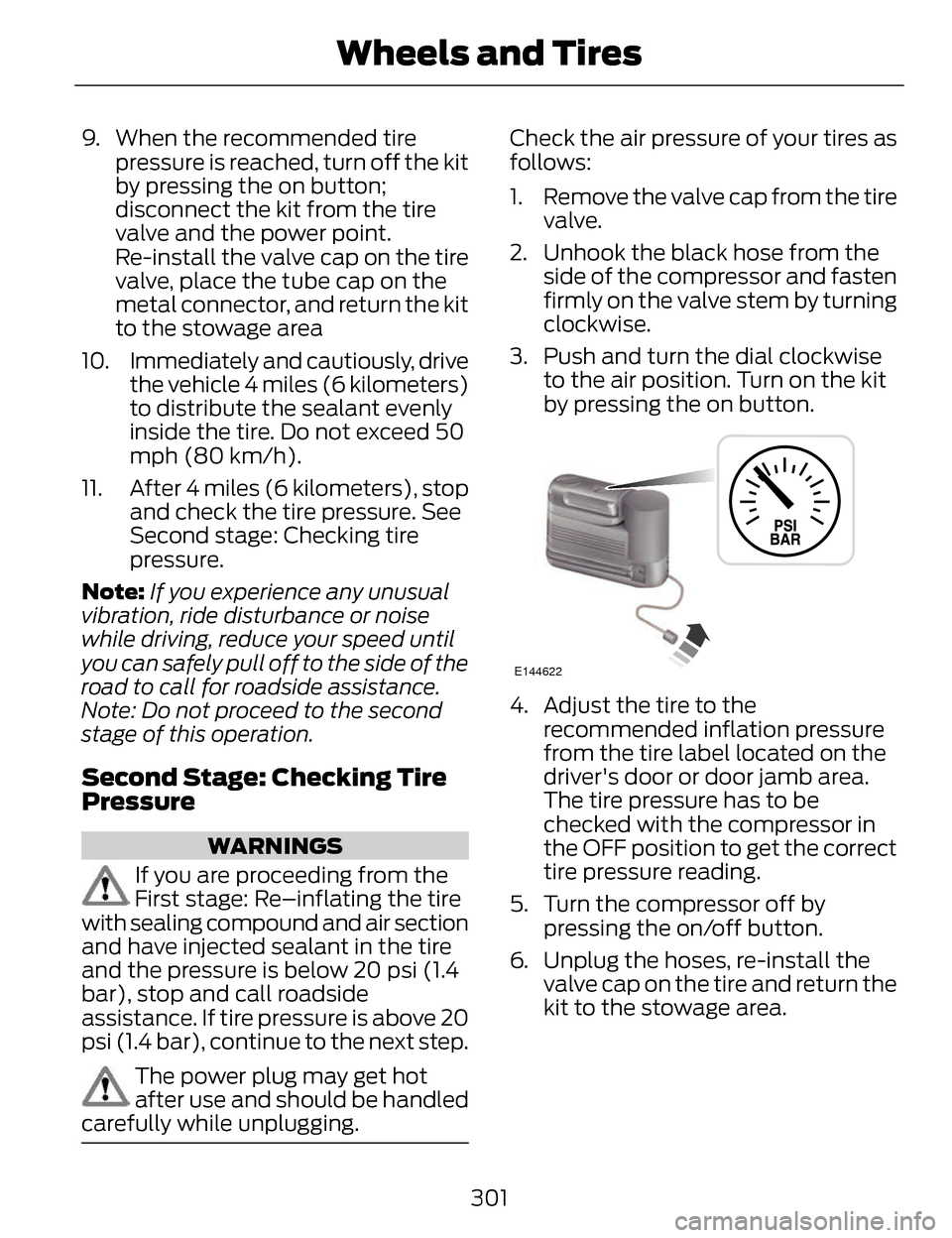
3. Push and turn the dial clockwise to the air position. Turn on the kit
by pressing the on button.
E144622
4. Adjust the tire to therecommended inflation pressure
from the tire label located on the
driver's door or door jamb area.
The tire pressure has to be
checked with the compressor in
the OFF position to get the correct
tire pressure reading.
5. Turn the compressor off by pressing the on/off button.
6. Unplug the hoses, re-install the valve cap on the tire and return the
kit to the stowage area.
301
Wheels and Tires