towing LINCOLN MKZ 2014 Owners Manual
[x] Cancel search | Manufacturer: LINCOLN, Model Year: 2014, Model line: MKZ, Model: LINCOLN MKZ 2014Pages: 468, PDF Size: 4.49 MB
Page 7 of 468
Towing
Towing a Trailer...................................232
Recommended TowingWeights..............................................233
Essential Towing Checks.................234
Transporting the Vehicle.................236
Towing the Vehicle on Four Wheels................................................237
Driving Hints
Breaking-In...........................................240
Economical Driving...........................240
Driving Through Water......................241
Floor Mats..............................................241
Roadside Emergencies
Roadside Assistance.........................243
Hazard Warning Flashers................244
Fuel Shutoff.........................................244
Jump-Starting the Vehicle..............245
Post-Crash Alert System.................247
Customer Assistance
Getting the Services You Need......248
In California (U.S. Only)...................249
The Better Business Bureau (BBB) Auto Line Program (U.S.
Only)...................................................250
Utilizing the Mediation/Arbitration Program (Canada Only)...............251
Getting Assistance Outside the U.S. and Canada......................................252
Ordering Additional Owner's Literature...........................................253
Reporting Safety Defects (U.S. Only)...................................................254 Reporting Safety Defects (Canada
Only)...................................................254
Fuses
Changing a Fuse.................................255
Fuse Specification Chart.................256
Maintenance
General Information..........................267
Opening and Closing the Hood.....268
Under Hood Overview - 2.0LEcoBoost™......................................269
Under Hood Overview - 3.7L..........270
Engine Oil Dipstick - 2.0L EcoBoost™........................................271
Engine Oil Dipstick - 3.7L...................271
Engine Oil Check..................................271
Oil Change Indicator Reset..............272
Engine Coolant Check.......................272
Automatic Transmission Fluid Check..................................................276
Brake Fluid Check..............................280
Power Steering Fluid Check...........280
Fuel Filter..............................................280
Washer Fluid Check..........................280
Changing the 12V Battery.................281
Checking the Wiper Blades............283
Changing the Wiper Blades...........283
Changing the Engine Air Filter.......283
Adjusting the Headlamps...............285
Changing a Bulb.................................286
Bulb Specification Chart.................287
Vehicle Care
General Information.........................288
Cleaning Products.............................288
4
Table of Contents
Page 126 of 468
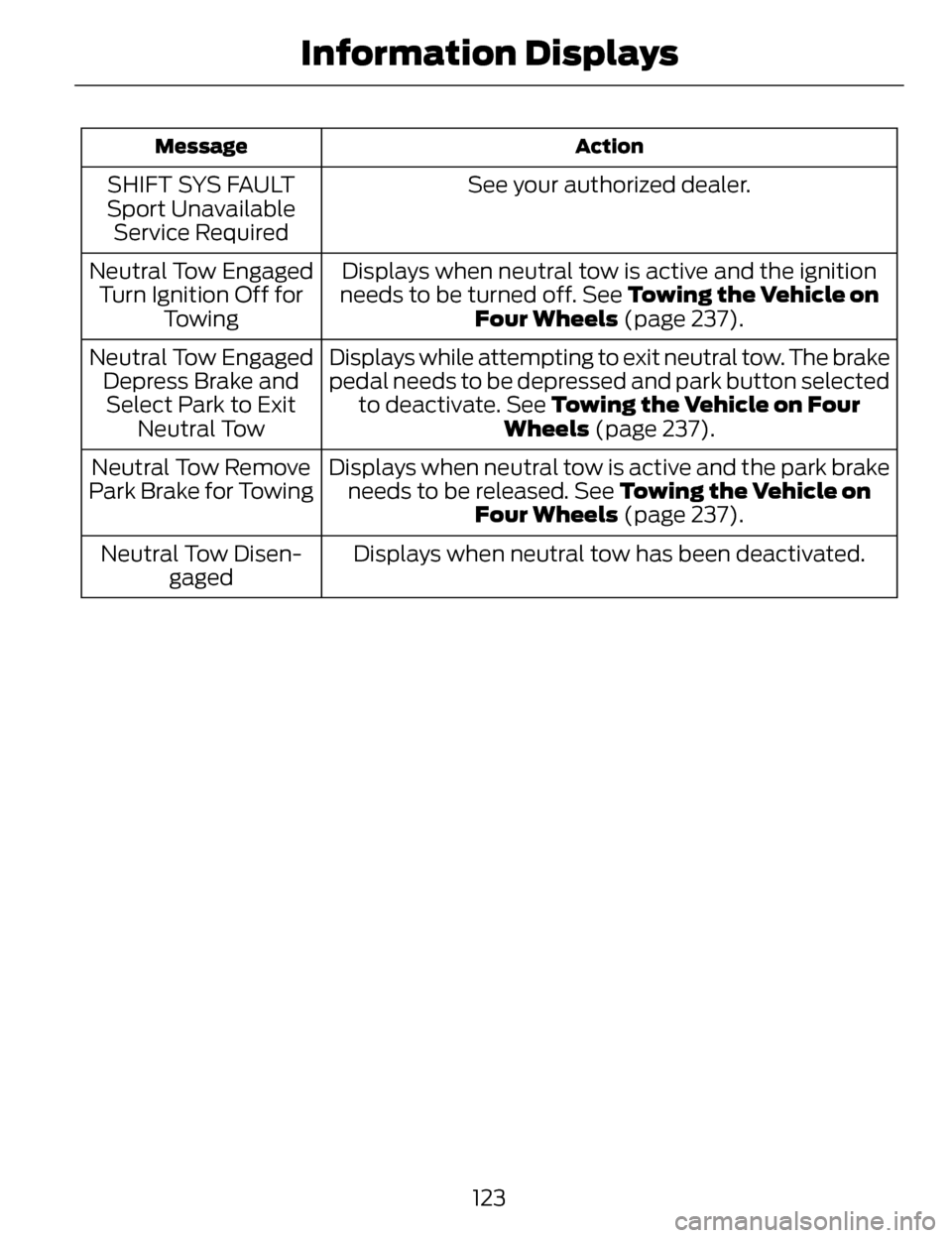
Action
Message
See your authorized dealer.
SHIFT SYS FAULT
Sport Unavailable Service Required
Displays when neutral tow is active and the ignition
needs to be turned off. See Towing the Vehicle on
Four Wheels (page 237).
Neutral Tow Engaged
Turn Ignition Off for Towing
Displays while attempting to exit neutral tow. The brake
pedal needs to be depressed and park button selectedto deactivate. See Towing the Vehicle on Four Wheels (page 237).
Neutral Tow Engaged
Depress Brake andSelect Park to Exit Neutral Tow
Displays when neutral tow is active and the park brakeneeds to be released. See Towing the Vehicle on Four Wheels (page 237).
Neutral Tow Remove
Park Brake for Towing
Displays when neutral tow has been deactivated.
Neutral Tow Disen-
gaged
123
Information Displays
Page 174 of 468
WARNINGS
If the parking brake is fully
released, but the brake warning
lamp remains illuminated, the brakes
may not be working properly. See your
authorized dealer.
Note: See your authorized dealer as
soon as possible if this procedure is
used.
Note: For some markets this feature
is disabled.
Note: This feature will only function if
your 12-volt battery has power.
Use the brake-shift interlock override
to move your transmission from the
park position in the event of an
electrical malfunction or if your
vehicle has a dead battery.
1. Apply the parking brake and turn your ignition off before performing
this procedure.
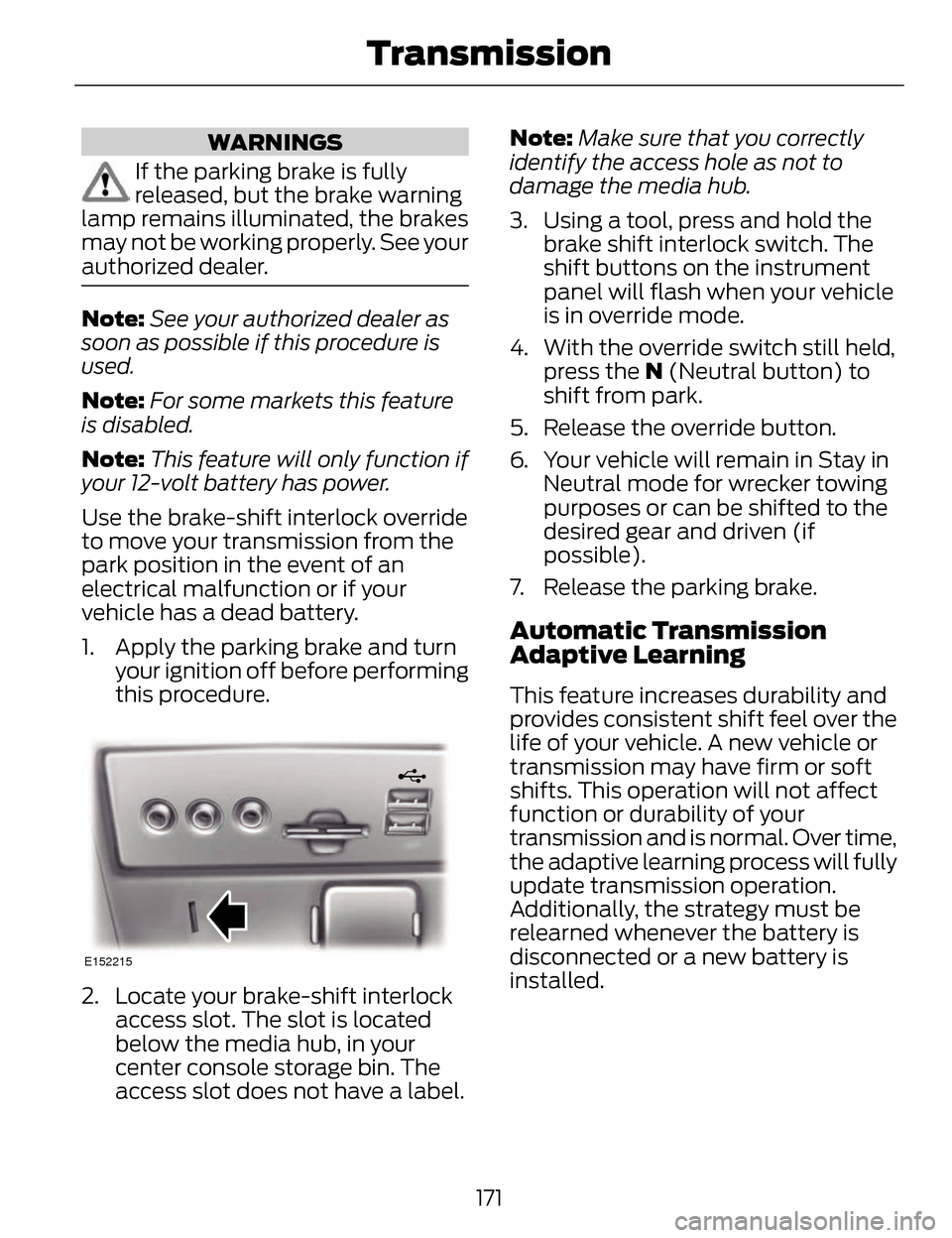
E152215
2. Locate your brake-shift interlockaccess slot. The slot is located
below the media hub, in your
center console storage bin. The
access slot does not have a label. Note:
Make sure that you correctly
identify the access hole as not to
damage the media hub.
3. Using a tool, press and hold the brake shift interlock switch. The
shift buttons on the instrument
panel will flash when your vehicle
is in override mode.
4. With the override switch still held, press the N (Neutral button) to
shift from park.
5. Release the override button.
6. Your vehicle will remain in Stay in Neutral mode for wrecker towing
purposes or can be shifted to the
desired gear and driven (if
possible).
7. Release the parking brake.
Automatic Transmission
Adaptive Learning
This feature increases durability and
provides consistent shift feel over the
life of your vehicle. A new vehicle or
transmission may have firm or soft
shifts. This operation will not affect
function or durability of your
transmission and is normal. Over time,
the adaptive learning process will fully
update transmission operation.
Additionally, the strategy must be
relearned whenever the battery is
disconnected or a new battery is
installed.
171
Transmission
Page 198 of 468
Note:If the transmission is in R
(Reverse) and the luggage
compartment is ajar, no rear view
camera features are displayed.
Note: If the image comes on while the
transmission is not in R (Reverse), have
the system inspected by your
authorized dealer.
Note: When towing, the camera only
sees what is being towed behind your
vehicle. This might not provide
adequate coverage as it usually
provides in normal operation and some
objects might not be seen. In some
vehicles, the guidelines may disappear
once the trailer tow connector is
engaged.
Note: The camera may not operate
correctly under the following
conditions:
• Nighttime or dark areas if one or both reverse lamps are not
operating.
• The camera's view is obstructed by mud, water or debris. Clean the
lens with a soft, lint-free cloth and
non-abrasive cleaner.
• The rear of the vehicle is hit or damaged, causing the camera to
become misaligned.
To access any of the rear view camera
system settings, make the following
selections in the touch screen when
the transmission is not in R (Reverse):
• Menu > Vehicle > Rear View Camera
After changing a system setting, the
touch screen shows a preview of the
selected features. Guidelines and the Centerline
Note:
Active guidelines and fixed
guidelines are only available when the
transmission is in R (Reverse).
Note: The centerline is only available
if Active or Fixed guidelines are on.
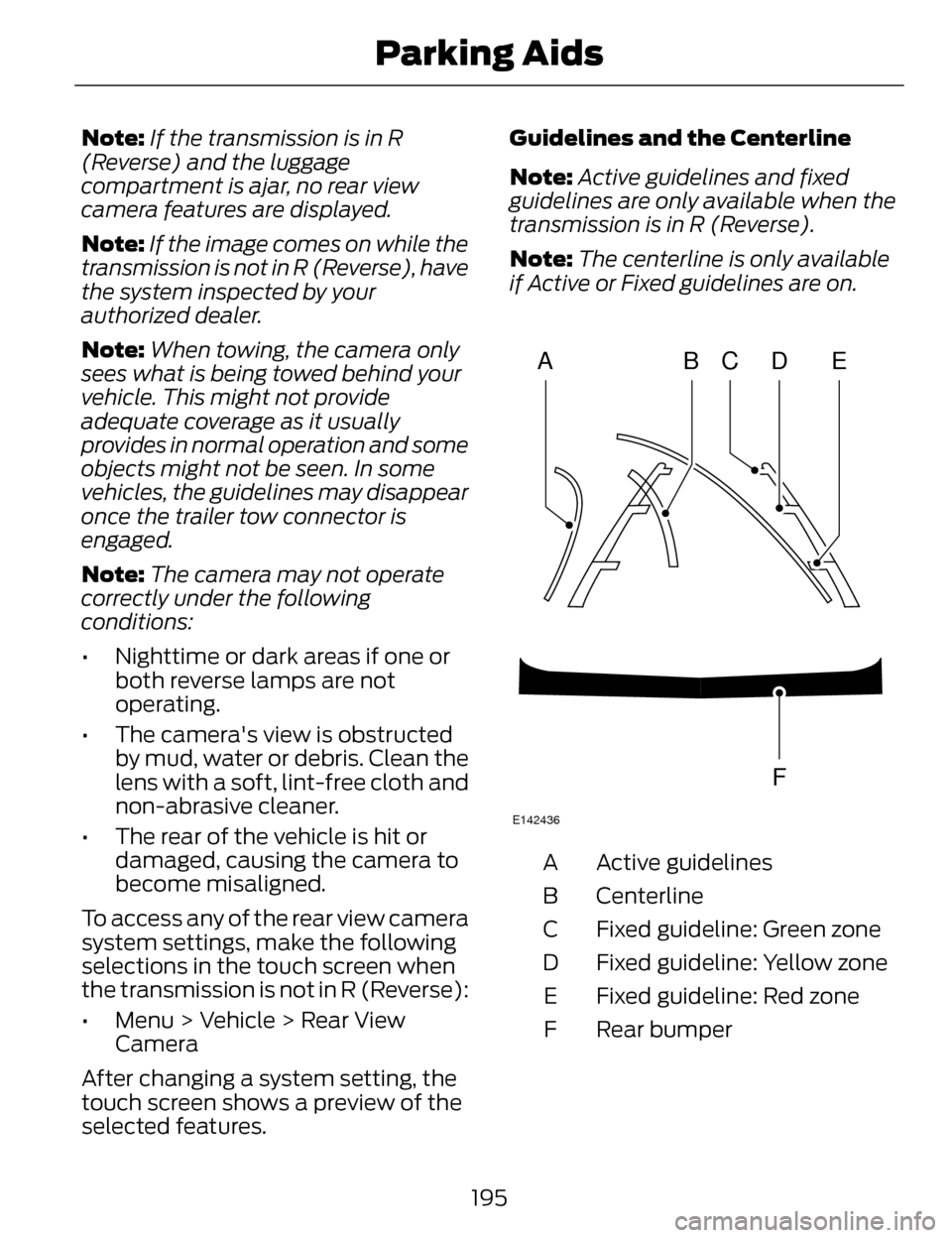
ABCD
F
E
E142436
Active guidelines
A
Centerline
B
Fixed guideline: Green zone
C
Fixed guideline: Yellow zone
D
Fixed guideline: Red zone
E
Rear bumper
F
195
Parking Aids
Page 207 of 468
E71621
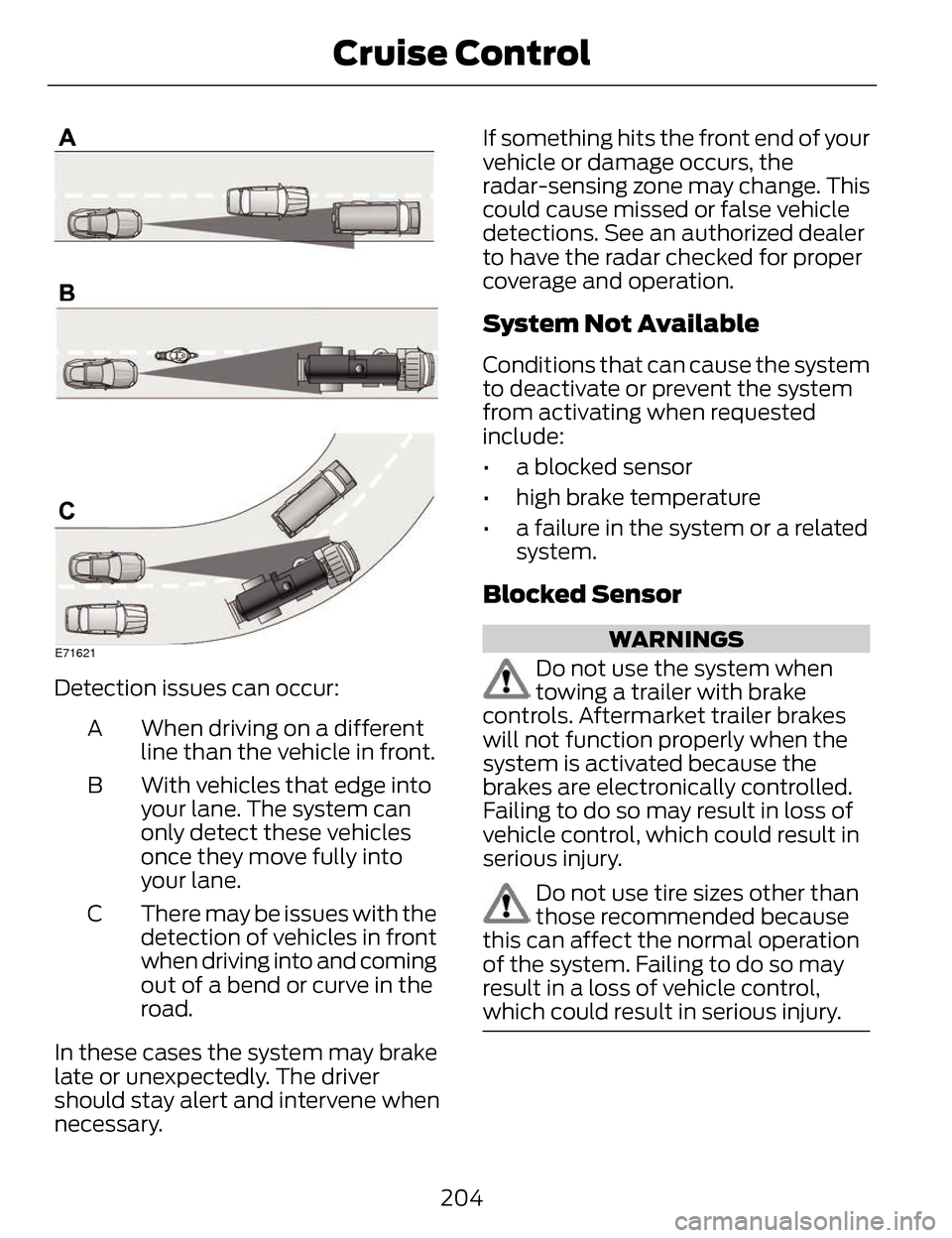
Detection issues can occur:When driving on a different
line than the vehicle in front.
A
With vehicles that edge into
your lane. The system can
only detect these vehicles
once they move fully into
your lane.
B
There may be issues with the
detection of vehicles in front
when driving into and coming
out of a bend or curve in the
road.
C
In these cases the system may brake
late or unexpectedly. The driver
should stay alert and intervene when
necessary. If something hits the front end of your
vehicle or damage occurs, the
radar-sensing zone may change. This
could cause missed or false vehicle
detections. See an authorized dealer
to have the radar checked for proper
coverage
and operation.
System Not Available
Conditions that can cause the system
to deactivate or prevent the system
from activating when requested
include:
• a blocked sensor
• high brake temperature
• a failure in the system or a related
system.
Blocked Sensor
WARNINGS
Do not use the system when
towing a trailer with brake
controls. Aftermarket trailer brakes
will not function properly when the
system is activated because the
brakes are electronically controlled.
Failing to do so may result in loss of
vehicle control, which could result in
serious injury.
Do not use tire sizes other than
those recommended because
this can affect the normal operation
of the system. Failing to do so may
result in a loss of vehicle control,
which could result in serious injury.
204
Cruise Control
Page 229 of 468
E142517
E143817
CARGO
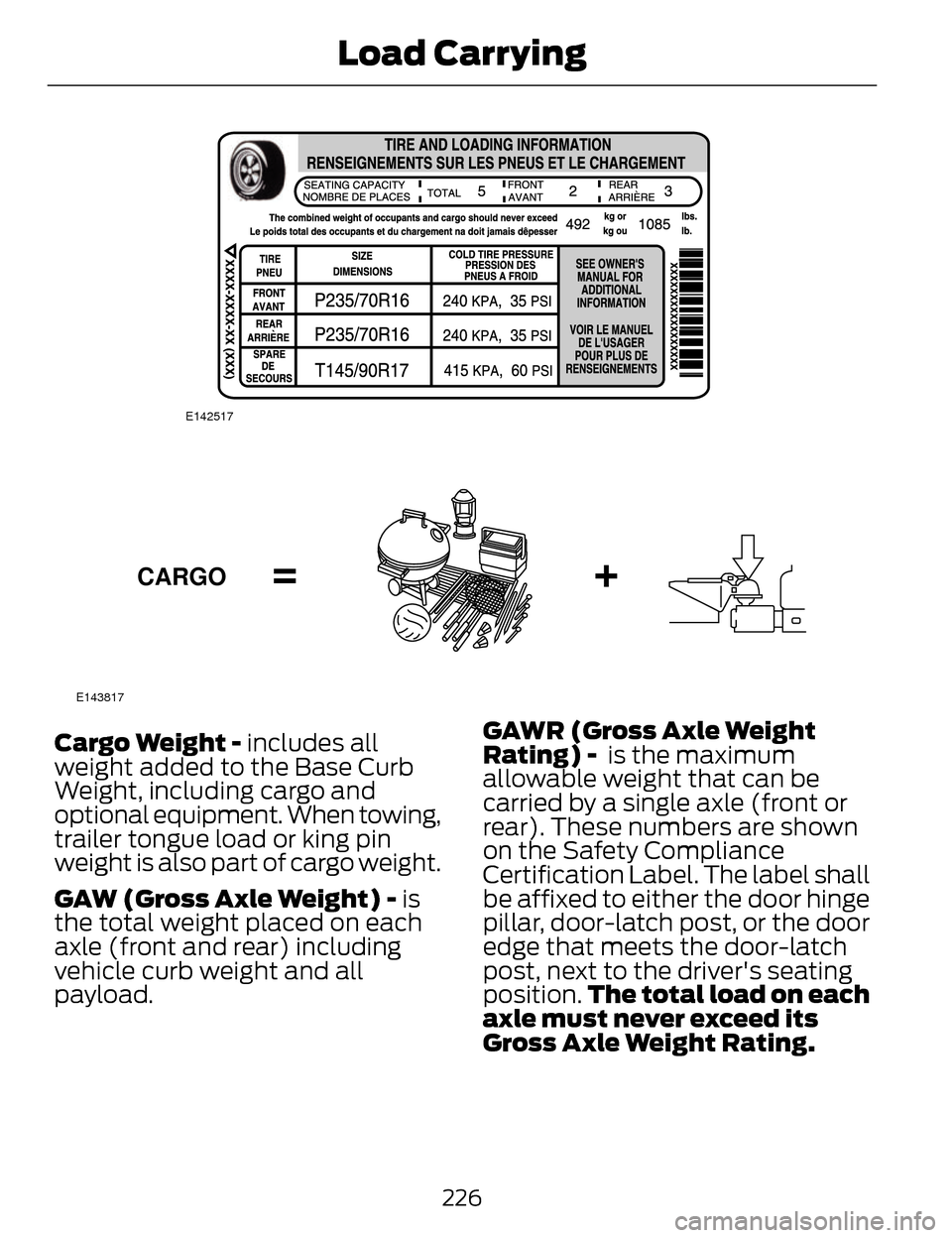
Cargo Weight - includes all
weight added to the Base Curb
Weight, including cargo and
optional equipment. When towing,
trailer tongue load or king pin
weight is also part of cargo weight.
GAW (Gross Axle Weight) - is
the total weight placed on each
axle (front and rear) including
vehicle curb weight and all
payload.GAWR (Gross Axle Weight
Rating) - is the maximum
allowable weight that can be
carried by a single axle (front or
rear). These numbers are shown
on the Safety Compliance
Certification Label. The label shall
be affixed to either the door hinge
pillar, door-latch post, or the door
edge that meets the door-latch
post, next to the driver's seating
position.
The total load on each
axle must never exceed its
Gross Axle Weight Rating.
226
Load Carrying
Page 230 of 468
Note: For trailer towing
information refer to the RV and
Trailer Towing Guide available at
an authorized dealer.
E143818
GVW
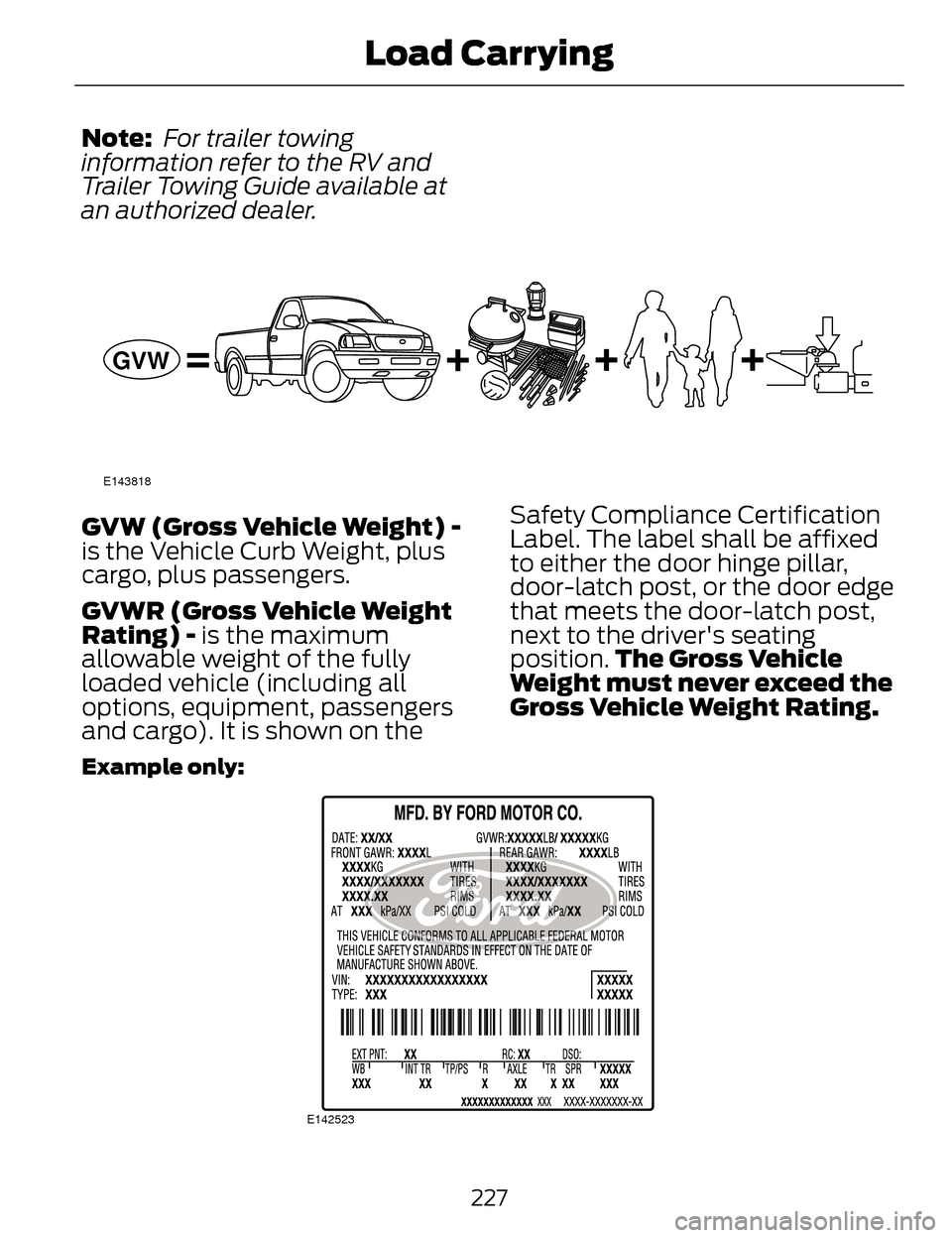
GVW (Gross Vehicle Weight) -
is the Vehicle Curb Weight, plus
cargo, plus passengers.
GVWR (Gross Vehicle Weight
Rating) - is the maximum
allowable weight of the fully
loaded vehicle (including all
options, equipment, passengers
and cargo). It is shown on the Safety Compliance Certification
Label. The label shall be affixed
to either the door hinge pillar,
door-latch post, or the door edge
that meets the door-latch post,
next to the driver's seating
position.
The Gross Vehicle
Weight must never exceed the
Gross Vehicle Weight Rating.
Example only:
E142523
227
Load Carrying
Page 231 of 468
E142524
WARNING
Exceeding the Safety
Compliance Certification
Label vehicle weight rating limits
could result in substandard
vehicle handling or performance,
engine, transmission and/or
structural damage, serious
damage to the vehicle, loss of
control and personal injury.
E143819
GCW GVW
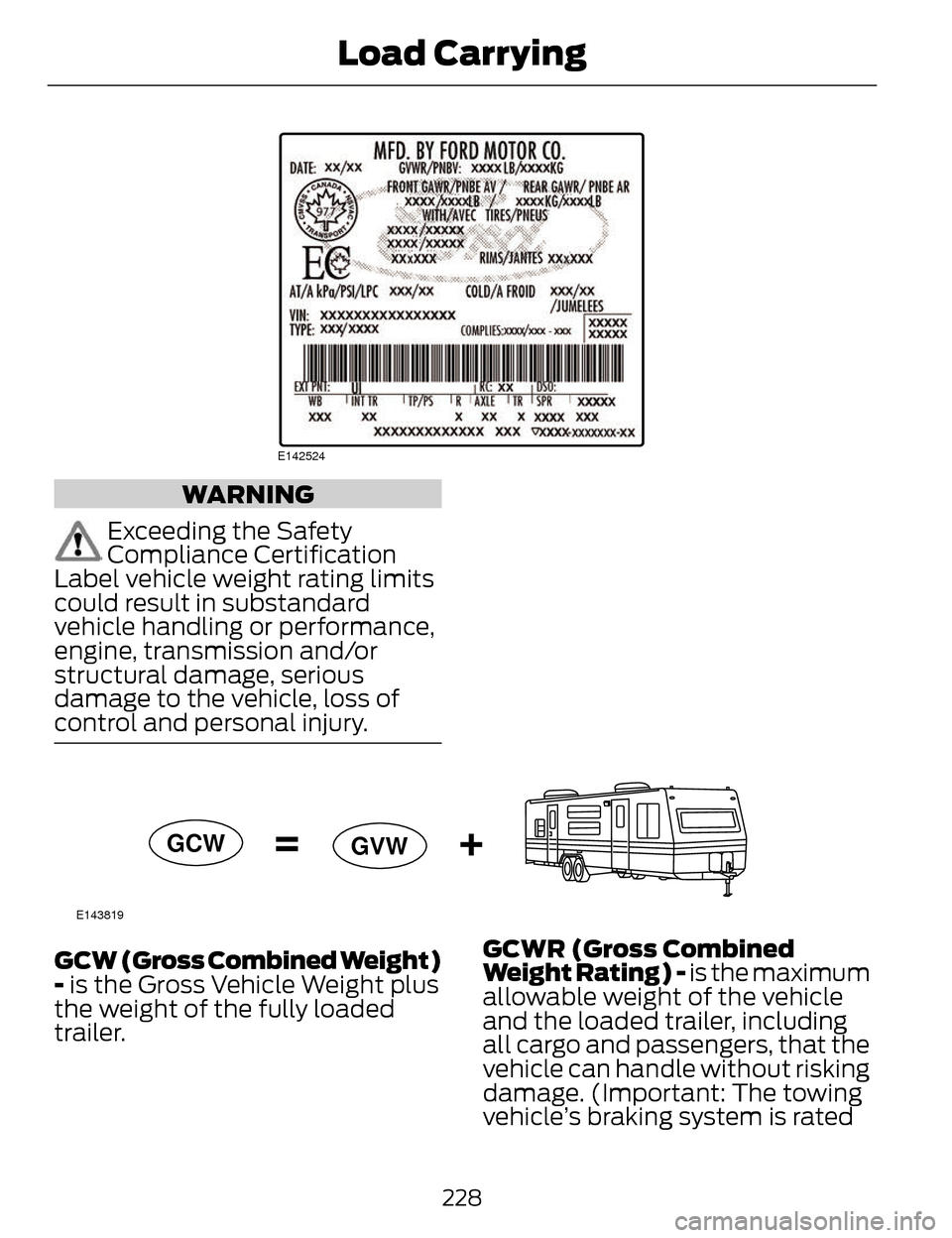
GCW (Gross Combined Weight)
- is the Gross Vehicle Weight plus
the weight of the fully loaded
trailer. GCWR (Gross Combined
Weight Rating) - is the maximum
allowable weight of the vehicle
and the loaded trailer, including
all cargo and passengers, that the
vehicle can handle without risking
damage. (Important: The towing
vehicle’s braking system is rated
228
Load Carrying
Page 232 of 468
for operation at Gross Vehicle
Weight Rating, not at Gross
Combined Weight Rating.)
Separate functional brakes should
be used for safe control of towed
vehicles and for trailers where the
Gross Combined Weight of the
towing vehicle plus the trailer
exceed the Gross Vehicle Weight
Rating of the towing vehicle.The
Gross Combined Weight must
never exceed the Gross
Combined Weight Rating.
Maximum Loaded Trailer
Weight - is the highest possible
weight of a fully loaded trailer the
vehicle can tow. It assumes a
vehicle with mandatory options,
driver and front passenger weight
(150 pounds [68 kilograms]
each), no cargo weight (internal
or external) and a tongue load of
10–15% (conventional trailer) or
king pin weight of 15–25% (fifth
wheel trailer). Consult an
authorized dealer (or the RV and
Trailer Towing Guide available at
an authorized dealer) for more
detailed information.
Tongue Load or Fifth Wheel
King Pin Weight - refers to the
amount of the weight that a trailer
pushes down on a trailer hitch. Examples: For a 5000 pound
(2268 kilogram) conventional
trailer, multiply 5000 by 0.10 and
0.15 to obtain a proper tongue
load range of 500 to 750 pounds
(227 to 340 kilograms). For an
11500 pound (5216 kilogram) fifth
wheel trailer, multiply by 0.15 and
0.25 to obtain a proper king pin
load range of 1725 to 2875 pounds
(782 to 1304 kilograms).
WARNINGS
Do not exceed the GVWR or
the GAWR specified on the
Safety Compliance Certification
Label.
Do not use replacement tires
with lower load carrying
capacities than the original tires
because they may lower the
vehicle’s GVWR and GAWR
limitations. Replacement tires
with a higher limit than the original
tires do not increase the GVWR
and GAWR limitations.
Exceeding any vehicle weight
rating limitation could result
in serious damage to the vehicle
and/or personal injury.
Steps for determining the
correct load limit:
1. Locate the statement "The combined weight of occupants
and cargo should never exceed
XXX kg or XXX lb." on your
vehicle’s placard.
229
Load Carrying
Page 233 of 468
2. Determine the combinedweight of the driver and
passengers that will be riding
in your vehicle.
3. Subtract the combined weight of the driver and passengers
from XXX kg or XXX lb.
4. The resulting figure equals the available amount of cargo and
luggage load capacity. For
example, if the “XXX” amount
equals 1,400 lb. and there will
be five 150 lb. passengers in
your vehicle, the amount of
available cargo and luggage
load capacity is 650 lb.
(1400-750 (5 x 150) = 650 lb.)
5. Determine the combined weight of luggage and cargo
being loaded on the vehicle.
That weight may not safely
exceed the available cargo and
luggage load capacity
calculated in Step 4.
6. If your vehicle will be towing a trailer, load from your trailer
will be transferred to your
vehicle. Consult this manual to
determine how this reduces the
available cargo and luggage
load capacity of your vehicle.
The following gives you a few
examples on how to calculate the
available amount of cargo and
luggage load capacity: *Suppose your vehicle has a
1400-pound (635-kilogram) cargo
and luggage capacity. You decide
to go golfing. Is there enough load
capacity to carry you, four of your
friends and all the golf bags? You
and four friends average 220
pounds (99 kilograms) each and
the golf bags weigh approximately
30 pounds (13.5 kilograms) each.
The calculation would be: 1400 -
(5 x 220) - (5 x 30) = 1400 - 1100
- 150 = 150 pounds. Yes, you have
enough load capacity in your
vehicle to transport four friends
and your golf bags. In metric units,
the calculation would be: 635
kilograms - (5 x 99 kilograms) -
(5 x 13.5 kilograms) = 635 - 495 -
67.5 = 72.5 kilograms.
*Suppose your vehicle has a
1400-pound (635-kilogram) cargo
and luggage capacity. You and
one of your friends decide to pick
up cement from the local home
improvement store to finish that
patio you have been planning for
the past two years. Measuring the
inside of the vehicle with the rear
seat folded down, you have room
for twelve 100-pound
(45-kilogram) bags of cement. Do
you have enough load capacity to
transport the cement to your
home? If you and your friend each
weigh 220 pounds (99 kilograms),
the calculation would be: 1400 -
(2 x 220) - (12 x 100) = 1400 - 440
- 1200 = - 240 pounds. No, you do
not have enough cargo capacity
to carry that much weight. In
230
Load Carrying