steering MASERATI LEVANTE 2019 Manual Online
[x] Cancel search | Manufacturer: MASERATI, Model Year: 2019, Model line: LEVANTE, Model: MASERATI LEVANTE 2019Pages: 436, PDF Size: 15.24 MB
Page 320 of 436
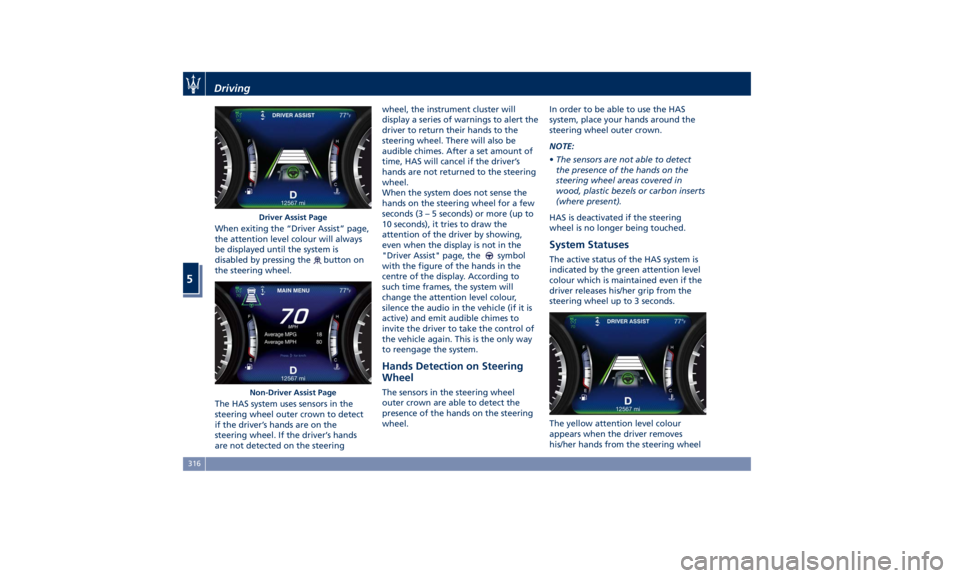
When exiting the “Driver Assist” page,
the attention level colour will always
be displayed until the system is
disabled by pressing the
button on
the steering wheel.
The HAS system uses sensors in the
steering wheel outer crown to detect
if the driver’s hands are on the
steering wheel. If the driver’s hands
are not detected on the steering wheel, the instrument cluster will
display a series of warnings to alert the
driver to return their hands to the
steering wheel. There will also be
audible chimes. After a set amount of
time, HAS will cancel if the driver’s
hands are not returned to the steering
wheel.
When the system does not sense the
hands on the steering wheel for a few
seconds (3 – 5 seconds) or more (up to
10 seconds), it tries to draw the
attention of the driver by showing,
even when the display is not in the
"Driver Assist" page, the
symbol
with the figure of the hands in the
centre of the display. According to
such time frames, the system will
change the attention level colour,
silence the audio in the vehicle (if it is
active) and emit audible chimes to
invite the driver to take the control of
the vehicle again. This is the only way
to reengage the system.
Hands Detection on Steering
Wheel The sensors in the steering wheel
outer crown are able to detect the
presence of the hands on the steering
wheel. In order to be able to use the HAS
system, place your hands around the
steering wheel outer crown.
NOTE:
• The sensors are not able to detect
the presence of the hands on the
steering wheel areas covered in
wood, plastic bezels or carbon inserts
(where present).
HAS is deactivated if the steering
wheel is no longer being touched.
System Statuses The active status of the HAS system is
indicated by the green attention level
colour which is maintained even if the
driver releases his/her grip from the
steering wheel up to 3 seconds.
The yellow attention level colour
appears when the driver removes
his/her hands from the steering wheelDriver Assist Page
Non-Driver Assist PageDriving
5
316
Page 321 of 436
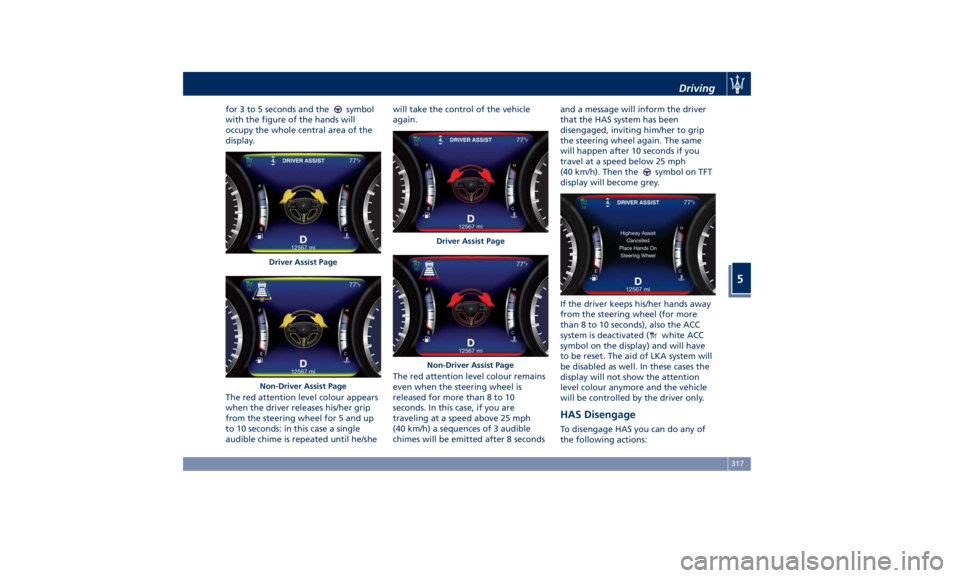
for 3 to 5 seconds and the symbol
with the figure of the hands will
occupy the whole central area of the
display.
The red attention level colour appears
when the driver releases his/her grip
from the steering wheel for 5 and up
to 10 seconds: in this case a single
audible chime is repeated until he/she will take the control of the vehicle
again.
The red attention level colour remains
even when the steering wheel is
released for more than 8 to 10
seconds. In this case, if you are
traveling at a speed above 25 mph
(40 km/h) a sequences of 3 audible
chimes will be emitted after 8 seconds and a message will inform the driver
that the HAS system has been
disengaged, inviting him/her to grip
the steering wheel again. The same
will happen after 10 seconds if you
travel at a speed below 25 mph
(40 km/h). Then the
symbol on TFT
display will become grey.
If the driver keeps his/her hands away
from the steering wheel (for more
than 8 to 10 seconds), also the ACC
system is deactivated (
white ACC
symbol on the display) and will have
to be reset. The aid of LKA system will
be disabled as well. In these cases the
display will not show the attention
level colour anymore and the vehicle
will be controlled by the driver only.
HAS Disengage To disengage HAS you can do any of
the following actions:Driver Assist Page
Non-Driver Assist Page Driver Assist Page
Non-Driver Assist Page Driving
5
317
Page 322 of 436
• Press the HAS enable button on
the steering wheel.
• Begin steering manually.
• Press brake pedal.
• Turn off ACC.
• Unbuckle the driver’s seat belt.
• Press ACC Gap button for two
seconds to enable CC system.
• Shift out of the (D) Drive gear.
• Enter an Autonomous Emergency
Braking (AEB) event (See chapter
"Forward Collision Warning - FCW"
in this section).
• Turn signal activated.
System Cancellation The HAS system will cancel (without
driver intervention) if either of the
following actions occur:
• Curve that is too tight.
• When leaving the grip of the hands
on the steering wheel.
• Vehicle exits the highway or limited
access freeway.
• Lane line markers aren’t detected by
the forward facing camera.
• Any ADAS system faults.
• ACC cancellation.
• Vehicle speed exceeds the maximum
limit. • Lateral accelerations exceeds the
limits.
NOTE:
• When HAS cancels, the
symbol
will turn red then grey.
• The presence of the hands on the
steering wheel is detected by a logic
combination of a capacitive sensor
installed in the steering wheel and
the measured applied torque at the
steering column. This leads to a more
robust hands detection.
System Limitations HAS is unable to guide the vehicle
when the following conditions occur.
• Lane markings are not clear or
visibility is poor (i.e. heavy rain,
snow, fog, etc.).
• Obstructed, covered or damaged
forward-facing camera or sensor.
• When driving on hills or sharp curves.
• When approaching toll booths.
• When the highway entrance or exit is
wider than 20 ft (6 meters).
• Bright light (ex. direct sunlight or
glare) facing the forward camera. WARNING!
Many unforeseen conditions can occur
that can affect the performance of
Highway Assist (HAS). Always keep
this in mind and drive attentively. It is
the drivers responsibility to keep
control of the vehicle at all times.
Radar Device - Regulatory
Information The “Regulatory Information” for all
the radio frequency and radar devices
can be consulted by accessing the
"Services" section on the website
www.maserati.com.Driving
5
318
Page 330 of 436
Three primary driving aspects are
affected by improper tire pressure:
Safety
WARNING!
• Improperly inflated tires can be
dangerous.
• Under-inflation increases tire flexing
and can result in tire overheating.
• Over-inflation reduces a tire's ability
to cushion shock. Objects on the
road and potholes can cause damage
that results in tire failure.
• Over-inflated or under-inflated tires
can affect vehicle handling and can
fail suddenly, resulting in loss of
vehicle control.
• Unequal tire pressures can cause
steering problems.
• Unequal tire pressures from one side
of the vehicle to the other can cause
the vehicle to drift to the right or
left.
• Always drive with each tire inflated
to the recommended cold tire
inflation pressure.
Economy
Improper
inflation pressures may cause
uneven wear patterns to develop across the tire tread. These abnormal
wear patterns will reduce tread life
resulting in a need for earlier tire
replacement. Under-inflation also
increases tire rolling resistance
resulting in higher fuel consumption.
Ride comfort and vehicle stability
Proper tire inflation contributes to a
comfortable ride. Over-inflation
produces a jarring and uncomfortable
ride.
Tire Pressure Checkup The proper cold tire inflation pressure
is indicated on the driver's side rear
door pillar and on the table “Tire
Inflation Pressure” in section “Features
and Specifications”.
Inflation pressure specified on the
table always refers to “cold tire
inflation pressure”. Cold tire inflation
pressure is defined as the tire pressure
after the vehicle has not been driven
for at least three hours, or driven less
than 1 mi (1.6 km) after a three hour
period.
Check tire pressures more often in case
of significant outside temperature
changes, as tire pressure varies
according to temperature changes.
The pressure should be checked and if
necessary adjusted; tire wear and overall conditions should also be
checked monthly. Tire pressures
change by approximately 1 PSI (0.07
bar) per 12°F (7°C) of air temperature
change. Keep this in mind when
checking tire pressure inside a garage,
especially in winter.
Example: If garage temperature = 68°F
(20°C) and the outside temperature =
32°F (0°C) then the cold tire inflation
pressure should be increased by 3 PSI
(0.21 bar) for every 12°F (7°C) for this
outside temperature condition.
Tire pressure may increase from 2 to 6
PSI (0.13 to 0.4 bar) during operation.
DO NOT reduce this normal pressure
build-up or your tire pressure will be
too low. After inspecting or adjusting
the tire pressure, always reinstall the
valve stem cap. This will prevent
moisture and dirt from entering the
valve stem, which could damage the
valve stem and the TPMS sensor
connected to it.
Tread Wear Indicators Tread wear indicators are in the
original equipment tires to help you
determine when your tires should be
replaced.
These indicators are molded into the
bottom of the tread grooves.Driving
5
326
Page 331 of 436
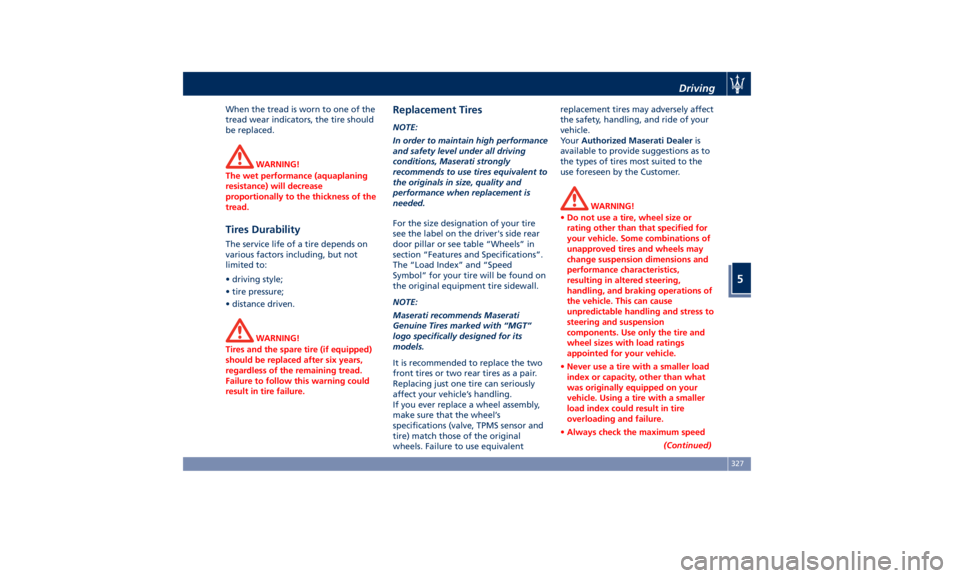
When the tread is worn to one of the
tread wear indicators, the tire should
be replaced.
WARNING!
The wet performance (aquaplaning
resistance) will decrease
proportionally to the thickness of the
tread.
Tires Durability The service life of a tire depends on
various factors including, but not
limited to:
• driving style;
• tire pressure;
• distance driven.
WARNING!
Tires and the spare tire (if equipped)
should be replaced after six years,
regardless of the remaining tread.
Failure to follow this warning could
result in tire failure. Replacement Tires NOTE:
In order to maintain high performance
and safety level under all driving
conditions, Maserati strongly
recommends to use tires equivalent to
the originals in size, quality and
performance when replacement is
needed.
For the size designation of your tire
see the label on the driver's side rear
door pillar or see table “Wheels” in
section “Features and Specifications”.
The “Load Index” and “Speed
Symbol” for your tire will be found on
the original equipment tire sidewall.
NOTE:
Maserati recommends Maserati
Genuine Tires marked with “MGT”
logo specifically designed for its
models.
It is recommended to replace the two
front tires or two rear tires as a pair.
Replacing just one tire can seriously
affect your vehicle’s handling.
If you ever replace a wheel assembly,
make sure that the wheel’s
specifications (valve, TPMS sensor and
tire) match those of the original
wheels. Failure to use equivalent replacement tires may adversely affect
the safety, handling, and ride of your
vehicle.
Your Authorized Maserati Dealer is
available to provide suggestions as to
the types of tires most suited to the
use foreseen by the Customer.
WARNING!
• Do not use a tire, wheel size or
rating other than that specified for
your vehicle. Some combinations of
unapproved tires and wheels may
change suspension dimensions and
performance characteristics,
resulting in altered steering,
handling, and braking operations of
the vehicle. This can cause
unpredictable handling and stress to
steering and suspension
components. Use only the tire and
wheel sizes with load ratings
appointed for your vehicle.
• Never use a tire with a smaller load
index or capacity, other than what
was originally equipped on your
vehicle. Using a tire with a smaller
load index could result in tire
overloading and failure.
• Always check the maximum speed
(Continued)Driving
5
327
Page 342 of 436
Fuel Filler Cap Open Warning
Light After refueling the car
performs a check of the fuel
filler cap and the amber
warning light on the TFT
display comes on if it is not correctly
closed, after approximately 10 minutes
also depending on driving conditions.
If the problem is in the fuel system, the
Malfunction Indicator Light
also
comes on.
If the fuel filler cap is locked and the
issue remains in the system, at the next
engine start only the Malfunction
Indicator Light
comes on. In this
case, contact an Authorized Maserati
Dealer .
Emergency Fuel Filler Door
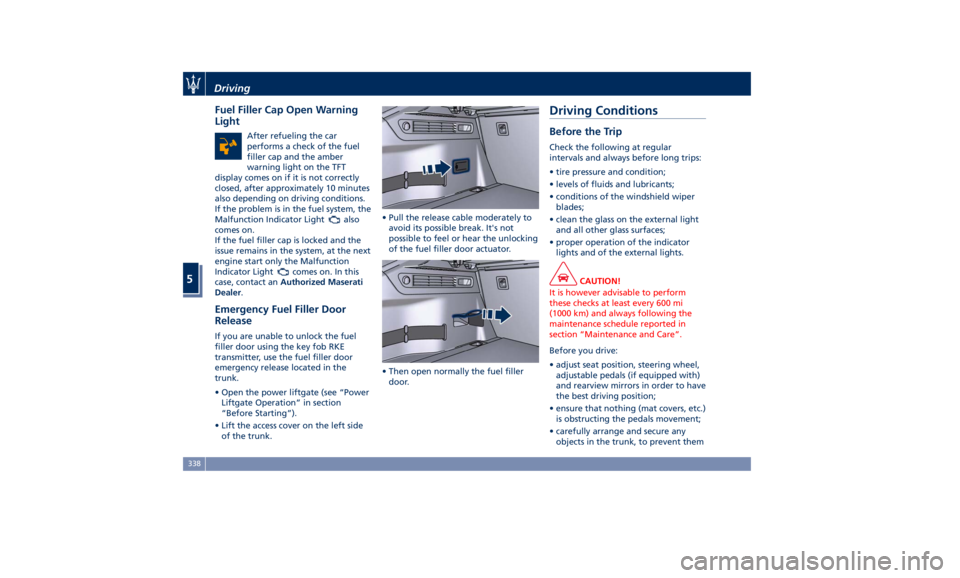
Release If you are unable to unlock the fuel
filler door using the key fob RKE
transmitter, use the fuel filler door
emergency release located in the
trunk.
• Open the power liftgate (see “Power
Liftgate Operation” in section
“Before Starting”).
• Lift the access cover on the left side
of the trunk. • Pull the release cable moderately to
avoid its possible break. It's not
possible to feel or hear the unlocking
of the fuel filler door actuator.
• Then open normally the fuel filler
door.Driving Conditions Before the Trip Check the following at regular
intervals and always before long trips:
• tire pressure and condition;
• levels of fluids and lubricants;
• conditions of the windshield wiper
blades;
• clean the glass on the external light
and all other glass surfaces;
• proper operation of the indicator
lights and of the external lights.
CAUTION!
It is however advisable to perform
these checks at least every 600 mi
(1000 km) and always following the
maintenance schedule reported in
section “Maintenance and Care”.
Before you drive:
•
adjust seat position, steering wheel,
adjustable pedals (if equipped with)
and rearview mirrors in order to have
the best driving position;
• ensure that nothing (mat covers, etc.)
is obstructing the pedals movement;
• carefully arrange and secure any
objects in the trunk, to prevent themDriving
5
338
Page 349 of 436
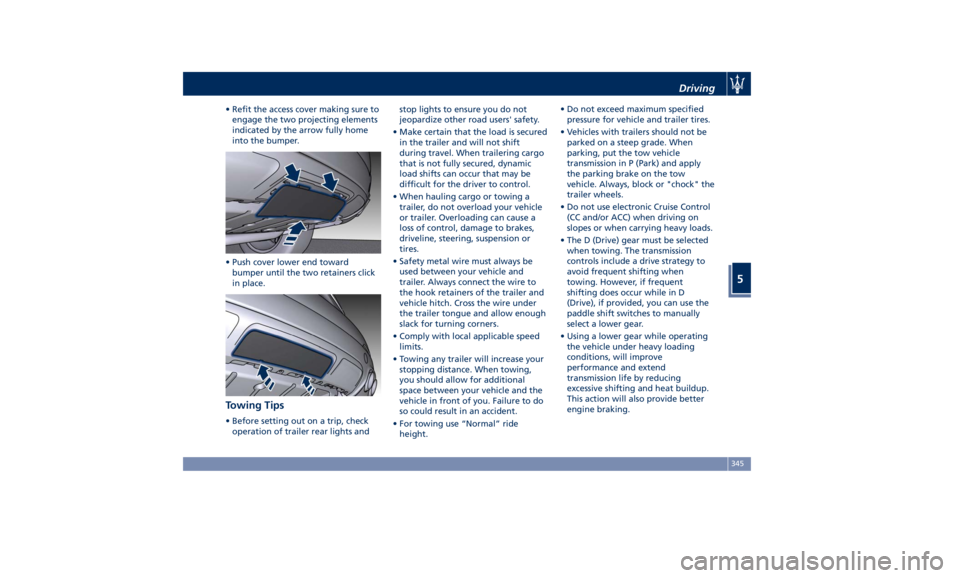
• Refit the access cover making sure to
engage the two projecting elements
indicated by the arrow fully home
into the bumper.
• Push cover lower end toward
bumper until the two retainers click
in place.
Towing Tips • Before setting out on a trip, check
operation of trailer rear lights and stop lights to ensure you do not
jeopardize other road users' safety.
• Make certain that the load is secured
in the trailer and will not shift
during travel. When trailering cargo
that is not fully secured, dynamic
load shifts can occur that may be
difficult for the driver to control.
• When hauling cargo or towing a
trailer, do not overload your vehicle
or trailer. Overloading can cause a
loss of control, damage to brakes,
driveline, steering, suspension or
tires.
• Safety metal wire must always be
used between your vehicle and
trailer. Always connect the wire to
the hook retainers of the trailer and
vehicle hitch. Cross the wire under
the trailer tongue and allow enough
slack for turning corners.
• Comply with local applicable speed
limits.
• Towing any trailer will increase your
stopping distance. When towing,
you should allow for additional
space between your vehicle and the
vehicle in front of you. Failure to do
so could result in an accident.
• For towing use “Normal” ride
height. • Do not exceed maximum specified
pressure for vehicle and trailer tires.
• Vehicles with trailers should not be
parked on a steep grade. When
parking, put the tow vehicle
transmission in P (Park) and apply
the parking brake on the tow
vehicle. Always, block or "chock" the
trailer wheels.
• Do not use electronic Cruise Control
(CC and/or ACC) when driving on
slopes or when carrying heavy loads.
• The D (Drive) gear must be selected
when towing. The transmission
controls include a drive strategy to
avoid frequent shifting when
towing. However, if frequent
shifting does occur while in D
(Drive), if provided, you can use the
paddle shift switches to manually
select a lower gear.
• Using a lower gear while operating
the vehicle under heavy loading
conditions, will improve
performance and extend
transmission life by reducing
excessive shifting and heat buildup.
This action will also provide better
engine braking.Driving
5
345
Page 375 of 436
Maintenance Procedures The following pages contain the
“required” maintenance standards
determined by Maserati engineers.
Besides those maintenance items
specified in the “Scheduled Service
Plan”, there are other components
which may require service or
replacement in the future.
To perform most of the services, it is
necessary to open the hood (see
“Hood Operation” in section “Before
Starting”).
The following images show the
position of the components involved
in the maintenance service.
CAUTION!
• Failure to properly maintain your
vehicle or perform repairs and
service when necessary could result
in more costly repairs, damage to
other components or negatively
impact vehicle performance.
Immediately have potential
malfunctions examined by an
Authorized Maserati Dealer or a
qualified repair center.
• Your vehicle has been equipped with
improved fluids that protect the
performance and durability of your vehicle and also allow extended
maintenance intervals. Do not use
chemical flushes for washing as the
chemicals can damage your engine,
transmission, power steering or air
conditioning. Such damages are not
covered by the New Vehicle Limited
Warranty. If a flush is needed
because of component malfunction,
use only the specified fluid for the
flushing procedure. Maintenance and Care
7
371
Page 395 of 436
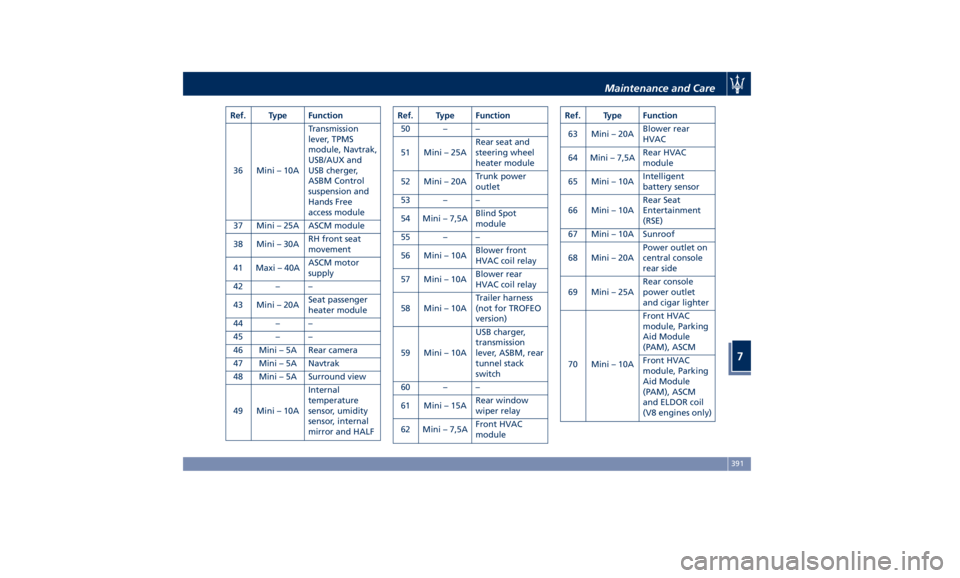
Ref. Type Function
36 Mini – 10A Transmission
lever, TPMS
module, Navtrak,
USB/AUX and
USB cherger,
ASBM Control
suspension and
Hands Free
access module
37 Mini – 25A ASCM module
38 Mini – 30A RH front seat
movement
41 Maxi – 40A ASCM motor
supply
42 – –
43 Mini – 20A Seat passenger
heater module
44 – –
45 – –
46 Mini – 5A Rear camera
47 Mini – 5A Navtrak
48 Mini – 5A Surround view
49 Mini – 10A Internal
temperature
sensor, umidity
sensor, internal
mirror and HALF Ref. Type Function
50 – –
51 Mini – 25A Rear seat and
steering wheel
heater module
52 Mini – 20A Trunk power
outlet
53 – –
54 Mini – 7,5A Blind Spot
module
55 – –
56 Mini – 10A Blower front
HVAC coil relay
57 Mini – 10A Blower rear
HVAC coil relay
58 Mini – 10A Trailer harness
(not for TROFEO
version)
59 Mini – 10A USB charger,
transmission
lever, ASBM, rear
tunnel stack
switch
60 – –
61 Mini – 15A Rear window
wiper relay
62 Mini – 7,5A Front HVAC
module Ref. Type Function
63 Mini – 20A Blower rear
HVAC
64 Mini – 7,5A Rear HVAC
module
65 Mini – 10A Intelligent
battery sensor
66 Mini – 10A Rear Seat
Entertainment
(RSE)
67 Mini – 10A Sunroof
68 Mini – 20A Power outlet on
central console
rear side
69 Mini – 25A Rear console
power outlet
and cigar lighter
70 Mini – 10A Front HVAC
module, Parking
Aid Module
(PAM), ASCM
Front HVAC
module, Parking
Aid Module
(PAM), ASCM
and ELDOR coil
(V8 engines only)Maintenance and Care
7
391
Page 400 of 436
Wheels Maintenance Tires Maintenance CAUTION!
To obtain the best performances and
the longest mileage from the tires,
take the following precautions during
the first 310 mi (500 km):
• do not drive at the vehicle’s
maximum speed;
• drive at low speed on curves;
• avoid sudden steering;
• avoid sudden braking;
• avoid sudden acceleration;
• do not drive at high speeds for too
long.
The tires inflation pressure must
correspond
to the prescribed values
(see the chapter “Tire Inflation
Pressure” in section “Features and
Specifications”) and should be checked
only when the tires have cooled down.
In fact, the pressure increases as the
tire temperature progressively
increases.
Never reduce the pressure if tires are
hot (see “Tires – General Information”
chapter in section “Driving”). Insufficient tire inflating pressure can
cause tire overheating and possible
internal damage.
CAUTION!
After inspecting or adjusting the tire
pressure, always reinstall the valve
stem cap. This will prevent moisture
and dirt from entering the valve stem,
which could damage it.
Impacts with curbs, holes, and
obstacles
in the road, and prolonged
trips on rough roads or off-road trails
can cause tire damage which may not
be visible to the naked eye.
Check your tires regularly for any signs
of damage (e.g. scratches, cuts, cracks,
bulges, etc.). If sharp objects penetrate
the tires, they can cause structural
damage which is only visible when the
tire is removed.
In any case, any possible damage must
be inspected by an experienced
technician, as it may seriously reduce
the tire life.
Remember that tires deteriorate with
time, even if used little or not at all.
Cracks in the tire tread and sides,
alongside possible bulging, are a sign
of deterioration. WARNING!
• Check the inflating pressure of the
tires when cold, at least every two
weeks and before long trips.
• Have old tires inspected by an
experienced technician, to make sure
they can still be used safely. If the
same tire has been on your vehicle
for 4 or 5 years, have it inspected
anyway by an experienced
technician.
• Never fit tires of uncertain origin.
• “Directional” tires have an arrow on
their side showing the rolling
direction. To keep the best
performance when replacing a tire,
make sure that the rolling direction
corresponds to the one shown by
the arrow.
• During the tire life, the rolling
direction used for the first fitting
should always be observed, also in
case of “nondirectional” tires.
• Check the depth of the tire tread at
regular intervals. The minimum
allowed value is 0.06 in (1.6 mm) at
that point the wear indicators on the
tire will be visible (see “Tires –
General Information” in sectionMaintenance and Care
7
396